
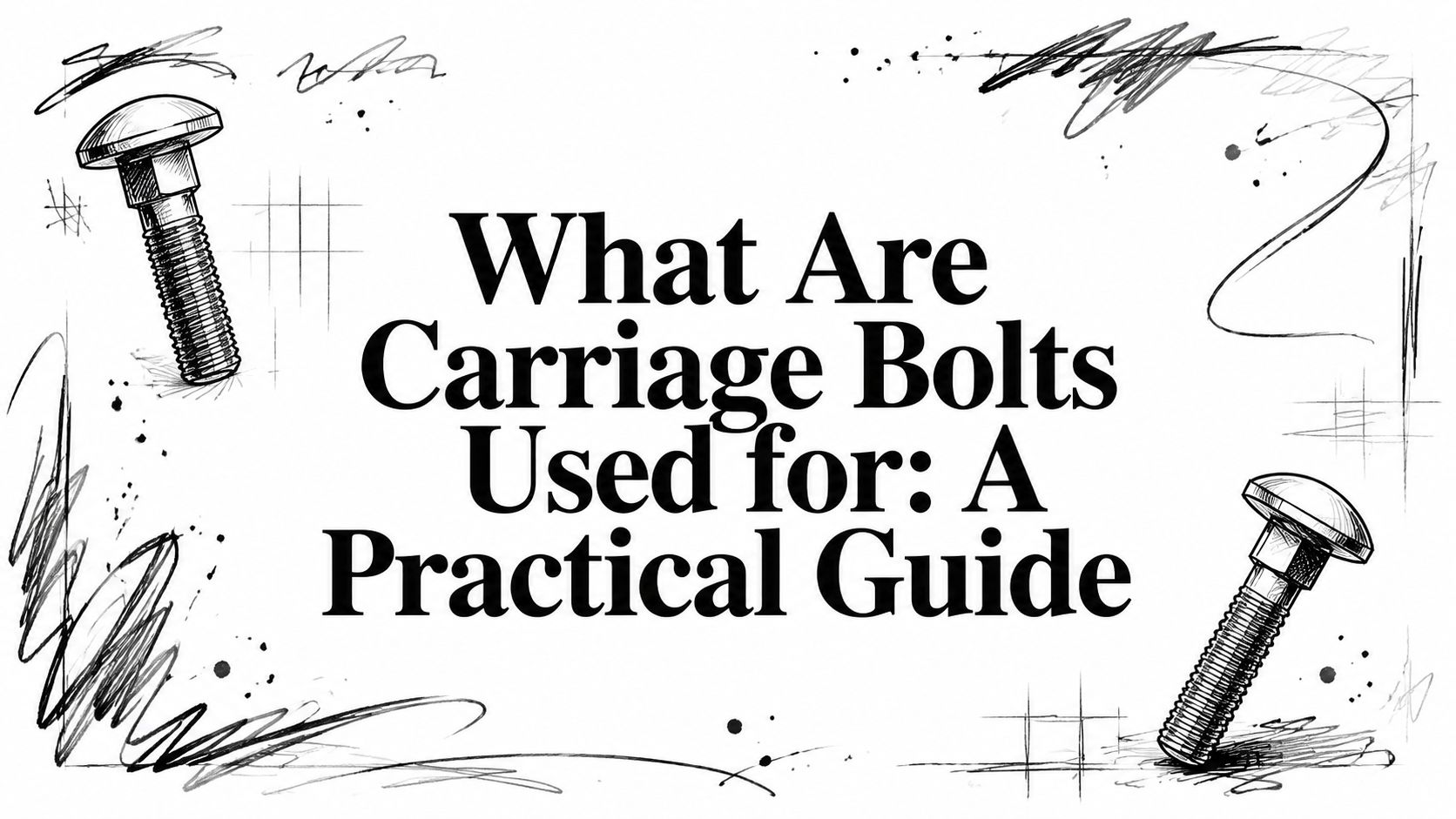
You're halfway through a deck or fence build, with a drill in one hand and a box of fasteners in the other. The hex-head lags look familiar, but the round-headed bolts with square shoulders seem designed for a different job. That small square section is the clue. It lets you tighten a nut from the accessible side without holding the bolt head, which can make a difficult outdoor connection much easier.
So, what are carriage bolts used for? They're used mainly for wood-to-wood and wood-to-metal connections where one-sided installation, resistance to spinning, a smooth exposed head, or easier tamper resistance matters. The right choice still depends on the wood, load, exposure, and applicable building requirements. A carriage bolt can be an excellent deck or fence fastener, but it isn't automatically a substitute for an engineered structural bolt.
Where Carriage Bolts Actually Show Up on a Job Site
On a Saturday morning deck build, two DIYers are fastening a timber assembly. The older builder reaches past the hex lags and picks up a box of round-headed bolts with square shoulders. That choice isn't about decoration. It's about controlling the bolt from one side while the nut is tightened from the other.
A carriage bolt has a domed or round head, a smooth shank, a square neck directly beneath the head, and machine threads that accept a nut. Push it through a drilled hole, place a washer and nut on the accessible end, and tighten. As the square neck seats into the wood, it resists rotation.
The working principle: the square neck does the holding while the nut does the clamping.
That arrangement is useful when the visible face needs to stay smooth or when you can't get a wrench behind the bolt head. It's common in pressure-treated decks, cedar fences, gate frames, outdoor furniture, railing assemblies, and timber connections. Carriage bolts also suit exterior wood connections where someone might catch clothing or skin on a projecting hex head.
Start with the joint, not the bolt
Before choosing hardware, identify which faces you can reach. If you can drill through the assembly but can only operate a wrench on one side, a carriage bolt may solve the installation problem. The bolt head stays still because the square neck engages the wood, while you tighten the nut from the opposite face.
That's also why the fastener appears in practical code-sensitive assemblies. Kern County's housing code requires boarding fasteners to be at least 3/8 inch, or 9.5 mm, in diameter, with enough length for the assembly, washers, and nuts, and specifies minimum nominal 2×4 framing for the boarding assembly. The rule is a concrete California example of carriage bolts being used where secure clamping and resistance to unauthorised removal matter. See the Kern County housing-code requirements for boarding fasteners before treating a similar project as ordinary DIY work.
For broader background on how framing assemblies are organised, insights from Ofir Engineering can help you understand the surrounding wood-frame construction rather than viewing the bolt in isolation.
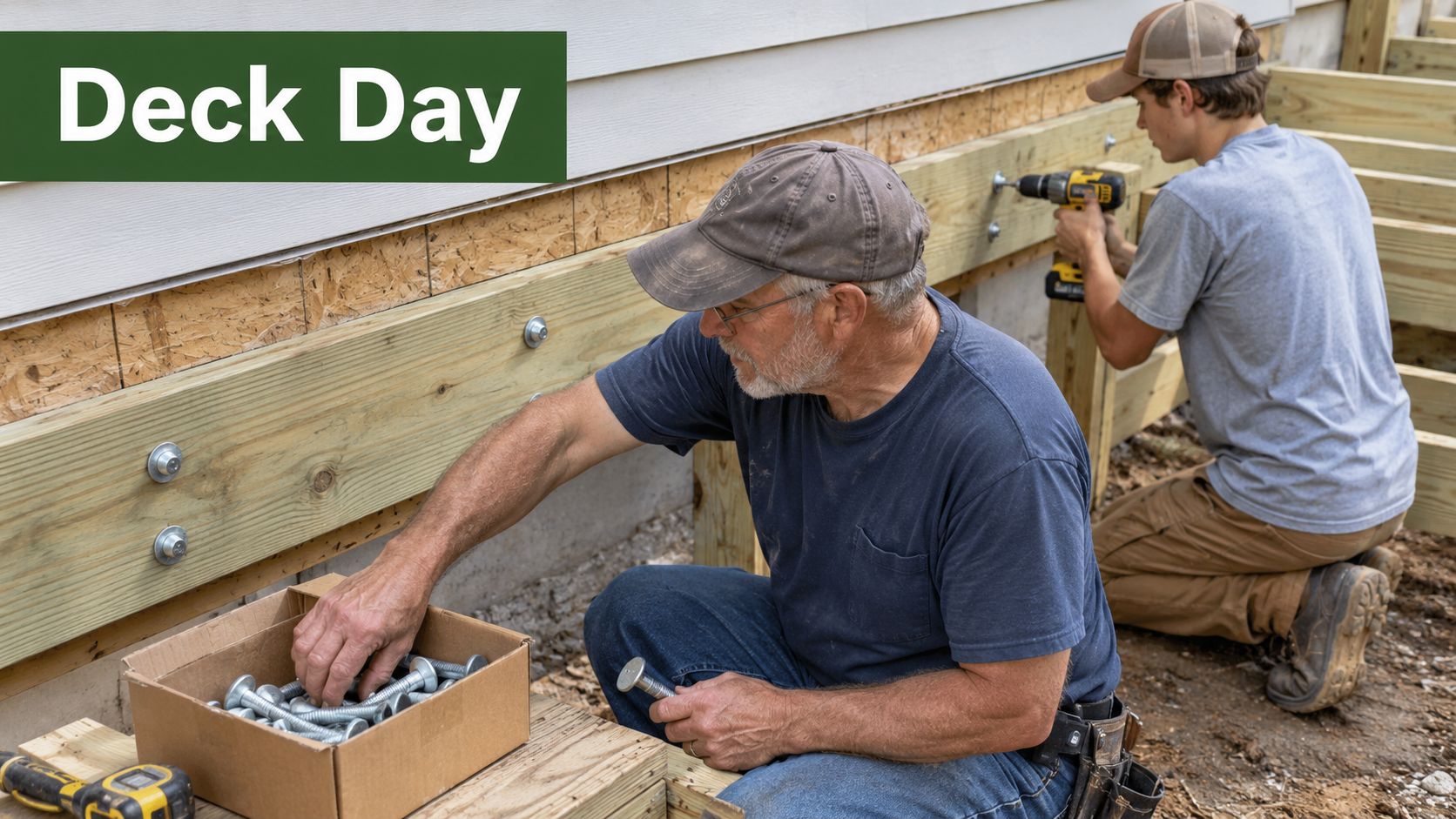
The practical test is simple. If the head needs to remain low-profile, the nut side is accessible, and the joint benefits from anti-rotation, a carriage bolt deserves consideration. If the connection carries a load specified by plans or code, use the fastener type, diameter, washers, spacing, and installation method required by that design.
The Anatomy of a Carriage Bolt and What Each Part Does
Set one on your workbench and start at the top. The head is usually domed or mushroom-shaped, with no screwdriver slot or hex surface. That low profile helps prevent snags on a deck, bench, railing, or gate, but the head's main practical value is that it provides a broad bearing surface while leaving the finished face relatively unobtrusive.
Directly below it is the square neck. This is the part that makes a carriage bolt different from a conventional hex bolt. In wood, the square shoulder seats into the hole and resists turning. In a metal bracket, it needs a properly formed square opening or another compatible arrangement.
Follow the load path
Below the neck, the smooth shank passes through the connected members. Keeping the unthreaded portion in the joint can help the members bear against a smooth surface rather than against threads. The threaded section extends far enough to receive the washer and nut, then creates the clamping force that pulls the assembly together.
The washer spreads pressure over the wood. The nut holds the assembly, and a suitable locking arrangement may be needed where vibration could loosen the connection. California Title 8 recognises carriage bolts in anchor arrangements and requires a minimum 3/8-inch diameter when separate bolts are used with anchors. It also limits the drilled hole to no more than 1/16 inch larger than the bolt, a tolerance intended to control movement in that regulated connection. Review the California anchor-bolt requirements in Title 8 Section 3283 when your project falls within a regulated installation.
Material and finish change the answer
Low-carbon steel with zinc plating can suit indoor or dry framing. Hot-dip galvanised hardware is a more appropriate direction for treated lumber and damp exterior work, while 304 stainless steel suits general outdoor service. 316 stainless steel offers a better choice for coastal salt exposure, provided the complete fastener system is compatible.
Check the marking and specification instead of assuming every carriage bolt has structural capacity. Markings such as ASTM A307 identify a common bolt specification, but ordinary carriage bolts generally aren't the same product as high-strength structural assemblies such as A325 hex-bolt systems. California's rules for inspection and testing of high-strength structural bolt assemblies reinforce the point. Structural design, not the rounded head, determines whether a fastener is suitable for a high-load connection.
Real Projects Where Carriage Bolts Are the Right Choice
A deck ledger, a fence rail, and a gate hinge all place different demands on hardware, but they can share the same installation problem. You may have room to push a bolt through the joint and reach the nut, yet no practical way to hold the head. That's where the square neck earns its place.
Decks and railings
A carriage bolt can suit a through-connection in a rim-joist assembly, a stair-stringer support, or a railing section where the exposed side should remain smooth. The correct bolt still needs to match the drawings and local requirements. California sill-plate provisions demonstrate how specific a bolted wood connection can be, with one cited code excerpt requiring 5/8-inch-diameter by 12-inch bolts, spacing of no more than 4 feet on centre, and at least two bolts for each piece of sill plate. Those dimensions apply to the specified anchorage situation, not automatically to every deck joint. Read the California wood provisions for bolted framing connections before borrowing a detail from another project.
Fences and gates
On a privacy fence, you might have access to the outside face of a post but limited room behind the rail. A carriage bolt can pass through the rail and post, with the nut tightened from the reachable side. On a gate, repeated opening and closing can challenge a joint, so the anti-spin neck and through-bolt arrangement can be preferable to a fastener that relies only on threads biting into wood.
For chain-link work, carriage bolts are also used with accessories such as rail ends, tension bands, and brace bands on corner and terminal posts. Match the bolt to the fitting and the manufacturer's installation details rather than forcing a square neck into an unsuitable hole.
Furniture and timber assemblies
Heavy picnic tables, pergola beams, swing frames, landscape ties, and workbench legs are familiar places to use carriage bolts. The smooth head reduces snagging on a seat or walking surface, while a through-bolt gives the joint a clamped connection rather than relying solely on a lag's embedded threads.
Very high-load or code-mandated joints may require a designed hex-bolt assembly with specified washers, nuts, and tightening procedures. Palo Alto guidance, for example, requires hold-down connectors in Seismic Design Category D, E, or F to be tightened to finger tight plus one-half wrench turn, and specifies a 3-inch by 3-inch by 0.229-inch steel plate washer in the cited anchorage detail. That's a reminder that connection hardware works as a system.
| Project | Typical Size | Recommended Finish |
|---|---|---|
| Fence rail or gate frame | 3/8 inch | Hot-dip galvanised or stainless steel |
| Deck railing or outdoor furniture | 3/8 inch or 1/2 inch | Hot-dip galvanised or 304 stainless steel |
| Pergola or timber join | 1/2 inch | Hot-dip galvanised, with design confirmation |
| Coastal exterior assembly | Project-specific | 316 stainless steel or an approved corrosion-resistant system |
For a deck-focused look at available hardware, compare carriage bolts for deck projects with the connection details in your plans.
Carriage Bolt vs Lag Bolt vs Hex Bolt
The easiest way to choose among these fasteners is to ask how the joint will be installed and what must resist movement. A carriage bolt passes through the material and uses a nut. A lag bolt cuts threads into wood and doesn't need a nut behind the work. A hex bolt normally passes through the joint with a nut, but its head must be held with a wrench or socket.
| Feature | Carriage Bolt | Lag Bolt | Hex Bolt |
|---|---|---|---|
| Installation | Push through, then tighten the nut from the accessible side | Drive into a prepared wood hole with a socket | Hold the hex head while tightening the nut |
| Anti-rotation | Square neck resists spinning in a suitable hole | Head is held by the driver during installation | No built-in anti-spin neck |
| Best access condition | One-sided wrench access | No rear-side nut access | Access to the head, nut, or both |
| Typical load role | Clamped wood-to-wood or wood-to-metal joint | Embedded tension and pull-out resistance in wood | Controlled clamping, including many metal and structural joints |
| Visible face | Smooth, rounded head | Hex head | Hex head |
| Main limitation | Needs a suitable through-hole and nut space | Can split wood if poorly drilled or overloaded | Requires head access and may be unsuitable where a smooth face matters |
Match the fastener to the scene
| Project scenario | Fastener that usually wins | Why |
|---|---|---|
| Deck ledger detail with accessible nut side | Carriage bolt, if plans permit | One-sided tightening and a low-profile exposed head |
| Gate hinge through a timber stile | Carriage bolt | Square neck resists turning during nut installation |
| Pergola rafter where the rear face is inaccessible | Carriage bolt or specified connector | The installation method may be simpler from one side |
| Timber connection with no room for a nut | Lag bolt | Threads engage the wood without a through-bolt |
| Steel bracket requiring controlled tightening | Hex bolt | The head accepts a socket and can be held during adjustment |
A carriage bolt's security advantage comes from the inaccessible or difficult-to-grip head, not from the dome alone. If you need to inspect, retighten, or remove the fastener frequently, a hex bolt may be more practical. If the joint needs a specified high-strength assembly, follow the structural design rather than choosing based on convenience.
Installing Carriage Bolts Without Splitting Wood or Stripping Threads
Begin with the joint dry-fitted. Mark the hole through the members, clamp them if needed, and drill straight through the assembly. The hole for the bolt shank should suit the bolt diameter, while the area that receives the square neck must allow the shoulder to seat without letting it spin freely.
A sharp brad-point or twist bit helps keep the hole aligned. Drill carefully through hardwood and through the end grain of a 4×4 post, where breakout can damage the far face. A shallow chamfer or countersink around the entry can help the square shoulder seat cleanly, but don't enlarge the hole so much that the shoulder loses its purchase.
Assemble in the right order
Push the bolt through from the finished side. If the square neck doesn't seat with firm pressure, inspect the hole rather than immediately reaching for a hammer. The shoulder should engage the wood naturally as the nut draws the head into place.
On the opposite side, use a flat washer, then a lock washer if the assembly calls for one, followed by the nut. Leave enough thread exposed for the nut to engage fully, but don't run the nut past the end of the bolt. A matching washer helps distribute the clamping force and protects softer wood from crushing.
Practical rule: tighten until the joint is firmly seated, then add a modest turn. Don't try to crush the timber with an impact driver.
A snug connection with a small additional turn is usually more sensible than “gorilla-tight” tightening on a wood joint. Over-tightening can compress fibres, pull the head too far into the surface, damage the finish, or distort a bracket. For code-sensitive anchorage, use the specified tightening procedure instead of relying on a general DIY rule.
Watch this installation demonstration after you've reviewed the drilling and washer sequence:
Before checkout, it's useful to compare carriage bolts and washers for outdoor assemblies. The common failures are preventable: an oversized hole lets the square neck rotate, a short bolt leaves insufficient thread engagement, and hammering the head flush can split the near face instead of seating the shoulder.
Choosing the Right Size, Length, and Finish for Your Build
Size selection starts with the finished joint, not the bolt box. Measure the combined thickness of the members, add the washer and nut stack, and choose a length that leaves at least two full threads beyond the nut after assembly. Don't count a bolt by its overall length without checking how the supplier measures from the underside of the head.
Diameter and thread length
For many residential deck and fence connections, 3/8 inch and 1/2 inch are familiar starting points. 5/8 inch may appear in heavier timber or anchorage details, but diameter must follow the load, plans, and applicable code. California sill-plate and anchorage examples show why you shouldn't substitute a convenient diameter in a regulated connection.
Fully threaded carriage bolts can suit thinner stock or joints where thread engagement throughout the assembly is expected. A partially threaded bolt can be preferable in thicker members because the smooth shank can occupy more of the shear plane. Either way, ensure the threaded section reaches the washer and nut without leaving the joint poorly supported.
Finish matters more outdoors
Zinc plating can be suitable for dry indoor conditions, but it isn't the default answer for treated lumber or constant wetting. Hot-dip galvanising generally provides a more appropriate exterior coating, while stainless steel is useful where corrosion exposure is a central concern. In coastal air, 316 stainless steel deserves consideration because salt exposure can challenge ordinary finishes.
Treated lumber chemistry also matters. If the timber is ACQ-treated or otherwise preservative-treated, select hardware with a coating or material approved for contact with that treatment. Use matching nuts and washers where possible. Mixing dissimilar metals can accelerate galvanic corrosion, especially where water remains trapped around the joint.
Material check: the bolt, nut, and washer should be selected as one compatible system.
Finally, read the grade marking. ASTM A307 and A307 Grade A identify specification information, but neither label automatically turns an ordinary carriage bolt into a high-strength structural bolt. When plans name a structural assembly, use the named product and installation requirements.
For exposed projects, compare stainless steel carriage bolt options against the wood treatment, climate, and connection specification.
Finding the Right Fasteners and Wrapping Up the Build
The final purchase should be organised around the joint. Whether you're buying from a local fastener counter or an online catalogue, check the diameter, length measured under the head, thread length, finish, and matching nut and washer before adding anything to the cart.
A useful order usually includes more than the bolts themselves. You may need flat washers, lock washers or locking nuts where the design permits them, square nuts for a particular fitting, and spare hardware for damaged or lost pieces. For chain-link fence work, verify that the carriage bolts suit the rail ends, tension bands, and brace bands you're installing. For timber projects, confirm that the bolt finish is compatible with treated lumber and the expected moisture exposure.
A quick buying checklist
- Joint depth: Add the thickness of every connected member, the washer stack, and the nut before choosing length.
- Thread position: Confirm that the threaded area will reach the nut without placing unnecessary threads in the main shear plane.
- Material compatibility: Match the hardware to ACQ or other treated lumber and avoid casual metal combinations in wet locations.
- Environmental exposure: Choose a finish suited to rain, irrigation, salt air, or sheltered indoor use.
- Code and plans: Use specified bolt diameters, washers, spacing, and tightening methods where the connection is regulated.
- Quantity: Account for every joint, then keep compatible replacements rather than mixing finishes on site.
XTREME EDEALS INC. offers carriage bolts, washers, deck and fencing accessories, anchors, and related home-improvement hardware in product configurations suited to DIY and trade purchases. Its catalogue also includes fence and deck components, so you can check the fastening hardware alongside the fittings that determine the connection.
The four decisions that drive most carriage-bolt choices are straightforward. Match the material to treated lumber, size the length for the full member depth plus washer and nut, choose a finish for the wet or coastal conditions, and use the low-profile head where the finished surface matters. Then confirm that the square neck has sound wood or a compatible opening to engage.
Visit XTREME EDEALS INC. to compare carriage bolts, washers, and deck and fence hardware for your next outdoor timber project. Check the dimensions and finish before ordering so the hardware arrives ready for the joint you're building.