
You're probably at the stage where the framing is up, the posts are in place, and you're staring at a shopping cart full of fasteners wondering which ones belong in a deck. That's where a lot of deck problems start. People spend time choosing lumber, stain, and railing, then treat bolts like an afterthought.
For several key deck connections, that's a mistake. The right carriage bolt for deck work can give you a clean finished look, solid clamping force, and a connection that's easier to inspect over time. The wrong bolt, wrong finish, or sloppy installation can leave you with a loose railing, crushed wood fibres, rust staining, or a bolt that spins when you try to tighten it.
What Is a Carriage Bolt and Why Use It for Decks
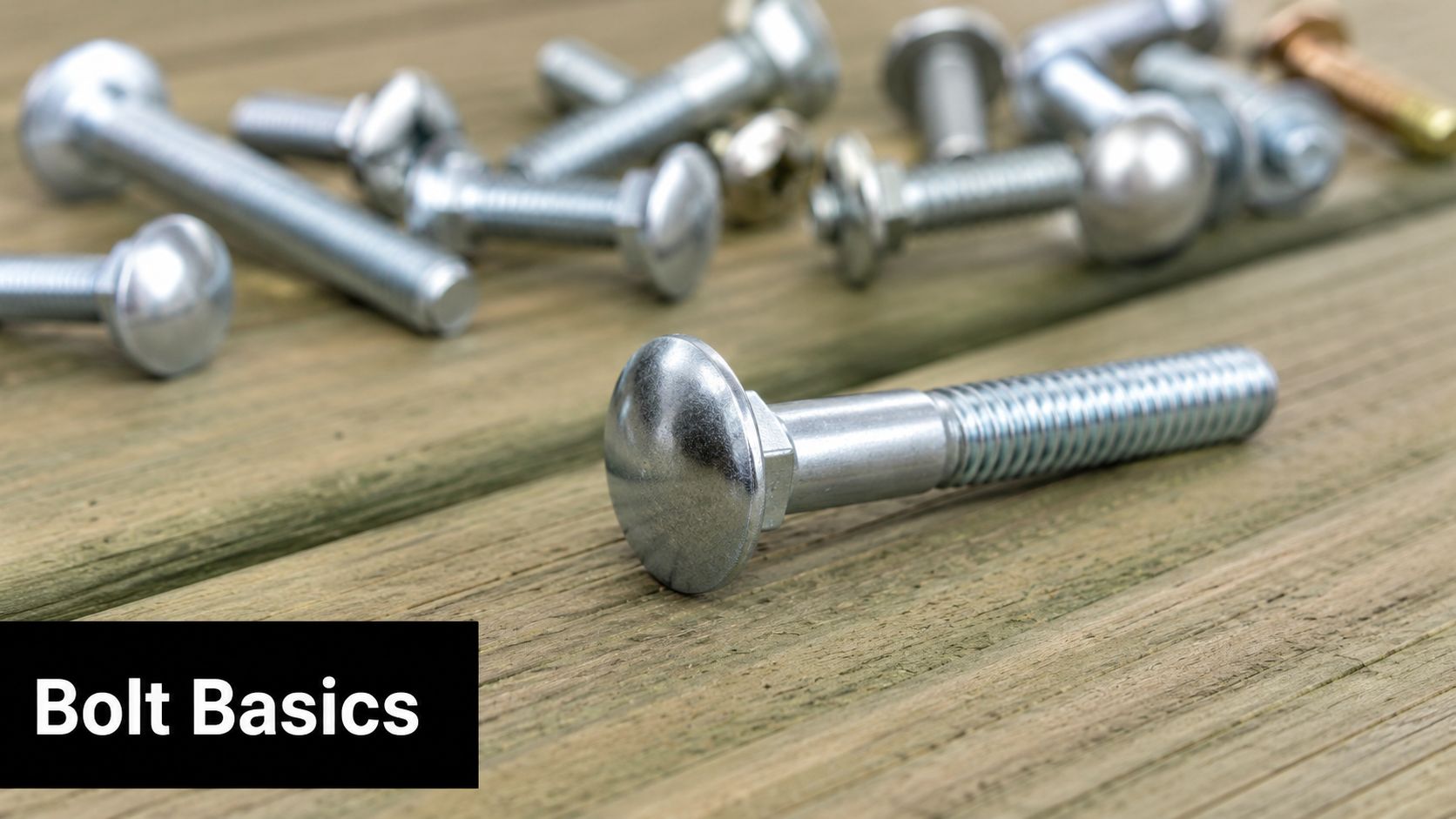
A carriage bolt is easy to spot once you know what you're looking at. It has a smooth, rounded head on one end, threads on the other, and a square section tucked under the head. That square section is the part that makes it useful in deck building.
In wood, that square neck works like a built-in wrench. Once it seats properly in the hole, it helps stop the bolt from turning while you tighten the nut from the other side. That's why a carriage bolt for deck connections is so common on rail posts, beam build-ups, and wood-to-metal brackets where you want the visible side to stay smooth and low profile.
Why the shape matters
The rounded head does two practical jobs. First, it gives the finished side of the deck a cleaner look than a hex head. Second, it leaves less to snag clothing, skin, hoses, or furniture on exposed deck areas.
Builders use them because of the square neck. According to this carriage bolt use guide, the square neck resists rotation when driven into a properly sized hole, which helps maintain clamping force in wood-to-wood and wood-to-metal assemblies used for rail posts and ledger attachments. The same source notes that common deck-use diameters range from 3/16 in. to 3/4 in., with lengths up to 16 in.
Practical rule: A carriage bolt only works properly if the square neck can bite into the material. If it spins, the connection was usually drilled or assembled badly.
If you're sourcing hardware for a full project, it helps to look at a deck-specific selection of fasteners and fittings rather than mixing random pieces from different bins.
Where they make sense on a deck
Carriage bolts aren't for every joint, but they're a strong choice where two-sided access is available and you want a through-bolt connection.
Common examples include:
- Railing posts to framing: Good where you need a firm mechanical connection and want the exposed head side to stay neat.
- Built-up beams: Useful for clamping multiple members together.
- Wood-to-metal hardware: Handy when you're bolting through brackets, plates, or heavy connector parts.
- Pergola and fence tie-ins: The smooth head works well on visible outdoor structures.
Where they don't shine is in spots where you can only reach one side, or where later removal is likely to be awkward. That's where other fasteners may make more sense.
Choosing Your Bolt Materials Finishes and Grades
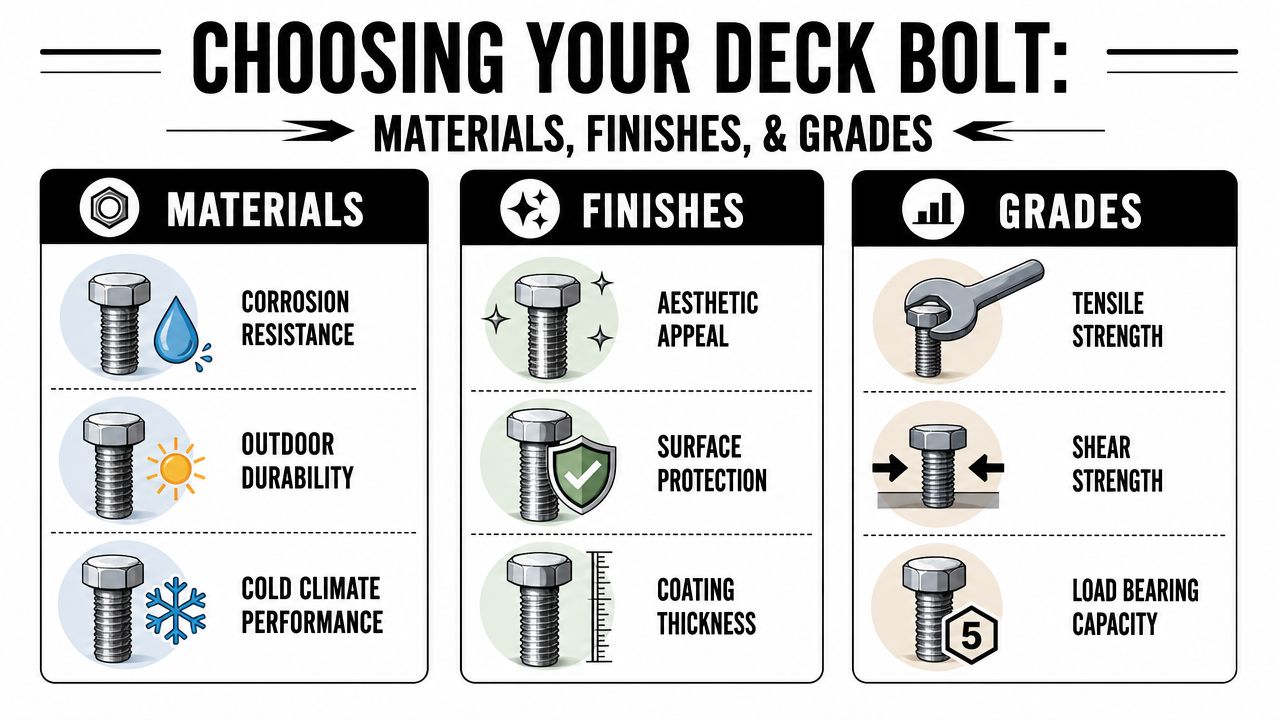
A deck can look solid on day one and still fail early if the hardware is wrong for the site. I see that more often than undersized bolts. In Canada, freeze-thaw cycles, wet lumber, and pressure-treatment chemicals are hard on metal, so material and finish come before strength.
What works outdoors and what doesn't
Plain steel belongs indoors. Zinc-plated hardware is fine for dry utility work, but it is a poor default for exposed deck structure, especially against treated lumber.
Start with one question. What will this bolt sit in for the next 10 or 15 years?
If the answer is pressure-treated wood, repeated rain, snow, or splashback from grade, use hot-dipped galvanized or stainless steel. Those are the finishes that hold up in real deck conditions. The cheaper bolt on the shelf often becomes the expensive repair later, once the nut seizes, the shank pits, or staining starts around the connection.
Here is the field-level breakdown.
| Finish | Corrosion Resistance | Best Use Case | Compatible with Treated Lumber? |
|---|---|---|---|
| Plain steel | Low | Dry indoor assemblies only | No |
| Zinc-plated | Limited | Light-duty covered applications | Not the safe default |
| Hot-dipped galvanized | Strong for exterior use | Most outdoor deck framing and railing connections | Yes |
| Stainless steel | Highest in harsh exposure | Coastal, wet, or maximum-longevity applications | Yes |
Hot-dipped galvanized versus stainless
For a typical backyard deck, hot-dipped galvanized is usually the practical choice. It gives good corrosion resistance at a reasonable cost and fits most framing, beam, and railing work.
Stainless steel costs more, but there are jobs where the upgrade makes sense right away. Waterfront properties, decks that stay damp, shaded sites with poor drying, and projects where the owner wants the longest service life all push the decision toward stainless. I also like stainless for highly visible details where rust streaks would be hard to hide later.
Match the rest of the fastener package to the same exposure level. Mixing one premium connector with low-grade companion hardware creates a weak point in the assembly. If you are building out the whole package at once, check related corrosion-resistant hardware such as stainless steel deck screws for exposed Canadian deck builds.
What Bolt Grade Changes
Grade affects how much force the bolt can take before it yields or breaks. It does not protect the bolt from corrosion, and it does not make up for weak wood, poor edge distance, or bad washer placement.
For many deck connections, the limiting factor is the wood connection, not the steel itself. That is why grade should be chosen with the joint in mind. Use a basic structural approach:
- Grade 2: Suitable for many general wood-to-wood deck connections where the design and local code allow it.
- Grade 5: A better fit where the joint sees higher demand, stronger clamping force, or less tolerance for movement.
- Any grade outdoors: Pair it with the right corrosion-resistant material or finish, or the extra strength will not matter much after a few seasons.
One more practical point. Higher-strength bolts are not a license to overtighten. Cranking down too hard can crush wood fibres, dish the washer into the lumber, and reduce long-term holding power. Snug the joint firmly, seat the square neck properly, use washers under the nut and where needed under the head side, then recheck after the wood has had time to dry and settle.
That is the full lifecycle view. Choose the metal for the site, choose the finish for the treatment level and moisture exposure, then choose the grade for the load. Builders who source all of that together, including compatible hardware from suppliers such as Xtreme eDeals, usually avoid the mismatch problems that show up a few years after install.
Sizing Your Carriage Bolts for Structural Integrity
A lot of deck hardware problems start at the planning stage. The bolt goes in, the joint feels tight on day one, then the lumber dries, shrinks, and the connection starts to move because the diameter, length, or placement was wrong for the job.
Sizing is not just a matter of making the bolt fit through two pieces of wood. On a Canadian deck, that joint also has to live through snow load, spring moisture, summer heat, and repeated wet-dry movement. Good sizing gives you enough clamping force and bearing area without removing more wood than the member can afford to lose.
Picking diameter for the connection
Choose diameter based on the connection type and the wood around it. Post-to-beam and built-up framing joints usually call for a larger bolt than a light-duty accessory mount or a decorative assembly. The reason is simple. As the joint demand goes up, you need more shank area and better load distribution, but you also need to protect the wood from splitting.
The trade-off matters. A larger carriage bolt can raise connection capacity, but it also requires a larger hole. That removes more wood fibre and reduces your margin if edge distance or spacing is tight. On narrow members, especially railing posts, going too large can weaken the piece before the deck ever sees service.
As noted earlier, bolt strength and connection strength are not the same thing. In deck work, the wood often governs. Species, moisture content, member thickness, edge distance, washer bearing, and how the load is applied all affect what the joint can safely carry.
A practical rule on site is to size the bolt to the joint first, then confirm the surrounding wood can support that choice. If the member is small or the bolt would end up too close to an edge, revise the connection instead of forcing in a bigger fastener.
Getting the length right
Length should cover the full stack-up cleanly without leaving excessive thread exposed. Measure the total thickness of the connected members, then add the washer, the nut, and enough extra thread for full engagement past the nut.
That usually gives a clean result:
- combined thickness of all wood members
- washer thickness
- nut thickness
- a small amount of extra thread beyond the nut
Too short, and the nut may not fully engage. Too long, and the extra thread becomes a snag point, collects dirt and corrosion, and looks like an afterthought. On exposed deck framing, that small detail affects both durability and finish quality.
Dry-fitting helps. Before drilling a full run of holes, stack the members, washer, and nut on one sample bolt and check the projection. Builders who buy hardware in batches from suppliers such as Xtreme eDeals save themselves trouble by confirming this before final assembly instead of finding out after the holes are bored.
A sizing mindset that prevents problems
Good sizing is conservative. It respects the load, the lumber dimensions, and the long-term movement of an outdoor structure.
Do not choose a bigger diameter just because it feels safer. A carriage bolt works best when the joint is designed around it, with proper spacing and enough wood left around the hole to hold together under load. That is why railing post connections, beam assemblies, and stair framing should each be sized on their own terms instead of using one bolt size everywhere.
If you are unsure between two lengths, choose the one that gives full thread engagement without a long tail past the nut. If you are unsure between two diameters, check the wood dimensions and connection layout before stepping up. That approach holds up better over the life of the deck.
Installation Guide for a Safe and Secure Deck
Good hardware won't save a bad install. Most carriage bolt problems come from drilling the wrong hole, forcing the bolt into place, or cranking the nut so hard that the wood gets crushed.
Drill the hole to match the shank
The hole should match the bolt shank size. Not smaller, not larger. A properly sized hole lets the bolt pass through while still allowing the square neck to seat in the wood.
If the hole is undersized, the square neck may never seat fully. If the hole is oversized, the neck won't grip well and the bolt can rotate or the joint can shift over time. That anti-rotation point is especially important in outdoor framing that moves through wet and dry seasons.
Seat the square neck properly
Push the bolt through, make sure the head is sitting flat, then tap it firmly so the square section bites into the wood. Don't rely on the nut to pull the square neck into place if the fit is poor. That often tears fibres instead of locking the bolt cleanly.
Use a washer under the nut. In many deck connections, that washer does more than protect the wood surface. It helps spread load and gives the nut a proper bearing surface while the joint tightens.
A common retrofit issue shows up when people use the wrong washer arrangement or no washer at all. The nut chews into the wood, clamping force drops, and the bolt starts acting loose even though the nut feels tight.
Tighten for clamping, not crushing
Tightening torque matters, but the field rule is simple. Tighten until the members are drawn together firmly and the washer is seated well, then stop before you start crushing the wood fibres.
That's where less experienced installers often go wrong. They think tighter always means safer. In wood, over-tightening can damage the fibres around the bolt and reduce the quality of the connection.
Use this sequence on a typical deck joint:
- Align first: Clamp or hold members in their final position before drilling if possible.
- Drill cleanly: Keep the bit square to the face so the bolt doesn't bind.
- Seat the neck: Tap the head side so the square section engages.
- Add washer and nut: Don't skip either if the connection calls for them.
- Snug and inspect: Tighten, check alignment, then finish tightening.
If your deck ties into footings, post bases, or other supported framing, related hardware details matter too. This is especially true where framing meets masonry or slab work, so it helps to understand anchoring posts to concrete as part of the whole connection path.
A final check before you move on
Look at both sides of the joint. The head should sit flat. The washer should bear evenly. The nut should run on cleanly and not be cross-threaded. If anything looks crooked, fix it before the rest of the deck buries the mistake.
Carriage Bolts vs Lag Bolts and Structural Screws
A carriage bolt is strong and dependable in the right place, but it isn't automatically the right fastener for every deck connection. Speed, access, appearance, and future service all matter.
Where carriage bolts stand out
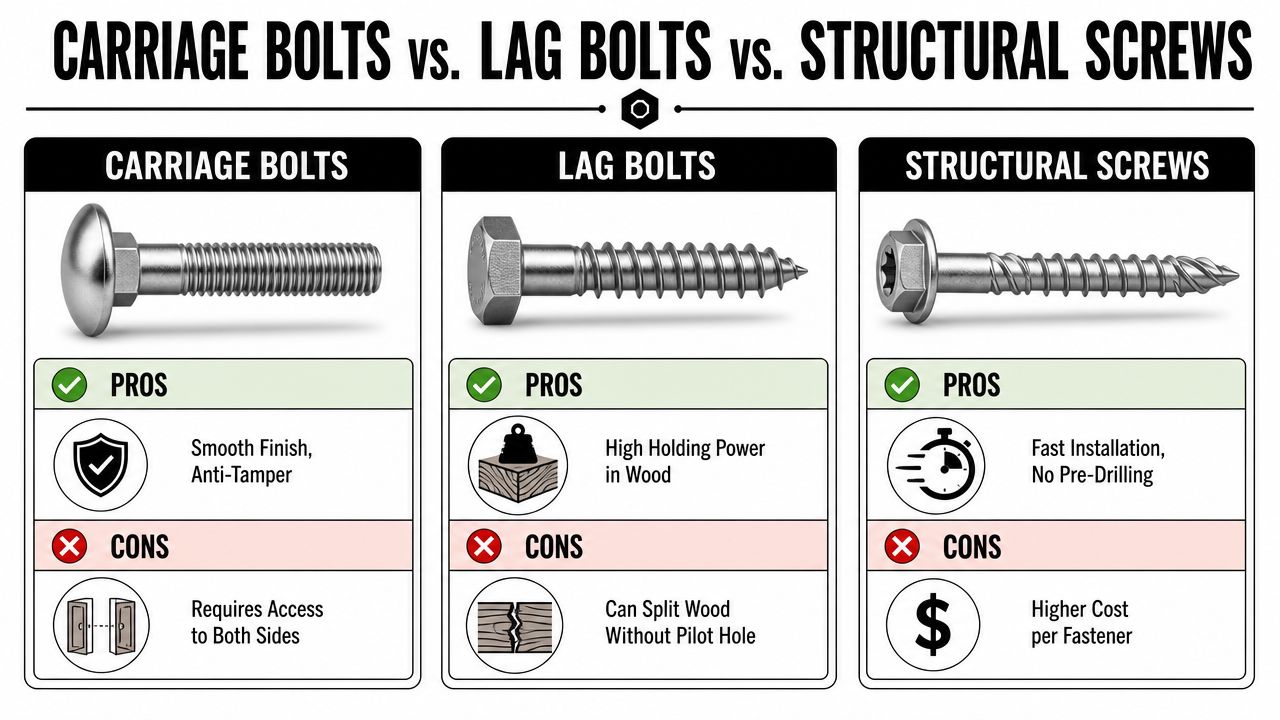
Carriage bolts excel when you can access both sides of the joint and want a through-fastened connection with a smooth visible head. They're well suited to post details, beam laminations, and bracketed assemblies.
Their weakness is speed and serviceability. You need to drill through, fit washers and nuts, and reach the back side. If the square neck loses its bite later, removal can become irritating.
Lag bolts and structural screws in real work
Lag bolts work from one side, which is handy in repairs or places where through-bolting isn't practical. They're common in wood framing, but they don't leave the same clean exposed finish and usually need more care to avoid splitting or poor pilot-hole work.
Structural screws are often the fast option. They install quickly, can be easier in tight spaces, and suit a lot of framing tasks well. On some jobs, they're more efficient than carriage bolts.
This side-by-side view helps:
| Fastener | Best Advantage | Main Drawback | Good Deck Uses |
|---|---|---|---|
| Carriage bolt | Strong clamping with smooth exposed head | Needs access to both sides | Posts, beams, brackets |
| Lag bolt | Installs from one side | Less clean finish, more pilot-hole sensitivity | Repairs, one-side access framing |
| Structural screw | Fast installation | Cost per fastener can be higher | Framing, retrofits, tight access |
For a visual comparison, this video is useful:
How I'd choose on an actual deck
Pick a carriage bolt for deck work when appearance and through-clamping matter. Pick a lag when only one side is reachable and the detail suits it. Pick a structural screw when installation speed, tight access, or retrofit convenience matters more than a traditional bolted look.
The right fastener isn't the strongest one on paper. It's the one that fits the joint, the access, and the exposure conditions without creating a new problem.
Deck Maintenance Buying Tips and FAQs
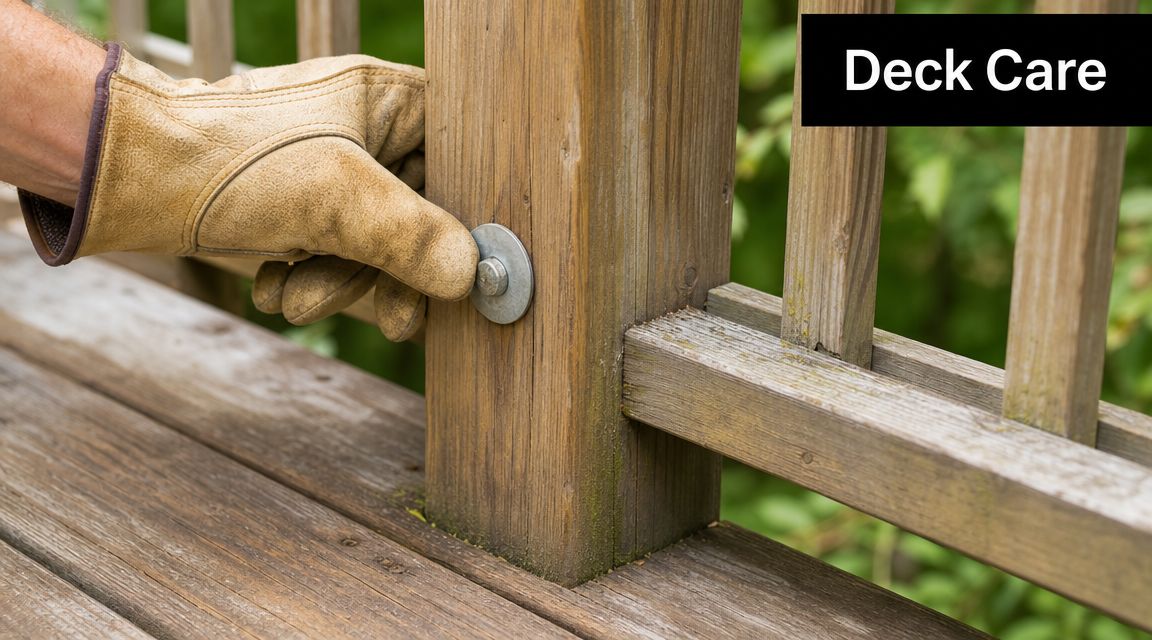
A carriage bolt joint changes after the build. The nut was tight on install day, but the wood keeps drying, swelling, and shrinking through rain, snow, and summer heat. On Canadian decks, that seasonal movement is what loosens good-looking connections that were installed correctly the first time.
What to inspect every season
Check bolted joints at least once a year, and check again after the first full season on a new build. I pay close attention to beam-to-post and railing connections because those joints see regular loading and weather exposure.
Look for:
- Loose nuts: Wood shrinkage can reduce clamping pressure, even if the bolt was tightened properly at install.
- Washer imprinting or crushing: A washer that has buried itself into the wood usually means the joint was overtightened, the washer was undersized, or the wood has softened from moisture.
- Rust, black streaks, or staining: Those signs often point to a coating mismatch, standing moisture, or hardware that is not suited to the treated lumber.
- Joint movement: If two members can shift, rub, or separate under load, the connection needs attention.
- Spinning bolt heads: A carriage bolt that turns during tightening or removal often means the square neck never seated well, or the wood fibers around it have worn out.
As noted earlier, common service issues include bolts loosening after seasonal movement and bolts spinning because the square neck was not seated correctly. If a bolt has to come out, backing off the nut and tapping the threaded end can help break it free without tearing up the surrounding wood.
Buying tips that save frustration
Buy hardware as a system. Bolt, nut, washer, and finish should match the exposure and the lumber you are using. Mixing plated parts with galvanized or stainless components is a good way to create corrosion problems or make future maintenance harder.
Before ordering, confirm these details:
- Diameter and thread pitch: Nuts must match the bolt exactly.
- Actual grip length: Measure the full assembly, including washers, then leave enough thread for full nut engagement without several extra inches sticking out.
- Washer size and type: Standard washers work for many deck joints, but larger bearing washers can make more sense on softer wood or high-load connections.
- Finish for the site conditions: Hot-dipped galvanized suits many treated-lumber decks. Stainless costs more, but it usually makes sense near water, in heavy wet exposure, or where long service life matters more than upfront price.
- Spare quantity: Order extra pieces for damaged threads, field changes, and later repairs.
If you are buying online in Canada, one practical option is XTREME EDEALS INC., which lists deck and fence hardware including carriage bolts, nuts, washers, anchors, and related accessories from brands such as Decorex Hardware. For a full deck package, I would still compare sizes, finishes, and washer options against the actual cut list before placing the order.
Quick FAQs
Can I use carriage bolts everywhere on a deck
No. Use them where you can access both sides of the joint and where through-bolting suits the detail. For hidden cavities, one-sided repairs, or cramped framing, another fastener usually makes more sense.
Why does my carriage bolt spin when I tighten it
The square neck is supposed to bite into the wood and hold the head still. If the hole is oversized, the wood is damaged, or the parts were stacked in a way that kept the neck from seating, the bolt can spin instead of tightening.
Should I retighten deck carriage bolts later
Yes. A check after the first season is smart, especially with new pressure-treated lumber. Tighten only enough to restore firm clamping. Crushing the wood creates a new problem.
Is hot-dipped galvanized enough in Canada
Often, yes. It is a common choice for exterior deck work in treated lumber. Stainless is usually the better long-term call in harsher wet conditions, near salt exposure, or on jobs where the owner wants the least maintenance possible.
If you're lining up hardware for a new build, a repair, or a railing upgrade, XTREME EDEALS INC. is a straightforward Canadian source for carriage bolts, washers, nuts, anchors, and other deck and fence hardware. It's a practical place to compare sizes, finishes, and compatible fastening products before you commit to a full materials list.