
You're standing in the fastener aisle with two nearly identical boxes of carriage bolts in your hand. One costs $9, the other $28, and the label on the expensive box says 316 stainless steel. The project is a backyard deck, not a marina, so the obvious question is whether the upgrade is sensible or just expensive packaging.
That question catches experienced builders too, because stainless steel isn't one universal premium grade. A 304 carriage bolt and a 316 carriage bolt can look almost identical while responding differently to de-icing salt, treated lumber, lake-effect spray, and coastal moisture. The right choice depends on the environment, the joint, and what happens if corrosion or installation trouble shows up later.
This guide treats carriage bolts stainless steel as a jobsite decision rather than a marketing category. We'll sort out alloy grade, diameter, length, and matching washers and nuts, then compare stainless with hot-dip galvanised hardware so you don't overspend in a dry inland setting or under-specify a connection exposed to chlorides.
The Fastener Aisle Dilemma Most Buyers Never Solve
A homeowner building a fence usually starts with the visible details. The bolt has a neat domed head, the box says stainless, and the hardware looks like it should last. The hidden decision is whether the fastener will spend its life in ordinary rain, pressed against copper-treated wood, or sitting where salty slush repeatedly dries on the joint.
A 304 bolt can be a sensible choice for general exterior work. A 316 bolt earns its price when chloride exposure is a regular part of the job. Treating both as “stainless” hides the decision that controls the result.
Practical rule: Buy for the exposure, not for the word stainless on the label.
California construction guidance connects stainless fastener selection with exterior exposure and wet locations, where stainless is commonly selected for corrosion resistance in building assemblies. Its guidance also identifies ASTM F593 for stainless steel bolts, hex cap screws, and studs in inch-series diameters from 1/4 inch through 1-1/2 inch. See the California fastener specifications before treating a carriage bolt as generic shelf hardware in a structural assembly.
The same reasoning applies across Canadian decks and fences, although the environment changes from region to region. An inland privacy fence may be well served by hot-dip galvanised hardware. A deck beside a treated-lumber joint, a pool, a salted walkway, or a shoreline splash zone deserves a closer look at stainless grade and accessory compatibility.
The expensive mistake goes both ways. Paying for 316 where 304 or hot-dip galvanised would perform properly wastes money. Choosing a basic finish where salt and moisture stay concentrated can leave rust staining, seized nuts, and a weakened connection that's difficult to repair after the structure is finished.
What a Carriage Bolt Actually Is and Why the Shape Matters
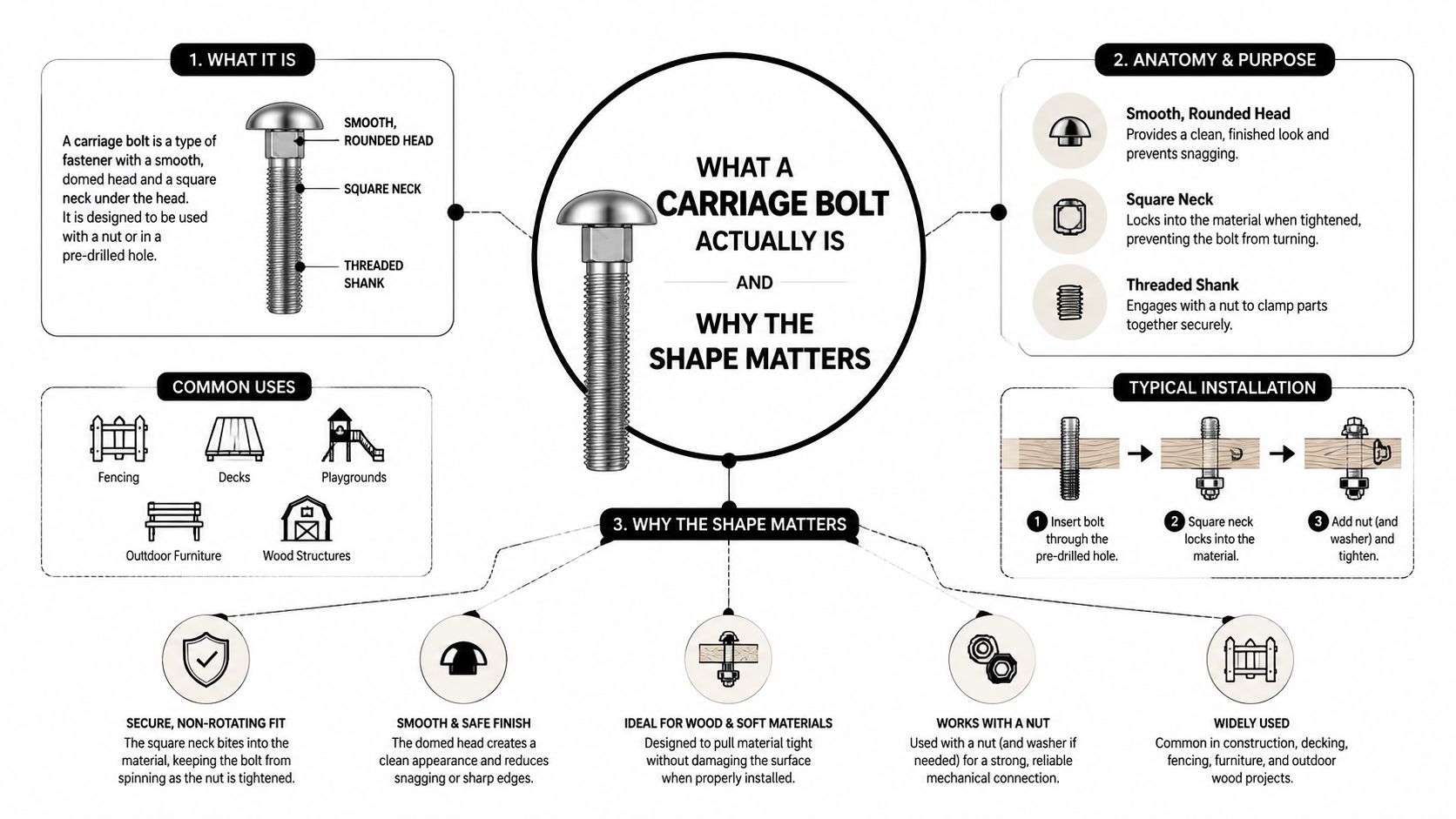
A carriage bolt is a through-fastener designed to draw two parts together from the nut side. It has a rounded or domed head, a square neck directly beneath that head, a smooth unthreaded shoulder, and machine threads at the opposite end.
The square neck is the feature that makes the bolt useful. As you pull the nut down, the neck bites into a matching recess in wood or a mating part, stopping the bolt from spinning. You can tighten the nut with a wrench without holding the head with a second tool, which is valuable when the rear face is difficult to reach.
The four parts that do the work
- Domed head: Gives the exposed face a finished appearance and removes the sharp corners associated with a standard hex head.
- Square neck: Resists rotation during tightening. In wood, it needs enough seating depth and material around it to hold securely.
- Smooth shoulder: Provides a bearing surface through the connected materials and keeps threads from occupying the shear plane when the bolt is selected correctly.
- Threaded end: Receives the nut and creates clamp force as the joint is drawn together.
A carriage bolt isn't tightened from the head side. It's an external and internal draw-up fastener, meaning the nut pulls the assembly together while the head bears against the visible or access-limited face.
The geometry follows the same basic standard whether the bolt is carbon steel or stainless. ASME B18.5 covers carriage bolt dimensions and forms, while stainless material and strength requirements are handled through specifications such as ASTM F593. The square neck doesn't make a poor joint structurally sound, though. Washers, edge distance, wood condition, hole alignment, and the design load still determine whether the connection performs.
For that reason, a carriage bolt suits a post-to-beam connection or gate strap where a clean head and one-sided tightening matter. It's less attractive where a large washer under a conventional hex-head bolt would distribute bearing pressure more effectively.
Comparing 304 and 316 Stainless Steel Grades
The useful difference between 304 and 316 stainless steel is not the shine. It's how the alloy handles chloride exposure and the surrounding material.
304 is the common general-purpose stainless choice for exterior woodwork, inland decks, fences, and ordinary wet locations. It offers good corrosion resistance without the added alloying cost of 316. In a dry or moderately wet environment, it's often the sensible middle ground.
316 adds molybdenum, which improves resistance to chlorides. That makes it the stronger candidate for road-salt splash, shoreline exposure, pool surrounds, and other locations where salt remains on the fastener rather than being washed away quickly. The Canadian Wood Council guidance recommends hot-dip galvanised or stainless steel bolts, washers, and nuts for exposed, high-moisture conditions, so the decision isn't automatically “buy stainless”. It's about choosing the material that fits the exposure.
| Property | 304 Stainless | 316 Stainless |
|---|---|---|
| General corrosion resistance | Suitable for ordinary exterior and wet-location work | Higher resistance where chlorides are persistent |
| Chloride exposure | Can be adequate in mild exposure, but more vulnerable to staining and pitting | Preferred for salt, de-icing splash, and shoreline conditions |
| Treated-lumber use | Practical for many exterior wood assemblies | Better choice where treatment chemicals and moisture remain aggressive |
| Typical jobsite role | Inland decks, fences, gates, and general outdoor repairs | Salted areas, pool surrounds, coastal or lake splash zones |
| Cost position | Lower stainless option | Higher-cost upgrade justified by harsher exposure |
The treated-lumber question
Pressure-treated lumber changes the conversation because the wood remains damp and contains preservative chemicals. The right compatible fastener depends on the treatment system, exposure, and the requirements of the assembly. Read the practical background on what pressure-treated wood means for hardware selection before choosing bolts by appearance alone.
For ordinary inland construction, 304 is usually the default stainless specification. In chloride-heavy conditions, 316 is the safer call. Buyers looking for stainless options can review stainless steel fasteners for outdoor assemblies and then match the grade to the actual site rather than assuming the most expensive box is always necessary.
The key point is simple: 304 is the general exterior grade, while 316 is the chloride-zone grade. If salt is part of the environment, the upgrade has a reason. If it isn't, hot-dip galvanised or 304 stainless may deliver the required protection without paying for a grade the site doesn't need.
Standard Sizes, Dimensions and How to Read a Callout
A carriage bolt callout tells you more than the diameter. Consider 1/2-13 x 4 in, 316. The first value identifies the nominal diameter, 1/2 inch. The second identifies the thread pitch, 13 threads per inch. The length is measured under the head, not from the top of the dome.
That last detail causes plenty of ordering mistakes. A bolt that looks long enough on paper can leave too little thread for the washer and nut after passing through a thick beam, a bracket, and a second board. A bolt that's too long can leave an exposed threaded section that catches clothing, equipment, or moisture.
Read the callout in this order
- Diameter: Select this from the joint design, load, hole condition, and available bearing area. Stainless carriage bolts covered by ASTM F593 range from 1/4 inch through 1-1/2 inch in nominal diameter, according to the ASTM F593 specification summary.
- Thread pitch: The threads-per-inch value tells you which nut belongs on the bolt. Never mix a fine-thread nut with a coarse-thread bolt.
- Length: Measure from beneath the head through every connected part, then allow room for the washer and full nut engagement.
- Material or grade: The final designation identifies the stainless family, such as 304 or 316, where the product specification provides it.
ASME B18.5 listings commonly separate smaller and larger diameter classifications. One classification covers nominal sizes from 1/4 to 5/8 inch, while another covers 3/4 to 1-1/2 inch, as shown in this carriage bolt dimensional reference.
The shoulder should pass through the portion of the joint where you expect bearing and shear. If the threads sit inside the shear plane, the smaller threaded section carries the contact, which can be a poor choice. You also need enough exposed thread to install the washer and nut without the nut bottoming out against the unthreaded shoulder.
| Diameter | Threads per Inch | Head Height (in) | Square Neck Width (in) | Typical Length Range (in) |
|---|---|---|---|---|
| 1/4 in | Product-specific | Product-specific | Product-specific | Product-specific |
| 3/8 in | Product-specific | Product-specific | Product-specific | Product-specific |
| 1/2 in | Product-specific | Product-specific | Product-specific | Product-specific |
| 5/8 in | Product-specific | Product-specific | Product-specific | Product-specific |
| 3/4 in and larger | Product-specific | Product-specific | Product-specific | Product-specific |
Don't use a table like this as a substitute for the manufacturer's dimensional drawing. Head height, neck width, thread length, and available overall length vary by classification and product line. Confirm the exact dimensions before drilling a production run of holes.
Strength, Corrosion and Load Performance Explained
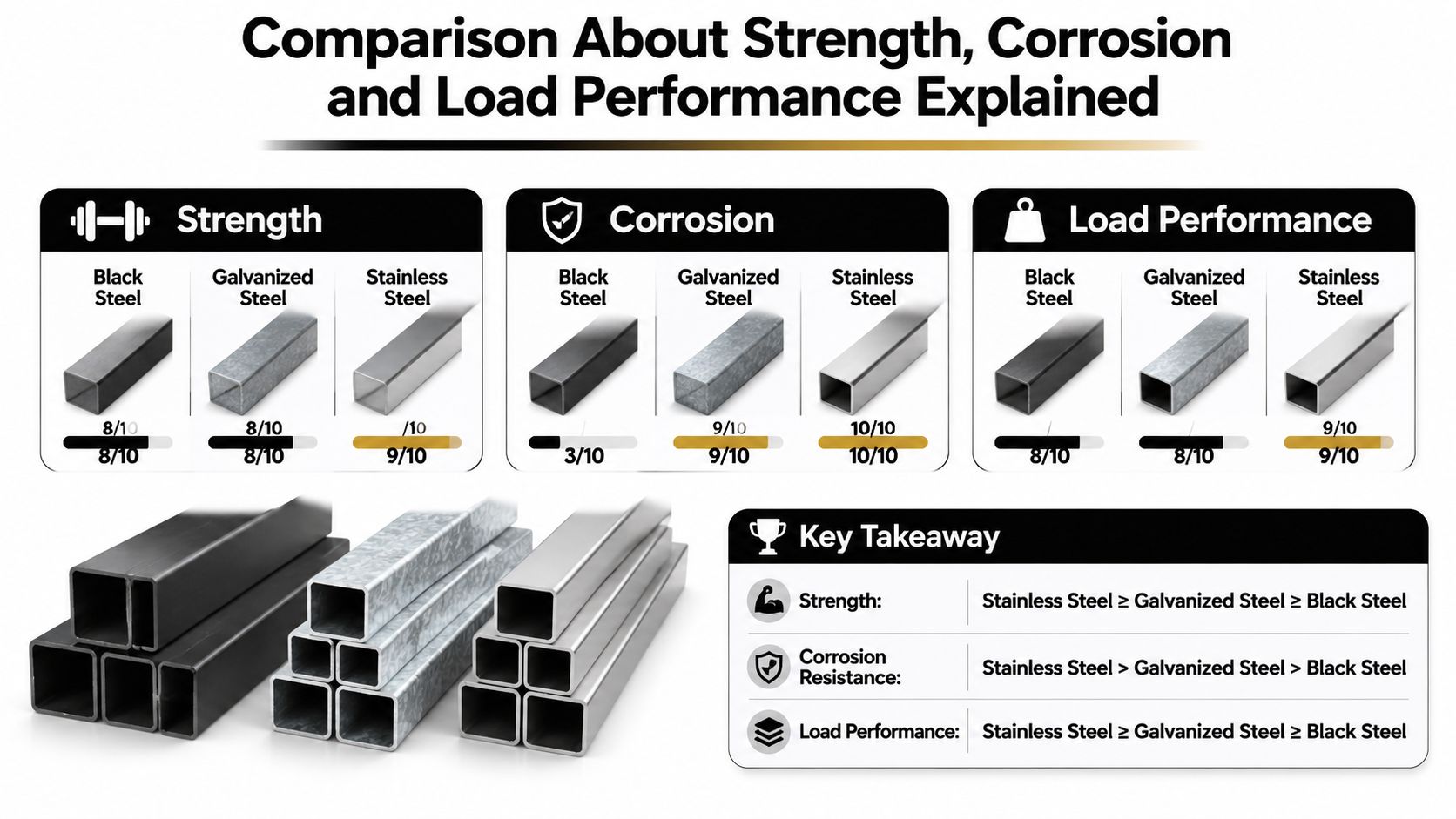
Stainless carriage bolts are commonly specified through ASTM F593, which groups material by alloy family and condition. The condition matters because solution annealed, cold-worked, and strain-hardened material can provide different strength levels.
Alberta specifications identify stainless anchor bolts as ASTM A276 Type 304 and stainless fasteners as ASTM A320 Grade B8 Class 2 AISI 304, with a minimum yield strength of 690 MPa and hardness of 321 HB. That establishes 304 stainless as a serious construction material, not merely decorative hardware, while also showing why buyers need to read the full grade and condition rather than relying on the word stainless. The specification is available in this Canadian rust and acid-resistant fastener document.
Strength isn't the same as a complete connection design
A bolt's material strength doesn't tell you the capacity of the whole joint. Wood crushing beneath the washer, splitting near an edge, oversized holes, poor contact with a metal bracket, and insufficient thread engagement can control the result long before the stainless alloy reaches its limit.
For structural work, confirm the governing design and inspection requirements. California's building framework requires bolt design, installation, and inspection to follow the applicable steel provisions, so a carriage bolt used in a structural connection shouldn't be selected as generic hardware. The ASME B18.5 stainless carriage bolt product reference also illustrates why dimensional and material compliance belong in the purchase decision.
Corrosion creates a different failure path. 304 can perform well in rain and many treated-wood assemblies, while 316 is selected when chloride exposure increases the chance of staining, pitting, or surface attack. ISO 3506 guidance also makes grade selection relevant to intergranular corrosion risk, although ordinary cold-formed carriage bolts aren't exposed to the extreme service temperatures associated with that particular concern.
The practical test is not whether stainless is strong enough in isolation. It's whether the bolt, washer, nut, wood, bracket, hole, and environment have been specified as one connection.
Where Stainless Carriage Bolts Earn Their Place
Carriage bolts make sense when the joint needs a clean rounded head on one face, a smooth bearing shoulder through the assembly, and tightening access from the nut side. That combination appears often in outdoor carpentry, but not everywhere.
A ledger-to-house connection may use carriage bolts where the assembly and local design permit them. Post-to-beam connections on pergolas, gate hinge straps, and metal-to-wood joints through a bracket or sill are other familiar applications. The square neck stops the bolt from turning while one person works the nut, and the dome keeps the exposed side visually tidy.
Good applications
- Gate straps and hinge hardware: The head presents a finished face while the nut remains on the protected side.
- Post-to-beam joints: The smooth shoulder passes through timber, with the nut and washer drawing the members together.
- Pergola and fence connections: Stainless helps where water collects around the joint or where appearance matters.
- Metal-to-wood brackets: The square neck can register against a suitable hole or recess while the nut is tightened.
A carriage bolt isn't automatically the best fastener for a structural connection. Hidden loads may benefit from a conventional through-bolt with a larger hex head and washer arrangement that spreads bearing stress more effectively. Face-fastening deck boards is another poor match. A purpose-designed structural screw is usually faster and easier for that task, provided it's approved for the application.
A clean head is a design advantage, not a substitute for load verification.
Pressure-treated wood can hold moisture against the hardware, and the joint may be exposed to water even when the rest of the structure is sheltered. That's why the material choice has to follow the wood system and exposure, not only the visual finish.
The best use is a partially exposed, mechanically meaningful joint where the carriage shape solves an access or appearance problem. If the bolt head is hidden, the back is easy to reach, and a larger washer is more valuable than a low-profile dome, another bolt style may be the better trade.
A short demonstration of carriage bolt installation can help visualise how the square neck engages the material:
Installation Tips That Prevent Stripped Holes and Stuck Nuts
Most carriage bolt failures I see at the counter aren't caused by the stainless alloy. They come from a misaligned hole, a neck that never seats, a washer left off the back, or a dry nut forced onto stainless threads with a powered driver.
Start by marking both faces and drilling cleanly. In wood, use a clearance hole that lets the shank pass without splitting the member. In metal-to-wood work, size the hole so the shoulder registers properly in the metal while the wood still receives the bolt without excessive play.
A reliable fitting sequence
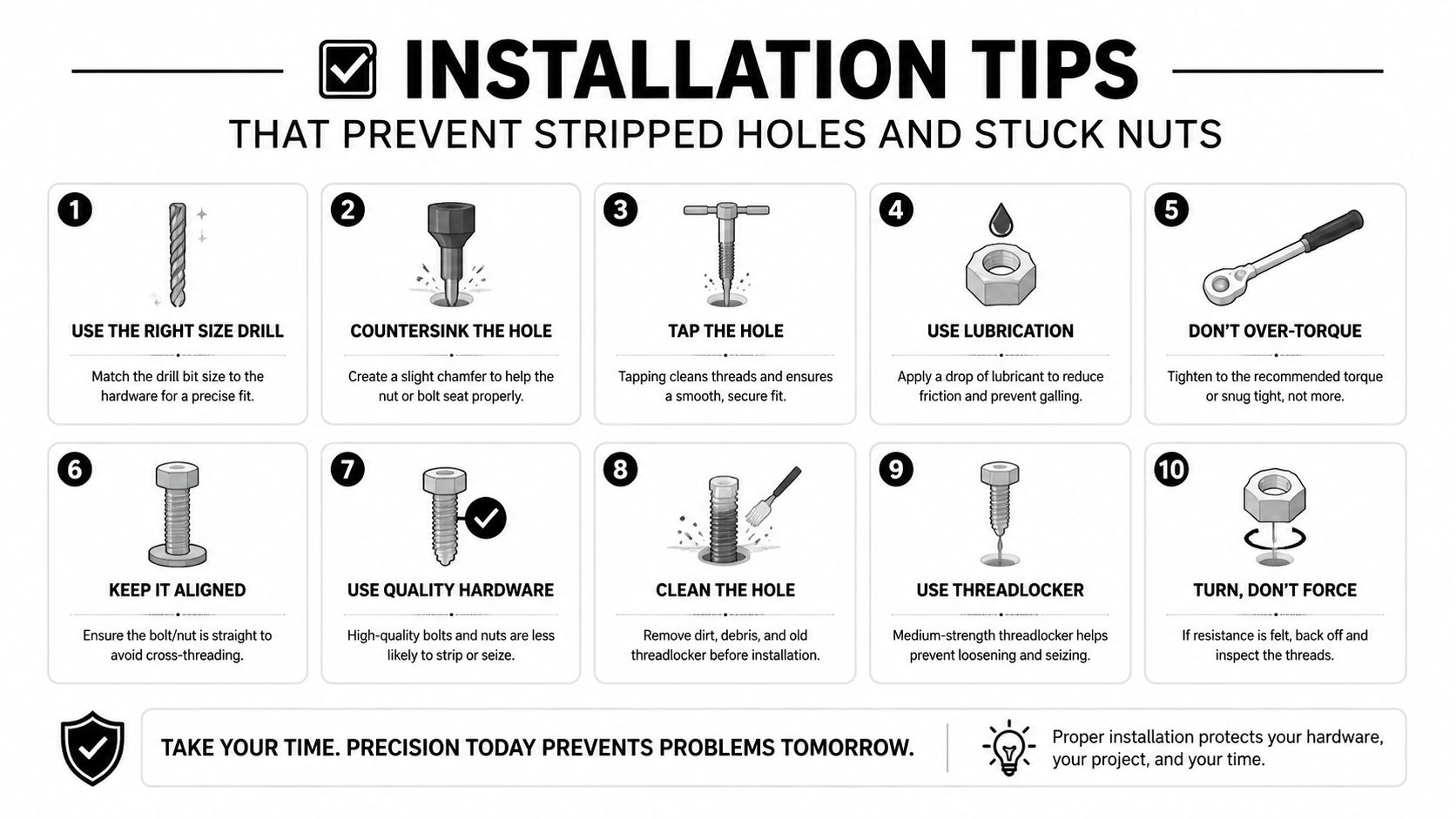
- Dry-fit the parts: Clamp the boards or bracket in their final position and confirm that the holes line up before inserting hardware.
- Seat the square neck: Tap the head gently with a non-marring hammer until the square shoulder bites into the wood or enters the matching recess. Don't rely on nut tension to pull a badly misaligned neck into place.
- Use the washers: Place a flat washer wherever the head or nut bears against the assembly, unless the approved connection detail specifies another arrangement. Washers spread pressure and help protect the joint face.
- Start the nut by hand: Stainless threads can gall. Run the nut down several turns manually so you can feel cross-threading before it becomes expensive.
- Apply anti-seize sparingly: A light smear of nickel or PTFE anti-seize reduces the risk of thread seizure. Keep it off visible wood surfaces and avoid flooding the joint.
- Tighten progressively: Bring the nut snug, check that the members remain aligned, then finish with a wrench. Crushing wood fibres can reduce clamp force rather than improve the connection.
Never use a powered nut-runner to spin a dry stainless nut onto 304 or 316 carriage bolt threads. Heat and friction can cause the threads to cold-weld, leaving you with a seized assembly that may need to be cut apart.
For concrete-mounted work, a carriage bolt may not be the right anchor at all. Review the difference between a through-fastener and expansion anchors for concrete before transferring a wood-joint solution to masonry.
Assembly check: If the head spins while you tighten, stop. Fix the square-neck seating instead of increasing torque.
Stainless vs Galvanised vs Other Exterior Fasteners
Hot-dip galvanised carriage bolts are often the sensible choice for above-grade decks and fences outside coastal or salt-splash zones. Their zinc coating provides sacrificial protection, but the finish can eventually streak onto cedar or pressure-treated lumber as the coating is consumed. That visible staining matters on a decorative fence, even when the connection remains serviceable.
304 stainless occupies the middle ground. It avoids the coating-related streaking associated with galvanised hardware and handles many ordinary outdoor applications. 316 costs more, but the premium has a clear purpose where de-icing salt, pool chemicals, shoreline spray, or persistent chloride contamination reaches the joint.
Silicon bronze has a loyal following in boatbuilding and cedar decking. It resists chloride exposure and avoids the dark or rusty streaks that can spoil a timber surface, but it's softer, expensive, and less common in larger carriage bolt diameters. Zinc-plated hardware belongs in dry indoor work or temporary applications, not as a long-term exterior specification.
| Material | Corrosion Resistance | Relative Cost | Best Use |
|---|---|---|---|
| Hot-dip galvanised steel | Strong outdoor protection, with sacrificial zinc coating | Lower than stainless | General decks, fences, and above-grade outdoor joints away from heavy salt exposure |
| 304 stainless steel | Good general corrosion resistance, more vulnerable to chlorides than 316 | Moderate stainless option | Inland exterior work, gates, and ordinary treated-lumber assemblies |
| 316 stainless steel | Better suited to persistent chloride exposure | Higher stainless option | De-icing salt, pool surrounds, shoreline splash, and severe damp conditions |
| Silicon bronze | Strong resistance to marine corrosion and no typical steel-rust streaking | High | Boatbuilding and appearance-sensitive cedar work |
| Zinc-plated steel | Limited exterior durability compared with hot-dip galvanised or stainless hardware | Low | Interior assemblies and short-term, low-moisture uses |
The Canadian Wood Council's guidance on bolts supports using hot-dip galvanised or stainless hardware in exposed, high-moisture conditions. That still leaves a practical choice. Hot-dip galvanised is often enough for a sheltered inland fence, 304 stainless suits many general exterior jobs, and 316 is justified when chlorides are part of daily exposure.
Match the fastener budget to the failure consequence. A replacement is inconvenient on a garden gate, but it's far more disruptive when the hardware is buried behind finished decking, a post cap, or a structural connection.
XTREME EDEALS INC. offers carriage bolts, stainless fasteners, washers, nuts, and related deck, fence, gate, and repair hardware for projects where the grade and finish need to match the environment. Visit XTREME EDEALS INC. to compare suitable hardware and order the components for your next outdoor connection.