
You're at the fastener aisle, or halfway through an online order, holding a gate bracket in one hand and an old carriage bolt in the other. The bracket came from a metric supplier. The old hardware looks close to a common inch size. Close is where jobs go sideways.
That mix-up happens constantly on deck, fence, and light exterior builds. A bolt drops through the hole but the square neck won't bite. Or the nut starts, then binds because somebody matched a metric shank with an imperial nut. By the time you notice, the crew has already drilled posts, stained boards, or hung a gate.
Metric carriage bolts deserve their own guide because they're not just inch bolts with millimetres on the label. The geometry, thread pitch, length options, and stock availability all affect whether the bolt seats cleanly, pulls tight, and stays put in service. In Canada, that matters most on mixed-spec jobs, imported hardware, chain link accessories, replacement parts, and any build where you need to match an existing hole pattern instead of forcing a near fit.
Introduction to Metric Carriage Bolts for Canadian Projects
A crew hangs a replacement gate, tightens the nut, and the bolt still turns. The head is smooth, the bracket hole looks close enough, and the hardware came out of a mixed box from the shop. By the time someone checks the thread pitch, the post is drilled and the gate is already sagging on one side.
That failure pattern shows up all over Canadian deck and fence work. Imported gate kits, chain link fittings, ornamental brackets, and replacement parts often use metric carriage bolts, while the rest of the job is built around imperial lumber, imperial drill bits, and whatever stock the local yard had on hand. The result is usually one of three problems. The shank is wrong for the hole, the nut does not match the thread, or the square neck does not seat well enough to stop the bolt from spinning.
For Canadian buyers, the useful starting point is the geometry standard, not the label on the bin. Metric carriage bolts in this category are commonly supplied to DIN 603 / ISO 8678 proportions, and that matters on real jobs because head shape, neck dimensions, and thread form all affect whether a replacement bolt will pull into wood cleanly or fit an existing metal fitting without rework. On deck and fence jobs, M6 stock is the size you will see most often in imported accessory hardware, usually with a 1.0 mm pitch and shorter stocked lengths suited to brackets, gate straps, latch hardware, and light connector stacks.
Canadian supply also has a practical constraint. Metric carriage bolts are available, but the range is usually tighter than imperial stock. One Canada-based source lists metric DIN 603 carriage bolts with common M6 lengths such as 16 mm, 20 mm, 25 mm, 30 mm, and 35 mm, which lines up with the replacement work crews face on gates, fence panels, and hardware retrofits (Bolts Plus carriage bolt catalogue).
The inspection side gets missed too often. If the job spec calls up ASTM or CSA hardware elsewhere, that does not automatically mean the carriage bolt on an imported bracket follows the same system. Match the actual bolt standard first, then check material and corrosion requirements against the project conditions. For exterior Canadian work, that usually matters more than making a near conversion fit.
Use metric stock when the hardware was designed for it. That saves threads, preserves hole geometry, and gives the square neck a fair chance to hold the way DIN 603 and ISO 8678 intend.
What Makes a Metric Carriage Bolt Different
A metric carriage bolt is easy to recognise once you know what to look for. The head is rounded and smooth. There's no drive slot and no hex to hold with a wrench. Under that head sits the square neck, and that square section is what makes the bolt work in wood or a matching slot.

The three parts that matter
The bolt's performance comes down to shape more than appearance.
- Rounded head: This gives you a low-profile face on the exposed side of the work. On fences, gates, and deck details, that smooth head is less likely to snag.
- Square neck: This is the anti-spin feature. When the neck beds into wood, or fits the right punched opening in metal hardware, you can tighten from the nut side.
- Metric threaded shank: Many mistakes happen. Metric shanks use metric pitch, so the nut has to match exactly.
On softwood, the square neck often pulls in and locks as the nut tightens. On hardwood, steel brackets, or prefinished material, you need the hole or slot to suit the neck properly. If it doesn't, the bolt turns and the head just polishes the face of the material.
Metric naming is different from inch naming
Imperial carriage bolts are usually identified by diameter in inches and thread count. Metric carriage bolts are identified by nominal diameter in millimetres and thread pitch in millimetres. So an M6 carriage bolt tells you the shank diameter family first, and the pitch tells you what nut fits.
That sounds basic, but it changes buying and installation. A crew that knows 1/4 in. and 5/16 in. by feel can still get slowed down by M6, M8, or M10 if they don't stop and verify the mating hardware.
If the nut only starts for a turn or two, stop. That's usually a thread system problem, not dirt on the threads.
A quick visual primer helps before you sort dimensions.
Where this design works best
Carriage bolts are strongest when the joint benefits from a smooth exposed head and a bolt that can be tightened from the back side. Good examples include fence rails, gate hardware, deck brackets, timber trim, and chain link accessory connections.
They're not the right answer for every joint. If the assembly needs frequent adjustment from the head side, a hex-head fastener is often easier to service. If you need blind fastening with no rear access, a carriage bolt won't help because it still needs a washer and nut on the far side.
Standards That Define Metric Carriage Bolt Dimensions
Metric carriage bolt buying gets simpler once you stop shopping by appearance and start shopping by standard. For Canadian work, the key is knowing whether the product listing is giving you the carriage-bolt geometry standard, the material standard, or both. Most confusion comes from those being blended together on distributor pages.
The geometry standards you'll actually see
A California-available technical sheet identifies metric carriage bolts under ISO 8677, DIN 603, and JIS B 1171, with metric pitch and length tables that separate them from inch-series carriage bolts. That same reference also notes the historical split between ASME B18.5 for inch sizes and ISO/DIN standards for metric sizes, which is why supply listings in North America often show both families side by side (AFT Fasteners metric carriage bolt technical information).

That matters on the ground because a listing might say DIN 603 and then list a zinc finish or a property class separately. The geometry standard tells you what the head shape, neck form, and thread format should look like. It does not tell the full story on finish, corrosion resistance, or what a buyer can substitute without checking.
Reading a spec sheet without guessing
When you scan a listing or technical sheet, focus on these fields first:
| Spec field | What it tells you | Why it matters |
| | | |
| Nominal diameter | The metric size family, such as M6 or M8 | Determines compatible nut and hole planning |
| Pitch | Thread spacing in metric form | Prevents nut mismatch |
| Length | Measured from under the head | Ensures enough thread projects past washer and nut |
| Standard | DIN 603, ISO 8677, or JIS B 1171 | Confirms carriage-bolt geometry |
| Material or class | Carbon steel, stainless, or property class | Affects service life and suitable use |
CSA and ASTM references in real procurement
For Canadian procurement, CSA C83-2022 matters because it includes a cross-reference of comparable standards and property classes for metric and imperial fasteners. That helps when a job started with legacy Canadian or inch-based requirements and the replacement part in front of you is a DIN or ISO metric carriage bolt (CSA cross-reference note in the Hubbell specification sheet).
In practice, that's the gap many competitors skip. They'll list a metric carriage bolt and leave the buyer to figure out whether it's just dimensionally similar, compatible, or suitable as a substitution in a documented build. If you read the standard line, the pitch, and the material callout together, you won't be buying blind.
Metric Size and Dimension Tables You Can Reference
A crew is hanging a gate, the imported hinge strap is drilled for metric hardware, and the bolt has to sit flush, bite the neck, and tighten without spinning. That is the job this table helps with. For Canadian deck and fence work, the fit check is not just thread diameter. It is diameter, pitch, under-head length, and whether the square neck matches the wood or hardware you are fastening through.
Common metric carriage bolt dimensions
The geometry you'll see most often in Canadian supply for metric carriage bolts tracks back to DIN 603 and ISO 8678. In day-to-day stock, M6 x 1.0 is one of the sizes that shows up regularly for fence fittings, light gate hardware, and imported brackets. A typical stocked length spread runs from 16 mm to 60 mm, with common stops such as 16, 20, 25, 30, and 35 mm. That range is widely available through industrial fastener distributors, including Canadian listings from Fasteners & Fittings, which show M6 carriage bolts in those practical short lengths used on site (Fasteners & Fittings metric carriage bolt listings).
| Common Metric Carriage Bolt Dimensions DIN 603 | ||
|---|---|---|
| Nominal Diameter | Pitch and Length Range | Head and Neck Dimensions |
| M6 | 1.0 mm pitch. Common Canadian stocked lengths include 16 mm to 60 mm, with listings commonly showing 16, 20, 25, 30, and 35 mm. | Geometry follows DIN 603 / ISO 8678 carriage bolt format. Confirm the exact head diameter, head height, and square neck dimensions on the supplier sheet before ordering. |
That single-row reference is deliberate. The point is to anchor the size family Canadian buyers run into most often, then push the final fit check back to the technical sheet for the exact part number. If the neck is undersized for a punched strap, the bolt will spin. If the head diameter is too wide, it can foul a recessed plate or sit proud where the hardware expects a tighter dome.
For close-tolerance work, use a dimension sheet that shows more than thread and length. KAD Fasteners publishes carriage-bolt dimensional information with nominal bolt size, nominal bolt length, and length tolerance, which is the kind of reference worth checking when a bracket hole, strap slot, or predrilled steel fitting gives you very little room to cheat (KAD Fasteners carriage bolts page).
How to measure length the right way
Carriage bolt length is measured from under the head to the end of the shank.
That detail matters on timber connections. If you measure over the dome, the installed bolt often ends up short once the washer and nut are in place, especially on softwood members that compress slightly during tightening.
Use this check on site:
- Measure the full material stack.
- Add the washer thickness.
- Add enough thread for full nut engagement.
- Round up to the next stocked length if the exact target is unavailable.
Square-neck fit decides whether the install behaves properly
On deck and fence jobs, square-neck fit is where good-looking hardware turns into a callback. The shank can pass through a round hole and still be wrong if the neck never beds into the wood or mating plate. In cedar and pressure-treated lumber, an oversized hole gives the neck nothing to bite into. In steel straps and gate fittings, a round clearance hole may suit the thread but still fail to hold the square section.
Buy to the neck as much as the thread.
That is also where DIN 603 and ISO 8678 geometry matters in practice. The standards define the round head and square-neck form, but field success depends on matching that form to the hardware in front of you. For Canadian builds, that often means checking whether the fitting was made around a true metric carriage profile or around an imperial equivalent sold as a rough substitute.
What works on decks and fences
Metric carriage bolts on Canadian deck and fence projects are usually there for one reason. They match imported hardware already in the assembly. Gate kits, chain link accessories, decorative fence brackets, and some light connector sets are often drilled around metric geometry from the start.
Use the metric bolt the fitting was designed for. That keeps the head seated properly, the square neck engaged, and the replacement easier to defend if the job is being reviewed against CSA or ASTM-referenced procurement notes elsewhere in the spec set.
Materials Grades and Finishes for Durability
A carriage bolt that fits perfectly can still be the wrong bolt if the material or finish doesn't suit the job. On deck and fence work, corrosion usually decides service life before pure bolt strength does. In interior work, a simple plated bolt may be fine. Outdoors, especially around pressure-treated lumber or regular wetting, finish selection matters more than many buyers expect.
What you'll actually find in catalogues
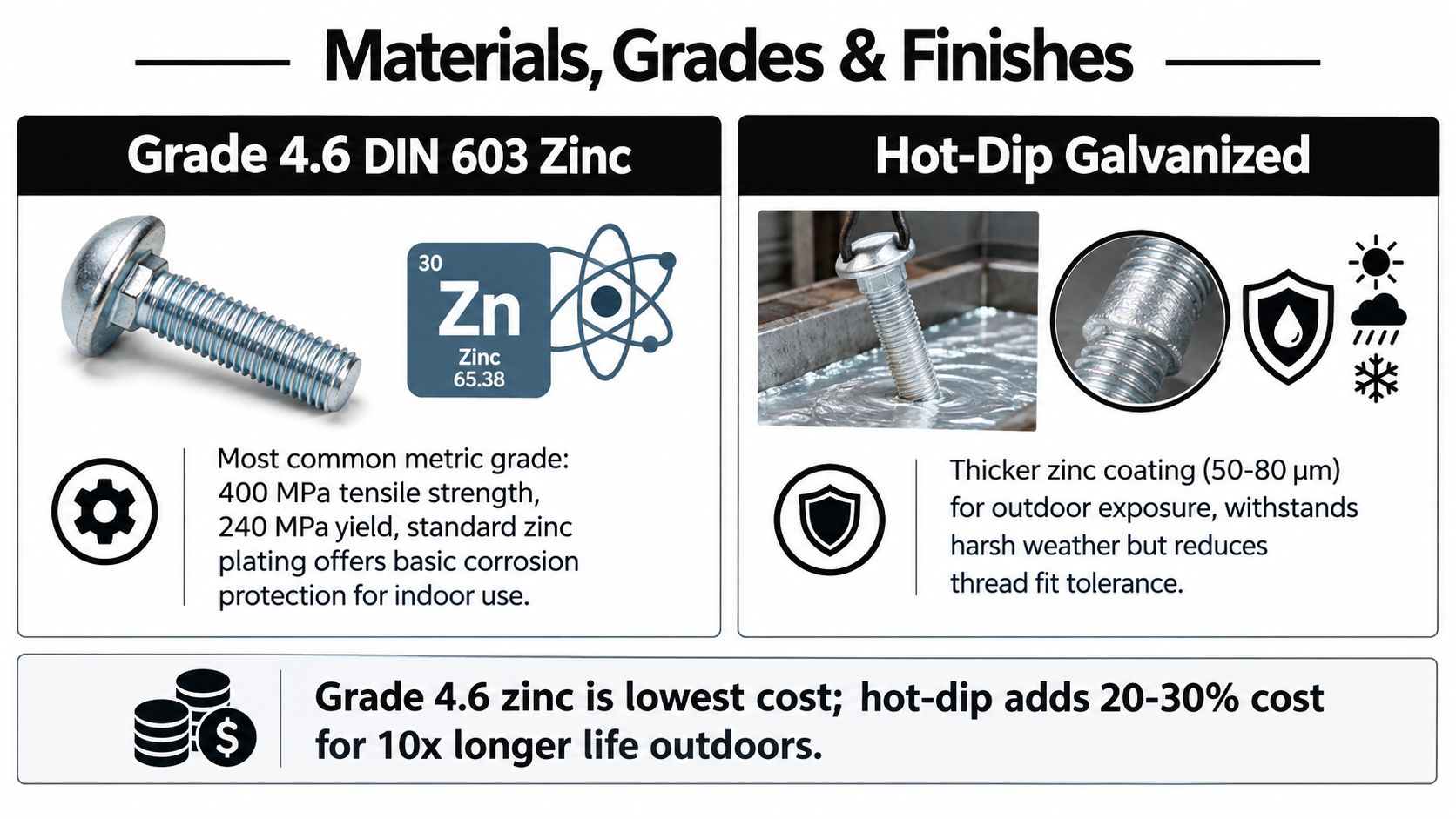
A California fastener catalogue shows carriage bolts in several material and finish combinations, including A307 Grade A plain, zinc, hot-dip galvanized, Grade 5 zinc, 18-8 stainless, and Class 4.6 DIN 603 zinc. That's a useful reminder that carriage bolts are not one generic product, and that DIN 603 is the metric carriage-bolt standard showing up alongside North American grade and finish options in real supply channels (California Fastener catalogue).
Choosing finish by exposure
Use exposure first, strength second, and convenience third.
- Class 4.6 DIN 603 zinc: Common for general metric stock. Suitable where the joint is sheltered and corrosion demand is modest.
- Hot-dip galvanized: A practical outdoor choice where weathering is constant and hardware is exposed.
- 18-8 stainless: Useful where corrosion resistance matters most, especially for visible hardware or persistently damp locations.
- Plain steel: Better kept to protected interior or temporary use unless the assembly has its own protection system.
- Grade 5 zinc and similar stronger carbon steel options: Relevant where the design needs more strength, but plated carbon steel still needs the right environment.
If you're specifically looking for stainless options, a retail category such as stainless steel carriage bolts makes it easier to separate corrosion-driven choices from standard plated stock.
The real trade-offs on wood builds
Pressure-treated lumber changes the conversation. Outdoor decks, fences, and gates trap moisture around hardware, especially at washers and under heads. That's why cheap interior-grade plated bolts often disappoint outside even when the initial fit is correct.
For most fence and deck crews, the trade-off isn't complicated:
| Finish type | Best use | Watch for |
|---|---|---|
| Zinc plated | Indoor or sheltered exterior hardware | Shorter life in exposed wet service |
| Hot-dip galvanized | General outdoor framing and hardware | Coating thickness can affect thread feel |
| Stainless | Wet, visible, or corrosion-sensitive areas | Higher material cost |
Matching finish across bolt, nut, and washer usually saves headaches later. Mixed hardware often ages unevenly and can be awkward to service.
Where substitutions are involved, CSA cross-references help buyers compare metric and imperial property classes, but the dimensional and environmental fit still have to be checked item by item. On exterior builds, a modestly stronger bolt with the wrong finish often loses out to a correctly protected fastener.
How to Select the Right Metric Carriage Bolt for Your Build
Selection gets easier when you stop hunting for one perfect chart and work through the joint in order. Start with what the hardware must pass through. Then look at what has to clamp. Last, make sure the neck can lock.
Start with the existing hole and mating hardware
If you're replacing a missing bolt in a gate hinge, chain link fitting, or imported bracket, the existing hole usually makes the first decision for you. Measure the shank size and verify the thread system before anything else. If the assembly was designed for metric, use metric nuts and washers from the start.
Mixed Canadian inventory causes delays. Federal Canadian guidance has long noted that most fasteners are available to metric specifications, but Canada-centric supply still leans on a mixed ASTM/SAE/ANSI and ISO/DIN environment, and some commercial sources show traditional inch carriage bolts with only limited metric options (Canadian federal publication on metric fasteners). In plain terms, metric exists, but it isn't always the default shelf choice.
Work through the joint in this order
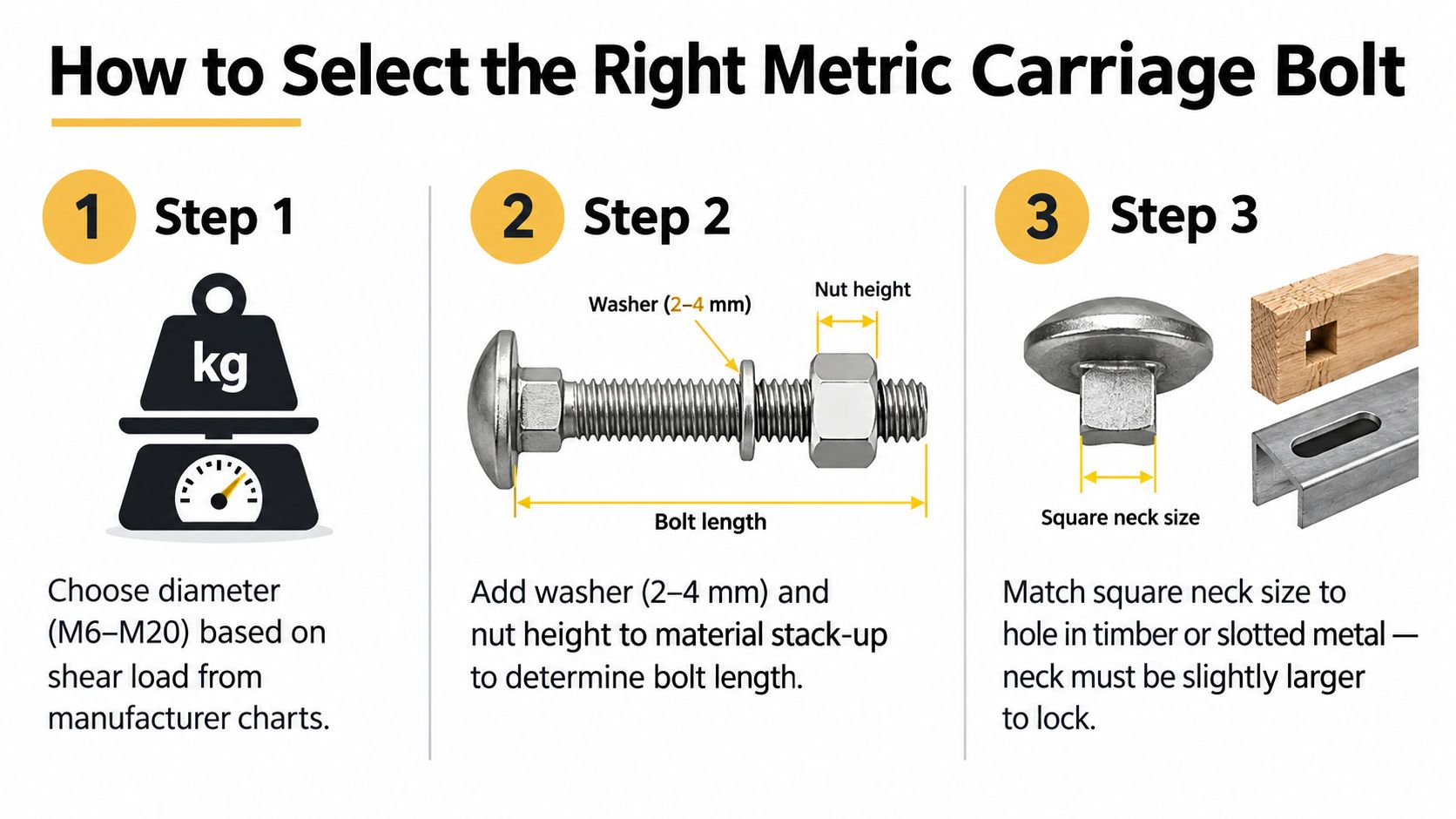
- Diameter first. Match the existing bracket, hole, or specified hardware family.
- Pitch second. Don't assume nuts are interchangeable because they almost fit.
- Length third. Add material stack, washer, and nut allowance.
- Neck fit last. Confirm the square section will lock into the receiving material.
A simple replacement order for common jobs often looks like this:
- Fence rail to bracket: Match existing bracket hole and make sure the neck won't free-spin in thin steel.
- Gate hardware: Prioritise exact fit because gate movement exposes loose or poorly seated fasteners quickly.
- Post base or accessory bracket: Check stack thickness carefully. Short bolts leave poor thread engagement once a washer is added.
Handle metric versus imperial as a compatibility check
Don't treat metric and imperial as a direct conversion game. Treat them as separate systems that may overlap visually but not mechanically. Canadian catalogues still show broader inch availability in many carriage-bolt lines and narrower metric length sets, so a straight one-for-one shelf swap often fails where the neck or thread matters most.
For routine ordering, a product category such as carriage bolts and washers can help keep matching components together. XTREME EDEALS INC. also lists metric carriage-bolt hardware in its fastener range, including an 8 x 35 mm carriage bolt set with hex nut used in chain link fence accessories, which makes it relevant when you need metric replacement hardware rather than an imperial substitute.
On repair work, the fastest route is usually to match the existing standard exactly, not to convert it.
A short field checklist
Before placing the order, confirm these five points:
| Check | Why it matters |
|---|---|
| Existing hole size | Avoids forcing the shank or leaving excess play |
| Thread pitch | Prevents nut mismatch |
| Neck seating area | Stops spin during tightening |
| Total stack thickness | Ensures enough usable thread |
| Exposure conditions | Guides finish choice |
That checklist catches most ordering errors before the box shows up.
Installation Best Practices and Common Mistakes to Avoid
A good carriage bolt install should feel controlled from the first pull-up. The head sits neatly. The square neck bites. The nut draws the joint tight without the bolt spinning. When that doesn't happen, the cause is usually hole prep, poor fit, or mixed hardware.
Install in the right sequence
Start by drilling or confirming the through-hole for the shank. Then make sure the square neck has a proper seating zone. In wood, that means a clean hole and solid face fibre under the head. In slotted metal hardware, it means the opening must suit the neck well enough to resist turning once you apply load.
Use a washer under the nut side where the material can compress or where you need better bearing. Tighten from the nut side only. Don't try to grip the rounded head with pliers to rescue a poor fit. That damages the finish and usually doesn't solve the underlying issue.
Common mistakes that cause failures
- Oversized holes: The bolt may pass through, but the neck never locks.
- Metric bolt with imperial nut: It may start, then bind or strip.
- No washer on soft material: The nut can crush fibres and loosen later.
- Driving the head into hard material without checking fit: The neck can polish the opening instead of seating.
- Reusing damaged nuts: Rough threads create false resistance and bad tightening feedback.
A step-by-step field refresher such as how to install carriage bolts is useful for crews training new hands or for DIY owners doing their first through-bolt assembly.
If the bolt starts spinning, stop tightening and fix the seat. More force usually makes the hole worse.
Inspection and formal project considerations
On ordinary residential work, fit and finish usually drive the decision. On formal public or infrastructure-related work, acceptance can be more complicated. California guidance still treats carriage-bolt usage inside a broader structural-bolting framework tied to ASTM references rather than a separate carriage-bolt rule. Caltrans sign-structure guidance states that, unless otherwise specified, bolts and nuts must conform to ASTM A307, and a California DGS interpretation for high-strength structural bolts requires sampling one complete fastener assembly for every 400 bolts or fraction thereof on projects with fewer than 1,600 assemblies, with a minimum of three assemblies per bolt type (California DGS interpretation and related state guidance).
That's a California example, but the lesson travels well. If a project has documented inspection requirements, product naming alone isn't enough. Material standard, test basis, and acceptance criteria all need to line up before installation starts.
Quick Reference Cross References and Related Resources
A fast check is all that's needed once the job is moving. Is this a true metric carriage bolt. Does the thread system match. Is metric stock normal for this application, or am I chasing a less common replacement. That's where a short cross-reference is more useful than another long explanation.
Fast lookup guide
Use this list when you need a quick verification:
- DIN 603: Common metric carriage-bolt geometry reference in supplier listings.
- ISO 8678: Commonly cited in Canadian context for the same practical geometry family used for carriage-bolt selection.
- ISO 8677 and JIS B 1171: Other standards you may see on technical sheets or import listings.
- ASME B18.5: The inch-series family most buyers are trying not to confuse with metric carriage bolts.
- CSA C83-2022: Helpful for comparing standards and property-class references in Canadian procurement work.
Glossary that actually helps on the job
| Term | Plain meaning |
|---|---|
| Nominal diameter | The labelled size family, such as M6 |
| Pitch | The distance between threads in metric form |
| Under-head length | How carriage bolt length is measured |
| Square neck | The anti-rotation section below the head |
| Property class | Metric strength designation family |
| Finish | Surface protection such as zinc, galvanizing, or stainless material choice |
When metric is standard and when it isn't
In Canada, metric carriage bolts are real stock items, not just catalogue theory. But they're not universal in the way common inch carriage bolts still are for everyday wood construction. That's the practical answer. If you're working with imported hardware, chain link accessories, machine brackets, or a documented metric assembly, metric is often the correct and only clean choice. If you're doing conventional residential wood framing with locally common hardware, inch stock is still often easier to source broadly.
That's why it pays to check availability before specifying. A supplier may carry the exact metric diameter you need but only in a narrow length set. Another may have broad imperial stock and limited metric replacement options. For recurring work, keep your own reference list of the metric sizes and lengths your crews use, especially around gate repairs, chain link hardware, and imported accessory brackets.
Good fastener buying is less about memorising every standard and more about checking the few dimensions that decide fit.
XTREME EDEALS INC. carries deck and fencing hardware, including carriage bolts, washers, anchors, post hardware, and related accessories that matter when you're matching metric fasteners to real field installs. If you need replacement hardware for fence, gate, or deck work, visit XTREME EDEALS INC. and compare the bolt size, finish, and companion hardware before you order.