
You're standing in a hardware aisle with a gate that closes but won't stay latched. One package says “universal,” another promises heavy-duty security, and a third looks right until you measure the gate frame. The problem usually isn't a shortage of locks. It's that the lock is being chosen before the gate, hinges, closer, frame, traffic pattern, and local requirements have been considered together.
A gate hardware lock is one part of an access-control system. A wood side gate, steel pedestrian gate, pool enclosure, driveway entrance, and commercial double gate all ask different things of the hardware. The right choice must account for material, weather, frequency of use, expected resistance to unauthorised entry, and whether an inspector, fire official, or accessibility requirement controls the design.
Why Choosing a Gate Hardware Lock Is Bigger Than the Cylinder
A lock cylinder can be perfectly functional and still fail in daily use. If the gate has sagged, the latch and strike no longer meet cleanly. If the hinges bind, a self-closer may not generate enough force to engage the latch. If the post flexes, a well-installed keeper can move out of alignment after repeated use.
That's why I start with the gate rather than the lock package. Identify whether it's a pedestrian gate, a pool gate, a single driveway gate, or a pair of vehicle gates. Then check the frame material, post size, swing direction, clearance, traffic level, and exposure to rain, salt air, fertiliser, treated timber, or irrigation.
Practical rule: If the gate doesn't close squarely by itself, replacing the lock first usually treats the symptom rather than the cause.
Security context matters, but statistics shouldn't be used to promise that one product prevents burglary. The California Department of Justice 2024 crime report records a burglary rate of 308.2 per 100,000 residents in 2024, down from 339.0 per 100,000 in 2023, a 9.1% decrease. The 2024 rate was also 18.8% below the 2019 rate of 379.4 per 100,000. Those figures show a long-term decline, while confirming that property security remains a practical concern across California.
The useful takeaway is narrower. A lock can help control casual access through a side yard, service alley, pool enclosure, or perimeter fence, especially when it works with a sound latch, rigid frame, and properly adjusted hinges. It shouldn't be treated as a complete security system or selected without considering how authorised users need to enter and leave.
The Main Families of Gate Hardware Lock
The simplest way to understand gate locks is to ask what the hardware must do. A gravity latch mainly holds a gate shut. A keyed latch adds controlled entry. A deadbolt resists movement more deliberately. An electronic or coded lock manages access without handing every user a physical key.
Match the mechanism to the gate
Gravity and thumb latches suit light-duty pedestrian gates where convenience matters more than high resistance to forced entry. They're familiar, inexpensive in concept, and easy to operate from one side. They don't provide the same control as a keyed mechanism, and a poorly aligned gate can leave the latch sitting on the edge of the keeper.
Slide bolts, cane bolts, and drop rods work well when the main job is securing a gate in a fixed position. A drop rod is particularly useful on a double-drive gate because it can anchor one leaf into the ground or a receiver. It's not a substitute for a properly designed access lock when people need regular entry.
Keyed latches and deadbolts are closer to a front-door arrangement. They provide controlled access and can suit pedestrian gates where authorised users need a key. Their performance depends heavily on alignment. A deadbolt that has to be forced into a misaligned strike will wear the cylinder and frustrate users.
Mechanical keypad and electronic locks can reduce key management for shared entrances. They're useful on gates with frequent authorised traffic, but they add installation and maintenance considerations. A keypad or powered lock must still provide a reliable exit method and shouldn't conflict with accessibility, pool safety, or emergency access rules.
For readers comparing gate hardware with door security, the discussion of AS 5039 door standards offers useful context on how security hardware is evaluated in a broader door system. A gate isn't a door, but the same principle applies: the lock is only as dependable as the frame, hinges, strike, and surrounding structure.
Gate Hardware Lock Families at a Glance
| Lock Family | Security Level | Typical Use | Keying Option | Best Fit For |
|---|---|---|---|---|
| Gravity or thumb latch | Basic | Side-yard pedestrian gate | Usually none | Wood or light metal gates |
| Slide bolt or cane bolt | Basic to moderate | Holding single or double gates | Optional padlock provision | Driveway and service gates |
| Keyed latch | Moderate | Controlled pedestrian access | Keyed cylinder | Wood, steel, or aluminium frames |
| Deadbolt or enclosed latch | Moderate to high | Higher-security pedestrian entry | Keyed or coded | Rigid metal or reinforced wood gates |
| Mechanical keypad lock | Moderate to high | Shared access points | Code rather than key | Frequent-use pedestrian gates |
| Electronic or smart lock | Variable | Managed or automated access | Keypad, fob, app, or override | Properties with compatible power and controls |
A light garden gate behaves like a shed door. A heavy vehicle gate behaves more like a moving structural assembly. Don't specify the same lock family for both just because the package uses the word “universal.”
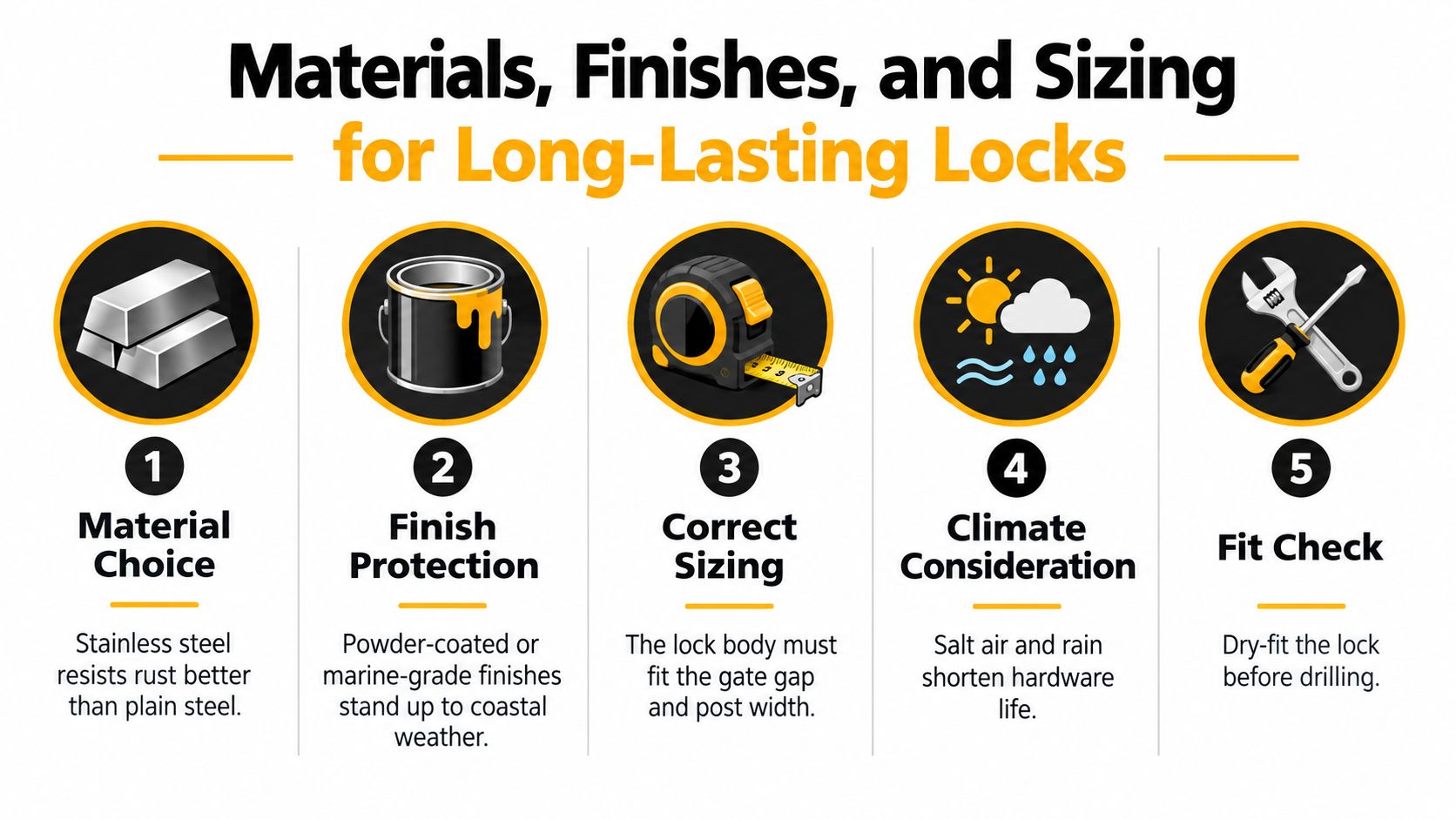
Materials, Finishes, and Sizing That Decide How Long a Lock Lasts
Lock type determines function, but material and fit determine whether that function survives outdoors. A finish can slow corrosion, but it can't compensate for a body that rubs against the frame or a fastener that reacts badly with the surrounding metal.
Start with the environment
Stainless steel is a sensible choice where rain, irrigation, or salt exposure creates a persistent corrosion risk. It's especially useful around coastal properties, although the surrounding screws, strike, hinges, and posts must also be suitable for the environment. A stainless latch mounted with incompatible fasteners can still create staining and corrosion at the connection.
Zinc-plated steel can work in sheltered residential locations when the finish remains intact. Cut edges, drilled holes, scratches, and exposed fasteners become weak points. I'm cautious about using it where salt air, pool chemicals, fertiliser spray, or constant wetting will reach the hardware.
Powder-coated finishes add a protective barrier and can coordinate with painted steel or aluminium gates. They're practical where appearance matters, but chips and abrasion need attention before moisture reaches the underlying metal. Marine-grade finishes are more appropriate for harsh coastal conditions than a finish intended for a dry inland setting.
Measure the assembly, not just the lock
Read the listing for the gate-frame thickness, body depth, backset, keeper dimensions, and required post clearance. A lock specified for a nominal 4×4 post may not fit a true 6×6 frame without an adapter or a different mounting arrangement. The latch body also has to clear the gate gap while reaching the strike without forcing the leaf sideways.
For treated timber, inspect areas where runoff can sit around the lock body and fasteners. For steel, check whether drilling will expose unprotected metal. For coastal gates, evaluate the complete hardware set rather than buying a corrosion-resistant lock and pairing it with ordinary hinges.
Dry-fit the lock before drilling. Close the gate slowly, mark the latch centreline, and confirm that the strike has enough adjustment to cope with normal movement. A few minutes of fitting can prevent a row of mislocated holes and a lock that never reaches full engagement.
Pool Gates, Accessibility, and Fire Access in California
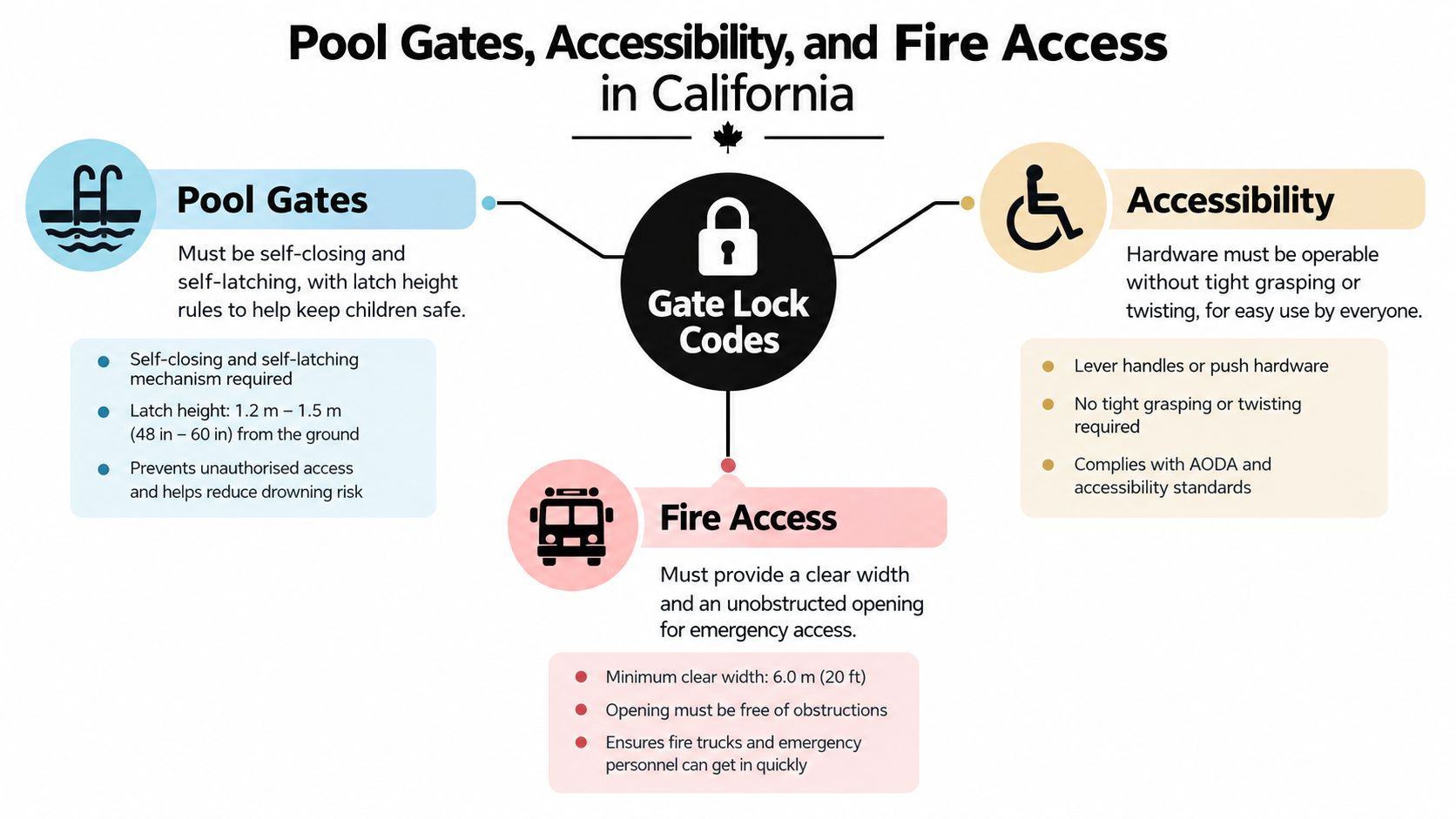
California pool gates require a safety system, not merely a strong-looking lock. Under California Health and Safety Code section 115923, an access gate must open away from the pool, close automatically, and use a self-latching device with its release mechanism at least 60 inches above finished ground.
That requirement changes the hardware selection. A keyed latch doesn't solve the problem if the gate drags, the closer is weak, or the latch release is positioned incorrectly. The frame must stay rigid, the hinges must be aligned, and the closer must generate enough final force to engage the latch from every opening angle.
Treat the release and swing as one system
Check the gate from partially open positions, not only when it starts fully open. Wind loading, hinge friction, a sagging latch side, or a warped frame can stop automatic latching. Decorative components near the release should not create climbable footholds.
For newly constructed or remodelled private single-family pools, California Health and Safety Code section 115922 requires at least two drowning-prevention features from the statutory list. One qualifying arrangement combines removable mesh fencing meeting ASTM International F2286 with a self-closing, self-latching gate capable of accepting a key-lockable device. The local building official must inspect the required safety features before final approval.
Accessibility creates a separate constraint. California provisions place hand-activated gate latching and locking hardware between 30 and 44 inches above the floor. Hardware on an accessible route must operate with a single effort without grasping, pinching, or twisting. That can rule out a small rotating knob, a difficult padlock arrangement, or a keyed hasp where users need a simple lever action.
For gates serving fire-apparatus access, ordinary security hardware may be the wrong answer. A San Bernardino County fire standard requires access-control devices to be operable by emergency responders without special knowledge or effort, and manual gates must allow one-person emergency operation. Approved Knox-type equipment, or an equivalent accepted by the fire official, may be required.
A driveway gate that crosses an emergency route can therefore need a designated responder-access system rather than a heavier conventional lock. Confirm the local fire department's requirements before ordering.
A clear visual summary of these relationships appears below.
For pedestrian routes where rapid exit matters, review suitable panic hardware for gates before choosing a keyed or padlock-based solution.
Installing a Gate Hardware Lock the Right Way
A quality lock can become unreliable after a poor installation. The usual mistake is drilling the latch and strike before proving that the gate moves through its complete travel without binding.
Before drilling
Open and close the gate several times. Confirm the swing direction, measure the frame thickness, inspect the post for movement, and check whether the hinges hold the gate square. If the latch side drops, correct the hinge or frame problem before setting the lock height.
For a pedestrian gate, the latch should meet the strike cleanly with light closing force. For a driveway gate, consider the weight, wind exposure, ground clearance, and whether a cane bolt, drop rod, automated operator, or emergency-access device also forms part of the system.
Set the striker plate only after the gate is held in its normal closed position. Mark the latch centreline, use the manufacturer's template where provided, and drill a pilot hole suitable for the fastener and frame material. Don't rely on self-drilling screws to compensate for a post that flexes or a frame that has twisted.
Build the supporting hardware around the lock
The lock is easier to service when the complete assembly is planned together. XTREME EDEALS INC. supplies categories including hinges, gate inserts, joist hangers, post-base brackets, and matching fasteners that can be selected as supporting components for a properly designed gate installation. These parts don't replace structural repair, inspection, or code compliance.
Pay particular attention to pool-driveway combinations. Placer County guidance states that driveway gates forming part of a pool enclosure must be electronically operated and automatically close within one minute after opening. The county also addresses lockable hardware and automatic operation for non-pedestrian access points, so local requirements should be checked before installation.
After fixing the lock, test the gate from every opening angle. Confirm that it closes without assistance, that the latch fully enters the keeper, and that the release works from the intended side. Then test the arrangement under the conditions that matter, including normal wind movement, repeated use, and any required power-loss or emergency-release scenario.
Maintenance and Troubleshooting for Long Service Life
Outdoor locks fail gradually. Dirt collects in the latch, timber moves around fasteners, and hinges lose alignment long before the hardware looks obviously damaged.
Use a dry-film or silicone lubricant suitable for outdoor hardware on moving parts. Check fasteners for backing out as wood changes, inspect the keeper and striker plate for corrosion, and recheck alignment after severe weather or freeze-thaw movement.
Diagnose the cause before replacing the lock
- The gate won't latch: Check sag, hinge friction, strike position, and closer force first. Replacing the latch won't correct a gate that stops short of the keeper.
- The key won't turn: Look for a misaligned strike before blaming the cylinder. If alignment is sound, the cylinder may be worn or contaminated.
- Rust runs down the post: Inspect the finish, cut edges, fasteners, and water path. The problem may be a material mismatch rather than a defective latch.
- The latch feels loose: Tighten the mounting hardware and examine the frame for crushed timber, enlarged holes, or movement around the post.
A seasonal check should end with a full close-and-latch test, not merely a visual inspection. For more fault-finding help, use this practical hardware troubleshooting guide.
A Practical Buying Checklist by Gate Type
The quickest purchase decision starts by classifying the gate. Don't buy a lock until the gate's movement, users, and regulatory role are clear.
Side-yard pedestrian gate
Choose a gravity latch, thumb latch, keyed latch, or mechanical keypad according to the required access control. Use a corrosion-resistant finish where irrigation, rain, or treated timber will affect the hardware, and confirm the latch body fits the frame thickness and post width.
Pair the lock with compatible hinges, a rigid frame, a suitable strike, and matching fasteners. A gate insert or post cap can also improve the finished installation where the surrounding timber or metal needs protection.
Pool enclosure gate
Start with compliance, not security rating. The gate must open away from the pool, close automatically, self-latch, and position the release according to the applicable California requirements. A keyed or key-lockable device may be one component of the system, but it doesn't make an incorrectly swinging or poorly closing gate compliant.
Check the full enclosure and local inspection process. A heavier lock can be less safe if it interferes with child-resistant operation, creates a climbable feature, or makes emergency use difficult.
Driveway or private-road gate
Decide whether the gate is ordinary property access, part of a pool enclosure, or across a fire-apparatus route. Vehicle gates may need drop rods, cane bolts, an electric operator, automatic closing, or an approved emergency-access arrangement rather than a standard pedestrian latch.
Placer County's pool-enclosure guidance is a useful example of why driveway gates need separate treatment. It requires lockable hardware or padlocks for certain non-pedestrian pool access points and addresses automatic closing for driveway gates forming part of the enclosure.
Double-drive or commercial gate
Plan both leaves together. Use a drop rod or cane bolt to locate the inactive leaf, then specify a latch or access-control device that can tolerate repeated traffic and frame movement. For commercial or shared properties, document who needs access and how emergency responders will operate the gate.
A gate-security review can also benefit from broader guidance on storage security compliance, particularly where a gate forms part of a managed site rather than a private garden.
Before purchase, confirm local building, pool, accessibility, and fire-department requirements. California rules can be enforced through local authorities with additional requirements, so a product that works on a side gate may be unsuitable for a pool barrier, accessible route, or emergency access road.
XTREME EDEALS INC. offers gate latches, hinges, gate inserts, post caps, padlock-compatible fittings, drop-rod components, and matching fasteners for projects ranging from side-yard repairs to complete fence upgrades. Review the available hardware and build your lock selection around the gate frame, hinge alignment, closing action, and applicable California requirements at XTREME EDEALS INC..