

You're at the fastener aisle with two boxes that look almost identical, and the only thing separating a clean wall from a callback is the number on the label. That's usually where drywall screws 1 1/4 earn their keep, not as a random length choice, but as the right match for the board, the framing, and the way the job gets driven. If you're trying to price a room or sanity-check a materials list first, the calculator in how much to drywall a room is a useful starting point before you decide what belongs in the cart.
Why 1 1/4-Inch Drywall Screws Are the Workhorse Size
A lot of people buy screws the same way they buy lightbulbs, by squinting at the box and hoping the “close enough” option works. That's how they end up with screws that are too short, too long, or entirely wrong for what's behind the board. 1-1/4-inch drywall screws became the standard because they match the most common interior wall build, 1/2-inch drywall, and they leave enough length to penetrate the stud without punching through the face paper.
On California remodels, that matters more than people expect. A big share of residential work is retrofit, patch, or room-by-room replacement, and the default wall board is still 1/2-inch in many of those jobs. That's why the fastener size that keeps showing up in charts and counters isn't a specialty item, it's the everyday answer for standard wall assemblies.
Practical rule: if you're hanging regular interior wallboard and the stud is behind it like you expect, 1-1/4-inch is usually the first box to reach for.
The reason the length keeps winning is simple. It gives you the penetration needed for a solid bite without making the screw behave like a pry bar on the drywall face. Industry guidance also ties the size to a practical embedment rule, drywall thickness plus about 5/8 inch of stud penetration, which lands 1/2-inch board squarely in the 1-1/4-inch zone. That's the foundation for the rest of the decision, because the question isn't “How long should the screw be?”, it's “What wall am I fastening to?” For a retail context where buyers can compare wallboard and fastener picks together, the category at XTREME EDEALS fasteners and fittings makes the match easier to see.
The Four Specs That Define a 1 1/4-Inch Drywall Screw
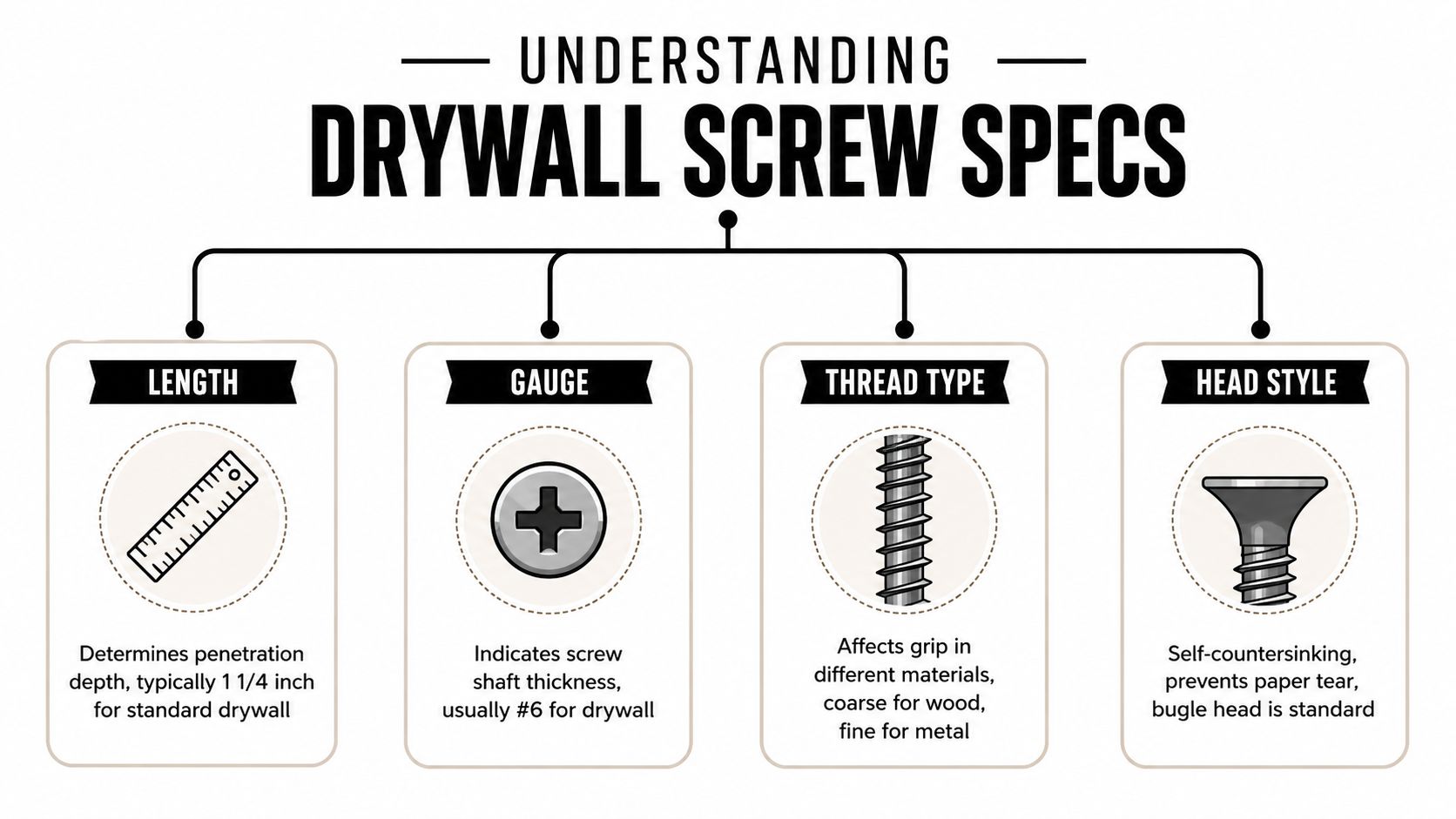
A drywall screw label is doing more work than one might realise. The four things that matter are length, gauge, thread type, and head style, and each one controls a different part of the fastening job. Get one of them wrong and the screw may still go in, but it won't behave the way a proper drywall fastener should.
Length and gauge are the first two checks
Length decides how much of the screw reaches the framing. For standard wallboard, 1-1/4 inch is the common interior size because it's long enough for proper engagement without making the head hard to seat cleanly. Gauge tells you shaft thickness, and the recurring default here is #6, the common size you'll see on interior drywall packs.
That #6 size shows up again because it's a balanced middle ground, not a heavy structural fastener and not a tiny finish screw. The box you pick up should read like a drywall screw, not a generic hardware screw pretending to fit the job.
Thread and head style are the real performance features
Thread type controls how the screw bites into the substrate. Coarse thread is the usual answer for wood studs, while fine thread is used on light-gauge steel. Head style is usually bugle head, because it spreads the load and helps the screw self-countersink without ripping the paper face.
The head should make a slight dimple, not a crater. If the paper tears, the screw is doing damage instead of clamping the board.
The common box language also includes Phillips drive and a black phosphate or phosphated steel finish, both of which are standard in interior drywall packs. For product browsing, that matters because the same length can show up with different thread and head combinations. On retail shelves and in contractor packs, drywall screws 1 1/4 are usually a #6 bugle-head fastener built to be driven fast and flush, not a general-purpose screw you hope will behave.
Matching Thread Type to Wood or Metal Studs
The biggest mistake I see is someone buying the right length and the wrong thread. That's a substrate mistake, not a screw-length mistake. If the wall is framed with wood, the screw has to bite wood. If the wall is framed with light-gauge steel, the threads need to engage metal without shredding or spinning.
Wood studs want coarse thread
Coarse-thread drywall screws are the normal pick for wood studs. The wider thread spacing grips timber fibres better and resists pull-out in residential framing. That's why supplier listings and common retail packs keep pairing #6 x 1-1/4-inch with wood applications, especially in standard wall work.
The numbers behind the spec support that choice. One technical guide reports 94% proper penetration and a 7% 5-year failure rate for 1-1/4-inch screws, compared with 58% proper penetration and 22% failure for 1-inch screws, a difference described as 67% fewer callbacks for wall repairs. Those figures are a reminder that the extra quarter-inch isn't cosmetic, it's helping the fastener do its job.
Metal studs want fine thread
Fine-thread screws belong with light-gauge steel studs, where the denser thread spacing gives a cleaner bite in thin metal. Commercial listings commonly tie that configuration to 20 to 25 gauge steel, and that's the setup you want when the framing isn't timber. A Grainger listing for a #6 x 1-1/4-inch drywall screw also reports a tensile strength of 1,600 psi, which shows these are engineered fasteners, not generic shelf screws.
The standards language matters too. Fine-thread packs are commonly tied to ASTM C1002 and ASTM C954 in commercial listings, which is the kind of detail that separates real drywall hardware from lookalikes. If the box says fine thread and the wall is steel, you're in the right lane. If it doesn't, keep walking.
Wood stud means coarse. Light-gauge steel means fine. Anything else is a gamble you don't need to take.
Drywall Thickness and Stud Combinations That Use 1 1/4
The easiest way to buy the right screw is to stop thinking in abstract lengths and start thinking in assemblies. Drywall thickness and stud material tell you more than the label does, because the same fastener can be perfect on one wall and wrong on the next. That's where most returns start; a person buys by price or pack count and ignores what the wall is.
Quick reference for common pairings
| Drywall Thickness | Stud Material | Thread | Notes |
|---|---|---|---|
| 1/2 inch | Wood studs | Coarse | Standard interior wall use |
| 1/2 inch | Light-gauge metal studs | Fine | Common in commercial or retrofit framing |
| 5/8 inch | Wood studs | Longer screw usually needed | 1-1/4 inch is often short for proper embedment |
For standard 1/2-inch drywall on wood studs, 1-1/4-inch is the normal choice, and that lines up with the industry charts and fastener guides used on job sites. For 1/2-inch drywall on metal studs, the length can still be 1-1/4-inch, but the thread changes to fine because the substrate changes. That's the part a lot of DIYers miss, they assume length is the only decision.
The edge case is 5/8-inch drywall. That board is common in garages, ceilings, and fire-rated work, especially in multifamily and other California assemblies, but 1-1/4-inch often doesn't leave enough practical embedment once the board thickness is accounted for. In that situation, longer screws such as 1-1/2 to 2 inches usually take over. For a panel-oriented overview that helps separate drywall board use from other sheet products, the SouthRay Kitchen & Bath note on drywall versus sheetrock is worth a look if you're sorting material names before you buy.
Tools, Bits, and Depth Settings That Prevent Blowouts
A good screw can still go wrong if the driver setup is sloppy. The two classic failures are easy to spot. The screw spins without biting, usually because the thread is wrong for the substrate. Or it punches through the paper, which usually means too much torque, the wrong bit, or both.
Use a #2 Phillips bit for most drywall screws and keep the drill square to the wall. A dimpler bit or depth-setting nose helps set the head just below flush without tearing the paper face. That slight recessed dimple is what you want, not a countersunk crater and not a proud screw head that keeps the next coat from laying flat.
The clutch setting on a cordless drill matters more than beginners think. Too tight, and the screw blows through the face paper. Too loose, and the screw stalls before it seats. The goal is controlled compression, enough to clamp the board, not enough to crush it.
For a practical reference on depth control with screws, the guide at how deep should deck screws go is useful in principle because the same idea applies here, drive to the correct depth and stop before the material starts failing. That's where skill comes in. Not spinning faster, just stopping in the right place.
If the screw head tears the paper, back off immediately and reset the clutch or bit. If the screw keeps spinning in the hole, stop and check the thread type against the stud material before you waste more board. The gun has to stay square, because a tilted drive encourages cam-out and makes a good screw look bad.
Materials, Coatings, and What XTREME EDEALS Stocks
For interior walls, the coating is less dramatic than the substrate match, but it still matters. Black phosphate and similar phosphated finishes are the usual interior drywall choice because they're made for quick driving and predictable seating. Zinc is more of a general corrosion-resistance option, while stainless belongs where moisture exposure is higher and the fastener needs to hold up longer in wet or semi-exposed spaces.
Pick the coating based on exposure, not preference
A bedroom wall does not need the same protection as a bathroom, garage, or exterior soffit. If the wall is dry and enclosed, a standard phosphated pack is normally enough. If the area sees damp air, incidental moisture, or tougher service conditions, the fastener spec should move accordingly.
XTREME EDEALS lists a 4000 pc Box #6 x 1-1/4" Drywall Screws pack with Phillips drive, bugle head, fine thread, sharp point, and black phosphate finish, along with a 100 pc Box #6 x 1-1/4" Drywall Screws option in the fasteners category. That tells you the size is being stocked as a real commodity item, not a niche special-order fastener. It also shows why pack size matters to contractors and B2B buyers, because the same basic screw can be bought for a small repair or a larger take-off.
For buyers comparing finishes across categories, the stainless options at stainless steel fasteners make sense when corrosion resistance matters more than unit price. For a normal interior wall, though, a #6 x 1-1/4 phosphated drywall screw is still the straightforward pick.
Choosing the Right Box at the Counter
Start with the board. If it's 1/2-inch drywall, you're usually in the 1-1/4-inch lane. Then check the studs, because wood means coarse thread and light-gauge steel means fine thread. That's the fastest way to avoid the wrong box, and it's the mistake I see get made most often when someone is in a hurry.
Then match the pack to the job. A pound of 1-1/4-inch drywall screws can land around 238 to 240 screws in some guides, while a Zoro chart puts the estimate at roughly ~300 screws per pound, so pack-out varies by brand, coating, and head style. That means count matters as much as length when you're trying to avoid a stalled job or a pile of unused fasteners.
For a typical 1/2-inch-on-wood interior wall, the safest buy is a #6 x 1-1/4-inch coarse-thread, bugle-head drywall screw in a phosphated finish, plus a #2 Phillips bit and a few spares. If the wall is steel, switch to the fine-thread version before you leave the counter. If you're not sure which substrate you've got, don't guess, find out first.
XTREME EDEALS INC. carries drywall screw packs, fasteners, and the matching hardware that keeps a wall job moving without extra store runs. If you're lining up drywall screws 1 1/4 for a remodel, a repair, or a bulk buy for a crew, visit XTREME EDEALS INC. and compare the packs, finishes, and thread styles before you load the cart.