
Deck screws should penetrate the joist by at least 1-1/2 inches for structural integrity. For standard 5/4 decking with an actual thickness of 1 inch, that usually means using a 2-1/2 inch screw.
That's the point where a lot of people stop, drill in hand, staring at a box of screws and wondering whether close enough is good enough. It isn't. Screw depth is one of those details that decides whether a deck stays flat, tight, and quiet underfoot, or starts showing the usual trouble later: cupped boards, screw-pop, loose decking, and split joists at the worst spots.
A deck doesn't fail all at once. It starts with small installation mistakes that look harmless on day one. A screw that barely bites the joist. A head driven too deep. A board end fastened without a pilot hole. If you want to know how deep should deck screws go, you're really asking how to keep the whole assembly working through wet weather, dry spells, movement, and years of foot traffic.
Why Your Deck Screw Depth Matters More Than You Think
If you're about to drive the first screw, this is the moment to slow down and get the depth right. Most decking problems blamed on “bad lumber” or “seasonal movement” are made worse by poor fastening. The screw isn't just pinning the board down. It's controlling how that board stays seated against the joist as the wood moves.
When the screw doesn't go deep enough into the joist, it has less bite in solid wood fibre. That weak grip shows up later as boards lifting slightly at the edges, fasteners backing up, and boards developing more movement between joists. You feel it when you walk. You see it when screw heads start sitting proud of the surface.
What proper depth prevents
Correct screw depth helps prevent several common deck problems:
- Board cupping: A board that isn't held firmly to the joist can move unevenly as moisture changes.
- Screw-pop: Shallow embedment gives the screw less hold, so seasonal movement can push the head upward.
- Joist-split near ends: Bad installation technique, especially overdriving or driving too close to the end without prep, can stress the framing.
- Premature looseness: The deck may still look finished, but it won't stay tight for long.
A deck screw should hold the board without crushing it. If the head disappears into a crater, the job already started going wrong.
Depth affects the whole deck, not one board
Think about the load path. People walk on the board. The board transfers that force to the joist. The screw has to keep that connection tight while the wood swells, shrinks, and dries. If the embedment is shallow, the board moves more than it should. Once movement starts, water gets invited into the problem. Dirt stays in the recess around damaged screw heads. Maintenance gets harder.
That's why depth isn't a finishing detail. It's a structural and durability detail. If you build decks long enough, you learn that shortcuts at the fastener show up before almost anything else.
The Golden Rule of Screw Penetration
The mandatory rule is simple. Deck screws need a minimum of 1-1/2 inches of penetration into the joist. Building codes in California and across the United States mandate that minimum joist penetration for deck screws as a structural requirement, not a suggestion, according to the Albany County Fasteners deck screw size chart.
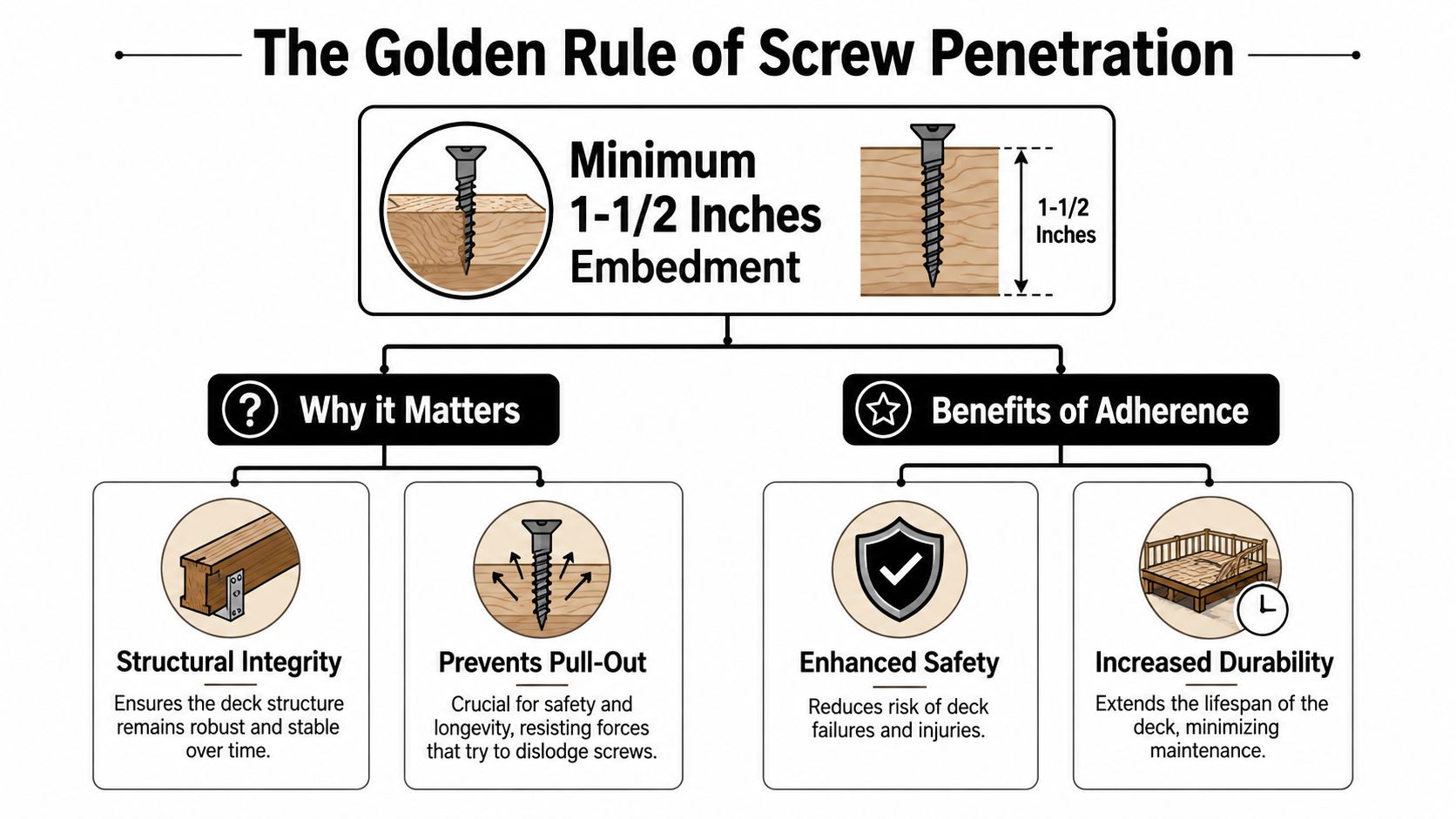
That rule matters because the joist is the anchor. The board is only the surface layer. A screw can be long overall and still fail the job if too much of that length is used up getting through the decking and too little is left buried in the framing. You don't measure success by screw length alone. You measure it by how much threaded shank is engaged in the joist.
Total length and working depth aren't the same thing
Here's where people get tripped up. They look at a screw and think, “That seems long enough.” But the screw has to pass through the entire deck board before it even starts doing useful anchoring work in the joist.
A practical way to look at it:
- Board thickness comes first
- Joist embedment comes second
- Only the part inside the joist provides the grip that keeps the board seated
If the screw only gets about an inch into the joist, it may hold at first. It just won't hold as reliably once weather and movement start working on it.
Why the extra bite matters
Think of the screw like an anchor set into timber. The deeper thread engagement gives the connection more hold against uplift and side-to-side stress from normal use. That's what keeps the board from working loose over time.
Practical rule: If you can't confirm at least 1-1/2 inches of joist embedment, you haven't finished the calculation yet.
Hardware choice matters too. Using proper exterior-rated decking fasteners from a dedicated fasteners and fittings selection gives you the right starting point, but the installation still has to honour the embedment rule. A premium screw driven to the wrong depth is still a bad fastening job.
Calculating the Correct Deck Screw Length
Once you know the joist needs 1-1/2 inches of embedment, the calculation gets straightforward. Use this formula:
Actual deck board thickness + 1-1/2 inches = minimum screw length
There's also a planning shortcut. A general rule of thumb is to choose a screw length that's about three times the thickness of the material being fastened, according to Eagle Claw's deck screw sizing guide. The same guide notes that a typical 100 square feet of decking takes approximately 350 deck screws, assuming 16 inch joist spacing.
Deck screw length cheat sheet
| Deck Board Type | Actual Thickness | Minimum Screw Length |
|---|---|---|
| 5/4 decking | 1 inch | 2-1/2 inches |
| 2x decking | 2 inches | 3 inches |
That table covers the common face-screwed situations most builders deal with. The key is using actual thickness, not the nominal label printed on the lumber rack.
How to calculate without guessing
If you want a clean method on site, use this sequence:
Measure the actual board thickness
Don't trust the name alone. What matters is the material the screw must pass through.Add the required joist penetration
The target is 1-1/2 inches into the joist.Choose the nearest standard screw length that satisfies both
For a lot of wood decking, that lands on familiar sizes.Buy enough for the whole field, plus margin for cuts and mistakes
Running short leads to bad substitutions, and bad substitutions create callback work.
If you need longer decking screws for thicker boards, a dedicated 8 x 3 deck screws product page is the kind of reference worth checking before ordering, especially when matching screw length to board thickness across a larger job.
Don't let “close enough” choose your fasteners. Decks get built one screw at a time, and every wrong one multiplies across the surface.
Choosing the Right Screws for Your Project
Length solves only half the problem. Screw type decides whether that connection survives outdoors. A deck screw has to resist moisture, wood treatment chemicals, and installation stress without snapping, stripping, or corroding in place.
For common 5/4 decking with an actual thickness of 1 inch, the technical specification is a #10 x 2-1/2 inch screw, which gives exactly 1.5 inches of embedment into the joist after passing through the board, as outlined in Albany County Fasteners' deck screw information.

Match the screw to the wood
Pressure-treated lumber is hard on the wrong fastener. If the coating or metal isn't suited to exterior use, the screw can deteriorate long before the board wears out. That's why deck builders pay attention to material and coating, not just size.
A few practical choices matter most:
- For pressure-treated lumber: Use deck screws rated for exterior and treated-wood contact.
- For damp or corrosive environments: Stainless steel is often the safer call.
- For cleaner driving: Star-drive heads give better bit engagement and reduce cam-out.
Drive type matters more than people think
Cheap fasteners usually fail you at the head first. The bit slips, the recess rounds out, and now you're forcing the screw instead of driving it cleanly. That leads to wobble, crooked seating, and ugly countersinks.
A good star-drive deck screw gives better control, especially when you're trying to finish flush without overdriving. If you're comparing options for exposed decking, a focused stainless steel deck screws range is worth a look when corrosion resistance matters more than purchase price.
What works and what doesn't
What works is simple: exterior-rated deck screws, the correct length, and a drive style that lets you seat the head cleanly.
What doesn't work:
- Drywall screws: too brittle for deck duty
- Generic interior screws: wrong coating and wrong job
- Undersized shanks: less confidence in a moving exterior assembly
- Mismatched driver bits: stripped heads and wasted time
The right screw should drive straight, seat clean, and hold for the long haul. If it fights the install from the first board, that's usually the screw telling you it doesn't belong there.
Proper Installation Techniques to Avoid Mistakes
Good screws can still be installed badly. Most deck fastener problems come from technique, not packaging. Overdriving, skipping pilot holes at board ends, and burying heads too deep all shorten the life of the connection.
In California's extreme dry seasons, standard 1-inch joist embedment often leads to screw pull-out as wood shrinks 2-3% in arid Interior Valley summers, and the Fastener Depot discussion of deck screw sizing points to 1.5-inch minimum embedment as the needed target in those conditions. That's one more reason not to treat shallow bite as acceptable.
Set the screw head flush, not buried
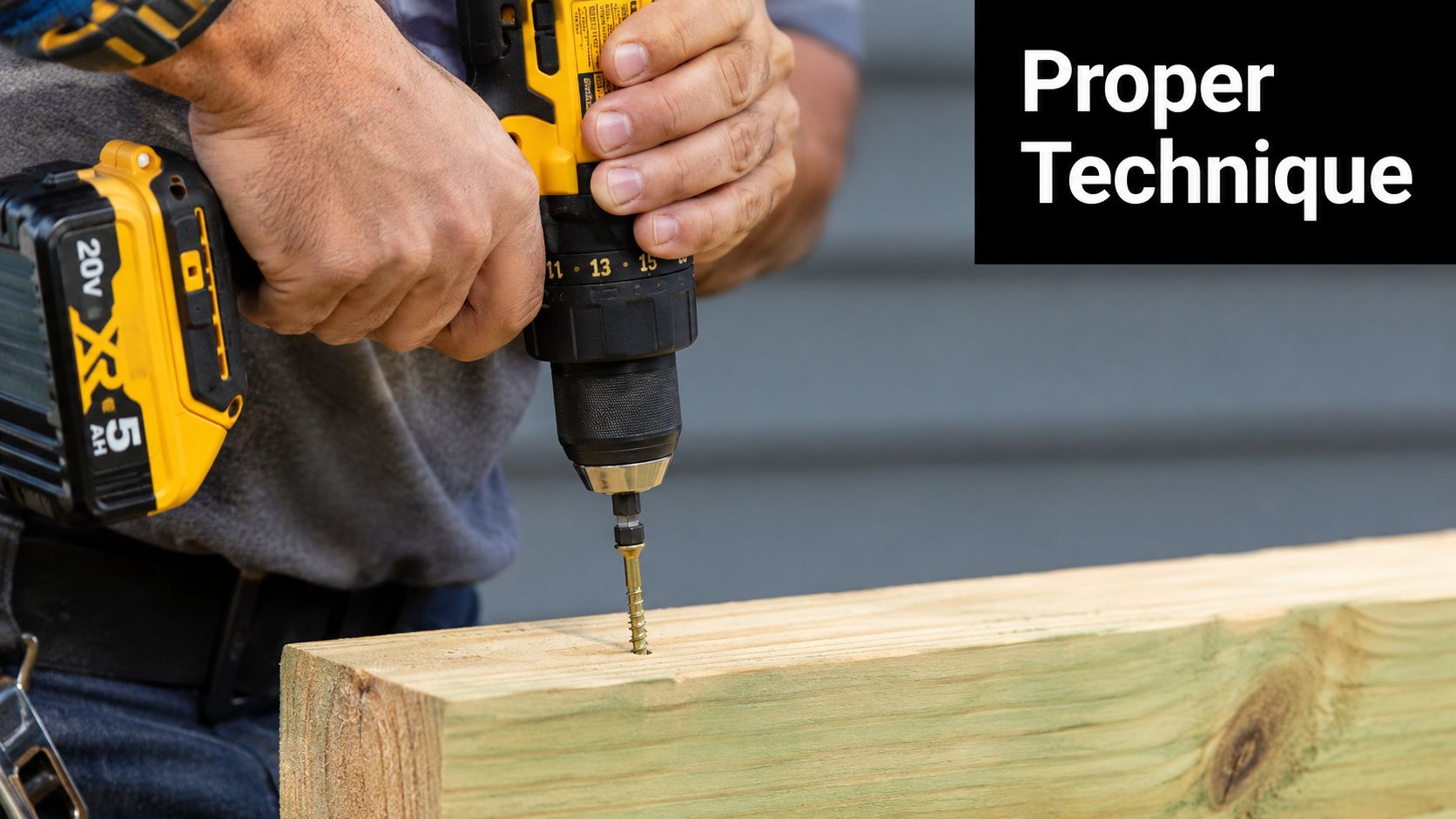
The cleanest installation puts the head flush or just slightly seated without crushing the wood fibres around it. Once the head is driven into a divot, the board surface gets damaged. Water and dirt can collect there, and the screw loses some of the clean bearing surface that helps hold the board snug.
Use the clutch on the drill. Start lower than you think. Adjust as needed after a few test screws in scrap or in the first hidden board run.
- If the head sits proud: increase torque slightly
- If the head craters the board: back the clutch down
- If the bit cams out: check the driver bit and screw recess before blaming the tool
Pre-drill where the wood is likely to split
Board ends and tight edge distances deserve more care. Driving straight into dry or dense stock near the end can split the decking or stress the joist below. Once that split starts, the board can loosen around the fastener even if the screw itself is strong.
On deck boards, the best-looking screw is the one you barely notice because it sits clean and consistent across the whole run.
For a visual walkthrough of clean screw driving and tool control, this install clip is useful:
Learn from crews that avoid callbacks
Experienced deck crews pay attention to repetitive small details: clutch setting, pilot holes, screw alignment, and consistent seating depth. If you want another practical reference point for how professionals approach deck work as a system rather than a one-off task, H-Towne & Around Remodelers deck services show the value of treating fastening, framing, and finish quality as one package.
A deck built with care stays quieter underfoot, resists movement better, and needs fewer corrections later. Fastener technique is a big reason why.
Frequently Asked Questions About Deck Screws
Should composite deck screws be countersunk
Usually, you want a flush finish, not an aggressive recess. For California's growing composite deck segment, the Build Tool HQ deck screw guide says 32% of composite deck failures in 2025 were tied to improper screw depth causing thermal expansion gaps, and it identifies 0.125-inch countersink depth as the precise figure discussed for that application. With composite, follow the board maker's fastening instructions closely because surface behaviour differs from wood.
Can I drive deck screws at an angle
You can, but angle driving needs control. Keep the angle consistent, avoid forcing the screw in a way that skates across the grain, and pre-drill if the stock is likely to split. Angled screws are often part of trim, rail details, or awkward tie-ins. They're not a substitute for proper framing connections.
Can I use regular deck screws for structural framing
No. Standard deck screws are for fastening decking and similar non-structural surface components. Structural framing needs hardware and fasteners rated for that job. Don't use deck screws where code or manufacturer guidance calls for structural connectors, bolts, or approved framing fasteners.
What's the biggest mistake beginners make
They focus on getting the screw in, not getting it seated correctly. A screw driven too shallow won't hold as intended. A screw driven too deep damages the board. Good deck work lives in that narrow middle where the head finishes clean and the joist engagement is right.
XTREME EDEALS INC. makes it easier to get the hardware side of a deck build right the first time. If you need deck screws, bolts, joist hangers, post caps, brackets, or other outdoor building essentials, browse XTREME EDEALS INC. for practical options suited to DIY projects and professional jobs alike.