
You stain the deck once, square the railing twice, and spend good money on cedar or pressure-treated lumber. Then one winter passes and rusty screw heads start bleeding into the boards. By spring, the fence hardware looks tired, the gate sags a little, and the whole project feels older than it is.
That usually isn't a wood problem. It's a fastener problem.
Outdoor builds in Canada punish hardware. Coastal salt, road salt, wet leaves trapped against boards, freeze-thaw cycling, and long shoulder seasons all work on the smallest parts first. Screws, bolts, washers, anchors, and brackets don't get much attention when people are shopping, but they decide whether a deck ages cleanly or starts showing streaks, loose joints, and corrosion around every connection.
Stainless steel fasteners solve a lot of that, but only if you choose the right grade, the right strength class, and the right installation method. “Stainless” by itself isn't a complete answer. A fence in Calgary doesn't face the same exposure as a deck near Halifax. A gate hinge connection doesn't ask the same thing from a fastener as deck boards do. And a beautiful stainless screw can still seize, pit, or fail early if it's paired with the wrong metal or driven poorly.
Your Deck Deserves Better Than Rust Stains
A common job-site story goes like this. The deck goes in late summer. The boards are straight, the cuts are tight, and the finish looks clean. The homeowner is happy. Then after one Canadian winter, orange halos show up around the screw heads, black streaks run down the grain, and a few fasteners start lifting as the wood moves.
At that point, people often blame the lumber, the stain, or the weather. The weather is part of it, but the underlying issue is usually simpler. The fasteners weren't chosen for the environment.
A deck or fence lives outdoors full-time. It sees standing moisture, condensation, grime, salt carried off roads, and expansion and contraction through repeated freeze-thaw cycles. If the screws and bolts can't resist that environment, the project starts failing at its connection points first. That's why hardware should never be an afterthought.
Practical rule: If the build is meant to last, buy the fasteners as carefully as you buy the wood.
This matters just as much for appearance as for structure. Rust stains around face screws can ruin the look of a new cedar deck. Corroded carriage bolts can leave a fence looking neglected long before the rails or posts are done. And once corrosion gets into a joint, you're not just dealing with colour. You're dealing with reduced holding power, seized hardware, and difficult repairs later.
For most outdoor residential work, stainless steel fasteners are the safer long-term choice when corrosion resistance matters more than shaving a little off the initial hardware cost. They're especially worth considering on visible deck surfaces, gate hardware, railing connections, and any location that stays wet or sees salt exposure.
Where Canadian projects usually go wrong
- Coastal exposure gets underestimated: Salt air and spray push hardware harder than many inland DIY buyers expect.
- Road salt gets ignored: You don't need to live on the ocean to have a chloride problem. Winter maintenance creates it.
- All stainless gets treated as equal: It isn't. Grade choice matters.
- Installers choose by size only: Diameter and length matter, but so do alloy, strength class, and compatibility with adjacent metals.
The Foundation of Stainless Steel Fasteners
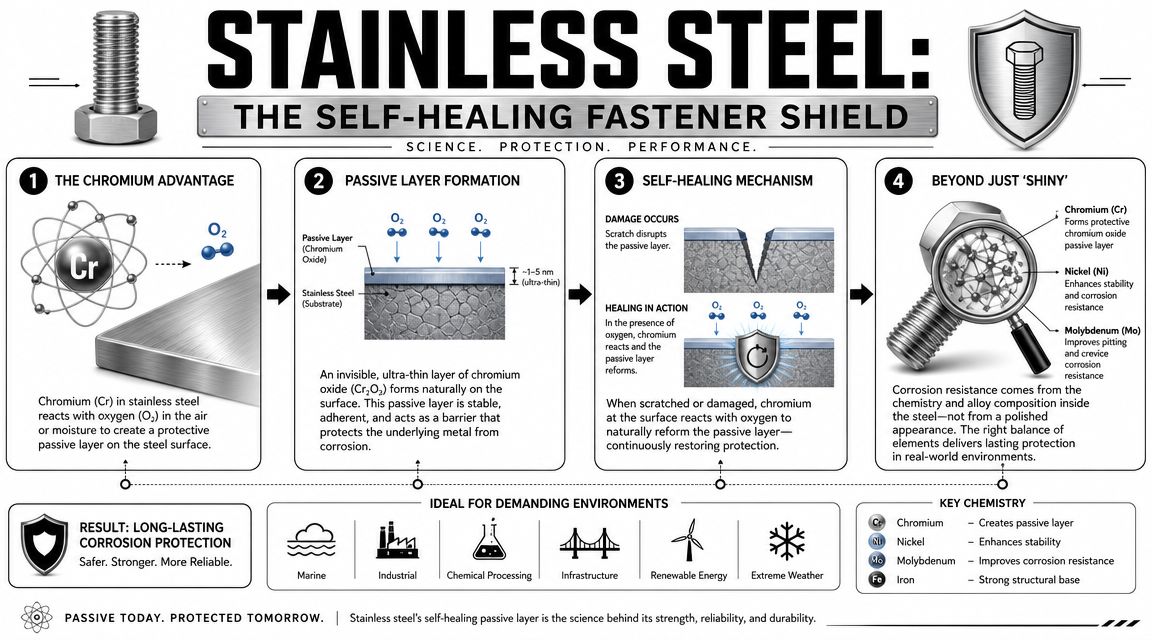
Stainless steel isn't “stainless” because it's shiny. It's stainless because of chemistry.
Stainless steel is defined as an iron-based alloy with at least 10.5% chromium, and that chromium threshold is what creates significant corrosion resistance, setting it apart from basic carbon-steel fasteners. The same source notes that basic carbon-steel fasteners are around 60,000 psi tensile strength, while stainless variants can range from 70,000 to over 220,000 psi depending on type and specification, which helps explain why stainless became so important in fastening applications (stainless steel definition and strength range).
What chromium actually does
Think of chromium as the ingredient that lets the metal form a thin protective skin. When the surface is exposed to oxygen, that protective layer forms and helps resist corrosion. If the surface gets lightly scratched, that layer can reform. That's why stainless steel fasteners can keep performing outdoors without the added coating that many carbon-steel fasteners rely on.
If you're comparing product types for exterior work, it helps to browse a supplier that groups these parts clearly by application. A category such as fasteners and fittings for outdoor hardware makes it easier to separate deck screws, bolts, anchors, and stainless options before you buy.
The grades most buyers actually see
For decks, fences, gates, and general exterior hardware, the two grades commonly encountered are A2/304 and A4/316.
- A2 / 304 stainless is the general-purpose option for a lot of outdoor work.
- A4 / 316 stainless is the stronger corrosion-resistance choice when chloride exposure is part of the job.
That difference matters more in Canada than many product listings admit. Inland and dry exposure is one thing. Salt water, coastal air, and road salt are another.
Comparing A2/304 vs. A4/316 Stainless Steel
| Attribute | A2 / 304 Stainless Steel | A4 / 316 Stainless Steel |
|---|---|---|
| Typical role | General-purpose exterior fastener choice | Better suited to harsher chloride exposure |
| Best use case | Inland decks, fences, general outdoor hardware | Coastal builds, marine-adjacent work, road-salt exposure |
| Corrosion resistance | Good for many outdoor applications | Better where chlorides are expected |
| Typical buyer mistake | Using it everywhere without checking exposure | Avoiding it on price, even where exposure demands it |
| Good fit for | Standard residential exterior use | Decks, fences, and hardware in high-salt environments |
The finish you see isn't the reason stainless lasts. The chromium content is.
Understanding and Preventing Fastener Corrosion
Stainless resists corrosion. It doesn't make corrosion impossible.
That distinction matters because most outdoor failures don't begin with a dramatic break. A bit of staining around a screw head. A washer that looks off-colour. A bolt in a damp pocket that holds for now, then degrades over time. In Canadian conditions, especially where chlorides are present, you need to think beyond “will it rust?”
The three failures that matter most outdoors
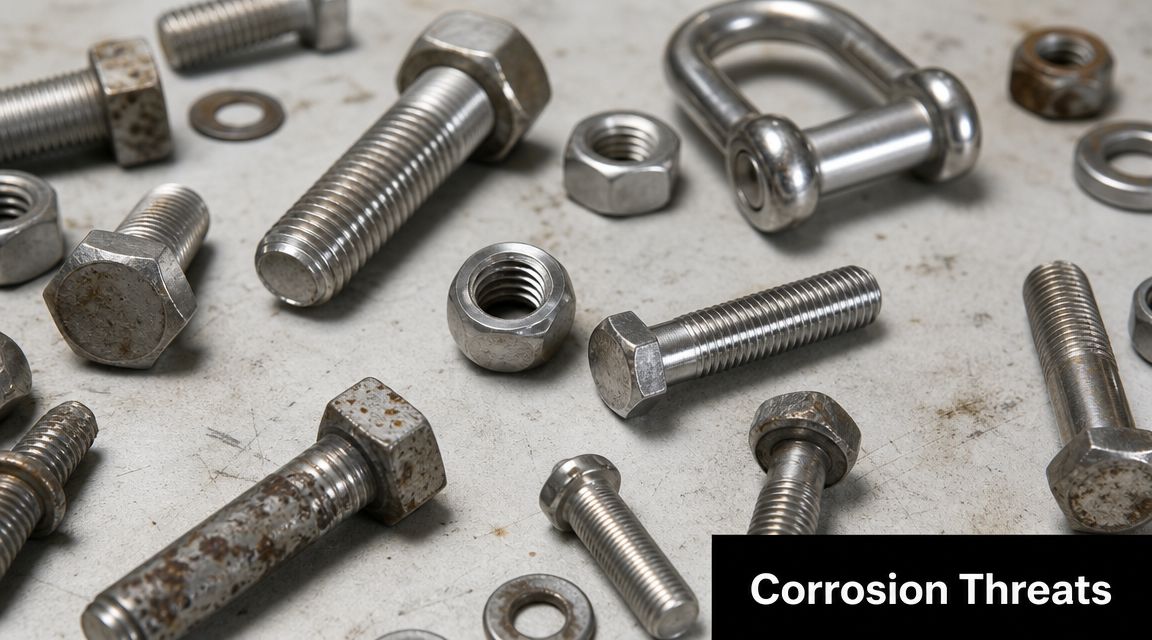
Pitting corrosion is the one that catches people off guard. The fastener can still look mostly fine from a distance, but small localised attack starts on the surface. Chloride-heavy environments make this more likely, which is why coastal jobs and road-salt exposure deserve better grade selection.
Crevice corrosion shows up where moisture gets trapped. Under a washer, inside a tight lap joint, in a hardware pocket, or where debris sits against the metal. Stainless needs oxygen at the surface to maintain its protective behaviour, so cramped wet zones can become trouble spots.
Galvanic corrosion happens when dissimilar metals touch in the presence of moisture or another electrolyte. Think of it as a tiny battery you didn't mean to build. One metal sacrifices itself faster.
Why galvanic corrosion causes expensive callbacks
Industry guidance for structural stainless fasteners says austenitic bolts in grades A2 or A4 are generally recommended, and also states a critical rule: use stainless bolts when connecting stainless members to avoid bimetallic corrosion. The same guidance notes that property class 70 or 80 is used where higher mechanical performance is needed, and class 80 has mechanical properties similar to carbon-steel grade 8.8 bolts (structural stainless bolt guidance).
That recommendation has a practical lesson for deck and fence work. Don't treat the fastener as a separate purchase from the bracket, hinge, post base, washer, or strap. The connection is a system. Mixed metals in a wet outdoor assembly can create problems even when the screw itself is high quality.
What works in the field
- Match metals where you can: If the connected hardware is stainless, use stainless fasteners with it.
- Don't trap moisture unnecessarily: Tight hidden pockets that stay wet are where corrosion gets started.
- Treat chloride exposure seriously: Salt air and road salt change the grade choice.
- Look at the whole joint: Screw, washer, bracket, bolt, and parent metal should be selected together.
Stainless doesn't fail because it was a bad idea. It usually fails because someone assumed “stainless” was the whole specification.
Matching Fastener Strength and Size to Your Project
A longer screw isn't automatically a stronger connection. A thicker bolt isn't automatically the right bolt. Strength comes from the material and property class as much as the dimensions.
For load-bearing work, you need to think about two different ideas. Yield strength is how much load a fastener can take before it permanently deforms. Tensile strength is how much pull it can take before it breaks. A simple way to think about it is a rubber band. Pull it a little and it returns. Pull it too far and it stretches out for good. Pull harder and it snaps.
Why property class matters
Mechanical properties for stainless fasteners are standardised. One technical reference for common stainless round bar lists a minimum 30 ksi yield strength and 75 ksi tensile strength, which is a useful reminder that corrosion resistance and structural performance are not the same thing (stainless mechanical property reference).
For practical buying, that means don't assume every stainless screw or bolt is suitable for structural duty just because it won't rust easily. Gate hinges, post-to-bracket connections, ledger-related hardware, and heavily loaded joints need a declared grade and strength level that suits the work.
A practical selection process
- Start with the joint's job: Deck board fastening, hinge mounting, post restraint, and bracket anchoring all ask different things from the fastener.
- Check whether the connection is structural: If it carries load or resists movement, verify strength class instead of buying by appearance.
- Choose the right anchor type for masonry or concrete: For bases and brackets into slab or concrete, look at dedicated concrete screw anchors for exterior connections instead of forcing a wood-fastener solution into the wrong substrate.
- Think about wind and uplift when it applies: Outbuildings, pergolas, and sheds need connection planning too. For readers looking into tie-down concepts and anchoring logic, this guide on ultimate shed protection for homeowners is useful background.
The mistake to avoid
Don't swap a high-strength carbon-steel fastener for a random stainless one without checking the requirement. Stainless may be the right corrosion choice, but the exact product still has to meet the load demands of the connection.
Choosing the Right Stainless Fasteners for Decks and Fences
If you want the short version, here it is. Use 304 for general inland exterior work. Use 316 when salt is part of the environment. That single decision solves a lot of future headaches.
Technical guidance consistently treats 316 stainless as the better option for salt water, marine, and high-chloride exposure, while 304 stainless is commonly used as the general-purpose choice. That's the decision line most Canadian buyers need to understand before filling a cart (304 vs. 316 stainless guidance).
Halifax, Vancouver, Calgary, cottage country
For a deck in Halifax, I'd treat chloride exposure as a live issue. Same for many coastal BC applications, waterfront projects, and homes near areas where salt hangs in the air. That's where 316 earns its keep.
For a fence in Calgary or an inland backyard with ordinary residential exposure, 304 is often a sensible choice if the rest of the connection details are right.
For projects near roads that get heavy winter treatment, be careful. You may be inland and still have enough chloride exposure to justify stepping up to 316 on vulnerable hardware, especially low-to-ground fasteners, gate hardware, and splash-zone connections.
What to buy for each part of the build
Here's the practical breakdown.
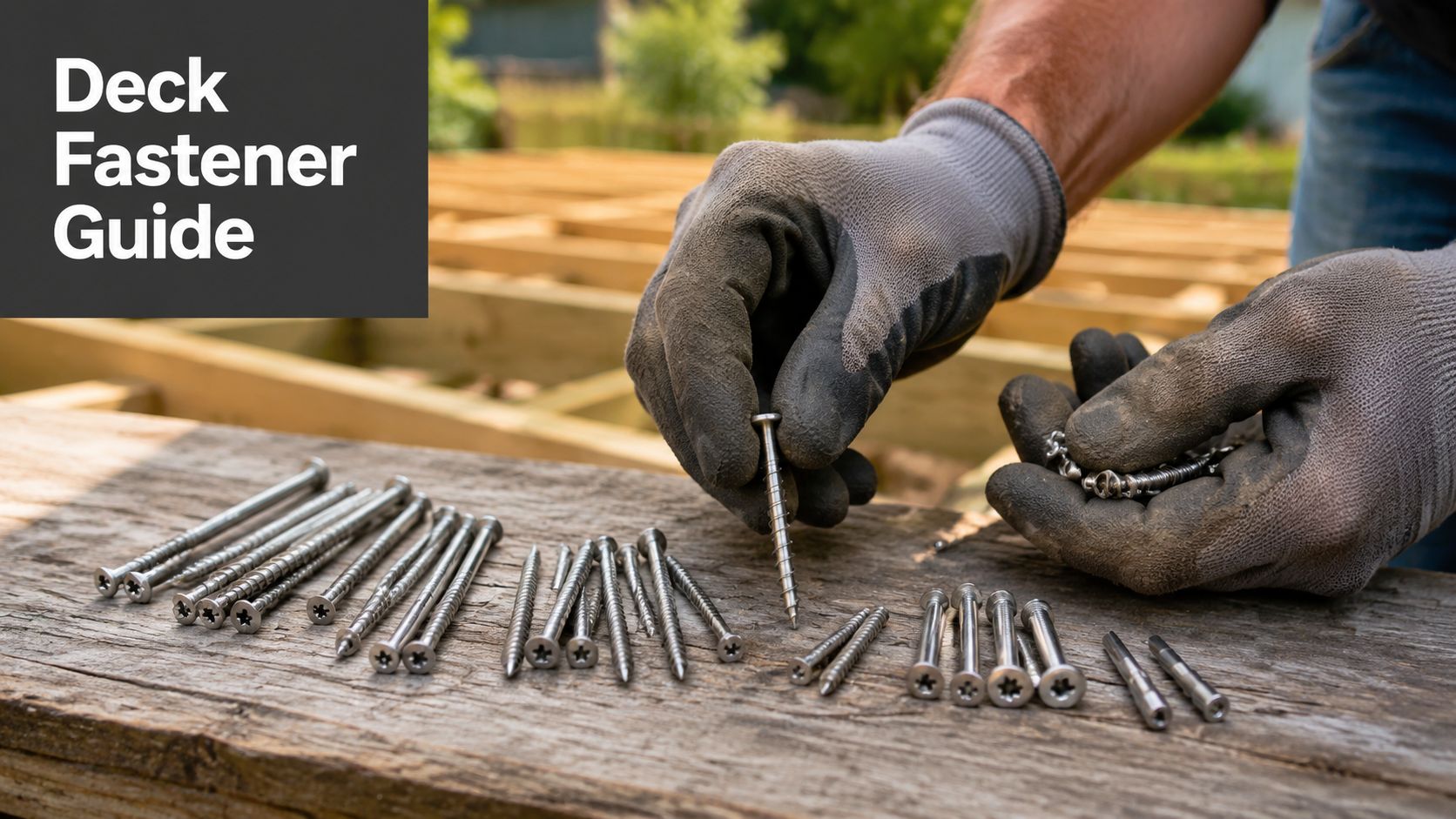
- Deck boards: Use stainless deck screws with a drive style that resists cam-out and a head that seats cleanly without chewing the surface.
- Post and beam hardware: Use properly specified bolts or structural connectors, not just oversized wood screws because they “look heavy.”
- Fence rails to posts: Match screw or bolt type to the joint. For simple wood-to-wood rail fastening, stainless screws are often the cleanest answer.
- Gate hinges and latches: Mixed-metal mistakes quickly become apparent. Match the fastener to the hinge material and exposure.
- Post bases and brackets: Use the right anchor for the substrate and don't ignore water traps around the hardware.
If you're shopping product categories, stainless steel deck screws are the place to start for visible deck-surface fastening. For broader outdoor hardware, XTREME EDEALS INC. carries deck screws, carriage and lag bolts, anchors, post hardware, and related deck and fencing accessories in project-ready pack options, which makes it easier to keep one hardware standard across the build instead of mixing random pieces from different bins.
Don't buy one grade for the whole job by habit
A lot of DIYers either overbuy or underbuy. They use 316 everywhere because they don't want to think about it, or they use 304 everywhere because it's easier to source. Both approaches can be wrong.
Use the environment to decide.
| Project scenario | Better stainless choice | Why |
|---|---|---|
| Inland backyard fence | 304 / A2 | General exterior exposure |
| Cottage deck away from salt | 304 / A2 | Usually suitable for standard outdoor use |
| Coastal deck or marina-adjacent fence | 316 / A4 | Better resistance in chloride exposure |
| Gate hardware near salted driveway | 316 / A4 | Splash and salt residue are hard on hardware |
This walk-through is useful if you want to see deck fastening hardware in context before ordering:
Buy for the exposure, not just the postal code. A sheltered inland deck and a salted driveway gate can need different answers on the same property.
Best Practices for Installation and Maintenance
Good stainless hardware can still be ruined by bad installation. The most common shop-floor frustration is galling, where the threads seize during tightening. People describe it as the nut and bolt “welding” together, and that's close enough for practical purposes. Once it happens, the hardware is usually done.

A technical overview of stainless fastener failure modes notes that thread galling is a common installation problem, and practical prevention includes lubrication and slower drive speeds. The same guidance also flags pitting and crevice corrosion as real risks, especially in chloride-rich environments, which is why “stainless = rust-proof” is too simplistic (stainless galling and corrosion risks).
Installation habits that save hardware
- Use lubricant on threads: Especially on bolts, nuts, and assemblies where stainless is bearing against stainless.
- Slow the driver down: High speed creates heat and friction. That increases the chance of galling.
- Pre-drill hardwoods and dense stock: This reduces splitting, lowers drive resistance, and helps the screw seat without damage.
- Use the correct bit and keep it fresh: Worn bits lead to cam-out, stripped heads, and ugly finished work.
- Don't over-torque: Stainless can be damaged by brute force just as easily as cheaper hardware can.
Maintenance that's actually worth doing
Outdoor hardware doesn't need constant fuss, but it does need a glance now and then.
Check visible fasteners at seasonal transitions. Look for loosening at gates, trapped debris around brackets, staining that suggests a compatibility issue, and damp pockets where leaves or dirt sit against metal. On decks, pay extra attention to low areas that stay wet. On fences, inspect hinge and latch hardware before the gate starts dragging.
A short do and don't list
Do
- choose the grade for the environment
- keep drive speed controlled
- inspect problem spots after winter
Don't
- dry-run stainless nuts onto stainless bolts at full speed
- mix metals carelessly
- assume a stuck fastener only needs more force
Smart Buying Tips for DIYers and Pros
Buying stainless steel fasteners online gets easier when you stop shopping by headline terms alone. “Outdoor screw” isn't enough. “Stainless” isn't enough either. Product pages should tell you the grade, the application, the head style, the drive type, and the pack size. If they don't, keep looking.
What to check before adding to cart
- Grade identification: Look for clear mention of 304/A2 or 316/A4 where the application calls for it.
- Intended use: Decking, fencing, anchors, bolts, and structural connectors shouldn't be treated as interchangeable.
- Pack size: Pros usually know this already, but project-sized boxes are easier to manage than buying too many small packs.
- Compatible hardware: Washers, nuts, brackets, hinges, and anchors should suit the same environment and material logic.
Buying for one project instead of one item
DIY buyers often purchase fasteners one line at a time. Screws from one seller, bolts from another, brackets from a third. That can work, but it also raises the chance of mixing grades and finishes in one assembly.
A better approach is to build the hardware list by connection type. Deck boards first. Structural wood-to-wood joints next. Post bases and anchors after that. Gate hardware last. That method catches incompatibilities before checkout.
If the product page doesn't tell you enough to know where the fastener belongs, it's not ready for a serious outdoor project.
For contractors and repeat buyers
Consistency matters more than novelty. You want the same drive fit, the same corrosion behaviour, and the same product description standard from order to order. That reduces installation surprises and makes it easier to keep crews from mixing the wrong hardware into the wrong stage of the build.
Frequently Asked Questions About Stainless Steel Fasteners
A lot of confusion around stainless fasteners comes from short product labels and overconfident assumptions. These are the questions that usually matter right before purchase or installation.
Common Questions
| Question | Answer |
|---|---|
| Are stainless steel fasteners rust-proof? | No. They're corrosion-resistant, not immune to every failure mode. Chlorides, trapped moisture, wrong metal pairing, and poor installation can still cause problems. |
| Should I use 304 or 316 for my deck? | Use 304 for many general inland exterior projects. Use 316 when the deck is exposed to salt water, coastal air, or heavy chloride exposure such as road salt. |
| Is stainless always stronger than carbon steel? | No. Strength depends on the specific fastener and property class. Don't assume corrosion resistance means the same load capacity as a higher-grade carbon-steel fastener. |
| What does A2 or A4 mean? | In practical buying terms, A2 usually lines up with 304 stainless, while A4 lines up with 316 stainless. The main decision point is the corrosion environment. |
| Why did my stainless nut and bolt seize during installation? | That's often galling. Lubrication and slower installation speed help prevent it. |
| Can I mix stainless fasteners with other metals? | Sometimes, but you need to think about galvanic corrosion. Matching the fastener to the connected metal is often the safer route. |
| Are stainless screws enough for every structural connection on a fence? | Not automatically. Some joints need a properly specified bolt, anchor, or structural connector rather than a generic screw. |
| Do I need to inspect stainless hardware after installation? | Yes. Seasonal checks are still worth doing, especially at gates, brackets, splash zones, and any area where moisture or debris collects. |
The final buying filter
Before you buy, ask four questions.
- What environment is this fastener living in?
- Is this a visible finish connection or a structural one?
- What metal is it touching?
- Am I buying a screw, bolt, or anchor that matches the job?
If you can answer those cleanly, you'll avoid most of the common mistakes people make with stainless steel fasteners.
If you're comparing deck screws, bolts, anchors, post hardware, and fence accessories for one outdoor build, XTREME EDEALS INC. is a practical place to review the categories in one catalogue and match hardware to the job before you order.