

In Canada, 64% of Canadians said they didn't trust general contractors, while 70% reported difficulty finding a contractor they could trust for renovations worth $5,000 or more, according to an Ipsos survey commissioned by Reno-Assistance and reported by Canadian contractor-selection data. That makes a recommendation more than a friendly name passed along over coffee. For a deck, fence, gate, or exterior hardware project, it's the opening lead in a hiring decision that still needs evidence.
A good referral gives you a starting point. It doesn't prove licensing, insurance, workmanship, permit knowledge, or financial reliability. The practical difference between a useful recommendation and an expensive mistake is the verification work that follows.
Why Contractor Recommendations Matter More Than Ever
A trust gap changes how homeowners should read word-of-mouth. In Toronto, 63% of surveyed homeowners reported major contractor problems, and 78% said it was difficult to find a trustworthy renovation contractor, according to the Reno-Assistance and Ipsos survey summary. Those figures do not make every referral suspect. They show why a confident introduction still leaves important questions unanswered.
A neighbour may recommend a crew because the fence looks straight and the workers were pleasant. That is useful evidence about the visible result and the customer experience, not proof that the company legally exists, carries current insurance, holds the right licence, or used suitable fastening and anchoring methods. The same survey found that only 16% checked whether a company legally existed, 19% checked insurance, 27% checked licensing, and 14% checked legal history before hiring.
Treat every referral as an unverified lead
A referral can sound convincing until the project scope is examined. A crew that installed a simple privacy fence may not be equipped for a raised deck with guards, stairs, ledger connections, and permit requirements. A carpenter praised for indoor trim work may not understand post depth, drainage, frost movement, or exterior corrosion resistance.
Match the referral to the work. For a deck or fence, ask what the recommended contractor built, not whether the referrer liked the crew. Confirm whether the job involved similar grades, gates, stairs, structural connections, or municipal requirements. A good experience on a small repair does not automatically transfer to a larger exterior build.
The Canadian Home Builders' Association recommends asking friends, family, coworkers, and neighbours for names, then using at least three past customer references to check whether the contractor finished on time, on budget, and to the customer's satisfaction. It also says a contractor who cannot or will not provide references should not be considered. That guidance appears in Canadian construction and contractor-selection guidance.
Practical rule: A recommendation earns a phone call. It does not earn a deposit.
Use the trust gap as a screening signal
Reputation matters in deck and fence work because defects can become concealed. You may not see inadequate post support, missing blocking, unsuitable fasteners, or rushed flashing after cleanup. Movement, corrosion, or water damage can appear later, when the original crew is difficult to reach.
| Trust Gap Snapshot: Homeowner Experience With Contractor Hires | Value | Source |
|---|---|---|
| Canadians who didn't trust general contractors | 64% | The same survey |
| Canadians who had difficulty finding a trusted contractor for renovations worth $5,000 or more | 70% | The same survey |
| Toronto respondents reporting major contractor problems | 63% | The same survey |
| Toronto respondents who found trustworthy contractors difficult to find | 78% | The same survey |
| Homeowners checking licensing before hiring | 27% | The same survey |
The strongest recommendation reduces uncertainty through inspectable work, a clear match to your project, and a referrer willing to answer uncomfortable questions. Close the remaining gaps with licence checks, insurance documents, reference calls, and a written bid comparison. That process turns a casual name into a hiring decision you can defend.
Where to Find Strong Contractor Recommendations
Start with work you can inspect. A recently completed fence on a nearby property tells you more than a polished portfolio image because you can look at post alignment, gate operation, privacy layout, hardware, cleanup, and how the installation sits against neighbouring grades.
Ask the owner who performed the work, when it was completed, what the original scope included, whether the price changed, and whether they'd rehire the contractor. Don't stop at “Were you happy?” Ask whether the crew communicated delays, protected the property, handled changes in writing, and returned to correct deficiencies.
Rank the source, not just the name
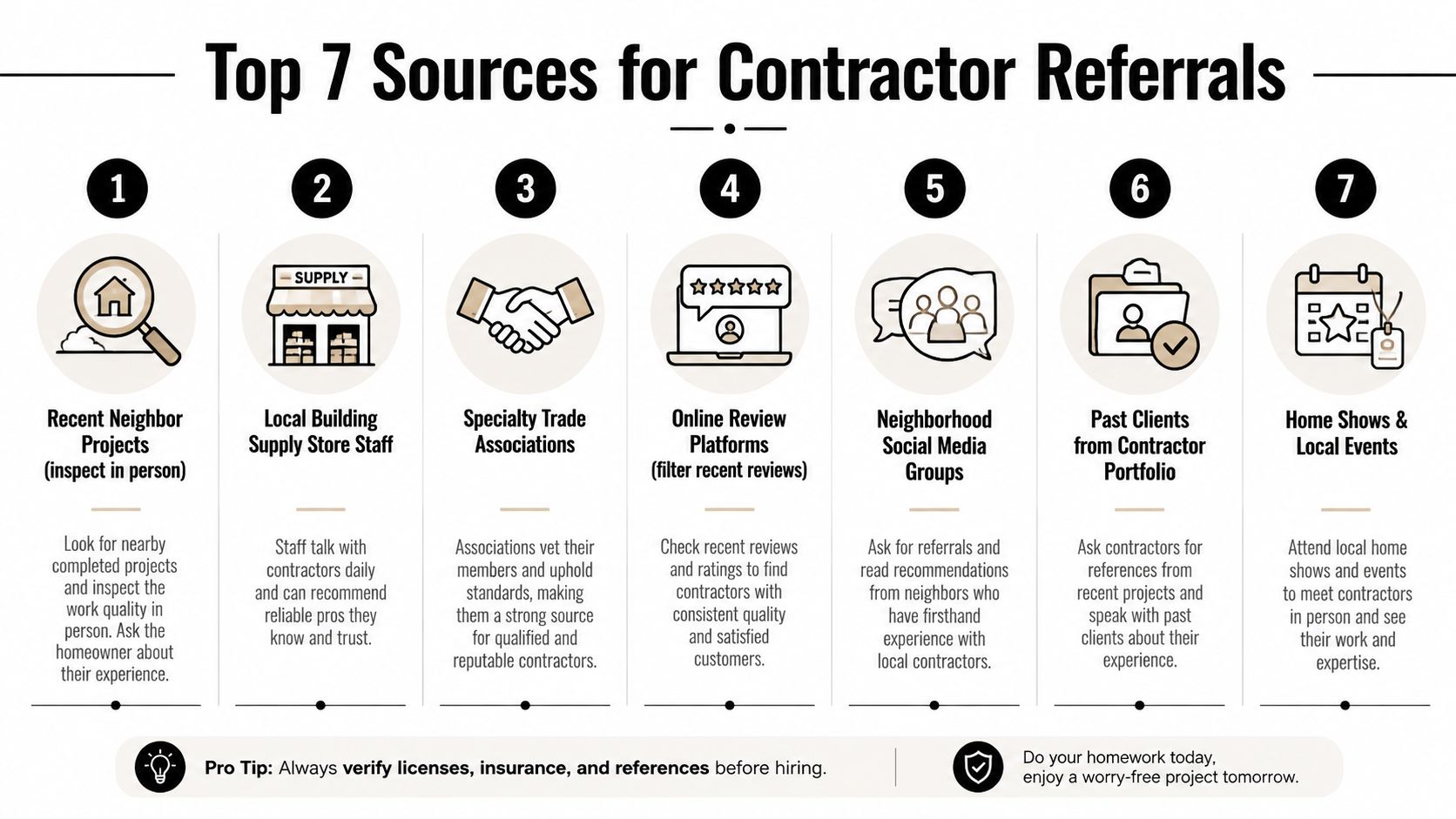
Different referral channels provide different levels of evidence.
- Recent neighbour projects: Highest practical value when you can inspect the finished installation and speak with the owner.
- Local building-supply staff: Ask which crews consistently purchase the right materials for deck framing, fencing, and exterior repairs. Treat staff suggestions as leads, not endorsements.
- Specialty trade associations: Directories can help identify relevant trades, but membership doesn't replace licensing and reference checks.
- Manufacturer-certified installer lists: Useful when a product system has specific installation requirements. Confirm what the certification covers.
- Supplier and foreman relationships: A supplier who knows a contractor's ordering habits may identify dependable operators, but may not know their dispute history.
- Supervised review platforms: Filter for recent, project-specific reviews with photos. Star averages alone don't establish competence for your scope.
- Home shows and local events: Good for meeting several contractors and seeing how they explain materials, sequencing, and limitations before you request a bid.
For broader referral habits, homeowners can also consult this practical resource on finding a tradesman Ireland, particularly its emphasis on checking experience and asking direct questions before hiring.
Capture comparable referral details
Write down the project type, approximate scope, completion timing, material choices, crew size, communication quality, and whether the owner would rehire. You don't need a precise contract value from a neighbour. A broad description is enough to identify whether the referral matches your job.
Two independent referrals that describe similar strengths are more useful than one enthusiastic recommendation. If the same contractor appears through unrelated homeowners, a supply counter, and a specialty association, you've gained corroboration. You still need to verify the credentials, but the referral has become more than a name.
How to Verify Credentials and References
A contractor's first answer should be easy to verify. Confirm the licence or registration directly with the applicable provincial regulator, municipality, or, for California work, the Contractors State License Board. Don't rely on a screenshot supplied by the contractor. Check the legal business name, status, scope, bond information where applicable, and disciplinary history shown by the regulator.
California's Contractors State License Board reported 9,317 complaints against licensed and unlicensed contractors since July 1, 2024. Its intake and mediation staff settled about 31% of licensee complaints and recovered $11,743,932 in restitution, while approximately 4,245 complaints were assigned to special investigators, according to California Contractors State License Board enforcement reporting. The lesson isn't to reject every contractor with a complaint. It's to examine the record, understand its status, and avoid treating a public lookup as a complete risk assessment.

Verify the four evidence categories
Licensing comes first. In Ontario, the HCRA reported 1,120 professional conduct complaints in 2024/25, with professional conduct complaints representing 72% of all complaints received. The number of licensees rose from 6,186 in 2021 to 7,232 in 2025, according to the Auditor General of Ontario report on the HCRA. A recommendation that doesn't answer who is licensed, who supervises the work, and who is accountable leaves a major gap.
Insurance needs independent confirmation. Ask for a certificate showing the correct legal entity and project address, then contact the insurer or broker using independently sourced contact information. Confirm general liability and workers' compensation coverage, policy dates, and any exclusions relevant to the work. For an overview of questions surrounding contractor all-risk insurance, use this Bi-me guide to contractors all risk.
References should be specific. Call at least three customers, preferably from projects old enough to reveal settlement, drainage, corrosion, gate sag, or warranty issues. Ask what changed, how the contractor handled the change, whether communication stopped during delays, and what remained unfinished.
Complaints and legal records add context. Search the BBB, provincial consumer affairs resources, and available court records for liens or unresolved judgements. Record the date and result of each search rather than relying on memory. You can also compare the contractor's answers with XTREME EDEALS customer testimonials as part of a wider reputation review, while keeping product-supplier testimonials separate from contractor references.
For electrical or code-sensitive work, ask who will perform the installation and which notices or permits apply. ESA said complaints in the first nine months of fiscal 2026 commonly involved unauthorized or unqualified people working under a licensed contractor's licence, along with late required notifications, and it processed just shy of 500 complaint records during that period, as described in ESA's licensing guidance.
A contractor-provided insurance certificate, an impressive online rating, or a clean-looking lookup page can all be incomplete. Verification works when you contact the underlying source and preserve what you found.
Interview Questions and Bid Comparison That Work
A homeowner replacing a deck doesn't need a theatrical interview. They need questions that expose how the contractor runs work. Ask who will be on site, who pulls permits, whether subcontractors will be used, and who remains responsible if a subcontractor makes a mistake.
Ask how the contractor handles concealed conditions, material substitutions, weather delays, and change orders. Ask for a sample daily log, the proposed payment milestones, the written warranty, and the contract language used for lien releases. Finally, ask what the contractor expects the homeowner to decide before demolition begins.
One installer may answer with a clear sequence: inspect, document, price the change, obtain written approval, then proceed. Another may say, “We'll deal with it when we get there.” The second answer isn't automatically disqualifying, but it tells you the project will depend on informal decisions when the pressure is highest.
Make competing bids genuinely comparable
A deck replacement bid often looks cheaper because it excludes demolition, disposal, stairs, guard details, ledger treatment, or final grading. Put every bid into the same line-item structure. Separate fixed prices from allowances, identify product brands or performance requirements, and tie payments to completed work rather than calendar dates.
Ontario consumer guidance recommends getting written estimates from at least three contractors, comparing them, and including the selected estimate in the written contract. It also advises checking the Consumer Beware List for enforcement action, as set out in Ontario consumer guidance for hiring contractors.
| Sample Bid Comparison Sheet for a Deck or Fence Project | Bid A ($) | Bid B ($) | Notes / Risk Flag |
|---|---|---|---|
| Demolition and disposal | $________ | $________ | Confirm what gets removed |
| Posts, anchoring, and concrete | $________ | $________ | Identify system and installation method |
| Framing and joist hardware | $________ | $________ | Check corrosion-resistant fasteners |
| Decking or fence boards | $________ | $________ | Record species, grade, or product |
| Stairs, gates, and guards | $________ | $________ | Avoid “included” without details |
| Labour and subcontractors | $________ | $________ | Name responsible supervisor |
| Permits and required notices | $________ | $________ | State who obtains them |
| Cleanup and final walkthrough | $________ | $________ | Include disposal and restoration |
| Written warranty | ________ | ________ | State coverage and exclusions |
For a second perspective on screening questions, this GeneratorInstallerList questions guide is useful because it focuses on scope, responsibility, installation method, and service expectations. The same questioning discipline applies to a fence contractor.
Use XTREME EDEALS project cost estimation to organise your material assumptions before comparing bids. The point isn't to force a contractor into your number. It's to spot omissions, inconsistent quantities, and allowances that could turn a low bid into a series of change orders.
Red Flags and Follow-Up Practices After You Hire
Signing the contract does not end the hiring decision. Warning signs can appear before work starts, especially when a contractor requests unexpected money, changes the crew, or asks you to disregard a permit or inspection requirement.
Treat each warning as a same-day verification task. Ask for the reason, require the change in writing, and confirm who carries responsibility. A credible contractor should answer directly without making urgency the basis for approval.

Match each warning to an action
- Deposit request above 25%: Compare the request with the signed payment schedule. Ask for payments tied to delivered materials and visible progress, and pause if the terms have changed.
- Pressure to skip permits: Contact the municipality or applicable authority to confirm whether permits, inspections, or notices apply. “Everyone does it” is not a compliance answer.
- Vague change-order pricing: Require a written description of the labour, materials, timing, and price before approving the change.
- No written contract: Hold the start date until the scope, payment terms, warranty, subcontractor responsibility, and cleanup duties are documented.
- Large upfront cash demand: Use a traceable payment method and obtain a receipt naming the legal business. Urgency does not replace documentation.
- Unfamiliar subcontractors: Request each worker's name and role, confirmation of insurance, and the supervising contractor's site responsibilities.
The 25% deposit threshold is a practical warning sign, not a universal legal limit. Contract rules and consumer protections differ by jurisdiction, so confirm local requirements before withholding or issuing payment.
Inspect concealed work before paying
Deck and fence defects often disappear behind boards, concrete, or trim. Photograph post locations and depth before backfill, framing connections before decking, flashing before cladding, and fastener patterns before final caps or plugs are installed. For a structured review of completed deck work, use this deck inspection checklist.
For deck construction, product compliance materials reference the National Building Code of Canada 2015 and Subsection 9.12.3 of Division B for certain post-anchor applications, including third-party testing claims for a specific anchor product, as described in post-anchor compliance information. That reference does not make one anchor suitable for every site. The contractor should identify the selected system and explain its intended application.
Canadian deck and guard-rail guidance for a 4×4 post-and-rail system calls for two through-bolts measuring 9.5 mm, or 3/8 inch, in diameter. It also states that guard rails must be at least 36 inches high when the surface is 30 inches above grade, equivalent to 60 cm in Canada, according to Canadian deck code guidance.
Keep daily notes, receipts, photographs, and approved changes in one project folder. Schedule a punch-list review at completion, then revisit the work at 30 days and six months. Check for movement, drainage problems, gate alignment, and fastener issues while the project record remains organised.
Your Quick-Reference Recommendation Playbook
Good contractor recommendations are built, not borrowed. The following workflow turns a casual name into a documented decision that a homeowner, co-owner, property manager, or project lead can review later.
Save this six-step workflow
Source two or more referrals. Start with inspectable neighbour projects, trusted suppliers, associations, and relevant installer networks. Capture the referrer's answers about scope, timing, communication, changes, and rehire intent. Set aside a focused block of time to gather the names and organise the notes.
Verify the licence and insurance. Save a screenshot or regulator record showing the legal name and current status. Contact the insurer or broker independently, confirm coverage for the work, and record the date and person who confirmed it.
Check references and past work. Speak with three customers from completed projects older than 12 months. Record what each person says about delays, cleanup, warranty response, concealed work, and final cost. Visit a finished project when the owner agrees.
Get detailed written estimates. Give every contractor the same scope, drawings or measurements, material assumptions, access details, and demolition expectations. Place the bids into a matched comparison sheet so allowances and exclusions can't hide inside a low headline price.
Sign a clear contract. Include the legal parties, scope, payment milestones, change-order procedure, permits, subcontractor responsibility, warranty, cleanup, and lien-release requirements. Keep the signed contract, insurance confirmation, licence record, and reference notes together.
Conduct milestone inspections and the final walkthrough. Inspect concealed work before it's covered and review the finished deck, fence, gates, guards, hardware, drainage, and cleanup before final payment. Capture photographs and obtain the agreed closeout documents, including signed lien waivers where applicable.
California procurement guidance reinforces the value of a written evaluation matrix. It says source-selection decisions must be documented for every procurement effort and that evaluators should excuse themselves when they have personal involvement with a bidder, as explained in California source-selection guidance. For a private home project, that translates into predefined criteria and a written reason for choosing one contractor over another.
Hiring rule: Don't hire the most persuasive referral. Hire the contractor whose licence, insurance, references, scope, and contract survive independent checking.

For a deck or fence project, the materials also need to match the verified installation plan. XTREME EDEALS INC. supplies deck and fencing accessories, fasteners, post caps, balusters, gate hardware, joist hangers, anchors, and post base brackets for DIYers and trade buyers, with product information that can help you organise the hardware portion of a contractor's scope.
XTREME EDEALS INC. offers deck and fencing accessories, fasteners, anchors, post caps, gate hardware, joist hangers, and other home-improvement hardware for DIY homeowners and professionals. Visit XTREME EDEALS INC. to compare products and build a clearly documented materials list before your next contractor recommendation becomes a signed project.