
A contractor arrives to collect deck screws, post caps, hinges, and an electronic accessory for a project that starts tomorrow. The retailer has reliable distributors, familiar brands, and invoices in order. Then a buyer asks a simple question: where did the steel come from, who assembled the electronic component, and what checks were completed before the products reached the shelf?
That question exposes the difference between having supplier relationships and having supply chain transparency. In hardware, visibility has to work at the level of fasteners, outdoor finishing products, electrical components, packaging, freight, and the businesses that sit behind each tier. It also has to satisfy regulators without making products harder to buy or pushing every customer toward a higher price.
What Supply Chain Transparency Means for Hardware Retailers
A hardware retailer may buy deck screws from one supplier, decorative post caps from another, and electronics through a separate importer. Each vendor can provide a catalogue, price list, and delivery schedule while leaving important questions unanswered. The retailer may still not know where the steel was processed, which factory made the post cap, or where the electronic component was assembled.
Supply chain transparency closes those gaps. It means documenting the path from raw materials and component manufacturers through processors, assemblers, distributors, importers, and the retailer. It also means identifying risks at each stage, retaining evidence, and knowing who owns the response when a supplier cannot support a claim.
The hardware version of a strong foundation
Think about a deck foundation. A finished surface can look excellent, but weak footings eventually create movement, uneven load, and expensive repairs. A hardware business faces the same problem when its customer-facing claims rest on incomplete supplier information.
For a box of fasteners, useful records might include the product specification, manufacturing location, material documentation, supplier declarations, lot identification, and import paperwork. For a post cap, the trail may involve the metal or polymer input, finishing process, packaging site, and distribution route. Electronics usually require a closer look at component origin, assembly, testing, safety documentation, and changes between product versions.
This visibility isn't limited to a spreadsheet of direct vendors. A distributor may be tier one, while the steel mill, coating facility, moulding plant, or contract assembler sits deeper in the chain. Retailers need enough information to understand those relationships and determine where evidence is strong, incomplete, or dependent on an unsupported statement.
Visibility has to support operations
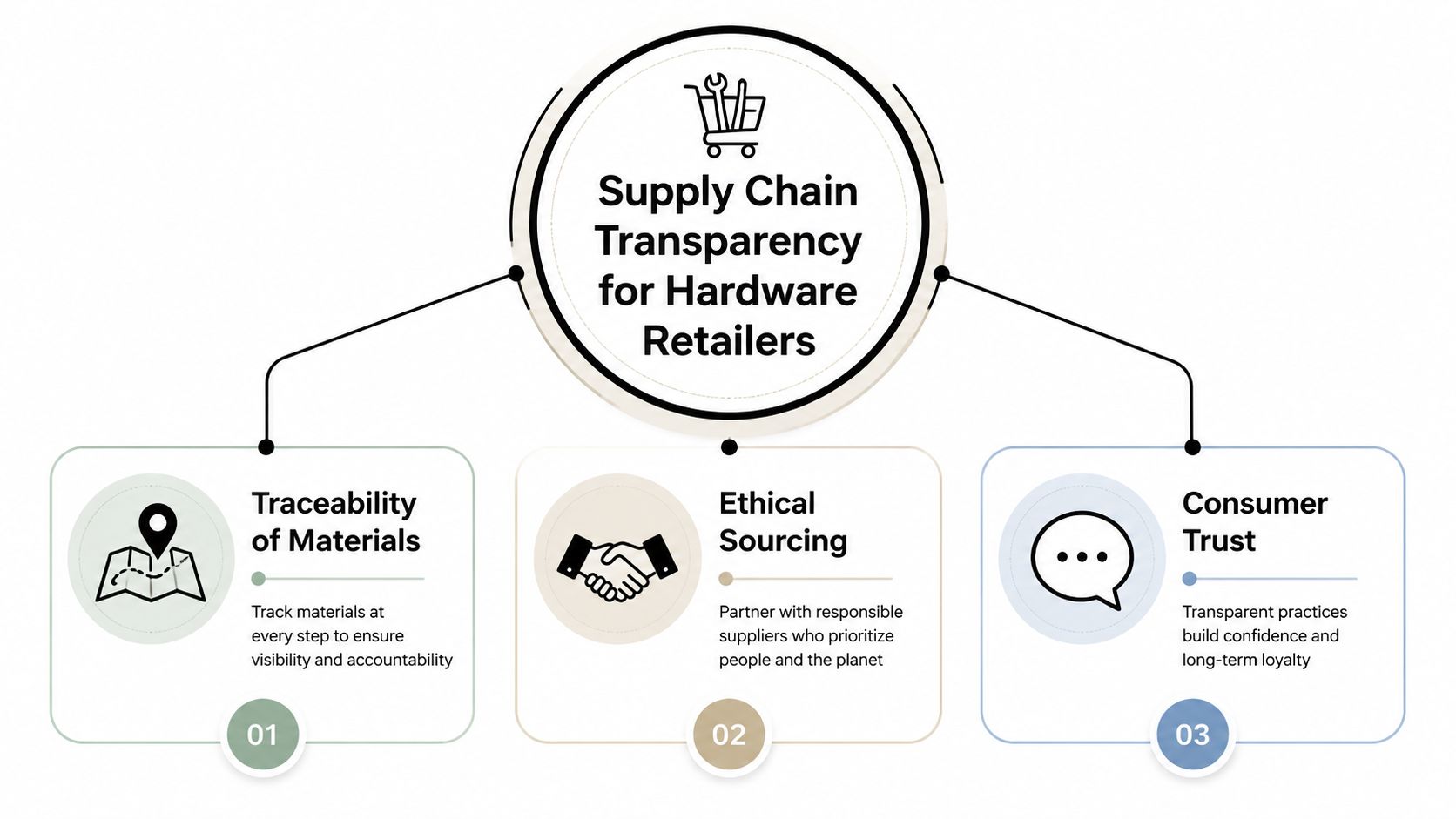
Good transparency work helps a purchasing manager answer practical questions quickly. Which supplier supplied the affected lot? Which customers received it? What alternatives are available? Can the business show its due diligence to a commercial buyer, regulator, or insurer?
Importers and retailers should also assess whether their logistics partners can support accurate records across customs, warehousing, and delivery. A resource on asistencia aduanera y distribución can help businesses think through that wider movement of goods, rather than treating transparency as a factory-only exercise.
Why Transparency Matters for Hardware Businesses and Buyers
Transparency matters because hardware failures are rarely isolated to a single transaction. A missing certificate can delay a project, an inconsistent fastener can create installation concerns, and an unclear product origin can make a retailer's response look evasive even when the product itself performs well.
For retailers, the first benefit is risk control. Clear supplier records make it easier to quarantine a lot, investigate a complaint, compare alternate sources, and defend a purchasing decision. They also improve supplier conversations. Instead of asking for a broad ethical statement, a retailer can request a specific manufacturing location, material declaration, audit record, certification, or corrective-action update.
The commercial benefit is more nuanced. Transparency can distinguish a smaller retailer from established names such as Decorex Hardware and Nuvo Iron, but only when the information is useful. A badge that says “responsibly sourced” won't carry much weight if the business can't explain what was checked or what remains unknown.
Business resilience: Transparency isn't just about ethics. It's about knowing enough to protect availability, quality, compliance, and customer confidence.
What contractors need from a transparent supplier
Professional contractors, carpenters, and handymen usually care about dependable installation more than a long corporate statement. They need confidence that a deck screw has the stated finish and specification, that a hinge is suitable for the intended load, and that an electronic product includes the documentation required for its market.
Traceable purchasing records support warranty conversations and job documentation. They can also help contractors respond when a property manager, developer, or commercial client asks for evidence about materials used on a project. The best information arrives in a form that can be found quickly, not buried in an email chain.
Why consumers remain practical
DIY homeowners may appreciate ethical sourcing, but transparency doesn't automatically win the sale. PwC Canada's 2025 Voice of the Consumer research found that 62% of Canadians would choose a cheaper imported product over a more expensive Canadian equivalent (PwC Canada's consumer research). That finding should change how retailers communicate.
Customers may value traceability, but businesses need to connect it to quality assurance, product reliability, availability, and risk reduction, not ethics alone. A transparent product story is stronger when it explains what the buyer receives for the price and why the documentation matters.
Practical Steps to Increase Supply Chain Transparency
Retailers don't need a complex platform on the first day. They need a disciplined record of what they buy, who supplies it, what evidence exists, and which gaps deserve attention first.
Start with the products that create the most exposure
Create a product-risk register for fasteners, post caps, hinges, gate hardware, anchors, and electronics. Record the supplier, manufacturer, country of manufacture, material or component information, certification documents, lot or batch references, and the date each document was reviewed.
Then map beyond the immediate supplier. Ask whether the distributor knows the manufacturing site, whether the manufacturer relies on subcontractors, and whether the source changes by product run. A supplier that can't answer every question immediately isn't automatically unsuitable, but the uncertainty should be visible and assigned for follow-up.
Build a repeatable evidence process
Use a shared document structure with clear ownership. A purchasing employee might maintain supplier files, while a product or compliance lead reviews certificates and escalates inconsistencies.
A practical five-part checklist looks like this:
- Map tier-one suppliers. List every direct vendor and connect each to the products it supplies.
- Request supporting documents. Ask for manufacturing details, material declarations, relevant certifications, audit information, and policies.
- Track product identity. Use purchase orders, lot references, barcodes, or QR codes so records can connect a product to its source.
- Train the team. Show buyers, warehouse staff, and customer-service employees how to retrieve evidence and report a discrepancy.
- Communicate accurately. Publish only claims the business can support, and state where verification is still developing.
Inventory discipline is part of this system. Retailers can use their hardware inventory management resources to connect purchasing, stock records, and product documentation rather than maintaining disconnected files.

Scale technology after the process works
A QR code can connect a product or lot to a controlled record, but it doesn't verify the underlying claim. A platform can improve retrieval and permissions, but it won't repair incomplete supplier data. Start with a manageable product family, test whether staff can maintain the records, and expand once the workflow survives normal purchasing pressure.
The most useful early result isn't a polished public dashboard. It's an internal record that lets the team answer a customer, regulator, or quality question without starting the investigation from scratch.
Transparency Technologies and Certification Options
Technology should match the decision you need to make. A small retailer tracking post caps doesn't necessarily need the same system as a multinational electronics importer. The expensive option can create more administration without producing better evidence if suppliers don't maintain accurate records.
| Approach | Best For | Cost Level | Implementation Time |
|---|---|---|---|
| Supplier document register | Smaller retailers building a reliable baseline | Low | Short |
| Barcode or QR code records | Connecting lots, products, and documents | Low to moderate | Short to moderate |
| Third-party traceability platform | Retailers managing many suppliers or locations | Moderate to high | Moderate |
| Blockchain-based records | Multi-party chains requiring shared, tamper-evident records | High | Long |
| Product certifications and test reports | Hardware with defined safety or performance requirements | Varies by product and scope | Moderate to long |
Simple tools often win early
A controlled supplier register, purchase-order reference, and QR code can provide practical traceability for deck screws or a batch of post caps. The weakness is governance. Someone has to update the record, check the source document, manage version changes, and prevent staff from treating an uploaded PDF as proof of every claim.
Blockchain can offer a shared record across parties, but it doesn't make the original entry true. If a factory enters an inaccurate origin statement, an immutable record preserves the inaccurate statement. The approach makes more sense where several independent parties need a common audit trail and have the systems and incentives to maintain it.
Certifications answer narrower questions
For electronics, Canadian buyers may look for applicable CSA certification, while electrical products may also require recognised safety evidence such as a UL listing, depending on the product and market. These marks can support a compliance file, but retailers still need to confirm that the certification applies to the exact model, configuration, manufacturer, and intended use.
A post cap or decorative finial may need different documentation from an electronic accessory. Material specifications, coating information, dimensions, and performance testing can matter more than an electrical safety mark. Certification isn't a substitute for provenance. It verifies a defined attribute within a defined scope, so the retailer should record what the document covers.
Canadian Compliance Requirements and Key Metrics
Canada's first federal supply chain transparency law was the Fighting Against Forced Labour and Child Labour in Supply Chains Act, Bill S-211. It received royal assent on May 11, 2023, passed the House of Commons on May 3, 2023, and came into force on January 1, 2024 (Baker McKenzie's overview of the legislation).
The Act creates annual reporting obligations for certain businesses and federal institutions, with reports due by May 31 each year. In 2024, Public Safety Canada received 5,795 reports by the deadline, including 5,650 entity reports. Among those entities, 2,156 reported that they had identified forced-labour or child-labour risks in their supply chains, illustrating how quickly a reporting rule became a large compliance exercise (Baker McKenzie's Canadian compliance analysis).
Determine whether the Act covers your business
An organisation is covered if it has a place of business, business activity, or assets in Canada, or is listed on a Canadian stock exchange, and meets at least two of these thresholds in one of its last two financial years: at least $20 million in assets, at least $40 million in revenue, and an average of at least 250 employees (Filion's explanation of the reporting thresholds).
Coverage isn't the only reason to prepare. A smaller retailer may supply a covered wholesaler, contractor, institution, or brand that asks for equivalent information. Building the records before a buyer requests them reduces disruption.
The federal report must describe the entity's structure, activities, supply chains, due-diligence processes, high-risk areas, mitigation steps, and remediation actions (the Government of Canada's Supply Chains Act reporting guidance). For a hardware business, useful internal metrics include supplier-document completion, unresolved risk questions, product families mapped beyond tier one, corrective actions, and evidence-review dates.

Account for cross-border exposure
Canada's trade data shows that 47% of merchandise imports in 2023 were intermediate goods, inputs used by Canadian businesses to make or resell products. The same data indicates that 51% of Canadian importing firms sourced from only one partner country in 2018, while by 2022, the United States supplied 53% of Canadian intermediate-goods imports and 69% of commercial services imports (the Canadian trade and supply-chain analysis). Retailers should treat this concentration as a mapping question, not automatically as evidence of wrongdoing.
A business with California operations or in-scope customers should also review California's Transparency in Supply Chains Act. It focuses disclosures on verification, audits, certification, internal accountability, and training, creating a useful governance benchmark for companies serving that market (California Attorney General guidance).
For shipping workflows and customer expectations, retailers can connect compliance planning with their Canadian shipping options, ensuring product, import, and delivery records remain consistent.
How to Verify Product Provenance and Communicate Transparency
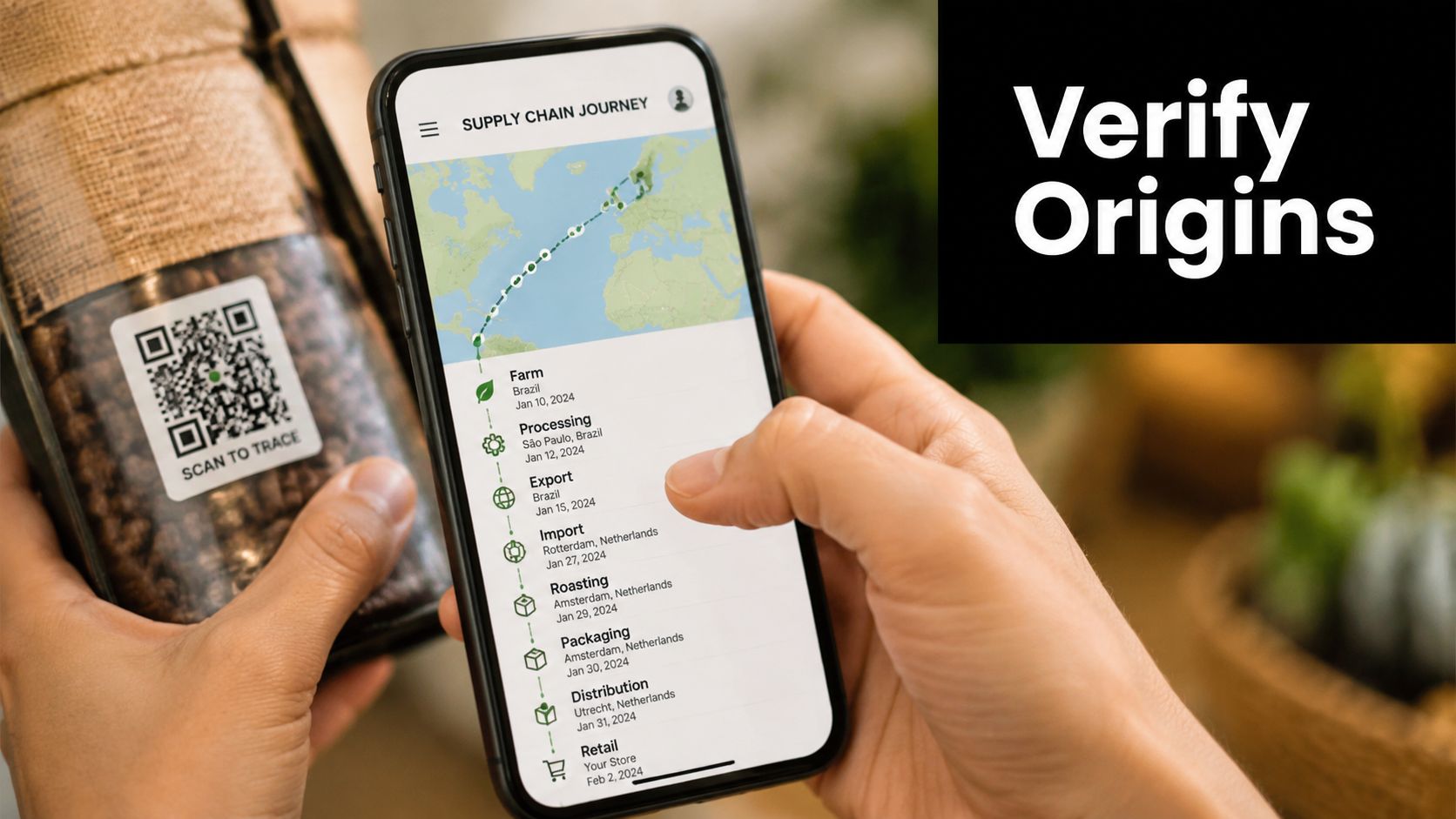
A provenance claim should answer four questions: what was made, where it was made, who supplied it, and what evidence supports the statement. If a supplier provides only a general policy, ask for product-level or facility-level documentation that relates to the specific item.
Check claims by product category
For steel deck screws, request the material specification, manufacturing location, applicable coating information, lot identification, and any testing or certification document relevant to the product. For a decorative post cap, check the stated material, finish, production site, dimensions, and whether the supplier changes factories between runs.
Electronics need a different line of questioning. Ask who assembles the product, where key components originate, which model the safety documentation covers, how revisions are controlled, and what testing supports the stated use. A QR code may make these records easier to retrieve, but it doesn't replace document review.
Buyers comparing digital verification tools can compare credential verification platforms before choosing a system. The right platform should make evidence easier to validate, update, and present, not merely give a product a more convincing label.
Buyer's checklist: Identify the manufacturer, confirm the document's scope, check the model or lot reference, record the review date, and ask what happens when a supplier can't verify an important claim.
Retailers should communicate the same discipline publicly. Say what has been verified, identify the product range covered, and avoid implying that one certificate proves every social or environmental characteristic. If an investigation is incomplete, explain the process and the next review point rather than replacing uncertainty with polished marketing language.
For buyers, price and transparency will often pull in different directions. A contractor with a fixed project budget may prioritise availability and specification, while a property manager may require a stronger evidence trail. Use product durability testing records and guidance, including hardware durability testing information, alongside provenance documents when deciding whether a product is fit for a demanding application.
The following video can help teams discuss why traceability needs to connect product records, supplier evidence, and customer communication.
Building Your Supply Chain Transparency Strategy
A workable strategy has four phases. Assess the current state by listing suppliers, product families, import routes, documents, and unresolved questions. Pay particular attention to items where a failure would affect a project schedule, warranty position, safety decision, or regulatory response.
Plan by ranking gaps according to risk and effort. A retailer may begin with fasteners and electronic accessories because the product records are manageable, then extend the process to post caps, hinges, anchors, and other categories. Assign an owner, define the evidence required, and set a review routine that staff can follow during ordinary purchasing.
Execute through a limited pilot. Select one supplier and one product family, test document requests, connect records to inventory, and ask a customer-service employee to retrieve the information without assistance. If the process works only when one senior manager is available, it isn't ready to scale.
Optimise by reviewing supplier responses, missing records, customer questions, and corrective actions. Supplier resistance is common, particularly when requests are broad or repetitive. Specific questions tied to a product, lot, factory, or certification are easier to answer and produce more useful evidence.
Transparency works best as an operating habit, not as a once-a-year document exercise.
Keep a one-page action plan with five fields: priority product, responsible employee, evidence needed, supplier deadline, and next decision. That format helps a small business make progress without buying technology before it understands the workflow. It also gives contractors, DIY customers, wholesalers, and regulators a clearer basis for trust.
XTREME EDEALS INC. offers deck and fencing accessories, fasteners, home-improvement hardware, and selected electronics for DIYers and professionals who need dependable products and practical purchasing support. Visit XTREME EDEALS INC. to browse the catalogue and choose hardware from a retailer focused on clear product information and reliable supply.