
You're probably looking at hardware right now that seemed fine when it came out of the box. The finish was clean, the screws looked solid, and the hinge felt heavy in the hand. Then a season passes. Rust starts bleeding from a fastener head. A gate drops slightly. A railing connection loosens just enough to make you grab it twice.
That's usually not a workmanship problem alone. It's often a durability problem that was baked in long before installation.
Good-looking outdoor hardware can still fail early if it wasn't designed and tested for the stresses it will face. Product durability testing matters because decks and fences don't live in showroom conditions. They live through wet-dry cycles, freeze-thaw swings, UV, movement, vibration, salt, and repeated use. If you build in Canada, that gap between lab assumptions and site reality matters even more.
Why Some Decks and Fences Fail Prematurely
A common failure starts small. A fence goes in straight, posts are plumb, caps look sharp, and the gate swings cleanly. By the next season, the hinge leaves brown streaks down the stile, the latch starts binding, and the screws backing the hardware show the first signs of corrosion. Nothing dramatic happened. The hardware just wasn't ready for the environment.
The same pattern shows up on decks. Rail connectors loosen before the framing does. Post bases hold dirt and moisture longer than expected. Decorative balusters still look fine from a distance, but their coatings begin to break at edges and contact points. Homeowners blame age. Contractors get the callback.
Product durability testing is what separates hardware that merely fits from hardware that lasts. As explained in Dewesoft's overview of durability testing, it evaluates a product's ability to withstand wear, fatigue, and environmental factors such as temperature and humidity extremes, and by simulating expected lifespan under accelerated conditions, manufacturers can identify design weaknesses before market release.
Failure usually starts at the small details
The biggest mistakes are rarely glamorous:
- Wrong coating for the exposure: A finish may look uniform on the shelf but break down at corners, threads, or cut edges.
- Poor metal pairing: Fasteners and brackets that don't belong together can create corrosion trouble.
- Weak fatigue resistance: A gate hinge might hold static load well and still wear out early from repeated opening and closing.
- Design traps for water: Hardware that captures moisture will stay wet longer, especially around posts and base connections.
Practical rule: Most premature failures begin where stress and moisture meet. Threads, joints, edges, and moving parts tell the truth faster than broad flat surfaces.
If you want to understand why one material system survives and another doesn't, modern AI-driven materials R&D is worth following because it focuses on failure modes rather than surface-level specs. On the installation side, support details matter just as much. Post stability, connector choice, and layout all influence hardware life, which is why proper deck support planning belongs in the same conversation as finish and fastener selection.
What Is Product Durability Testing
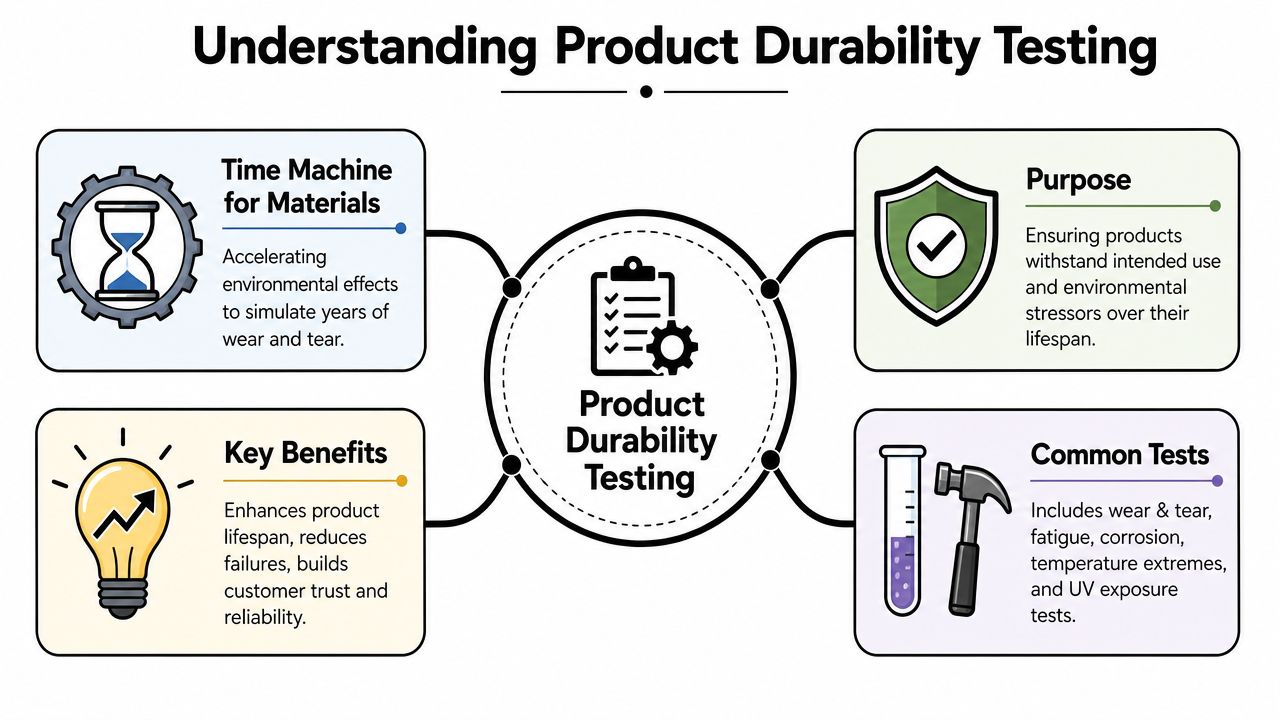
Think of product durability testing as a time machine for materials. It compresses long service exposure into a shorter test window so engineers can see how a product behaves after years of use, weather, and stress without waiting years to find out.
That's different from ordinary quality control. Quality control asks whether a part was made correctly today. Durability testing asks whether the design, material, coating, and assembly will still perform after real use piles up.
As described by ATS Lab's explanation of accelerated durability testing, accelerated durability testing is the standardized method used to determine long-term reliability by replicating years of wear and tear in a significantly shorter timeframe, enabling prediction of lifespan, strength, and performance under intended use conditions.
What durability testing looks for
A useful test program doesn't just push a part until it breaks. It tries to answer practical questions:
- Will the finish hold up outdoors
- Will repeated movement loosen or crack the part
- Will temperature and humidity shift performance
- Will the material fail gradually or suddenly
- Will a weak point show up at seams, bends, threads, or welds
For outdoor hardware, those questions apply to screws, post caps, gate hinges, balusters, post bases, joist hangers, and decorative inserts.
Why acceleration helps and where it can mislead
Acceleration is valuable because waiting for field aging is slow and expensive. A contractor can't pause a product decision for several winters just to confirm whether a coating system was a good idea. Testing speeds that feedback loop.
But acceleration only helps when the test matches the actual failure mode. If the stress is unrealistic, the result may be neat on paper and useless on site. A hardware sample that survives one aggressive lab condition may still fail outdoors if the actual problem is moisture retention around fasteners, coating damage during installation, or movement at a connection point.
A good durability test doesn't just create failure. It creates the same kind of failure the field will create.
That's why the best test programs combine controlled exposure, mechanical loading, inspection, and failure analysis. They're trying to understand not just whether a part failed, but how it failed and whether that failure pattern matches the jobsite.
Key Durability Tests for Outdoor Hardware
Outdoor hardware doesn't fail in one way. It corrodes, loosens, cracks, discolours, wears, and sometimes does all of that in sequence. The most useful tests each answer a different question about that process.
One of the more important principles comes from hardware fatigue work. In this explanation of shaker-based accelerated durability testing, field-measured loads are input into shakers to simulate fatigue under a protocol aligned with IEC 60068-1, and the work moves through five phases: pre-conditioning, initial examination, exposure, recovery, and final examination. That sequence matters because outdoor hardware rarely fails from load alone. Condition before loading and recovery after exposure both change what you learn.
Common durability test methods at a glance
| Test Name | What It Measures | Why It Matters for Your Project |
|---|---|---|
| Salt spray | Resistance to corrosive attack on metal and coatings | Helps assess whether hinges, screws, brackets, and post caps will resist rust in damp or salty environments |
| Tensile strength | How much pulling force a component or fastener can withstand | Matters for screws, bolts, anchors, and connectors that must stay locked under load |
| Fatigue testing | Resistance to repeated loading and unloading | Critical for gates, hinges, latches, railing connections, and any hardware that moves or flexes over time |
| UV exposure | Resistance to sunlight-driven fading and degradation | Important for coated post caps, decorative pieces, polymer inserts, and visible exterior finishes |
| Freeze-thaw cycling | Stability through repeated freezing and thawing | Useful for Canadian exterior projects where trapped moisture and winter swings punish coatings and joints |
Salt spray
Salt spray testing is the corrosion chamber people ask about most often. It exposes metal or coated parts to a controlled corrosive environment so weak finishes show themselves faster.
For a contractor, the practical value is simple. If you're installing hinges, screws, post bases, or decorative caps near moisture, road salt, or coastal air, corrosion resistance is not cosmetic. Rust changes fit, stains visible surfaces, and can eventually reduce section thickness at the exact points carrying load.
Tensile strength
A tensile test is a high-tech tug-of-war. The equipment pulls on a sample until it yields or breaks.
This matters most where the hardware's job is to keep parts from separating. Think lag bolts holding ledgers, anchors fixing post bases, carriage bolts clamping structural members, or screws resisting withdrawal and pull-through. Tensile strength won't tell you everything about long-term field life, but it does show whether the underlying material has enough backbone for the job.
Fatigue testing
Fatigue is where many outdoor assemblies get into trouble. A hinge can carry a gate just fine in a static sense and still fail from repetition. The same goes for brackets that see slight movement, fasteners in vibrating assemblies, or inserts that experience small but constant flexing.
The useful question isn't “Can this part survive one big load?” It's “Can it survive normal use repeated over and over without micro-damage turning into looseness or fracture?”
If a part moves even slightly in service, fatigue resistance matters more than most buyers realise.
UV exposure
Sunlight attacks more than colour. UV can embrittle polymers, chalk coatings, and degrade the appearance of visible accessories long before a structural problem appears.
That matters for black post caps, coated decorative hardware, baluster elements, and trim components where appearance is part of the value. When a finish fades unevenly or starts breaking down at corners, the product looks old early, even if it hasn't fully failed yet.
Freeze-thaw cycling
Canadian winters expose a weakness many generic product sheets barely acknowledge. If moisture gets into a coating defect, seam, crevice, or fastener interface and then freezes, the resulting expansion can accelerate damage fast.
Freeze-thaw cycling is especially relevant for:
- Post caps and decorative tops: Water can sit at joints and edges.
- Fastener heads and recesses: Tiny coating breaks become entry points.
- Base hardware near grade: Wet debris extends exposure time.
- Gate hardware: Movement plus winter moisture is a hard combination.
The best reading of any one test is never in isolation. Corrosion, fatigue, UV, and freeze-thaw work together in the field. That's why experienced specifiers look for patterns across several tests rather than one impressive line item.
Lab Tests Field Tests and DIY Checks
Lab testing gives you control. Field testing gives you realism. DIY checks give you a quick filter before you buy or install. None replaces the others.

Lab testing finds patterns
A good lab removes variables on purpose. Temperature, humidity, load, exposure time, and inspection intervals are controlled so results can be repeated. That makes labs strong at comparing coatings, metal grades, fastener designs, and assembly details.
The weakness is obvious. The lab can't reproduce every installation mistake, every drainage issue, or every weird site condition. If a product only performs in ideal mounting conditions, the field will expose that eventually.
Field testing reveals behaviour
Field trials are slower, messier, and often more honest. Hardware installed on an exposed deck by a lake won't age the same way as the same hardware on a sheltered inland fence. Sun angle, splash, wind, debris, and maintenance habits all affect what happens.
That's why serious evaluation uses both approaches. The lab identifies likely weak points quickly. The field confirms whether those weak points matter in actual service.
DIY checks that catch a lot
You don't need a chamber or shaker table to reject questionable hardware. A few simple checks can save trouble:
- Magnet check: A magnet can reveal when “stainless” doesn't behave the way you expected. It's not a full metallurgy test, but it can prompt better questions before purchase.
- Coating inspection: Look for thin spots, rough edges, pinholes, chips, and uneven gloss. Coating defects often start at corners and punched areas.
- Thread and head quality: Poorly formed screw heads, ragged threads, or burrs often signal weak process control.
- Fit-up check: Hinges, caps, and brackets should seat cleanly. Forced fit damages coatings during installation.
- Packaging review: Hardware tossed loosely together often arrives pre-damaged, especially coated decorative parts.
Buy one sample first when you can. Handling the actual part usually reveals more than a polished product listing.
DIY checks won't replace formal product durability testing, but they're excellent at catching poor finish quality, weak fabrication, and sloppy handling before those problems get installed into your project.
How to Read a Durability Test Report
A test report looks technical because it is technical, but the reading strategy is straightforward. Don't start with the marketing claim. Start with the test conditions. If those aren't clear, the conclusion doesn't mean much.
In professional-grade testing, precision is the whole point. California's CTM-229 method for aggregate durability is a good example of that mindset. It specifies a specimen weight of 2550 g ± 25 g and a test duration of 10 min ± 15 s, with drying to constant weight at 230˚F ± 9˚F before testing. Hardware testing worth trusting follows the same discipline. Tight inputs make repeatable results possible.
The first things to look for
When reading a report or spec sheet, check these items first:
- Test method named clearly: If a manufacturer says a product was “tested for durability” but won't identify the method, that claim is weak.
- Sample condition: Was the part tested as manufactured, after coating, after assembly, or after pre-conditioning?
- Failure criteria: Did the test stop at first cosmetic change, functional impairment, structural failure, or something else?
- Environment relevance: A report should tell you enough to judge whether the test resembles your use case.
Translate the report into jobsite meaning
A report matters only if you can connect it to your project. A hinge on a gate, a screw in treated lumber, and a decorative cap on an exposed post do not need the same type of evidence.
Ask practical questions such as:
- Does the test reflect movement or only static loading?
- Was the coating evaluated after mechanical handling?
- Did the report check appearance only, or actual function?
- Is the environment in the report close to inland, coastal, high-moisture, or freeze-thaw service?
If you're making maintenance and replacement decisions across a portfolio of properties, a reliability framework helps. Forge Reliability's guide for actionable RCM decisions is useful because it frames durability data around practical maintenance planning rather than isolated lab numbers.
The best report is the one that tells you what can fail first, under what conditions, and how that failure will show up on the job.
What should make you cautious
Be careful when a report is heavy on claims and light on setup. Vague wording, missing test conditions, and broad statements about “extreme durability” usually signal marketing more than engineering. A short, clear report with named methods and defined pass criteria is often more trustworthy than a glossy sheet full of adjectives.
Choosing Hardware That Withstands Canadian Weather
Canada punishes bad assumptions. Hardware that survives a generic lab sequence can still struggle in service if the product was never evaluated with local exposure in mind. Coastal salt, prairie temperature swings, freeze-thaw stress, and long wet periods all attack hardware differently.
That's why region-specific thinking matters more than brand slogans. Contrarian evidence in Transportation Research Record challenges the idea that generic accelerated tests perfectly predict real-world durability in varied climates, and it specifically notes that local factors such as humidity, salt air, and extreme temperature swings can alter outcomes significantly. For Canadian projects, that's the central issue.
Match the hardware to the exposure
A deck screw on an inland backyard build doesn't face the same risks as a fastener on a lakeside stair, a pool fence gate, or a coastal deck. The smart move is to select hardware by exposure category first, appearance second.
For example:
- Wet and corrosive settings: Stainless steel fasteners are often the safer choice where moisture lingers or corrosive exposure is possible. For those applications, dedicated stainless steel fasteners make more sense than trying to stretch a lower-grade option past its comfort zone.
- Visible decorative elements: Post caps, finials, and inserts need both corrosion resistance and finish stability. A weak coating ruins the look long before the part is unusable.
- Moving gate hardware: Hinges and latches need fatigue resistance and corrosion resistance together. A thick-looking part isn't enough if repeated motion works on the pin, leaves, or mounting points.
Where product selection goes wrong
Buyers often focus on one feature and ignore the rest of the system. They choose a coated post cap but pair it with poor fasteners. They buy corrosion-resistant screws but mount them into a connection detail that traps water. They choose decorative hardware based on shape and finish without asking how the coating behaves at edges and fastener holes.
Products from brands such as Decorex Hardware and Nuvo Iron become a useful comparison point. Both are visible in the deck and fence accessory market, but the right choice still depends on the exact exposure, material pairing, and installation detail. Product lines that include post caps, gate hardware, balusters, brackets, and fasteners should be judged as installed systems, not isolated catalogue pieces.
What tends to work better in practice
For Canadian exterior work, a more durable selection usually has these traits:
- Corrosion-resistant base material: Not just a decorative finish over vulnerable metal.
- Uniform coating coverage: Especially around edges, bends, and contact points.
- Clean fabrication: Sharp burrs and rough punched edges often become early coating failure points.
- Compatibility across components: Fastener, bracket, cap, and post material should work together.
- Realistic use-case fit: A decorative item on a sheltered porch has a different threshold than hardware on an exposed fence line.
In cold climates, the detail that sheds water usually outperforms the detail that merely looks heavier.
Think in assemblies, not parts
A fence or deck doesn't fail one SKU at a time. It fails as an assembly. Post caps, screws, brackets, anchors, hinges, and inserts all influence one another.
That's why practical buyers look at the whole package:
| Project area | What to prioritise |
|---|---|
| Deck framing connections | Fastener corrosion resistance, withdrawal strength, compatibility with treated lumber |
| Rail systems | Connector stiffness, coating integrity, long-term movement resistance |
| Fence gates | Hinge fatigue resistance, latch fit, corrosion at moving interfaces |
| Post tops and decorative accents | Finish durability, UV stability, water-shedding geometry |
| Base connections | Moisture management, debris accumulation, coating protection near grade |
The hardware that lasts isn't always the one with the loudest spec claim. It's usually the one whose material, finish, and design all fit the climate it's going into.
Your Durability Checklist for Specifying Hardware
Most failures can be prevented before the first hole is drilled. A short specification checklist catches the issues that cause the most callbacks, replacements, and arguments later.
Use this before you buy
Keep this list on your phone or in the truck:
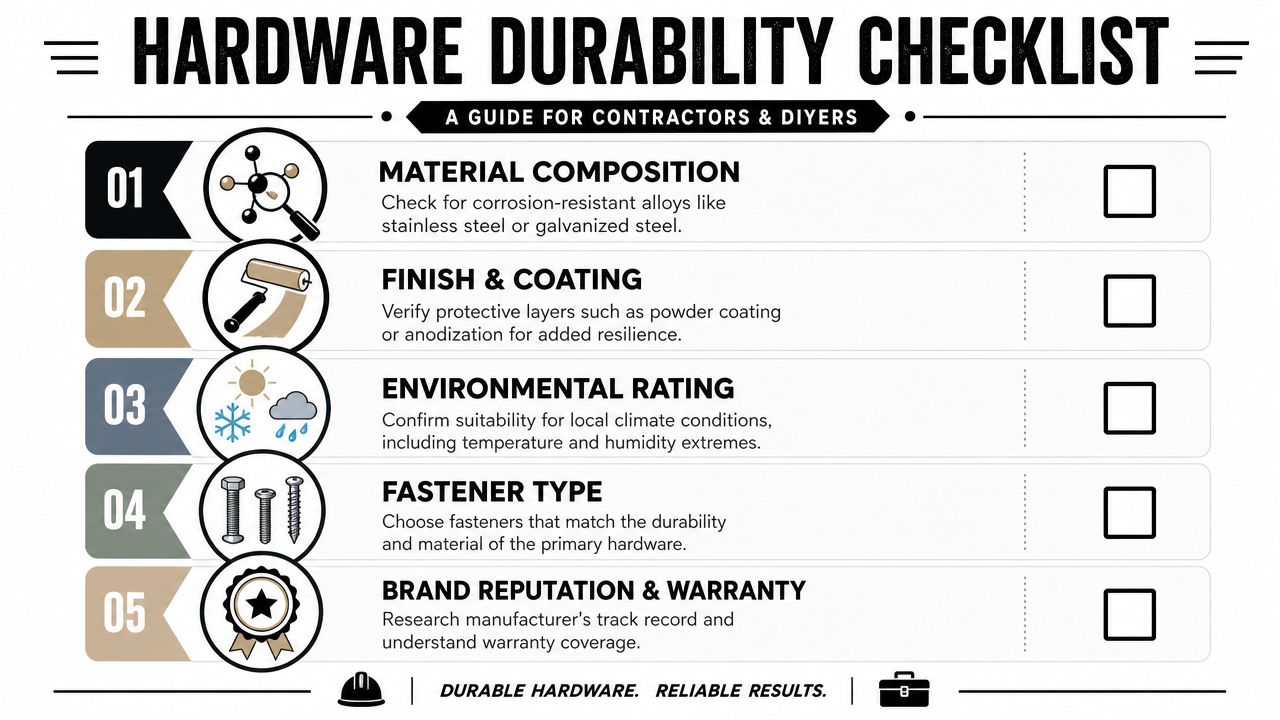
- Confirm material composition: Check whether the part is stainless steel, galvanized steel, coated steel, aluminium, or a mixed-material assembly. Don't assume a black finish means corrosion resistance.
- Check coating quality: Look for complete, even coverage. Pay attention to corners, holes, threads, and cut edges.
- Match the fastener to the hardware: The screw or bolt should be at least as durable as the bracket, hinge, cap, or base it secures.
- Verify local climate fit: Coastal, poolside, shaded wet areas, and freeze-thaw exposure all deserve stricter scrutiny.
- Inspect moving parts closely: Hinges, latches, and gate kits should move cleanly without slop, binding, or finish damage at pivot points.
- Review installation detail: Water-shedding geometry and drainage matter just as much as metal choice.
- Ask for actual test information: Named methods and clear pass criteria beat vague “weather-resistant” language.
- Check compatibility with treated lumber: Fasteners and connectors need to suit the wood treatment in the assembly.
- Inspect packaging damage: Chipped coatings before installation are an early warning sign.
- Keep a maintenance plan: Even good hardware lasts longer when debris, standing moisture, and loose connections are addressed early.
Use this after installation too
Durability checking doesn't end at purchase. A brief post-install review helps confirm the system wasn't compromised during the build.
Look for coating damage from tools, overdriven fasteners, metal shavings left on finished surfaces, and hardware installed in a way that traps water. Seasonal inspections also matter. A simple deck inspection checklist is useful for catching movement, corrosion, and wear before they become structural or cosmetic headaches.
Hardware specification is risk control. The more exposed the project, the less room there is for guesswork.
Conclusion Building to Last Is Smart Business
Durability is rarely the cheapest line item at purchase. It's often the cheapest decision over the life of the project.
When you understand product durability testing, you stop buying hardware based on appearance alone. You start looking at failure modes, coatings, movement, corrosion paths, and climate fit. That changes the quality of your decisions. Contractors reduce callbacks. Property managers avoid recurring replacement cycles. Homeowners get safer decks and fences that keep their appearance longer.
The same mindset shows up in other demanding environments. Labs making long-term surface and material decisions rely on application-specific comparisons, and this overview of casework decisions for research labs is a good reminder that durability always depends on matching the material system to the use case.
Build with hardware that suits the climate, the load, and the details of the assembly. That's what lasts.
When you're ready to source deck and fence hardware with practical options for post caps, fasteners, brackets, balusters, hinges, and finishing details, browse XTREME EDEALS INC.. It's a straightforward place for DIYers and trade professionals to compare products, plan complete assemblies, and choose hardware that fits the way outdoor projects are built.