

You're probably dealing with some version of the same problem every hardware shop, contractor trailer, and garage workshop runs into. A half-open box of deck screws is sitting on one shelf, another partial box is buried in the truck, the black post caps you know you ordered last month have vanished, and someone just told a customer, “I think we have those joist hangers somewhere.”
That isn't a stock problem. It's a control problem.
Most writing on hardware inventory management talks about laptops, servers, and office devices. Useful in its own lane, but it doesn't help much when you're managing carriage bolts, wedge anchors, balusters, gate hinges, post base brackets, and three finishes of the same decorative cap. Physical hardware has its own kind of mess. Packaging gets torn, quantities get split across jobs, returns come back dusty, and one “miscellaneous fasteners” bin can ruin a whole afternoon.
A solid system doesn't need to be fancy. It needs to be consistent. If you know what each item is called, where it lives, and how it moves in and out, you stop overbuying, stop wasting labour time searching, and stop disappointing customers or crews when the right part should have been on hand.
From Chaos to Control Your First Steps
The first fix is usually the least glamorous one. Stop treating inventory as a pile of products and start treating it as a list of individual stock lines with names, locations, and rules.
That matters more than is commonly understood. In California, 68% of hardware retailers report inventory discrepancies due to lack of unified tracking for non-IT assets, according to Tanium's overview of hardware inventory management. That lands directly on small retailers, deck builders, fence installers, and property maintenance crews who need accurate counts on physical goods, not just office equipment.
Start with product families
Break your stock into practical groups that match how people shop and pull material:
- Fasteners. Deck screws, wood screws, lag bolts, carriage bolts, washers, nuts, anchors
- Post accessories. Pyramid post caps, ball caps, solar caps, finials
- Structural connectors. Joist hangers, post base brackets, angle brackets, straps
- Gate and fence hardware. Hinges, latches, inserts, balusters
- Job consumables. Drill bits, blades, abrasives, adhesives, touch-up items
If a customer asks for a black 4×4 pyramid post cap, nobody should be searching through “decorative hardware” and “outdoor bits.” It belongs in one category, with one stock name, in one assigned location.
Build the system before you buy more stock
A lot of people try to organise inventory by buying more shelving. Shelving helps, but it doesn't solve bad naming.
A practical setup starts with:
- One product name for each item
- One SKU for each variant
- One home bin for each SKU
- One person responsible for count accuracy
That's the bedrock. Without it, every restock creates more confusion.
If two people use different names for the same item, your inventory is already wrong.
For a useful outside framework on how to think about stock as part of a larger asset process, the Reworx Recycling asset guide is worth a read. The same discipline applies whether you're tracking office equipment or bins of sleeve anchors. Define the item, assign ownership, and keep one record that matches the physical world.
Use real product logic, not vague labels
Good naming sounds boring, but it saves time every day. “Post Cap” is too broad. “4×4 Black Pyramid Post Cap” is usable. “Deck Screw” is weak. “Deck Screw 2-1/2 inch Exterior Brown 1 lb” is workable.
Think in terms of the products you move, such as Decorex Hardware post caps, deck screws in multiple lengths and coatings, joist hangers by size, and carriage bolts by diameter and finish. If the label isn't specific enough for a new employee to put away correctly, it isn't specific enough.
Building Your System Categorization SKUs and Bins
A reliable hardware inventory management system has three layers. First, you group similar products. Second, you assign a unique SKU to each sellable variation. Third, you give that SKU a fixed physical home.
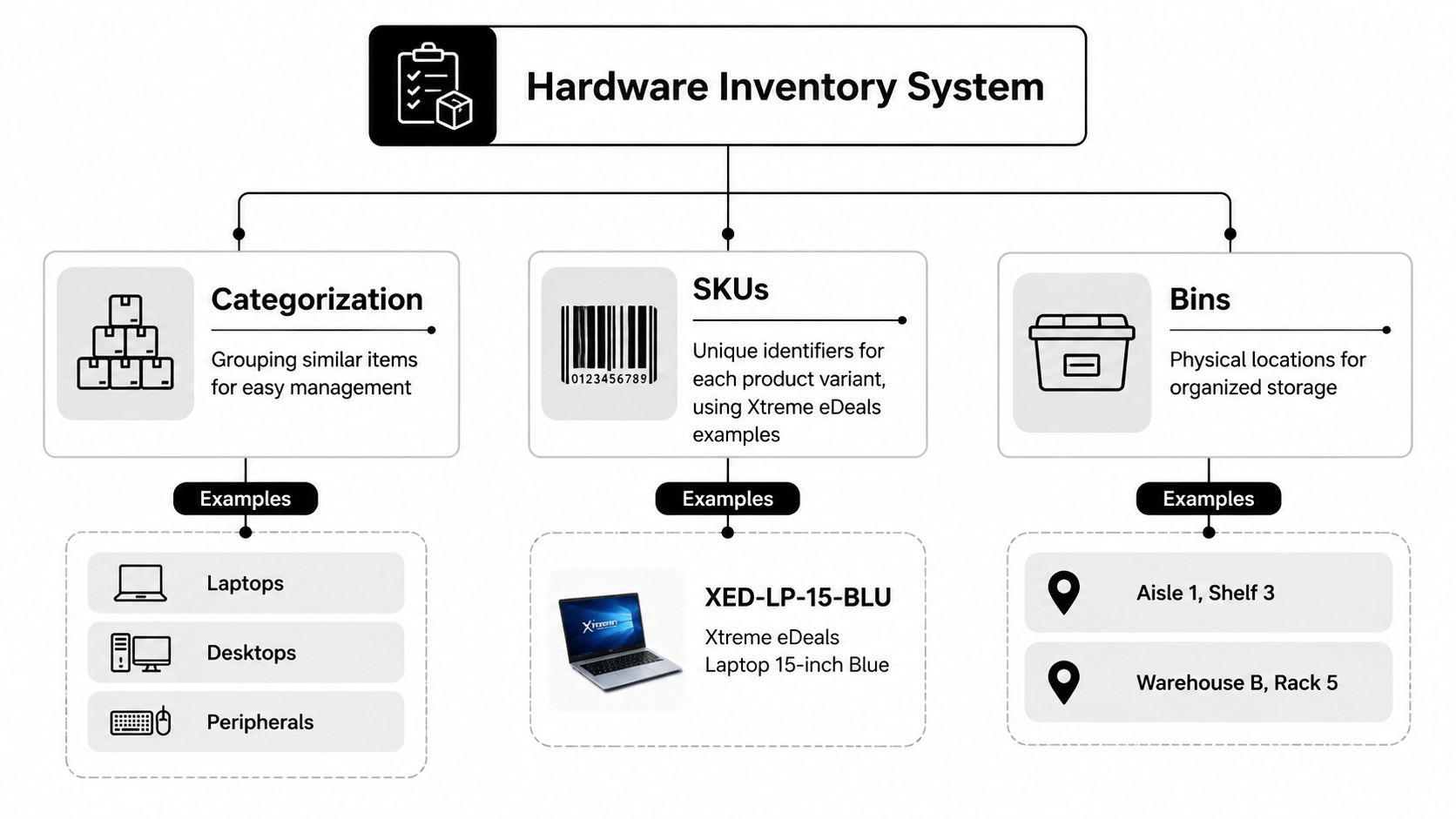
Categorisation that matches the real shelf
The category structure should follow how your team picks stock, not how a wholesaler prints its catalogue. A contractor's trailer and a small hardware store both benefit from plain categories such as fasteners, post caps, connectors, hinges, and anchors.
Within those, create sub-groups that reduce decision time:
Fasteners
- Deck screws
- Carriage bolts
- Lag bolts
- Nails
- Washers and nuts
Post caps
- Pyramid
- Ball
- Solar
- Decorative metal
Connectors
- Joist hangers
- Post bases
- Angle brackets
That structure keeps similar products together while still letting you separate close variants. A 4×4 black pyramid cap should never sit in the same “general outdoor hardware” bucket as a 6×6 copper cap.
SKU rules that people can actually follow
A SKU doesn't need to be elegant. It needs to be consistent.
For example:
| Product | Simple SKU |
|---|---|
| Decorex Hardware 4×4 Black Pyramid Post Cap | DEC-PC-PYR-4B |
| Decorex Hardware 6×6 Copper Ball Post Cap | DEC-PC-BAL-6C |
| Exterior Deck Screw 2-1/2 inch Brown | FAS-DS-250-BRN |
| Galvanised Joist Hanger 2×8 | CON-JH-28-GAL |
A good SKU usually captures brand or family, product type, size, and finish. That's enough for most physical hardware operations.
The value is proven in practice. In the CA region, businesses that implement unique identifiers like serial numbers or well-structured SKUs report a 25% reduction in asset discrepancies within the first year, according to Quadbridge's hardware inventory management guidance.
Practical rule: If one finish, size, or pack count changes, give it a different SKU.
That matters with construction hardware because close-enough substitutions cause errors. A 3-inch structural screw is not the same item as a 2-1/2 inch deck screw, even if both come in similar boxes and colours.
Bins are where systems succeed or fail
Even a perfect spreadsheet collapses if products don't have fixed locations. Every SKU needs a bin, shelf, hook, rack, or pallet slot that doesn't drift.
Use location codes that read plainly:
- A1-S2-B4 for Aisle 1, Shelf 2, Bin 4
- RACK-C-03 for connector rack, bay 3
- TRAILER-LEFT-05 for mobile contractor stock
Location naming should be visible from standing height. Printed labels beat handwriting. Bigger labels beat tiny labels. Open bins are fine for bulky brackets. Small divided bins work better for washers, anchors, and screws.
If you're tightening up a crowded stockroom, this guide on parts room storage optimization gives practical ideas for labels, bin logic, and layout discipline that transfer well to hardware shelves.
For real product grouping examples, browse a live tools and hardware catalogue such as tools and hardware selections. The useful lesson isn't the storefront itself. It's the product separation. Similar items are easier to find when names, variants, and categories are clear.
Cycle counts and full audits are not the same job
People often argue over whether they should do cycle counts or a full physical audit. The right answer is both, used differently.
| Method | Best use | Example |
|---|---|---|
| Cycle count | Fast-moving or high-problem items | Count deck screws, carriage bolts, and post base brackets every week |
| Full audit | Whole-business reset and reconciliation | Count all stock during a slow period or year-end close |
Cycle counts keep the errors small. Full audits catch drift across the entire operation.
If a contractor burns through boxes of structural screws every week, those need frequent checks. If decorative post caps move slowly, a scheduled full audit may be enough to confirm what's really sitting on the shelf.
The Art of Counting Cycle Counts vs Full Audits
A count only works if it fits the pace of the business. Shut down a busy yard for a full audit at the wrong time and the team will hate the process. Never count at all, and the records become fiction.

What cycle counts are good at
Cycle counting is the steady maintenance job. You count a small slice of inventory on a schedule instead of trying to verify everything at once.
For physical hardware, this works best on items that disappear quickly, get split into partial boxes, or are often borrowed for jobs:
- Deck screws and framing screws
- Washers, nuts, and wedge anchors
- Joist hangers and post bases
- Popular post cap sizes and finishes
A contractor can count one section of fasteners every Friday afternoon without stopping installs. A retailer can rotate counts by aisle before opening.
When a full audit earns its keep
A full audit is slower, but it resets trust in the numbers. It's useful after a peak season, before year-end reporting, after a warehouse move, or when the team already knows the records are off.
Canada's Business Development Bank says organisations conducting quarterly inventory audits can reduce inventory discrepancies by up to 40% compared to annual checks, as cited in this hardware inventory best-practices article. That fits physical hardware well because small count errors multiply quickly when boxes are opened, split, returned, and reassigned to jobs.
Count the items that cause the most trouble more often than the items that mostly sit still.
The tipping point between spreadsheets and software
A spreadsheet is enough when one person handles stock, one location stores it, and the product count is still manageable. It starts failing when the same SKU lives in the shop, on a truck, and at a job site at the same time.
Here's where software starts to beat manual tracking:
- Multiple locations. Shop, trailer, warehouse, site container
- Frequent transfers. Material moves between jobs constantly
- High SKU overlap. Similar sizes and finishes are easy to confuse
- Returns and credits. Restocking decisions need records
- Reordering pressure. You need low-stock warnings before crews run dry
A good practical benchmark is pain. If someone spends too much time hunting for counts, correcting duplicate entries, or phoning the yard to ask whether there are enough post caps for tomorrow's install, the manual method has stopped paying for itself.
For builders who want a field-ready process mindset, a deck inspection checklist is a useful example of why repeatable checklists matter. The same discipline that catches a missed fastener or loose connection on site also keeps stock records honest in the yard.
Choosing Your Tools From Spreadsheets to Software
The best tool is the one your team will use every day. Plenty of inventory systems fail because the owner bought software before fixing the receiving process, return process, and naming rules.
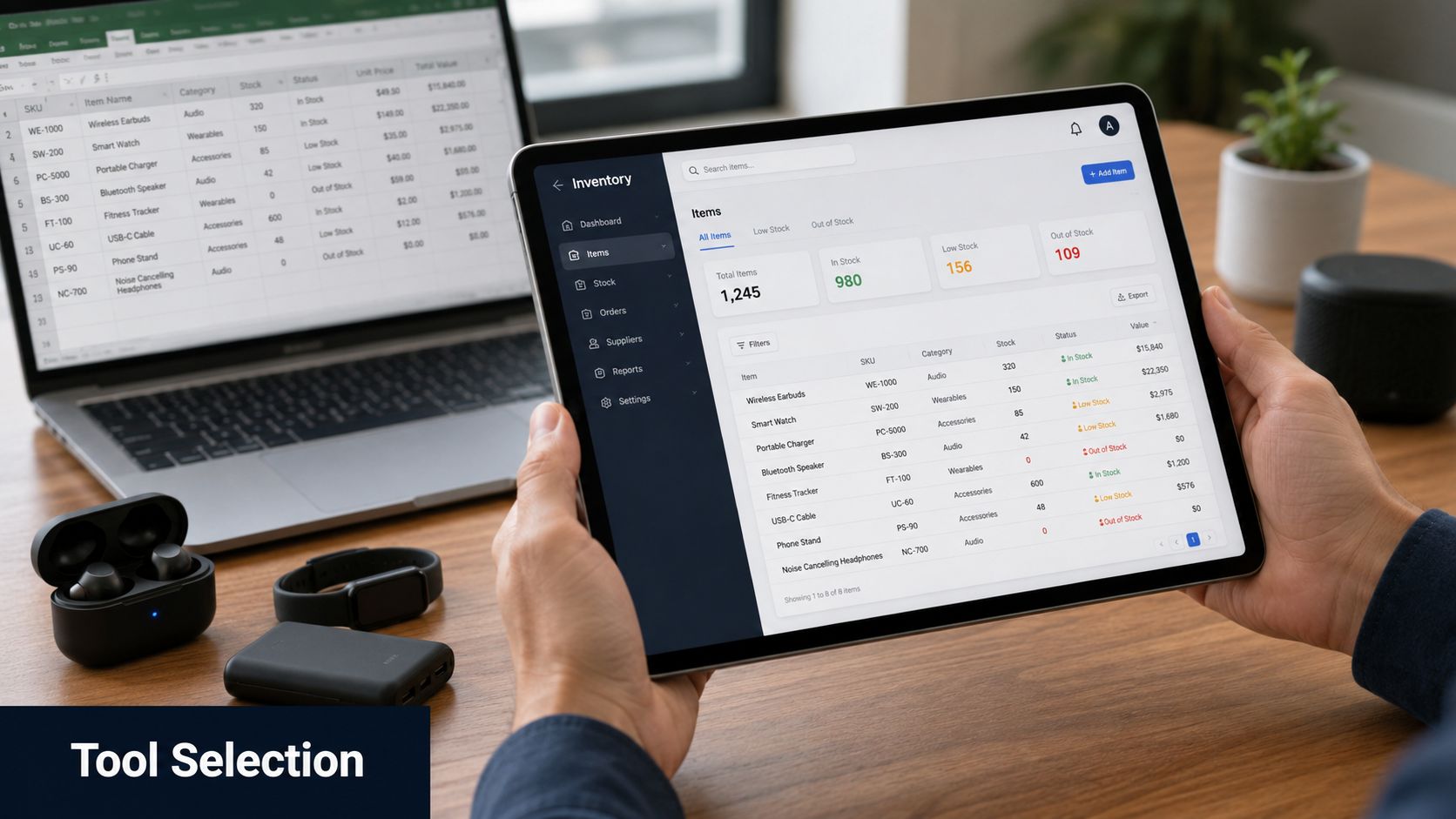
The broader market is moving toward automation. The global inventory management software market is projected to reach $5.52 billion by 2034, with North America accounting for 35.01% of the market, according to Fortune Business Insights. That projection tells you where operations are heading, but it doesn't mean everyone needs software on day one.
When a spreadsheet is enough
A spreadsheet works well for a solo contractor, a small shed-based operation, or a compact retail back room with a controlled number of items.
Keep the columns simple:
| SKU | Product name | Category | Unit | Qty on hand | Bin location | Reorder note | Supplier |
|---|
That's enough to manage joist hangers, carriage bolts, and decorative caps if one person updates it at the moment stock moves.
What breaks the spreadsheet isn't size alone. It's delay. If boxes come in on Monday and the sheet gets updated on Thursday, your count is wrong for three days.
Receiving stock without creating fresh errors
A shipment of joist hangers should follow the same routine every single time:
- Match the packing slip to the purchase order.
- Open and inspect for damage, wrong size, wrong finish, or short count.
- Assign or confirm the SKU.
- Update the quantity in the system before the box hits the shelf.
- Put every unit into its assigned bin.
- Flag any discrepancy immediately, not at month end.
The same goes for deck screws and post caps. Don't leave them on a “to be sorted” pallet unless someone owns that pallet and clears it the same day.
Good inventory records are made at receiving. They're rarely fixed later without extra labour.
What software should do for a hardware business
Dedicated software earns its keep when it removes repetitive clerical work. For physical hardware, the most useful features are usually practical, not flashy:
- Barcode or mobile scanning so staff can receive and count quickly
- Multi-location tracking for yard, warehouse, trailer, and job site
- Clear item variants for size, finish, pack count, and brand
- Reorder alerts for core items like deck screws and anchors
- User permissions so not everyone can edit counts freely
- Return workflows to separate sellable returns from damaged stock
Software should make discipline easier. It won't create discipline by itself.
A short walkthrough helps when teams are comparing digital workflows and paper habits:
Returns need their own process
Returns are where plenty of stock systems go soft. A customer hands back a box of fasteners, someone drops it near the counter, and it never gets checked in properly.
Use a basic return routine:
- Receive the item and attach the original SKU if known
- Inspect condition before anything goes back into saleable stock
- Separate opened from unopened
- Update the quantity and status immediately
- Restock only after the item passes inspection
A dusty box of post caps with missing pieces shouldn't return to prime shelf stock. Mark it, isolate it, and decide whether it's resaleable, discounted, or scrap.
Mastering the Flow Receiving Returns and Reordering
Inventory accuracy lives in the handoffs. Buying good products doesn't protect you from bad process. What protects you is a repeatable flow for incoming stock, customer returns, and replenishment decisions.
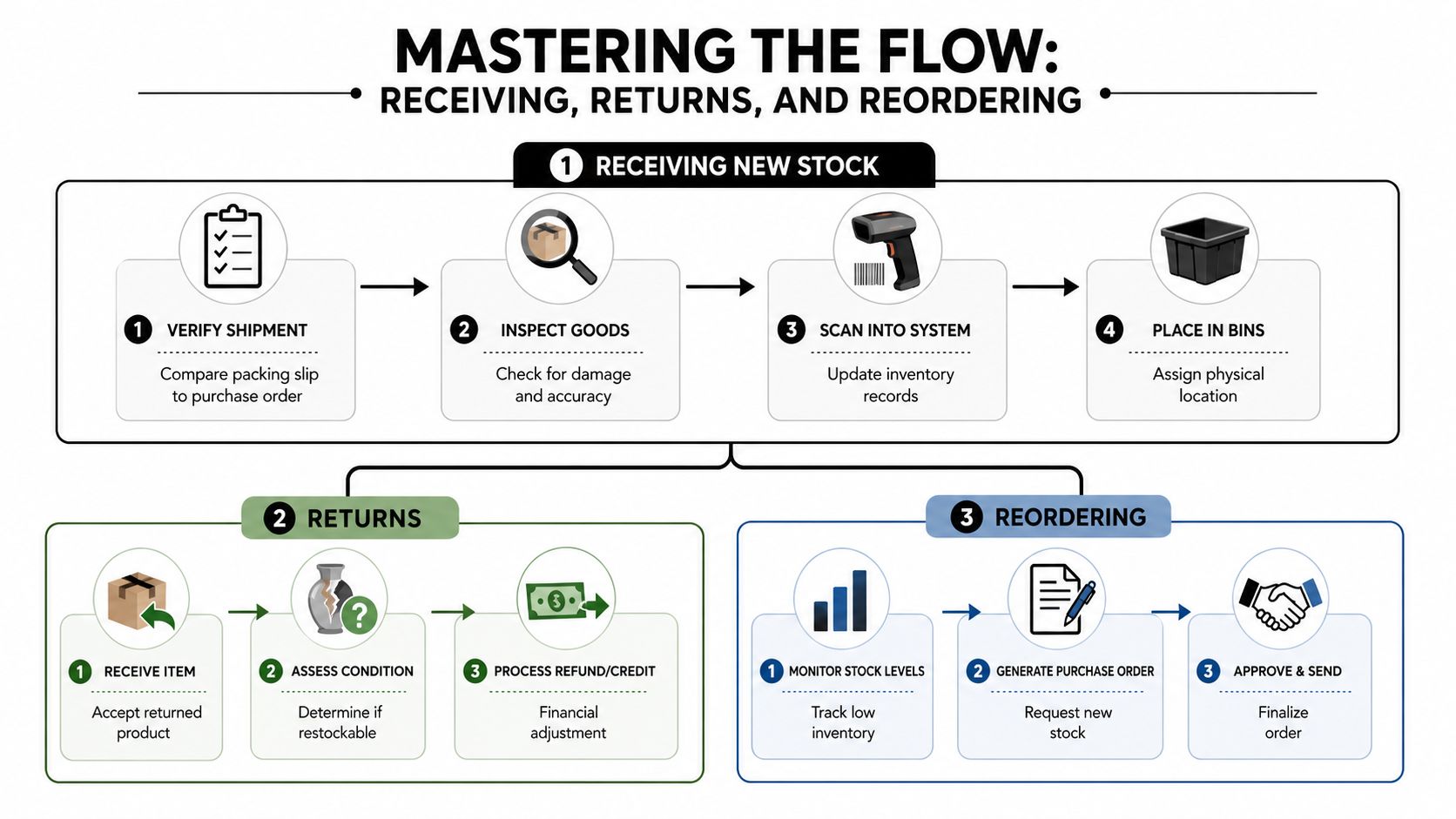
Receiving without shortcuts
Receiving is where most stock errors first enter the building. The common mistake is treating the delivery as complete the moment it arrives. It isn't complete until the stock is verified, recorded, and shelved correctly.
A dependable receiving checklist looks like this:
- Verify the shipment against the purchase order and packing slip.
- Inspect each product family for damage, finish mismatch, and quantity problems.
- Record the received quantity under the right SKU.
- Assign the physical location before staff start pulling from the shipment.
- Report shortages or supplier errors while the paperwork is fresh.
If a carton of black 4×4 pyramid post caps arrives but gets parked in the aisle for two days, your system says you have stock that the sales floor and pick team still can't access properly.
Handling returns without contaminating stock
Returns need a quarantine step. That's especially true for hardware because packaging can hide missing pieces.
Use three return statuses:
| Return status | What it means | What to do |
|---|---|---|
| Resaleable | Unopened or verified complete | Restock to primary bin |
| Review needed | Opened, dusty, uncertain count | Hold in inspection area |
| Unsaleable | Damaged, incomplete, corroded | Remove from active stock |
That small separation prevents the classic problem of “phantom stock,” where the system shows ten units available but four are sitting in a damaged box near the service desk.
Reordering based on movement, not guesswork
Most small operators reorder by memory. That works until a busy week empties a shelf faster than expected.
For staples like 2-inch deck screws, joist hangers, lag bolts, and post bases, use a simple reorder rule based on actual movement patterns. Watch which items disappear first, which ones are tied to seasonal demand, and which supplier shipments tend to arrive slowly. Then set a trigger point that gives you enough buffer to keep working without piling up dead stock.
The same principle helps with supplier conversations. If one vendor consistently ships complete, clearly labelled boxes of carriage bolts and another sends mixed or damaged cartons, your receiving records should show it. Inventory data isn't only for counting. It sharpens purchasing decisions.
The KPIs that actually matter in a hardware setting
You don't need a wall of dashboards. You need a few measures that tell the truth.
Start with these:
- Inventory turnover. How quickly a product line moves through stock
- Sell-through rate. How much of received stock sells in a useful time frame
- Stock-out pattern. Which items keep going unavailable at the wrong time
- Return quality notes. Which products come back damaged, incomplete, or mis-picked
Turnover helps you spot slow-moving decorative items that are eating shelf space. Sell-through helps you judge whether a special finish or niche bracket is worth carrying deeper. Return notes tell you whether the issue is product quality, picking errors, or customer confusion.
For operations serving different regions or job sites, delivery options matter too. Clear logistics reduce ad hoc substitutions and emergency purchases. A customer-facing reference such as Canadian shipping options shows how much expectations around timing and fulfilment shape inventory planning.
The best reorder system is boring. It triggers at the right time, follows the same rule, and doesn't depend on somebody's memory.
Key Metrics and Common Inventory Pitfalls
A lot of people assume inventory trouble comes from bad counts. More often, it comes from bad habits around ownership, naming, and location discipline.
The ugliest mistakes are usually ordinary ones. A shelf marked “miscellaneous hardware.” A return box under the counter. A handful of post base brackets borrowed for a site job and never logged out. Those aren't dramatic failures. They're daily leaks.
The metrics worth watching
Keep your scorecard grounded in operations:
- Turnover by category tells you whether fasteners, caps, or connectors are moving at the rate you expected.
- Stock-out frequency shows which items are costing you rushed orders or lost sales.
- Count accuracy by zone helps pinpoint whether the problem sits in receiving, the yard, the trailer, or the returns area.
- Ageing stock review highlights products that keep sitting while cash stays tied up on the shelf.
These aren't finance-only measures. They help the person ordering deck screws and the person picking decorative hardware make better calls.
Vague ownership creates real loss
One of the most expensive assumptions in hardware inventory management is “the team” owns the stock. That usually means nobody owns it.
Common pitfalls like vague ownership assignments lead to up to 30% asset misplacement in CA tech firms, according to AssetCues on inventory tracking pitfalls. The same problem shows up in construction and retail with physical goods. If stock is assigned only to “yard,” “shop,” or “crew,” parts drift, counts weaken, and replenishment decisions get worse.
Use named responsibility instead:
- Receiving lead confirms inbound quantity and condition
- Stock controller or manager owns master count accuracy
- Crew lead signs out job-site material transfers
- Counter staff process returns the same day
Three trouble spots that deserve zero tolerance
A bin without a precise label becomes a hiding place for mistakes.
First, kill the generic bin. “Misc. screws” becomes a magnet for leftovers that should have been counted back into proper SKUs.
Second, process returns immediately. Don't set opened boxes aside for later.
Third, give leftover job material a formal check-in routine. If half a box of carriage bolts returns from a fence install, it needs inspection, count verification, and re-entry into stock or a scrap decision. Otherwise it becomes untrusted inventory that clutters shelves and poisons the numbers.
A strong system doesn't eliminate every variance. It stops small variances from becoming normal.
Putting It All Together Your Path to Efficiency
The best hardware inventory management systems aren't complicated. They're steady. Products are named clearly, every SKU has a location, counts happen on schedule, returns are inspected before restocking, and reorders follow real usage instead of hunches.
That's how a messy pile of deck screws, gate hinges, post caps, washers, wedge anchors, and joist hangers turns into a working operation. Not perfect. Working. Staff know where to look. Buyers know what to order. Crews stop wasting time hunting. Customers hear “yes, we have it” more often.
What a dependable system looks like in practice
It usually comes down to a few essential factors:
- One item, one name, one SKU
- One SKU, one primary location
- Every movement recorded when it happens
- Returns inspected before they re-enter stock
- Regular counts on the items that create the most pain
If that sounds simple, good. It should.
Where the real gains show up
A tighter system saves money, but the day-to-day wins are often more visible than the accounting line. The team moves faster. Job prep becomes calmer. The sales counter gives better answers. Ordering gets less emotional.
For operators who want a wider industrial perspective on tagging, visibility, and process discipline, this piece on optimizing industrial asset tracking is a useful companion read. The setting is broader than a hardware shelf, but the operating principle is the same. Clear identification beats memory every time.
Know what you have, know where it is, and know when you need more.
That rule works whether you're running a small hardware retail room, managing contractor stock across multiple sites, or just trying to stop buying duplicate boxes of fasteners for the same deck job. Consistency beats complexity. A plain system used every day will outperform a clever system that only gets updated when things are already off the rails.
If your stockroom, trailer, or back counter feels chaotic today, that doesn't mean you need a giant overhaul. It means you need a starting point and the discipline to stick with it. Name the items properly. Label the bins. Count the troublemakers first. Tighten receiving. Tighten returns. Then keep going.
XTREME EDEALS INC. makes that job easier with a broad catalogue of deck and fencing accessories, fasteners, post caps, joist hangers, hinges, anchors, and other project hardware for DIYers, contractors, and small retailers. If you want dependable supply from one source, browse XTREME EDEALS INC. for practical products that fit the kind of inventory system described above.