
You've installed a gate that looks perfectly square, yet it drifts open whenever the wind catches it. Or perhaps the opposite is happening: the gate closes with enough force to rattle the latch, and you're worried that the next adjustment will make it worse. The right spring loaded gate hinges can solve both problems, but only when the hinge type, spring tension, gate structure, and local requirements work together.
This guide walks through that decision in practical terms, using Decorex Hardware products stocked at Xtreme eDeals alongside Nuvo Iron alternatives and related gate hardware. By the end, you should know what to buy, how to mount it, how to tune the spring, and when a different closing system makes more sense.
Why Your Gate Won't Stay Closed and How Spring Loaded Hinges Fix It
A garden gate that won't stay shut usually has a simple mechanical problem. Ordinary hinges let the gate pivot, but they don't provide the return force needed to bring it back to the latch. A slight post movement, a heavy gate panel, or a latch that sits just out of alignment can leave the gate open after every use.
A spring-loaded hinge combines three jobs in one assembly: it supports the pivot, pulls the gate towards its closed position, and helps the panel meet the latch. That makes it useful for garden entrances, driveway gates, pool barriers, and other openings where people shouldn't have to remember to close the gate manually.
Practical rule: A self-closing hinge can only close the gate reliably if the post, gate frame, hinges, and latch are aligned well enough for the spring to finish the job.
The outcome depends on the symptom. If the gate drifts open, the spring may need more tension or the hinge may be carrying a sagging panel. If it slams, the tension may be excessive, the gate may be too light for the selected hardware, or the closing path may have too little resistance. If it reaches the frame but doesn't latch, adjusting the spring alone won't fix a misaligned strike.
Spring-loaded hinges sit among several other gate products, including standard gate hinges, self-closing latches, hinge-and-latch combination kits, post caps, and installation fasteners. Xtreme eDeals carries Decorex Hardware gate accessories for projects where the hinge needs to work as part of a complete fence assembly, rather than as an isolated replacement part.
The same logic applies indoors. If you're trying to keep a door from swinging open, the cause may be hinge alignment or frame geometry rather than the door itself. Outdoor gates add weather, soil movement, corrosion, and heavier construction, so selecting the spring mechanism requires more care.
How a Spring Loaded Gate Hinge Actually Works
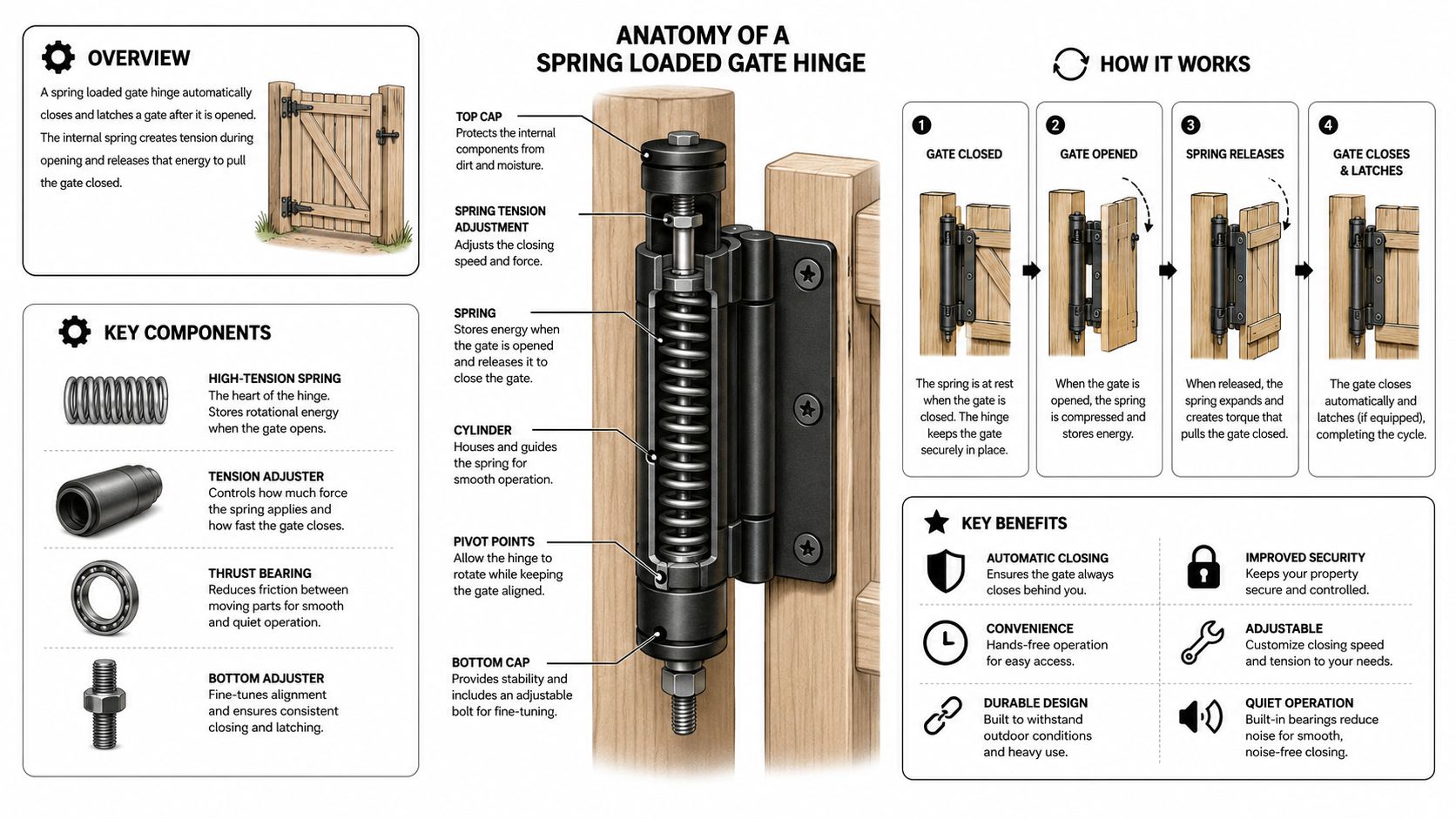
Think of a spring hinge as a pivot with a stored return force. The hinge barrel turns as you open the gate, and an internal spring resists that movement. When you release the gate, the spring releases its stored energy and rotates the panel back towards the closed position.
A useful analogy is a rubber band wrapped around a pencil. Turning the pencil winds the band tighter. Letting go allows the band to unwind and rotate the pencil in the opposite direction. A spring-loaded hinge uses a controlled version of that action, with metal components designed to guide the movement through the hinge axis.
The three jobs inside the hinge
Pivoting comes first. The hinge leaves or mounting plates connect the moving gate to the stationary post while allowing controlled rotation. If the post is leaning or the mounting surfaces aren't parallel, the spring has to fight friction and misalignment before it can close the panel.
Closing is the spring's job. Fixed-tension models provide a predetermined return force. Adjustable models let you alter the stored force so the hinge can suit different gate sizes and operating conditions.
Latching happens at the end of the travel, but the hinge doesn't control the latch itself. The gate must arrive at the strike with enough movement to engage it, without hitting so hard that the latch or frame absorbs excessive impact.
Adjustable designs commonly use a 5/32-inch wrench and a locking pin. One instruction sheet describes removing the pin before changing spring tension, then replacing it once the desired setting is reached. That incremental method is safer than forcing the hinge beyond its intended range because each adjustment changes the closing force in a controlled step. The manufacturer adjustment sheet provides this wrench-and-pin procedure.
Another product instruction specifies that clockwise rotation increases tension, while depressing the wrench disengages the ratchet for counter-clockwise reduction. It also sets a limit of no more than 6 ratchet clicks when increasing tension. The self-closing gate kit instructions should take priority over general adjustment habits for that particular product.
Tension and closing speed are connected. More tension usually gives the gate more force to return, but excessive force can create a hard closing impact. Hinge offset matters too, because the distance between the hinge axis and the gate's centre of mass changes the force the spring must overcome.
California's accessibility guidance creates a concrete benchmark for applicable gates and doors. A spring hinge must be adjusted so a gate opened to 70 degrees closes in at least 1.5 seconds, as set out in California Standards for Accessible Design, Chapter 11B, Section 404.2.8.2. That's an engineering check, not merely a suggestion to make the gate feel smooth.
Main Types of Spring Loaded Hinges for Gates
The catalogue terminology can be confusing because several products may all be described as self-closing. The useful distinction is how the hinge mounts, where the spring force is applied, and whether the design can handle the gate's structure and exposure.
| Hinge Type | Best For | Tension Adjustment | Typical Finish |
|---|---|---|---|
| Barrel-style gravity hinge | Light garden and pedestrian gates | Usually fixed or limited | Black, coated metal, or exterior polymer |
| Adjustable-tension spring hinge | Wood gates and general residential gates | Wrench, ratchet, and locking pin | Black or powder-coated metal |
| Heavy-duty spring hinge | Metal, chain-link, and demanding exterior gates | Adjustable on selected models | Galvanized, coated, or corrosion-resistant metal |
| Hinge-style closer | Gates needing compact self-closing hardware | Model-dependent | Black, dark metal, or exterior-rated finish |
Barrel and gravity designs
Barrel-style hinges use a compact body and a simple return action. They're a sensible match for a lighter pedestrian gate where appearance and straightforward installation matter more than extensive force adjustment. Their limitation is flexibility. If the gate changes after installation because the wood swells, the post shifts, or the panel gains weight, a fixed-force hinge gives you fewer ways to compensate.
Adjustable spring hinges
Adjustable Decorex Hardware self-closing hinges are useful when you need to tune the gate after installation. Wood gates often change slightly with moisture and seasonal movement, so the ability to increase or reduce spring force can be more practical than relying on a preset setting.
Nuvo Iron provides a competing product family worth comparing when finish, mounting style, or gate construction points you in a different direction. The right choice isn't determined by brand alone. Compare the hinge's mounting method, exterior rating, adjustment system, and compatibility with the gate frame.
Heavy-duty options
Metal and chain-link gates can impose different loads from wood panels. A chain-link frame may be lighter in some configurations but can still place demanding force on the hinge, especially when the gate is wide or exposed to wind. A heavy-duty spring hinge may be appropriate, but don't confuse a stronger spring with a stronger post or frame.
The latch must also match the closing arrangement. Before choosing the hinge, review practical gate latch selection tips so the latch, strike, and self-closing action work as one system.
A hinge-style closer is enough when the gate is moderate in size, the post is stable, and the hinge can provide reliable closing without harsh impact. A dedicated closer arm is the better direction for a wider, heavier, or heavily used gate where controlled closing matters more than the compact appearance of a spring hinge.
Choosing the Right Size and Material for Your Gate
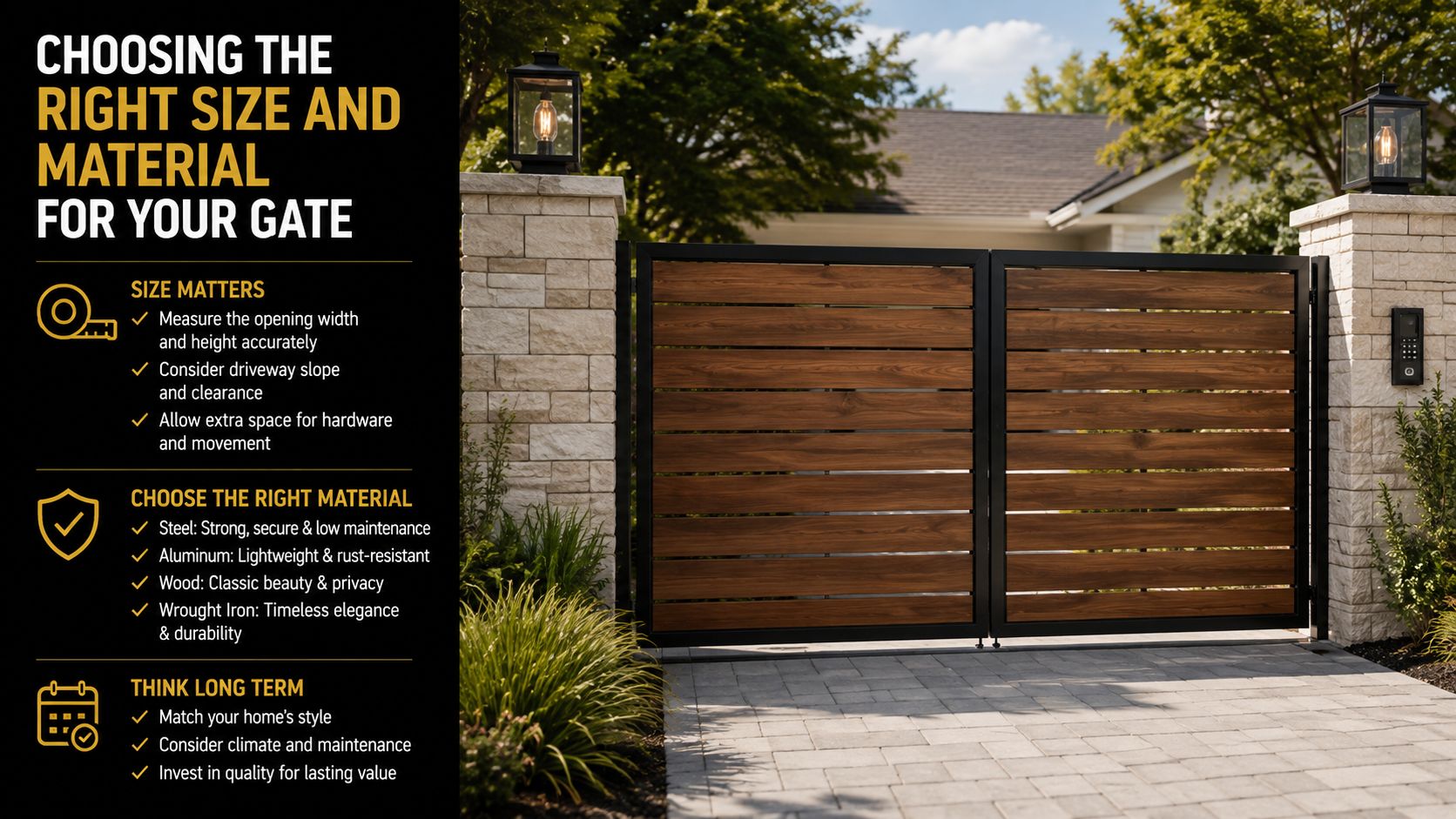
Start with the gate, not the product photograph. Measure the panel's width and height, identify whether the structure is wood, metal, vinyl, or chain-link, and inspect how the load reaches the post. A wide gate can create substantial force even when the panel doesn't feel unusually heavy in your hands.
For a wood gate, look at the frame, boards, bracing, and moisture exposure. A decorative panel may be lighter than a solid privacy gate, while a gate with a metal frame may concentrate load differently at the hinge points. Metal and chain-link gates need hardware that suits their frame profile and fastening method, not just a hinge rated for a similar visual size.
Use width to plan hinge distribution
Canadian chain-link specifications show why hinge count matters. For gates 3 m or more in width, the specification calls for three hinges per section to distribute the load across the frame. The BCIT exterior improvements standard also emphasises adequate hinge strength for chain-link gates.
For a typical residential gate, use the hinge manufacturer's capacity and mounting instructions rather than treating a two-hinge layout as universal. If the panel is wide, heavy, or subject to frequent use, additional support or a different hinge arrangement may be necessary.
Exterior finish deserves equal attention. Galvanized or coated moving parts help protect the mechanism from moisture, while stainless steel can be a sensible choice in coastal or highly corrosive settings. Canadian freeze-thaw cycles can change the alignment between the post, hinge, and latch, so exterior-rated materials and protected moving surfaces should be part of the original selection.
Use the Decorex adjustable gate hinges catalogue page to compare available mounting styles and finishes against your gate construction.
The following installation video can help you visualise the relationship between the hinge plates, gate frame, and post before you drill:
For public facilities, exterior exposure and repeated cycles make hardware grade important. California technical guidance cites BHMA A156.17 Grade 1 exterior-rated spring hinges in installation specifications for public facilities, reinforcing the need to match the hinge to corrosion exposure and use rather than choosing solely by gate weight. San Francisco building code guidance provides that code-adjacent reference.
Installing and Adjusting Spring Loaded Gate Hinges Step by Step
A gate may look aligned while still fighting the hinges. Before drilling, open and close the panel by hand. Check the post, frame, hinge mounting areas, latch, and strike. A moving post or twisted frame will make spring adjustment unreliable, especially on an exterior gate exposed to Canadian freeze-thaw movement.
Prepare the opening
Support the gate first. Use wedges, a temporary prop, or a helper to hold the panel at its intended height. The support carries the gate while you position the hinges and prevents the panel from pulling fasteners out of the frame.
Mark the hinge locations. Keep the hinge line straight, with upper and lower mounting points fixed to solid material. On a wide or heavily used gate, follow the selected Decorex Hardware hinge layout instead of estimating the spacing.
Choose compatible fasteners. Match screws, carriage bolts, lag bolts, washers, or anchors to the post and frame. Wood, steel, masonry, and hollow gate sections each need a different fastening approach. Xtreme eDeals lists these fastener categories, but the substrate determines the suitable option.
Check the swing before tightening. With the gate supported, move it through its full travel. It should clear the post, frame, ground, and latch without rubbing, lifting, or binding.
Use the gate hinge installation guide as a practical reference for plate orientation, mounting sequence, and alignment checks.
Set the spring gradually
Attach the hinge while the gate remains supported. Tighten the fasteners enough to hold the plates, then confirm that the gate is still square. Many adjustable models use a 5/32-inch wrench and a locking pin. Follow the product instructions to disengage the pin, make a small adjustment, secure it again, and test the movement.
Set the closing force through testing rather than guessing. Let the gate close from fully open, halfway open, and 70 degrees. Note where the impact is hardest. Adjust from the weakest closing position upward until all three positions close smoothly and reach the latch without slamming. This sequence checks the spring across the gate's actual travel, not just at one convenient angle.
Test before calling the job finished
Watch the final approach to the latch and listen for impact. If the panel stops short, inspect alignment and friction before increasing spring force. If it closes too quickly, reduce the setting in small increments and retest all three opening positions.
For applicable California installations, confirm from 70 degrees open that the gate takes at least 1.5 seconds to close, following the California accessibility requirement. The referenced guidance also gives a 5-pound maximum activation force, so reliable closing does not by itself confirm acceptable operating effort.
Finish by tightening every fastener while the gate is still supported. Operate it again afterward, because tightening can shift a hinge plate and change the latch alignment.
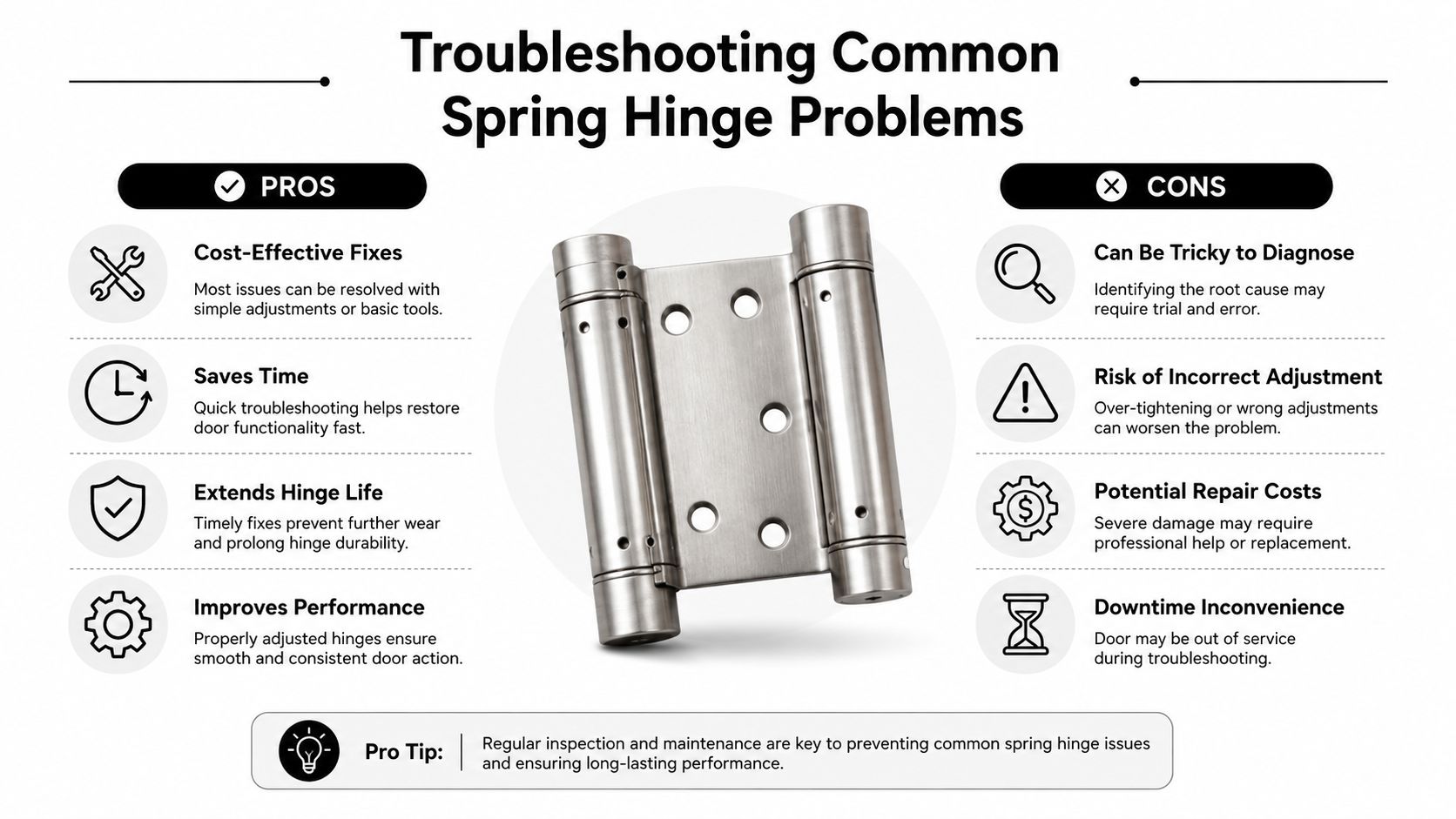
Troubleshooting Common Spring Hinge Problems
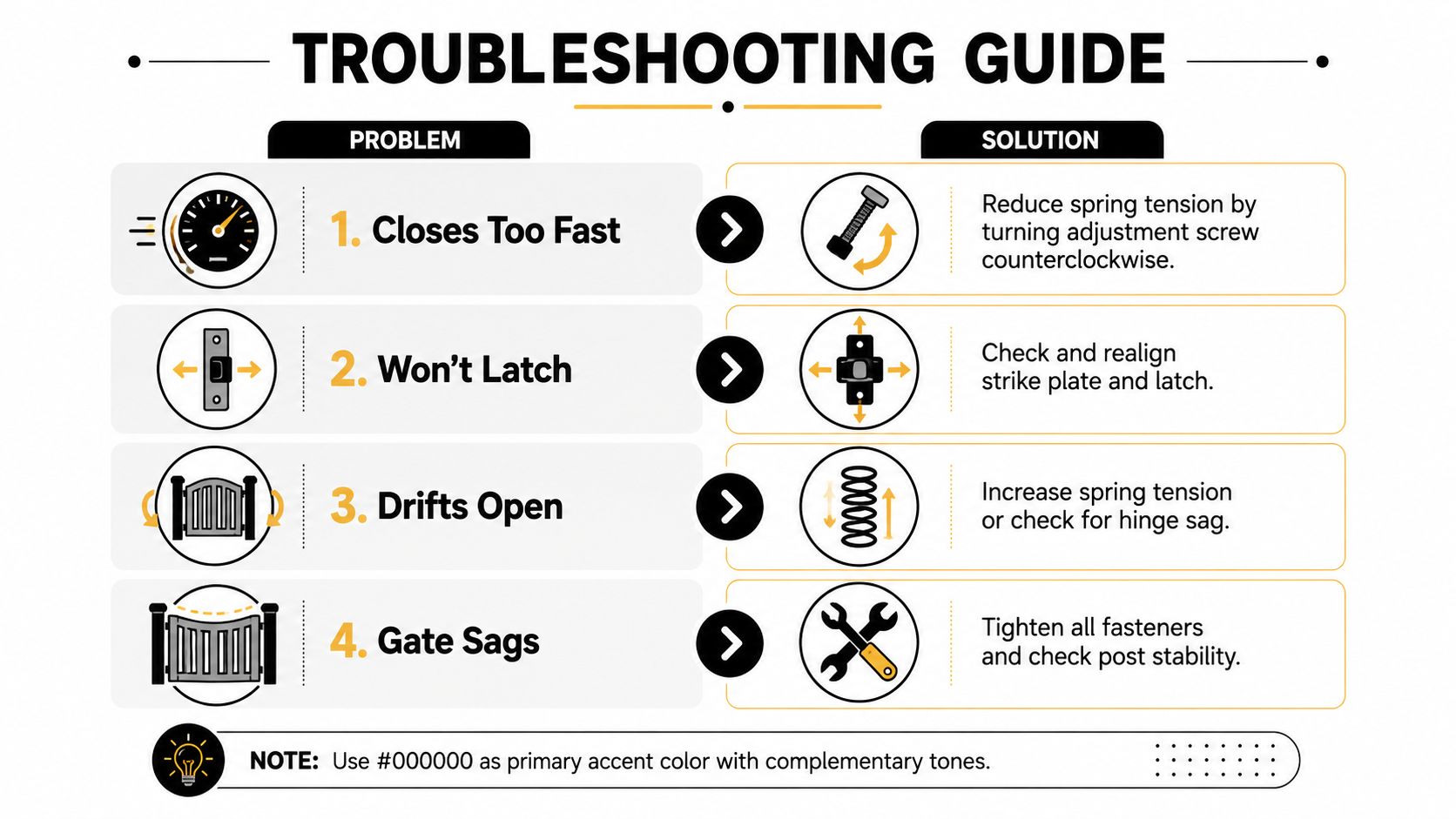
Most spring hinge failures announce themselves through the gate's behaviour. Treat the symptom as evidence about the system rather than immediately turning the tension adjustment.
| Symptom | Likely cause | First corrective action |
|---|---|---|
| Gate closes too fast | Excess spring tension or poor alignment | Reduce tension and inspect the swing path |
| Gate reaches the frame but won't latch | Strike or latch misalignment | Realign the latch and strike |
| Gate drifts open | Insufficient return force or hinge sag | Check alignment, fasteners, and tension |
| Gate sags | Loose fasteners, moving post, or overloaded hinge | Stabilise the post and redistribute support |
A gate that slams isn't necessarily a powerful gate. It may have a spring set too aggressively for the panel, or the hinge may be binding and releasing suddenly. Reduce tension in small increments, lubricate only where the product instructions permit, and check that the gate isn't rubbing against the post or frame.
Read the movement before replacing parts
A gate that won't latch usually needs alignment work, not more spring. Check whether the latch tongue meets the strike centrally, whether the gate is level, and whether the post has shifted. Tightening a hinge against a misaligned post can mask the problem briefly while increasing stress on the hinge.
Freeze-thaw movement can alter the relationship between the post and gate frame. Water enters gaps, freezes, expands, and changes the hinge geometry or latch position. Look for scraped coating, binding at one part of the swing, or a gap that changes between seasons.
For a tired hinge, inspect the pin, washers, mounting screws, and post-side fasteners. Replacing worn pins or washers may restore smooth movement, while upgraded fasteners may help when the original hardware has loosened in wood. Don't compensate for a structurally weak post by adding spring tension. The added force can increase impact loads and accelerate wear.
Field diagnosis: If the gate closes freely when disconnected from the latch but fails when the latch engages, correct the latch alignment before changing the hinge setting.
When a Spring Loaded Hinge Is Not the Right Choice
Spring-loaded hinges suit many pedestrian and residential gates, but they aren't a universal answer. A very wide or heavy gate can demand more control than a compact spring mechanism provides, particularly where the opening sees frequent cycles or where the gate's frame flexes.
A non-spring commercial hinge may be preferable when the gate needs independent control over pivoting and closing. This arrangement lets the installer use a separate closer, latch, or hold-open device instead of asking one hinge assembly to manage every part of the movement.
Hydraulic gate closers are another option for heavier or more frequently used openings. They can provide a more controlled closing action, although they require appropriate mounting space and adjustment. The choice depends on the gate's structure, traffic, exposure, and the consequences of a failed closing cycle.
Pool and child-access gates deserve particular caution. In those settings, self-closing reliability protects more than property security. Canadian safety guidance focuses on sufficiently strong gate hardware, while British Columbia guidance notes that a gate intended to swing 180 degrees requires the hinge offset to be correct. Federal Canadian regulations for expandable enclosures were amended in 2022, making current safety references important for compliance-minded installations. The federal Canadian reference is useful when the gate forms part of a child-access or enclosure system.
A practical decision rule is simple. Light residential and many DIY gates can use adjustable spring hinges. Commercial, very wide, or very heavy gates may need a dedicated closer, a stronger multi-hinge arrangement, or a non-spring commercial hinge system. For self-closing options, compare the hardware at Xtreme eDeals with the gate's actual load and safety requirements rather than choosing from appearance alone.
Buying Spring Loaded Gate Hinges at Xtreme eDeals
Start with the hinge family. Decorex Hardware self-closing hinges stocked at Xtreme eDeals are a practical starting point for adjustable residential and exterior gate projects, while Nuvo Iron alternatives provide another product family to compare for finish, mounting style, and gate design.
Then match the rest of the assembly. A spring-loaded hinge may close the panel, but the latch, strike, post, fasteners, washers, and frame must all hold their position. Xtreme eDeals also carries related gate hardware, construction fasteners, post caps, and finishing components, so you can check compatibility before ordering instead of discovering a missing washer or unsuitable bolt during installation.
Use this final checklist:
- Gate type: Wood, metal, vinyl, chain-link, pool, garden, or driveway.
- Load and width: Choose the duty level and hinge count for the actual panel.
- Adjustment method: Confirm whether the hinge uses fixed tension, a wrench, a ratchet, or a locking pin.
- Exterior finish: Select galvanised, coated, stainless, or polymer hardware according to exposure.
- Fasteners: Match screws, bolts, washers, or anchors to the post and frame.
- Closing test: Plan to check latching, impact, swing clearance, and applicable closing-speed requirements.
XTREME EDEALS INC. offers Decorex Hardware gate hinges, self-closing gate hardware, fasteners, post accessories, and related fencing supplies through its online catalogue. Visit XTREME EDEALS INC. to compare spring-loaded hinge options and assemble the hardware your gate needs for a reliable installation.