
A gate rarely fails all at once. It starts with a light rub at the bottom corner. Then the latch needs a lift. Then one wet season or one hard winter later, you’re shoulder-checking it shut and telling yourself you’ll fix it next weekend.
That’s where adjustable gate hinges earn their keep. They don’t just hold a gate. They give you room to correct real-world movement after installation, when posts settle, timber moves, metal expands, and daily use starts pulling the gate out of line. If you’ve ever had a gate that looked fine on day one and acted crooked six months later, you already know why fixed hinges can be a dead end.
The difference is simple. With the right adjustable hardware, you can tune the gate instead of rebuilding it. That saves time, saves frustration, and often saves the post, latch, and frame from taking unnecessary abuse.
The End of the Sagging Gate Problem
Most sagging gates give the same warning signs. The latch side drops. The bottom edge starts scraping a hard surface. The gap along the top rail stops looking even. You can ignore it for a while, but every forced close puts more strain on the hinges, screws, latch, and post.
Adjustable gate hinges solve that problem in a way fixed hinges can’t. Instead of removing hardware and trying to shim, redrill, or muscle the gate back into place, you make small corrections at the hinge. That matters because gates don’t live in controlled indoor conditions. Outdoor gates move. Wood takes on moisture and dries back out. Posts can shift slightly. Heavy gates settle under their own weight.
Practical rule: If a gate has any chance of carrying real weight, seeing regular use, or sitting in exposed weather, install adjustability from the start instead of treating it as an upgrade later.
That’s also why better hinge hardware has become part of normal home improvement buying, not a specialty afterthought. The global door hinges market exceeded $9.5 billion in 2024, with demand reflecting continued investment in specialised hardware for residential and commercial projects, according to Woodworker Express.
For a homeowner, that market figure isn’t the main point. The practical point is that manufacturers keep refining hinge options because people are tired of gates that work well for one season and fight them after that.
A good adjustable hinge won’t fix a rotten post or a badly racked gate frame. It will, however, let you counter normal movement before that movement becomes a bigger repair. That’s the primary advantage. You’re not buying a gimmick. You’re buying serviceability.
What Exactly Are Adjustable Gate Hinges
A standard hinge gives you a pivot point. An adjustable hinge gives you a pivot point plus a way to correct alignment after the gate is hung. That’s the whole idea, and it’s more useful than many DIYers realise until their gate starts drifting.
On most modern setups, the hinge body includes a mechanism that lets you shift the gate slightly without removing the hinge from the post. Depending on the design, that can mean vertical correction, horizontal correction, depth adjustment, tension adjustment, or a mix of those.
What they actually adjust
The language changes by manufacturer, but in the field the adjustments usually fall into a few practical categories:
- Vertical movement helps when the latch side has dropped and the gate no longer meets the striker cleanly.
- Horizontal movement changes the side gap so the gate stops binding on the post or misses the latch.
- Depth or projection adjustment moves the gate closer to or farther from the mounting face.
- Tension adjustment matters on self-closing models where closing force needs to be increased or softened.
That’s why I don’t treat these as simple hinges. They’re alignment hardware. The hinge still supports the load, but it also becomes your correction point when seasonal movement or long-term wear shows up.
Why this isn’t a new gimmick
Adjustable gate hardware sounds modern, but the underlying idea is old and proven. The technology traces back to shepherd’s hinges, which used gravity to auto-close gates. That principle was commercialised in the 1800s by companies including Reading Hardware Company, and the history now spans 130+ years, as outlined by Lynn Cove.
That history matters because it tells you something important. These hinges weren’t invented to look clever in a catalogue. They were developed to solve a simple operating problem. Gates need to swing properly, close reliably, and keep doing both after use and weather start working against them.
A mature hinge design is usually easier to trust than a flashy one. Proven hardware tends to be simpler to install, easier to adjust, and less fussy in the long run.
Where adjustable hinges make the biggest difference
They’re most useful on gates that deal with one or more of these conditions:
| Situation | Why adjustable hinges help |
|---|---|
| Timber gates | Timber moves with moisture and seasonal change |
| Metal-framed gates | Weight and frequent use can pull alignment over time |
| Vinyl or composite gates | Surface materials often need precise spacing to avoid rubbing |
| Sloped or uneven areas | Fine-tuning matters more when clearances are tight |
| Self-closing gates | Tension and alignment need to work together |
What they don’t do is compensate for bad fundamentals forever. If the post is loose, the concrete footing is failing, or the gate frame is twisted, adjustment only buys time. But when the structure is sound, adjustable hinges make routine correction straightforward, which is exactly what outdoor gate hardware should do.
How to Choose the Right Adjustable Hinges
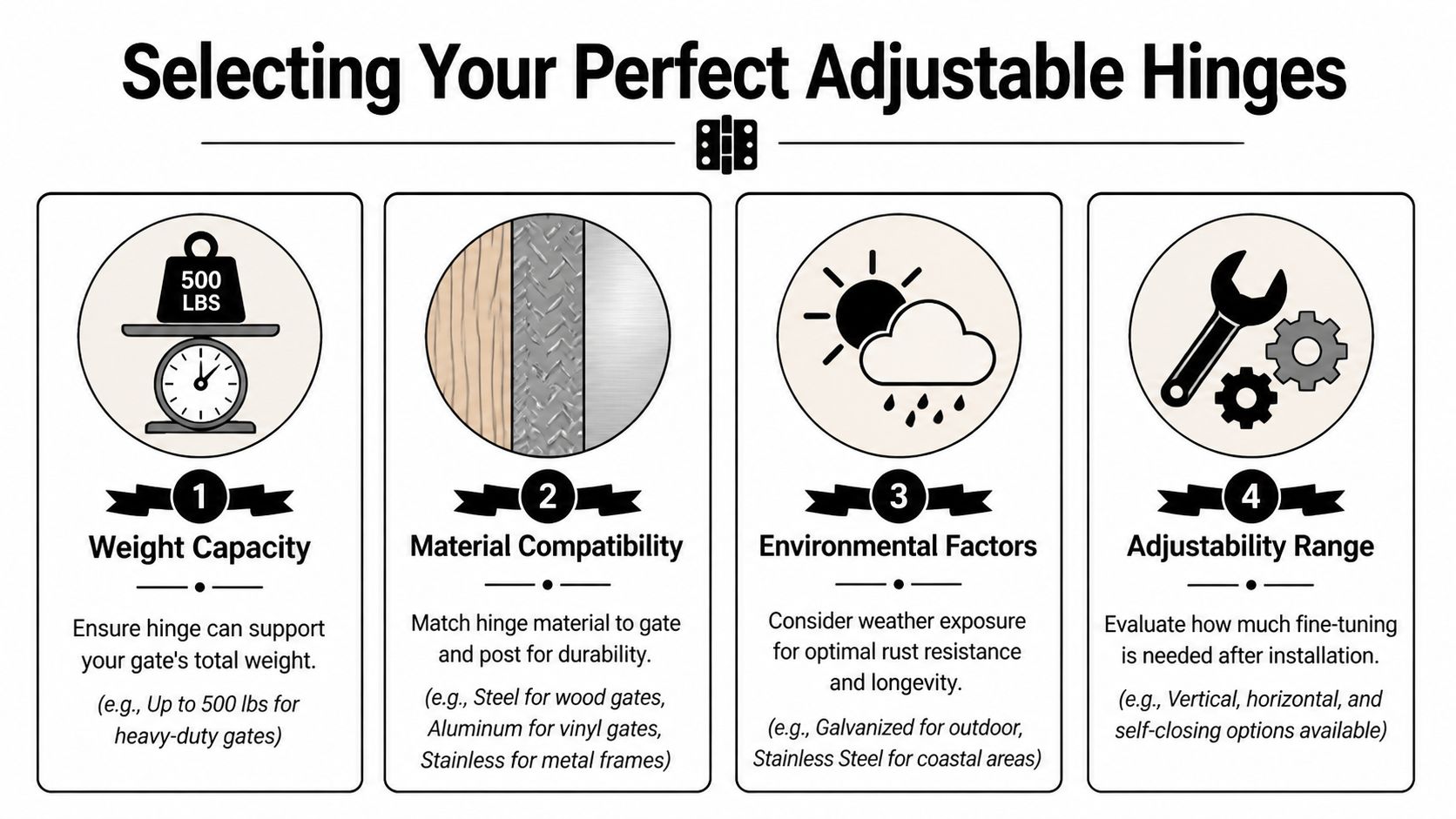
Choosing adjustable hinges starts with one question. What is the gate asking the hinge to do every day? Not what it looks like in the store, and not what the package promises in big lettering. You need to match the hardware to the gate’s weight, material, exposure, and use pattern.
A narrow side-yard gate and a broad driveway leaf don’t stress hardware the same way. Neither do a dry inland installation and a salt-heavy coastal one. If you choose hinges by finish alone, you’ll usually regret it.
Start with gate weight and frame stiffness
Most bad hinge choices begin when people look at gate width, not actual load. A gate can be compact and still be heavy if it’s built from thick timber, steel tube, or a reinforced frame. It can also be wide and deceptively light.
The safer approach is to think about total strain, not just dead weight:
- A solid timber gate puts constant downward load on the top hinge.
- A steel-framed gate may stay square better, but it can stress fasteners hard at the mounting points.
- A lighter decorative gate still needs enough hinge body and fixing strength to resist wobble.
If the hinge looks undersized in your hand, it probably is. Outdoor gates punish hardware that’s merely adequate.
Material matters more than finish
The hinge material affects strength, corrosion resistance, maintenance, and how well the adjustment mechanism survives years outside. Powder-coated parts can look great on day one, but the coating is only part of the story. What’s underneath matters more.
Here’s a practical quick-reference table.
Adjustable Hinge Material Quick Reference
| Material | Best For | Rust Resistance | Strength | Cost |
|---|---|---|---|---|
| Powder-coated steel | General residential gates in moderate conditions | Moderate | High | Lower |
| Galvanised steel | Utility gates and exposed outdoor use | Good | High | Moderate |
| Stainless steel | Coastal installs, wet zones, premium long-term use | Excellent | High | Higher |
| Polymer or composite-bodied hinges | Corrosion-prone areas, lighter gates, self-closing applications | Excellent | Moderate to application-dependent | Moderate to higher |
| Brass-bearing or mixed-material assemblies | Smooth operation where bearing quality matters | Good to very good, depending on housing | Varies by design | Moderate to higher |
Some brands available through hardware retailers carry lines aimed at different use cases. Nuvo Iron products often suit decorative and residential fence work where appearance matters alongside function. Decorex Hardware tends to fit the buyer who wants practical gate and fence hardware options without overcomplicating the purchase. The right pick still depends on the actual gate, not the brand badge.
Climate changes the right answer
This gets overlooked all the time. A hinge that performs well inland may age badly near the coast. A hinge that feels smooth in mild weather may tighten up or wear differently where freeze-thaw cycles and dust are part of normal life.
For coastal properties with salt spray, stainless steel or specialised polymer hinges often justify the extra cost because standard steel can be more vulnerable to corrosion that gums up adjustment points over time, as noted by DJA Imports.
That doesn’t mean everyone needs stainless. It means environment belongs in the buying decision.
Consider the installation like this:
- Coastal air and salt exposure call for better corrosion resistance and closer inspection of moving parts.
- Hot, dry areas can be hard on finishes and can dry out neglected hinge points.
- Cold regions with freeze-thaw cycles expose any small alignment issue faster because movement in the post and surrounding ground can show up seasonally.
- Irrigated garden gates often corrode faster than expected because sprinklers hit the same hardware repeatedly.
Buy for the site, not just the gate. The same hinge can be overkill in one yard and underbuilt in another.
Match hinge style to gate function
Some gates only need smooth swing and easy adjustment. Others must self-close, clear sloped ground, or line up with a locking latch. Those requirements push you toward certain hinge types.
A few practical pairings work well:
- Heavy timber pedestrian gate: strong adjustable hinges with solid through-fastening or deep bite into structural material.
- Pool or safety gate: adjustable self-closing hinges paired with compatible latch hardware.
- Decorative metal gate: hinges that allow clean reveal lines and consistent spacing.
- Frequent-use side gate: hardware that balances strength, adjustability, and easy maintenance access.
If you’re comparing options for a new project, browsing a broad category page like fence and gate hardware helps you see the hardware ecosystem as a whole. Hinges rarely work alone. Latches, fasteners, brackets, and post material all affect the final result.
What works and what doesn’t
What works is a hinge with adjustment range you’ll use, enough strength for the gate, and corrosion resistance suited to the site.
What doesn’t work is buying a light-duty hinge for a heavy gate because the finish matches, using interior-grade screws outdoors, or assuming a thick powder coat makes a weak hinge durable. It doesn’t.
The best hinge choice usually feels a little sturdier than you first thought you needed. That’s usually the right instinct.
A Practical Guide to Installing Your Hinges
Good hinge installation is less about speed and more about setup. If the post is out of plumb, the gate frame is out of square, or the fasteners don’t bite into solid material, no adjustment feature will save the job. The hinge can only fine-tune a sound installation.
Get the post and gate ready first
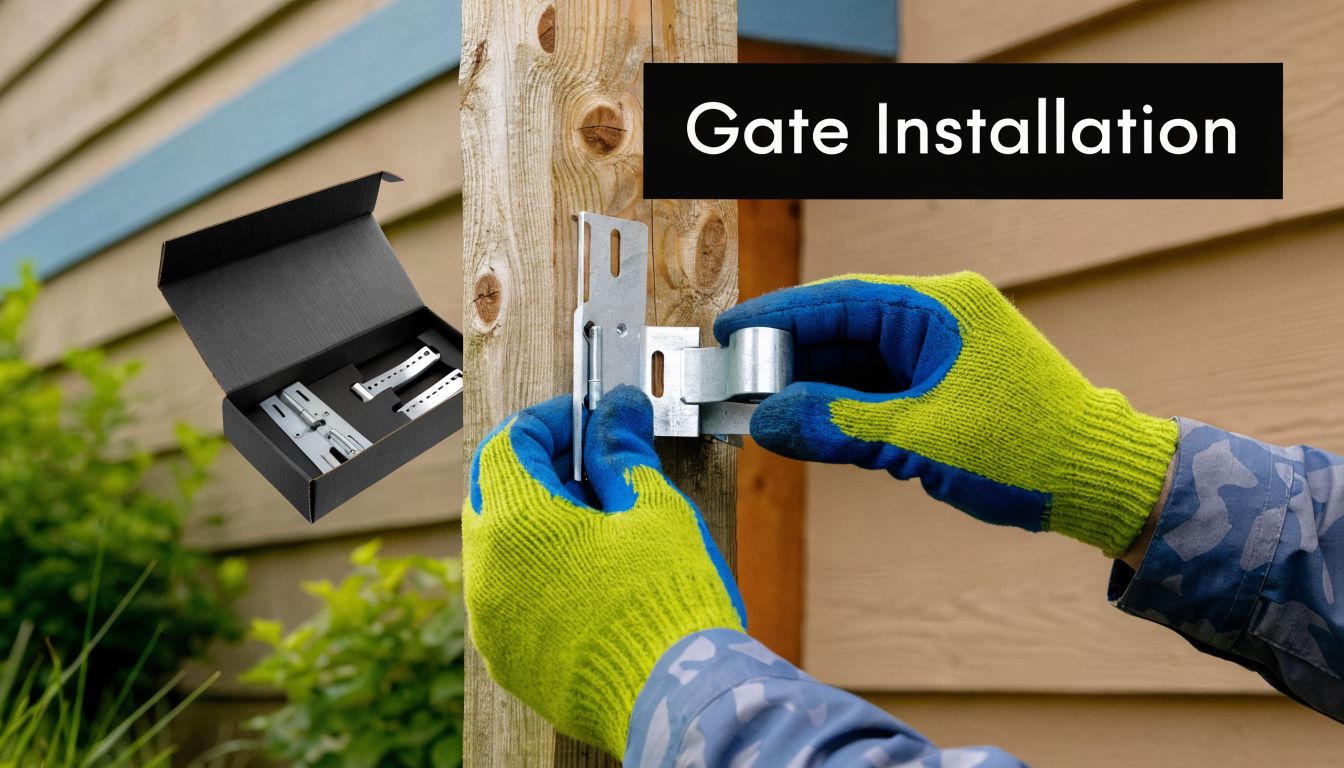
Before the hinge comes out of the box, check three things. The post should be solid, the gate should be square, and the opening should be measured at more than one point. If the gap changes from top to bottom, deal with that before mounting hardware.
For timber gates, I always treat pre-drilling as mandatory, not optional. It reduces splitting, keeps screws on line, and gives you cleaner pull-in when the hinge plate seats against the surface. On metal frames, the equivalent is making sure your mounting holes are clean, aligned, and suited to the hardware being used.
If you’re still in the planning stage for the whole project, a broader guide on how to build your own fence is worth reviewing before you hang the gate. A hinge problem is often a fence layout problem in disguise.
Positioning matters more than people think
Top and bottom hinge placement affects the distribution of forces. On a heavier gate, the top hinge fights the pull of gravity while the bottom hinge helps stabilise the swing and carries its share of the load. Place them carelessly and the gate will tell you.
A few habits make installation cleaner:
- Support the gate at final height with shims or blocks before fixing anything permanently.
- Mark all hole positions with the gate in place instead of trusting rough measurements from the bench.
- Check reveal gaps visually as well as with a tape. A gate can measure close enough and still look wrong.
- Tighten fasteners progressively so the hinge plate seats evenly and doesn’t twist.
Mount for adjustment, not just attachment
A lot of DIY installs fail because the hinges are bolted on with the gate already under bind. The hardware is technically installed, but the adjustment range gets wasted correcting a bad starting position.
Leave yourself room. Aim for a neutral initial position where the gate swings freely, the latch side isn’t dragged down by poor support, and the hinge body remains accessible for later tuning. If your hinge system includes adjustment screws or tension ports, don’t bury them where a tool can’t reach.
For a project that includes the gate itself, this guide on building a fence gate can help you think through hinge placement, frame support, and opening layout together instead of as separate jobs.
Set the gate so it works before adjustment. Then use the hinge to refine it. Don’t use the hinge to rescue sloppy layout.
Common installation mistakes
The same errors show up over and over:
| Mistake | What happens later |
|---|---|
| Fastening into weak material | Screws loosen and sag returns |
| Skipping pilot holes in timber | Splits, poor holding, crooked screws |
| Ignoring post plumb | Gate swings open or shut on its own |
| Mounting with tight, uneven gaps | Seasonal movement causes rubbing |
| Overtightening one side first | Hinge body twists and binds |
Take your time here. Most long-term gate problems begin at installation, not at adjustment.
Fine-Tuning Your Gate for a Perfect Swing
Once the hinges are mounted properly, small changes make a big difference. Adjustable hardware starts paying you back at this stage. A quarter turn in the right place can stop a latch miss, lift a dragging corner, or clean up an uneven reveal.
Raise, shift, or space the gate correctly
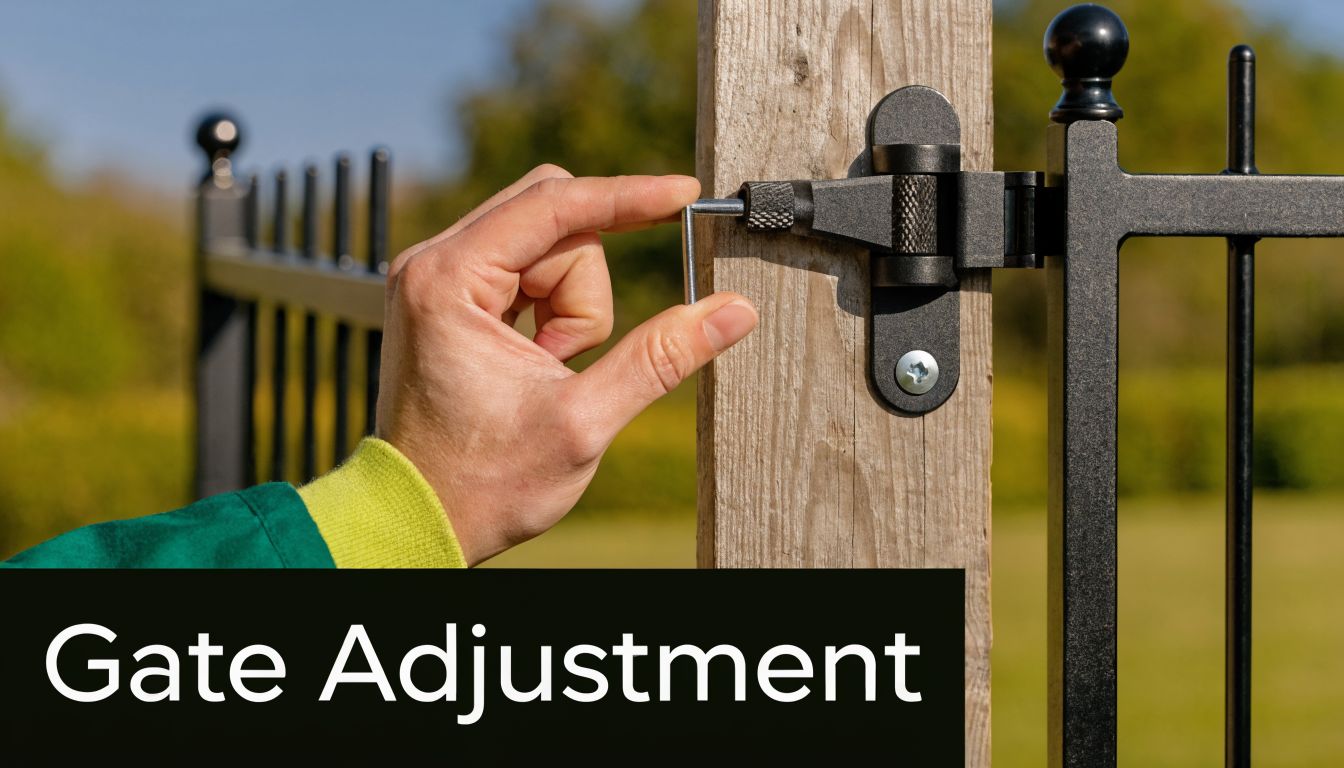
Different hinge models use different fasteners and access points, so the exact tool and turning direction can vary. Always confirm with the product instructions. The field logic stays consistent, though.
If the latch side has dropped, start with the top hinge and use the vertical adjustment that lifts that side of the gate. Make a small change, test the swing, then decide whether the bottom hinge needs a balancing correction. Don’t crank both hinges aggressively at once or you’ll chase the alignment back and forth.
If the gate is too tight to the latch post or not reaching the latch cleanly, use the horizontal adjustment to move the leaf slightly in or out. This is usually where you fix rubbing, poor latch engagement, or a reveal that looks crooked from the front.
If the gate needs to sit closer to or farther from the post face, use the depth-style adjustment if your hinge has one. That matters on gates with trim, post caps, protruding latch bodies, or tight clearance to a wall or fence return.
Work in small increments
Treating adjustment like rough carpentry is a mistake. It isn’t. This is closer to tuning.
A simple sequence works best:
- Make one adjustment at a time so you know what changed.
- Test the full swing after each change instead of only checking the closed position.
- Watch the latch side and bottom edge together because one problem can hide another.
- Balance both hinges after the major correction so one hinge isn’t carrying all the stress.
If a small adjustment makes the problem worse, stop and reverse it. Forcing a bad correction usually creates a second problem before you’ve solved the first.
When you’re dealing with self-closing hardware, tension adds another variable. Too little tension and the gate drifts open or stalls before the latch. Too much and it slams, strains the latch, and feels cheap. That kind of fine adjustment isn’t unique to gates either. If you’ve worked on other closing systems before, a guide on how to adjust garage door sensors is a useful reminder that alignment and closing behaviour often go hand in hand.
A compatible latch also matters. If the gate swings properly but still won’t stay shut, look at the latch geometry, not just the hinges. A properly matched self-locking gate latch helps the whole system work as intended.
Here’s a visual walkthrough of the adjustment process in action:
Know when adjustment isn’t the answer
If you’ve used most of the hinge’s adjustment range and the gate still sags, stop blaming the hinge. At that point, the likely issue is elsewhere. Common culprits are a moving post, a frame that’s racked, loose fasteners, or a gate that was undersized structurally for its width and weight.
Adjustment should refine operation. It shouldn’t compensate for a failing structure indefinitely.
Long-Term Hinge Care and Troubleshooting
A gate that swings perfectly today won’t stay that way on neglect alone. Maintenance is not optional. Outdoor hardware lives with moisture, dust, movement, vibration, and temperature swings. Adjustable hinges give you serviceability, but only if you service them.
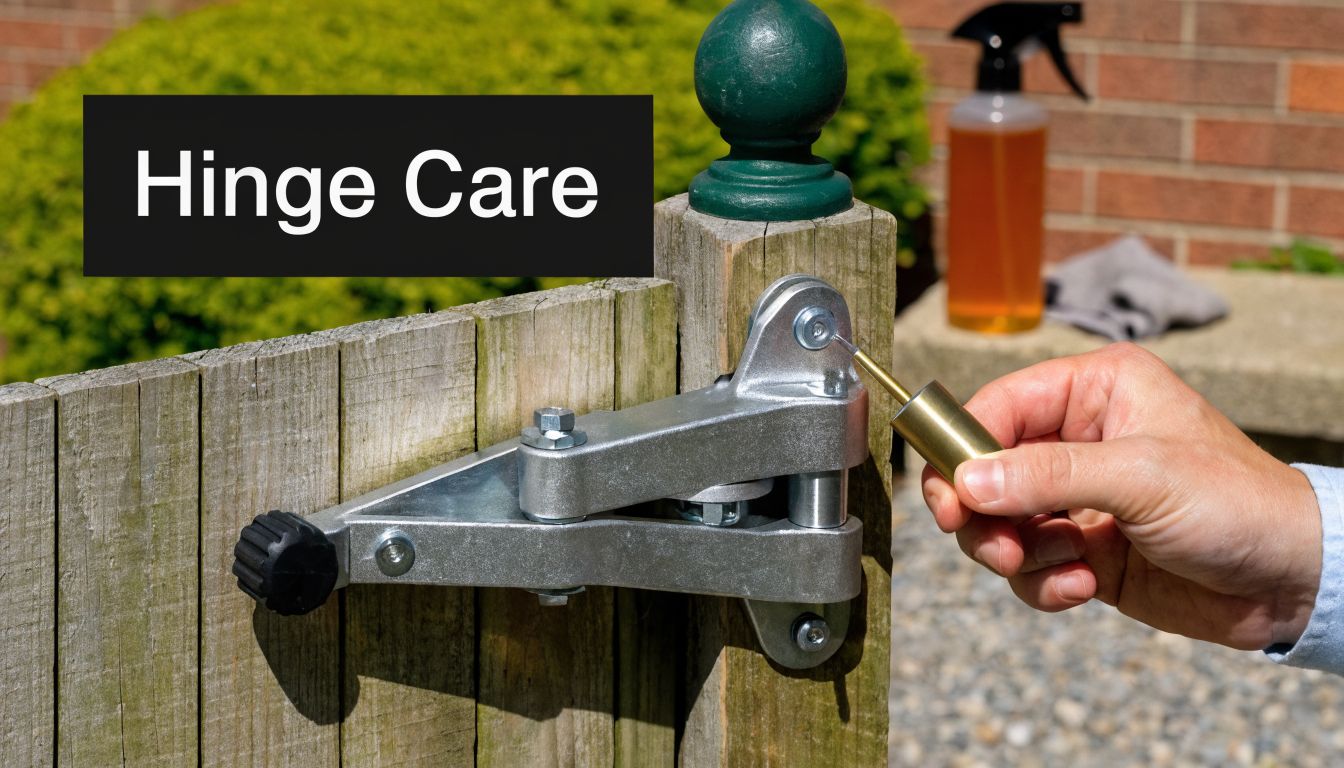
Product listings often mention adjustment tools, tension control, or lubrication points, but they rarely tell homeowners how to manage the gate after the honeymoon period. That’s a real gap. As noted by Fence Workshop, owners need to know how often to check tension over time, what settings suit different gate weights, and how to tell normal settling from a failure that calls for replacement.
A maintenance rhythm that actually works
You don’t need a complicated spreadsheet. You do need a routine.
During the first year, check the hinges more often because that’s when initial settling usually shows up. Look at fastener tightness, reveal gaps, latch alignment, and any sign that the gate is starting to drop. If the post, gate frame, and hardware all stay stable through that early period, you can move to a seasonal check pattern.
After that, treat the gate like any exterior moving assembly:
- Inspect after major weather swings if your area gets wet-dry cycles or freeze-thaw movement.
- Lubricate moving parts as needed based on hinge design, especially if the hinge includes a grease point.
- Clean off dirt and salt residue instead of lubricating over contamination.
- Retighten loose hardware promptly before movement elongates holes or chews up mounting points.
Troubleshooting the usual problems
A noisy or stubborn gate doesn’t always mean the hinge has failed. Usually, it’s asking for attention.
Squeaking
Squeaking usually points to dry movement surfaces, contamination, or light corrosion. Clean first, then lubricate according to the hinge design. If the noise comes back quickly, inspect for misalignment because a hinge under side load can squeak even when lubricated.
Gate sag returning
If the latch side starts dropping again, don’t jump straight to a big adjustment. Check whether the screws or bolts have loosened. Then inspect the post for movement and the gate frame for twist. If the structure is stable, a small hinge correction may be all that’s needed.
Rust or seized adjustment points
Surface rust is one thing. Frozen adjusters are another. Once corrosion gets into the adjustment mechanism, the whole reason for buying adjustable hinges starts disappearing. In wet or coastal conditions, clean and inspect the adjustment points before they become immovable.
A rusty hinge that still swings is already warning you. Once the adjuster seizes, future alignment becomes a bigger repair.
Normal settling versus actual failure
Homeowners either overreact or wait too long.
Normal settling looks like a minor alignment drift that responds to hinge adjustment and doesn’t keep worsening rapidly. The post remains firm, the gate frame stays square, and the hardware still carries the load cleanly.
Structural failure looks different:
- The post moves when the gate opens or closes.
- Fasteners won’t stay tight because the surrounding material has degraded.
- The frame is visibly racked and hinge adjustment can’t restore even gaps.
- Cracks, rot, or deformation appear at mounting points.
- The gate binds despite repeated tuning because the underlying geometry is gone.
When you see those signs, stop turning the adjusters and start planning repair or replacement. Adjustable hinges are excellent at managing ordinary life outdoors. They are not a cure for structural problems.
Frequently Asked Questions About Adjustable Hinges
Can I use adjustable gate hinges on an interior door
Usually, no. Gate hinges are designed for outdoor loads, outdoor movement, and gate-style mounting conditions. They’re often bulkier, more exposed, and less suited to the finish and swing expectations of interior doors.
Are adjustable hinges secure
They can be, provided the hinge style, fasteners, and gate design are appropriate for the opening. Security depends on more than the hinge body. It also depends on access to fixings, post strength, latch quality, and whether the gate frame itself resists tampering.
Do I need self-closing hinges
Only if the gate needs to return to the closed position automatically. That’s common on pool gates, some side-yard gates, and access points where you don’t want the gate left standing open. For a decorative garden gate with light traffic, self-closing hardware may be unnecessary.
Can I paint my hinges to match the gate
You can, but be careful. Paint on adjustment ports, moving joints, springs, or bearing surfaces can gum up the mechanism fast. If you want a colour match, it’s better to mask the functional parts carefully and leave the adjustment points accessible.
Why does my gate still sag after adjustment
Because the hinge may not be the underlying issue. Check the post, the fasteners, and the gate frame. If the hardware is mounted into weak material or the frame has lost its shape, adjustment won’t hold for long.
How tight should the self-closing tension be
Tight enough to close and latch the gate consistently, but not so tight that it slams. The right setting depends on the gate’s weight, wind exposure, latch resistance, and how freely the gate swings. Start light and increase gradually.
Are adjustable hinges worth it on a small gate
Yes, if the gate lives outdoors and you want the option to correct future movement without rehanging it. Even a small pedestrian gate can drift enough to rub or miss the latch.
Should I replace both hinges if one fails
In many cases, yes. Hinges wear as a set. If one is badly worn, seized, or corroded, the other has likely seen similar conditions. Replacing both usually gives you a cleaner adjustment range and more predictable operation.
If you’re replacing worn hardware or building a gate that you don’t want to fight with later, XTREME EDEALS INC. carries fence and gate hardware, fasteners, latches, and outdoor project accessories for DIY homeowners and trade users who want dependable parts without wasting time hunting across multiple suppliers.