
You can buy a solid-looking fence panel, spend a weekend setting posts, and still fail the inspection before the gate even gets tested. That's the part most homeowners don't expect. Pool fences regulations are measured against the yard you have, not the neat drawing you had in your head when you ordered materials.
I've seen the same pattern over and over. A homeowner thinks the problem is the fence itself, but the fail comes from a low spot on a slope, a retaining wall that works like a step, or a latch sitting just a little too low for the inspector's tape measure. The fence can look finished and still be wrong at one post, one gate, or one climb point.
Why Pool Fence Inspections Fail More Often Than You Think
A homeowner calls after a failed inspection and usually says the same thing, the fence is new, the posts are straight, and the panel spec sheet says it's pool-safe. The inspector still fails it. That happens because pool fences regulations are judged in the field, not on a packaging label, and the yard rarely behaves like a flat showroom floor.
The yard is the actual test
A sloped lot can turn a compliant fence into a fail at the low side, even when the top rail looks fine from a distance. Barrier height in California has to reach 60 inches, and that measurement has to work at the actual ground level, not just at the highest point in the run. California's statewide framework under HSC 115920–115929 is built as a code-based system, so inspectors do not give much room for “close enough” installs. See the state-focused summary in the California code guide for the statutory framework and barrier basics: California pool fence requirements by state, and compare it with fence height requirements when you are checking what your chosen system needs to clear on site.
Practical rule: measure every post location from the outside grade, because one low spot can make the whole run fail.
The same problem shows up near retaining walls and raised planters. A wall, bench, or planter box can create an easy step-up path, and then the fence is no longer just a fence, it becomes part of a climb route. Installers get caught there all the time, because the hardware may be right while the placement is wrong.
The yard is the actual test for retrofit work
Retrofit jobs are where I see the most frustration. A fence that looked fine on a flat drawing can fail once it gets tied into an older deck, a cracked slab, or a yard that shifts after rain. The layout matters as much as the fence panel, because inspectors are checking whether a child can use the site itself to get over, through, or around the barrier.
That is also why above-ground pools cause so many headaches. The access points are often built into the pool structure, so the ladder, platform, or deck edge becomes part of the compliance check. If one side has a climb assist and the other side has a compliant fence, the install still fails if the easy access point stays open or unprotected.
The evidence behind fence regulation is strong. A systematic review found the odds of drowning or near-drowning in a fenced pool were 0.27 times those of an unfenced pool, about a 73% reduction in odds, and isolation fencing performed better than perimeter fencing, with an odds ratio of 0.17 versus three-sided fencing (systematic review and California history). That is why modern code looks at the whole barrier system, not just whether a fence exists.
Los Angeles County's older ordinances, enacted before 1996, did not appear to reduce the overall childhood drowning rate in the covered pools, which shows that an ordinance alone is not the same as a working barrier system. Good materials help, but the layout, grade, gate, and access points decide whether the install passes.
Core Barrier Height and Opening Requirements
A fence can look fine from the street and still fail the moment an inspector measures it. The first item that gets checked is height. California's residential pool rules call for a 60-inch minimum barrier height and a self-closing, self-latching gate, plus two of seven drowning-prevention features for compliance under the state's residential safety framework (California code guide). That is stricter than the common 48-inch model guidance used in federal CPSC-style safety recommendations, so a standard residential fence panel is not automatically enough. If you want a quick reference point before ordering materials, the fence height requirements guide is a practical place to check the basic dimensions against the layout you're building.
The opening test that fails more fences than anything else
Inspectors check openings with a 4-inch sphere. If that sphere can pass through a gap, the barrier fails. That applies to pickets, mesh, decorative cutouts, and the awkward little spaces that show up where a fence meets a wall or deck edge (California fence dimensions summary). The practical takeaway is simple, if the panel spacing looks acceptable on paper but opens up at the posts or corners, it is not a pool barrier in the field.
Material choice changes how hard that is to hold together. Wrought iron or aluminium picket systems need tight spacing and consistent fabrication. Mesh has to stay taut and dimensionally stable. Wood needs board spacing that stays under the sphere rule, and the exposed face needs to resist climbing. On retrofit jobs, I pay close attention to balusters and gate inserts, because those parts often solve opening problems without forcing a full replacement of the fence line.
Anti-climb geometry matters as much as height
Barrier geometry has to resist climbing, not just block a straight walk-through. Horizontal members on the pool side need to avoid becoming footholds, and the horizontal member spacing rule is concrete, they must be at least 45 inches apart unless arranged to prevent climbing (California fence geometry summary). That is where attractive ornamental work gets in trouble. Decorative rails, wide cutouts, and loosely supported panels can turn into a ladder even when the overall fence looks solid.
A fence needs to pass the measure, not the eye test.
California guidance also points to the 4-inch sphere opening limit and the 60-inch barrier height as the baseline on residential pool jobs (California fence dimensions summary). Those are the numbers worth checking before you buy panels, because once the materials are on site, fixing a short panel or a wide opening usually costs more than getting the dimensions right from the start.
Gate Latch and Clearance Specifications That Inspectors Check First
Gates get attention first because they fail first. A fence can be perfect and still miss inspection because the gate doesn't close itself, the latch sits too low, or the gate opens the wrong way. That's where the actual pool fences regulations become very practical, because the hardware has to work every time, not just when someone remembers to pull it shut.
The gate has to do its job without help
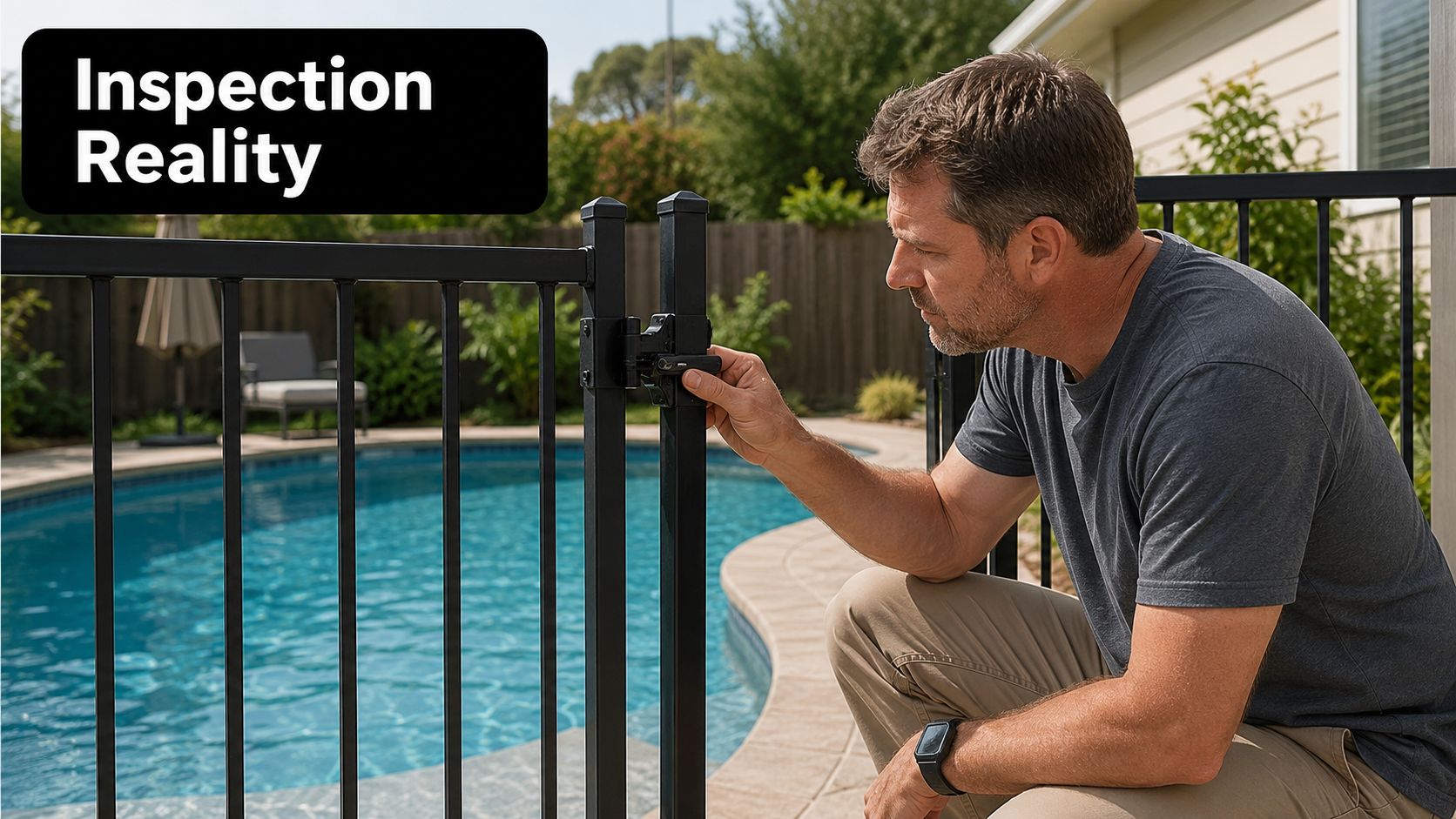
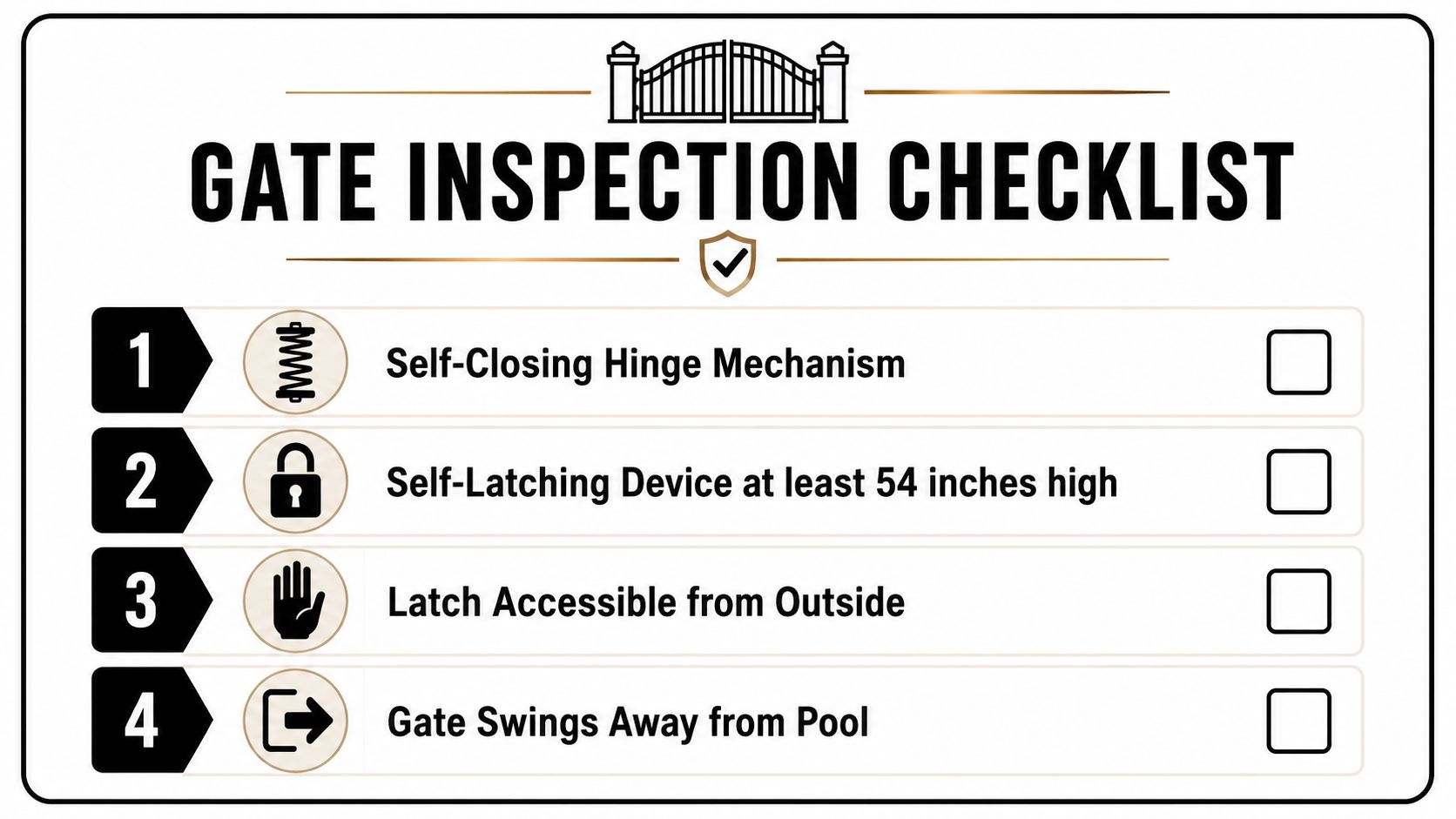
California guidance calls for gates that self-close, self-latch, and swing away from the pool (California safety laws summary). On the pool side, the latch release is commonly required at 54 inches or higher in local enforcement guidance, which is exactly the kind of measurement an inspector checks with a tape in hand (California and local gate guidance, Maricopa county technical guidance).
The practical issue is tension. A spring hinge that looks fine in the shop can drag when the post settles, the grade changes, or a cross-breeze hits the gate. If the gate needs a nudge to shut, it isn't compliant in real use. That's why I always test it from more than one open position, not just from fully open.
Clearance numbers that get overlooked
The bottom clearance is where a lot of installs go sideways. Technical guidance used in nearby code practice limits clearance to 2 inches on soil or 4 inches on solid surfaces, and chain-link systems are also constrained by an 11-gauge minimum wire and a 1 3/4-inch maximum mesh opening (Maricopa technical guidance). Those details matter because a gate that drags in the shop can open cleanly after a bad shim job, then fail once the post settles into the final grade.
A few hardware choices make a real difference here:
- Self-closing hinges: use purpose-built gate hardware, not general-purpose exterior hinges.
- Self-latching latch sets: pick hardware meant to hold alignment after repeated cycling.
- Fasteners: use exterior-rated screws, bolts, and brackets that won't loosen under weather and vibration.
- Post stability: make sure the posts are rigid enough to keep the latch aligned after repeated use.
For a hardware example, the self-closing and self-latching gate page is worth reviewing when you're matching the gate body to the hardware. A good gate isn't just a panel with a latch, it's a controlled moving part that has to close, catch, and stay aligned every single time.
Sloped Yards and Above-Ground Pool Compliance Challenges
The inspections that fail most often are the ones where the fence looks fine from the patio and fails once someone measures it on the low side of the yard. In a sloped yard, the fence has to work across the full run, and the outside measurement is what counts. A barrier that reads tall at the high end can still come up short at a downhill corner, and that is usually where the correction notice starts.
Height changes with grade, not with optimism
A 60-inch minimum height leaves little room for grade mistakes, especially where the lot drops off between posts (California code guide). I've seen installs look acceptable from inside the yard and still fail because the exterior side measured short at one panel or one post location. Stepping the fence, raking panels to match the slope, or reworking the grade can make the difference between passing and tearing parts of the job back out.
Practical rule: if you only measured the high side, you didn't measure the fence.
Retaining walls, raised planting beds, and deck edges create another problem. They can become climb aids even when the fence height itself is correct. A child does not need a ladder if the yard gives them a set of usable footholds, so I inspect every fence-to-wall and fence-to-deck transition twice. That is where clean-looking work often turns into a failed inspection.
Wet or slick surfaces make those transitions worse, especially around decks and pool edges. A non slip outdoor tile flooring guide is useful here because the surface around the barrier affects how easily someone can gain purchase near the fence line.
Above-ground pools still need a real access review
Above-ground pool owners sometimes assume the pool wall does the job by itself. In practice, the wall can be part of the barrier, but ladders, decks, and removable access points can still create an access route that fails inspection, especially after a remodel adds a permanent step or platform near the entry side (above-ground access discussion).
Retrofit work is where a lot of jobs get tripped up. A pool that passed before a deck build can fall out of compliance once a walkway, landing, or platform gets added. When fence posts need to be fastened to slab or deck surfaces, the attachment method matters just as much as the panel layout, so the details in anchoring posts to concrete apply directly to retrofit work.
The questions I ask on an above-ground job are straightforward:
- Can a child reach the pool by ladder or steps without passing through a controlled gate?
- Does the deck create a direct route over or around the barrier?
- Are there nearby objects, like benches or equipment, that turn the wall into a climb path?
- Does every access point still meet the gate and latch rules after the remodel?
That sequence catches the problems inspectors usually find first. It also saves rework, because once the deck is finished, fixing a climb route costs more than correcting it during layout.
Multi-Layer Safety Requirements Beyond the Fence
A fence can pass inspection and still leave a pool too easy to reach. That is why California's residential pool rules call for two of seven drowning-prevention features, which can include a fence, a safety cover, exit alarms, self-latching door devices, pool alarms, and other approved safety features (California safety features summary). The point behind modern pool fences regulations is straightforward. The barrier has to work with the rest of the property, not stand alone.
What the second layer usually looks like
On many homes, the second layer is the nearest door or opening from the house to the pool area. Door alarms or self-latching devices keep that direct route from becoming the weak point. California's guidance also notes that a 4-foot removable mesh pool fence can count when it meets ASTM F-2286 standards and uses a self-closing, self-latching, lockable gate (California removable fence guidance). That setup is practical when a homeowner wants a barrier that can be removed for supervised access and then put back in place for daily use.
A safety cover can also serve as one layer, but the cover has to be the right type. A winter tarp or solar blanket may cover the water, yet that does not make it a compliant safety barrier. Inspectors care about whether the cover is built and rated for protection, not just whether it keeps debris out.
The walking surface around the pool matters too. A wet approach, a slick patio, or poor drainage can make an otherwise compliant setup harder to use safely, especially at gate landings and access points. Homeowners comparing surface options near pool entries can use this non slip outdoor tile flooring guide to get a better sense of slip resistance around the path to the water.
A system works better than a single feature
The stronger installations usually combine a compliant fence, a gate that closes on its own, and one more layer on the house side or the access side. The exact mix depends on the yard, the door locations, and whether the pool is attached to a deck, patio, or remodel area. The inspection question is not just whether a fence exists. It is what still stops access if someone gets past the first barrier.
A fence buys time. The second layer blocks the shortcut.
That is why experienced contractors talk through the whole yard, not just the fence line. The visible barrier matters, but so do the doors, alarms, cover, and the surfaces people cross on the way to the pool.
Your Pre-Inspection Compliance and Installation Checklist
A final walk-through catches more failures than any sales pitch ever will. Use the table below before you call for inspection, and check every post, gate, and access point in the same order an inspector is likely to follow. If the install is on a slope, repeat the height checks at the low points, not just the easy spots.
| Inspection Item | Required Standard | How to Verify |
|---|---|---|
| Barrier height | 60 inches minimum in California, or the local code requirement | Measure from the outside finished grade at every post, especially low spots |
| Openings in fence | 4-inch sphere must not pass through | Test pickets, mesh, decorative cut-outs, and wall transitions with a rigid 4-inch check |
| Bottom clearance | 2 inches on soil, 4 inches on solid surfaces | Measure under the fence and gate at posts and mid-span |
| Gate swing | Gate must open away from the pool | Stand on the pool side and confirm it pushes outward |
| Gate closure | Self-closing from any open position | Open the gate to several positions and release it |
| Latch action | Self-latching every time | Close the gate repeatedly and confirm it catches without help |
| Latch height | Commonly 54 inches or higher on the pool side | Measure to the release point on the latch assembly |
| Climb routes | No accessible footholds or handholds | Check nearby walls, planters, furniture, equipment, and rails |
| Post stability | Posts fixed for exterior use | Confirm proper concrete set, brackets, or anchors where required |
| Multi-layer safety | At least two approved features for California residential pools | Verify the fence plus the second required safety feature is installed and functional |
If you're working from a new pool build or a yard remodel, document everything with photos before and after final grade. That matters especially when you're combining fencing with pool construction, which is why it helps to review a landscaping and pool coordination example like build a pool in Northern Arizona with R.E. and Sons Landscaping when you're planning the sequence of work.
I also like to check hardware in the same sweep. Carriage bolts, lag screws, wedge anchors, post base brackets, and hinge fasteners need to be exterior-rated and tightened after the fence settles. Loose hardware isn't a small problem, it's how a good install becomes a callback.
DIY Installation Versus Hiring a Licensed Contractor
DIY can work if you're careful, patient, and willing to measure more than once. The upside is control. You choose the materials, you choose the schedule, and you can match the fence to the yard instead of forcing the yard to fit the fence. The downside is that pool fences regulations punish small mistakes, especially on gate hardware, latch height, and grade changes.
A licensed contractor brings inspection experience and usually spots the trap points faster. That matters on slopes, above-ground pool retrofits, and any layout where a deck, retaining wall, or existing structure affects the barrier line. A good installer should show you how they're measuring the outside grade, how they're handling gate closure, and how they're documenting the final compliance layout.
For DIY or pro installs, the hardware still has to be right. Xtreme Edeals carries exterior hardware categories that fit this kind of work, including deck screws, wedge anchors, post base brackets, hinges, and decorative post caps for wood and metal posts. Those aren't cosmetic details, they're part of whether the barrier stays aligned after weather, use, and settling.
If you hire someone, ask for the measured layout, the latch height confirmation, and the material spec sheet before the inspector arrives. If you do it yourself, keep those same records for your own protection and for any future sale or permit review. The cheapest install is the one that passes once.
XTREME EDEALS INC. carries the exterior hardware and fencing accessories that matter on a pool barrier job, from anchors and brackets to hinges, latches, post caps, and finishing parts. If you're matching materials to a California pool layout or fixing an inspection issue, visit XTREME EDEALS INC. to compare the hardware options before you start the next install.