
Most advice on a self-closing and self-latching gate gets the first half right and the second half wrong. People shop for a spring hinge, watch the gate swing shut, and assume the job is done. It isn't.
A gate that swings closed but doesn't secure itself is still a failure point. Around pools, that mistake isn't just inconvenient. It can fail inspection, leave access unprotected, and create a false sense of safety. The primary job is building a gate system that closes on its own and latches on its own, every time, without a hand on it.
Contractors see this often on retrofit jobs. The hinges are new, the gate looks straight from a distance, but the latch is mounted too low, misaligned, or dependent on a hard slam to catch. That's not a hardware problem alone. It's a system problem involving swing, geometry, clearances, latch type, and code.
The Gate Safety Mistake Most People Make
The biggest mistake is treating self-closing and self-latching like they mean the same thing. They don't. One moves the gate. The other secures it.
A lot of homeowners buy a spring hinge because that's the visible part of the job. They can see the gate return toward the post, so they assume they've met the safety requirement. In practice, the hinge only solves the motion. It doesn't guarantee the latch will engage, hold, and stay engaged when the gate closes softly, in wind, or after the frame shifts a little with weather.
That distinction matters most on pool barriers. California requires more than a gate that “usually” shuts. The gate has to return to the closed position and secure itself without manual help. If it needs a push, a slam, or a hand on the latch, it isn't doing the job.
Why the usual advice falls short
Many DIY guides simplify the job down to “install spring hinges and a latch.” That's incomplete advice because it skips the interaction between the two parts.
What causes trouble on site is usually one of these:
- Good hinge action, poor latch engagement. The gate swings back but stops just short, or touches the post without catching.
- Latch mounted for convenience instead of compliance. The release ends up where a child can reach it or where an inspector will flag it.
- Frame and post movement. Wood swells, vinyl flexes, screws creep, and the keeper no longer lines up cleanly.
- Over-tensioned hardware. The installer adds spring force to compensate for bad alignment, which often creates slamming instead of reliable latching.
Practical rule: If the gate only works when it closes hard, the setup isn't finished. A safe gate should work on a normal close, not only on impact.
This is why I treat a self-closing and self-latching gate as one coordinated safety assembly, not a pile of parts. Choose the hinge for control. Choose the latch for reliable engagement. Then install both around correct geometry.
Closing vs Latching Understanding the Two Essential Functions
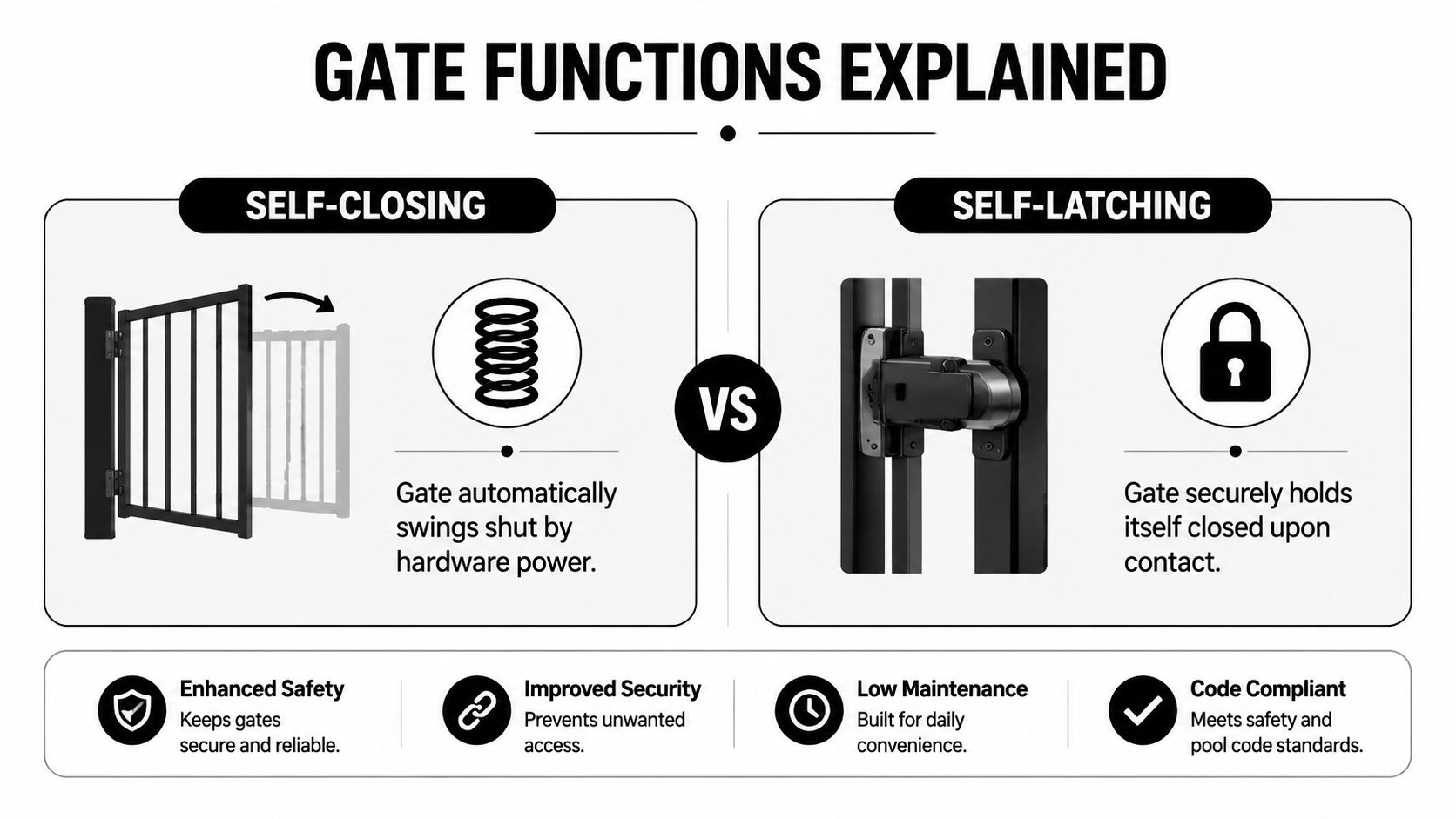
The mistake I see on pool gates is simple. Owners and even some installers treat “self-closing” and “self-latching” like the same feature. They are not. One brings the gate back to the post. The other keeps a child from pushing it back open.
What self-closing actually means
Self-closing refers to return action. After the gate is opened and released, it has to swing back to the closed position on its own. That force usually comes from spring hinges, a hydraulic closer, or another controlled closing device.
A gate that sticks halfway, drifts, or needs a hand at the end is not self-closing in any practical sense. For many residential setups, self-closing gate hinges are a common way to create that return action, but the hinge only handles movement. It does not secure the gate.
What self-latching actually means
Self-latching is the separate function that catches and holds the gate shut when it reaches the post. The latch has to engage automatically. If someone has to lift a knob, flip a catch, or slam the gate harder to make it hold, the gate is not self-latching.
This is the point that gets missed during pool gate installs. A gate can look closed and still fail inspection, or worse, fail in use, because the latch never fully catches.
Why the distinction matters
Closing and latching fail in different ways, and the fix is different too.
| Function | What it does | Common hardware | What happens when it fails |
|---|---|---|---|
| Self-closing | Returns the gate toward shut position | Spring hinges, gate closers | Gate stays open or stops short |
| Self-latching | Secures the gate once it reaches the post | Gravity latches, spring latches, magnetic safety latches | Gate appears closed but can reopen |
Here is a practical test. Open the gate, let it go, and watch for three separate results. It returns. It reaches the post. It catches and stays caught.
Miss any one of those, and the safety system is incomplete.
A gate that swings shut but does not latch is not doing the job. On a pool barrier, that distinction can decide whether the gate passes inspection or creates a serious hazard.
I judge these gates by repeat performance, not by one lucky close. If the hardware only works when the gate is released from the same angle or with extra force, it is not set up right.
How Self-Closing and Self-Latching Hardware Works
Hardware choice should match the gate's weight, material, use, and risk level. A light garden gate and a pool barrier don't deserve the same casual approach.
Self-closing hardware options
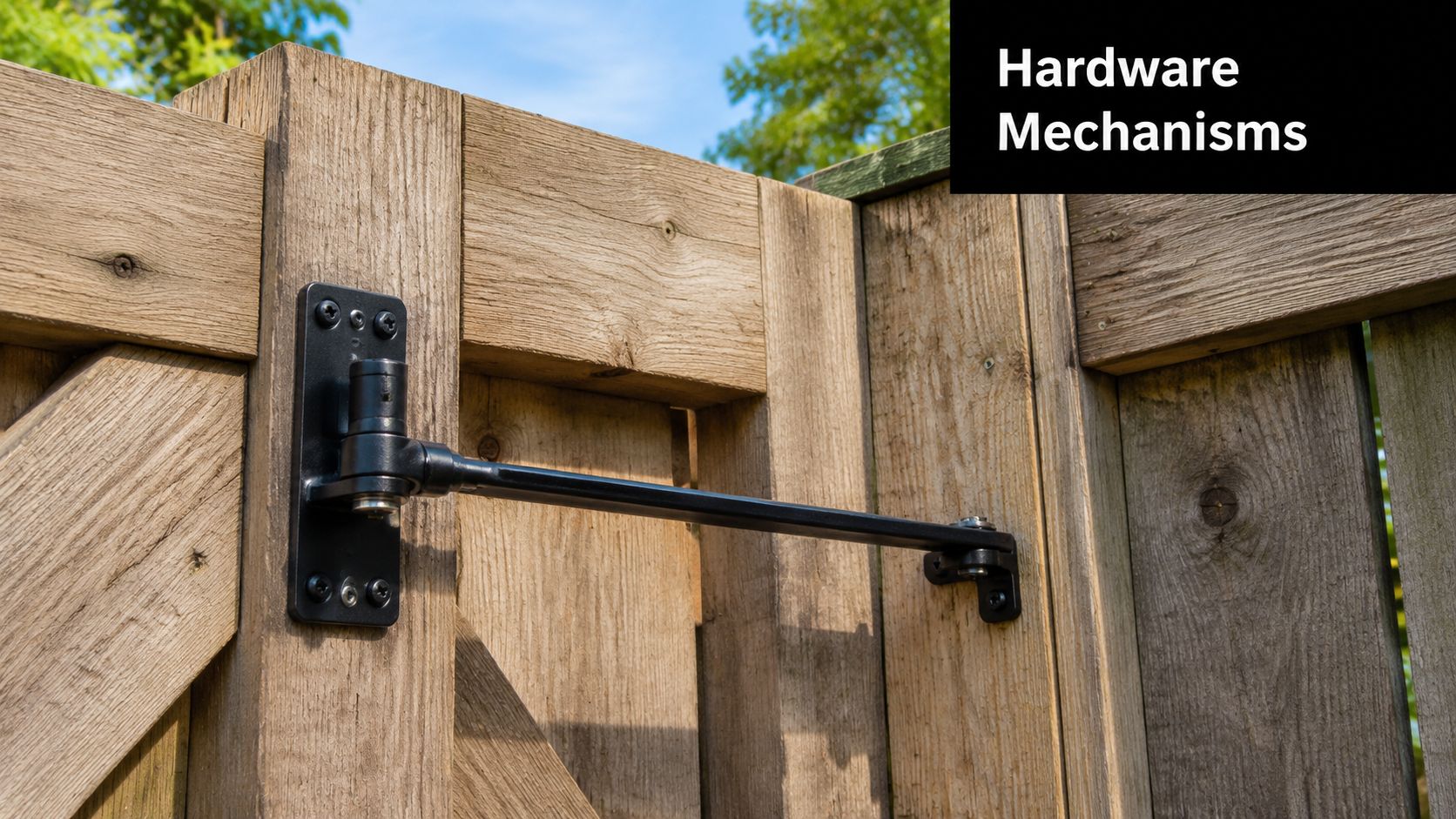
Spring hinges are the common starting point. They use internal spring tension to pull the gate shut after it opens. For many residential gates, they're practical because they're compact, familiar, and adjustable.
For a straightforward look at this hardware category, self-closing gate hinges are a common initial selection when automatic return action is needed on a fence or side yard gate.
What spring hinges do well:
- Simple retrofits. They fit many existing wood or metal gates.
- Adjustability. You can increase or decrease tension to suit the gate.
- Lower complexity. Fewer moving parts than some closer systems.
Where they fall short:
- They can't fix bad geometry. If the gate sags or binds, more spring tension just masks the underlying problem.
- They can slam. A strong spring on a light gate often creates a hard close.
- Performance varies with gate weight. Heavy wood gates can outrun weak hinges or wear them faster.
Hydraulic or pneumatic gate closers give you more control over speed and final approach. They suit gates where a softer, more predictable swing matters. On busy entries, they can reduce slamming and help the gate behave more consistently.
Self-latching hardware options
Latch choice matters just as much as hinge choice.
Gravity latches are simple and common. They rely on the latch dropping into place as the gate meets the post. They're fine for some general-purpose gates, but they can be less forgiving if alignment shifts.
Spring-actuated latches use internal force to help the mechanism engage. They can offer a more positive catch than basic gravity hardware, depending on the setup.
Magnetic safety latches are often the more reliable option where code compliance and repeatability matter. On vinyl or PVC gates, magnetic units are especially useful because they tolerate variation in closing better than basic gravity hardware, which helps when the frame flexes or seasonal movement changes clearances.
A quick demonstration helps if you're comparing hinge behaviour and closure action in the field:
What works well in real projects
For wood pool gates, I usually favour adjustable spring hinges paired with a quality magnetic or high-tolerance latch. The hinge handles the return. The latch handles the secure catch. If the gate is tall, heavy, or exposed to wind, the closer becomes more attractive because controlled motion helps the latch do its job.
Products in this category include Decorex Hardware hinge options, self-closing gate springs, and magnetic latch styles sold through hardware suppliers. XTREME EDEALS INC. carries gate hinges self-closing, a galvanized self-closing gate spring, Decorex Hardware items, and related fence hardware, which makes it one practical supply option when you're matching a hinge and latch set for the same project.
If you have to choose where to spend more, spend it on the latch and on proper installation. Cheap hinges annoy people. Bad latching fails the gate's purpose.
Meeting Safety and Building Code Requirements
A gate can close perfectly and still fail inspection.
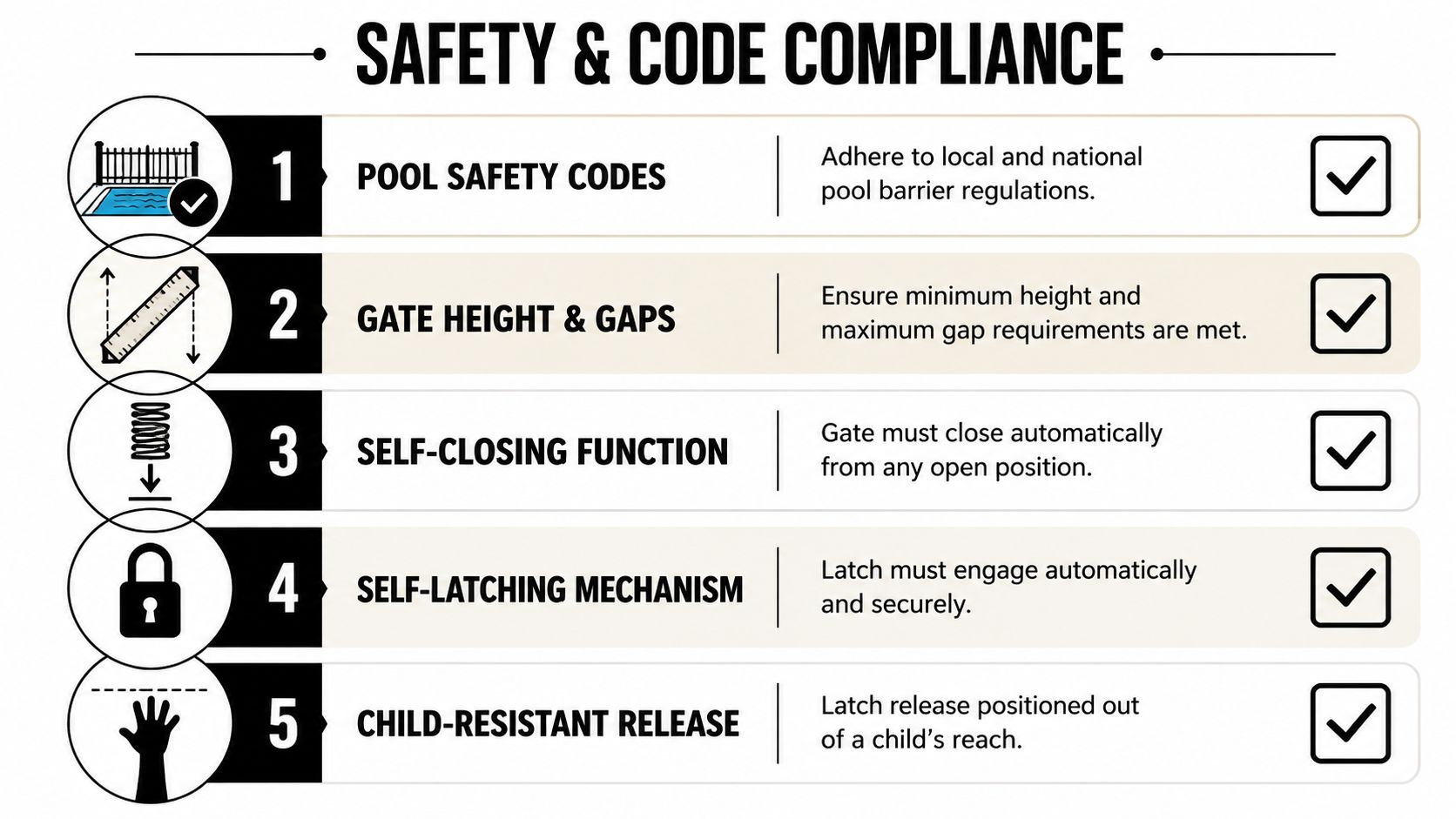
That happens because inspectors are checking two separate safety functions. The gate has to return to the closed position on its own, and it has to catch and stay secured without someone pushing it the last inch. A lot of homeowners and even some installers treat those as the same thing. They are not. For a pool barrier, that mistake is expensive and dangerous.
Code details vary by state, county, and municipality, so the first job is to verify the local requirement before hardware is ordered. In pool work, the usual checkpoints are consistent. The gate must swing away from the pool area, the release point has to be mounted high enough or protected from child access, and the gate has to close and latch on its own from any normal open position. If it only works from fully open, or only works when slammed, expect trouble at inspection.
What inspectors usually look for
The hardware matters, but inspectors are really judging performance in the field.
- Swing direction must follow the pool barrier rule in your area, which commonly means away from the pool.
- Latch height and release access must meet the local child-safety requirement.
- Closing action must be reliable through the full swing, not just under ideal conditions.
- Latching action must happen automatically, without a hand on the gate.
- Clearances and alignment must stay tight enough that the latch engages every time.
Why decent-looking gates still fail
I see the same pattern on service calls. The gate looks fine standing still, but the system was never set up to pass a real-world test.
| Problem on site | Why it fails |
|---|---|
| Gate closes only from wide-open position | The closer or hinge tension is not doing enough through the full arc |
| Latch engages only with a hard slam | The latch alignment is off, or the closing speed is masking a bad install |
| Latch release sits too low | The gate may be easy for a child to operate and may not meet local code |
| Gate swings the wrong direction | The installation does not match pool barrier intent or local rule |
A pool gate should be judged on its worst close, not its best one.
That is also why permit knowledge matters. If you are hiring the work out, make sure the installer understands barrier rules, inspection standards, and local amendments. For readers comparing licensing requirements more broadly, this Virginia Class A contractor license guide gives a good example of the background to check when regulated work is involved.
For hardware research, a self-closing gate hardware category can help you compare hinges, closers, and latch options side by side. Just do not buy by label alone. A package marked self-closing does not mean the finished gate will meet code once it is mounted on a real post with real movement, real wind, and real tolerances.
Choosing the Right Gate Hardware for Your Project
The right hardware starts with the gate itself. Material, weight, width, exposure, and use pattern all matter more than brand loyalty.
Match the hardware to the gate
Start with four questions.
What is the gate made of?
Wood moves. It swells, shrinks, and can sag under its own weight. Vinyl and PVC can flex. Metal is usually more dimensionally stable, but it still needs proper hinge placement and latch alignment.
How heavy is it?
A narrow pedestrian gate can work well with spring hinges. A broader, heavier wood gate often needs stronger hardware and tighter alignment discipline. The heavier the gate, the less forgiving the setup becomes.
Is the site windy or sloped?
Wind changes how the gate closes. So does a slope that affects swing path or ground clearance. If the gate catches air or has limited clearance at one end, choose hardware with enough control to avoid bounce-back and enough strength to finish the close.
Who uses the gate and how often?
A side yard gate used twice a day can tolerate simpler hardware than a pool gate or common-access entry used constantly by kids, guests, or tenants.
A practical selection guide
- Heavy wood gate. Use heavy-duty adjustable closing hardware and a latch that tolerates minor movement well.
- Vinyl or PVC gate. Magnetic latches are often the safer bet because they handle closing variation better.
- General garden gate. A simpler latch may be enough if no pool code applies and access risk is lower.
- Pool enclosure gate. Prioritise code-compliant latch height, reliable automatic engagement, and repeatable closure over appearance.
When you're comparing categories, fence and gate hardware is the right place to sort by function rather than trying to mix unrelated parts from different aisles.
What doesn't work well
Don't rely on these shortcuts:
- Extra spring tension to cure sag. That usually creates slamming and premature wear.
- A bargain latch on a demanding gate. The latch is the final safety action. That's the wrong place to get casual.
- Mixing hardware without checking compatibility. Hinge speed and latch tolerance have to suit each other.
Nuvo Iron and Decorex Hardware both show up in the market, but the decision still comes back to fit for the gate, not the logo stamped on the box.
Installation Troubleshooting and Maintenance Tips
A gate can look fine and still fail inspection. I see it all the time. The closer pulls the gate shut, but the latch only catches if someone gives it a shove. For a pool gate, that is a failure, not a minor adjustment issue.
The trouble usually starts with installation geometry, not bad hardware. The key point from field experience is simple. Proper self-locking gate latch alignment matters because a self-latching gate only works reliably when the geometry is right. If the keeper is set so the latch has to hit hard to engage, the gate may pass a casual glance and still fail in daily use.
Start with the parts that hold position over time. A hinge spring or closer can only do so much if the gate frame is sagging or the post has moved.
Fix geometry before you adjust force
Check these items in order:
- Post plumb. A leaning hinge post changes the swing path and the latch meeting point.
- Even reveal. The gap between gate and post should stay consistent from top to bottom.
- Clean swing path. The gate should not drag on grade, scrape a threshold, or bind near full close.
- Latch meeting point. The latch body should enter the keeper cleanly and drop into place without a bounce.
If the latch needs a slam, move the keeper first. Do not start by cranking up spring tension.
That shortcut creates two problems. The gate closes faster than it should, and the extra impact beats up the latch, hinges, and post connections. It may look fixed for a week, then fail again when the weather changes or the gate gets used harder.
Common failures and what usually causes them
The gate closes but does not latch
Look for keeper alignment, gate sag, loose hinge screws, or a latch that does not tolerate small movement well.
The gate slams shut
Spring tension is too high, the gate is too light for the hardware, or the closer speed is set too aggressively.
The gate stops short
Check for rubbing at the bottom, swollen wood, hinge bind, loose fasteners, or a closer that needs adjustment.
The latch works in dry weather but not after rain or heat
Wood moves with moisture. Vinyl and metal frames can shift slightly with temperature. Marginal alignment shows up fast when conditions change.
Maintenance that actually prevents failures
Routine checks beat big annual repairs.
- Tighten fasteners early. Loose screws turn into enlarged holes and a sagging gate.
- Watch the reveal. Gap changes usually show movement before the gate stops working.
- Test slow closes. A gate that only latches with momentum is not set up properly.
- Replace worn latch parts before they round off or stick. Wear spreads to the keeper and striker area if you leave it too long.
One more field tip. Test the gate from different opening positions, not just from fully open. A lot of bad installs will latch from a hard swing but fail from a short, slow return, which is exactly how kids and guests often use the gate.
Very few gate failures are sudden. The warning signs are usually there for weeks.
Gate Safety FAQs
A self-closing and self-latching gate only counts when the full cycle works. The gate returns on its own, the latch engages on its own, and the gate stays secured without help. That's the standard to keep in mind before you buy hardware, during installation, and during routine checks.
Can I retrofit an old gate to be self-closing?
Often, yes. The bigger question is whether the old gate is straight, stable, and worth retrofitting. If the frame is sagging or the posts have moved, adding spring hardware may create frustration instead of a safe result.
How do I test whether my gate is working properly?
Use functional tests, not a quick glance. Pool gate testing guidance from Pool Guard USA includes the Full-Open Test, where the gate must close and latch from 90 degrees, and the Slow Closure Test, where the latch must still engage without momentum. A gate fails if it stalls, stops short, or needs assistance to latch.
What's the difference between a gate closer and a spring hinge?
A spring hinge stores force at the hinge point and returns the gate by spring tension. A gate closer is a separate control device designed to manage the gate's movement more deliberately. In practical terms, closers usually offer more control, while spring hinges are simpler and more common.
Can one latch work for every gate?
No. Gate material, frame stiffness, exposure, and code requirements all affect latch choice. A latch that behaves fine on a light side gate may be a poor fit for a heavier wood pool gate.
How often should I check the gate?
Check any safety gate regularly, and always after weather shifts, visible movement, or hardware adjustments. If the gate protects a pool area, treat testing as routine maintenance, not a one-time install task.
If you're sourcing hardware for a new build, a retrofit, or a pool gate correction, XTREME EDEALS INC. offers fence and gate hardware, post caps, fasteners, hinges, springs, and related components that fit both DIY and contractor workflows. Match the parts to the gate, install them with tight geometry, and test the full close-and-latch cycle before you call the job finished.