
You're probably in one of two spots right now. You've either got a half-planned outdoor project on the go, with a pile of brackets, screws, and post caps in front of you, or you're pricing a job and trying to avoid the kind of part mismatch that comes back as a callback later.
That confusion is normal. A homeowner replacing deck railings may think the hard part is choosing the boards, then realise the key decisions sit in the smaller pieces: the right post base, the right hinge, the right coating, the right fastener length. A contractor bidding a fence run often runs into the same problem from the other end. The layout is simple enough, but the hardware choices decide whether the build stays tight, square, and clean after a few seasons.
The scale of demand helps explain why this category feels so crowded. The California lawn and outdoor equipment sector supports over 7,231 businesses nationwide and generated $13.8 billion in 2026, reflecting strong demand for replacement parts in residential and commercial projects, according to IBISWorld's lawn and outdoor equipment store industry data. More demand usually means more options. More options usually mean more chances to buy the wrong thing.
Introduction to Outdoor Equipment Parts
Outdoor equipment parts don't just mean engine components. In practical home improvement work, they include the hardware that holds decks, fences, gates, and outdoor structures together and helps them survive weather, movement, and daily use.
Think about a simple fence gate. The wood gets most of the attention, but the hinge carries the swing, the latch manages alignment, the screws hold under repeated force, and the post anchor keeps the support steady at ground level. If one part is undersized or poorly coated, the whole assembly starts to fail from the weakest point first.
Why the small parts decide the lifespan
Shoppers often prioritize visible pieces first. They pick a nice post cap, a decorative baluster, or a black hinge that matches the rest of the yard. Those choices matter, but performance comes from the less glamorous details:
- Base support keeps posts from shifting or rotting at the bottom.
- Fasteners manage pull-out strength and resist corrosion.
- Brackets and hangers transfer load between members.
- Caps and trim pieces protect exposed surfaces and improve finish quality.
Practical rule: If a part carries load, touches concrete, or sits where water collects, treat it as a structural decision, not a cosmetic one.
A good buying decision balances four things at once: category, material, size, and local conditions. That's where many generic guides fall short. They'll tell you what a joist hanger is, but not why a humid Ontario setting may call for a different finish than a sheltered inland installation. They'll mention galvanized hardware, but not what to look for when a bracket needs to resist long-term corrosion.
That's where careful selection pays off. Done well, the right outdoor equipment parts reduce repeat work, simplify installation, and keep a project looking organised instead of patched together.
Understanding Outdoor Equipment Part Categories
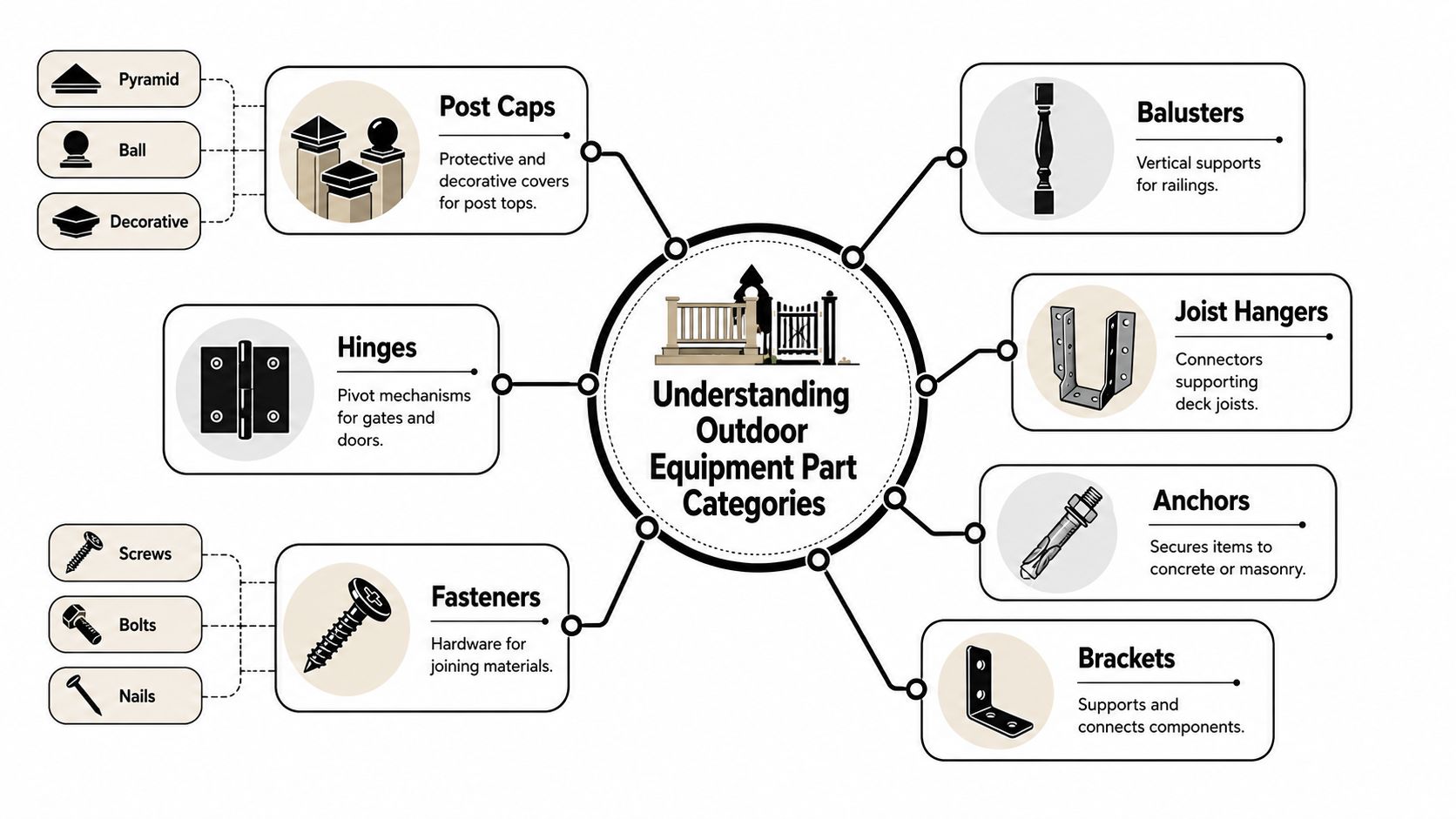
The easiest way to sort outdoor equipment parts is to think in terms of jobs. Some parts protect. Some connect. Some carry load. Some control movement. Once you sort hardware by role, the product list becomes much easier to read.
Parts that finish and protect
Post caps sit on top of fence and deck posts. They do two jobs at once. They improve appearance and help shield exposed end grain from water entry.
Common styles include:
- Pyramid caps for a clean, classic profile
- Ball caps for a more traditional ornamental look
- Decorative caps when the project needs a stronger design feature
These are commonly matched to posts from 2×2 up to true 6×6 sizes, and the exact fit matters. A cap sized for nominal lumber can sit loose on a true-dimension post, while a true-size cap may not fit dressed lumber the way you expect.
Balusters are the vertical members in railing systems. They help create spacing and support while shaping the overall style of the deck or porch. Metal balusters give a sharper, more finished line. Wood versions blend into traditional builds more easily.
A useful comparison sits outside decking but applies here too. When you're matching screen frame parts and spline dimensions, fit has to be exact or the assembly never sits right. That same discipline shows up in Sparkle Tech's screen replacement guide, which is worth a look if you want another example of how small component choices affect the finished result.
Parts that connect and support
Brackets are the building blocks of outdoor assembly. They hold one component against another and keep angles consistent. L-brackets, post base brackets, and rail connectors all fall into this group. If you've ever tried to keep a post perfectly upright while fastening it, you already know why brackets matter.
Joist hangers support deck joists where they meet ledgers or beams. These are structural connectors, not decorative hardware. They need the right dimensions, the right nail or screw pattern, and the right material for the exposure level.
Anchors secure hardware into concrete or masonry. Wedge anchors and sleeve anchors are common choices when fixing post bases, brackets, or heavy hardware to a slab or footing. Their job is simple. They turn a surface connection into a stable one.
For shoppers trying to compare common joining hardware in one place, a category page such as fasteners and fittings for outdoor assemblies can help you see how screws, bolts, anchors, and related fittings are grouped by task rather than by brand name alone.
Parts that move
Hinges belong wherever a panel, gate, or door needs to swing. A hinge seems straightforward until the gate starts sagging, binding, or pulling fasteners loose. That usually means the hinge style, thickness, or mounting surface wasn't matched to the job.
Here's the simple breakdown:
| Category | Main job | Typical examples |
|---|---|---|
| Finishing parts | Protect and improve appearance | Post caps, finials, inserts |
| Support parts | Carry or transfer load | Joist hangers, brackets, anchors |
| Joining parts | Hold materials together | Screws, bolts, nails, washers |
| Moving parts | Allow controlled motion | Hinges, gate hardware, latches |
A good hardware list reads like a crew list. One part carries weight, one keeps alignment, one manages movement, and one protects the exposed edges.
Fasteners tie all of it together. Screws, carriage bolts, lag bolts, nails, and washers each behave differently. A deck screw isn't just a “screw for outside.” It's a specific choice for thread grip, head style, and coating. A carriage bolt gives through-fastened clamping force where a screw can't. Nails install quickly, but they're not always the right answer where pull-out resistance matters.
Once you start seeing categories by function, catalogues stop looking random. You're no longer browsing parts. You're selecting roles in a system.
Materials and Coatings Explained
Material choice often determines the success or failure of many outdoor builds. Two brackets can look nearly identical on a shelf, yet one may hold up far better because its base metal and coating match the environment.
What the common metals actually do
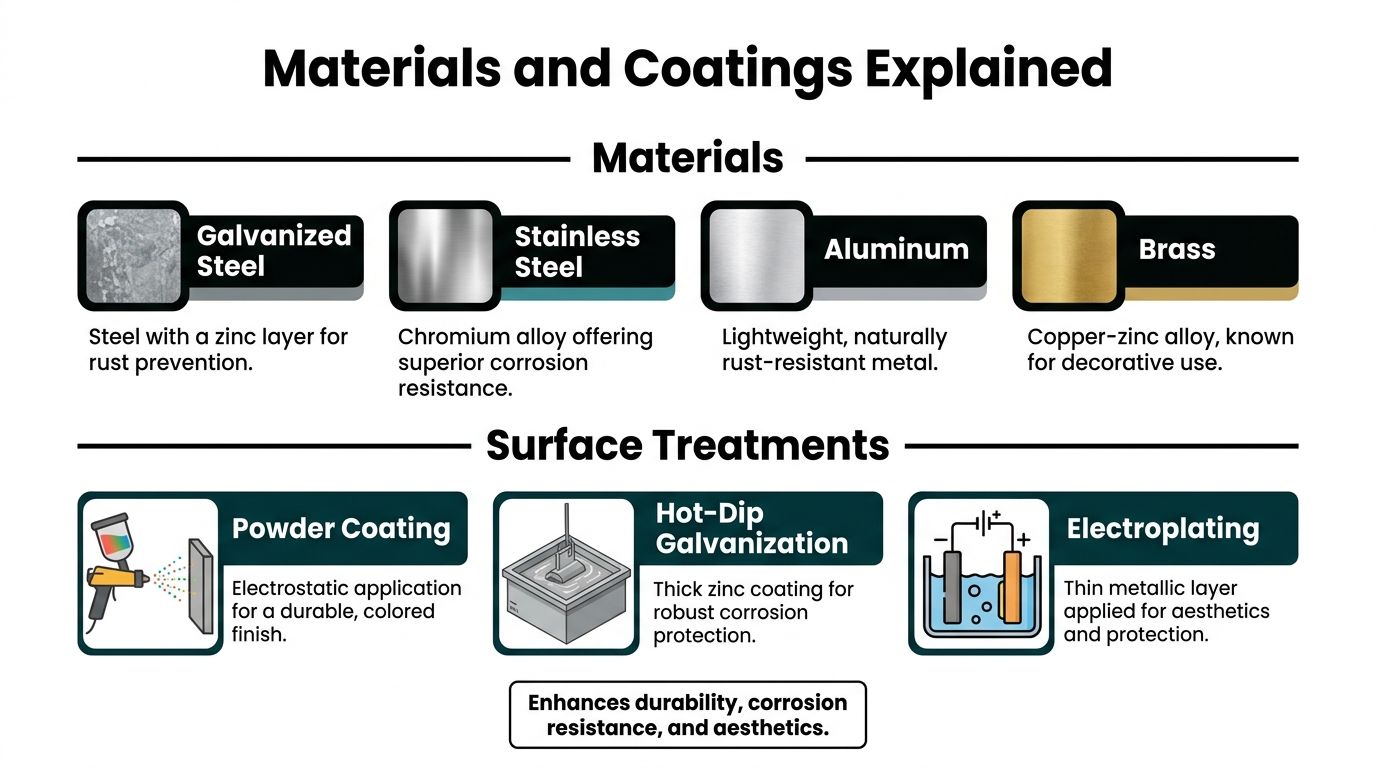
Galvanized steel is standard for many outdoor brackets and structural connectors. Steel provides strength. The zinc layer helps resist corrosion. This makes it a common pick for post bases, joist hangers, and anchors where load matters.
Stainless steel offers stronger corrosion resistance than many coated steels, which is why many builders favour it in damp, exposed, or higher-maintenance-sensitive settings. It often makes sense for screws, bolts, and fittings where staining or rust transfer would be a concern. If you're comparing options for exposed connectors and hardware, stainless steel fasteners for outdoor use are worth reviewing alongside galvanized alternatives.
Aluminum is lightweight and naturally resistant to rust. It's common in decorative components and some railing parts, though it isn't always the right answer where heavier structural loads are involved.
Brass appears more often in decorative or accent roles. It offers a distinct finish but isn't usually the first choice for heavy-duty structural connections in deck and fence framing.
Why coating quality matters more than many buyers think
A coating isn't paint with a fancier name. It's part of the performance package.
Here's the practical difference:
- Powder coating adds a durable finish layer and helps with appearance
- Hot-dip galvanization builds a thicker zinc barrier for corrosion resistance
- Electroplating usually applies a thinner metallic layer, often suited to lighter-duty or more appearance-focused use
The hidden mistake is assuming all “galvanized” parts are equal. They aren't. Coating thickness changes service life, especially where moisture lingers.
That's why standards matter. Galvanized steel post base brackets must meet a minimum zinc coating of 600 g/m² for a 25-year corrosion-resistance lifespan in humid Ontario climates, per CSA A231.2, as noted in this CSA-related reference on galvanized steel bracket coating requirements.
Field note: A bracket at grade level faces a much harsher life than a decorative cap near the top of a fence. Don't judge them by appearance alone.
Region-adapted selection for Ontario conditions
Ontario creates a mix of challenges. Humidity, freeze-thaw cycles, trapped moisture near concrete, and in some areas salt exposure all put pressure on coatings. A generic guide written for a dry climate may tell you any outdoor-rated fastener is fine. On a real site, that can be expensive advice.
Use this lens when comparing materials:
| Material or finish | Best use | Watch for |
|---|---|---|
| Galvanized steel | Structural brackets, anchors, hangers | Zinc level and long-term exposure |
| Stainless steel | Screws, bolts, exposed hardware | Cost and matching with adjoining metals |
| Aluminum | Lightweight decorative parts | Lower strength in structural roles |
| Powder-coated steel | Visible decorative hardware | Surface chips that expose base metal |
A hidden cost of mismatch isn't just replacement. It's staining on finished wood, seized hardware during future repairs, loose joints after corrosion starts, and labour spent revisiting work that should have stayed solid.
A simple rule helps. Match the metal and coating to the wettest, saltiest, or most exposed condition the part will face, not the average day in the yard. That approach costs a bit more upfront and saves trouble later.
Sizing and Compatibility Guidelines
Sizing errors create some of the most frustrating failures because everything can look close enough until installation starts. The cap almost fits. The bracket holes are slightly off. The anchor is the right diameter but the wrong length. By then, the packaging is open and the job has stalled.
One warning sign comes from project failure data. 68% of fence and deck projects in California fail within five years due to material mismatch, often from incorrect sizing or incompatible coatings, according to Prospect Equipment's note on fence and deck project failures. Even if your project is in Ontario, the lesson carries over. Size and compatibility aren't small details.
Measure the actual part, not the label
A “4×4” post doesn't always measure the same way across products. The safest habit is to measure the installed or purchased component directly.
Check these points before ordering:
- Post outside dimensions. Measure width and depth at the actual installation point.
- Rail and baluster spacing. Confirm both the member size and the gap requirement.
- Bracket hole pattern. Measure centre-to-centre spacing, not edge-to-edge.
- Mounting surface depth. Concrete thickness and edge distance affect anchor choice.
- Fastener clearance. Make sure heads, washers, and tools can fit in the assembled space.
If you've ever chosen trailer hardware, you know “close enough” can be risky. The same thinking appears in this practical guide to hitch selection for secure hauling. The lesson transfers well to outdoor hardware. Match the exact dimensions first, then the application.
Part Compatibility Table
| Part Type | Compatible Sizes | Material Notes |
|---|---|---|
| Post caps | 2×2, 4×4, 5×5, true 6×6 and other listed post dimensions | Match nominal versus true size before purchase |
| Balusters | Sized to railing system and rail opening | Metal and wood balusters need compatible fasteners |
| Post base brackets | Match exact post footprint | Use corrosion-resistant material suited to moisture exposure |
| Joist hangers | Match joist width and lumber dimensions | Pair with approved connector fasteners |
| Hinges | Sized to gate thickness and weight | Use stronger corrosion resistance on exposed gates |
| Anchors | Match bracket hole diameter and embedment needs | Choose concrete-rated anchors for masonry surfaces |
Compatibility logic that saves time
Some buyers start with the part they like best. A better habit is to start with the substrate.
- If you're fastening into concrete, choose the anchor system first. Then match the bracket hole diameter. For this kind of work, concrete anchor bolts for outdoor mounting are the category to compare before choosing the bracket itself.
- If you're capping posts, measure the true outside dimensions after any planing, wrapping, or finishing.
- If you're hanging a gate, work backward from gate width, weight, and swing direction.
Most compatibility problems don't come from obscure engineering. They come from one skipped measurement and one assumption made too early.
Metric versus imperial sizing can also trip people up. If a product lists dimensions in one system and your tape is in another, convert carefully and verify against the manufacturer's stated fit. For hardware, one small mismatch compounds quickly.
Installation and Maintenance Best Practices
Installation quality decides whether even good parts perform properly. I've seen premium hinges installed with weak screws, and basic brackets installed so carefully that they outperformed more expensive setups. The difference was method.
Four common installs done properly
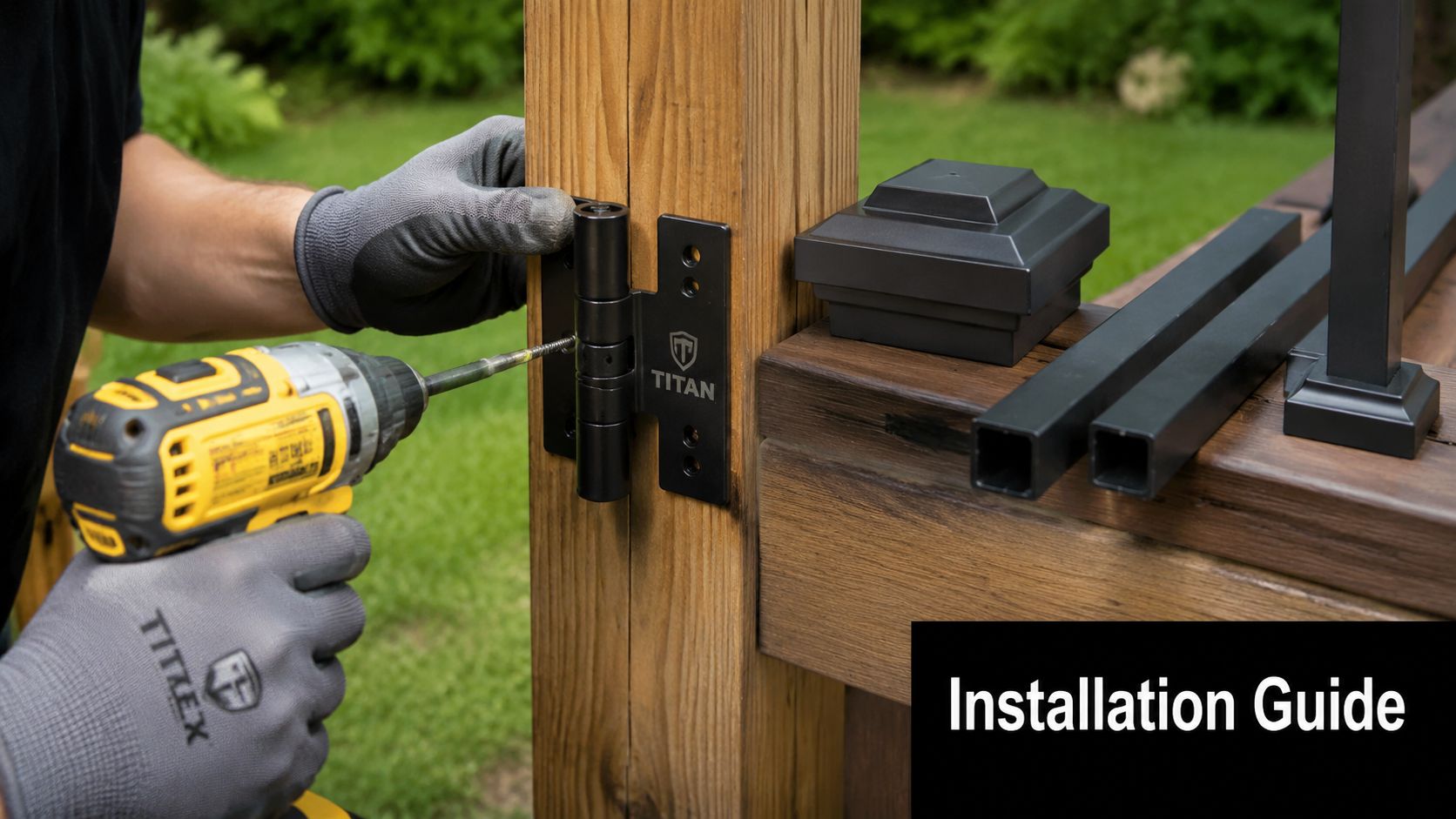
Post caps seem simple, but alignment matters. Dry-fit first. Confirm the cap seats fully without forcing it. If adhesive or set screws are part of the design, apply them only after you've checked orientation from more than one angle.
A professional I know who installs outdoor structures uses painter's tape to mark the front face of each post before fastening caps on a windy day. That sounds minor, but it keeps decorative profiles lined up across a long run.
Post base brackets with wedge anchors need a clean surface. Drill the hole to the specified diameter and depth for the anchor being used. Remove dust from the hole before setting the anchor, then tighten evenly so the bracket sits flat rather than twisting against the slab.
Gate hinges need accurate reveal spacing. Support the gate at finished height with shims before marking holes. Fasten one side, test swing, then lock in the remaining screws or bolts. If you fully tighten everything before checking movement, you often build the sag in from the start.
Balusters go faster when you use a spacing jig. Even a scrap block cut to a fixed width keeps sightlines cleaner than measuring each gap individually.
The habits that prevent callbacks
A few practices make a big difference:
- Pre-drill where splitting is likely. This matters near board ends and with hardwood or dense treated lumber.
- Use the correct fastener type. Connector hardware often needs specific screws or nails, not whichever exterior screw is closest.
- Tighten in stages. Bring all fasteners snug first, then finish tightening after alignment checks.
- Protect cut edges. If a coated part gets nicked during installation, inspect it and address damage promptly.
- Avoid mixed hardware without thought. Different metals in wet environments can create problems over time.
A neat install usually starts with slower layout, not faster drilling.
Seasonal maintenance that actually matters
Outdoor hardware doesn't need constant attention, but it does need inspection. Check moving parts at season changes, especially hinges, latches, and exposed fasteners on gates and stairs. Look for finish wear, looseness, staining, and any shift in alignment.
Use this short maintenance cycle:
| Season check | What to inspect | What to do |
|---|---|---|
| Spring | Rust spots, movement after winter | Tighten hardware, clean surfaces |
| Summer | UV and heat exposure on finishes | Inspect coatings and touch up where needed |
| Autumn | Debris around bases and anchors | Clear buildup that traps moisture |
| Winter prep | Gate swing and freeze-prone contact points | Lubricate moving hardware as appropriate |
Powder-coated parts deserve extra attention if they're in high-contact areas. A coating chip won't always spread into a major problem, but if water reaches the base metal repeatedly, deterioration starts there first.
The best maintenance plan is short and repeatable. Ten focused minutes with a drill, wrench, and inspection eye each season is worth far more than ignoring the hardware for years and replacing it all at once.
Troubleshooting Common Part Issues
Failures usually leave clues before they become major repairs. Rust streaks, squeaks, wobble, sag, and visible movement all point to a specific cause if you read them properly.
Match the symptom to the cause
Rust streaks below hardware often mean the coating is compromised or the material wasn't suited to the location. Check whether water is collecting around the part or running across it constantly.
Loose balusters usually come from undersized fasteners, wallowed mounting holes, or movement in the rail assembly itself. Tightening the same screw again may not solve it if the substrate has already worn.
Sagging brackets or shifting posts can indicate poor anchor choice, insufficient embedment, or a base that was never fully seated. When this happens near concrete, inspect both the hardware and the concrete condition.
Gate drag often starts with hinge alignment, but don't stop there. Check the post plumb, fastener tightness, and whether the gate picked up moisture and changed weight balance.
A fast diagnosis checklist
- Look for staining paths. Rust usually tells you where water sits.
- Test movement by hand. If the part shifts before the structure does, the connection is the weak point.
- Inspect the fastener head. Stripped or mushroomed heads often signal overdriving or wrong tool use.
- Check adjacent materials. Rotting wood or cracked masonry can make good hardware appear to have failed.
- Replace regulated parts promptly. On equipment used in wildland areas, compliance matters as much as performance.
That last point matters beyond decks and fences. Under California law, spark arresters on off-highway vehicle equipment must remain in effective working order, making replacement arrester parts an essential compliance issue, as outlined by California State Parks OHV spark arrester requirements. The broader lesson applies to all outdoor equipment parts. Some parts aren't optional upgrades. They're required safety components.
If a part controls safety, movement, or fire risk, repair isn't something to postpone until the next season.
Repair or replace
Use repair when the issue is isolated and the surrounding materials remain sound. That might mean replacing a few baluster screws, resetting a hinge, or installing the correct anchor where the wrong one was used.
Replace the full part when corrosion is advanced, the metal has deformed, or the hardware no longer matches the environment. A badly rusted bracket or bent hinge rarely becomes trustworthy again just because it's tightened.
Troubleshooting gets easier when you stop treating symptoms as random. Most recurring part issues come from one of four roots: the wrong material, the wrong size, poor installation, or missed maintenance.
Buying Considerations and Decision Criteria
Buying outdoor equipment parts well means looking past the first three things most shoppers notice, which are colour, price, and whether the item appears close enough to fit. Those matter, but they shouldn't lead the decision.
Start with the project type
A DIY homeowner replacing a few rail parts can usually prioritise ease of installation, appearance, and small-pack convenience. A contractor building multiple gates or a long fence line has a different priority set. They need consistency across packs, dependable finish quality, and ordering that supports repeat work.
That changes the buying checklist:
- DIY jobs benefit from smaller quantities, clearer fit descriptions, and forgiving installation hardware.
- Professional jobs benefit from multi-pack options, stable product availability, and cleaner category organisation for repeat purchasing.
- Property maintenance work often needs durable, easy-to-service parts more than decorative upgrades.
Compare brands by fit for purpose
Brand reputation matters most when it reflects consistent machining, finish quality, and fit. In deck and fence accessories, buyers often compare names such as Decorex Hardware and Nuvo Iron because both come up in decorative and structural outdoor categories. The better choice depends on the application, finish preference, and how closely the dimensions match your build.
Don't buy by brand name alone. Buy by the combination of:
| Decision factor | What to ask |
|---|---|
| Fit | Does it match the exact dimensions you measured? |
| Material | Is the metal suited to your local exposure? |
| Finish | Will the coating hold up where the part is installed? |
| Pack size | Are you paying for extras you won't use, or running short mid-job? |
| Serviceability | Can the part be inspected, tightened, or replaced later without major disruption? |
CAD pricing can also help Canadian buyers compare options more clearly when budgeting a full hardware list. It's easier to plan a deck or fence package when the pricing reflects the currency you're working in.
Buy with future compliance in mind
Even if your current job is focused on structural hardware rather than powered equipment, regulations shape what parts categories remain practical to stock and maintain over time.
One clear example is California's rule change. California's 2024 green lawn care law bans new gas-powered outdoor equipment under 25 hp, requiring retailers to prioritise zero-emission or electric replacement parts, according to LawnStarter's summary of the California green lawn care law. If you manage mixed outdoor assets or supply maintenance parts, that changes future buying priorities.
For buyers, the lesson is simple. Don't build your parts shelf around categories that are losing practical relevance in regulated markets if electric-compatible options better match where the industry is going.
Buy for the next repair too, not just today's install.
A sensible purchase order
If you want fewer surprises, use this order:
- Confirm dimensions.
- Match material to exposure.
- Verify the part's role, decorative, structural, moving, or anchoring.
- Choose pack quantity based on project scale.
- Compare brand and finish only after the first four are settled.
That sequence keeps the decision grounded. It also helps you avoid the most common buying mistake, which is choosing the nicest-looking part first and trying to force the rest of the project around it.
Conclusion and Next Steps
Good outdoor work holds up because the small parts were chosen with care. Post caps protect exposed ends. Hinges control movement. Brackets and hangers carry load. Fasteners and anchors tie the whole assembly together. When category, material, coating, and size all line up with the prevailing site conditions, the project feels solid from day one and stays that way longer.
For Ontario projects, that region-adapted thinking matters even more. Humidity, trapped moisture, concrete contact, and seasonal swings can punish hardware that looked acceptable on paper. CSA-aware selection, careful measuring, and a quick compatibility check before purchase save more trouble than most buyers expect.
Keep the basic process close at hand. Measure the actual component. Match the material to exposure. Use the right installation method. Inspect the finished hardware seasonally. If a part shows movement, staining, or corrosion, treat it as a warning sign early.
If you're ready to shop, it helps to review product categories, FAQs, and support resources in one place so you can compare deck accessories, fasteners, anchors, and finishing hardware without guesswork.
If you're sourcing parts for a deck, fence, gate, or outdoor upgrade, XTREME EDEALS INC. is a practical place to start. You can browse post caps, balusters, hinges, brackets, joist hangers, fasteners, anchors, and more in CAD pricing, with options suited to both DIY homeowners and contractors. If you need help narrowing down fit, finish, or quantity, their support resources and catalogue make it easier to choose the right hardware before you order.