
You're halfway through repairing a fence when the post starts leaning, the rail won't sit square, and the exposed steel already shows rust around an old drilled hole. On a deck project, the same frustration appears when a joist edge needs guidance, a bracket needs a straight mounting surface, or a support member needs more stiffness without adding a bulky beam. Galvanized U channel can solve these problems, but only when its profile, coating, thickness, and fasteners match the job.
This guide treats U channel as part of a working system, not as a loose piece of metal. You'll learn how the shape supports posts and rails, how pre-galvanized steel differs from hot-dip galvanized steel, how to read sizing information, and how Canadian weather and building requirements affect your choice.
Introduction to Galvanized U Channel for Outdoor Projects
A carpenter repairing a backyard deck may use U channel to hold an edge straight while the surrounding framing is fastened. A fencing contractor may use it to support a rail, protect an exposed edge, or create a clean connection between metal and timber. A sign installer may choose a pre-punched U-channel post because the holes make mounting hardware easier to position.
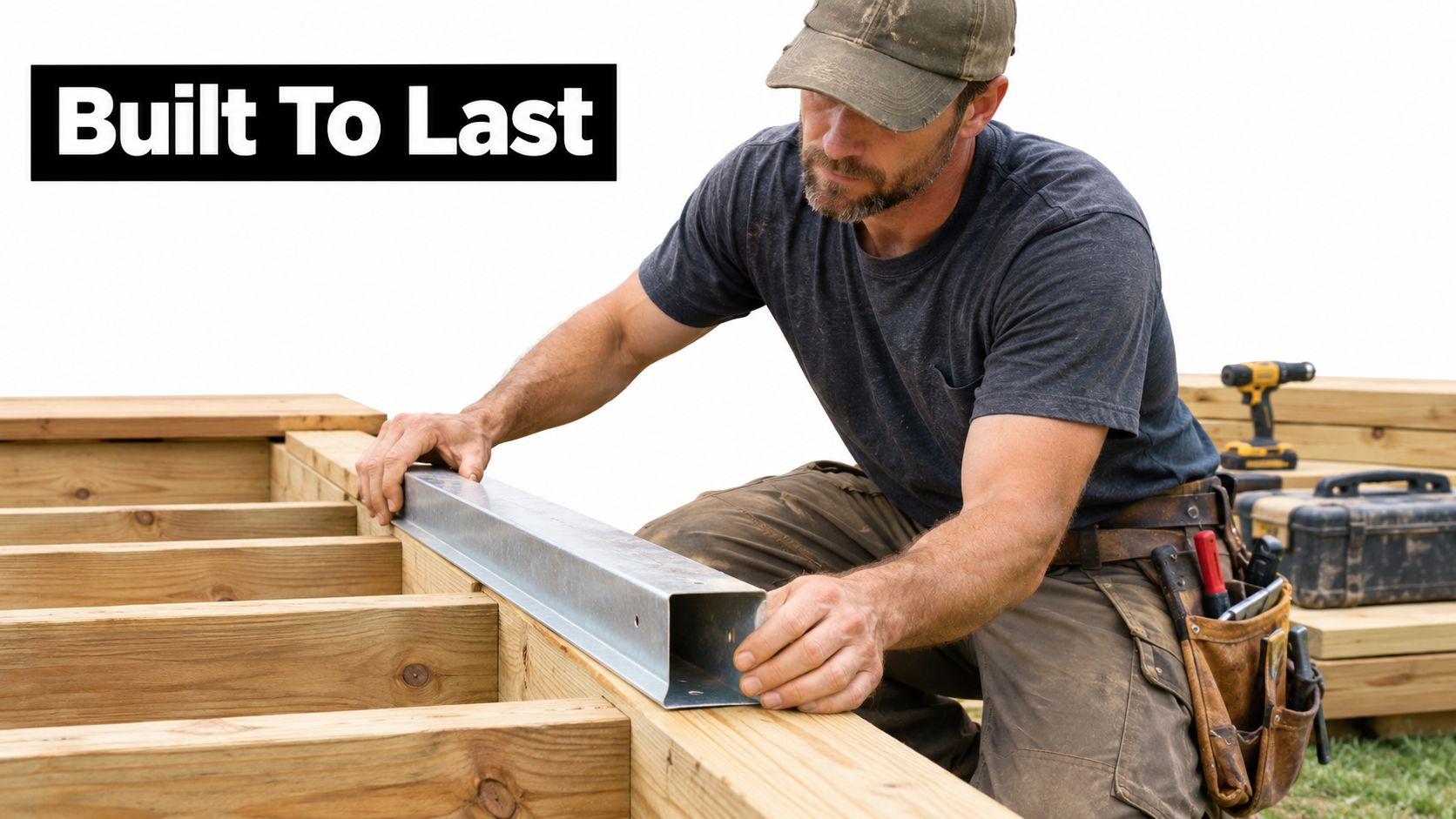
The useful mental model is simple. U channel is a steel track. Its flat web forms the base of the track, while the two flanges rise on either side to cradle, guide, cap, or stiffen another component. It can help keep a fence rail aligned, protect the edge of a deck detail, or provide a mounting surface for signs and light framing.
Canadian distributors commonly sell galvanized channel as standard structural steel channels or strut-channel systems. Their listings identify both pre-galvanized and hot-dip galvanized finishes, and some standard A-36 / 44W channel stock lengths are listed at 40, 45, 50, 55, 60, and 65 feet in Canadian channel documentation. Those long stock lengths are more relevant to fabricators and contractors than to a small homeowner project, but they show that the product belongs to an organised steel supply chain.
Your first decision isn't, “What size U channel should I buy?” Start with the job:
- Fence or gate: Does the channel guide a rail, reinforce a connection, or act as a post?
- Deck: Is it supporting an edge detail, protecting timber, or connecting framing members?
- Signage: Do you need pre-punched holes and a tapered or driven end?
- Code-sensitive framing: Does the assembly require documented steel grade, thickness, finish, and compliance?
Once you answer that, the right product becomes much easier to identify. A channel for a sign post isn't automatically suitable for a structural deck beam, and a light indoor framing channel shouldn't be treated as a heavy exterior support.
What Galvanized U Channel Is and How It Works
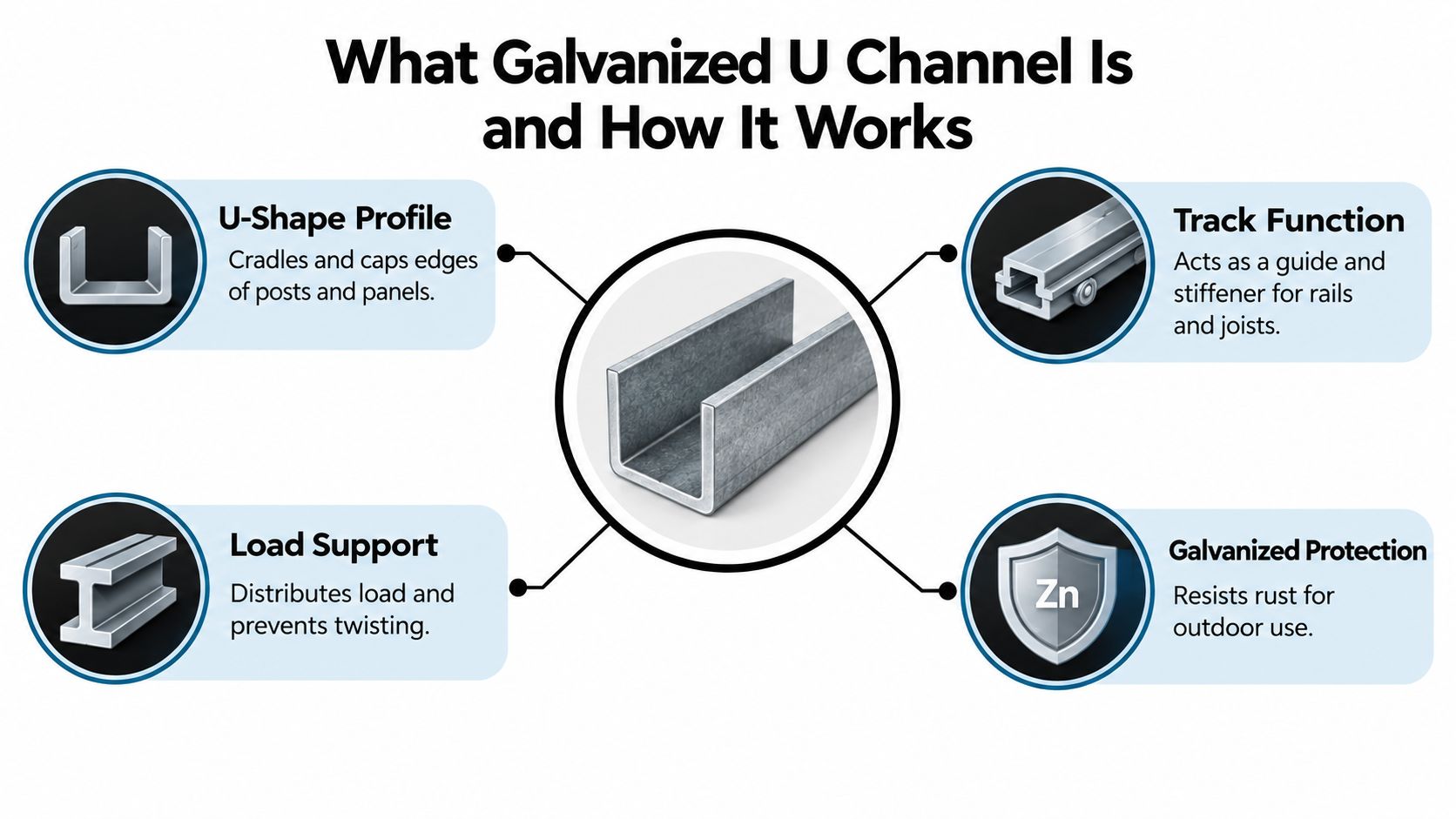
Think of a U channel as a steel cradle. Place a board, rail, post edge, or panel inside the opening, and the two raised sides help keep it aligned. The web carries contact against the supported member, while the flanges help resist sideways movement and twisting.
That geometry does useful work without requiring a solid bar of steel. A flat strip can flex easily in one direction. Bending the strip into a U adds depth, giving the section more resistance to distortion. The result is a practical profile for guiding, capping, reinforcing, and supporting components that don't require a heavy beam.
The four jobs the profile performs
Cradling and capping: The opening can receive the edge of a rail, panel, or post. This helps protect vulnerable edges and creates a cleaner connection.
Tracking and alignment: A channel can act like a rail or guide. On a fence, that may help keep a horizontal member straight. On a deck detail, it can help locate an edge before final fastening.
Stiffening: The flanges add shape to the steel and help resist twisting. Heavier sections generally provide more stiffness and impact resistance, although they also require more effort to cut, lift, and fasten.
Weather protection: Galvanizing places a zinc coating over steel. That coating separates the base steel from moisture and helps protect the surface from rust in outdoor conditions.
U channel isn't the same as every channel-shaped product
A C channel usually has flanges that turn in a way that creates a different opening and section behaviour. A strut channel is typically designed around a standard support system with fittings, brackets, and threaded hardware. A pipe post is a closed section, so it behaves differently under load and offers a different connection surface.
That distinction matters on a real project. A U-channel sign post with punched holes may be convenient for sign mounting, but a fence specification may call for galvanized pipe or a roll-formed shape under standards such as CAN/CGSB 138.2 or ASTM F1043, as shown in Ontario procurement requirements for fence and rail work.
Practical rule: Choose U channel when the open profile improves alignment, edge support, or fastening access. Choose another section when the project specification requires a closed post, a particular roll-formed shape, or a calculated structural member.
For fences, gates, sign supports, and light framing details, the open profile can be especially useful. For major beams or load-bearing elements, rely on the project design, the required section properties, and the applicable building requirements rather than selecting by appearance alone.
Material and Coating Differences That Affect Performance
A fence beside a wet driveway and a deck frame under a roof may use similar-looking channels, yet they do not face the same service conditions. Performance depends on how the steel was formed, how thick it is, what grade it carries, and when the zinc coating was applied. Treat the coating as part of the system choice, not as a colour or catalogue label.
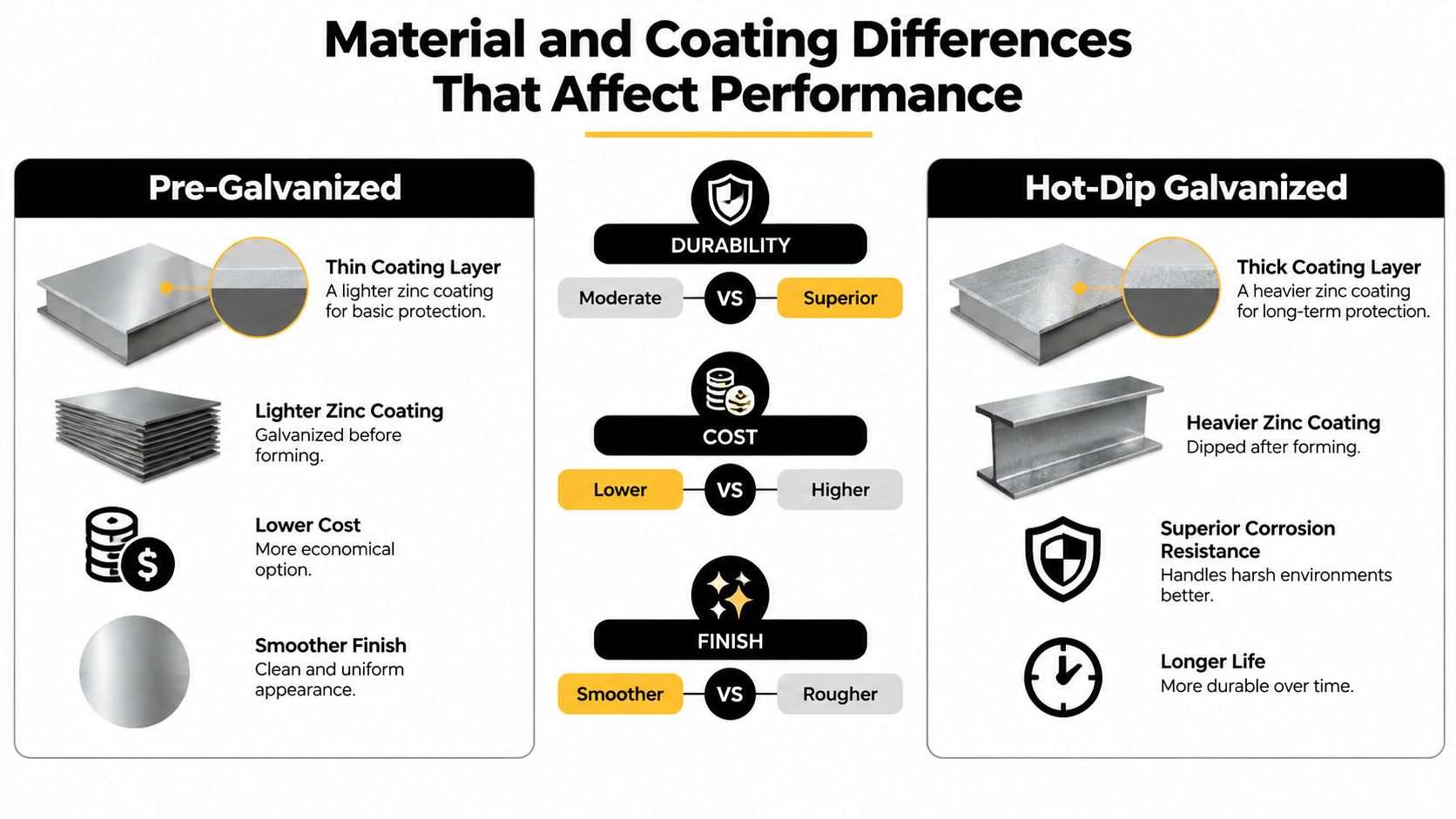
Pre-galvanized steel receives its zinc coating before the final forming process. The finish is often smoother and more uniform, which can suit indoor framing or sheltered areas. Hot-dip galvanized steel is immersed in molten zinc after forming. That process coats the completed part, including areas near edges and fabrication points that may otherwise be more exposed.
Canadian product documentation identifies pre-galvanized steel as the standard finish and hot-dip galvanizing as an available option for channel products. That distinction gives buyers a practical starting point:
| Finish | Practical strength | Typical fit |
|---|---|---|
| Pre-galvanized | Smooth, lighter corrosion protection | Interior framing and sheltered locations |
| Hot-dip galvanized | Heavier exterior-oriented protection | Fences, decks, roadside hardware, and exposed supports |
Finish selection should follow the installation, not just the appearance. A pre-galvanized channel may work in a controlled, dry location, while a fence near soil, road salt, or repeated freeze-thaw exposure may call for hot-dip galvanizing. The coating can affect maintenance later, especially where water remains trapped against the steel.
Grade and compliance belong on the order
Canadian distributors describe channel products by channel size, flange dimensions, web thickness, length, steel grade, and finish. Galvanizing must also be specified when ordering through Canadian U-channel product information. A catalogue category that includes galvanized products does not guarantee that every plain steel channel arrives galvanized.
For structural channels, A-36 / 44W appears as a common Canadian designation in distributor stock information. For light-gauge nonstructural framing, one listed product uses 54-mil, 16-gauge steel, with a design thickness of 0.0566 inches and a minimum thickness of 0.0538 inches. Its documentation lists ASTM A653/A653M, ASTM A924, A1003, C955, and C1007, along with code listings for the California Building Code 2013 and 2016 in its U-channel specification.
Those marks identify material and manufacturing requirements that can be checked against the planned fence, deck, or mounting assembly. They do not replace engineering review or the project's applicable code requirements.
For a broader finish comparison, review galvanized versus stainless steel. Match the choice to exposure, design requirements, appearance, and the rest of the fastening system.
The following walkthrough shows how strut-style channel and fittings come together in a typical mounting.
Sizing and Spec Charts Made Simple
A specification sheet becomes useful once you translate each line into a job-site decision. Start with the web, the broad flat section at the bottom of the U. Then check the flange width and thickness, the overall channel size, the steel grade, the finish, the length, and the weight per foot.
A taller or heavier section usually offers greater resistance to bending and impact, but it also adds handling demands and material cost. A small sign post and a deck support shouldn't be selected from the same assumption. The load, span, connection method, and exposure all matter.
A practical comparison
| Channel Size | Weight per Foot | Key Dimensions | Typical Use |
|---|---|---|---|
| 1-5/8 in by 1-5/8 in, 12 gauge | Not stated in the cited Canadian catalogue entry | 7/16-inch holes on 2-inch centres | Fence, sign, and hardware mounting |
| Standard galvanized U-channel post | 2.3 lb/ft | 7/16-inch holes on 2-inch centres | Fence and sign support |
| C10x20 | 20 lb/ft | 0.379-inch web, 2.739-inch flange dimension | Heavier fabrication and support work |
| C12x30 | 30 lb/ft | 0.51-inch web, 3.17-inch flange dimension | Larger, stiffer support sections |
The 1-5/8-inch by 1-5/8-inch, 12-gauge sign-post format is listed in Canada with a standard length of 10 feet, or 120 inches, and a hot-dip galvanized finish in the Canadian catalogue entry. It suits applications where a narrow profile and prepared mounting surface matter more than the section capacity of a large structural channel.
A separate Canadian supplier lists a standard galvanized U-channel post at 2.3 lb/ft, with 7/16-inch holes on 2-inch centres in its product specification. Those holes can save layout time for signs, fence hardware, and similar attachments, but they don't tell you whether the post is suitable for a particular wind, impact, or soil condition.
Read the heavy-channel example differently
A C10x20 section is listed at 20 lb/ft, with a 0.379-inch web and a 2.739-inch flange dimension. A larger C12x30 reaches 30 lb/ft, with a 0.51-inch web and a 3.17-inch flange dimension in California-relevant channel supply data.
These examples show why “bigger” isn't a complete specification. Larger sections can offer more stiffness and impact resistance, but the installer must also handle greater weight, use suitable cutting equipment, and provide connections that can transfer the expected load.
Before ordering, write down:
- The supported member: rail, post, panel edge, joist, or sign.
- The unsupported distance: longer spans generally need more section capacity.
- The connection: bolts, screws, anchors, welds, or a designed bracket.
- The exposure: sheltered, exterior, roadside, coastal, or soil-adjacent.
- The required finish: state pre-galvanized or hot-dip galvanized on the order.
For more application-specific sign-post options, compare the galvanized sign post U-channel selection before choosing a section by dimensions alone.
Corrosion Considerations for Canadian Climates
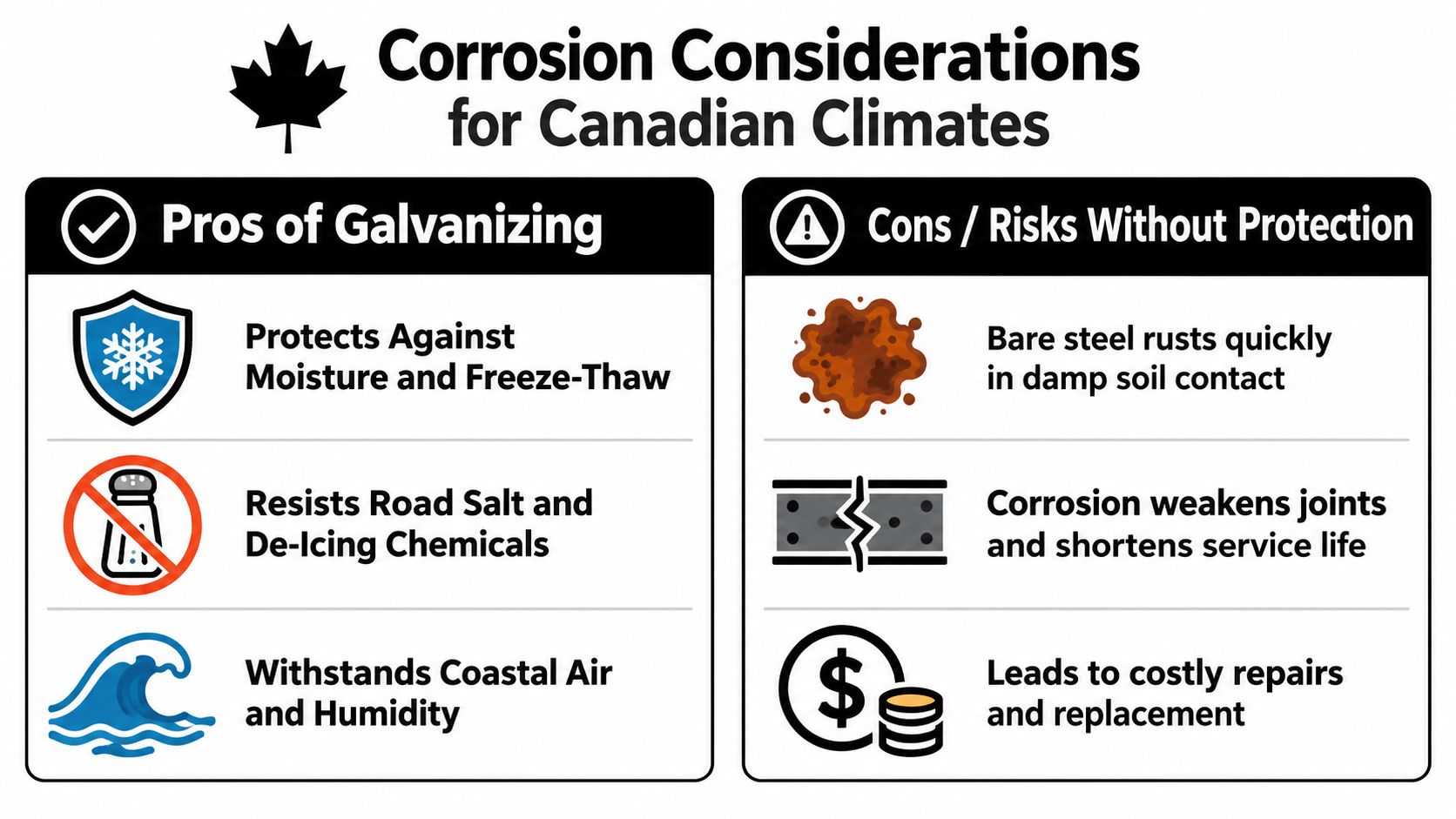
A fence post beside a salted driveway and a deck support under a dripping edge face different corrosion conditions. Canadian outdoor steel may encounter wet soil, road salt, de-icing chemicals, coastal air, trapped moisture, and repeated freeze-thaw cycles. The first trouble spots are often the connections, cut ends, drilled holes, and places where dirt or water stays against the metal.
Galvanizing places a zinc layer between the steel and its surroundings. That barrier works like a protective raincoat, which matters when maintenance access is limited behind a fence panel or beneath a deck edge.
Match the finish to the exposure
Use pre-galvanized channel for indoor work or locations that remain reasonably sheltered. For an exposed fence, deck, gate, roadside attachment, or exterior support, hot-dip galvanizing is generally the better direction because it provides heavier corrosion protection for demanding conditions.
Canadian galvanized-steel facilities describe corrosion-protection lifespans of 75 to 100 years under ASTM A123 in normal environments. Use that range as a benchmark rather than a promise for every project. Soil chemistry, salt, water retention, coating damage, and maintenance can change actual performance as documented in Canadian galvanized-steel manufacturing material.
Canada's long-established galvanizing industry also supports a mature supply base, so galvanized construction products are generally available through local and regional suppliers. That availability can make it easier to match the coating, section size, and replacement parts to a Canadian fence or deck project.
Know when U channel isn't the specified product
A U-shaped profile may resemble a fence post or rail, but appearance alone does not establish that it can replace one. Ontario procurement documents identify standards such as CAN/CGSB 138.2 and ASTM F1043 for galvanized steel pipe or roll-formed shapes used in fence and rail projects in the cited procurement guidance.
Site check: If the drawing, tender, permit package, or manufacturer's installation guide names pipe, roll-formed sections, or a specific standard, confirm compatibility before substituting U channel.
For buying decisions, compare the selected coating with the actual exposure, then check whether the channel's size and specified product type suit the fence or deck detail. Keep steel clear of standing water, avoid burying an unsuitable open section, and touch up damaged coating after cutting or drilling. Good drainage and a suitable detail give the galvanized coating a better chance to perform.
Mounting and Fastening Recommendations That Last
A galvanized U channel stays useful outdoors when the connection keeps it aligned, tight, and protected. Before drilling, hold the channel against the post, rail, joist edge, or mounting surface and mark each hole. A level, straightedge, clamps, tape measure, drill, metal bits, socket set, and zinc-rich touch-up coating handle many small fence and deck installations.
Pre-punched holes can make sign and fence work faster. Check their diameter and spacing before ordering bolts. A hole pattern may look convenient while still leaving too little room for a bracket or washer.
Build the connection in a sensible order
Dry-fit the channel. Clamp it in place and check that the flanges clear the board, rail, bracket, and fastener head.
Align before tightening. Use a level for a vertical post and a straightedge for a horizontal rail. Tightening one end first can pull a light channel out of line.
Use broad bearing surfaces. Washers spread the clamping force over more steel, reducing the chance that a fastener head will deform a thin flange.
Pair compatible metals. Select corrosion-resistant fasteners suited to galvanized steel. In a wet Canadian exposure, dissimilar metals can speed corrosion where they touch.
Protect altered areas. After cutting or drilling, remove burrs and cover exposed steel with a zinc-rich repair coating. Set the channel so water cannot sit inside it.
Fastener choice depends on both the timber and the load. Deck screws suit some light attachments, while carriage bolts or lag bolts provide a more substantial connection when access and clearance allow. A fastener should fit the substrate and connection, not only the channel opening.
Anchoring into concrete
A fence base, deck-adjacent bracket, or support frame may connect to concrete. Choose a wedge or sleeve anchor by checking the base material, required embedment, edge distance, hole size, and assembly load. This wedge-anchor guide for concrete installations can help organize those checks before drilling.
Matched carriage bolts, washers, and sleeve anchors are available through the XTREME EDEALS catalogue at xtremeedeals.ca. Confirm the fastener coating, dimensions, and substrate compatibility before ordering, then pair the hardware with the selected channel and repair coating.
Fastening reminder: Treat the channel, fastener, washer, substrate, and coating repair as one connection. A galvanized profile can still fail at an exposed cut end or an unsuitable fastener.
Choosing the Right Galvanized U Channel With Confidence
Choose the profile by asking four questions: What does it support? Where will it live? How much stiffness does the connection need? How will it be fastened?
For a sign or light fence attachment, a pre-punched U-channel post may simplify mounting. For a deck edge or exterior support, confirm the section capacity and use hot-dip galvanized protection where the exposure demands it. For interior framing, pre-galvanized steel may be a practical fit. For a code-sensitive assembly, match the product documentation to the applicable Canadian requirements instead of relying on a visual match.
Your decision path can stay short:
- Measure the member and available opening.
- Select the web, flange, thickness, and length for the actual load and span.
- Specify the finish clearly, especially when ordering galvanized material.
- Confirm whether the project calls for U channel, pipe, or another roll-formed shape.
- Choose compatible bolts, screws, washers, anchors, brackets, and coating repair materials.
If you're still shaping the project itself, an ai deck design tool can help you think through layout and deck details before you buy framing accessories. Use the design as a planning aid, then verify structural requirements and local approvals with the appropriate professional.
A good galvanized U-channel installation is rarely just about the steel profile. It's the result of matching shape, coating, dimensions, environment, and mounting hardware to one specific job.
XTREME EDEALS INC. offers galvanized fasteners, deck and fence brackets, joist hangers, post bases, post caps, washers, and concrete anchors to help complete a compatible U-channel assembly. Visit XTREME EDEALS INC. to compare the hardware you need, confirm product finishes, and prepare your fence or deck project with the right parts before installation.