
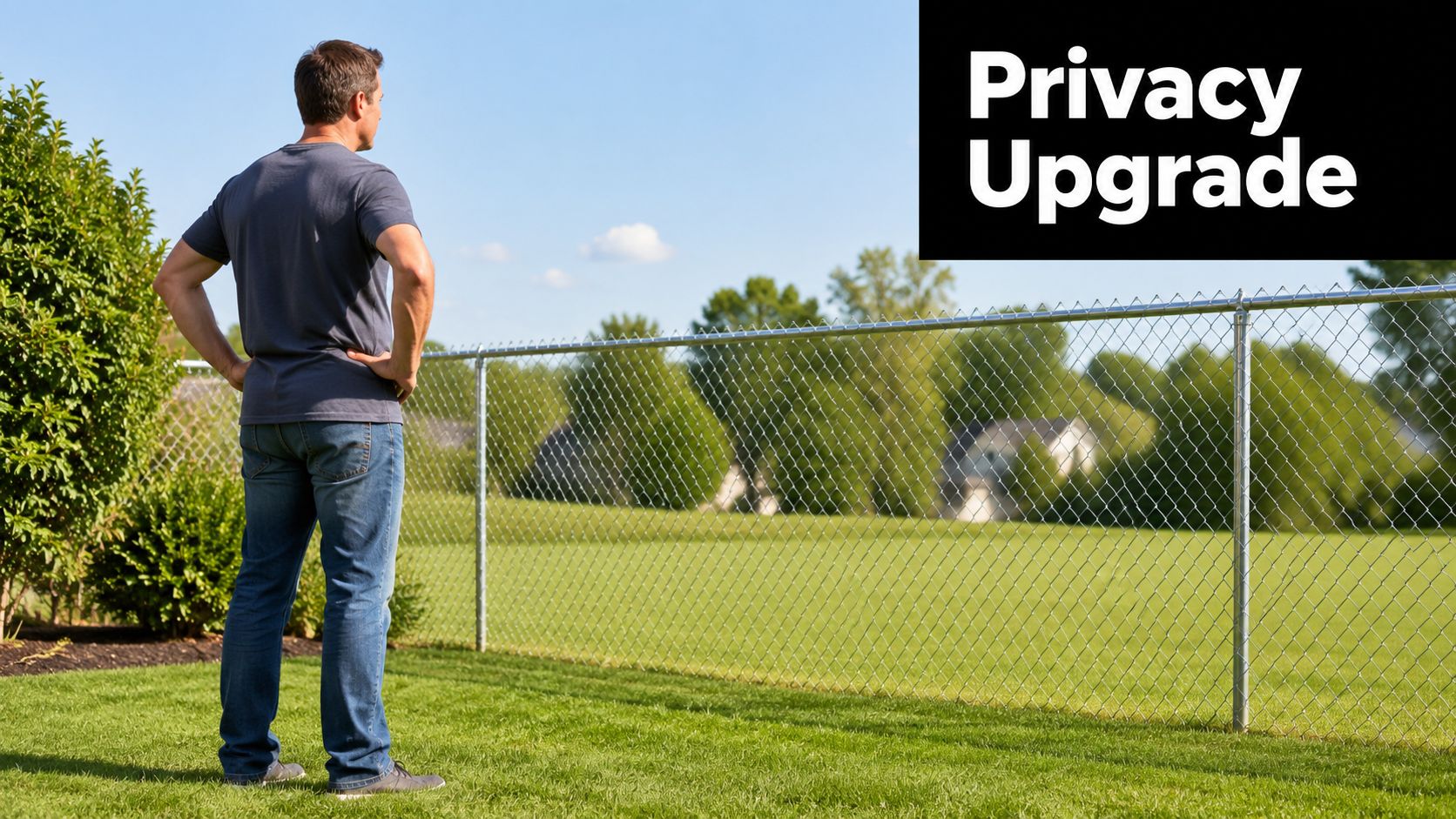
You're standing in the yard looking at a chain-link fence that does its job, but not the part you want. It keeps pets in, defines the property line, and costs far less than a full rebuild, yet every neighbour, passerby, and delivery driver can see straight through it. That's where fence privacy slats make sense, because they turn an open fence into a practical screen without tearing out the whole structure.
Used well, they're one of the simplest retrofit upgrades for backyards, pool enclosures, and side yards. Used badly, they become a loose, noisy insert that doesn't fit the mesh, catches more wind than the fence can handle, or looks patchy from the angle that matters most. The difference usually comes down to fit, material, and whether the existing posts can take the added load.
What Fence Privacy Slats Are and Why Homeowners Choose Them
A common call starts with a fence that already does the basic job. The owner wants the property line defined and the yard contained, but does not want every neighbor, passerby, or service person looking straight through the mesh. Fence privacy slats answer that problem by weaving into the chain-link and reducing visibility while leaving the fence frame in place.
That retrofit approach is why slats show up so often in backyard, pool, and side-yard installs. They let owners keep the existing fence and add screening without committing to a full tear-out, which usually keeps the project simpler and less disruptive. In practical terms, slats are chosen because they can improve privacy, preserve airflow, and avoid replacing sound posts and framework just to get a more closed-in feel.
There is still a trade-off, and it shows up fast in the field. Adding material to the fence changes how it catches wind, so a slat job that looks fine in a brochure can behave very differently on a real fence line if the mesh is loose, the posts are already tired, or the fence is exposed to open conditions. Fit matters just as much as the privacy goal itself.
The best way to judge slats is to look at the yard from the angles that matter. Stand at the neighbor's window, the driveway, the sidewalk, and any uphill or downhill vantage point, then check what is visible through the fence. Manufacturer claims can be useful, but a real viewing-angle test tells you more about whether the installed slats will do the job where people see the fence.
Xtreme Edeals carries compatible fencing hardware and accessories for this kind of project, and if you are comparing yard-level screening ideas more broadly, the Guelph deck privacy screen guide is a useful reference for thinking through screening goals before you choose a product.
Practical rule: if you want more privacy without rebuilding the fence, slats are worth considering first, but only when the fence is straight, the mesh matches the slat profile, and the posts are still in good shape.
Homeowners keep choosing slats because they solve a narrow problem well. They give a chain-link fence a more private look, they usually cost less than replacement, and they let the existing structure stay in service. The catch is that the installation has to respect both privacy and structure, because a fence that cannot handle the added load will not stay a good screen for long.
Comparing Slat Materials and Privacy Styles
A fence that looks private from the street can still leave clear sightlines from a deck, a slope, or an upper window. That is why material and slat profile matter together. A homeowner who wants to screen a patio may accept some visibility loss at the edges, while a property manager along a sidewalk usually needs tighter visual blockage and a cleaner look from multiple angles. The right choice depends on how the fence is built, how much wind it sees, and how much privacy the site needs.
The most common residential choice is HDPE slats with UV inhibitors. They're used because they're light, hold up outdoors, and tolerate temperature swings, which matters on a fence that sits in full sun for years. In product specifications, HDPE slats are described with a density near 0.957, tensile strength around 4,000 psi, low melt index around 0.6, and published flexibility from roughly -76°F to 250°F (PrivacyLink cut sheet). That mix explains why they are common for long-term exterior use and why pressure-wash maintenance is usually manageable.
Privacy style changes the result just as much as the base material. Flat slats are simple and economical, while winged or finned profiles grip the mesh more firmly and push visual blockage toward the top end of the range. Regional guidance puts slat performance around 75% to 98% visual blockage, with winged or finned designs capable of 95% or even 98% coverage in suitable mesh (regional fencing guide). That trade-off is real on site, stronger retention and more coverage usually mean less openness and more wind load on the fence structure.
| Slat Type | Material | Privacy Factor | Best Use Case | Durability |
|---|---|---|---|---|
| Flat standard slats | Common polymer or HDPE | Moderate blockage | Budget retrofits where partial screening is enough | Good when UV-stabilised |
| Winged or finned slats | Polymer, often HDPE-based | High blockage, up to 98% in suitable mesh (PrivacyLink cut sheet) | Backyards, pool enclosures, side yards needing stronger screening | Stronger retention, more dependent on fit |
| Hedge-style slats | Polymer designed for denser visual screening | Upper end of the privacy range | Decorative screening where appearance matters as much as privacy | Good outdoors if UV-protected |
| Industrial HDPE slats | HDPE | Variable, often high | Light-commercial or exposed installations | Best when matched to mesh and anchoring |
Colour choice affects how private the fence feels, not just how it looks. Darker tones usually hide dirt and shadow the mesh better, while lighter colours can look cleaner at first but show gaps and fading sooner in sun-heavy exposure. If the fence sits in a harsh climate, UV inhibition matters more than a brochure photo, because colour alone does not stop material breakdown.
The slat that looks most private in a display rack isn't always the one that holds its shape best after a windy season.
For homeowners comparing patterns and finishes, the fence-style ideas page is a useful visual starting point. The right product still comes down to whether you want tighter screening, a cleaner appearance, or easier serviceability over time.
A contractor also has to think beyond privacy. A denser slat profile adds surface area, and that extra surface changes how the fence handles gusts. On a tired fence, or one already exposed to open conditions, a slat that performs well visually can still create a maintenance headache if the posts and rails are not up to the added load. The structure has to stay straight and tight, or the screening work will not last.
For jobs near electrical work, appliance pads, or other site upgrades, I also pay attention to access and layout so later trades are not blocked off. If a property owner is already planning home EV charger installation, it is worth checking how the fence treatment affects access, service clearances, and future utility work before choosing a style.
Mesh Compatibility and How to Measure for the Right Fit
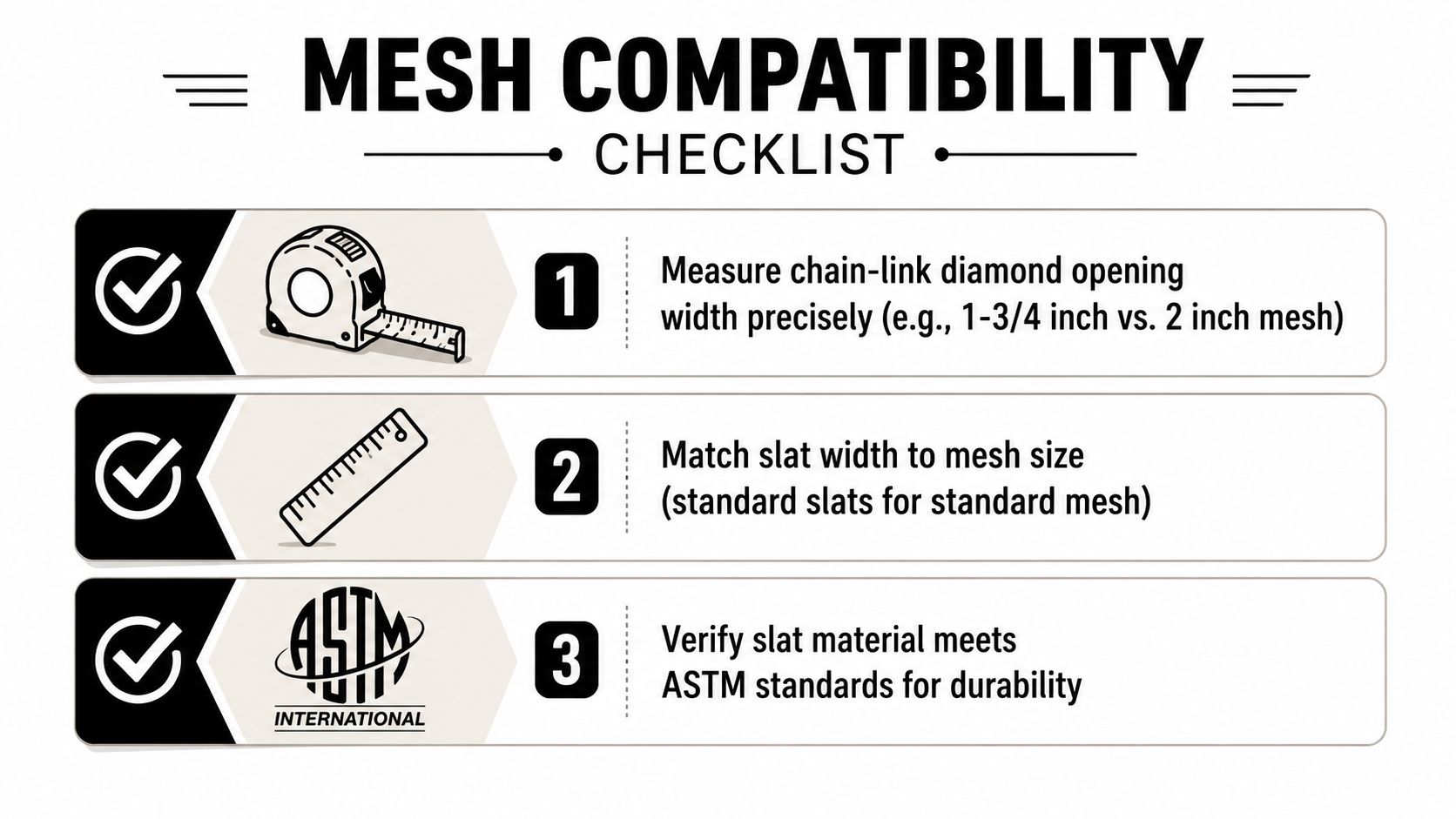
A lot of bad slat jobs start with a simple mismatch at the fence face. The slat may look fine in a catalog and still fit poorly once it meets the actual diamond opening, because privacy performance and retention both depend on how the insert matches the mesh. ASTM F3000/F3000M covers polymer insert slats for standard 2-inch and 3.5 x 5-inch chain-link mesh, and manufacturers tie slat widths to specific openings for a reason (technical sheet).
Start with the fence in front of you, not the packaging. Measure the diamond opening width in several spots, note the fence height, and check the wire gauge before you order anything. Commercial products are commonly specified from 36 to 144 inches in height, and fit charts for 2-inch mesh may call for slats in the 1-3/32-inch to 1-7/16-inch range depending on the locking design. If the slat is too wide, installation gets sloppy and retention suffers. If it is too narrow, you end up with visible gaps and less privacy than the product promised.
A simple pre-order checklist
- Measure the mesh opening carefully: Check the diamond width at several points, because older fences are not always uniform.
- Confirm the fence height: Slat systems are sold in specific height ranges, and a mismatch creates trimming or waste.
- Check the wire gauge and mesh pattern: The same slat can behave differently across fence types.
- Inspect the locking design: Fit charts exist to prevent over-widening or loose retention.
- Verify the installation path: If the fence has bends, repairs, or mixed mesh sections, the slat choice may need to change.
For a practical walkthrough of fit issues, see slats in chain link fence. The point is straightforward, the same product can deliver noticeably different privacy and retention results across mesh configurations. That is why contractors treat slat selection as a measurement job first and a colour choice second. If you are pairing the fence work with other exterior upgrades, the home EV charger installation guide is a useful reminder that outdoor projects often succeed or stall on the quality of the underlying layout and access.
Wind Load and Structural Considerations Most Guides Miss
A chain-link fence without slats is relatively wind-permeable. Add slats, and you change that behaviour fast, because the fence starts acting more like a wind barrier than an open mesh. That matters in California's coastal areas, hill locations, and other exposed sites where local wind conditions can turn a nice privacy upgrade into a structural headache if the posts, rails, or anchoring weren't sized with that load in mind.
The best technical guidance on slats rarely stops at aesthetics. One neutral source points out that slats reduce visibility while preserving airflow, but also notes that heavier or larger-diameter posts may be needed if slats are added later for wind resistance (chain-link privacy slats guide). That's the key decision point, because tighter privacy often means more surface area, and more surface area means more lateral force on the fence line.
California also adds a material constraint. The state's Building Standards Code requires exterior plastic products used in building applications to meet a minimum ASTM E84 Class B flame-spread performance, which is relevant when slats are marketed for residential or commercial use in the state (ASTM coverage of fence privacy slats). That doesn't answer every install question, but it does mean material choice can't be treated as cosmetic only.
The practical check is whether the existing fence was meant to carry that extra load. If the posts are already loose, if the fence rattles in gusts, or if the line was built light, slats can push it past comfort range. In those cases, reinforcement is often smarter than forcing a privacy product onto a structure that wasn't designed for it.
If the fence moves before the slats go in, it won't get better after you add more surface to catch the wind.
For post spacing and layout decisions, the fence post spacing guide is a helpful companion reference because it puts more attention on the structure the slats are going to load up. In practice, the right answer is often not “can the slats fit”, but “can the whole line carry them through a windy season without loosening.”
Preparation and Installation Overview
A clean installation starts before the first slat goes in. Walk the fence line, check for bent mesh, loose ties, damaged top rail sections, and posts that lean or rock when pushed. If the fence is dirty or full of debris, clean it first, because dirt and corrosion make insertion harder and hide weak points you should fix before you add weight and wind resistance.
The weaving process is straightforward once the mesh is matched. Most slats go in bottom-up through the diamond openings, then lock at the top and bottom according to the product design. Keep the alignment consistent from section to section so the finished line doesn't look wavy, and don't force a slat that resists heavily, because that usually means the mesh and profile don't match.
The mistakes that cost the most time
- Forcing incompatible slats: This usually means the wrong diamond opening or the wrong locking profile.
- Skipping the locks or end pieces: Loose tops and bottoms move in wind and wear faster.
- Ignoring thermal movement: Plastic expands and contracts, and a tight fit in morning shade can turn into a stressed fit under afternoon sun.
- Leaving weak sections unrepaired: A damaged fence segment can make the whole run look uneven and unstable.
Professional installers usually move faster because they're checking mesh uniformity, line tension, and post condition as they go. A confident DIYer can handle a straightforward straight run with compatible slats, but curved sections, mismatched mesh, or already-stressed posts are where calling in help makes sense. For a project like this, Xtreme Edeals stocks the fasteners, post caps, and hardware accessories needed to finish the job properly, especially when the fence line also needs replacement ties or caps.
One more point matters in real work. A slat job that looks easy on a sunny day can become frustrating if the fence isn't square or the mesh size changes mid-run. Measure, test-fit a small section, and only then commit to the full line.
Cost Ranges and Getting the Best Value
Slats often make sense because they cost less than replacing a fence outright. Neutral buying advice puts typical slat material in a fairly wide range, and that spread usually reflects the material, locking style, and how much coverage you want (neutral guide). For homeowners and property managers, the appeal is straightforward, keep the fence you already have and add privacy without starting over.
Material cost only gets you partway to the budget. If the fence needs extra support for wind, or if the posts are already leaning, those repairs can become the larger expense. Labour also matters on long runs, damaged sections, or fences that need cleaning, repairs, and re-tensioning before the slats go in.
| Cost Factor | What It Affects | Budget Impact |
|---|---|---|
| Slat material | Privacy level, appearance, and fit | Usually the first line item |
| Reinforcement work | Posts, rails, anchoring | Can exceed the slat purchase if the fence is weak |
| Professional installation | Labour, speed, and finish quality | Worth it when the line is long or uneven |
| Maintenance | Cleaning, replacement, and fade control | Lower with UV-stable materials |
Cheap slats can look acceptable on day one and disappoint later if they fade, crack, or work loose in the mesh. HDPE products with UV protection usually cost more upfront, but they hold up better on fences that get hard sun or seasonal weather swings. Darker colours also hide dirt and fading better than lighter shades, so the fence keeps a cleaner look for longer.
Bulk buying can reduce the per-foot cost on larger projects, but only if the mesh stays consistent across the whole run. A sample section can be misleading if the rest of the fence has different openings, bent wire, or uneven tension. Locking-channel styles deserve extra attention in windy areas because they stay put better than looser profiles, which means less rework after the first rough weather.
Value comes down to installed cost, usable privacy, and how much upkeep you are willing to accept. A cheaper product that needs constant resetting or early replacement usually costs more in the end. If the fence is sound, the mesh is consistent, and the slat style matches the exposure, the better buy is the one that holds up without creating extra work.
Frequently Asked Questions About Fence Privacy Slats
A common question is whether slats work on fences other than chain-link. In practice, they are made for chain-link mesh, and the fit depends on the opening pattern, so wood fences and solid panel fences usually need different privacy options. If you are comparing accessory types, Xtreme Edeals' fencing and hardware categories can help you sort through what belongs on a chain-link run without guessing.
Cleaning is straightforward. A rinse, mild soap, and a soft brush usually handle normal dust and grime, and outdoor-rated HDPE holds up well enough for that kind of routine on most residential fences. The job matters more near trees, open fields, or dusty roads, because dirt makes gaps stand out and makes aging easier to see.
Privacy also depends on viewing angle, and a lot of marketing glosses over that. A fence can look solid from straight on and still allow clear sightlines from the side, from higher ground, or from an upstairs window. Real-world privacy testing means checking the fence head-on, from an angle, and from above if nearby homes sit higher than the fence line. Slat-spacing guidance shows the trade-off clearly, tight spacing gives stronger screening, while wider spacing starts to read as partial privacy or decoration rather than a full visual block (slat spacing guide).
Removal and reuse depend on the locking style and how weathered the material has become. Many slats can be removed for fence repair, but older or brittle pieces do not always go back in cleanly. If the fence section may need service later, choose a profile that comes out without tearing up the mesh. That saves time when a post, rail, or damaged wire needs attention.
XTREME EDEALS INC. carries fence hardware, post caps, fasteners, and related accessories that fit real-world privacy projects, from simple retrofits to fence repairs that need a cleaner finish. If you are comparing slat options, compatibility details, and the hardware that keeps a project together, visit XTREME EDEALS INC. and build the right setup for your fence line.