
You've found a fence style you like, saved a few black metal designs, and started measuring the boundary. Then the practical questions arrive: Will the posts withstand the wind? Is the height allowed in your front yard? Will the coating survive coastal air? Can the gate hardware stay aligned after years of use?
A metal fence can still look excellent after five years, but only when the design, material, footing, finish, and hardware suit the property. The most successful metal fence designs balance appearance with local rules, wildfire exposure, privacy needs, wildlife movement, and the forces placed on every post and hinge.
Choosing Your Metal Fence Design Strategy
Stand at the edge of a property with a catalogue in hand and the decision can seem simple. A homeowner may want a clean flat-top fence around the lawn, a more formal ornamental style near the entrance, or a solid panel along the patio. The trouble starts when a beautiful catalogue design meets a sloping site, a windy corner, a pool enclosure, or a home in a wildfire-prone area.
The right choice begins with the job the fence must perform. Open ornamental steel or aluminium gives a property definition without making the boundary feel heavy. Slatted or corrugated panels deliver privacy, but they transfer much more wind pressure to posts and footings. Welded wire can contain pets or protect a garden while keeping the surroundings visually open, though it won't provide the same sense of permanence as a substantial ornamental frame.
Start with the boundary, not the catalogue
Walk the proposed line at different times of day. Note where the fence meets the house, deck, retaining wall, driveway, pool, or gate. Those junctions often determine whether the design remains tidy and durable, because transitions create awkward cuts, concentrated loads, and places where water or debris can collect.
A useful first decision is whether you need presentation, privacy, containment, security, or a combination. A front boundary may benefit from open pickets and carefully spaced rails, while a rear patio may justify a privacy screen. Around planting beds, a narrow welded-wire panel may be more practical than a heavy decorative fence that competes with the garden.
Practical rule: Choose the visual language first, then test it against wind, corrosion, code, access, and maintenance. A fence that only looks good in a product photo isn't a finished design.
Metal also matters in wildfire-interface areas. The Insurance Institute for Business and Home Safety identifies a 5-foot noncombustible zone around structures as an important defensible-space feature, and University of California Agriculture and Natural Resources guidance warns that embers can ignite wood fences or gates attached to a home. That makes a metal connection near the house especially relevant, although surrounding vegetation, debris, and combustible transitions still need attention. The California wildfire mitigation research from IBHS provides useful background for evaluating that near-building zone.
For visual inspiration beyond a standard black picket, homeowners can find modern fencing styles that combine clean lines, mixed materials, and contemporary proportions. Use galleries to identify a direction, not to copy a specification. The final design has to belong to the property and work under its actual conditions.
Comparing Core Metal Fencing Materials
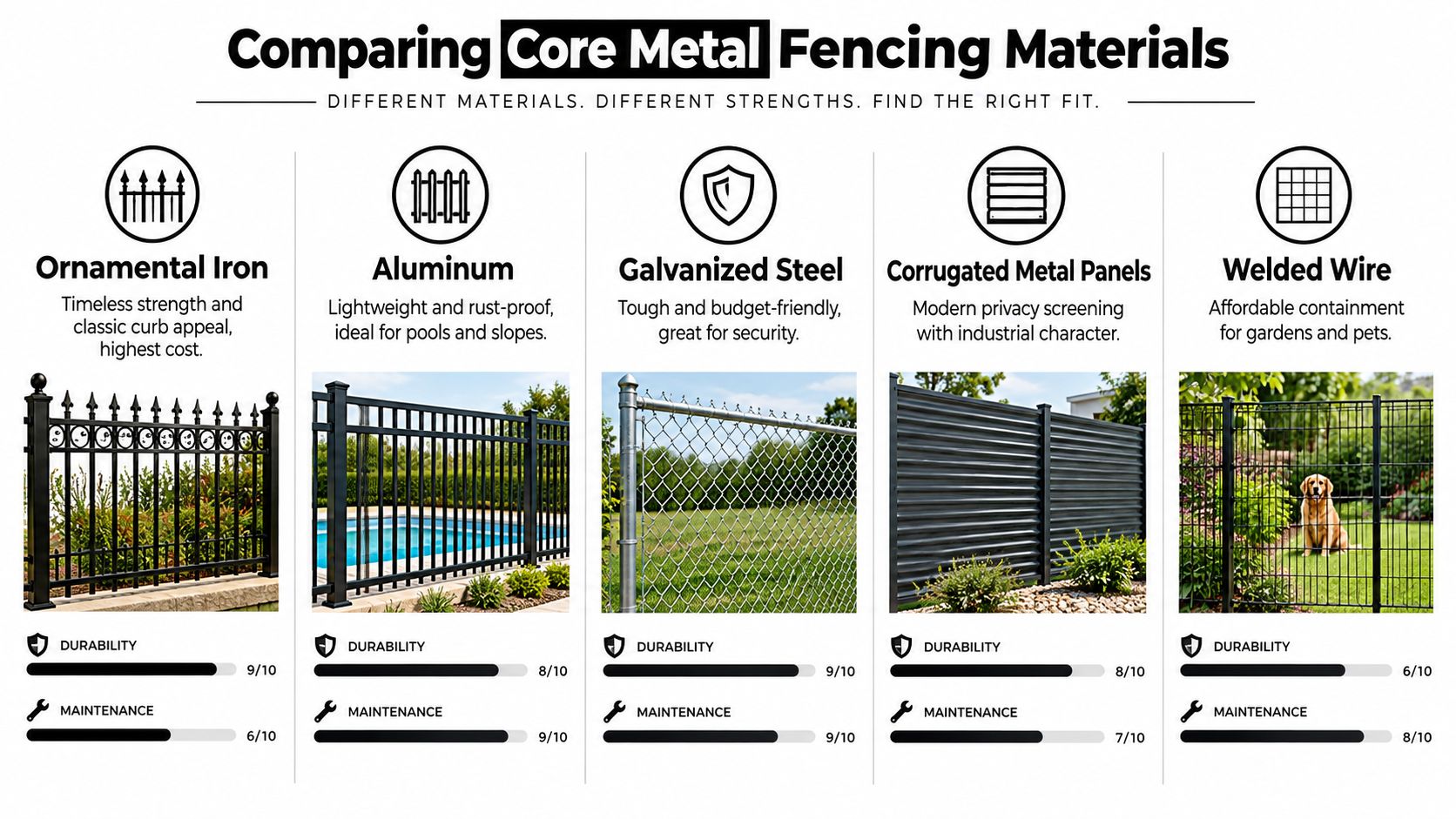
Material selection changes the fence's weight, stiffness, corrosion risk, maintenance routine, and visual character. It also changes how much care the installer must take with posts, connections, and gates. The five options below cover most residential and light commercial applications.
Ornamental iron
Traditional ornamental iron offers the strongest sense of permanence. Its scrolls, rings, finials, and substantial rails suit formal entrances, heritage homes, and properties where the fence is part of the architecture rather than a background boundary.
The trade-off is weight and corrosion management. Bare or poorly protected iron can rust at welds, cut ends, and damaged areas. A carefully prepared and coated system can last well, but decorative complexity also creates more edges and recesses to inspect. Ornamental iron is usually the highest-cost choice among these five materials because fabrication, weight, and detailing demand more labour.
Aluminium
Aluminium delivers the ornamental look with less weight and strong resistance to ordinary corrosion. It works particularly well around pools, planted slopes, and sites where moving panels or carrying materials is difficult. A lightweight section also places less demand on hinges, although the posts and connections still need to suit the gate and local wind exposure.
Aluminium isn't the default choice for every security application. It generally offers less impact resistance than a heavy steel system, and thin sections can look insubstantial beside masonry or large gates. Specify compatible brackets and fasteners, especially where aluminium meets another metal.
Galvanized steel
Galvanized steel is the workhorse option for strength and practical security. It suits gates, service yards, side boundaries, and projects where rigid posts matter more than intricate ornament. The zinc coating provides a protective layer, but installers still need to protect drilled holes, cut edges, welds, and damaged areas.
A powder-coated finish can improve colour and appearance, but the coating isn't a substitute for sound galvanizing or correct drainage. Steel is also heavier than aluminium, so lifting, alignment, hinges, and footing design deserve more planning.
Corrugated metal panels
Corrugated panels create a strong architectural look and provide privacy with relatively simple lines. They work well beside contemporary buildings, patios, and service areas where a clean screen is more important than an open view. Their profile adds stiffness to the sheet, but the broad surface still behaves like a sail in exposed conditions.
Don't treat a corrugated panel as ordinary decorative infill. Use a properly designed frame, keep water from collecting at overlaps and bases, and select a finish appropriate to the environment. For garden applications where a crisp steel edge complements the fence, this guide to Modern Yard Landscapes steel edging offers a useful visual reference for integrating metal details.
Welded wire
Welded wire is a sensible choice for gardens, pets, small livestock, and boundaries where visibility and airflow matter. The welded grid stays more orderly than loose wire mesh, and it can disappear into planting when installed with restrained posts and a dark finish.
It won't provide the privacy or visual weight of a panel fence. Small openings may also create issues for wildlife, pets, or children depending on the site, so choose mesh dimensions and bottom clearances deliberately. For broader product comparisons and gate options, the metal fence and gates collection shows how panels and access components can be considered as one system rather than separate purchases.
Balancing Aesthetics, Privacy, and Wind Load
Privacy and wind resistance pull a fence in opposite directions. An open picket design lets air pass through and preserves sightlines, while a tightly slatted or solid panel blocks views by presenting a much larger surface to the wind. The more continuous the barrier, the more carefully the posts, rails, anchors, and concrete footings must be designed.
California code guidance requires exterior metal elements and their attachments to resist wind loads under CBC Section 1609, with corrosion-resistant fastenings for exterior metal assemblies. A City of Poway standard plan uses an 85-mph design wind speed, Exposure C, and Seismic Design Category D, demonstrating why a fence specification cannot be transferred from one California site to another. The relevant California exterior-wall and attachment code guidance should be checked alongside local requirements.
Open designs preserve more than views
Flat-top pickets, ornamental rails, and welded wire usually create a lighter boundary. They can frame a garden, keep a front yard visible, and reduce the visual compression that comes with a solid wall. Scrolls and finials can add character, but they should be attached securely and proportioned to the rails rather than used to compensate for a weak frame.
Wildlife is another reason to avoid designing solely around privacy. California wildlife guidance recommends considering local species, terrain, seasonal movement, and nearby streams or wetlands. It advises wildlife-friendly fences to be 40 inches or less where practical and no higher than 42 inches, with roughly 18 inches below the lowest wire and at least 12 inches between the top two wires. The same guidance stresses visibility to reduce bird and ungulate collisions. See the California wildlife-friendly fencing guidance before using rails or mesh near habitat corridors.
Solid panels need a stronger structure
A solid corrugated panel or close-spaced slat screen may be the right answer beside a patio, but the designer must reduce unsupported panel width, add intermediate rails or stiffeners where necessary, and select posts with adequate section stiffness. Gate posts need extra care because the gate's weight and projected area concentrate forces at the hinges and latch.
A fence on a slope can also look taller from the lower side. Step panels carefully, maintain consistent reveals, and avoid forcing a long rigid panel to follow changing ground levels. Poorly handled transitions create gaps, twisted rails, and visual waves that become more obvious as the landscaping matures.
Open fencing is often the better-looking solution after several seasons because it shows the garden rather than hiding it. Use privacy panels where privacy solves a real problem, not simply because a solid fence appears substantial in a showroom.
Navigating Local Codes and Height Restrictions
A fence can be well fabricated and still require removal or alteration if its height, location, or gate arrangement violates local rules. California doesn't provide one universal metal-fence specification. City and county standards control important details, including height, front-yard visibility, permit exceptions, setbacks, and structural requirements.
Start with the property's city or county planning department. Ask for the fence rules that apply to the exact frontage and zone, then confirm whether the project needs a permit or approval. Don't rely on a neighbour's fence as evidence of compliance, because it may predate current rules or sit under a different exception.
Check these items before ordering
- Height: Confirm the permitted height for the front, side, and rear yard separately. Decorative open sections may be treated differently from solid panels.
- Visibility: Check sightline restrictions near driveways, corners, and road intersections. A tall or opaque front boundary can create a safety problem even when the design looks attractive.
- Setbacks: Verify the property line and any required distance from sidewalks, roads, drainage areas, or easements.
- Permit status: Ask whether the fence, gate, retaining structure, or masonry support changes the approval requirement.
- Footings: Make sure the structural design matches the local standard and the actual soil conditions.
San Diego County provides a concrete regional example. Its published standards generally list fences and freestanding masonry walls up to 6 feet high within a permit exception, while certain open fences may reach 8 feet when the uppermost 2 feet consists only of barbed or razor wire with required angled supports. The same document specifies metal posts or pipes in concrete footings 12 inches in diameter and at least 24 inches deep, with 3 inches of loose gravel beneath the footing, in undisturbed natural ground or properly compacted fill. These are regional reference points, not statewide permission. Consult the San Diego County fence standards before using them as a design basis.
Bell Gardens illustrates the same caution from another angle. Standard side- or rear-yard fences may reach 6 feet, while decorative wrought-iron portions may reach 8 feet in specified circumstances. Its front-yard chain-link limit is 48 inches, with solid coverings or slats limited to 42 inches. Those distinctions make front-yard visibility and material selection part of the initial design, not a last-minute adjustment.
Pool projects need a separate safety check. One Ontario zoning order requires a private swimming pool enclosure to use a sturdy fence at least 1.5 metres high, or a building wall, with a self-closing, lockable gate. The same provision places the pool at least 1.5 metres from a side or rear lot line and pumps or filters at least 3 metres from those lot lines. Review the Ontario pool enclosure regulation where it applies, then confirm municipal requirements.
For other Ontario development-control situations, a fence or gate may be permitted up to 2.4 metres, while a brick or stone wall may be limited to 1.2 metres, unless a municipal fencing by-law sets different rules. The Ontario development-control regulation makes clear why local verification matters. For design ideas outside California and Ontario, a resource on the best front boundary for Irish houses can help with proportion and streetscape thinking, but it can't replace the rules governing your property.
Essential Hardware and Finishing Touches
A fence rarely fails in the middle of a good panel. It loosens at a hinge, stains around a cut edge, pulls a bracket out of a post, or develops rust where incompatible metals meet. Hardware is the part that turns a collection of panels and posts into a working boundary.
Start with the connection schedule rather than buying fasteners at the end. List every joint, including panel-to-rail connections, rail-to-post brackets, gate hinges, latches, stops, post caps, anchors, and any transition to timber, masonry, or decking. Each connection needs suitable strength, corrosion resistance, access for installation, and a finish that belongs with the fence.

Treat the coating as a system
Coating damage at a drilled hole or weld can become the starting point for localized corrosion. Touch up exposed steel with a compatible repair system, keep water from sitting inside hollow sections, and avoid sealing a post in a way that traps moisture at the base.
Coastal California needs a more deliberate specification. Caltrans defines the marine atmospheric zone as land within 1,000 feet of ocean or marine water, where marine water has a chloride concentration of at least 500 ppm, and recommends a site-specific corrosion investigation to determine mitigation measures and service-life requirements. In that environment, bare carbon steel and weathering steel are poor assumptions because persistent chloride deposition and wetting can prevent the protective patina that weathering steel requires. The Caltrans corrosion guidelines should inform the specification.
A practical coastal approach is duplex protection, hot-dip galvanizing combined with a compatible exterior powder or paint system. Aluminium or appropriately rated stainless steel may suit highly exposed locations, but the entire assembly still needs consideration. Posts, rails, brackets, hinges, and fasteners have to work as one corrosion system.
Prevent galvanic corrosion
California regulatory guidance states that dissimilar metals shouldn't contact one another unless a corrosion-prevention method, such as a zinc-rich primer, is provided. Isolate aluminium panels from galvanized or carbon-steel frames with nonconductive washers or separators, seal water-trapping interfaces, and use corrosion-resistant fasteners instead of mixing generic plated hardware with premium coatings.
The detail matters most where installers cut, drill, weld, or stack components. A bracket can look sound during installation while holding moisture against a post for years. Use washers that spread the load, avoid overtightening thin sections, and keep the fastener head compatible with the surrounding finish.
XTREME EDEALS INC. offers relevant options such as metal post caps, brackets, hinges, anchors, fasteners, gate inserts, and steel-framed gate kits that can accept wood, vinyl, or composite infill. Its catalogue also includes products from brands such as Decorex Hardware, with CAD pricing and multi-pack options. Contractors comparing connection methods can review fence brackets for metal posts alongside the post dimensions and coating system selected for the project.
Gates expose weak planning
A gate should swing without dragging, latch without lifting, and remain aligned after repeated operation. Use adjustable hinges where appropriate, give the latch post enough stiffness, and install a positive stop so the gate doesn't transfer impact into the hinge side.
Post caps and finials finish the design, but they also protect open post tops from collecting water and debris. Choose a cap that suits the post profile and attachment method. A decorative ball cap on a minimalist fence can look forced, while a simple pyramid cap may reinforce the geometry of a flat-top design. The best finishing choices are coordinated, not merely added.
DIY Versus Professional Installation Decisions
A lightweight aluminium kit on level, accessible ground can be within a capable homeowner's reach. The work still demands accurate layout, careful post alignment, proper concrete placement, and patience around gates. A small error at the first post can become a visibly uneven run by the final panel.
Professional installation becomes more persuasive when the fence is heavy, solid, tall, exposed to wind, or built across changing terrain. Ornamental iron panels may require lifting equipment or several people, and a large gate can place more demand on its posts than a typical fence panel. Slopes complicate panel stepping, transitions, drainage, and the apparent height from one side of the property.
A realistic DIY boundary
DIY assembly makes sense when the manufacturer supplies compatible panels, posts, brackets, and instructions, and when you can verify the boundary before digging. Work in a controlled sequence:
- Confirm the line: Locate the property boundary and mark gates, corners, services, easements, and changes in grade.
- Check the rules: Verify height, setbacks, visibility, permit status, and any pool or wildfire requirements before ordering.
- Mock up a bay: Assemble one section to confirm the post spacing, panel height, cap proportions, and gate relationship.
- Set posts carefully: Use a consistent line, plumb each post in both directions, and allow the concrete to develop adequate strength before loading the assembly.
- Fit the gate last: Align the hinge and latch posts before attaching the gate, then test swing, clearance, and locking action through the full opening.
Don't improvise footing dimensions for a tall solid panel. California guidance connects metal post installation to concrete footing size and depth in regional standards, while wind design depends on local exposure, soil, panel openness, and attachment details. A taller, solid, or unusually exposed fence deserves a check of wind pressure, post bending, anchor capacity, and footing overturning.
When professional work earns its cost
Hire an experienced contractor when the fence borders a public path, supports a heavy gate, connects to a structure, encloses a pool, crosses a steep slope, or uses solid panels in a windy location. A professional can coordinate survey information, code checks, fabrication tolerances, footing excavation, and the small adjustments that keep a long run straight.
The contractor should be able to explain the post section, footing approach, coating repair method, hinge rating, latch arrangement, and treatment of dissimilar metals. If the proposal only describes a colour and a height, it hasn't addressed the parts most likely to fail.
For homeowners and tradespeople assembling a coordinated boundary and gate system, metal gate and fence hardware can help organise the panel, gate, and accessory requirements before installation. The finished fence should be judged from the driveway, the garden, the gate swing, and the connections, not just from a product image.
XTREME EDEALS INC. supplies metal fence hardware including post caps, brackets, hinges, anchors, fasteners, gate inserts, and steel-framed gate kits for practical fence and deck projects. Visit XTREME EDEALS INC. to compare compatible finishing and connection components before you order materials or begin installation.