
Chain-link fencing runs about $15 to $45 per linear foot installed in Canada in 2026, and that band is where a sane budget starts. Wood, vinyl, aluminum and composite each carry their own band, and none of them can be priced from a single Canada-wide rate.
Construction costs don't sit still long enough for a national average to survive the trip from a blog post to your driveway. Statistics Canada reported that residential building construction costs rose 0.4% in the fourth quarter of 2025, after rising 0.6% in the third quarter, measured across the 15 census metropolitan areas the index tracks from St. John's to Victoria. That index captures the contractor's total price, materials, labour, equipment, overhead and profit included, with value-added taxes left out.
So the number on screen is only as good as what sits behind it: a date, a city, a material row, and separate lines for the costs that never fit inside a per-foot figure. A fence cost calculator Canada page that skips any of those is answering a question nobody asked.
2026 Per Foot Fence Costs You Can Start From
A useful 2026 fence budget needs a timestamp, a local market and a material-specific range. Chain link commonly runs $15 to $45 per linear foot installed in Canada. That is a starting band, not a national price for every fence. Price cedar privacy at chain-link rates and the budget will fall short; apply privacy-fence rates to chain link and the estimate may overstate the job.
2026 planning bands per linear foot installed
| Fence type | Installed CAD per linear foot | About 100 feet (30 m) | What shifts the band |
|---|---|---|---|
| Chain link | $15–$45 | $1,500–$4,500 | Gauge, coating, privacy slats, gate count |
| Pressure-treated wood privacy | $25–$55 | $2,500–$5,500 | Board style, height, post size |
| Cedar privacy | $35–$70 | $3,500–$7,000 | Grade of cedar and cap detail |
| Vinyl | $30–$65 | $3,000–$6,500 | Panel height and rail count |
| Aluminum ornamental | $40–$85 | $4,000–$8,500 | Pickets per panel and powder coat |
| Composite | $45–$90 | $4,500–$9,000 | Board brand and hidden fasteners |
For a straight 30-metre run, about 100 feet, the table gives a chain-link planning range of $1,500 to $4,500 and a cedar range of $3,500 to $7,000. These estimates assume ordinary post spacing, one gate opening and no unusual ground conditions. They are broad starting points, not a substitute for a current quote in your city.
What the Planning Band Includes and What It Leaves Out
The ranges cover fabric or panels, line posts at normal spacing, concrete for the posts, and standard two-person labour. Terminals may need more concrete than line posts.
Allow for separate costs that can move the total:
- Tax. GST or HST applies at the provincial rate.
- Delivery. Panels and bundles of posts may carry a delivery charge.
- Old-fence removal. Budget for removal labour and disposal fees.
- Ground conditions. Rock, roots and steep grades can add work.
- Extra gates. Each gate needs heavier posts, framing and hardware.
- Paperwork. Survey, permit and private utility-locate costs may apply.
Construction pricing changes over time, and local labour and material costs differ. Refresh the per-foot band against a current local quote before ordering materials. Then carry the selected row's low and high figures into your calculation.
Inputs a Fence Cost Calculator Canada Needs
A fence estimate needs more than a length and a material. Record the city or census metropolitan area and the estimate date, then enter the site measurements and costs that change with the job.
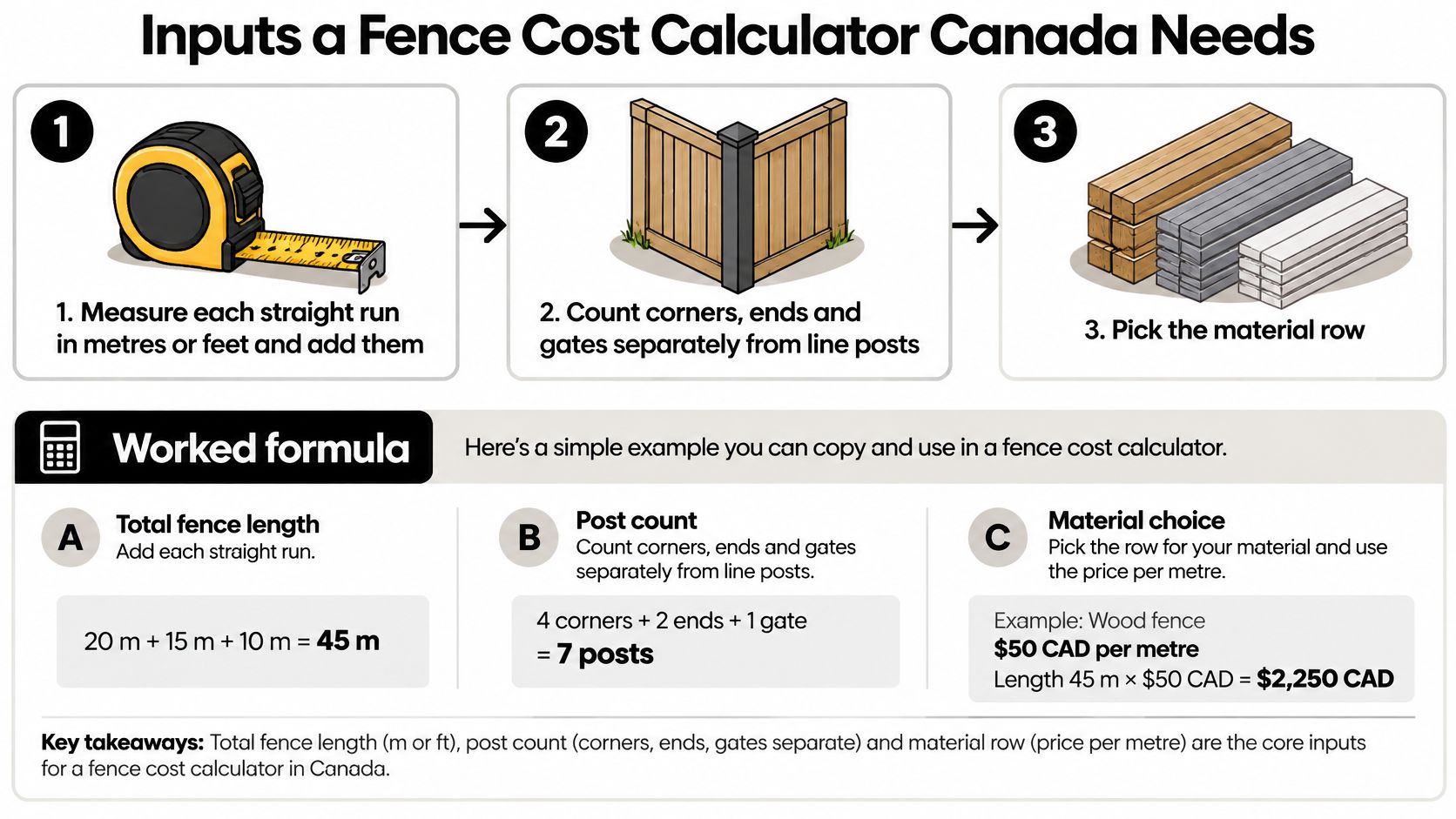
Work through these nine inputs:
- Measure each straight run along the ground, in metres or feet, and add the lengths. Measure the ground rather than the distance across a slope.
- Count corners, ends and gates separately from line posts. These locations need heavier posts and wider holes.
- Choose a material row and multiply the total length by its low and high per-foot figures. This gives a materials-and-basic-labour range.
- Allow for waste. About 10% on boards or panels covers cuts, miscuts and unusable pieces.
- Calculate concrete by post count, allowing more volume for gate, end and corner posts than for line posts.
- List hardware separately: hinges, latch, post caps, screws or ties, and anchors. Do not bury these costs in a per-foot figure.
- Add delivery if the order is bulky enough to arrive on a pallet.
- Include permit, survey and utility-locate allowances where the city or lot requires them.
- Apply GST or HST last. Contractor price indexes exclude tax.
A 24-Metre Side Yard, Priced
A 24-metre side and back run is about 79 feet. At $30 per foot, the base is about $2,370 before waste, the gate, caps and tax. Add roughly 10% for waste, one gate with its hardware, a set of post caps and provincial tax, and the total rises above the base. A quote at the base figure alone leaves out those items.
| Length | Cedar privacy ($35–$70/ft) |
|---|---|
| 50 ft (15 m) | $1,750–$3,500 |
| 100 ft (30 m) | $3,500–$7,000 |
Date It and Name the City
Toronto, Vancouver, Montréal and Calgary can have different contractor pricing for an identical fence. Put the quarter and city on the estimate, then treat the figure as a starting range until you have a current quote.
For retail materials, XTREME EDEALS INC. lists prices in Canadian dollars, excluding tax and shipping; both are shown at checkout before payment. Its project cost estimation guide can help organize project line items.
Fence Material Categories and Price Drivers
A fence estimate needs a material-specific price band, a city or CMA, and a date. A single national per-foot figure can hide the cost of different panel builds, finishes and hardware.
Chain link pricing changes with fabric gauge, framework diameter, and galvanized or black vinyl-coated finish. Privacy slats add material. Count gates separately: each opening needs gate framing and hardware, plus heavier posts at the sides.
Wood needs separate estimates for pressure-treated privacy, cedar privacy, and picket or split-rail. Board coverage and post size affect the material takeoff. Board-on-board uses more lumber than butted pickets across the same span, while 6×6 posts cost differently from 4×4 posts.
Vinyl and composite prices depend on panel height, rail count and colour. Specify all three before comparing quotes; a price for one panel configuration may not fit another.
Aluminum ornamental pricing varies with picket count per panel and powder-coat finish. Panel count also depends on whether the fence covers a full lot line or only one decorative side.
Why a Quebec Board Price Doesn't Belong in Alberta
Price each material for the city and date of the estimate. The linked Statistics Canada page covers building construction price indexes for the third quarter of 2025; it does not support claims about first-quarter residential renovation costs or regional price differences between wood and composite fencing.
Use local material pricing. A composite board priced in Ontario should not automatically be assigned the same cost in a Prairie estimate, and a cedar panel priced in Quebec should not be carried over unchanged to Alberta.
Wood and composite estimates also need distinct lines for posts, fasteners and caps. Keep those hardware costs separate from the material band, and list frost-related footing allowances separately so the total shows what is driving the price.
Municipal Height Permit and Lot Rules
A fence estimate needs a city and a lot location before it needs a total. Municipal rules can change the legal height by yard, restrict visibility near a street corner, or require a permit based on height and placement. Each change can affect panel quantities and material costs.
Check the applicable municipality's current rules before settling the layout. Front yards and corner lots may have lower height limits or sightline restrictions than rear yards. For a practical overview, review these Canadian fence height and permit requirements and confirm the rules with your local municipality.
Jasper National Park has specific requirements. Parks Canada's Jasper fence guidance sets maximum heights of 2.4 metres in rear yards and 1.8 metres in front yards. Front-yard fences also need a visually transparent top section of 0.46 metres. A development permit is required for every fence, with an automatic-permit route for in-town residential projects that comply fully.
Who Pays on a Shared Boundary
A boundary fence can involve more than one owner. Ontario's Line Fences Act allows an owner to ask municipal fence-viewers to decide what adjoining owners should build, repair or maintain. That process can affect the project budget, separately from the cost of materials.
For a shared line in Jasper, Parks Canada's fence guidance requires the neighbouring lessee's consent. Elsewhere, check local rules and confirm the boundary before ordering materials. A property survey can help establish where the fence belongs.
The National Building Code does not apply identically in every municipality. The National Research Council's National Building Code guidance directs readers to confirm applicable codes with provincial, territorial or municipal officials. A published national code alone does not establish whether a local permit is needed.
Price each segment at its permitted height, then list survey and permit costs separately. A single height across the whole lot may overstate what can be built in one area and understate what is needed in another.
Post Depth Concrete and Frost Allowances
Post footings are where a national average fails hardest. The Canadian General Standards Board's 2024 chain-link installation publication states that footing design follows the National Building Code of Canada, and that footing depth should not be less than frost penetration in an average year unless the applicable specification says otherwise.
That single sentence rules out one fixed post depth for the country. The same 1.8-metre fence needs a deeper, wider hole in Winnipeg than in Victoria, and the concrete difference is not trivial once you're setting 20 posts.
Three Post Classes, Three Concrete Volumes
Price these apart or the total drifts:
- Line posts. The lightest section, standard spacing, one bag each in most soils.
- End and corner posts. They take the pull of the fence from one or two directions, so they need deeper holes and more concrete.
- Gate posts. The heaviest load on the run and the first thing to sag when it's under-built.
A wider gate or a double gate leaf means a bigger post and a bigger hole. That moves the total more than an extra panel does, and it's the line a length-only estimate always misses.
Keep these separate too: rock, roots, groundwater, spoil haul-away and access. A rocky side yard reached through a narrow gate with a wheelbarrow is a different labour day from an open suburban trench, and hiding that gap inside a generic 10% contingency flatters the estimate. The same applies to soil type and post material, both of which belong in the input list rather than the fine print.
Ask for the hole depth in writing. If a quote lists post spacing but no footing depth, the number you're comparing isn't a fence, it's a sketch.
Then run the quantity check: posts equal each run divided by the spacing, rounded up, plus one, with an extra post at every corner and each gate leaf. Wood and composite owners should carry that count straight into the cap and fastener lines.
Pool Fences and Removal Haul-Away Fees
A pool enclosure and an old fence being removed both change the estimate beyond the cost of a new fence run. Give each its own line item.
The Pool Case Adds Height and a Latch
Pool barrier height and gate requirements come from the local pool bylaw. The required height can exceed general guidance, and the gate may need to be self-closing and self-latching. Check the local rules before setting panel specifications or ordering hardware. The pool fence regulations guide covers the compliance points to check against your layout.
Build the pool line into the calculator this way:
- Measure the full pool perimeter, not just the privacy run.
- Price panels to the height required by the local bylaw.
- List the gate, hinges, self-closing hardware, latch and fasteners separately.
- Confirm the bylaw before ordering. A height change affects the panel specification and may change the accessory budget.
Keep the pool barrier's required height separate from the height of any adjoining privacy fence. They serve different purposes and may have different specifications.
The Removal Case Is a Line Item, Not a Surprise
Price demolition and haul-away separately from the new fence. Include the length to remove, the disposal charge and whether posts set in concrete must be dug out or can be cut at grade. Concrete footings add removal work, and disposal charges add to the total. The guide to how landfill tax affects shed clearance explains disposal costs for another outdoor structure.
Add removal and disposal before comparing DIY and contractor totals. Otherwise, the estimates cover different scopes.
Scale the Same Job for DIY or a Contractor
Price one job two ways and the interesting part isn't the gap. It's what causes it. Take a 30-metre cedar privacy run, one gate, flat grade. Both paths buy the same boards, posts, concrete and hardware. The difference is who digs, who hauls, and who carries the risk when a post lands beside a root.
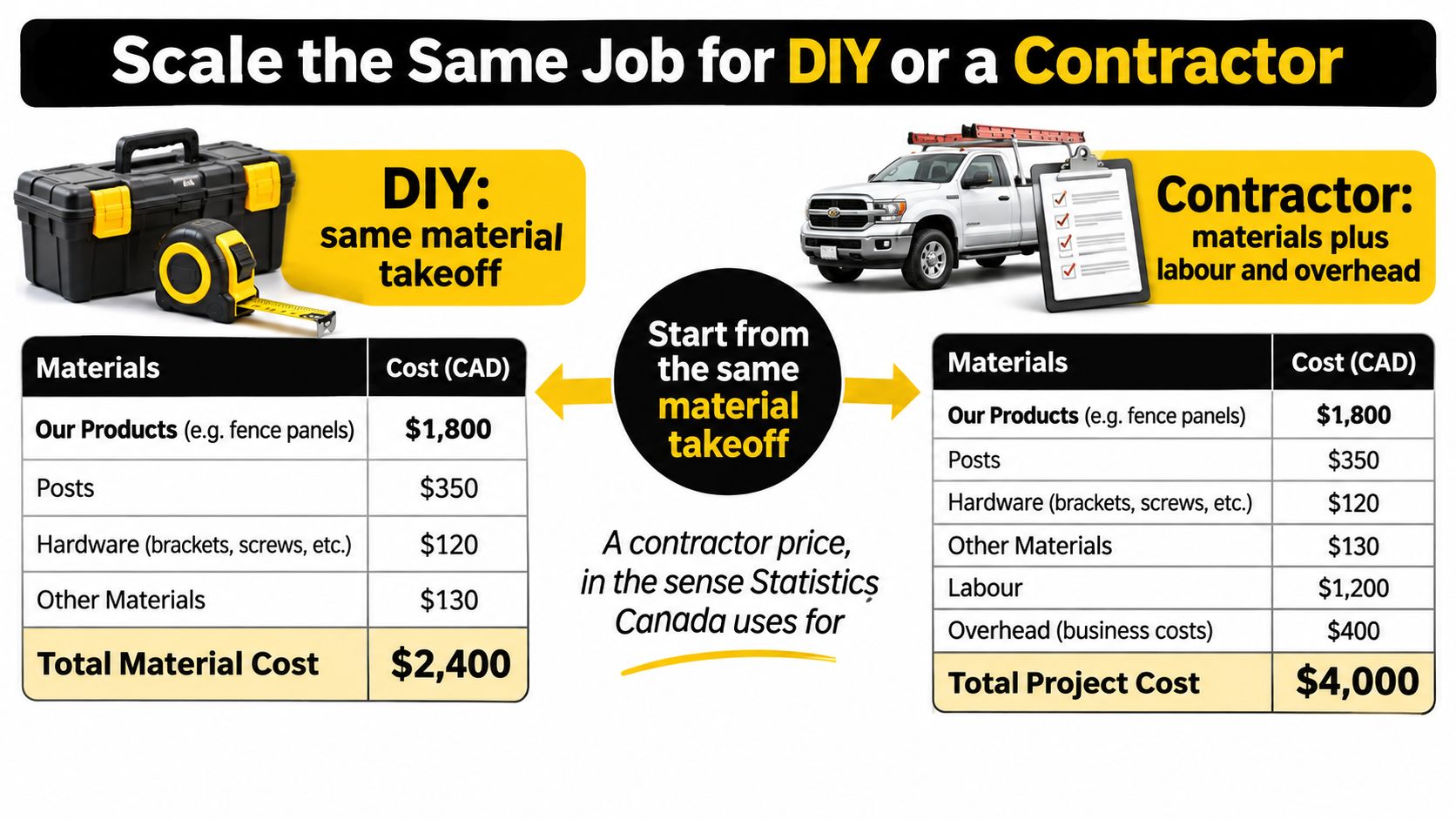
A contractor's price bundles materials, labour, equipment, overhead and profit, then adds tax on the invoice. A DIY total is retail materials, the hardware rows, delivery, concrete, an auger rental when the holes are deep, and dump fees, with your weekends unpriced unless you want to price them.
| Cost piece | DIY treatment | Contractor treatment |
|---|---|---|
| Panels, fabric and posts | Retail price plus about 10 percent waste | Inside the quoted per-foot or lump sum |
| Concrete and excavation | Bags or ready-mix, plus auger rental and spoil | Labour, equipment and difficulty in the price |
| Gate hardware, caps and fasteners | Separate CAD line items | Often bundled; ask for a hardware schedule |
| Overhead and profit | None | Included in the contractor construction price |
| GST or HST | Added at checkout by province | Excluded from price indexes; added on the invoice |
| Permit, survey and locate | Owner pays | Owner pays unless the quote lists them |
Don't Assume the Contractor's Material Unit Is Your Retail Unit
Contractors buy at trade pricing and often in package deals. You buy at retail, in ones and tens. That gap alone can swallow the labour you thought you were saving on a short run, so ask for a hardware schedule on any quote. Caps, latches, hinges and screws that appear in both the quote and your shopping cart get paid for twice.
Here's the build sequence in video form, worth watching before you decide the run is a two-weekend job.
When to Hire and When to Build
Fixed costs don't scale with length. A 15-metre run with a gate carries the same survey, the same locate and much the same gate hardware as a 40-metre run, so its per-foot figure looks worse without being worse. Judge the short job on the total, not the rate.
Decision rule: hire when gate posts, rock, a steep grade or a pool latch sit outside your tools. Stay DIY when the run is straight, the locate is clear and the hardware list is already priced.
If you'd rather have the takeoff priced by someone else, the HireArchitects estimator pricing guide sets out what that service costs in 2026, which is itself a line to weigh against your own weekends.
Carry two written totals, low and high, dated with the city. Then pick the path and stop re-running the numbers.
Gate Hardware Post Caps and Fastener Prices
Official Canadian construction data separates the cost of materials from labour content and total construction value, as the federal open data catalogue shows in its measure definitions. The same separation belongs on your estimate: accessories get their own rows instead of disappearing into a per-foot figure.
XTREME EDEALS INC. sells gate and fencing hardware and chain-link accessories, priced in Canadian dollars with tax and shipping shown at checkout. Three current shelf prices make the point.
| Item | Price CAD | How to count it |
|---|---|---|
| 1 7/8 in galvanized chain-link centre brace band, black | $6.29 | One per braced panel or as the layout specifies |
| Heavy-duty gate latch with cable and ring | $19.39 | One per pedestrian gate, more if the pool section applies |
| 5.5 x 5.5 in aluminum pyramid post cap, black | $14.59 | One per exposed post of that size |
A Ten-Post Side Yard, Added Up
Take a chain-link side yard with ten posts and one gate. Ten pyramid caps at $14.59 come to $145.90. One latch at $19.39. Five brace bands at $6.29 is $31.45. Subtotal: about $196.74 before tax, sitting underneath the chain-link band from the first table.
Step-ups exist if the look is part of the spec: the same cap in a ball profile runs $32.39, and copper or pineapple profiles cost more again. On metal posts, a 2.5 x 2.5 inch aluminum pyramid cap at $7.19 does the job. Count one per exposed post, and count the posts before you order.
These are accessory prices, not installed fence prices. A contractor's quote may already include equivalents, so check the hardware schedule before you buy twice.
Chain link brace bands are also the part most likely to rust first on a galvanized run, which is why they belong on the list even when the fabric is heavy gauge.
Lock the Estimate Then Buy the Missing Hardware
Write the estimate on one page and the decision gets easy. Date and quarter. City. Fence type and the per-foot band you chose. Total length. Post counts by class. Gate count. Pool or boundary flag. DIY or contractor path. Hardware subtotal. GST or HST for the province.
If two contractor quotes differ by more than the width of your band, ask which one excluded caps, latches or haul-away before assuming the cheaper quote describes the same fence. That question resolves most gaps on its own.
For the DIY path, order the accessory gaps from XTREME EDEALS INC., which ships anywhere in Canada. Match each post cap to the actual post size, add a latch to every gate, and add chain-link brace bands only where the layout calls for them. Re-check the municipal height before paying for panels the front yard can't legally hold.
If frost depth, a pool latch or a shared boundary is still unresolved, pause the order. Those three move the total more than a small swing in the per-foot band ever will.
XTREME EDEALS INC. stocks the pieces that fall outside every per-foot band: pyramid, ball and decorative post caps for wood and metal posts in sizes from 2×2 to true 6×6, gate latches and hinges, chain-link brace bands, deck screws, carriage and lag bolts and anchors, all priced in Canadian dollars with tax and shipping shown before payment. Match each cap to your actual post size, count one latch per gate, and the accessory subtotal stops being a surprise at checkout. Browse the deck and fencing hardware range at XTREME EDEALS INC. before you place the panel order.