
You're usually standing at the point where the deck is already built, the old railing looks tired, and every sample you hold against the house changes the whole look. Black aluminium deck railing is the option that keeps coming up because it can sharpen a façade fast, but the decision isn't just colour. It's whether you're buying a proper system, with the right rails, brackets, caps, and finish grade to survive the job you're building.
A lot of projects go sideways because the railing looks simple in the photo and turns complicated at the corner, the stair turn, or the first inspection. The panels, post caps, and angle hardware are what separate a clean install from a kit that looks pieced together. If you're trying to choose once and buy once, start with the construction, not the colour.
What Black Aluminum Deck Railing Actually Is
The homeowner in the driveway is usually comparing two dark samples and asking the same question, what makes one of them black aluminum deck railing and the other just a dark-looking barrier? The answer is in the build, not the shade. A true system is an aluminium railing finished at the factory with a powder-coated surface, and that coating is doing two jobs at once, it creates the black colour and it protects the metal underneath black aluminum deck railing is commonly defined as an aluminium railing system with a factory-applied powder-coated finish.
Powder coating is straightforward in practice. A dry powder, usually polyester or epoxy, is sprayed onto the metal, then baked so it bonds to the surface. That matters more than the colour name on the box, because a bonded finish holds up far better than a simple painted look on an exterior railing.
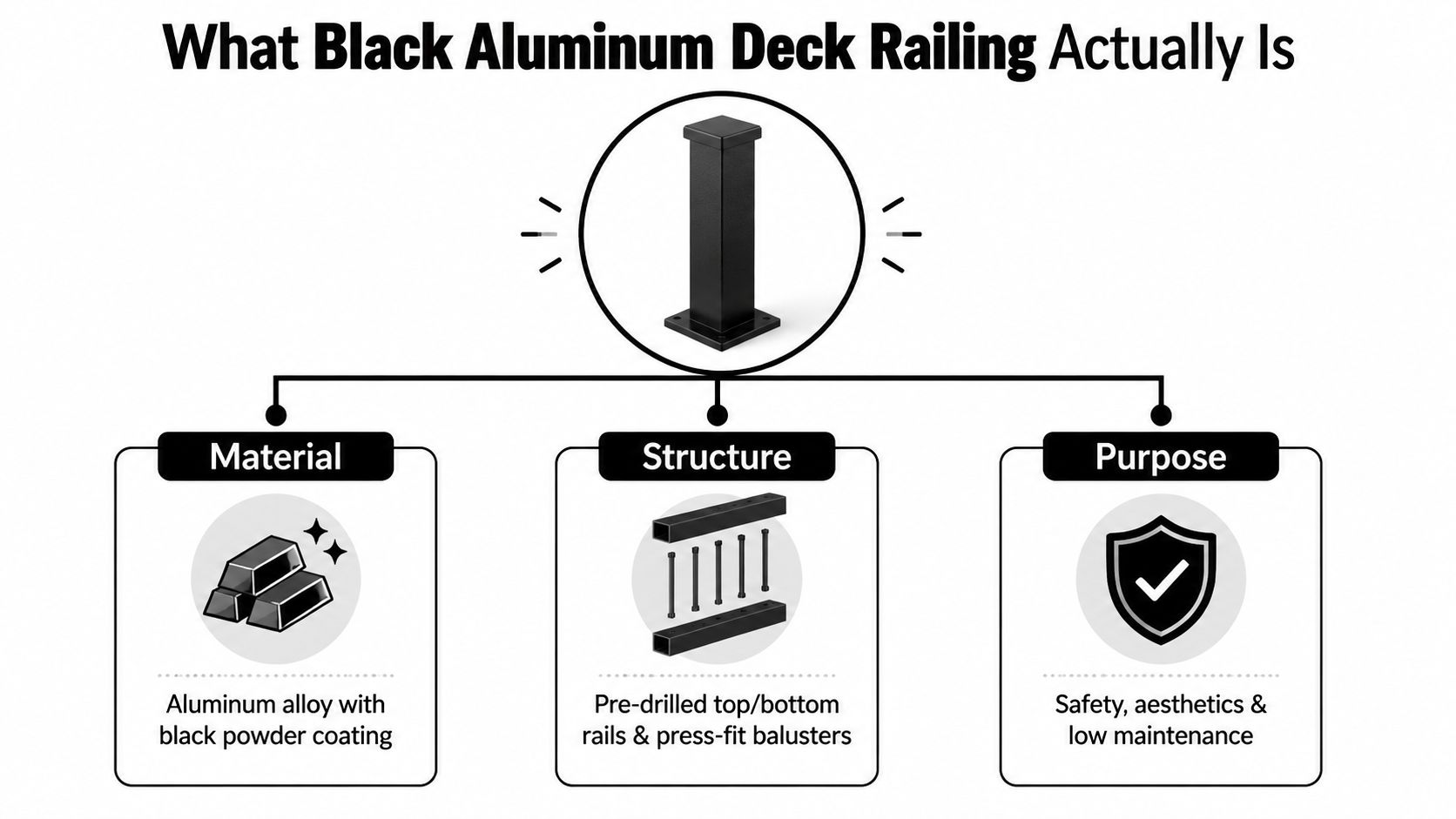
A buyer isn't really choosing a “black rail”, they're choosing a set of parts. That means top and bottom rails, balusters or pickets, posts, post caps, and the brackets that connect everything. A typical 6-ft panel often arrives as the rails, the infill pieces, and the fasteners or connectors needed to assemble the section, with the actual panel length often shorter than the nominal size so it can fit between posts properly. If you're shopping parts separately, the internal framing of the listing matters as much as the photo, which is why a broad catalogue like Xtreme eDeals' aluminium deck materials guide is useful when you're trying to understand what belongs in the cart.
Practical rule: if the listing doesn't tell you whether you're buying rails only, a full panel, or a post-and-bracket kit, you're not comparing the same product.
A proper black aluminium system feels lightweight in the hand, but it's still a structural assembly. That's why contractors think in terms of post centres, rail span, and connection points, not just colour swatches. Once you understand those parts, product pages start making sense instead of reading like a pile of terms.
How Aluminum Compares to Other Railing Materials
Black aluminium keeps showing up in remodels because it solves a very specific set of problems at once. It's lightweight, it's durable, it doesn't ask for repainting the way wood does, and independent guidance puts its service life at 20 to 50 years with minimal maintenance source. That long service window is a big reason it fits so naturally on modern decks and fences where people want a sharp look without yearly upkeep.
Where each material actually wins
Wood still wins when the brief is rustic or cottage-like, especially if the deck is meant to blend into a timber-heavy exterior. It can be painted or stained to match almost anything, but that freedom comes with maintenance. Steel and wrought iron bring a heavier, more traditional feel, and they're often chosen where security or a substantial visual presence matters more than easy handling on site. Vinyl tends to appeal when the owner wants a lower-fuss finish on a tighter budget, while composite is often selected when the goal is a coordinated deck-and-rail package with a consistent colour story.
Black aluminium sits in the middle on purpose. It's lighter than steel, easier to work with than wrought iron, and visually cleaner than most bulky alternatives. That's why it pairs so well with black trim and black windows, a combination that's become a default look in a lot of recent renovations black is one of the most common aluminium railing finishes.
Here's the practical trade-off table buyers usually need:
| Material | What it does well | Main drawback |
|---|---|---|
| Black aluminium | Clean modern look, low maintenance, lighter install | Not the cheapest upfront |
| Wood | Warm, traditional appearance | Ongoing paint or stain upkeep |
| Steel / wrought iron | Strong visual presence, traditional security feel | Heavier, more maintenance risk outdoors |
| Vinyl | Simple finish, low fuss | Less architectural feel |
| Composite | Coordinated modern palette | Can cost more than a basic metal rail |
The installed price also explains the popularity. Independent guidance places aluminium railing systems at about $50 to $150 per linear foot installed, with higher-end custom or coastal-grade systems reaching $150 to $200+ per linear foot source. DIY budgets are often lower, but the labour and finish choices still move the number quickly source.
If you want a railing that looks modern, stays light on the structure, and doesn't turn into a maintenance project, aluminium is the material that usually earns the shortlist. If your priority is pure tradition or the lowest possible initial spend, another material may fit better.
Styles, Profiles, and Finish Grades Worth Knowing
Two black aluminium railings can land near the same budget and still look like different products on the deck. One feels crisp and built in, the other looks generic because the rail profile, baluster shape, and finish grade were not chosen as a set. That is the part many buyers miss, and it shows up fastest at the corners, bracket joints, and post caps.
Profiles change the design language
A square picket profile usually reads as more traditional or craftsman, especially when it sits under a thicker top rail. A narrow rectangular baluster pushes the look toward contemporary because the sightlines stay slimmer and the shadow lines stay cleaner. Wider top rails make sense when the homeowner wants the rail to feel like part of the deck edge rather than a delicate add-on, and glass-panel infill moves the system toward a more open, modern look.
The right profile depends on the house, not just on taste. A modern farmhouse with dark windows can handle a sharper profile without much visual conflict. A coastal property with a lot of glazing may need a rail that disappears more than it announces itself. On real projects, that choice also affects bracket visibility, post-cap proportions, and how forgiving the installation will be if the framing is slightly out.
Finish grade is the part you can't see in the showroom
The finish is where long-term value shows up. An AAMA 2604 textured powder-coated finish is a higher architectural grade made for tougher exterior exposure, while basic powder coating is more of a general-purpose decorative finish. In California, that difference matters because sun, salt air, and urban exposure can wear a weaker coating faster than buyers expect.
One manufacturer specializing in aluminium deck systems says black has been its most requested colour by a wide margin since 2004, and current design guidance treats black aluminium as the default look for many modern deck renovations source. That lines up with the way people are building now, black windows, black trim, and railings that are meant to sit into the architecture instead of fighting it.
Ask one direct question before you buy, what AAMA rating does the black finish carry? Two systems can both look black on a screen and age very differently in sun, salt, and abrasion. If you are comparing specs for a project, a quick reference like this deck railing height code guide helps keep the finish choice tied to the rest of the build, not just the color sample.
The same colour family also comes in different visual textures. A textured black finish usually hides minor handling marks better than a glossy surface, which is a real advantage on busy job sites. The smoother the coating, the more precise the installation needs to be, because every bracket edge, cut line, and post-cap detail shows faster.
Sizing and Code Rules That Decide the Design
The most expensive railing mistake isn't buying the wrong colour, it's installing a system that doesn't pass inspection. On a deck, the two numbers that drive most design choices are 42 inches for guard height and 4 inches for opening size. If the rail is too low or the openings are too wide, the whole job can stall when the inspector shows up.
The two measurements that matter first
The practical meaning of the 4-inch rule is simple. Openings have to stay small enough that a small child can't slip through the baluster field, so black aluminium systems are commonly built around 4-inch baluster spacing. A typical 42-inch-high system gives the guard the profile most often used on higher deck applications, and the PEAK 6-ft black aluminium railing is listed at 42 in. high, 72 in. wide, 2.3 in. deep, with 4 in. baluster spacing and a 20-year limited warranty source.
The detail that surprises first-time installers is that the “6-ft” and “8-ft” names are nominal. Williams' aluminium railing catalogue shows actual panel lengths of 69.43 in. and 91.31 in., and that shorter actual length is intentional, because it accounts for post offset and reduces field cutting source. TimberTech describes the same sizing logic for ease of installation and limited need to cut panels down, which is the reason good systems fit more cleanly on real job sites.
What to carry to the building department
Use this quick checklist before you order parts, and keep it handy when you talk to the permit office.
| Common Black Aluminium Railing Specs | Common Value | Why It Matters |
|---|---|---|
| Guard height | 42 in. | Often used for higher-deck guard applications |
| Baluster spacing | 4 in. | Keeps openings within common residential guard geometry |
| Nominal panel size | 6 ft or 8 ft | Helps with layout planning |
| Actual panel length | 69.43 in. or 91.31 in. | Accounts for post offset and reduces cutting |
| Finish | Powder-coated black | Protects the metal and sets the look |
The local rules still matter. Guards, handrails, stair rails, and landings aren't treated the same way in every jurisdiction. If you're unsure how the guard and handrail definitions apply to your project, the deck railing height code guide is a useful starting point before you lock in a system.
Tools, Hardware, and the Install Sequence
Most black aluminium kits are popular because the major parts are already organised, with pre-drilled rails and press-fit balusters doing a lot of the work for you. That doesn't mean the install is forgiving. The difference between a clean job and a crooked one usually comes down to the first post and the right bracket in the right place.
What should be on the bench
For a straightforward install, the tool list is short but specific. You'll want a drill/driver, level, tape measure, hacksaw or metal-cutting blade, socket set, and a non-marring rubber mallet. If you're cutting aluminium on site, keep the blade clean and go slow, because rough cuts show fast under a black finish. For a deeper walkthrough on trimming rails correctly, the how-to-cut-aluminum-deck-railing guide is worth keeping open while you work.
The small hardware is where the job gets professional. Post base brackets anchor the system. Angle brackets handle 45-degree corners. Horizontal swivel brackets make stair transitions less awkward. And the post cap is not decorative fluff, it's the visual finish that either hides the top of the post cleanly or makes the whole assembly look unfinished.
The install order contractors actually follow
Set and plumb the posts first.
If the posts aren't straight, every rail downstream will advertise the mistake.Attach the base rail.
Bracket alignment matters here, especially on longer runs.Drop in the balusters or fit the preassembled panel.
Keep spacing consistent and don't force pieces that don't seat cleanly.Snap on or fasten the top rail.
This is the stage where a rubber mallet helps without damaging the coating.Finish with matching post caps.
Pyramid, ball, or decorative caps all work, but the style needs to match the rail and the house.
The same principle applies to ladders and temporary access during install. A good external checklist like Pine Country Window Cleaning's ladder inspection and setup checklist is helpful if you're working alone or setting up on uneven ground.
A railing that looks custom usually isn't more complicated, it just has the correct brackets and caps from the start.
What a Real Black Aluminum Railing Project Costs
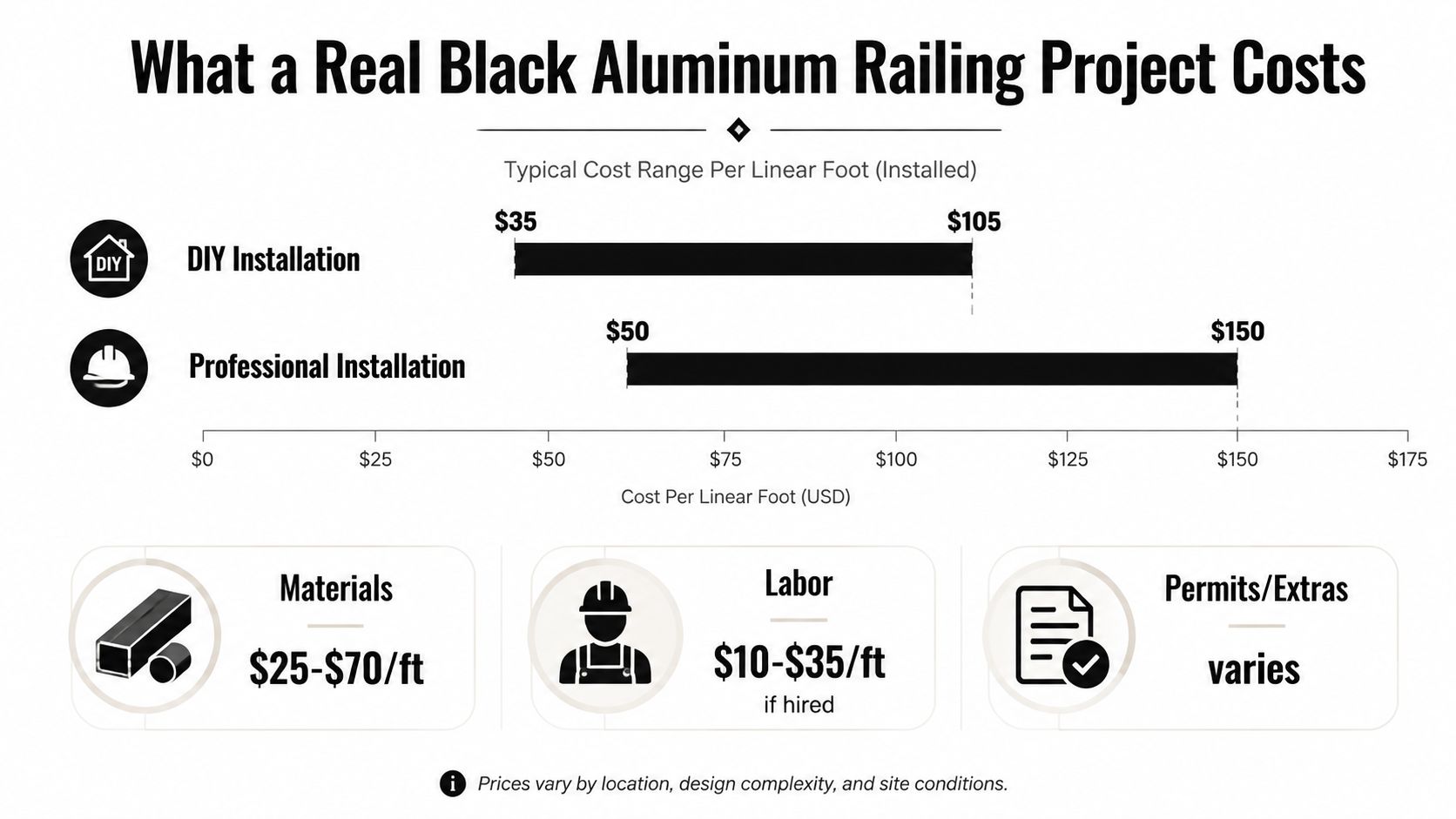
A quote for black aluminum railing can look simple until you start breaking it into parts. Rail price is only one line item. Posts, brackets, caps, stair fittings, gate hardware, and labor decide whether the job stays near the estimate or climbs fast. Published guidance puts black aluminium at about $35 to $105 per linear foot for DIY and $50 to $150 per linear foot installed source. In California, labor, permitting, and finish expectations often move the finished figure toward the higher end of the market source.
A contractor looks at the whole system, not just the rail panel. If the run needs tight corner brackets, stair angle hardware, or post caps that match the rest of the house, the material list gets longer and the install takes more time. That is why two railings that look similar from the street can land at very different prices once the hardware is counted.
A simple deck example
Take a 12-ft x 16-ft deck with railing on three sides. That works out to about 56 linear feet of railing. On a DIY basis, the material budget lands at roughly $1,950 to $5,880, and a professionally installed version lands at roughly $2,800 to $8,400.
Those figures still assume a fairly direct layout. Add a coastal-grade AAMA 2604 finish, custom angle hardware, or stair transitions, and the total moves up. Basic kits with simpler finish grades stay closer to the low end, especially on straight runs. Once the deck has multiple turns, every added corner brings more layout time and more specialty parts.
The hidden items that change the bill
The costs that surprise people are usually the pieces that do not show up clearly in a showroom photo:
- Surface-mount versus fascia-mount post bases can change both labour and layout.
- Gate kits add hardware and a separate fit-up step.
- Additional corner brackets are common on decks that aren't simple rectangles.
- Stair runs cost more to install because each step wants custom panel lengths and angled cuts.
Straight runs are easier to price and faster to assemble. Stairs, inside corners, and off-angle returns demand more measuring, more trial fitting, and more time at the post cap and bracket level. A railing that looks custom usually starts with the correct hardware package, not with extra labor after the fact. If you are sorting finish choices for the rest of the project, it also helps to compare deck staining options before the railing and deck materials are ordered together. For sourcing rails, caps, fasteners, and supporting hardware in one order, XTREME EDEALS INC. can fit into that planning stage.
Maintenance and Climate Performance Over Time
A black aluminium railing can stay in service for years with very little upkeep, but that only works if the finish and hardware were chosen for the site. The routine is plain enough, rinse the rail in spring, wash off dirt with mild soap when it starts to build, and check that brackets, caps, and fasteners are still snug. If you cut a panel or damage the coating, seal the exposed edge right away so corrosion does not start there.
Exposure changes the finish choice
Finish grade matters more once the railing leaves a sheltered backyard. An AAMA 2604 textured black finish is the safer choice where the railing sits in strong sun, near salt air, or beside a driveway that sees de-icing exposure. Basic powder coat can still hold up in many settings, but it usually shows wear sooner where the environment is harder on coatings.
That problem is easy to underestimate in Canada, where Statistics Canada reports roughly 7.9 million tonnes of road salt are used in winter maintenance each year source. If your deck or fence line sits close to a road, lane, or salty driveway, a lower-grade coating ages faster than many buyers expect.
Black finish shows everything
Black is unforgiving. It hides less than lighter colours, so field cuts, scratches, and sloppy touch-ups stand out fast. Constant attention is not required, but clean habits matter, especially at corners, stair connections, and any spot where a metal blade touched the coating.
If you are comparing low-upkeep exterior materials, it helps to compare deck staining options and see how wood stacks up against metal over time. That context matters when you are deciding whether you want to keep sanding and recoating a deck surface or move to a rail that asks for less ongoing work.
The best maintenance plan is boring, rinse, inspect, touch up, and keep the hardware tight.
A good black aluminium rail should look consistent for years because the finish was specified correctly on day one, and because the small parts were chosen to suit the exposure. That is the climate question in the field, whether the coating, brackets, and post-cap details were matched to the site.
A Buying Checklist for Shopping the Xtreme Edeals Catalog
Before you hit checkout, treat the railing as a complete system, not a single line item. The first thing to confirm is that the product is a true black powder-coated aluminium kit, not a steel lookalike with a dark coating. Then check the dimensions, because a rail that doesn't match the opening, the stair angle, or the local guard rule can turn into a return instead of an install.
The cart should include the following
- Black post caps: Choose pyramid, ball, or decorative caps that match the rail style.
- Base brackets: Make sure the post mounting hardware matches the deck surface and post size.
- Angle brackets: Add these for corners that aren't simple square runs.
- Stair brackets: Confirm the system supports the stair layout you're building.
- Compatible fasteners: Use the deck screws or structural fasteners required for the post mounting method.
- Finish grade: Match the coating to the exposure, especially in sun, salt, or roadside conditions.
- Baluster spacing and height: Verify 42 in. and 4 in. where those specs are needed for the project.
Brand comparison helps too. Decorex Hardware appears in the Xtreme Edeals catalogue, and Nuvo Iron is the main competitive alternative many buyers compare against when they're looking at equivalent railing accessories and finishing parts. The point isn't the logo, it's whether the system, the caps, and the brackets all belong together.
If you're shopping the Xtreme Edeals catalog, the right move is to build the full cart before you place the order. That means rails, posts, caps, brackets, and fasteners in one pass, so you're not waiting on a missing corner piece halfway through the weekend.
XTREME EDEALS INC. carries the deck and fencing hardware that makes a black aluminium railing project go together cleanly, from post caps and brackets to fasteners and compatible finishing parts. If you're ready to build a complete cart instead of chasing missing pieces later, visit XTREME EDEALS INC. and pull together the parts for your railing, deck, or fence job in one place.