
You're halfway through a Canadian fabrication job when the inspector spots the problem: the drawings cite ASME B31.1, but the line carries process hydrocarbons. The weld map, material records, stress calculations, and inspection plan all follow the wrong code path. At that point, changing the title block isn't enough. You may have to revisit design calculations, welding documentation, examination scope, and the registration package.
That's why B31.3 vs B31.1 isn't a preference between two familiar engineering references. It's a decision about system function, provincial adoption, applicable edition, and the authority having jurisdiction. Pick the wrong code and the project can stall before fabrication or fail during inspection.
The practical rule is straightforward: use B31.3 for process piping and B31.1 for power piping. The difficult work lies at the boundaries, especially in facilities that combine boilers, turbines, heat recovery, chemical processing, and utility systems. In Canada, the province and the edition it has adopted can determine whether a technically sound design is legally acceptable.
Why This Choice Matters on a Real Project
A contractor may describe a line by where it sits, such as “the pipe inside the power island.” An inspector will usually care more about what the line does and what it carries. A steam line serving a turbine auxiliary system points toward B31.1. A hydrocarbon stream routed through the same building points toward B31.3.
That distinction becomes expensive when the design basis, piping class, purchase specifications, and inspection plan all cite the wrong code. The error often survives early reviews because the drawings look conventional and the materials appear familiar. It surfaces later, when the authority having jurisdiction reviews the system boundary or when the contractor submits records for pressure testing and registration.
Practical rule: Decide the code before you release the piping class, not after the first weld is inspected.
California provides a clear example of how regulators separate the two pathways. California Title 8, Section 453 defines chemical plant and petroleum refinery piping under ANSI B31.3, while power piping is defined under ASME B31.1. The state has kept both standards in its regulatory structure, which demonstrates that they aren't interchangeable references. California's current Process Piping Code is based on ASME B31.3-2020 and became effective January 1, 2023, while regulatory references to B31.3 extend back to forms used in the 1960s and 1970s.
Canada applies the same basic separation through provincial systems. Ontario CRN registration guidance identifies B31.1 for power piping such as steam and compressed air, and B31.3 for other piping systems. New Brunswick regulations likewise list ASME B31.1-2018 as Power Piping and ASME B31.3-2016 as Process Piping.
The lesson is blunt. A code citation affects more than calculations. It controls the design basis, fabrication records, examination plan, pressure-test package, and the evidence you'll need to satisfy the regulator.
Scope and Applicability of Each Code
Start with service, not facility branding. A combined heat and power plant can contain both code families, and the boundary may run between systems within the same building.
B31.1 is the power-piping code. It fits piping associated with power generation or heating equipment, including steam, boiler feedwater, condensate, and related utility services. Typical examples include steam headers, boiler external piping, turbine auxiliaries, and condensate return systems.
B31.3 is the process-piping code. It fits piping in refineries, chemical plants, gas-processing facilities, pharmaceutical plants, food-processing facilities, semiconductor plants, and similar process environments. Typical streams include hydrocarbons, acids, caustics, liquefied petroleum gases, and anhydrous ammonia. ASME-aligned California guidance places B31.3 in these process industries and separately identifies B31.1 for power-related systems.
A working boundary test
Ask three questions before assigning a line:
- What is the fluid's role? Is it steam or water used to produce or transmit power, or is it a process material being reacted, separated, heated, cooled, or transported?
- What equipment does the line serve? A boiler or turbine auxiliary system generally supports B31.1. A reactor, separator, furnace process coil, or refinery unit generally supports B31.3.
- What has the regulator adopted? The province may prescribe the code family and edition for the exact installation.
| Code | Typical Service | Common Fluids | Pressure Range | Temperature Range | Exclusions |
|---|---|---|---|---|---|
| B31.1 | Power generation, boiler, turbine, and heating systems | Steam, boiler feedwater, condensate, utility water, air, and power-related fluids | Governed by the equipment and adopted code edition | Governed by the power-system design conditions and edition tables | Process-unit piping whose primary function is chemical or hydrocarbon processing |
| B31.3 | Refineries, chemical plants, gas processing, and other process facilities | Hydrocarbons, acids, caustics, LPG, ammonia, pharmaceuticals, and food-processing fluids | Governed by the process design basis and adopted code edition | Governed by fluid service, material, and edition-specific design rules | Piping assigned by regulation to power, building, refrigeration, or other B31 sections |
The boundary isn't always a valve or a flange. A heat-recovery steam-generator feed line delivering water to a boiler has a different function from a reactor-effluent line running near the same furnace. Put the boundary on the P&ID, line list, piping class, and design basis. If the documents disagree, the inspector will have to resolve the ambiguity for you.
Design Rules and Allowable Stress
Once the scope is correct, the calculations still won't be interchangeable. B31.3 and B31.1 use different design equations, tables, and treatment of material strength, so copying a wall-thickness result from one code into the other is poor practice.
A Canadian comparison identifies a concrete allowable-stress difference for A106B at 100°F. Under B31.3, the cited allowable strength is 20 ksig, compared with 17.1 ksig under B31.1. The comparison also discusses minimum design metal temperature, noting that B31.3 requires MDMT to be specified as a design condition, while B31.1 addresses low-temperature behaviour through its own provisions.
What changes in the calculation
B31.3 pressure design explicitly brings factors such as joint efficiency, temperature effects, material strength, and corrosion or erosion allowance into the design equation. The applicable stress table depends on the exact edition, material specification, product form, and temperature.
B31.1 has its own allowable-stress tables and pressure-design provisions. The same nominal material grade can therefore produce a different required thickness under B31.1 than under B31.3. The difference can affect:
- Minimum wall thickness, including the allowance needed for manufacturing tolerance and corrosion.
- Support spacing, because a heavier or thinner pipe changes flexibility and sustained-load behaviour.
- Branch and fitting design, where code-specific reinforcement and component rules apply.
- Stress analysis, including thermal expansion, occasional loads, and local intensification.
Don't use a generic “B31.3 is thinner” or “B31.1 is always more conservative” rule. The result depends on the adopted edition, design temperature, material table, weld condition, and the complete load case.
For a hot A106B line, select the edition-specific allowable stress first, then calculate pressure thickness, add the required allowances, and verify the result against mechanical and flexibility requirements. If the line operates at high temperature or sees frequent cycling, the pressure equation may not control the design. The stress model, supports, flexibility, and fatigue evaluation can dictate the final configuration instead.
The right workflow is simple:
- Confirm the edition. Don't lift allowable stress values from a superseded code book.
- Confirm the material form. Seamless and welded products may not share identical assumptions.
- Confirm the design condition. Pressure, temperature, MDMT, corrosion, erosion, and cyclic operation all matter.
- Keep the calculation traceable. The reviewer should be able to follow the material table and equation back to the adopted code.
Materials, Fabrication, and Welding
B31.3 usually gives process designers a broader material-selection framework, but that flexibility doesn't remove the need for disciplined procurement. B31.1 fabrication tends to place heavier emphasis on power-plant traceability, weld preparation, dimensional control, and documentation.
Common specifications such as A106B, A335 P11, and A312 TP304 may appear in either type of project. Their acceptance depends on the material tables, design temperature, product form, service restrictions, impact requirements, and the adopted edition. A material that appears acceptable by grade can still be unsuitable for the actual service or unavailable under the project's governing specification.
Where fabrication plans diverge
The welding procedure specification must match the code, material grouping, thickness range, process, filler metal, heat treatment, and impact requirements. Pay close attention to P-number grouping, impact-exemption curves, preheat, interpass control, PWHT, and fillet weld leg sizing. Those details determine whether an existing WPS can be used or whether the shop needs a new qualification.
B31.3 process classes can also connect examination scope to fluid service and hazard. B31.1 power systems often receive tighter scrutiny around high-energy piping, branch connections, valve records, and weld traceability. Neither code gives permission to substitute materials or reduce examination solely because the line looks low risk.
| Element | B31.3, Process Piping | B31.1, Power Piping |
|---|---|---|
| Material selection | Process-focused material tables and fluid-service considerations | Power-service material tables and high-energy service considerations |
| Welding control | WPS and PQR must satisfy the selected material, service, thickness, and edition | Strong emphasis on controlled weld preparation, traceability, and power-piping fabrication records |
| PWHT | Determined by material, thickness, welding variables, service, and edition | Determined by its own material and fabrication provisions, with close attention to power-service conditions |
| NDE planning | Tied to fluid service, examination category, owner requirements, and authority requirements | Tied to power-piping examination rules, service severity, weld type, and project requirements |
| Substitution | Requires engineering and code review, not informal approval | Requires engineering, procurement, and traceability review, often with tighter documentation expectations |
| Shop execution | Can offer practical flexibility where the service category allows it | Usually demands more controlled records and receipt-to-weld traceability |
Corrosion protection sits outside the basic code decision, but coating selection still belongs in the execution plan. For exposed supports, carbon-steel components, and site hardware, contractors can review protective coating options alongside the project coating specification.
The practical difference is not that one code permits careless fabrication. It's that B31.3 often gives the process project more ways to organise materials and examination, while B31.1 demands a tighter power-plant record trail. Agree on substitutions, NDE, weld maps, and traceability before the shop cuts pipe.
Fatigue and Cyclic Service Differences
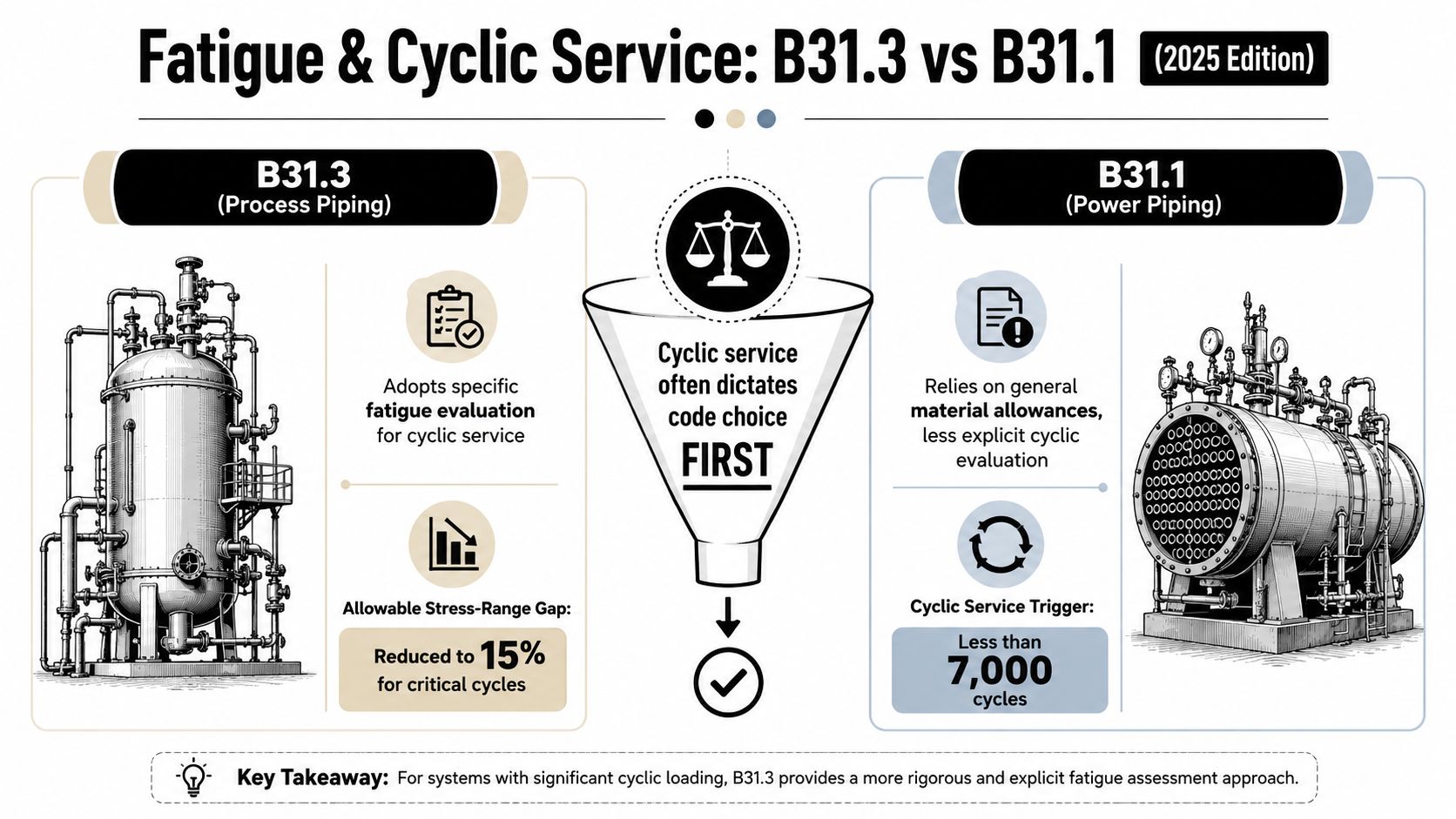
Scope should normally decide the code, but cyclic service can expose the consequences of that decision quickly. Thermal cycling, vibration, intermittent operation, and repeated start-up and shutdown loads can drive support layout and flexibility more strongly than nominal pressure thickness.
A technical review of the 2025 piping-code cycle reports that B31.1 retains the legacy Markl fatigue formulation with a -0.20 slope, while B31.3 uses the Hinnant Appendix W formulation with a -0.333 slope. The same review states that B31.1 allows a stress range about 28% lower than B31.3 for the same cycle count. The technical discussion explains the change and its design implications.
Read the cycle envelope, not one chart
Neither code gives the engineer a universal fatigue factor that can be selected without understanding the operating history. Count the meaningful pressure and temperature cycles, identify thermal transients, capture vibration sources, and evaluate the stress range at critical bends, branches, restraints, and equipment connections.
The correct result may change the routing rather than the pipe schedule. A designer may need longer legs, different support locations, a spring support, a loop, a guided shoe, or a revised branch arrangement. Treating fatigue as a late-stage check is how projects end up with a pipe system that passes pressure design but fails flexibility review.
The code choice must still follow the system's function and jurisdiction. Don't select B31.1 merely because its fatigue treatment appears more favourable for a particular load case. Document the actual cycles and let the adopted code govern the evaluation.
Testing, Inspection, and Documentation
A pressure test package can reveal a code mistake faster than a design review. The inspector sees the cited standard, test boundary, test medium, records, weld identification, and acceptance evidence. If those pieces don't align, the test may be delayed even when the pipe itself is sound.
B31.3 and B31.1 both require controlled verification of system integrity, but the details depend on the adopted edition, service, components, project specifications, and regulator. Don't promise a test duration or examination percentage from memory. Verify the exact code paragraph and the authority's requirements before issuing the test package.
Build the records around the code
A B31.3 package commonly centres on the piping class, fluid service, material certificates, weld maps, WPS and PQR records, NDE reports, pressure-test documentation, and examination category. The level of inspection should reflect the process hazard and the project specification, rather than an assumed universal radiography percentage.
A B31.1 package commonly receives close attention to power-system boundaries, valve and component documentation, weld traceability, branch connections, examination records, and code-related design documentation. For systems connected to regulated boilers or pressure equipment, the authority may also require specific forms, stamps, or witness points.
| Requirement | B31.3, Process Piping | B31.1, Power Piping |
|---|---|---|
| Test basis | Code edition, fluid service, design conditions, and project test specification | Code edition, power-system boundary, design conditions, and project test specification |
| Hydrostatic testing | Follow the adopted edition and documented test procedure | Follow the adopted edition and documented test procedure |
| Pneumatic testing | Requires an approved alternative procedure and appropriate safety controls where hydrostatic testing isn't feasible | Requires an approved alternative procedure and appropriate safety controls where hydrostatic testing isn't feasible |
| Examination | Fluid service and examination category influence the plan | Power-piping service, weld type, component, and project requirements influence the plan |
| Core records | Piping class, material certificates, weld maps, WPS and PQR, NDE, and test records | Material traceability, weld records, valve and component documentation, NDE, design records, and test records |
| Canadian registration | Code, category, drawings, calculations, and test evidence must align with the provincial process | Power-piping classification and supporting records must align with the provincial process |
Ontario's registration process makes the classification issue concrete. TSSA installation and test data guidance requires the submitted piping category to be identified when ASME B31.3 is listed. That means the CRN package can't cite the code and leave the service classification vague.
Before the witness inspection, reconcile the line list, P&IDs, isometrics, test boundaries, weld maps, material certificates, and code edition. For site hardware and access points around inspection areas, a deck inspection checklist obviously isn't a piping code document, but the same discipline applies: verify each item against the governing requirement before the inspector arrives.
Choosing the Right Code for Canadian Projects
Canadian code selection has three layers. First, identify whether the system is process or power piping. Second, confirm which provincial regulator has adopted the code and which edition is in force. Third, determine whether the installation requires pressure-piping registration, including a CRN submission.
That second layer is where many otherwise competent designs fail. Technical Safety BC's 2024 code update shows British Columbia adopted ASME B31.1-2022 and ASME B31.3-2022 for relevant boiler, pressure-vessel, and refrigeration work. Nova Scotia's safety bulletin lists earlier in-force editions, which demonstrates that Canadian compliance depends on province and edition, not merely on the B31 code family.
Use a jurisdiction-first decision
| Project Type | Applicable Code | Authority / Edition | CRN Required? |
|---|---|---|---|
| Boiler external piping | B31.1 | Confirm the provincial boiler and pressure-vessel regulator's adopted edition | Confirm with the provincial authority |
| District heating steam | B31.1 | Confirm the local adopted edition and system boundary | Confirm with the provincial authority |
| Refinery hydrogen process piping | B31.3 | Confirm the provincial process-piping edition and any supplementary requirements | Confirm with the provincial authority |
| Gas-plant amine regeneration | B31.3 | Confirm the provincial process-piping edition and service requirements | Confirm with the provincial authority |
Don't assume that a code edition accepted in one province will clear registration in another. A project crossing provincial lines needs a code matrix showing the authority, adopted edition, system boundary, drawing reference, and CRN status for each piping class.
The strongest Canadian workflow is to ask the regulator or registration body early, then freeze the answer in the design basis. A contractor should never discover the legally enforceable edition after procurement, because the edition affects calculations, materials, documentation, and review.
For field planning and general project organisation, RONA building and deck resources are separate from pressure-piping compliance, but the same project principle holds: establish the governing requirements before materials and labour are committed.
Final Recommendation and Common Questions
Use B31.3 for hydrocarbon, chemical, refinery, and process fluids. Use B31.1 only when the system serves a power boiler, steam turbine auxiliary, heating boiler, or related power function. Don't choose based on which code produces a preferred wall thickness or lighter inspection plan.
Can a CHP steam header use B31.3 to reduce NDE cost? Possibly, but only if the authority accepts the classification and the utility or power scope is clearly excluded. The plant name doesn't decide the code. The system function and documented boundary do.
Can one project use both codes? Yes. Independent piping classes can use different codes when the boundaries are documented on the line list, P&IDs, design basis, and registration documents. Keep the editions and responsibilities clear at every interface.
Do B31.1 welded branch connections use the same reinforcement calculation as B31.3? No. B31.3 uses an area-replacement approach, while B31.1 has a separate reinforcement rule that can be more permissive for certain boss arrangements. Use the rule from the governing code, not a familiar calculation copied from another project.
Final code selection still needs confirmation from the stamped engineer and the authority having jurisdiction. Get that confirmation before issuing fabrication drawings.
XTREME EDEALS INC. supplies practical deck and fencing hardware, including post caps, fasteners, hinges, brackets, anchors, and other construction essentials for contractors and property owners. Visit XTREME EDEALS INC. to review the catalogue and source dependable project hardware from one place.