

You're standing at the fence line with a 6×6 post in one hand and a steel spike in the other. The spike promises a faster installation, while the alternative means digging, forming a footing, handling concrete, and waiting for the foundation to become usable. The tempting question is, “Will this spike hold the post?” The more useful question is, “What foundation does this post need?”
A 6×6 post spike can be a sensible choice for some freestanding fence sections and light-duty outdoor work. It can also be the wrong component for a gate, deck column, raised structure, frost-prone soil, or a site exposed to corrosion or wildfire requirements. The post size matters, but soil, load, climate, drainage, material, and local approval matter more.
What a 6×6 Post Spike Actually Does
A 6×6 post spike is a driven steel anchor with a square socket sized to receive a nominal 6×6 post. Below the socket, a tapered or finned drive point enters the ground. Above it, a flat plate or standoff helps keep the timber away from direct contact with soil.
At the fence line, that arrangement performs a simple job. The socket holds the post upright, while the buried steel transfers vertical and lateral forces into the surrounding ground. It removes much of the digging and concrete handling associated with a poured pier, but it doesn't turn loose or frost-sensitive soil into a stable foundation.
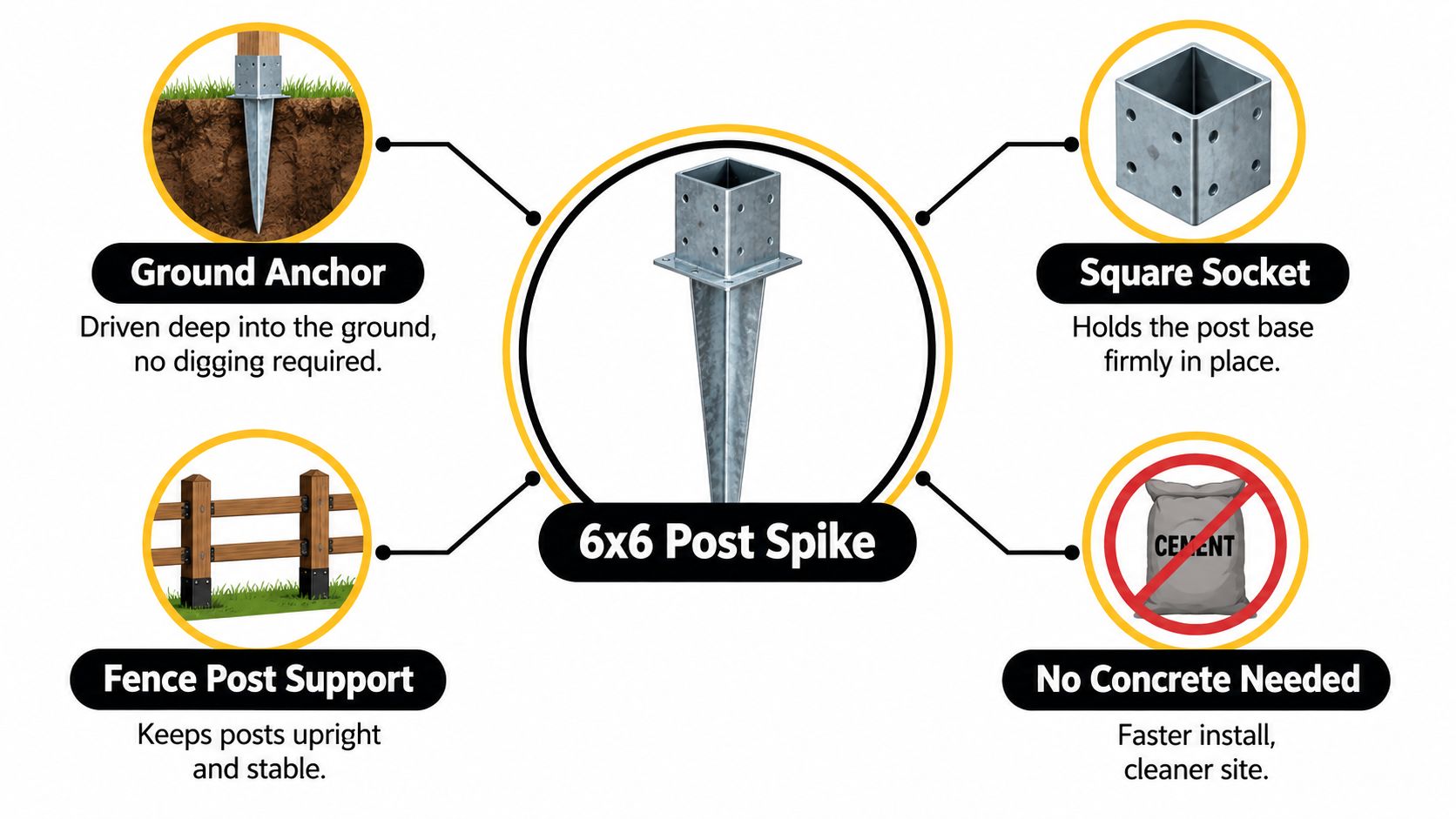
The spike isn't the post, and it isn't automatically a structural footing. A post base bracket normally bolts to an existing concrete pier or slab. A J-bolt is cast into wet concrete and then connects to a metal base. A driven spike occupies a different place in the foundation decision. It can provide a convenient ground connection, but its performance depends on the product's dimensions, steel, embedment, soil, fasteners, and intended load.
Practical rule: Treat the spike as one component in a load-transfer system, not as universal permission to avoid a footing.
Canadian conditions make that distinction important. Frost can lift or tilt a shallow anchor, especially in poorly drained clay or other frost-susceptible soils. A decorative fence section and a wide gate may use posts of the same nominal size, but the gate introduces repeated movement and concentrated lateral force that the fence panel doesn't.
Wildfire exposure can change the decision before structural questions even begin. San Diego County guidance requires fencing within 5 feet of a home, including attachments to the structure, to use noncombustible materials, and identifies noncombustible requirements for deck components in the covered wildfire context. The same guidance calls for 6 vertical inches of noncombustible material at deck-post grade, while CAL FIRE guidance discusses noncombustible fencing for the first 8 feet and separation of parallel combustible fences by at least 10 feet. Those dimensions come from San Diego County's Wildfire Prepared Homeowner Guide. A steel spike doesn't make a wood post acceptable in a location where the surrounding assembly must be noncombustible.
For a finishing detail such as a 6×6 post base cover, confirm that the cover suits the actual post and connection. It can improve appearance and help shield the base, but it doesn't replace structural design or fire-zone compliance.
Nominal Versus True 6×6 Sizing Explained
The label on the package is where many poor fits begin. A familiar 2×4 isn't usually measured as a full 2 inches by 4 inches after surfacing. The same distinction applies to a nominal 6×6 post, which commonly measures about 5.5 by 5.5 inches after surfacing.
A rough-sawn cedar or treated post may be a full 6 by 6 inches, or slightly larger depending on how it was milled. That difference is enough to change whether the post slides into the socket, binds during installation, or leaves movement that fasteners can't correct.
Measure the post across both faces before buying the spike. Then measure the socket's actual interior, not just the size stamped on the packaging. A socket sold for a nominal 6×6 may be comfortable around a dressed post and too tight around rough-sawn timber.
| Post Type | Nominal Size | True Size (in) | Fit in 6×6 Spike Socket |
|---|---|---|---|
| Dressed structural timber | 6×6 | About 5.5 by 5.5 | Often suitable if the socket matches the manufacturer's interior dimension |
| Rough-sawn timber | 6×6 | About 6 by 6 or slightly larger | May bind or require a larger or adjustable socket |
| Undersized milled post | 6×6 | Varies by supplier | May wobble unless the connection is packed or clamped |
A slightly loose fit can sometimes be corrected with galvanized or stainless shims, provided they are secured and don't create a path for water to sit against the wood. A compatible post-setting expanding grout can fill a controlled gap, but it shouldn't be used to disguise a socket that is fundamentally the wrong size. An adjustable spike with side-bolt clamps is often the cleaner answer where post dimensions vary.
Don't force an oversized post into an undersized socket. Driving it down can split the end grain and distort the connection. An undersized post in an oversized socket may rack under wind or gate movement, even when the post looks plumb during installation.
Materials and Finishes That Affect Service Life
The cheapest spike isn't always the lowest-cost choice. Steel thickness, galvanizing quality, fabrication damage, treated-lumber compatibility, drainage, and soil chemistry all influence how long the connection remains dependable.
A standard galvanized steel spike is often suitable for an inland fence in reasonably drained soil when the product is properly sized and approved for the application. A heavier-gauge version gives more stiffness for demanding fence lines, larger gates, and posts exposed to sustained wind. Stainless steel belongs in a narrower category, mainly where persistent moisture, salt, or coastal exposure makes ordinary galvanizing a marginal choice.
Powder coating is primarily a finish and colour decision. It can provide a useful surface layer over galvanizing, but driving can scratch or chip it, particularly around the point and lower shaft. Powder coating doesn't replace a sound corrosion-resistant substrate.
Caltrans identifies soluble salts, soil and water resistivity, pH, oxygen, chloride, sulfate, moisture, and sulfide content as corrosion variables. Its reference corrosion rates include 0.001 inches per year in ordinary soil, 0.0015 inches per year in fill or disturbed natural soil, and up to 0.006 inches per year in marine splash exposure. At that latter rate, uniform loss over 20 years could consume about 0.12 inches of steel thickness. Those figures are set out in Caltrans corrosion guidance, and they show why a spike in wet coastal soil shouldn't be selected from appearance alone.
| Finish | Typical Steel | Coating | Best For |
|---|---|---|---|
| Standard galvanized | Conventional structural steel | Zinc coating | Drained inland fence applications |
| Heavy-duty galvanized | Heavier structural steel | Thicker or more robust zinc protection | Larger gates, demanding fence lines, wetter sites |
| Powder-coated galvanized | Galvanized structural steel | Zinc beneath a coloured powder finish | Appearance-sensitive installations where scratches can be managed |
| Stainless steel | Stainless structural steel | Corrosion-resistant alloy surface | Severe moisture or salt exposure |
| Unprotected black steel | Plain steel | None or limited shop finish | Temporary, sheltered, or non-exposed use only |
Keep the driving end protected during installation. A chipped coating at the soil line becomes more significant when water, treated timber, salts, or fill are present. Make sure the socket drains instead of trapping water around the post end, and check that fasteners are compatible with both the spike finish and the preservative treatment in the lumber.
Spike Versus Concrete Footing Versus Bracket
There are three legitimate foundation paths here. A driven spike prioritizes speed and minimal excavation. A concrete footing provides a below-grade mass and anchoring point. An above-grade bracket keeps the wood away from soil but still needs a properly designed pier or slab beneath it.
| Criterion | 6×6 Post Spike | Concrete Footing | Above-Grade Bracket |
|---|---|---|---|
| Vertical and lateral loads | Depends heavily on socket, shaft, soil, and application | Can provide substantial support when designed for the load | Depends on the bracket, fasteners, and supporting pier |
| Frost behaviour | Vulnerable if shallow or placed in frost-susceptible soil | Can be designed with appropriate depth and drainage | Relies on the pier or slab below the bracket |
| Drainage and rot | Standoff helps, but water can collect at the socket | Wood treatment and concrete detailing remain important | Keeps wood above grade and usually improves separation |
| Inspection | May be accepted for some fence uses, but not automatically for structural work | Familiar foundation route for load-bearing work | Often useful where above-grade separation is required |
| Installation | Fast and clean, with driving effort | More excavation, forming, placement, and curing | Requires a completed concrete support before the post is mounted |
A spike's advantage disappears when the ground won't hold it or the post carries a large repeated load. A concrete footing takes more planning, but it is usually the more defensible route for a heavily loaded gate, structural pergola post, or raised deck element. A bracket is attractive where decay prevention, wildfire separation, or a clean above-grade connection is central, but it can't float without a sound base.
Canadian wood protection rules also affect the choice. The National Research Council of Canada states that structural wood less than 150 mm, or 6 inches, from finished ground level must be pressure-treated to resist decay. In areas where termites are known to occur, the guide identifies a 450 mm, or 17 3/4 inch, threshold for termite-related treatment and visibility requirements. The NRC illustrated guide to the 2020 National Building Code explains why lifting timber above grade doesn't remove every treatment or inspection obligation.
If you need to understand concrete methods in another regional context, information about commercial concrete services in Georgia can provide useful background on concrete work, though Ontario or another Canadian jurisdiction still governs a Canadian project. For hardware that bolts to a completed pier, compare the connection details of a base for a post rather than assuming a spike and bracket perform the same job.
The right choice is usually determined by the weakest demand placed on the post. A fence panel may be light, but a gate, wind-exposed corner, retaining condition, or inspector's requirement can govern the entire foundation.
Matching the Spike to Your Post and Soil
A practical selection sequence prevents the common mistake of buying a socket first and trying to make the project fit it.
Measure the post. Confirm the actual width across both faces. A dressed nominal 6×6 may be around 5.5 inches, while rough-sawn material can be larger.
Identify the application. A small freestanding fence section has a different demand from a privacy screen, driveway gate, deck beam, or guard. Gate hinges and latches create movement that a static panel doesn't.
Read the soil. Dense clay can grip strongly but may move with moisture and freezing. Sand may shift around the shaft. Loam can perform well when compact and drained. Rock, rubble, fill, and shallow bedrock may prevent proper driving or leave too little effective embedment.
Check frost conditions. Ontario's Building Code doesn't prescribe one province-wide frost depth for post foundations. It requires frost penetration to be established from local experience, so the municipality and site conditions must inform the foundation decision. The Ontario Building Code regulation is the appropriate starting point, not a generic depth copied from another community.
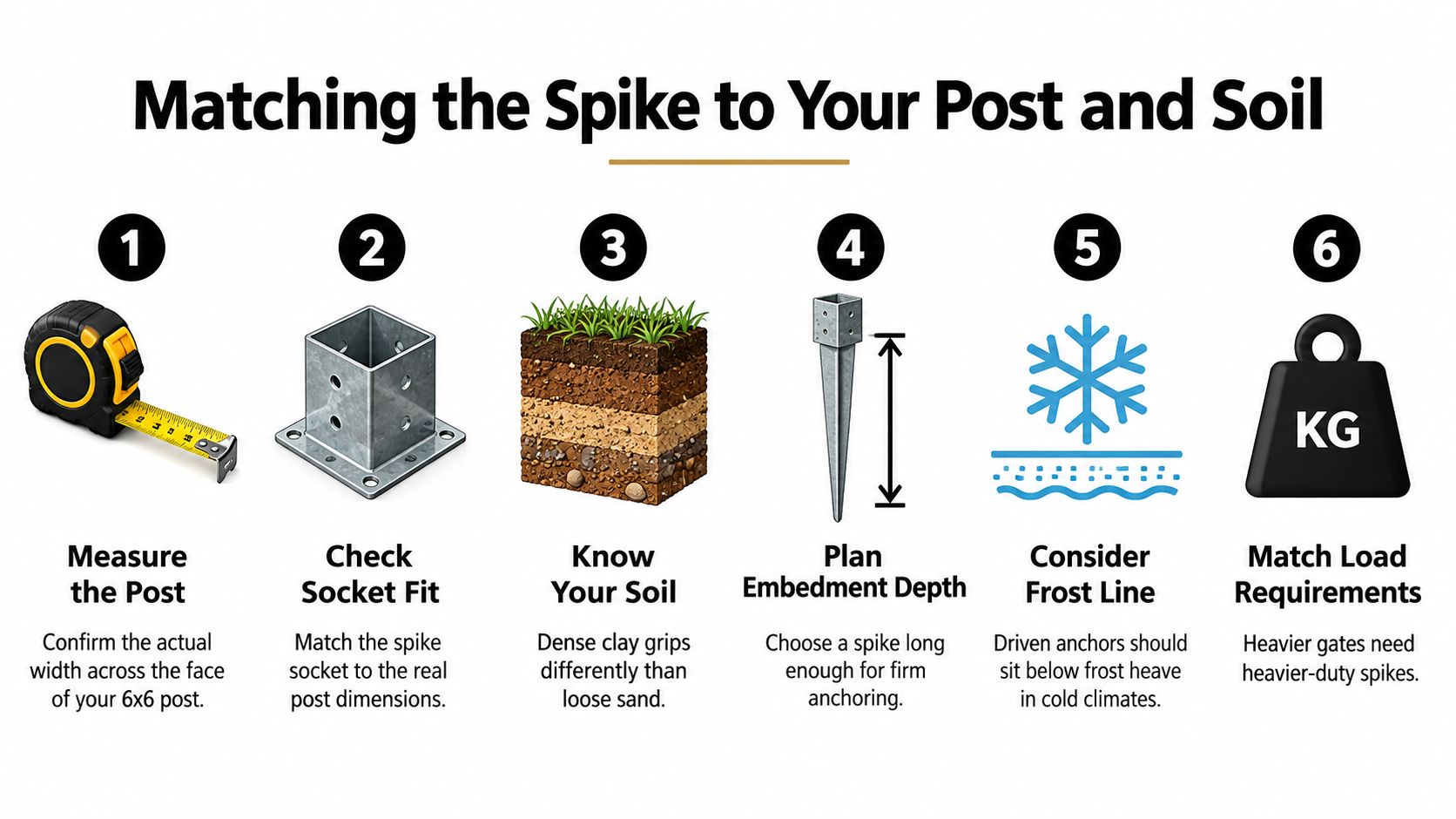
Match the finish to exposure. Use documented galvanizing or stainless steel where wet, saline, coastal, or treated-lumber conditions warrant it. Keep in mind that driving can damage a coating.
Complete the code check. Some municipalities may accept driven spikes for fence work while requiring a footing, pier, bracket, or engineered support for structural posts. If an inspector needs to approve the installation, obtain that answer before ordering materials.
For projects involving raised structures, the foundation logic matters more than the label on the hardware. Background on Texas pier and beam solutions illustrates the broader principle that soil and support conditions determine the foundation system, although it isn't a substitute for local Canadian requirements. For deck-related connections, review decking post anchors alongside the deck design rather than treating a fence spike as a universal deck component.
A spike is most defensible where the post dimensions are verified, the application is modest, the soil is suitable, drainage is reasonable, and the local authority permits that type of support.
Driving a Spike the Day of Installation
Before the first blow, submit the utility locate request. In Ontario, that means contacting Ontario One Call before digging or driving, then checking the site for shallow irrigation, outdoor lighting, private services, and anything the standard locate may not cover.
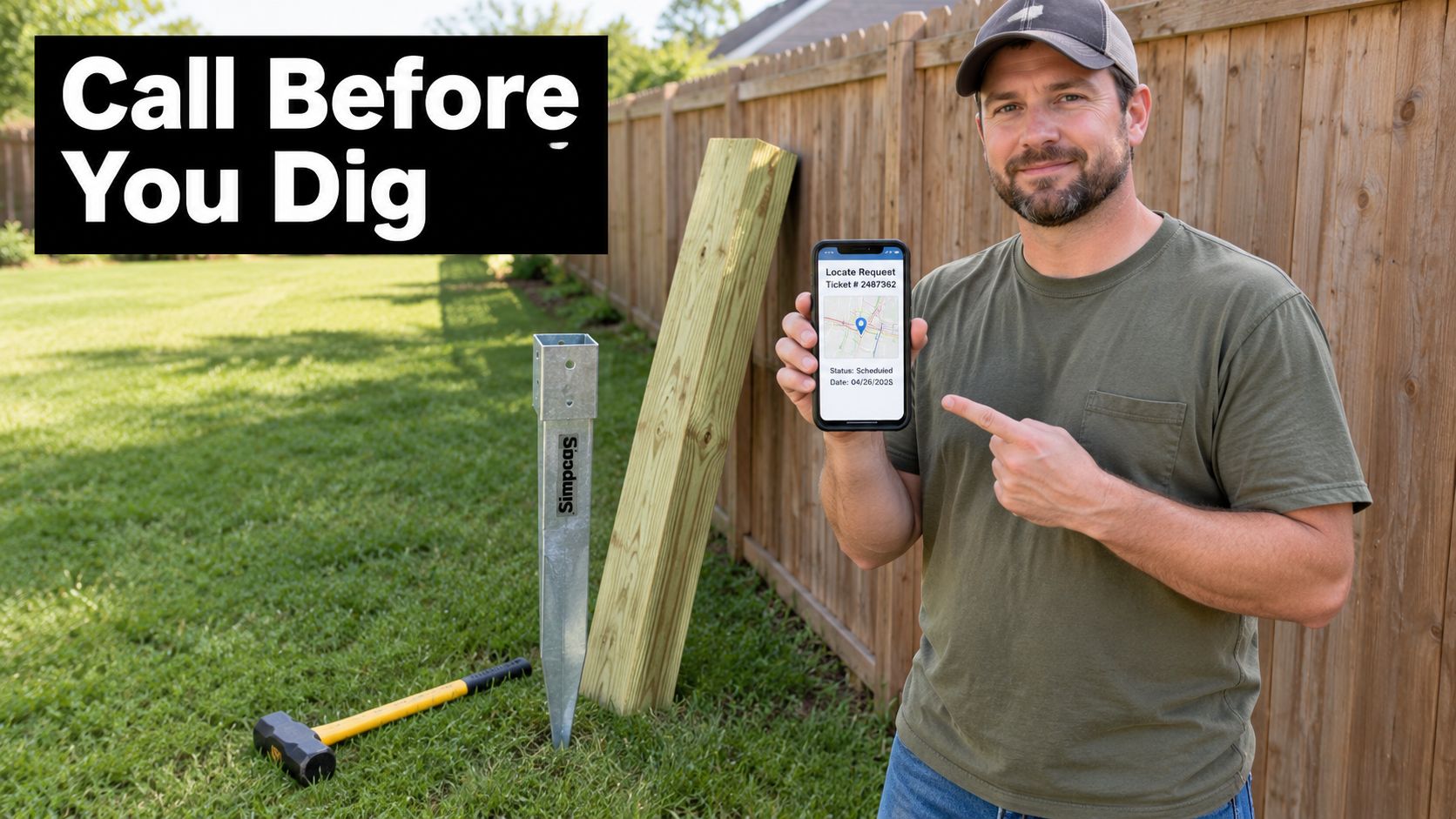
At the fence line, mark the post centre and set the spike point accurately. A digging bar can start a small pilot opening in firm soil, helping the point enter without wandering. It isn't a replacement for locating services, and it shouldn't be used to force a path through unknown obstructions.
Set the spike as plumb as possible before driving. One person can operate a heavy sledge or small breaker while another watches the socket with a level and calls out small corrections. Keep blows centred. Glancing impacts can chip galvanizing or powder coating, and steel-on-steel contact can throw sharp fragments, so use suitable eye, hearing, hand, and foot protection.
The following video can help you visualise the general driving sequence and tool position:
Stop if the spike meets solid rock, buried concrete, or unexpected resistance. Bending the socket or crushing the point won't improve the foundation. Once seated, place the post into the socket, check both faces for plumb, and use compatible shims if the fit calls for them. Finish by closing surface gaps so water doesn't pond against the timber, while preserving drainage away from the post.
When a 6×6 Post Spike Is the Wrong Choice
A package marked “6×6” doesn't guarantee a suitable fit. A dressed post may be close to 5.5 inches across, while rough-sawn or supplier-specific timber can be larger. If the socket leaves a visible gap, the post may wobble even when the spike itself is straight. If the socket is tight, forcing the post can split the end grain before the connection ever sees wind or gate movement.
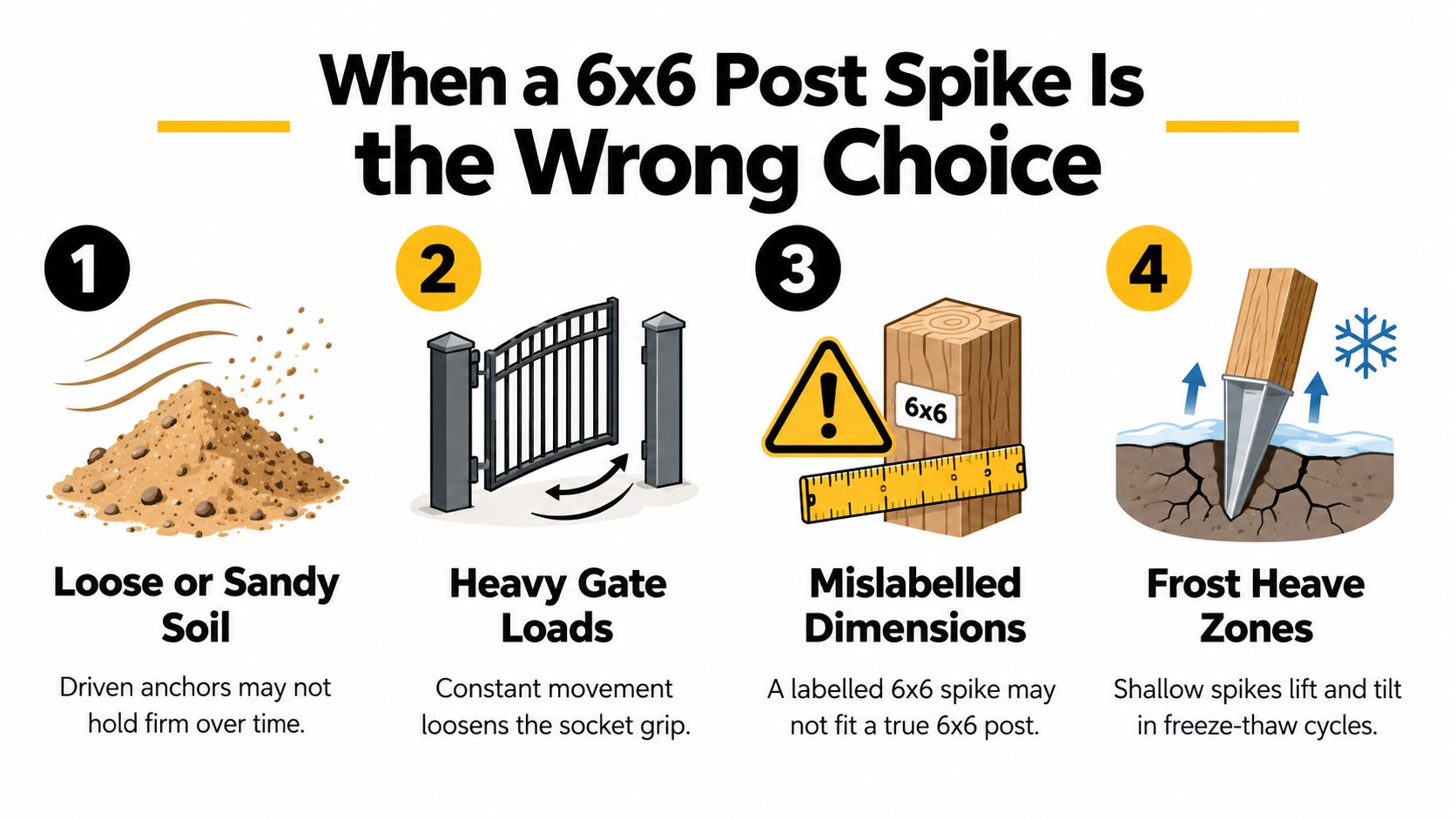
A driven spike is also a poor default for structural deck columns, guard posts, permanent building supports, and heavily loaded gates. Those applications need a support system whose capacity, fasteners, soil bearing, uplift resistance, and lateral restraint can be verified. California's deck provisions, for example, require posts to be supported by concrete footings or another approved structural system designed to transfer loads safely to the ground. The California Residential Code deck provisions also address lateral restraint and connector sizing, so a spike isn't automatically an approved substitute.
Ground conditions can disqualify the product before load calculations do. Shallow bedrock may stop the point above a useful depth. Dense glacial till may damage the spike or prevent proper seating. A high water table can soften the surrounding soil, while freeze-thaw movement can lift an anchor instead of allowing it to remain stable. Loose or shifting sand creates a different problem from compacted native soil, and neither should be treated as a standard installation condition.
If the post carries more than a simple fence panel, the ground fights the driver bar, or an inspector needs to sign off, pause before driving. A bracket, concrete pier, or helical pile may be the more economical decision.
A spike can save labour when the site and application suit it. It becomes a false economy when the post moves, the gate drops, or the entire assembly must be dismantled to replace a connection that was never appropriate for the load.
Bringing It All Together at the Project Site
Before the first strike, put the post, spike, tape measure, product sheet, and site information together. The decision should be clear enough that you can explain it to a helper, a client, or an inspector without relying on the package label.
Use this pocket check:
- Confirm the timber: Measure the actual post. A dressed nominal 6×6 may be about 5.5 by 5.5 inches, while rough-sawn material may need a different socket.
- Confirm the socket: Compare the manufacturer's interior dimension with the measured post. Don't accept a loose connection and hope fasteners will remove the movement.
- Confirm the steel: Check the spike's documented capacity, construction, and finish. Match the corrosion protection to soil moisture, salts, treated lumber, and coastal exposure.
- Confirm the ground: Make sure the soil can accept the spike and that frost, drainage, fill, rock, or groundwater won't undermine the connection.
- Confirm approval: Verify that the municipality permits a driven spike for this exact use. A fence support and a deck support aren't interchangeable just because both use a 6×6 post.
A 6×6 post spike is a tool, not a shortcut. The right foundation is the one matched to the post, load, soil, climate, drainage, and inspector's expectation, not the one that arrived in the truck first. Keep the receipt, installation instructions, product specifications, and any approval information with the project file so the connection can be checked later.
XTREME EDEALS INC. offers deck and fencing accessories, post base brackets, fasteners, post caps, and other hardware for DIY builders and contractors. Visit XTREME EDEALS INC. to compare compatible post hardware, check product details, and choose the connection that suits your actual post and foundation plan.