
You're halfway through framing a deck when you notice the joist hangers are already showing orange stains. The steel looked fine in the package, but the project uses pressure-treated lumber, the ledger sits outside, and the property is exposed to damp air. That small hardware choice can become a structural and maintenance problem long after the boards are fastened.
Galvanized joist hangers do more than hold a joist in place. They transfer load, protect the connection from corrosion, and help the framing meet local requirements when the wood and environment are demanding. The right choice depends on the hanger type, the joist dimensions, the fasteners, the zinc coating, and the treatment chemicals in the lumber.
Introduction to Galvanized Joist Hangers and Why They Matter
A joist hanger is easy to overlook because it disappears into the frame. On a deck, it sits between a joist and a ledger or beam. On a floor system, it supports the end of a joist while helping transfer the floor load into the supporting member. You might spend most of your time checking the layout, the decking, and the finish, but the hanger carries an important part of the connection.
The trouble starts when someone treats all silver-coloured hardware as interchangeable. A light zinc finish may look acceptable indoors, yet it may not suit an exterior deck, treated lumber, or a coastal site. A hanger can also be the right depth and still be wrong for the project if the fasteners are incompatible or the coating doesn't provide enough protection.
Job-site rule: Choose the hanger for the wood, exposure, load path, and fastener schedule, not by appearance alone.
This guide builds the decision in a practical order. First, you'll see how the bracket transfers force and what galvanization does. Then you'll compare coating choices such as G90, G185, post-fabrication hot-dip galvanization, and stainless steel in the situations where moisture, salt, or treated wood can accelerate corrosion.
You'll also learn how to identify hanger styles, match them to joist dimensions, read labels and evaluation information, and install them without leaving bearing gaps or unfilled holes. A homeowner repairing a small deck and a contractor ordering project packs face the same basic question: will this connector remain sound in the environment where it will be installed?
For shoppers using Xtreme eDeals, that means looking beyond a product photograph. Product descriptions, model numbers, hanger dimensions, coating information, and matching fasteners all belong in the same selection check. Galvanized protection isn't decorative. It is part of the connection's durability strategy.
How Joist Hangers Work and What Galvanized Means
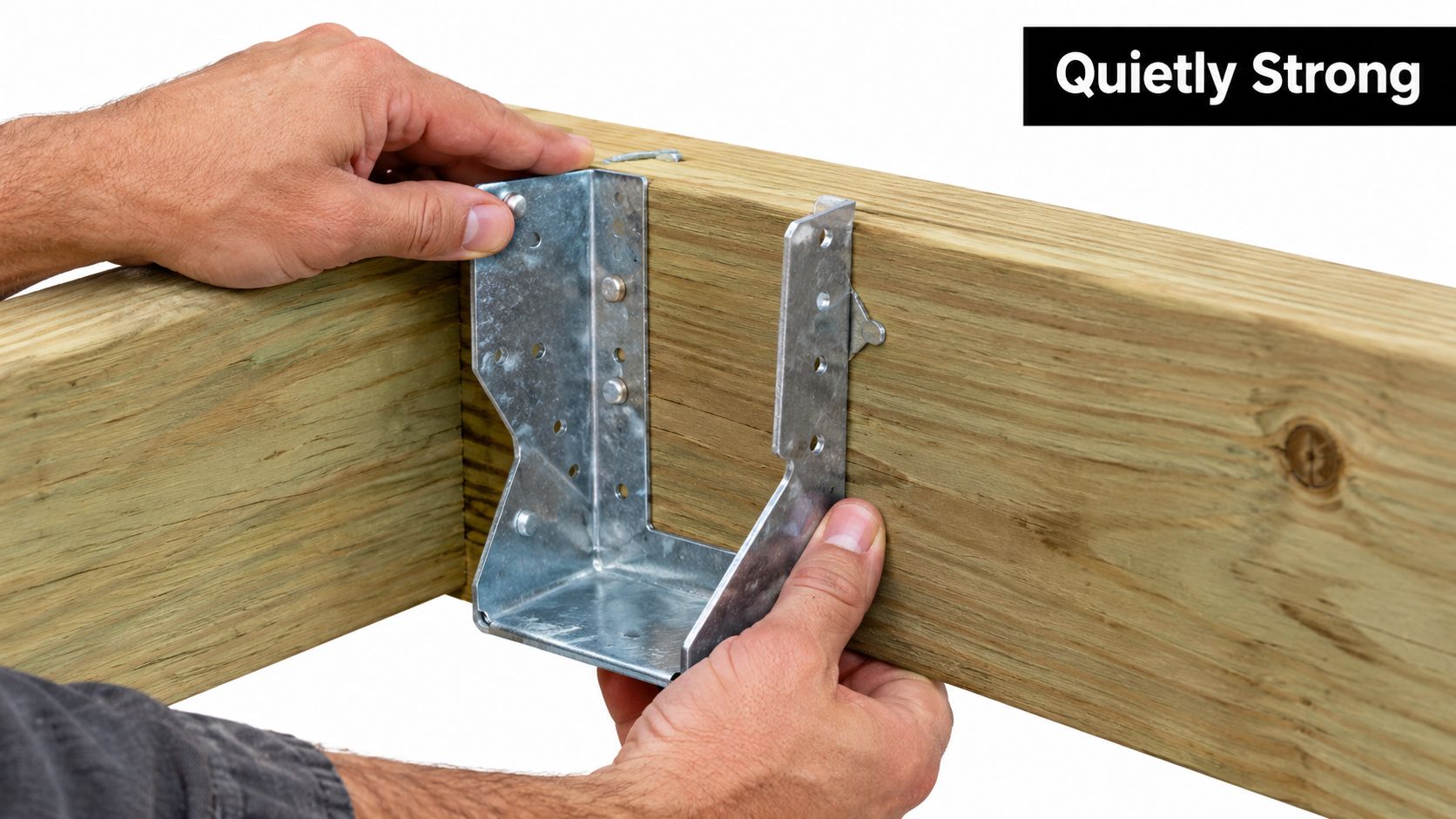
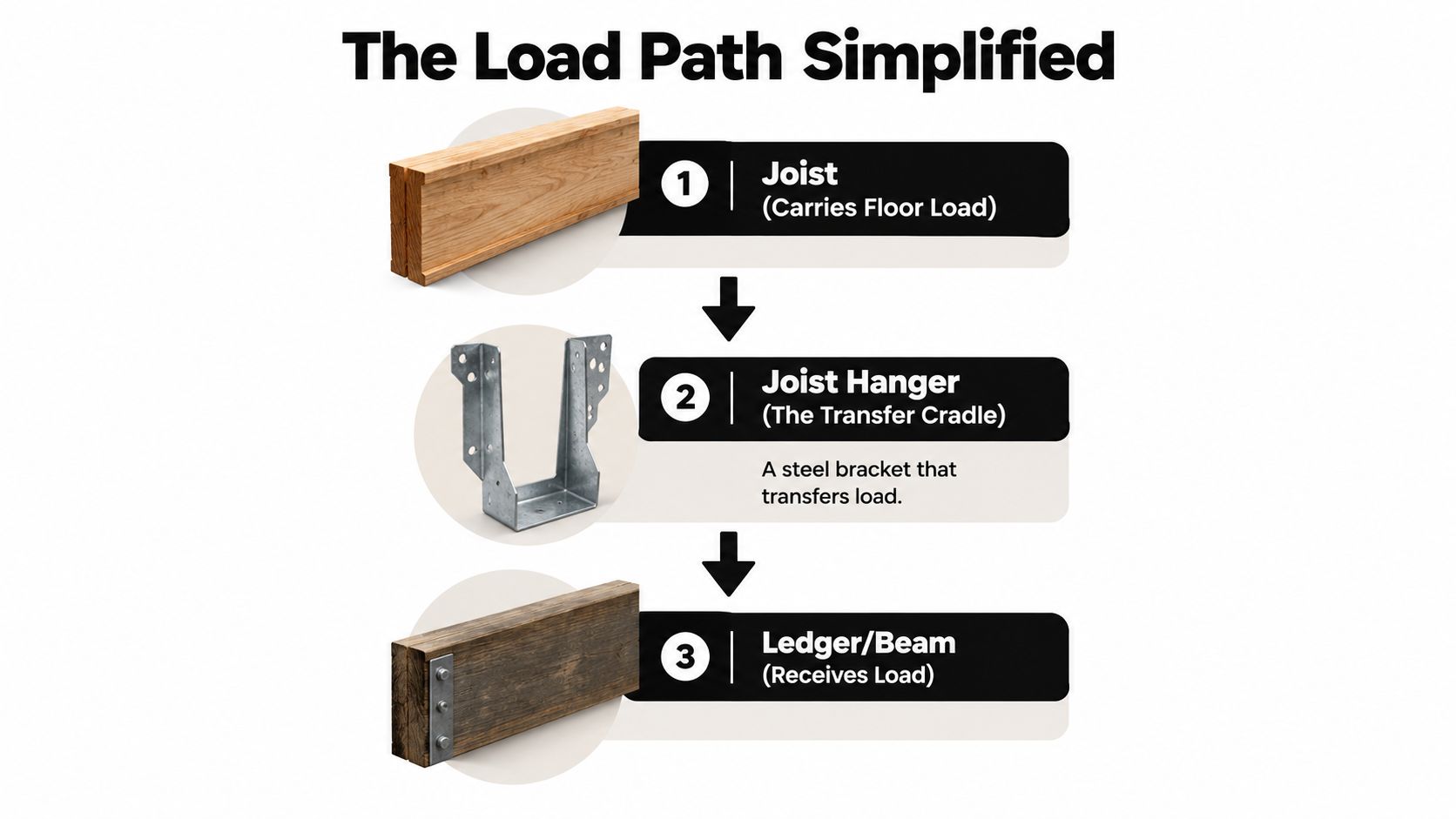
Think of a joist hanger as a steel cradle. The joist rests in the cradle, the hanger grips the sides, and the nails or screws connect the bracket to the ledger or beam. The load travels from the floor or deck surface into the joist, through the hanger, and into the supporting member.
That load path matters because the hanger isn't carrying the joist in isolation. The supporting beam or ledger must be sound, the joist must sit fully in the seat, and every required fastener must transfer force through the parts. If one link is weak, the connection won't perform as intended.
Zinc as sacrificial protection
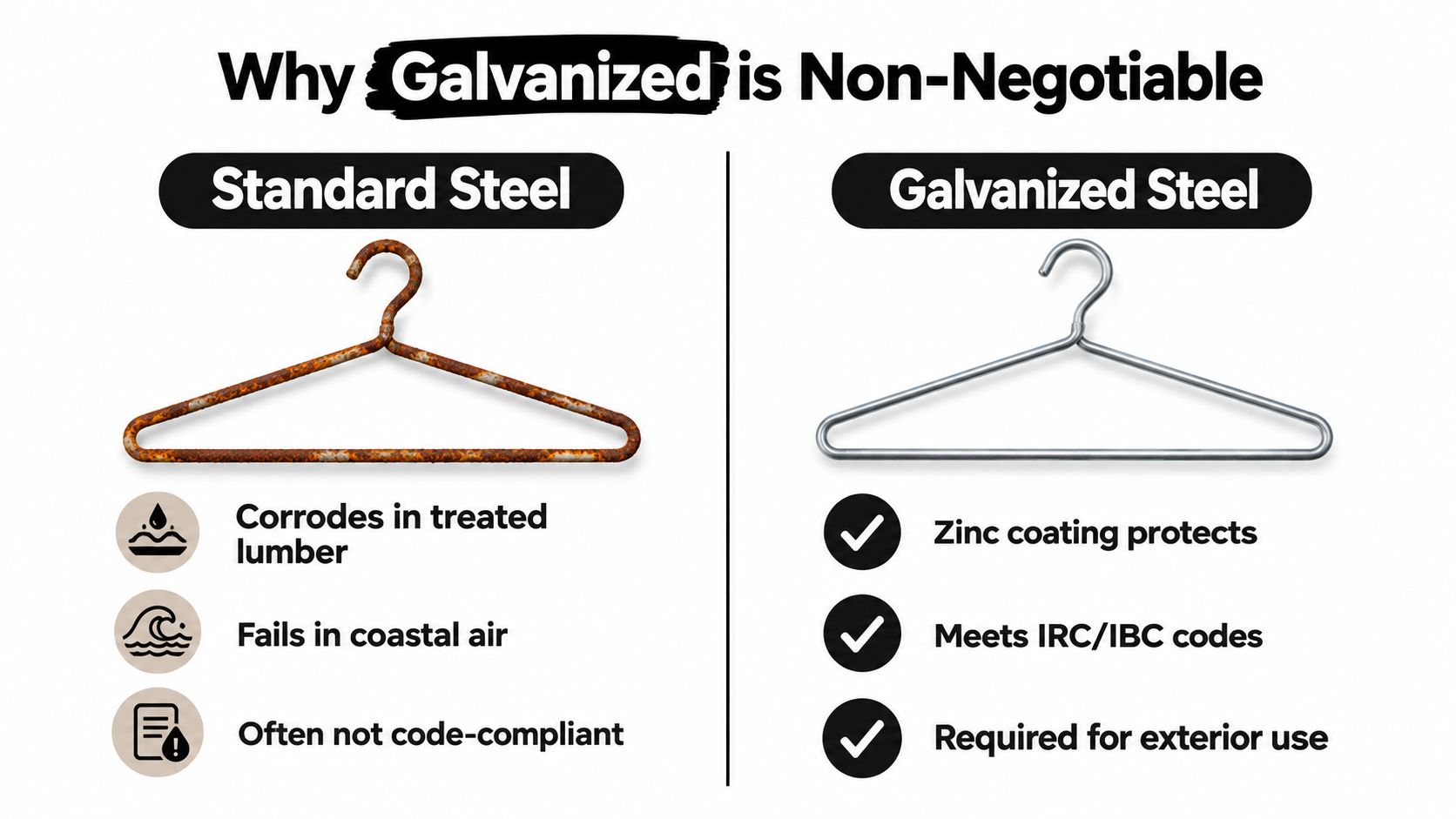
Plain steel rusts when moisture and oxygen reach its surface. Galvanization adds a zinc layer that acts as a protective barrier. Zinc also provides sacrificial protection, so it can help protect exposed steel around a small scratch while the surrounding zinc remains active.
Not every zinc finish provides the same reserve of protection. Pre-galvanized steel receives its coating before the sheet is formed into a connector. Cutting, punching, and forming can leave areas with less coverage. Post-fabrication hot-dip galvanization coats the completed connector, including its formed edges and manufactured surfaces.
The term G90 identifies a coating class, not a hanger shape or load rating. A heavier coating such as G185 contains more zinc than G90 and may be selected where the exposure and lumber chemistry call for additional protection. The right coating still depends on the manufacturer's listing and the applicable code.
Coating isn't the whole connection
A zinc-coated hanger can corrode prematurely if it is paired with an unsuitable fastener. Moisture can also carry treatment chemicals into the connection, creating a more aggressive environment than dry interior framing. That is why the hanger, nails or screws, and wood treatment should be considered as one system.
Sizing comes later. First, identify the exposure and chemistry. A hanger that works well in a protected interior floor system may not be the correct choice for an exposed deck near saltwater.
Corrosion Protection and Code Requirements for Treated Lumber and Coastal Use
A deck may look complete while its connectors are already facing a chemical test. Treated lumber holds preservative chemicals, and outdoor moisture carries them toward the hanger, nails, and screws. The correct galvanized joist hanger therefore depends on more than its appearance. It must match the wood treatment, exposure, fasteners, and applicable code.
California shows why corrosion protection can be a code requirement rather than a preference. Building rules for prefabricated wood connectors require corrosion-resistant steel or a protective coating such as post-fabrication hot-dipped galvanization. For exposed conditions, the cited California guidance identifies G90 as the minimum coating. It also requires the coating or material to be compatible with preservative-treated and fire-retardant-treated wood. (California DSA connector interpretation)
Pressure-treated wood is ordinary framing modified with treatment chemicals, not merely wood with a different colour. Learn what pressure-treated wood means before selecting hardware. The treatment, moisture, and any damaged coating can interact at the connection, so product documentation matters as much as the word “galvanized” on the package.
Comparing the main choices
G90 galvanized steel is the stated minimum for exposed conditions in the California guidance. That does not make it suitable for every location. Confirm the treatment chemistry, service exposure, manufacturer listing, and fastener requirements before choosing it.
G185 has a heavier zinc coating than G90. The same DSA interpretation gives G185 as an example for dry-service conditions with ACZA-treated wood. This example shows why the coating choice follows both the lumber chemistry and the environment, rather than hanger size alone.
Type 316L stainless steel is listed in that same interpretation as an example for severe conditions. It may suit especially aggressive exposure, including situations where a galvanized coating does not provide the specified protection. The connector listing must still approve the material and identify compatible fasteners.
Salt air raises the demand further. California coastal and high-wind provisions address metal plates and connectors exposed to weather within 3,000 feet of a saltwater coastline, as well as exposure to salt corrosion. They identify galvanization or equivalent materials and reference options such as ASTM A653 G185 and hot-dip galvanizing after fabrication to ASTM A123 for applicable connectors and smaller fasteners. (California coastal and high-wind provisions)
Local permit documents may set a clearer hardware specification. A California municipal deck handout requires anchors, fasteners, hangers, plates, and nails to be stainless steel, hot-dipped galvanized, or otherwise corrosion-resistant. It specifies deck hardware with a 1.85 zinc coating, so “galvanized” alone may not tell you whether the product meets an exterior deck requirement. (Millbrae residential deck requirements)
Check the connector label before installation. California guidance requires each prefabricated connector to identify the manufacturer, model number, and evaluation report number by stamp or adhered label. That information supports inspection and lets you verify that the purchased hanger matches the approved product details. (California DSA connector traceability guidance)
Types and Sizing of Galvanized Joist Hangers Explained
The most familiar style is the face-mount hanger. Its flanges sit against the face of a ledger or beam, while the joist fits into the pocket. A concealed-flange hanger hides more of the connector and can suit situations where the visible side of the framing needs a cleaner appearance.
A double-shear hanger uses a fastening pattern that transfers force through both sides of the connection. Skewed hangers turn the joist at an angle, while sloped hangers accommodate a sloping member or roof-related framing condition. Adjustable versions can help with unusual geometry, but they still require the correct approved fasteners and installation details.
Read the lumber, not just the label
Start with the actual framing member. A nominal 2×8 does not have the same finished dimensions as a nominal 4×8, and a hanger designed for a single joist won't automatically suit a double-ply member. Check the hanger's stated joist width, depth, seat, and flange arrangement.
Depth is especially important. The joist should sit down into the hanger without forcing, twisting, or leaving a visible gap beneath the end. If the member is deeper than the hanger pocket, or too narrow for the side flanges, stop and choose a compatible model.
The table below is a shopping aid, not a substitute for the manufacturer's load table.
| Joist Size | Typical Hanger Depth | Common Application |
|---|---|---|
| 2×8 nominal | Sized for 2×8 framing | Deck joists and floor framing using single 2×8 members |
| 4×8 nominal | Sized for 4×8 framing | Heavier timber or beam-to-joist framing |
| 4×10 nominal | Sized for 4×10 framing | Deeper timber framing and exposed structural work |
| 6×8 to 8×10 nominal range | Sized for the specified wide and deep member | Large timber connections requiring a matching heavy-duty hanger |
For a more targeted sizing check, use this joist hanger size guide and compare its recommendations with the product listing and your plans.
Loads and identification
Vertical load is the weight travelling down through the joist. Uplift pulls the connection in the opposite direction, which matters in wind-exposed construction. A hanger's shape alone doesn't tell you its allowable capacity. Use the manufacturer's evaluation information and fastener schedule for the specific model.
Check the physical stamp or label before installation. The California guidance cited earlier requires the manufacturer, model number, and evaluation report number on prefabricated connectors. That information lets you match the part in your hand to the details used by the designer or building official.
How to Install Galvanized Joist Hangers Correctly
Good installation begins before the first nail. Mark the joist centres on the ledger or beam, establish a level reference, and verify that the support member is straight and securely attached. A hanger installed slightly out of position can make the joist twist, reduce bearing, or interfere with the finished deck surface.
A careful installation sequence
Lay out the locations. Transfer the framing plan to the ledger or beam. Mark both sides of each hanger position so the pocket aligns with the joist.
Set and level the support. Confirm that the ledger or beam sits at the intended elevation. If the support is out of level, the joists may not form a consistent plane even when every hanger looks correctly attached.
Select the specified fasteners. Use the joist-hanger nails or structural screws listed for that connector. Ordinary wood screws, drywall screws, or random substitutions don't provide a reliable structural match.
Position the hanger. Hold the hanger tight to the layout marks and seat it squarely. Pre-drill only when the product instructions or the wood species require it, and avoid enlarging holes or damaging the coating.
Fill every required hole. Drive the specified fasteners fully without overdriving them through the hanger. Missing holes reduces the connection's intended fastening pattern.
Seat the joist. Push the joist fully into the pocket, check for gaps, and confirm that its top edge aligns with the surrounding framing.
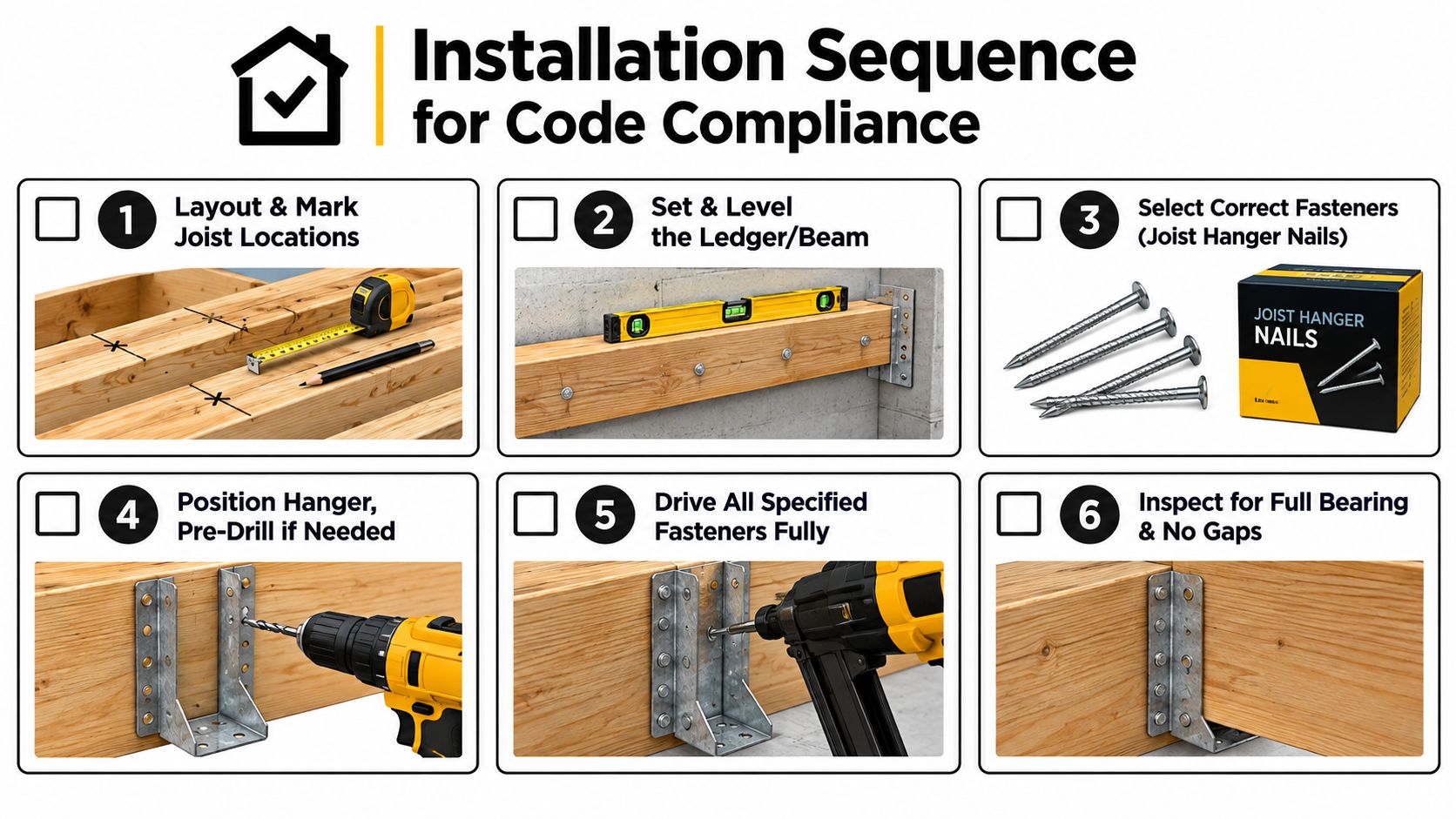
A hanger is only as strong as its fasteners and installation accuracy.
Pair the metals carefully
Treated lumber and exterior moisture make fastener selection part of corrosion control. Use fasteners approved for the hanger and compatible with the treated wood. Depending on the product and exposure, that can mean hot-dipped galvanized or stainless fasteners. Don't pair a corrosion-resistant hanger with an unprotected fastener and assume the connection has the same protection.
Mixing metals can also create galvanic corrosion when moisture provides a conductive path. Follow the connector manufacturer's pairing instructions, especially on coastal decks and projects using treated lumber. If you're still estimating the wider project, plan your deck budget with this guide so hardware quantities and related framing costs don't get missed.
Before ordering, review the joist hanger screws and compatible fastening options. On site, inspect the finished connection for a tight hanger-to-support fit, complete fastening, full joist bearing, and coating damage. Replace a connector that has been badly cut, bent, or scraped through its protective layer.
Choosing the Right Galvanized Joist Hangers at Xtreme eDeals
Shopping gets easier when the project description comes before the product filter. Start with the framing member and exposure, then narrow the list by hanger style, size, finish, and pack quantity. A deck joist beside a protected interior floor and a timber connection on an exposed outdoor structure may need different product specifications even if the connection looks similar.
For a deck framing project, look for a hanger that matches the joist width and depth, works with the treated lumber, and has a compatible fastener schedule. Exposed structures deserve closer attention to the coating description than an enclosed interior frame. If the product page doesn't identify the model or finish clearly, pause before placing the order.
The assortment at XTREME EDEALS INC. includes galvanized joist hangers for several framing applications, including options described for nominal 2×8, 4×8, 4×10, and larger nominal lumber ranges. Listings include Decorex Hardware options, multi-pack formats, and related items such as post base brackets and structural screws. CAD pricing and pack quantities help you compare a single repair with a larger framing order, but the product specification still controls the technical choice.
Use the listing as a verification tool
Look for these details while reviewing a product:
- Dimension match: Confirm the stated nominal lumber size and whether the hanger accepts a single or multiple-ply member.
- Material description: Check whether the listing identifies galvanized steel, stainless steel, or another finish.
- Fastener pairing: Match the recommended nails or structural screws to the hanger and treated wood.
- Traceability: Record the manufacturer and model number, then compare it with plan notes and evaluation information.
- Quantity: Choose a pack that covers the planned connections while leaving room for damaged or incorrectly installed pieces.
A product name such as “galvanized joist hanger” is only the starting point. Read the technical details, inspect the part when it arrives, and keep the label or packaging with your project records. For a repair, measuring the existing joist and support first prevents an attractive but incompatible purchase.
Xtreme eDeals also carries related deck and fence hardware, including post caps, finials, balusters, gate inserts, hinges, deck screws, bolts, nails, washers, and anchors. Keeping those components organised around the same exposure and compatibility requirements can simplify ordering, especially when the project includes both framing and finishing work.
Final Takeaways for Strong and Long Lasting Connections
A durable joist connection comes from three decisions made together.
First, match the type and size. Choose face-mount, concealed-flange, double-shear, skewed, sloped, or adjustable hardware according to the framing geometry. Confirm the joist width, depth, ply arrangement, and required load information before ordering.
Second, match the corrosion protection to the job. Exterior exposure, treated or fire-retardant-treated wood, damp conditions, and salt air can change the correct choice. California guidance uses G90 for exposed conditions, gives G185 as an example for dry-service conditions with ACZA-treated wood, and identifies Type 316L stainless steel for severe conditions. (California DSA connector interpretation)
Third, install the complete system. Use the specified nails or structural screws, fill the required holes, seat the joist fully, and avoid incompatible metal pairings. Check the finished connection for gaps, bent flanges, damaged coatings, and missing fasteners.
Before buying, run through this short checklist:
- Measure: Record the actual joist and support dimensions.
- Identify: Note the lumber treatment and site exposure.
- Verify: Confirm the hanger model, label, evaluation information, and fastener schedule.
- Inspect: Check every connection after installation and during routine deck maintenance.
- Replace: Remove hardware showing significant corrosion, distortion, or coating failure.
DIY builders can work through those checks one connection at a time. Contractors and property managers can make the same process repeatable across a full order by recording model numbers, pack quantities, and compatible fasteners.
XTREME EDEALS INC. offers galvanized joist hangers, Decorex Hardware options, structural screws, post base brackets, and related deck and fencing hardware with CAD pricing and multi-pack choices. Visit XTREME EDEALS INC. to compare hanger sizes and assemble the corrosion-compatible hardware your project requires.