
The popular advice is simple: grab a box of galvanized nails and start building. That shortcut is responsible for many loose pickets, rust stains, split boards, and avoidable callbacks. The best nails for fencing aren't chosen by length or thickness alone. They belong to a fastener system matched to the fence material, treated-wood chemistry, local climate, wind or seismic demand, and municipal requirements.
A cedar privacy fence in a wet Canadian climate doesn't experience the same stresses as a chain-link fence near the coast or a wood fence in California. Sometimes a ring-shank nail is the right answer. Sometimes a stainless-steel screw, staple, carriage bolt, or galvanized wire tie is the better choice. The practical question is always the same: which fastening method will remain compatible with the fence system after moisture, movement, corrosion, and inspection requirements have had their say?
Why Most Fence Nails Fail Before the Wood Does
A generic nail may hold a picket in place on installation day, but that doesn't prove it belongs outdoors. Fence lumber moves as it absorbs and releases moisture, treated wood can be chemically aggressive, and the connection may face wind, impact, frost movement, or seismic forces. The fastener often becomes the weak link before the board visibly fails.
Three field problems appear repeatedly:
- Corrosion: A bright electro-galvanized or inadequately coated nail can lose its protective layer in pressure-treated lumber. Copper-based preservatives and moisture accelerate the problem, especially where the coating is thin or damaged during driving.
- Withdrawal: Freeze-thaw movement and seasonal shrinkage can work a smooth-shank nail out of a rail or picket. The fence may look fine at first, then develop loose boards after repeated weather cycles.
- Shear or breakage: High wind, gate movement, and seismic loads place sideways force on connections. A nail with the wrong diameter, head, or embedment can bend, snap, or pull through the wood.
Practical rule: A stronger-looking nail isn't automatically a better nail. Compatibility and placement matter as much as holding power.
California makes that point clearly. Its building-code framework requires fasteners in contact with preservative-treated wood to use approved corrosion-resistant materials, including hot-dipped zinc-coated galvanized steel, stainless steel, silicon bronze, or copper, with zinc-coated nails referenced against ASTM A153 Class D or ASTM A641 Class 3S requirements (California fastener and corrosion requirements). That turns corrosion resistance from a preference into a code-aligned durability decision.
California's fastening provisions also connect nail quality with seismic performance. In Seismic Design Categories D, E, or F, mechanically driven nails used in wood structural panel shear walls must match required hand-driven nail dimensions, and clipped-head or box nails aren't permitted in new construction. The same provisions specify edge distances that vary with shear demand, including 1/2 inch from panel edges and 3/8 inch from connecting-member edges in higher-shear cases (Burbank wood fastening provisions).
A fence may not be a house wall, but fence-adjacent wood construction, gates, braces, and retaining elements can still fall under local rules. The right starting point isn't “What nail is strongest?” It's “What fastener system suits this fence, this exposure, and this jurisdiction?”
Fence Nail Types and Sizes Explained
Nail selection starts with the connection, not the tool. A picket-to-rail joint has different needs from a rail-to-post joint, and neither should be treated like finish carpentry.
Shank geometry controls withdrawal
Common nails have a smooth shank and a relatively substantial body. They're useful for general wood connections where corrosion resistance and adequate embedment matter, but smooth shanks are easier to withdraw when the wood moves.
Box nails have a lighter shank and are less likely to split thin stock, although they don't provide the same structural reserve as a heavier common nail. California's residential code identifies common or galvanized box nails for certain wall applications unless another requirement applies, and it specifies carbon-steel strength requirements by nail diameter and size (California Residential Code wall construction).
Sinker nails usually have a textured or coated shank and a head designed for efficient driving. They're common in framing work, but the coating and manufacturer approval still need checking before they're used in treated lumber.
Casing nails have a smaller, neater head. They suit visible trim or delicate attachments, not heavily loaded rail-to-post connections.
For fencing, ring-shank and spiral-shank nails generally offer better resistance to withdrawal than smooth-shank nails because their ridges mechanically grip the wood fibres. Use them for cedar and spruce pickets where seasonal movement can loosen a plain shank. A ring shank is especially useful where you want the speed of nailing but need more grip than a smooth framing nail provides.
Match the length to the joint
Penny sizing describes nail length, not diameter. Gauge describes the shank thickness, and the two terms shouldn't be treated as interchangeable. As a working rule, the nail should pass through the first component and penetrate the receiving member enough to hold without emerging on the far side.
| Nail Size (Penny) | Length (Inches) | Shank Type | Best Fencing Application |
|---|---|---|---|
| 6d | 2 | Ring or spiral | Picket attachment to rails |
| 8d | 2.5 | Ring or spiral | Standard rail fastening |
| 10d | 3 | Spiral or ring | Heavy rail-to-post joints |
| 16d | 3.5 | Ring or common | Structural post bracing |
| 20d | 4 | Ring or spiral | Gate posts and corner braces where the joint requires greater embedment |
The length must exceed the combined thickness of the materials being joined by at least one inch for reliable holding power. That isn't permission to use the longest nail in the box. Excessive length can strike hidden hardware, split narrow members, or create a hazard.
Head shape matters too. A flat head gives broad bearing on pickets, a checkered head helps reduce hammer slip, and a countersunk head can disappear into trim. For ordinary pickets, a properly seated flat or clipped head is usually more practical than a small casing head. For structural connections, use the head style required by the fastening schedule and local code.
Materials and Coatings That Resist Corrosion
A fence nail fails at its coating long before its strength becomes the issue. Cutting, collating, driving, treated lumber, and repeated wetting can damage that protection, so the fastener system must match the wood treatment and exposure.
Galvanized choices are not equivalent
Hot-dipped galvanized nails carry a thicker zinc coating than bright or electro-galvanized nails. For California projects using preservative-treated wood, the code specifically references zinc-coated nails meeting ASTM A153 Class D or ASTM A641 Class 3S (California's corrosion requirements for wood fasteners). Check the standard printed on the box. A label that only says “galvanized” does not identify the coating class or expected protection.
Electro-galvanized nails have a clean, bright finish, but their thinner zinc layer may tolerate treated lumber, moisture, and driving damage less effectively than hot-dipped galvanizing. Mechanically deposited zinc coatings follow different requirements. California permits them for fasteners other than nails when they meet ASTM B695 Class 55 minimum, reinforcing that nails have their own coating requirements under the code.
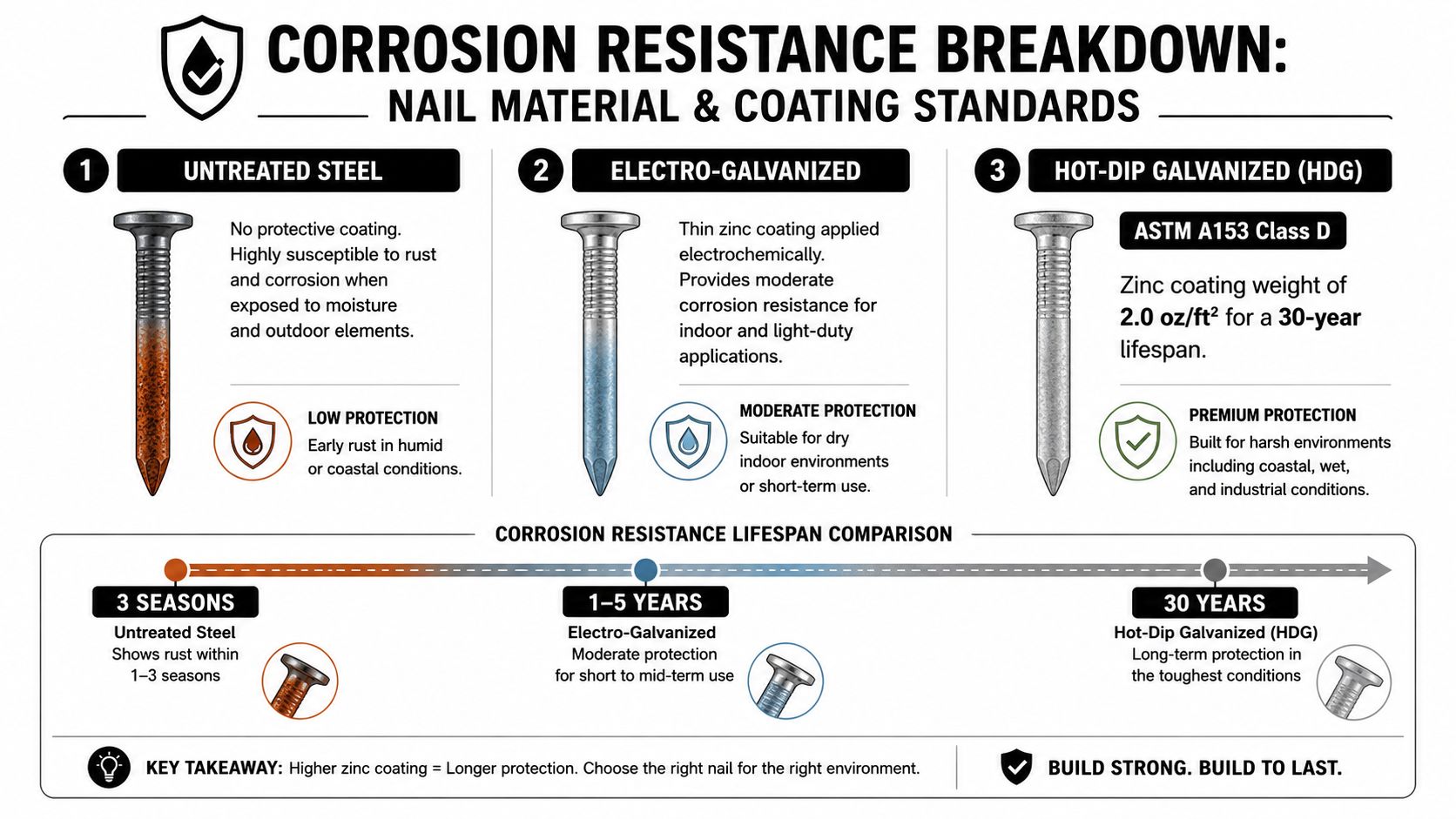
Polymer-coated nails add another moisture barrier, but pneumatic driving can chip the coating. Exposed steel then becomes a concentrated corrosion point. Confirm that the coating is approved for the specific preservative and exposure instead of choosing by colour or finish.
Stainless steel for severe exposure
Stainless steel suits salt, persistent humidity, and aggressive treated wood. Type 304 handles common exterior applications, while Type 316 provides greater resistance in severe marine exposure. Keep the entire connection compatible. Aluminium nails paired with steel brackets, or other dissimilar metals in a wet joint, can create galvanic corrosion.
The hot dip galvanizing cost per pound resource helps contractors assess coating economics before buying in quantity. For borderline exposure, this galvanized versus stainless steel comparison clarifies the trade-off between coating protection and stainless-steel performance.
AWPA references and ICC-ES evaluation reports can confirm whether a fastener suits the wood treatment and connection. If the manufacturer does not identify the coating, substrate, and approved applications, treat the product as unverified. A silver finish alone does not establish outdoor performance.
Matching Nails to Wood, Composite and Chain-Link Fences
Not every fence needs a nail. Forcing the wrong fastener into a fence system is a common source of premature failure, especially when installers treat chain-link mesh or composite boards like ordinary wood pickets.
Wood pickets and rails
Cedar and pressure-treated wood pickets generally pair well with corrosion-resistant ring-shank nails. A ring shank grips the rail and resists the repeated pull created by drying, swelling, and wind. Use a length that passes through the picket and reaches well into the rail without protruding.
Rails and posts often need a heavier nail than pickets. Where the connection carries gate movement, corner loads, or brace forces, screws or bolts may provide better control and serviceability than nails. Gate hardware deserves its own compatible bolts and washers, not whatever nail remains in the nailer.
Composite boards
Composite fencing expands and contracts differently from solid wood. Stainless-steel screws are usually easier to inspect, remove, and reposition, and they allow installers to follow the board manufacturer's fastening pattern. A nail that holds a wood picket can restrict movement or create a visible failure in a composite panel.
Chain-link and mesh
Chain-link fabric isn't nailed to posts. It is tensioned and connected with components such as tie wires, hog rings, tension bars, and carriage bolts. Ontario public specifications emphasise galvanized wire ties, hog rings, carriage bolts, and applicable ASTM and galvanization requirements rather than ordinary nails (Ontario chain-link fencing standard).
| Fence Type | Best Fastener | Material/Coating | Size/Length | When to Use Alternatives |
|---|---|---|---|---|
| Cedar pickets | Ring-shank nail | Hot-dipped galvanized or stainless steel | Sized for full rail penetration | Use screws for repairable or high-movement connections |
| Pressure-treated wood | Ring or spiral shank | Code-compatible galvanized or stainless steel | Match the joint thickness | Use bolts at heavily loaded gate and brace joints |
| Composite panels | Exterior screws | Stainless steel | Manufacturer specified | Use clips or proprietary hardware where required |
| Chain-link fabric | Tie wire or hog rings | Galvanized steel | Manufacturer or project specified | Use tension bars and carriage bolts at terminal connections |
| Welded wire mesh | Staples or approved clips | Corrosion-resistant steel | Match mesh and post system | Use screws with washers where the system calls for removable attachment |
For chain-link projects, a dedicated chain-link fence hardware selection is more useful than a generic nail search. The correct category is determined by how the fabric transfers tension to the posts, not by the nail's advertised tensile strength.
Climate, Frost Line and Code Requirements You Cannot Ignore
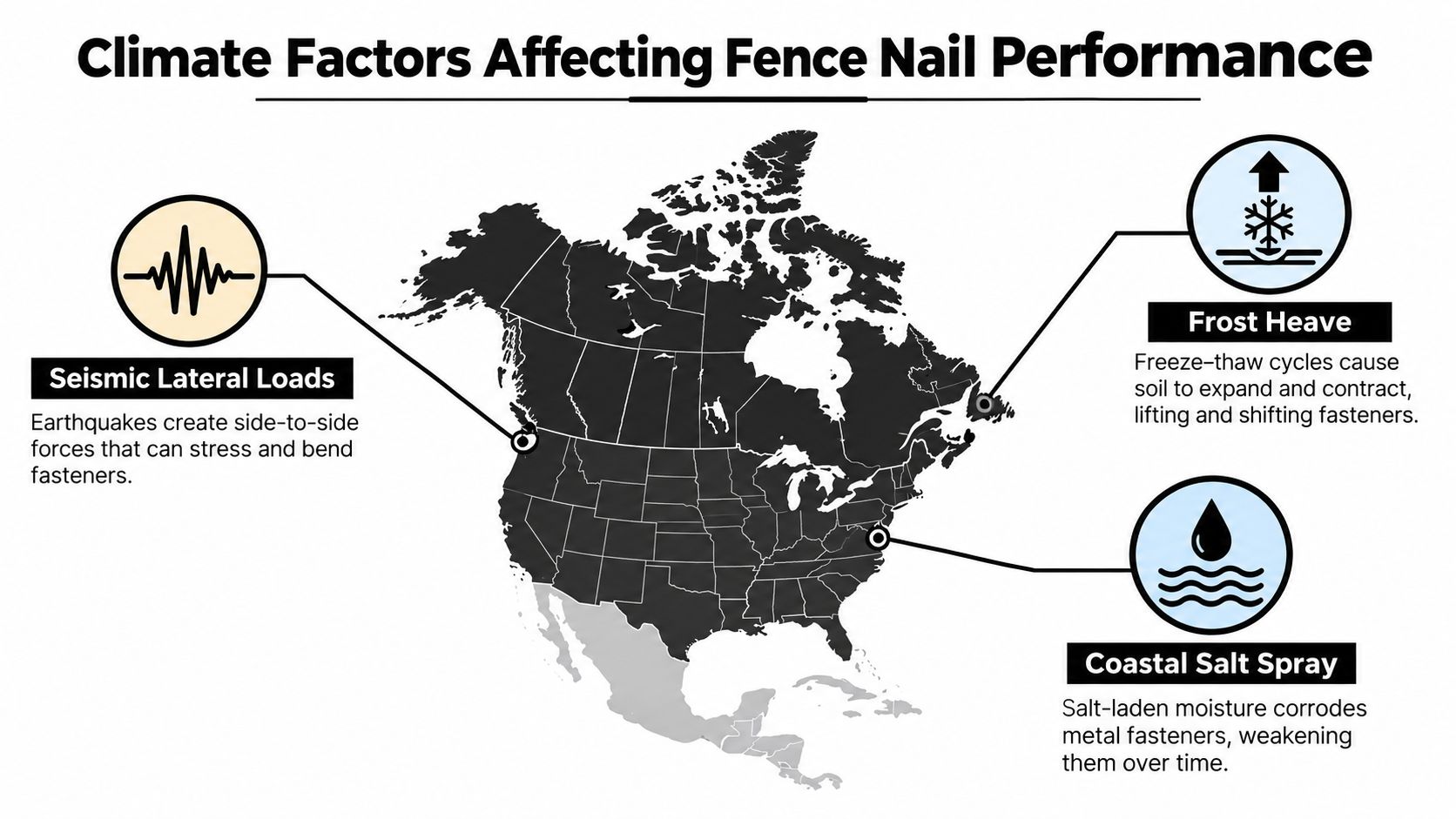
A nail that survives a dry southern yard may loosen or corrode in a Canadian winter, while a coastal California fence faces salt, moisture, and seismic requirements. Choose the fastener system around the fence type, ground movement, exposure, and local code, not tensile strength alone.
Canadian guidance emphasizes frost protection, post depth, and corrosion-resistant hardware. Freeze-thaw movement repeatedly loads rail-to-picket joints, making a smooth shank a weak choice where seasonal movement is severe. The guidance on connectors and coarse-threaded screws also shows why wood species, moisture, service conditions, and movement matter alongside holding power (Canadian wood connection guidance).
Screen the site before ordering:
- Identify exposure. Coastal salt, persistent humidity, treated lumber, and sheltered wet joints raise corrosion demand. Stainless steel may justify its cost in these conditions, while compatible galvanized hardware can suit less aggressive exposure.
- Check ground movement. Frost-prone regions need post depth and connection details suited to local frost conditions. Ask the municipality or building department for applicable requirements instead of relying on a generic depth rule.
- Screen seismic and wind demand. As noted earlier, California provisions connect nail diameter, length, head size, and placement with wood-connection performance. In certain seismic wall applications, mechanically driven nails must match specified hand-driven dimensions, and clipped-head or box nails are not accepted in new construction (California seismic fastening provisions).
- Confirm local approval. Municipal ordinances can regulate fence materials and construction details beyond broader building standards. La Puente provides one example of local fence and wall regulation (La Puente municipal fence provisions).
A zip code starts the check, not the code search. Confirm the fence material, exposure, post detail, and municipal rules before buying production quantities of fasteners.
For Canadian projects, a ring-shank galvanized nail can suit wood pickets, stainless screws suit composite, and chain-link requires purpose-built wire, hog rings, or bolt hardware rather than ordinary nails. For California treated wood, begin with the specified galvanized or stainless baseline, then check whether the jurisdiction adds requirements. This overview of fencing in Canada provides further regional context.
Installation Best Practices and Jobsite Safety
Even a correctly specified nail can fail if the installer overdrives it, places it too close to an edge, or drives it through a split grain line. Installation quality determines whether the fastener's coating stays intact and whether the wood can move without tearing around the connection.
Drive the nail for the material
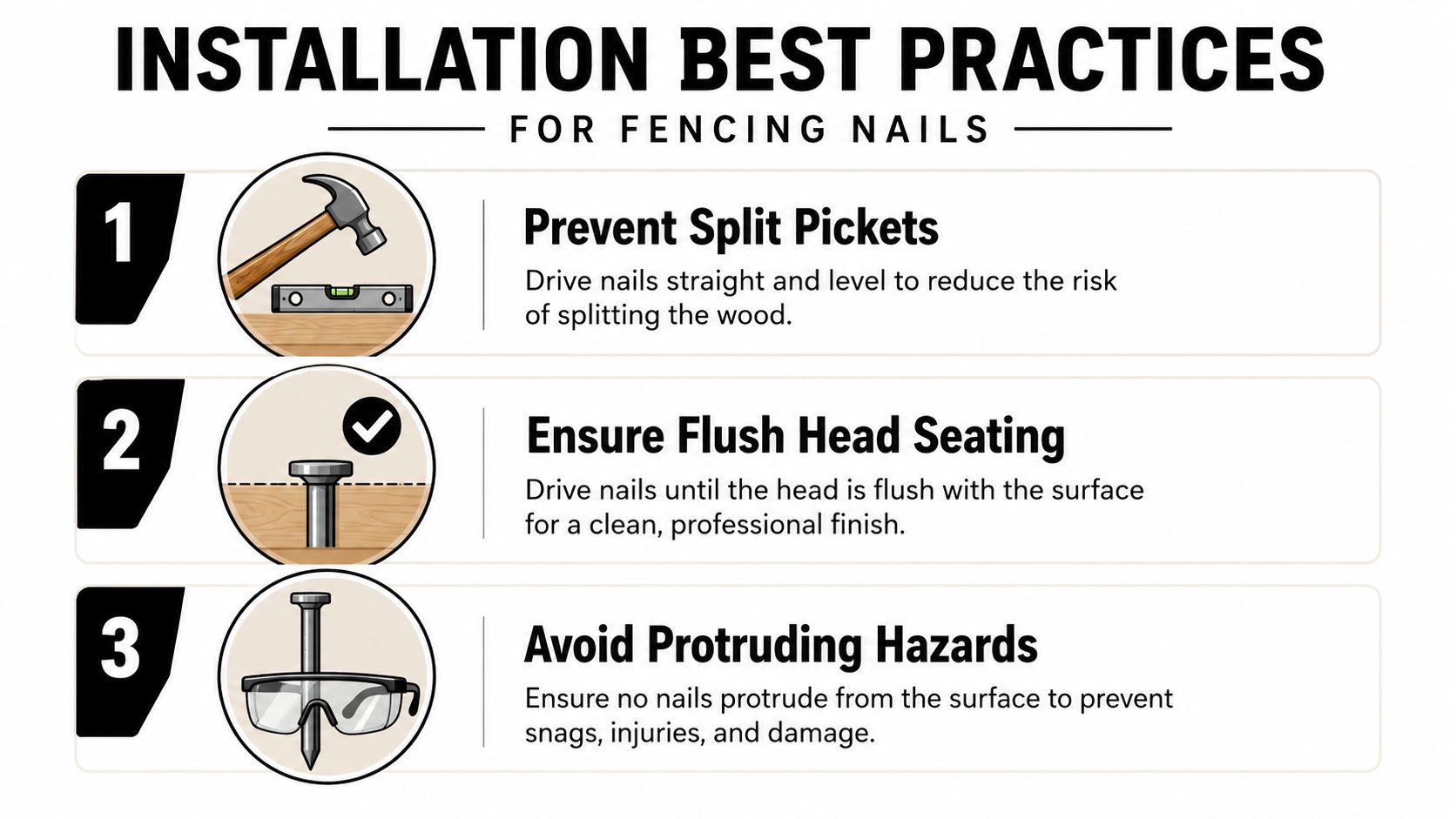
Pre-drill near board ends when working with dense hardwoods or brittle, dry cedar. Stagger nails across the rail face rather than placing them in one straight grain line, and use two nails per rail-to-picket connection where the fence design and material allow it. The second nail helps control rotation and wind shear, but it shouldn't be so close to the first that it creates a split.
Set the pneumatic nailer depth so the head sits flush. A proud head catches clothing and water, while an overdriven head breaks the wood surface and reduces local bearing. Test the setting on scrap from the same board batch before starting production.
Treat pressure-treated lumber with patience. Very wet material can shrink as it dries, loosening poorly placed fasteners. Store boards so air can circulate, and avoid building a connection around visibly split, crushed, or badly distorted stock.
Protect people after the tool is put down
Wear eye protection when using a nail gun, especially during misfires and jam clearing. Use the tool manufacturer's pressure range, and don't increase compressor pressure just to force a nail through a poor connection.
Inspect the rail side and the back of every gate and panel before leaving. California safety rules require form and scrap lumber with protruding nails to be reasonably cleared from work areas, passageways, and stairs during construction, alteration, or repair (California workplace rule on protruding nails). A fence crew should remove, bend, or replace exposed fasteners before the site is handed over.
Buying Checklist for Contractors and DIYers
A good purchase starts with a written specification, not a colour match between the nail and the fence bracket. Before ordering, identify the wood treatment, fence type, connection, exposure, nailer feed system, and local approval requirements.
Check the box before checking out
- Confirm the coating: Look for the stated galvanizing or stainless designation and any applicable ASTM or evaluation documentation.
- Match the shank: Ring or spiral shanks suit many wood picket connections, while composite and chain-link systems may require screws, clips, wire, hog rings, or bolts.
- Verify the length: Measure the materials being joined and ensure the nail reaches the receiving member without creating a protrusion.
- Check the head: Use a head that provides adequate bearing and suits the visible side of the fence.
- Confirm the tool: Coil nails and stick nails require compatible magazines, angles, collation, and drive depth.
- Reject interior fasteners: A bright interior nail isn't an acceptable substitute for an exterior-rated product in treated lumber.
For production fencing, a coil nailer reduces reload interruptions, while stick nailers can be easier to manoeuvre around posts and gates. The right feed system depends on crew habits, access, tool balance, and the connection specification, not just the length of the run.
| Fence Type | Recommended Nail | Minimum Coating | Head Style | Qty per 50 LF |
|---|---|---|---|---|
| Cedar pickets | Ring-shank exterior nail | Verified galvanized or stainless | Flat bearing head | Calculate from the approved picket and rail layout |
| Pressure-treated pickets | Ring or spiral shank | ASTM-compatible galvanized or stainless | Flat bearing head | Calculate from the approved connection schedule |
| Heavy rails and braces | Structural ring or spiral nail | Code-compatible corrosion resistance | Full bearing head | Calculate from the number of joints |
| Composite panels | Stainless screw rather than nail | Stainless steel | Manufacturer-specified head | Calculate from the panel system |
| Chain-link fabric | Tie wire or hog rings | Galvanized steel | System-specific | Calculate from the fabric and terminal details |
The quantity column should be calculated from the actual layout, not guessed from a universal linear-foot allowance. For business owners organising a larger installation operation, a practical Pipeline On resource for fence contractors can help with operational planning, but it doesn't replace the fastener schedule.
Building a Fence That Still Looks Straight in Five Years
A Pacific Northwest contractor replaced electro-galvanized common nails with hot-dipped galvanized ring-shank nails on a cedar privacy fence. At the first inspection, the heads sat flush and the pickets were tight. After several winters, the fence still showed no rust streaks, popped heads, or visibly loose pickets.
A neighbouring fence used the wrong fasteners for its treated components. Corrosion and movement loosened the pickets, the installation failed inspection, and the owner paid for a full re-nail. The difference wasn't a thicker nail. It was a system decision based on wood, exposure, and requirements.
Choose the fastener before you load the nailer. Review the fencing fastener inventory at XTREME EDEALS INC. and match the product, coating, shank, and feed style to your next fence project.
XTREME EDEALS INC. offers fencing nails, galvanized fasteners, gate hardware, and chain-link accessories for DIY builders and professional crews. Visit XTREME EDEALS INC. with your fence material and climate requirements in hand, then select the fastener system that can stand up to the actual job.