
Most of the advice online about lock washer vs flat washer repeats one line: put a split lock washer on anything that vibrates. Follow that on a deck ledger or a fence gate hinge and you usually buy the wrong part and still end up with a joint that works loose. A lock washer does one narrow thing, and it doesn't do it as reliably as the internet claims. A flat washer does something else entirely, and in wood construction it's usually the one doing the structural work.
What decides the choice isn't preference. It comes down to bearing area, substrate hardness, corrosion compatibility and whatever the drawing, specification or building guide requires. Those four settle it, and the washer is close to the last thing you pick, not the first.
I would rather see a correctly sized hot dip galvanized flat washer under a half-inch lag than a split washer biting into a cedar post. One protects the wood and keeps clamp load. The other marks the surface and, at the loads a deck sees, does very little.
Lock Washer and Flat Washer at a Glance
A flat washer spreads bearing load and protects the surface under a nut or bolt head. A lock washer is meant to resist rotation and loosening. They solve different problems, and neither is an upgrade of the other.
Lock washer vs flat washer at a glance
| Factor | Flat washer | Lock washer |
|---|---|---|
| Main job | Spreads bearing load over a larger area | Resists rotation and loosening under vibration or cyclic load |
| Bearing surface | Broad, flat face | Narrow split, helical or serrated edge |
| Protecting wood and soft substrates | Yes, when properly sized and corrosion resistant | Limited; the edge can dig in and mark the surface |
| Typical use | Under lag bolts, through-bolts and nuts in wood and metal | Bolted assemblies where vibration or loosening is a known risk |
| Prevents loosening alone | No | Only partly; depends on preload, bolt class and joint design |
Two joints make the difference concrete. A railing bracket bolted to a steel post carries the whole clamp load of the fastener through a contact patch barely wider than the bolt head, and a flat washer spreads that load across the bracket face so the powder coat doesn't crack around the hole. A gate hinge bolted to a wood post has the opposite problem: the wood under the fastener compresses and relaxes, the joint sheds preload, and the gate starts to sag on its latch side.
Neither of those failures gets fixed by swapping in a split washer.
The most common mistake: replacing a hardened plate washer named on a drawing with a thin washer from a bulk jar, or the reverse, without checking what the specification called for.
Flat washers are the default under nuts, lag bolts and through-bolts in wood. Lock washers are an add-on for joints with a genuine vibration problem, and they only belong where the bolt class and the substrate can support them. Most outdoor connections need both roles considered together: the flat washer to protect the wood, and a locking method only where service conditions demand one.
How Each Washer Works and Where a Lock Washer Fails
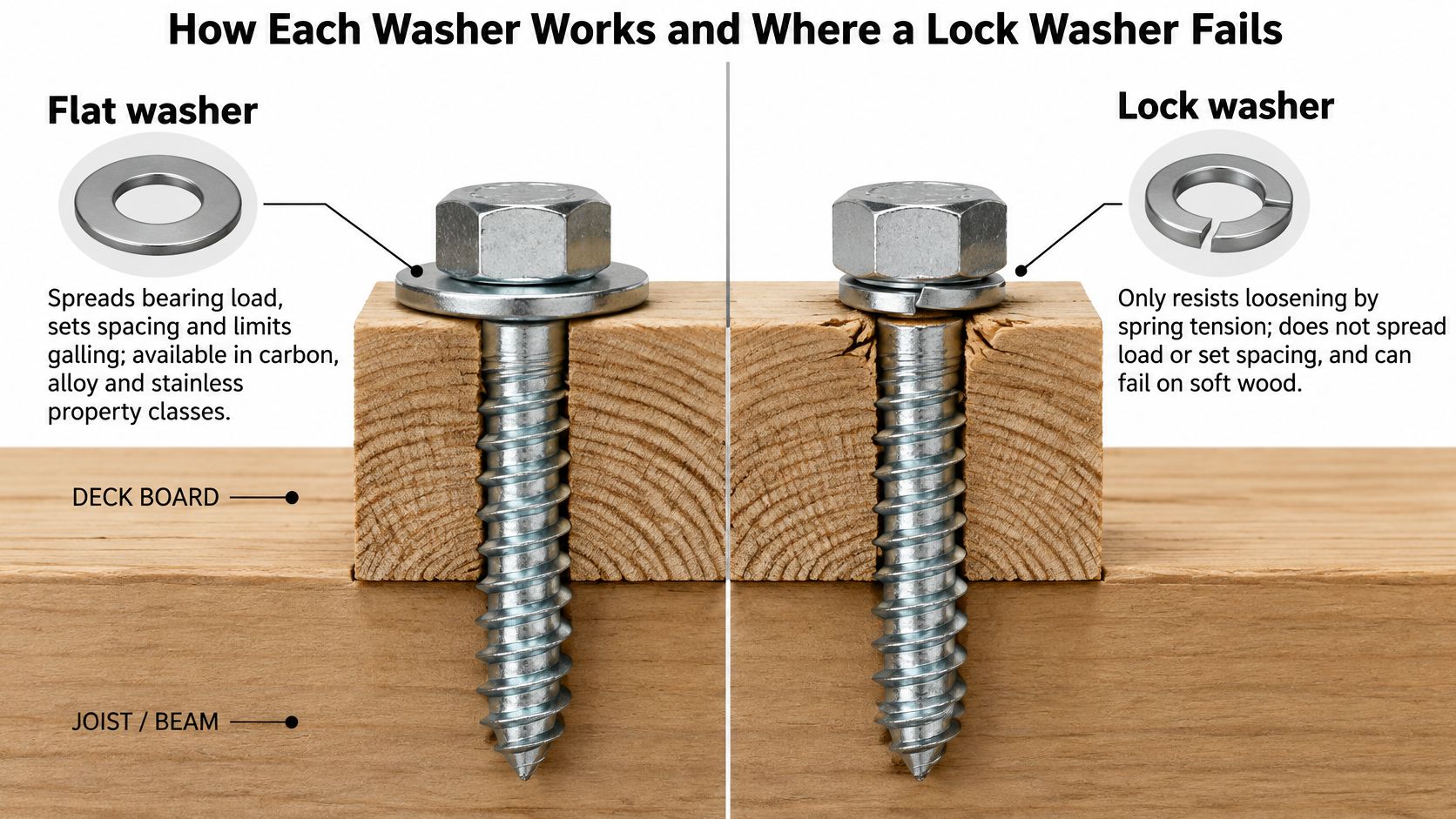
Drive a half-inch lag bolt through a deck board into a joist and both mechanisms show up in the same stack. Under the hex head, the flat washer turns clamp force into pressure spread across its whole face. Take the washer away and that force concentrates on a ring the diameter of the head, which is how boards end up dished, grain ends up crushed, and a fastener pulls partway into the surface it was supposed to hold.
Standards treat the two products as different tools with different jobs. Flat washers are specified to increase bearing surface, set spacing and limit galling, and the systems covering them sort carbon steel, alloy steel and stainless products into dimensional and property classes. Lock washers are specified to increase resistance to loosening, with that resistance tied to joint design, preload, substrate hardness and vibration level.
What the Flat Washer Is Doing
The washer earns its place because pressure is force divided by area. A flat washer sized to the bolt multiplies the contact area under the head several times over, so the wood sees a fraction of the stress it would see bare. That's the whole trick, and it's why a thin washer from a bulk bin dishing under a half-inch lag is worse than no washer at all: it flexes, cups, and lets the head chew into the board anyway.
Two secondary jobs come with it. A flat washer bridges the oversized and slotted holes that show up in real framing and in punched steel brackets, and it stops a tightened nut from galling a painted or plated surface. Neither job has anything to do with loosening.
Why a Spring Washer Can't Restore Clamp Load
Joints loosen in four ways, and a nut spinning free is the least common of them. The others are embedment, where wood, paint or coating compresses under the fastener; settlement of the joint faces; slip between plates that are supposed to be fixed; and cyclic vibration walking the nut back a fraction at a time. A washer that adds friction under the nut does nothing about the first three, and by the time the bolt reaches full tension a split washer has already been flattened.
A lock washer resists rotation. It cannot put back the clamp force the joint lost when the wood crushed.
Geometry is the other problem. A split washer presents a narrow hardened edge and a serrated washer presents teeth, and both concentrate pressure exactly where you don't want it. On a cedar gate post or a deck board, the flat washer goes against the wood, and the locking feature, if there is one, sits above it or against steel.
The diagram below shows the two positions side by side and what each part contributes to the joint.
Where Each Lock Washer Type Stops Working
A lock washer isn't one product with one performance level. Spring, serrated and wedge designs resist loosening by different mechanisms, and each one stops working at a different point.
Lock washer types and their limits
| Type | How it resists loosening | Key limit |
|---|---|---|
| Split helical lock washer, hardened M6 | Spring tension and edge bite | DIN 127 example is 6.5 mm ID, 2.5 mm wide and 1.6 mm thick; the cited specification limits it to class 5.8 bolts, and it isn't a wood-interface part |
| Serrated lock washer | Teeth grip the bearing surface | Preferred over split washers for higher-strength bolt classes, and the edge can mark soft material |
| Wedge-lock pair | Cam faces lock through tension rather than friction alone | Install in pairs with direct joint contact, use at least 30 percent of bolt capacity, and avoid wood and plastic |
The hardened M6 split washer shows how narrow a lock washer's rating can be. A Canadian supplier lists it at 6.5 mm inside diameter, 2.5 mm width and 1.6 mm thickness to DIN 127, rates it for bolts in tensile-strength class 5.8 only, and recommends serrated-edge washers for higher-strength classes (Würth Canada hardened lock washer M6 listing). Washer hardness and geometry have to match the fastener, so the word "lock" on a bin label promises nothing on its own.
A wedge-lock pair works on a different principle. Two washers with cam faces on their mating sides mean any attempt at rotation has to climb the ramps, so the connection is held through tension rather than friction alone. Manufacturer guidance is specific about the conditions: install them in matched pairs, keep them in direct contact with the joint surface, have at least 30 percent of bolt capacity in use for locking to be safe, and keep them off soft materials such as wood and plastic (ANSI fastener standards listing).
If a deck or fence joint is loosening, the fix is rarely a different washer. Work through these instead:
- Bolt diameter and embedment. An undersized lag or a short embedment sheds preload no matter what sits under the head.
- Specified torque. Correct clamp load is the main defence against back-out.
- A locking nut or thread-locking compound. Both hold position along the thread instead of relying on surface friction at one face.
- A wedge-lock system. Worth it only where the joint surface is hard enough to support the cam action.
When Specifications Require a Specific Washer
On a specified joint the washer is already chosen. Type, size and coating sit in the drawing, the building guide or the provincial spec. Stock in the truck does not override that callout. A substitution that still feels tight on install day is a compliance problem.
What the British Columbia Deck Guide Requires
The provincial guide for durable decks and balconies is plain about the ledger. Secure it to suitable structural backing with lag bolts or through-bolts used with washers. Those fasteners are 13 mm (0.5 in) in diameter and must fully penetrate the ledger and rim joist. Open decks may keep a 13 mm (0.5 in) drainage gap between ledger and wall, and stacked washers must be galvanized, stainless steel or another corrosion-resistant material (BC Housing guide to building safe, durable decks and balconies).
Read that washer clause as bearing area. The flat washer spreads the bolt head so the ledger does not crush or pull through the wood. A lock washer does not spread load that way. It is a thin spring, and on soft lumber it bites or collapses instead of holding preload. The corrosion line carries equal weight: a washer that rusts through in a coastal winter takes the connection with it.
What the Ontario Transit Specification Requires
Ontario's draft OPSS.PROV 907 requires lock washers on bolt assemblies and calls for flat washers with them unless steel side plates are used. ASTM F436 names the hardened flat washers in that assembly, not the lock washers. CSA G40.20/G40.21 covers the steel washers. Bolt tightening torque is limited to 40 N·m in the stated assembly context (Ontario Ministry of Transportation draft OPSS.PROV 907%20TCP.pdf)).
The same split shows up on a house. A flat washer has no locking feature, so pulling a specified lock washer because the nut feels snug fights the document. The other mistake is just as common. Put a lock washer into a stack drawn as a flat washer plus a controlled torque and friction under the head changes. Clamp load at that torque moves with it. The limit is written around preload, and a harder or softer washer changes how much of the turn becomes clamp.
Find the governing document before you reach into the bin. A balcony, a pool deck and a fence post all look like bolted joints, and none of them answer to the same specification.
Post and framing hardware still has to match size and coating on the drawing. I check those callouts against the deck post fasteners range before ordering.
Matching Washers to Fence, Deck and Outdoor Jobs
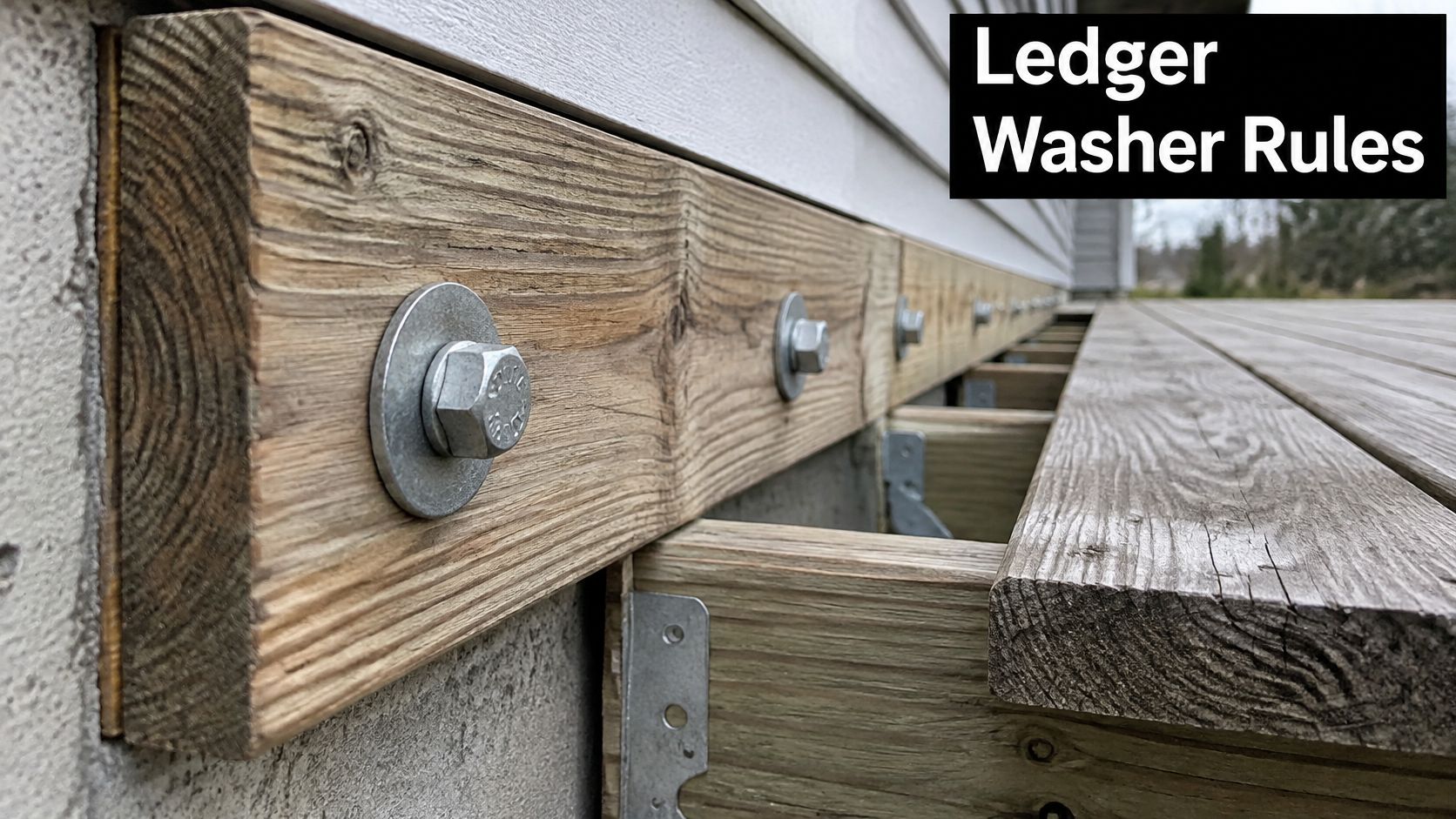
A Whitehorse, Yukon building bulletin shows how an entire assembly gets specified rather than just the washer. It lists 1/2-inch galvanized lag screws or through-bolts with washers for ledger-board anchoring, and one example requires a minimum 3-inch embedment into studs. The same bulletin requires galvanized steel complying with ASTM A153/A153M-16a, equivalent corrosion protection compatible with treated-lumber preservatives, or proprietary structural screws demonstrated to provide at least 230 lb (1.0 kN) of factored lateral resistance at 1 1/2-inch embedment in spruce-pine-fir wood (City of Whitehorse deck ledger building bulletin).
That joint is the one below, pulled tight to the rim with bolts and washers and a drainage gap managed at the wall.
A lock washer can't rescue a 3/8 inch lag where the detail asks for 1/2 inch, and it adds neither embedment nor corrosion protection. What it can do is sit in an assembly where vibration is real and the substrate can take it. Hot dip galvanized 1/2 inch lag bolts in 10-piece boxes from XTREME EDEALS INC. cover the diameter those details call for, with the coating the bulletin's corrosion clause is pointing at.
Washer setup by fence, deck and outdoor application
| Application | Flat washer role | Lock washer role | Recommended setup |
|---|---|---|---|
| Deck ledger lag bolt to rim joist | Spreads bearing and resists pull-through in wood | Not the main control | Galvanized flat washer with the fastener fully penetrating the structure |
| Ledger with 1/2-inch galvanized lag at 3-inch embedment | Protects wood at the bearing face | Only where specified | Galvanized flat washer, ASTM A153 or compatible corrosion protection |
| Fence gate hinge on wood post | Spreads load and protects the wood | Optional in low-vibration use | Flat washer; add a locking method if the gate slams and loosens |
| Railing bracket to metal post | Spreads load and protects the finish | Specified where vibration is expected | Flat washer plus a specified lock washer or locking nut |
| Vibrating machinery or equipment mount | Supports clamp load on the mating surface | Common practice, with limits | Lock washer or locking nut with correct preload and torque |
| High-strength structural bolt | Hardened flat or plate washer to the specified ASTM grade | Not a substitute for the required washer | Follow the drawing and specification exactly |
Fence gates are where this goes wrong most often. A flat washer is enough for most fences: it spreads the hinge leaf's load into the post and stops the wood crushing behind the fastener. Add a locking method only where the gate slams hard, the hinge works loose in service, and the joint can stay tight enough for the lock to mean anything.
Checking Material and Coating Before You Buy
The question that settles most purchases is whether any flat washer can replace a hardened or galvanized one. The answer is no when a drawing, code or fastener grade names a washer class. A thin general-purpose washer can dish or embed under high clamping loads, and an unsuitable coating combination can accelerate corrosion through exposure or galvanic interaction (Ontario Ministry of Transportation OPSS.PROV 906 specification).
Those transportation specifications ask for submitted evidence that bolts, nuts and washers satisfy chemical, mechanical, dimensional and workmanship requirements, and they call for hardened washers for high-strength bolt assemblies. The same family of documents separates ordinary lag-screw washers from hardened structural washers and can prescribe galvanized assemblies. Washer, in other words, is not one interchangeable category.
Traceability is the other half. The California Division of the State Architect requires washers for high-strength structural bolting to be laboratory tested under ASTM F606, with hardness as the specified test, and requires packaging or documentation to identify the ASTM designation, grade, type or style, size, manufacturer, piece count and lot number (California DSA interpretation of regulations IR 17-8). If the bag doesn't carry that information, you can't tell a structural washer from a hardware-store one by looking at it.
A Buying Checklist That Survives Inspection
- Bolt diameter and washer inside diameter. They have to match, and the washer has to clear the thread without slop.
- Outside diameter. A washer barely wider than the nut spreads almost nothing.
- Thickness and hardness. Thin washers dish, and a soft washer belongs nowhere near a high-strength assembly.
- Coating. Hot dip galvanized, zinc-plated and stainless each suit different exposures, and the coating should match the rest of the assembly.
- Preservative compatibility. Washers and fasteners in contact with pressure-treated lumber need protection rated for it, not just a plating that looks similar.
- Galvanic pairing. A zinc-plated washer against stainless or hot dip parts in wet or coastal conditions is a corrosion cell waiting on the first rainy season.
The label alone, flat, lock or hardened, confirms none of that. Flat washers sit in the Fasteners category at XTREME EDEALS INC. alongside carriage bolts, construction screws, deck screws, drywall screws, hex nuts, lag bolts, nails, sleeve anchors and wedge anchors, so a whole assembly can be ordered in one pass. When you're mixing metals, galvanized vs stainless steel is worth settling before checkout.
Stack and Tighten the Washer the Joint Needs
A split lock washer buried in cedar does not lock the joint. It cuts the face, the nut settles, and the preload you counted on is gone before the first season of movement. Stack order and the torque you stop at decide whether the washer is working or just filling space under the nut.
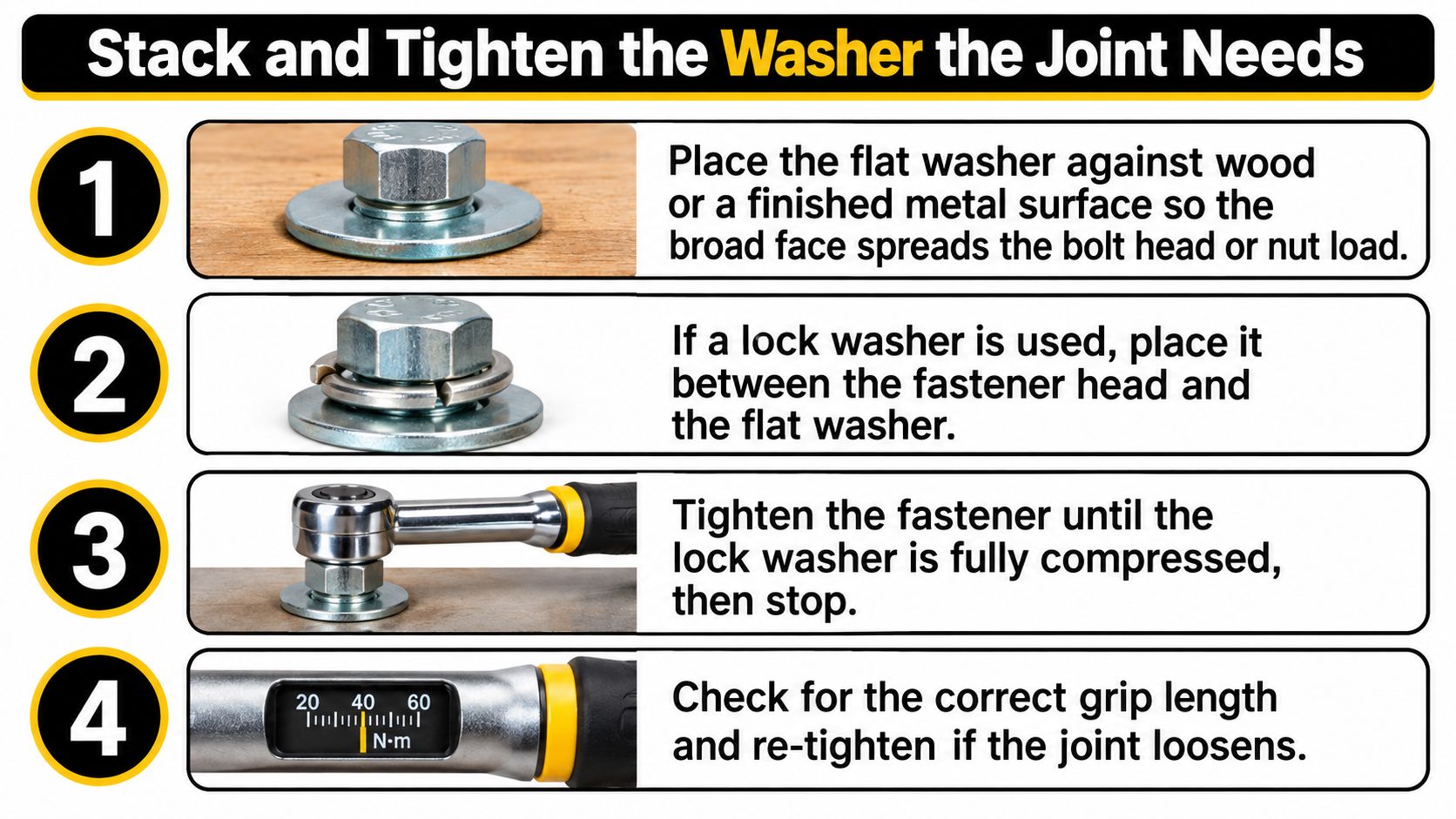
On any bolted deck or fence connection, I put the flat washer against the work first. The broad face belongs on the wood or the finished metal so the load spreads where the joint needs it, and nothing harder than the washer itself should bear on the grain. A conventional split washer, if the detail still calls for one, sits above that flat washer, between it and the nut or bolt head, so the split edge bites steel instead of cedar.
Wedge-lock washers are a different assembly. Install them as a matched pair, in direct contact with a hard joint surface, and only when enough of the bolt's capacity will be working for the cam faces to hold. Soft lumber will not give those cams a seat. Where the specification gives a torque limit, stop there. Another washer under the nut does not replace clamp you never developed.
Check penetration before that final torque. On a ledger, the fastener has to pass fully through the ledger and the rim joist. No washer makes up for short embedment. Embedment and settlement unload a joint in its first weeks of service, so a second pass with the wrench is normal maintenance rather than a repair.
Where a slotted plate washer is specified, keep a standard cut washer between that plate and the nut. The plate spreads load across the wood. The cut washer gives the nut a flat bearing face instead of letting it ride the slot.
Carriage bolts add one wrinkle. The square neck has to seat in the wood before the nut goes on, and the washer goes under the nut on the far side. The sequence is covered in how to install carriage bolts.
Watch the stack in motion before you pick up a wrench.
Write the washer type, size and coating on the order list before anything gets tightened. Pulling a crushed deck board off a ledger bolt assembled from the coffee can is the longer job.
A joint that holds starts with hardware matched to the detail: the right diameter, the right hardness and a coating that survives the exposure. XTREME EDEALS INC. carries flat washers in the Fasteners category with carriage bolts, lag bolts and hex nuts, so a ledger or gate assembly can be ordered in one pass. Visit XTREME EDEALS INC. to confirm sizes, coatings and pack counts before the next deck or fence goes up.