
You're at the ledger with a socket in one hand and a fresh box in the other. The boards are cut, the inspector is booked, and the only thing anyone has checked is that the head has six sides. That shape is useful. It is not the spec.
A hex head is a control on installation. A socket or hex bit lets you put real torque into the fastener without the bit walking out of the recess. Coating, diameter, length, and the approved connection still decide whether wood screws hex head belong in that joint. I would not buy on head style alone, and I would not drive the first screw until those other boxes are ticked.
Hex Head Wood Screws Compared With Other Heads
You reach for the socket because the bit keeps camming out of a Phillips recess on a thick ledger. A hex head is a six-sided head driven by a socket or hex bit, not a slot and not a star. A wrench or impact driver can stay seated while you pull two members tight. That is the point of the shape.
The trade-off is access. You need room for the socket and a driver that fits. That suits structural and exterior fastening. It is a poor choice where the head must disappear into a finished surface or where a bit has to sneak into a tight corner.
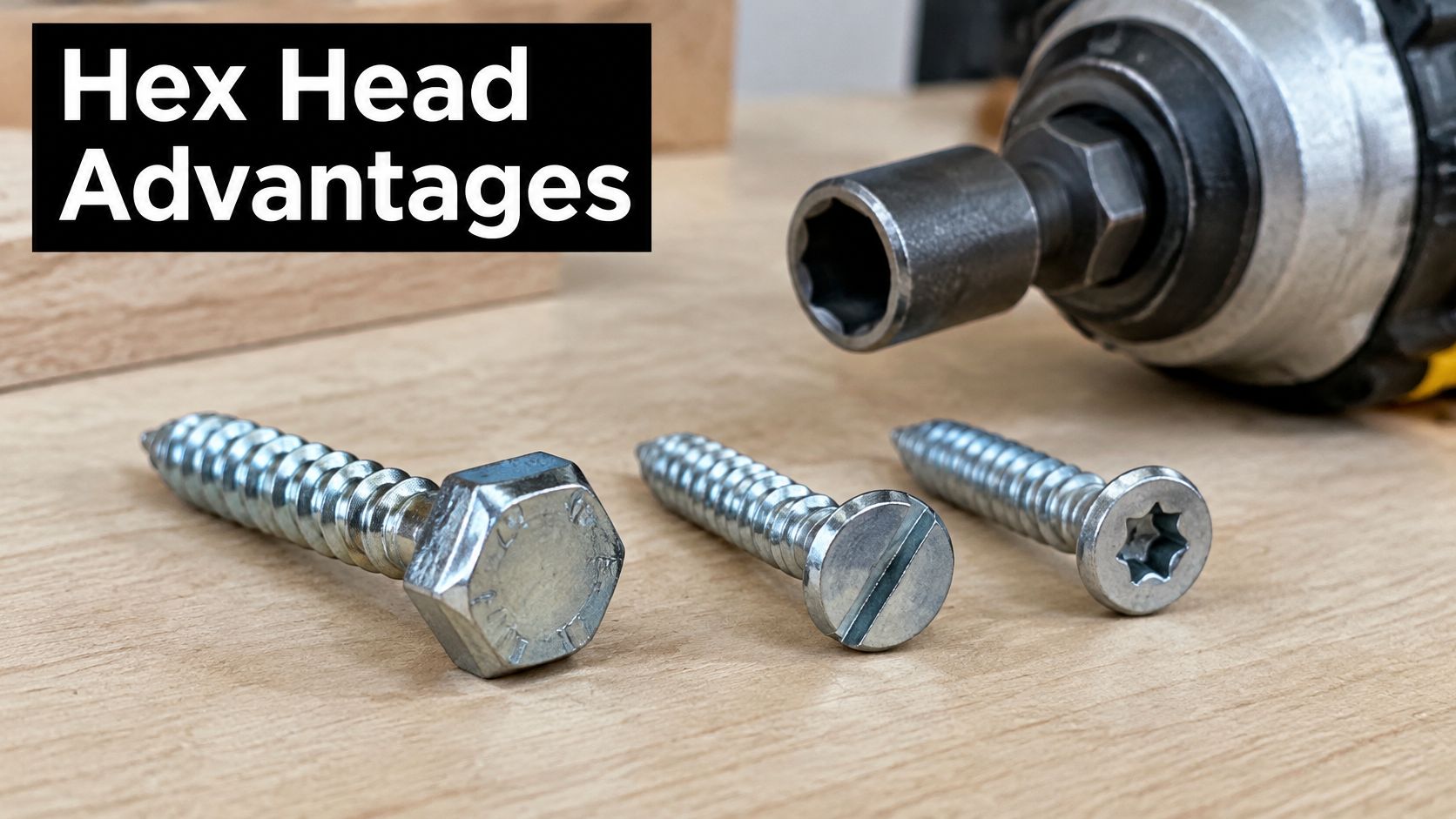
What the drive lets you do
| Head style | Drive | Typical use | Main trade-off |
|---|---|---|---|
| Hex washer head | Hex socket, commonly 5/16 in | Structural framing, ledgers and heavy exterior work | Needs socket access and a wrench or impact driver |
| Flat head | Phillips or Torx | Flush finish on decking and trim | Head can cam out under high torque |
| Pan head | Phillips | Hardware, brackets and thin material | Low clamping force on thick lumber |
| Star (Torx) head | Torx | Decking and fence work where cam-out matters | Bit must match the drive exactly |
| Hex-head lag screw | Hex socket, larger diameter | Heavy structural connections | Needs a pilot hole and torque control |
A hex washer head, common on structural wood screws, carries a wide flange under the hex. That flange bears on the wood and spreads the clamp so the head is less likely to crush fibres on the last turn. You pay for that with a proud head and the need for a matching socket.
A flat head sinks flush, which is what you want on deck boards and trim. A Phillips recess in that head will cam out once torque climbs. Torx in the same flat head holds better, but the bit still has to be the exact size.
A pan head sits proud with a low dome. It is fine for brackets and thin hardware. On thick lumber the bearing face is small and the clamp is modest, so it is the wrong head for a ledger or a post.
A star (Torx) head resists cam-out on long runs of decking and fence boards. The cost is strict bit matching. A near size rounds the lobes and ruins the screw.
A hex-head lag screw is the heavy end of the family. The external hex takes a wrench, which is what you want on a large-diameter structural connection. You also accept a pilot hole and deliberate torque, because the shank is thick enough to split dry lumber if you rush it.
Quick test before you buy: If the connection will see high torque, or you need a wrench to tighten it, choose hex. If the head must sit flush, or the bit has to reach a tight corner, choose flat, pan, or Torx.
Sizes, Drive Sizes and Markings to Check
Read three numbers before you open the box: diameter, length, and drive size. Miss one and the socket, the penetration, or the code detail is wrong before the first screw turns.
Canadian federal customs documentation lists wood screws from #4 through #24 in diameter, about 0.112 through 0.386 inches, and from 3/8 through 8 inches in length, about 10 through 200 mm, in its wood screw size notice. That span runs from small finish screws to long structural timber screws. A hex head can sit on either end of it. The head does not tell you which end you bought.
Named structural screws
The same federal trade file gets more precise on structural products. Canada Border Services Agency documentation describes TimberLOK heavy-duty structural wood screws with coarse threads, an approximately 0.189-inch blank shank, a countersinking hex-washer head, and a 5/16-inch drive, with overall length in inches marked on the head. It identifies LedgerLOK structural screws with a coarse thread and either a hex-washer head on a 5/16-inch drive or a flat head on a #40 Torx drive.
| Screw type | Head and drive | Shank or thread | Length marking |
|---|---|---|---|
| General wood screw range | Hex, Phillips, Torx or flat | #4 to #24 (0.112 to 0.386 in) diameter | 3/8 to 8 in long |
| TimberLOK structural | Countersinking hex washer, 5/16 in drive | Coarse thread, about 0.189 in blank shank | Overall length in inches marked on head |
| LedgerLOK structural, hex washer | Hex washer, 5/16 in drive | Coarse thread for wood engagement | Length marked on head |
| LedgerLOK structural, flat | Flat head, #40 Torx drive | Coarse thread for wood engagement | Length marked on head |
Coarse threads are what bite wood. Drive size is what the bit has to match. A head stamp of overall length lets you confirm, on the ledger or the post, that the screw in your hand is the length on the plan. A socket one size off will round the hex. Match the socket to the stamped drive before you apply any torque.
How to read the box
Confirm diameter, length, head type, and coating on the label together. A hex head on the photo does not make the screw a structural product. Ordinary wood screws share that head and carry none of the evaluation a ledger connection needs.
Use a three-point check at the truck.
- Measure the stack. Add the thickness you pass through to the embedment the detail calls for.
- Subtract the head. On a proud hex or washer head, length below the head is what threads into the member. A flat head counts its full length as engagement.
- Match the stamp. The length marked on the head should agree with the plan before you drive it.
Matching Hex Head Screws to Decks, Fences and Framing
The application sets the screw. The head style follows. A socket-friendly head on the wrong diameter, coating, or detail is still the wrong fastener.
San Diego's deck bulletin treats fastener choice as a structural and code issue. It specifies two #8 screws for each nominal 2-inch decking board, and it requires all deck fasteners and connectors to be hot-dip galvanized or stainless steel. Screw connections are distinguished from ordinary nails across deck parts, which is why corrosion resistance matters in the weather. The California Office of the State Fire Marshal position in that same guidance is that the Wildland-Urban Interface code applies to new buildings whose permits were submitted on or after July 1, 2008, in designated areas. Outdoor wood-screw work in those zones has sat inside statewide WUI rules for more than 17 years as of 2025.
Four jobs, four specs
California's 2025 residential-code change summary revised exterior-deck fasteners under R507.2.3 and ledger-to-band-joist rules under R507.9.1.3. Lag screws must be full-body-diameter screws. Common attached decks need a minimum 2-by-8-inch ledger, plus hold-down tension devices in at least two locations, within 24 inches of each end.
| Application | Connection rule | Corrosion requirement |
|---|---|---|
| Residential deck boards | Two #8 screws per nominal 2-inch board | Hot-dip galvanized or stainless steel |
| Ledgers and structural attachments | Full-body-diameter lag screws; minimum 2-by-8-inch ledger for common attached decks | Hot-dip galvanized or stainless steel, per approved detail |
| Fence posts and rails | Match the post and rail detail, then confirm with the building department | Hot-dip galvanized or stainless steel for exposed, treated wood |
| Canadian structural connections | Side member and screw size per the product's CCMC evaluation | Stainless steel or a corrosion-protection coating |
Deck boards are a count-and-coat job. Two #8s per nominal 2-inch board, hot-dip or stainless, will usually be a flat or Torx head so the surface stays flush. A hex head sticks up and catches feet.
Ledgers are where the hex earns its place. Say you are fastening a 2-by-8 ledger with hex lags. You need a socket, a full-body shank, galvanized or stainless metal, and the approved spacing and embedment. Our notes on lag bolts for deck posts walk through that post-side hardware when the same hex fastener moves from the house wall to the post.
Fences do not come with a universal screw count. Set diameter and length from the post, the rail, and the treatment tag, then confirm the detail with the local building department before you buy a box.
Canadian structural work means a code-evaluated screw and its published tables, including side-member thickness and withdrawal limits. Nominal length is not a design.
A hex head does not make a connection code compliant. Material, coating, diameter, length, and the approved detail have to match as well.
Once the fasteners are right, the wood still needs care. Deck care for Dallas homeowners is a useful reset on washing boards and fences without chewing the surface the screws are holding.
Corrosion Resistance and Coatings That Last
Treated lumber, standing water, and salt eat fasteners faster than the head style ever will. A perfect hex drive on a plain zinc screw is a short service life.
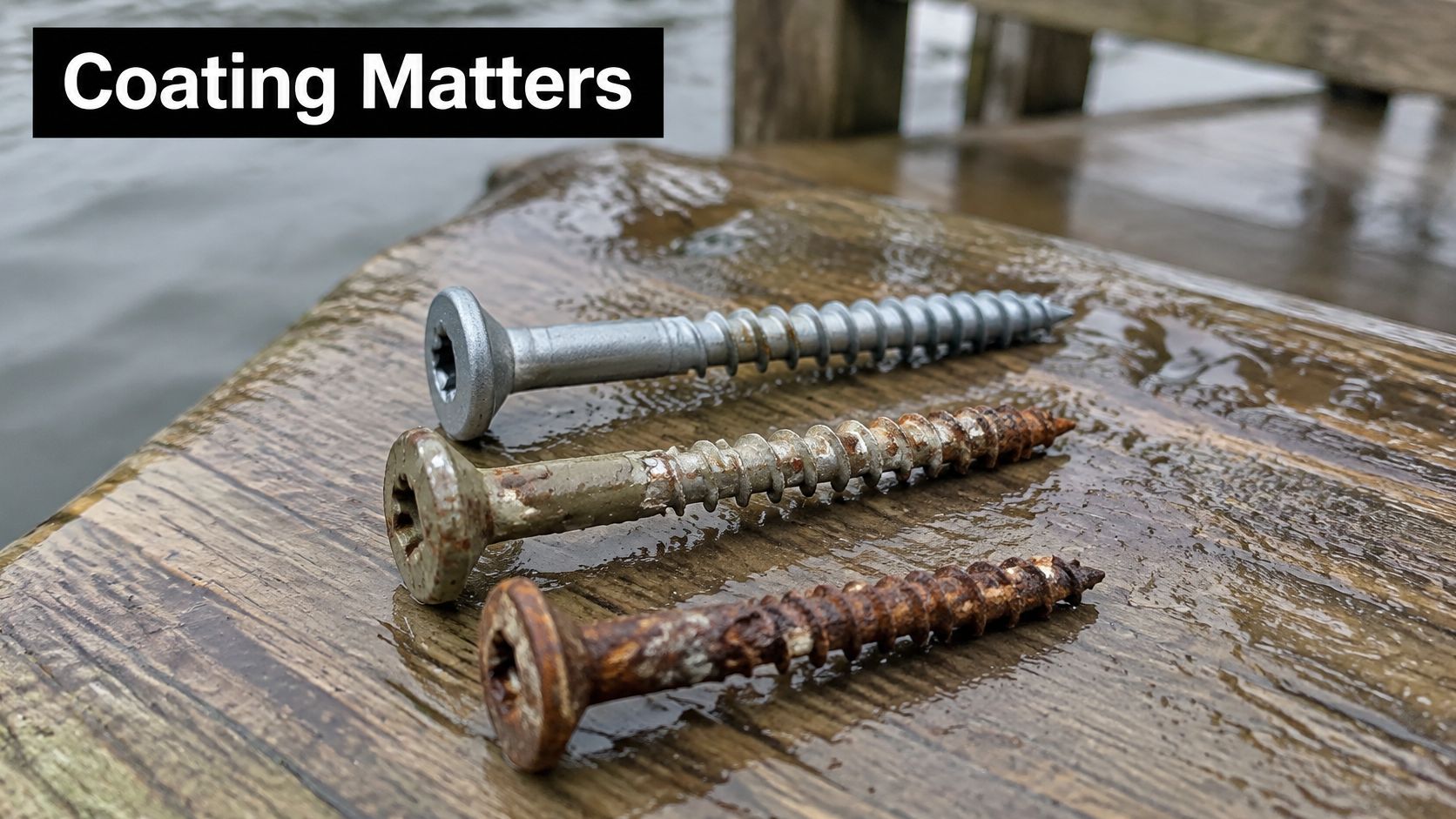
Canadian Wood Council guidance recommends stainless steel, typically Type 304 or 316, for maximum service life, high preservative retention such as ground-contact lumber, and severe exposure including salt spray. Fasteners in copper-based preservative-treated wood should be hot-dip galvanized to ASTM A153, or a high-quality polymer coating when both the preservative maker and the fastener maker accept it. Pairing stainless screws with galvanized connectors can start galvanic corrosion. Match the screw metal to the connector.
A Canadian Construction Materials Centre evaluation requires fasteners that secure wood products to conform to Article 9.23.3.1 of the National Building Code of Canada, and to carry a corrosion-protection coating or be stainless steel, as set out in the CCMC fastener evaluation. Head shape is not part of that test.
The short video below shows how quickly a mismatched coating shows rust once the lumber stays wet.
Coating by exposure
| Coating or metal | Best for | Watch for |
|---|---|---|
| Stainless steel Type 304 | Maximum service life in exterior work | Pair with stainless connectors only |
| Stainless steel Type 316 | Severe exposure, including salt spray | Higher cost; pair with stainless connectors |
| Hot-dip galvanized to ASTM A153 | Copper-based preservative-treated wood | Can corrode when paired with stainless fasteners |
| Polymer coating | Treated wood where both manufacturers accept it | Confirm acceptance before buying |
| Plain zinc plating | Dry interior use only | Not suitable for treated or wet exterior lumber |
Type 304 is the everyday exterior stainless. Type 316 is the one I would spend on near salt spray. Hot-dip to ASTM A153 is the workhorse on copper-treated stock, provided the hangers are galvanized too. A polymer coat is acceptable only with written acceptance from both manufacturers. Bright zinc belongs indoors and dry.
For a side-by-side on the two outdoor metals, see galvanized versus stainless steel.
Run this check at the yard.
- Read the treatment tag on the lumber before you pick a coating.
- Match the connector metal so stainless does not sit against galvanized.
- Confirm the coating is one the preservative supplier accepts.
For treated lumber outdoors, pick stainless or hot-dip galvanized, and do not mix metals without checking.
Wrenches, Sockets and Drivers That Fit Hex Heads
The drive only works if the tool fits. Buy the socket or bit that matches the stamp, not the nearest size in the pouch.
- Hex socket on a ratchet. Best control on lag screws and structural hardware, because you can feel the washer seat.
- Impact driver with a hex-shank bit. Faster on long runs of ordinary wood screws. It overshoots the seat, so ease off and finish the last turns by hand.
- Impact wrench with a hex socket. Handles large lags if you drop the speed and you have already drilled the pilot.
- Drill with a 1/4-inch hex-shank bit and a magnetic holder. Keeps the bit square in the head on lighter hex screws.
- Torque wrench. Use it when the structural spec names a torque. If the sheet gives none, read the product data before you guess a number.
What fails in the head
A worn bit cams out and rounds the hex. A bit that is too short rides up the corners and scars the face of the board. Drive size is fixed by the product, so a 5/16-inch head needs a 5/16-inch socket. One size off feels almost right until the corners are gone and the screw will not come back out.
Keep the tool in line with the shank. A cocked socket loads one flat, which is how a sound hex gets ruined on the first half-turn. If the socket rocks, stop and reseat it. Forcing torque on a rocking socket is how you scrap both the screw and the surface under it.
How to Size, Pre-Drill and Drive a Hex Head Screw
Size the joint before you size the driver. For large-diameter hex-head screws in Canadian structural wood connections, CCMC evaluation guidance requires the side member to be at least 4 times the thread outside diameter (d). Screws 10 mm or larger installed at an angle other than square to the grain need 8d. 12 mm screws at those angles need 10d. The same evaluation caps withdrawal, based on tensile capacity, at 11,300 N for 6 mm, 18,900 N for 8 mm, 24,000 N for 10 mm, and 30,000 N for 12 mm. Those are upper bounds, not design values. Check factored withdrawal, threaded length, geometry, angle, and tensile resistance, and use the published tables on beams, ledger repairs, and posts.
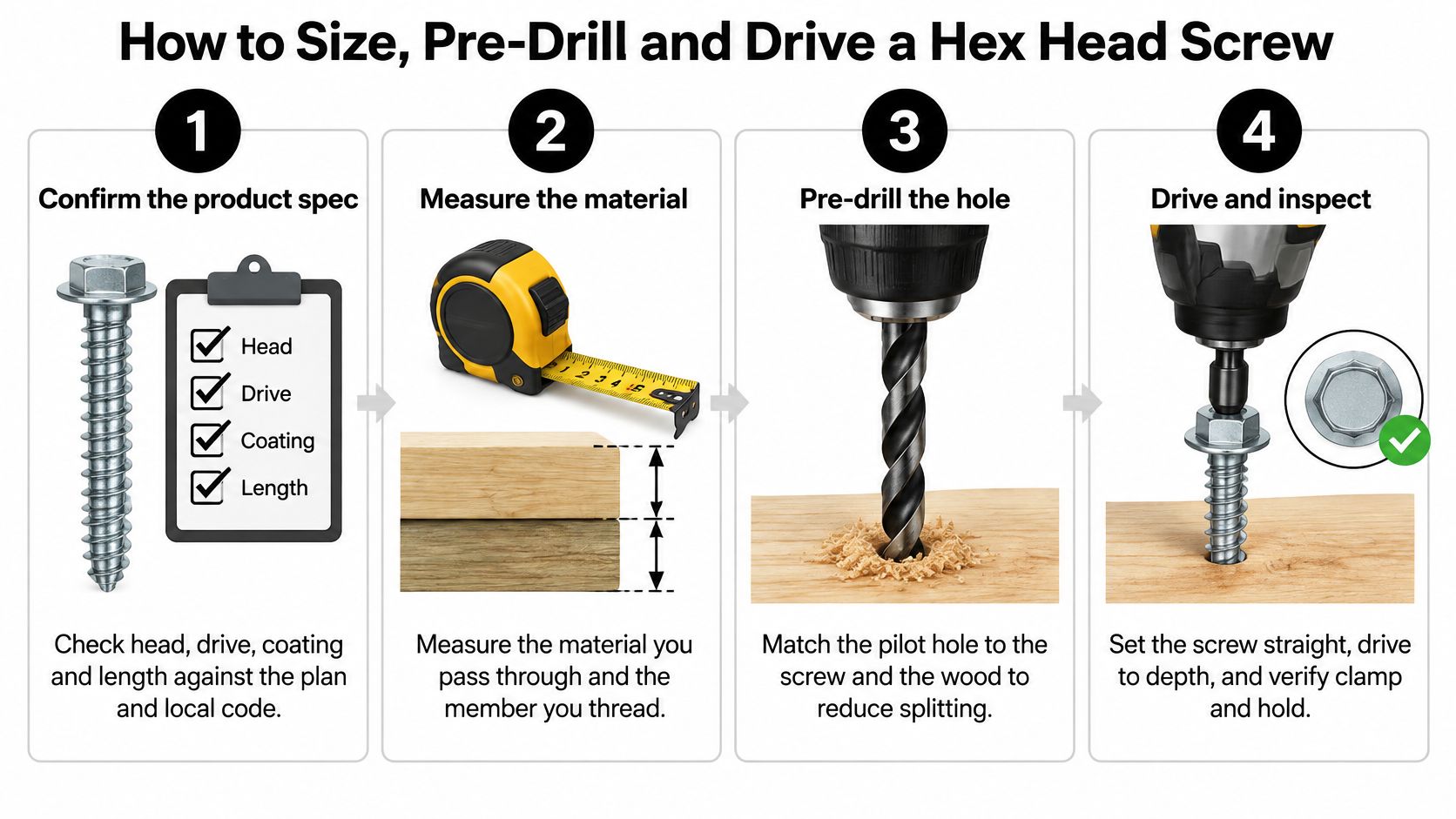
The driving sequence
- Confirm the product. Match head, drive, coating, and length to the plan and the local rule. A hex stamp is not an approval.
- Measure both members. Record what you pass through and what you thread into. On a Canadian structural screw, hold the side member to the 4d rule, and step up to 8d or 10d when the screw is angled and large.
- Pre-drill. Size the pilot to the screw core. On large lags, use the maker's diameter. Splitting is the usual failure in dry hardwood, and a skipped pilot is how it starts. Our note on how deep deck screws should go is the penetration check to run before that hole is drilled.
- Fit the driver. Use the socket or bit that matches the stamped drive, then turn at a steady speed so the threads cut rather than burn.
- Seat the washer. Stop when the flange bears firmly. Crushing the face does not add clamp. It wrecks the wood under the head.
- Check each screw. Look and feel for a clean seat, no spin, and no split along the grain.
Overdriving strips the hex and mashes fibres. A fast impact driver can split a board before the head ever seats, which is why the last turns belong to your wrist on anything structural.
A good install looks dull and quiet. The head or washer is firm, not buried. There is no crack at the edge. Nothing moves when you load the member by hand. If the screw spins, the threads have stripped and a larger diameter or a new location is the fix, not more torque.
Confirm the Specs Before You Buy Hex Head Screws
Price is the last comparison, and only after the spec is right. Recent Canadian listings set a rough yardstick, not a bid.

- Name the job. Deck boards, a ledger, or a structural connection each carry a different rule.
- Match the hardware. Head, drive, diameter, and length should agree with the plan and with the marking on the box.
- Match the metal. Coating has to suit the treatment tag and the connector.
- Compare cost per screw. Amazon.ca listed 50 #14 × 8-inch hex-head structural screws at CAD $43.91 (CAD $0.88 each), with the page available in 2026. A 50-count of #17 × 6-inch heavy-duty hex-head structural screws was CAD $128.29, first available in 2024, on Amazon.ca. Home Depot Canada listed 50 4-inch FastenMaster TimberLOK hex-washer screws at CAD $71.18, available in 2026.
- Buy the full count. A short box stops the job mid-run.
We sell contractor-grade fasteners, post caps, balusters, gate hardware, and deck hardware under our Decorex Hardware brand, alongside other lines. Our 1/2″ × 8″ lag bolt screws are hex head, hot-dip galvanized, meet ASTM A307, and come in 10-piece boxes at $25.19. Browse the fastener range at XTREME EDEALS INC. and check head, drive, length, and coating on each listing against this list before you order.
XTREME EDEALS INC. stocks hex-head lag bolts, deck screws, and the connectors those fasteners have to match, including Decorex Hardware for decks and fences. Pick the coating and the drive for the joint you are building, then order the full box so the run is not split across two products. Visit XTREME EDEALS INC. and line the listing up with your checklist before you check out.