
The most popular deck advice is simple, and it is wrong. Swap every nail for a screw and the frame will stay tight. A fatter thread and a bugle head do not make a fastener legal, or even strong, in the joint you are building. Boards, beam bearings, hangers, guards and the ledger each see a different force. The code that covers your lot names a different fastener for each of them.
Ontario plank counts are not California board counts. A coil of bright nails will not pass a treated-lumber job. A handful of toenails will not hold a house wall. I would split the cart into surface fasteners and structural fasteners before I drove a single piece. Read the joint, then the jurisdiction, then the coating on the box.
Which Fastener Wins on Each Deck Joint
Screws are not an automatic upgrade over nails. Match the fastener to the connection, using the Ontario schedule below, and buy two lines instead of one mixed box.
| Connection | Use this | Count and size | Do not substitute |
|---|---|---|---|
| Deck boards up to 7 1/4 in (184 mm) | Galvanized framing nails or coated screws | Two 2 in (51 mm) nails or two 1 3/4 in (45 mm) coated screws per joist | Uncoated nails or drywall screws |
| Joist bearing on a built-up beam | Galvanized framing nails | Two 3 1/4 in (82 mm) nails | A shorter deck screw unless it is rated equal strength |
| Double-shear joist hanger | Common galvanized hanger nails | Minimum 3 in nails to the hanger schedule | Wood screws, deck screws or drywall screws |
| Guards | Common spiral nails | Spiral nails that do not split the member | Smooth finish nails or uncoated screws |
| Ledger or withdrawal-critical tie | Lag screws, bolts or rated structural screws | Size and spacing from the approved plan | Toenails or nails loaded in withdrawal |
Those plank and beam numbers come from a municipal Ontario deck guideline. For plank decking no wider than 7 1/4 inches (184 mm), Highlands East's deck guidelines call for two galvanized framing nails at 2 inches (51 mm), or two coated screws at 1 3/4 inches (45 mm), into each joist. Where each joist bears on a built-up beam, the same guide wants two galvanized framing nails at 3 1/4 inches (82 mm), and it allows screws only when they provide equal strength.
Length is not a substitute for the listed part
A shorter coated screw can be the right piece on that narrow plank and the wrong piece on the beam. Head size and a shiny coat do not carry the comparison. The approved type, the coating, the length and the published strength all have to match the row you are fastening.
Practical rule: Buy structural fasteners and deck-board fasteners as separate lines, then keep them in separate pouches on the deck.
Hanger holes, guard posts and the ledger are not rows you fill from the decking box. A metal connector that has to bite wood is another part again. Hi Lo metal-to-wood screws are made for that metal-to-wood bite, not for face-fastening a board. Xtreme eDeals carries deck screws, nails, carriage and lag bolts, and joist hangers so those lines can be matched rather than dumped into one carton. These counts are Ontario values. California schedules differ, and the permit set for your city controls the purchase.
Local Code Rules That Change the Pick
Apply the Ontario table only where that guideline is what your building department adopted. California municipalities publish different board counts, and they draw a hard line at the house wall.
| Jurisdiction | Connection | Permitted fasteners |
|---|---|---|
| California (Auburn 2024) | Deck board to each joist | Two 16d galvanized nails or two No. 8 screws |
| California (Vallejo) | Deck board to each supporting member | Two 8d threaded nails or two No. 8 wood screws |
| California | Ledger to exterior wall | 1/2 in lag screws or bolts with washers, hot-dip or stainless; no toenails |
| Ontario | Plank decking up to 7 1/4 in | Two 2 in galvanized nails or two 1 3/4 in coated screws per joist |
Board counts are not ledger hardware
Auburn's 2024 residential wood-deck handout, as recorded in the UpCodes screws, bolts and nails reference, requires pressure-treated decking on each joist with two 16d galvanized nails or two No. 8 screws. That handout also keeps boards at least 1/4 inch apart and spanning at least three joists, with framing hardware in stainless steel, hot-dip galvanized steel, or another corrosion-resistant coating.
A different California city is tighter on the nail and looser on calling it a wood screw. San Bruno's 2025 residential deck requirements record the Vallejo pattern of at least two 8d threaded nails or two No. 8 wood screws per supporting member, unless the fastener maker requires another method. The same guidance bars toenails and nails loaded in withdrawal at an exterior-wall ledger.
Ledger hardware is a third specification. California's building standards, through the state code that local deck guidance applies, call for minimum 1/2-inch lag screws or bolts with washers, in hot-dip galvanized or stainless steel. Ordinary nails are not a stand-in where the connection has to transfer vertical and lateral load into the house.
Fire zones still do not forgive a toenail
Decks in a designated Fire Hazard Severity Zone or wildland-urban interface have to meet ignition-resistant construction, and a fastener choice does not create that compliance by itself. Santa Cruz County's deck construction bulletin still rejects toenails at the exterior wall. Where installation guidance is absent, that wildfire material points to deck screws and a stated edge spacing, inside a tested or code-recognized assembly.
Ontario adds its own limits rather than copying either California handout. The Ontario Building Code compendium on guards requires deck and guard fasteners to resist corrosion and forbids fasteners that split the wood. Guard nails, where that code applies, are common spiral nails. Lumber in guards and floors must be decay-resistant or treated. Use the row for your city, then let the approved plans override the table.
How Shear and Withdrawal Decide the Fastener
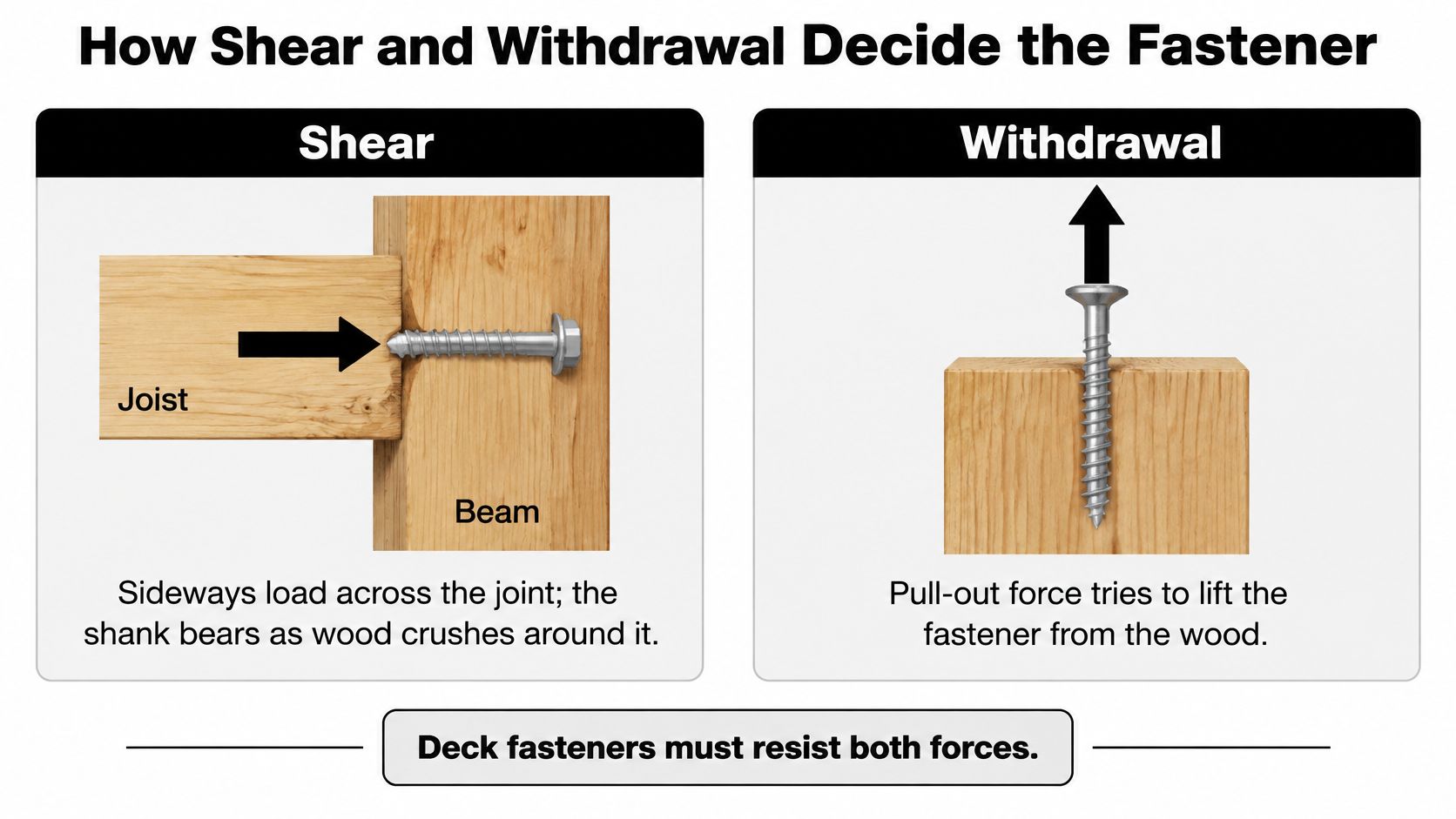
Two forces explain why the rows above refuse to share a box. Shear is a sideways load. Withdrawal is a straight-out pull. Every deck fastener sees some of both. The joint tells you which one the inspector, and the wood, will care about first.
Shear at a beam bearing
Say a joist sits on a built-up beam and a person steps near midspan. The load travels along the joist and tries to slide that joist off the beam, or through a hanger and into the beam face. The fastener shank crosses the joint. Wood fibres crush against the shank until the nail or the rated screw yields, or the wood splits ahead of it.
A common nail is what many hanger listings and beam-bearing details were tested with. For its diameter, that smooth shank is excellent in shear. It is not excellent at staying put once the lumber seasons. Threads do not automatically win this joint. A skinny screw in a hole that was punched for a nail shank is an untested shear pin, even if it feels tight when you lean on the joist.
Withdrawal on a board that cups
Withdrawal is the other picture. A deck board wets, swells, then dries and cups. The crown tries to lift the fastener straight out of the joist. A smooth shank loses bite as the hole polishes. Threads raise that pull-out resistance, which is why a coated deck screw keeps a walking surface flatter through a wet spring. A lag or a structural screw can take a withdrawal-critical tie only when that product is rated for the load. Aggressive threads on a general-purpose screw are not a rating.
Toenails fail this test for a mechanical reason. The shank is short inside the supporting member, and the angled hole is easy to split. You get little withdrawal length and a damaged fibre at the same time.
Head style belongs in the same decision. A bugle or trim head can seat in decking without a crater. A hanger hole is punched for a specified nail head and shank. A fat screw head sits proud. A thin screw shank was never the piece the connector lab loaded. How far those threads need to sit in the joist is its own setting, and how deep deck screws should go is the check before you bury the head.
Boards are mostly a withdrawal and appearance choice. Beams, hangers and ledgers are shear and tested-load choices.
Pick deck screws or nails for the force that joint experiences. Do not choose them because one box looks more modern on the shelf.
Coatings That Survive Treated Lumber and Rain
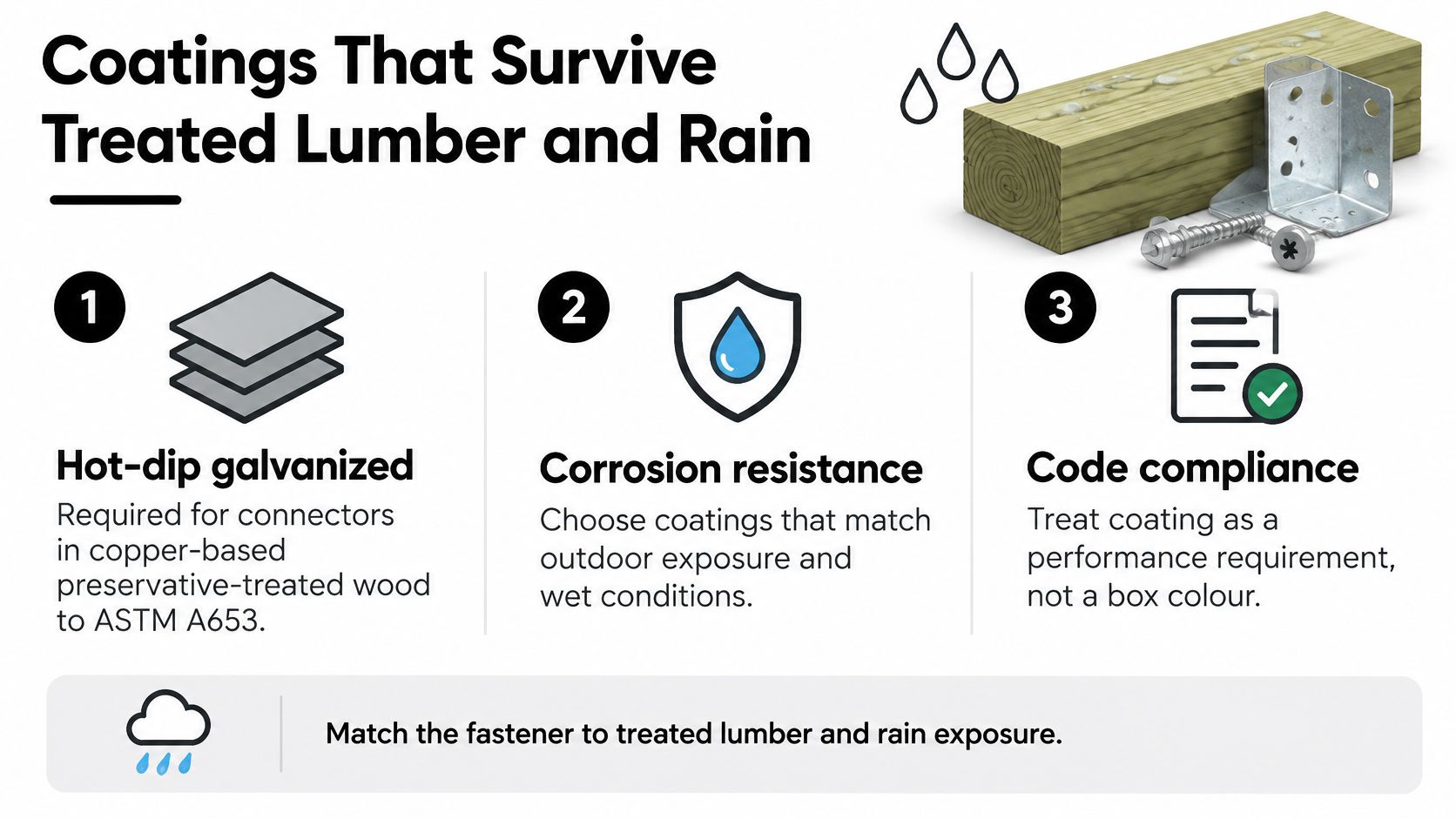
Coating is a performance requirement, not a colour on the carton. Modern preservatives carry copper. That chemistry attacks thin zinc. Rain then keeps the shank wet. The black streak on the board is the warning that the connection is getting thinner.
What the standard actually names
The Canadian Wood Council's fastener guidance is specific for copper-based preservative-treated wood. Connectors must be hot-dip galvanized to ASTM A653, or hot-dip galvanized after manufacture to ASTM A123. Nails in treated wood exposed to weather must be hot-dip galvanized to ASTM A153. Screws must meet ASTM A153 as well, unless both the fastener maker and the preservative supplier recommend a high-quality polymer coating.
That is why bright nails, interior construction screws and drywall screws do not belong outside. Electroplated or painted “gold” screws are not hot-dip. The zinc layer is thin, and the copper in the treatment consumes it. A polymer coat is acceptable only when both makers name that system, not when the package art looks outdoor-ready.
Match the hanger, the post base and the fastener so dissimilar metals do not share a wet joint. A stainless screw in a galvanized hanger, or the reverse, can start its own corrosion cell once water sits in the hole.
Salt air and the label check
Inland work can use code-compliant hot-dip, or an approved polymer coat, after you read the treatment tag on the lumber. Salt exposure and pool chemicals justify stainless on the same joint schedule. Makers commonly point to 304 or 316 for that choice. The difference between those grades, and when hot-dip is still enough, is laid out in galvanized versus stainless steel.
California draws a distance line, not a preference. Vallejo's fastener file requires stainless steel where the work is exposed to salt water or within 300 feet of a salt-water shoreline. An inland California deck can still use hot-dip or an approved polymer coat once the treatment tag agrees.
Before the box goes in the cart, read three lines on the label.
- ASTM callout: A153 on nails and screws for weather-exposed treated wood, A123 or A653 on connectors.
- Process name: Hot-dip, or a polymer system both the fastener maker and the preservative supplier recommend.
- Lumber note: Treated-lumber compatibility, not “exterior” as a marketing word.
If those three lines are missing, the screw-versus-nail debate does not matter yet. The coating has already failed the job.
Fastening Deck Boards Without Split Ends
Once the board fastener is the one your handout allows, the miss is usually placement, not brand. Two fasteners at every joist only count if the board stays whole and both pieces are the same type.
- Confirm the span and the seam. The board has to reach the span your permit already requires, with a visible drainage gap so water does not sit in a closed joint. A tight seam traps water against the joist and undoes a good coating. If the board is short, add a joist or pick a longer piece. Do not cantilever a butt joint into fresh air.
- Stay off the end grain. Keep each fastener in the outer third of the board, but back from the end far enough that the point does not exit the side. On dense cedar, dry fir or a brittle composite edge, predrill the last few inches. A split end means that fastener no longer counts, even if the head looks seated.
- Drive a matched pair. Two nails, or two screws, at each joist. Do not pair one nail with one screw on the same board. They move differently as the board cups, and the stiffer piece takes the load while the other loosens. Keep the pair square to the joist so both shanks get full wood, not the edge of a knot.
- Set the head without crushing the face. Nail heads sit flush. Screw heads go just below the surface. A bugle head and a clutch, or an impact driver with the bit that matches the recess, stop you from chewing a crater that holds water. A crushed ring around the head is a future pop, not a tighter board.
- Hidden clip systems stay on the clip schedule. Follow the clip maker. Do not face-screw one bay and clip the next on the same run. Mixed attachment leaves a ridge where the two methods grip differently, and it gives an inspector two details to reject.
Screws earn the board when you may lift it later, when the face has to stay tight through seasonal cupping, or when a hammer would mark a prefinished surface. You can back a screw out, shift the board, and drive it again. Nails earn it when the approved schedule is a framing nail, when the coil nailer is already set to that length, and when the collation is hot-dip rather than a bright nail that only looks galvanized in the strip.
A popped nail does not go back into the same hole. The hole is already polished, and the next winter will lift it again.
Replace it with the coated screw length from your board row. Stop the moment a board splits. Move the fastener, or replace the board, before you hide the crack under a second head.
Framing Beams Guards and Joist Hangers
The assumption that fails inspections is this one. If a deck screw feels tighter than a nail in a board, it must be better in a hanger. It is not. The connector was tested with a nail shank and a nail head in a punched hole. A deck screw can bite hard and still leave the listed load unpublished. That is enough for an inspector to reject the bay.
Barrie's deck specification requires nails that match the joist-hanger maker and calls for minimum 3-inch common galvanized nails in double-shear hangers. It states outright that wood screws, deck screws and drywall screws are not permitted for joist hangers. Fill every hole the schedule names. A half-filled hanger is not “mostly installed.” The load path the lab published assumed those holes were filled with the listed nail.
The nail length, the head and the galvanizing have to be the hanger's own list, which is why joist hanger nails are a separate buy from the screws you used on the walking surface. A palm nailer or a hammer drives them. An impact driver does not belong in that hole.
Beams, guards and the house wall
A joist sitting on a built-up beam stays with the long galvanized framing nails for that bearing, unless a structural-screw publication shows equal or better capacity in that exact joint. “Equal strength” is a published number for the joint, not a feeling when you try to pull the joist off by hand. A deck screw that is proud of the beam face is also a trip and a water pocket.
Guards add a different limit. Where the Ontario guard rules apply, the nails are common spiral nails, and the fastener must not split the member. A guard that wobbles is often a short screw run into the end grain of a rail, not a coating problem. End grain does not hold withdrawal the way side grain does. The post-to-rim connection, and any blocking the drawing shows, is what stops the lean. Finish nails and uncoated screws are the parts people reach for because they are already on the belt. They are the wrong reach.
Ledgers and post bases follow the connector instructions or the approved drawings. That means lag screws or bolts with washers, in hot-dip or stainless hardware, and no toenail-only tie to the house. Structural screws belong here only when they are the product named for ledgers or beams. They are not the same carton you opened for the decking.
If a repair has already mixed old hanger nails with new deck screws, pull the screws back out. Finish the hanger to its schedule. Leaving the mix “because it feels solid” keeps an unlisted fastener in a listed connector.
Cost Tools and Buying the Right Split
Price the job after the joint is legal. The cheapest fastener per piece is a loss if the inspector makes you pull it.
What each joint actually costs you
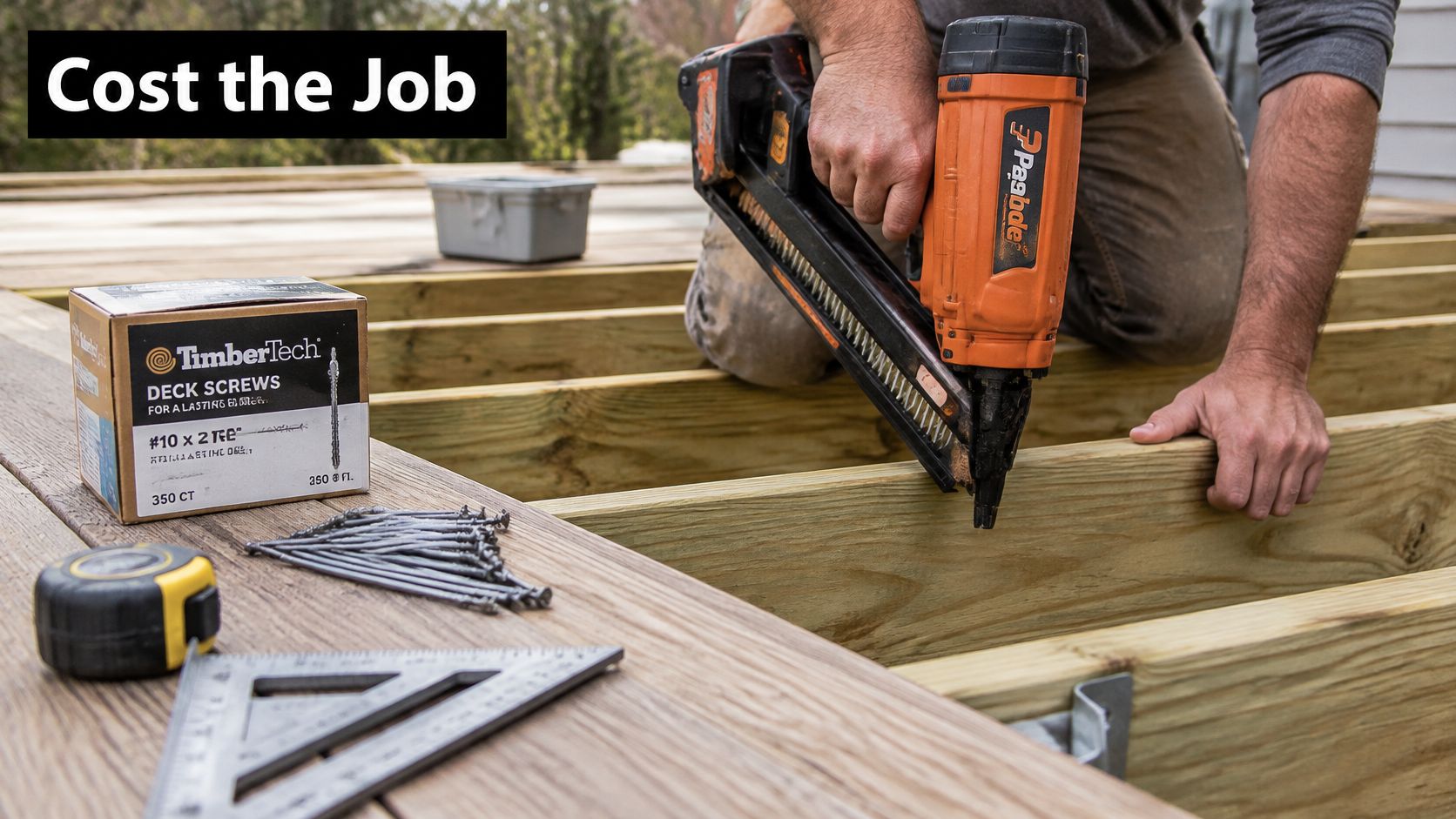
Hot-dip framing nails are usually the cheapest connection and the fastest on open joists once a framing nailer is set. Collation, a compressor or a battery, and a higher miss rate near board ends eat some of that saving. A bright collation nail that splits an end, or stains the board, is not the bargain the unit price suggested.
Coated deck screws cost more per piece. They need an impact driver and a bit that matches the drive, plus a spare bit once the first one cams out. One person can set a board, back a screw out and reuse it. That labour saving is real on a repair, and it is smaller on a wide new deck where a nailer stays in a rhythm.
Structural screws and lags cost the most. They need a socket or a structural bit, washers, and sometimes a pilot hole. They replace a few connections, the ledger, a beam tie, a post base, not every nail on the deck. Buying them by the thousand, because the listing looked versatile, is how structural screws end up in hanger holes.
Budget three groups, not one.
- Hanger nails: The common galvanized length the hanger maker lists, with enough to fill every hole plus a small reserve for bent shanks.
- Board fasteners: Either the hot-dip framing nails or the coated screws your board row allows, in one type only.
- Ledger hardware: Lags or bolts, washers, and the structural screws only if the drawing names them.
Tools that keep the head honest
For screws, use a clutch or an impact driver and change the bit before it rounds the recess. For face nails, set a hammer or a coil nailer so the head does not crater the board. For hangers, use a hammer or a palm nailer with the listed nail, not the deck-screw bit you already have chucked. Add time to predrill the last few inches of a board, especially on dense or dry stock. That predrill is cheaper than a split end you have to cut out.
A short look at how those tools sit on a real frame is worth it before you load the nailer.
Choose coated screws when boards may come up, the face is prefinished, or nails have already popped. Choose hot-dip framing nails when speed matters and the coating meets the hot-dip standard for treated lumber in the weather. For hangers, beams, guards and ledgers, buy the listed nail, the spiral nail, the lag or the bolt, and skip the deck-screw aisle.
Split the cart into a surface line and a structural line. Check each listing for length, coating and treated-lumber use before you add the quantity. The surface line, along with hanger nails and ledger bolts if you still need them, can come from Xtreme eDeals, which stocks deck screws, nails, carriage and lag bolts, and joist hangers as separate products rather than one mixed kit.
XTREME EDEALS INC. stocks the deck screws, nails, joist hangers, lags and bolts that keep a walking surface and a frame on different fastener schedules. Match the length and the coating to the joint you are building, then shop the hardware in one place. Visit XTREME EDEALS INC. and split the order into surface fasteners and structural fasteners before you start the deck.