
The popular advice is simple: if a joist sits on top of a beam, you can skip the hanger. That advice is incomplete, and in California it can lead to a connection that looks solid but fails inspection or moves under real service conditions. Bearing carries vertical compression. It doesn't automatically resist sliding, uplift, rotation, or lateral displacement.
The useful question isn't which option is universally stronger. It's which connection creates a continuous load path for your actual framing layout. A dropped beam with joists bearing on top can be an efficient arrangement. A flush beam with joists framed into its side generally needs approved hangers. Neither method excuses proper beam sizing, post support, fastening, restraint, or local review.
The Hidden Truth About Resting a Joist on a Beam
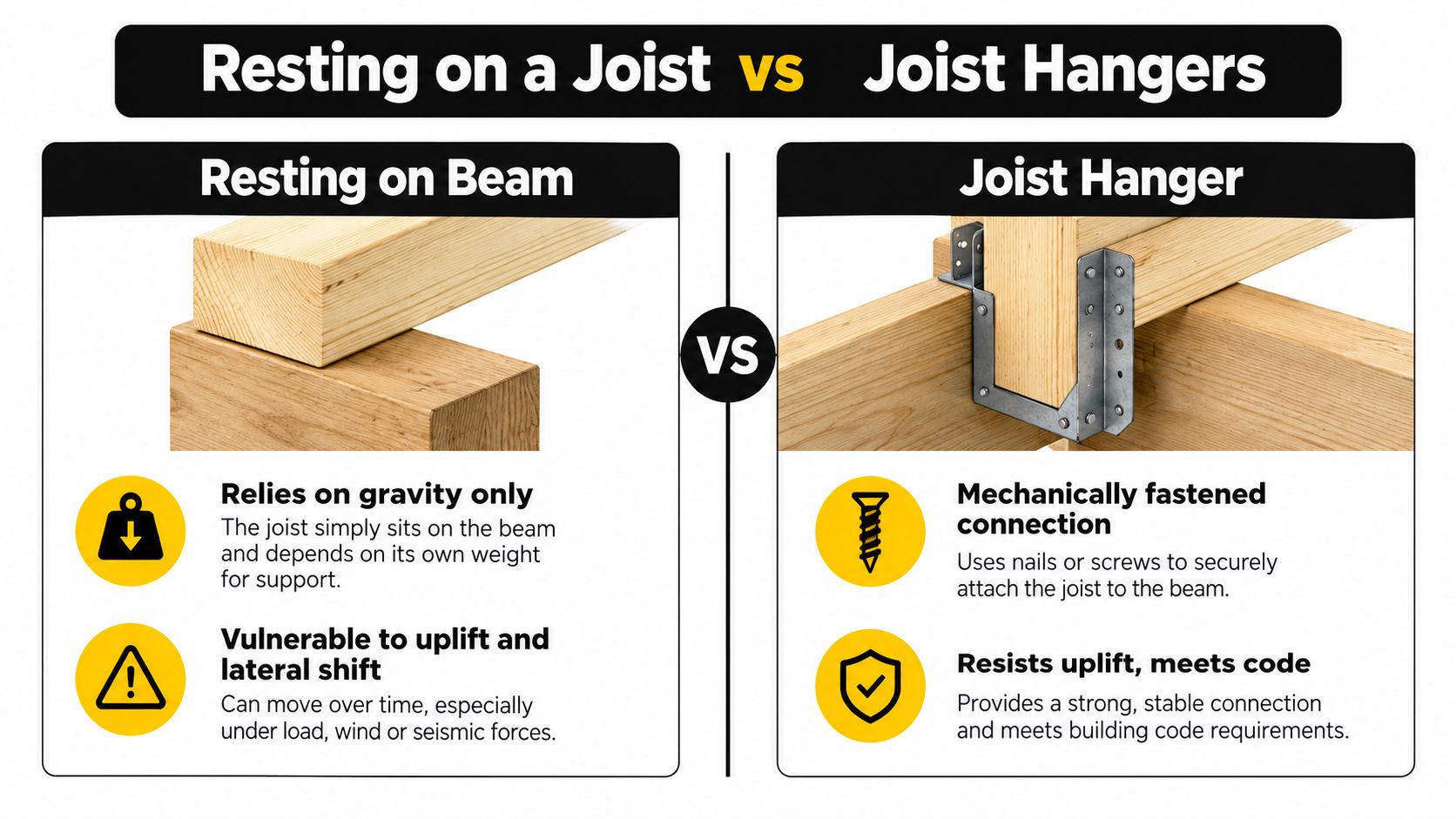
A joist resting on a beam has one obvious advantage: gravity pushes the joist into the support. The end bears directly on the beam, transferring compression across the supported area instead of suspending the member from a metal seat. That direct bearing is useful, but it solves only the vertical part of the problem.
A deck also experiences forces that try to move framing sideways, lift it, twist it, or roll a joist out of position. A loose joist can sit perfectly during installation and still shift when the structure flexes or wind acts on the deck. California's deck provisions distinguish gravity bearing from positive mechanical attachment, which is why a joist on a single-ply beam or ledger can still require a mechanical connector. The same framework requires beam-to-post connections that prevent lateral displacement, so the load path must continue beyond the joist end. California's Section R507 deck provisions treat these as separate connection conditions.
Bearing is not restraint
Top-bearing framing depends on accurate elevation and a properly seated joist end. If the beam is uneven, the joist bears only on a corner or short section. If the end doesn't overlap enough, the apparent support becomes unreliable. If the joist isn't restrained, it can slide or rotate even though its vertical reaction is transferred into the beam.
That's why “it's sitting there” isn't a structural conclusion. The connection must also address:
- Lateral movement, so the joist can't slide along the beam.
- Uplift, where wind or deck movement tries to separate framing.
- Rotation and rollover, especially where joists meet a narrow beam.
- Beam stability, including the connection from beam to post.
- Inspection requirements, which may call for listed hardware rather than field-selected screws.
A side-mounted joist has a different problem. Its end doesn't bear beneath it, so the hanger and its specified fasteners carry the connection forces. The hanger isn't decorative reinforcement. It's the engineered interface between the joist and the beam or ledger.
Practical rule: If you can't identify how the connection resists vertical, lateral, and uplift forces, the connection isn't finished.
For product selection, start with the framing geometry rather than a shopping list. A deck framing support guide can help you organise the hardware questions, but your adopted code and approved plans control the final detail.
Understanding Load Paths and Connection Mechanics
Every deck load should travel through connected structural members until it reaches the ground. People, furniture, snow, wind, and the deck's own weight act on the surface, then move through decking, joists, beams, posts, footings, and soil. A weak connection interrupts that path even when every individual piece of lumber appears adequately sized.
With a top-bearing joist, the vertical force travels through compression at the joist end and into the beam. The beam must be wide and accurately positioned enough to provide the required bearing. Mechanical attachment then keeps the joist from walking, lifting, or rotating away from that bearing surface.
With a side-mounted joist, the hanger forms the load-transfer assembly. The supported member loads the hanger seat, the hanger transfers force through its body and fasteners, and the beam or ledger receives that force. Capacity depends on the listed hanger, the compatible fasteners, installation pattern, wood condition, and the supported member.
Load Path Comparison
| Connection Type | Vertical Load Transfer | Lateral Restraint | Uplift Resistance | Primary Hardware |
|---|---|---|---|---|
| Joist resting on top of a beam | Direct compression through the seated joist end | Mechanical connector, blocking, or another approved restraint as required | Positive attachment or approved connector | Beam bearing surface plus compatible connector |
| Joist framed into the side of a beam | Hanger seat and side flanges transfer the load | Hanger fasteners, blocking, or specified restraint | Rated hanger and compatible fasteners where designed for uplift | Approved joist hanger and listed fasteners |
| Joist at a flush beam | Mechanical support because there is no bearing below the end | Hanger assembly and framing restraint | Connection hardware must suit the design actions | Hanger, fasteners, and beam connection |
| Joist in a retrofit opening | Depends on existing bearing and the new attachment detail | Must be checked rather than assumed | Existing and new connections may need separate restraint | Approved retrofit hardware or engineered detail |
The distinction matters on exposed decks. A hanger gives you a defined mechanical connection, but only when you use the fasteners and installation pattern specified for that hanger. Ordinary nails or random screws aren't substitutes for listed hardware. For side-mounted framing, choose joist hangers and compatible screws as a matched system, not as unrelated items from a parts bin.
Top bearing can be the cleaner choice for a dropped beam because it reduces dependence on hanger fastener transfer for gravity loads. It still needs positive restraint, and the beam itself must remain connected to its posts. A flush beam may keep the deck profile lower, but it shifts more responsibility into the hanger assembly. That trade-off should be made during layout, not after the beam is already installed.
Navigating California Deck Code Requirements
California's prescriptive deck rules don't treat top bearing and side framing as interchangeable. Section R507 contains dedicated provisions for deck joists, beams, bearing, and connections, and local jurisdictions may apply additional requirements based on site conditions and adopted amendments. The 2025 California Building Standards Code became effective January 1, 2026, so builders should confirm the rules currently enforced by the local building department. California deck permitting guidance provides useful examples of the prescriptive approach.
For joists bearing on wood or metal, California guidance identifies a minimum bearing length of 1.5 inches, or 38 mm. Bearing on concrete or masonry requires 3 inches, or 76 mm. Those are minimum bearing dimensions, not a complete design method. The beam must also support the joist across its full width, and the framing must be restrained against movement.
The key rules
- Top bearing on wood or metal: Provide at least 1.5 inches, or 38 mm, of bearing. California deck guidance identifies this minimum.
- Bearing on concrete or masonry: Provide at least 3 inches, or 76 mm, of bearing, using the same California code reference.
- Single-ply beam conditions: Add a mechanical connector where the applicable configuration requires it. Gravity contact alone isn't enough.
- Side-mounted joists: Use approved joist hangers rather than relying on an unsupported joist end.
- Beam-to-post connections: Prevent lateral displacement and maintain the load path from joists through beams and posts.
- Lateral restraint: California guidance identifies hangers or blocking as possible restraint methods, with blocking depth at least 60% of joist depth in the cited prescriptive guidance.
Those requirements explain why a wider beam doesn't automatically eliminate the need for hardware. A wider seat may provide better compression bearing, but it doesn't necessarily prevent uplift or sliding. Likewise, a hanger can be correctly rated yet improperly installed if the wrong screws are used or the hanger doesn't match the member size and wood conditions.
Carmel-by-the-Sea's residential-deck standard illustrates the difference between bearing geometry and hanger capacity. Its table lists a minimum hanger capacity of 600 pounds for a 2×8 joist and 700 pounds for a 2×10 joist, and it calls for galvanised or stainless-steel hangers from an approved manufacturer. The Carmel standard is jurisdiction-specific, so don't treat those values as a universal replacement for the requirements in your own permit set.
California hazards can also change the answer. Seismic, wildfire, coastal, wind, flood, and hillside overlays may trigger additional review or engineering. Local guidance also identifies newer Zone 0 wildfire requirements affecting construction in 2026, making under-deck ember exposure and material selection increasingly relevant. California permit guidance for deck projects explains why a generic hardware choice isn't enough for every site.
Step-by-Step Installation Guides for Both Methods
Start with the approved framing plan, not the lumber pile. Confirm the beam location, joist direction, member dimensions, bearing detail, connector schedule, and required fasteners before cutting. If workers are using saws, drills, ladders, or raised platforms, document a site-specific build compliant SWMS so the work method addresses the actual hazards.
Top-bearing installation
- Set and verify the beam. Check that the beam is level, properly supported by its posts, and connected against lateral movement. A joist can't have reliable bearing on a beam that shifts or twists.
- Mark each joist location. Keep the layout consistent and confirm that every joist end will land fully on the beam rather than barely overlap its edge.
- Confirm the bearing length. For California wood or metal beam bearing, provide at least 1.5 inches, or 38 mm, and verify the required material and support conditions against the adopted code. The California floor provisions set the cited minimum.
- Seat the joists fully. Check level across the frame and inspect the end grain for complete contact. Correct an uneven beam before fastening.
- Install positive restraint. Use the specified mechanical connector, toe-nailing detail, blocking, or other approved method. Don't assume the joist's weight will resist uplift or lateral movement.
- Check rollover control. Where joist ends are vulnerable to twisting, install the required blocking or restraint. The cited California guidance identifies blocking depth of at least 60% of joist depth for relevant lateral restraint conditions.
Hanger installation
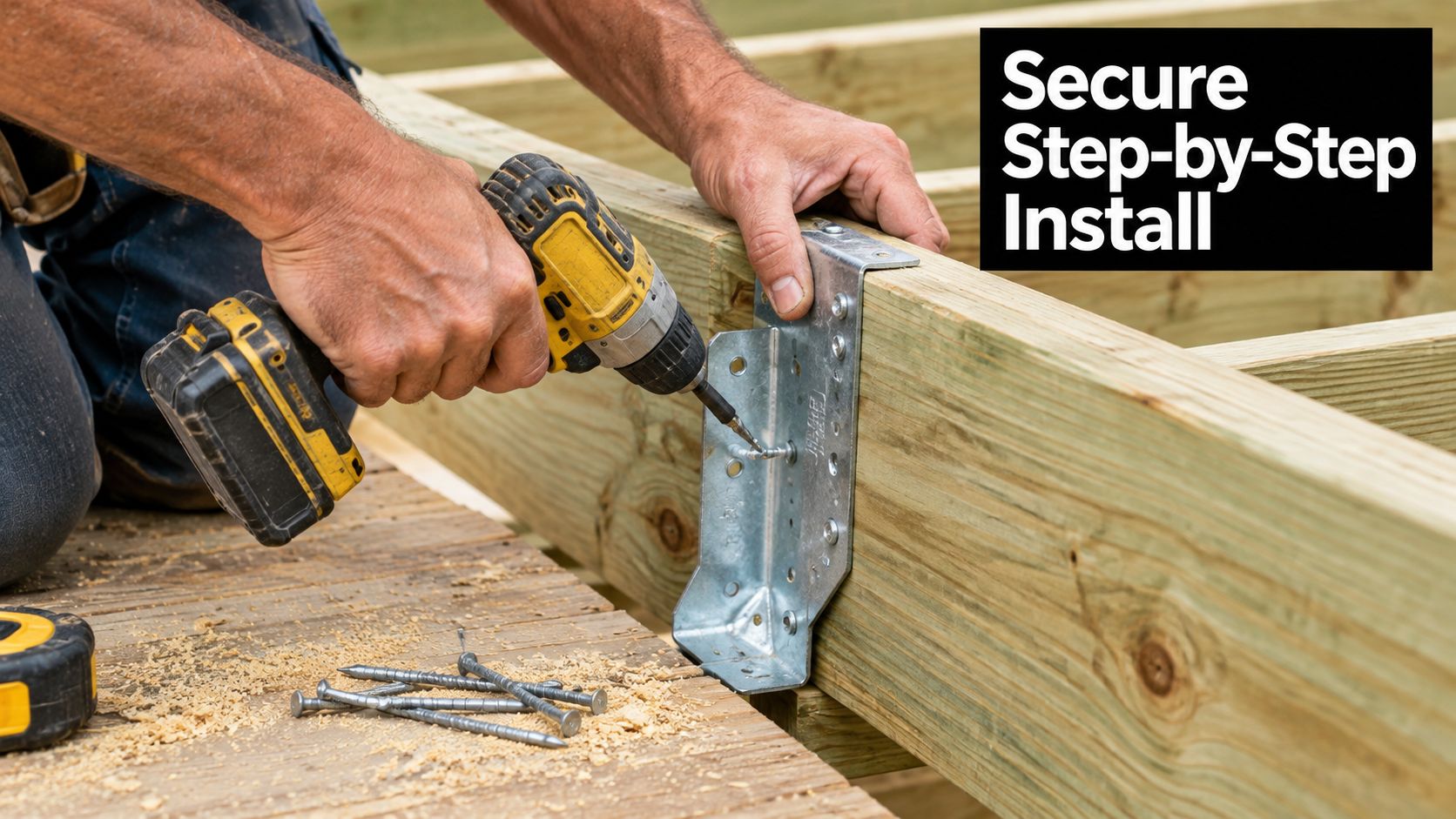
- Select a listed hanger for the member. Match the hanger to the joist size, beam or ledger configuration, exposure, and load requirement.
- Lay out the seat elevation. Mark the hanger so the joist sits at the planned deck height without forcing the member upward or leaving a gap beneath it.
- Fasten the hanger to the supporting member. Use only the manufacturer-specified fasteners and fill the required holes. Random deck screws can have the wrong diameter, length, or shear behaviour.
- Place the joist into the seat. The joist should sit fully in the hanger, with its edges aligned and no damaged flange interfering with the connection.
- Fasten the joist to the hanger. Install the specified face and seat fasteners, then inspect every connection before sheathing or decking hides it.
- Add restraint where required. Hangers don't automatically solve every lateral framing issue. Install blocking, rim framing, or other approved restraint shown on the plan.
For a practical reference on layout and fastening sequence, use this guide to install joist hangers. If the existing beam, ledger, or posts are damaged, stop and get the condition assessed rather than covering it with new framing.
Analyzing Material Costs and Long-Term Maintenance
Top bearing can reduce the number of individual hanger assemblies, but it may require a beam wide enough to provide reliable bearing and enough room for the specified restraint. A dropped beam can also simplify joist placement because the joist end sits on top instead of being held at the beam's side. That simplicity disappears if the beam is uneven, too narrow, or difficult to connect positively.
Hangers add a clear hardware cost and require careful installation. They can also save labour in a flush-beam layout because the joist elevation is established by the hanger rather than by shaping a bearing surface. The key comparison is therefore not “free bearing versus expensive hangers.” It is beam geometry and labour versus listed hardware and fastening labour.
Outdoor durability matters
Moisture and treated lumber can attack the wrong metal choice. Use galvanised or stainless-steel connectors approved for the exposure and compatible with the preservative treatment. Don't mix a hanger from one corrosion environment with fasteners intended for another.
Inspection and maintenance also differ. A top-bearing connection should be checked for movement, splitting, end-grain deterioration, and loss of restraint. A hanger should be checked for corrosion, bent flanges, missing fasteners, and gaps at the seat. Water trapped around a concealed connection can damage timber before the problem becomes obvious.
XTREME EDEALS INC. offers joist hangers, compatible fasteners, deck screws, bolts, washers, post base brackets, and related deck hardware, with product listings that include galvanised and stainless options where specified. Treat the product listing as a starting point, then verify the connector's approval, load rating, fastener schedule, and compatibility with your project.
Making the Final Choice for Your Deck Project
Choose the connection from the framing geometry first. If the joist bears on top of a dropped beam, use that direct bearing only when the beam provides the required seat and the plan includes positive restraint. If the joist frames into the side of a beam or ledger, use an approved hanger. If the beam is flush with the joists, a hanger is normally the practical structural solution because there is no supporting surface beneath the joist end.
Decision matrix
- Dropped beam with adequate seat: Prefer top bearing when the beam is level, the joist has the required bearing, and the approved connector controls sliding, uplift, and rotation.
- Flush beam: Use rated hangers and their specified fasteners. Don't try to create bearing by leaving a partial ledge or relying on toe-nails alone.
- Side-mounted ledger: Use approved joist hangers. Confirm the ledger, house connection, lateral restraint, and local permit requirements as one system.
- Freestanding deck: Top bearing can simplify the joist-to-beam detail, but posts, footings, beam-to-post connections, and lateral bracing still need proper design.
- Retrofit or damaged framing: Don't add hangers as a cosmetic supplement until the existing load path, wood condition, and support geometry have been assessed.

Local hazards can override a simple preference. Seismic sites need a reliable lateral path through posts, beams, footings, and the house connection. Coastal, wind, flood, hillside, and wildfire locations may require additional review. A freestanding layout can reduce dependence on a house ledger, but it doesn't remove the need for adequate footings or a stable beam system.
Use this short planning sequence before buying hardware:
- Confirm the currently adopted local code and permit path.
- Identify whether the joists bear on top or frame into the beam side.
- Verify the beam, post, footing, and restraint details.
- Match the connector, fasteners, corrosion protection, and inspection requirements.
The right answer in the joist hangers vs resting on beam decision isn't the method that looks strongest from below. It's the method that gives every force a continuous route into the supporting structure and satisfies the local approval requirements.
XTREME EDEALS INC. supplies joist hangers, compatible screws, deck fasteners, bolts, post hardware, and other framing accessories for deck and fence projects. Visit XTREME EDEALS INC. to compare the hardware your selected connection requires before you start installation.