
You're standing in a lumber yard with a deck order on the truck and two boxes of screws in your hand. One is galvanized and affordable. The other is stainless steel and costs more. The wrong choice may not look wrong today, but a corroded connection can return as a callback, a stained deck surface, or a failed joist hanger long after the invoice is paid.
The choice between galvanized vs stainless steel isn't just a question of price. Outdoor fasteners face rain, salt air, wet-dry cycles, freeze-thaw movement, pressure-treated lumber chemistry, and contact with other metals. A zinc coating can be a sensible protection system in the right environment. Stainless steel can be the safer long-life option where corrosion would be difficult or expensive to repair.
| Criteria | Hot-Dip Galvanized | 304 Stainless | 316 Stainless |
|---|---|---|---|
| Protection method | Sacrificial zinc coating over carbon steel | Chromium-based passive oxide layer | Chromium-based passive oxide layer with added molybdenum |
| Best general setting | Inland and moderate outdoor exposure | General outdoor use and mild coastal exposure | Coastal, marine, chloride-rich, and severe exposure |
| Main weakness | Zinc coating is finite and can be consumed | Can suffer chloride staining and pitting | Higher material cost and installation care |
| Pressure-treated wood use | Must match the treatment and project specification | Often suitable where approved | Strong choice for aggressive exposure |
| Field priority | Lower upfront cost | Balanced corrosion resistance | Maximum corrosion resistance among these choices |
This guide looks past the sales label and focuses on what fails in the field, including galvanic corrosion, treated-wood reactions, coating damage, chloride pitting, and code thresholds.
Why the Right Fastener Choice Matters for Outdoor Projects
A contractor can install a deck correctly and still create a future problem by choosing the wrong fastener. The boards may be straight, the joists properly supported, and the railing perfectly aligned, yet the connection can deteriorate because the fastener, bracket, and treated lumber are chemically incompatible.
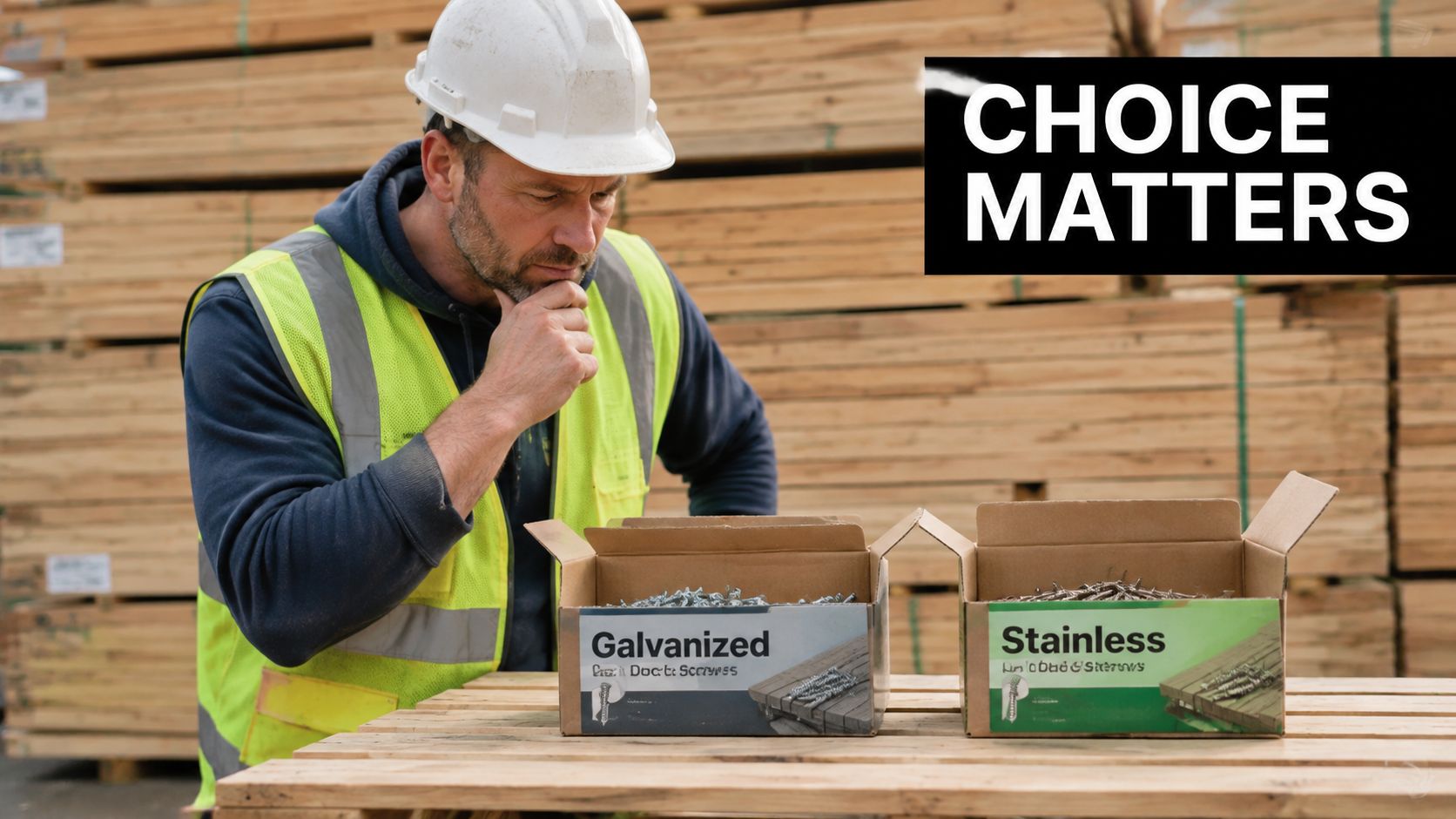
I've seen homeowners focus on the visible screw head while overlooking the hidden portion inside the joist. That's where moisture stays trapped, where preservatives contact the metal, and where a small loss of section can weaken a connection. A deck screw can still look acceptable from above while the threads inside the wood have already lost meaningful holding capacity.
The real cost sits behind the fastener
Galvanized steel is widely stocked and usually easier on the initial budget. That makes it practical for many inland decks, fences, agricultural structures, and outdoor repairs, provided the coating, fastener type, and treated lumber specification match.
Stainless steel costs more at purchase, but its corrosion resistance is built into the alloy rather than supplied by a coating that gradually wears away. Caltrans corrosion guidance explicitly recommends stainless steel over galvanized steel for critical components in corrosive environments, and notes that galvanized coating can be worn away in as little as 15 years for maintenance planning purposes (Caltrans corrosion guidelines).
Practical rule: If replacing the connection would require dismantling finished work, specify the material for the repair you don't want to make.
Exposure changes the answer
A fence in a dry inland yard doesn't face the same conditions as a deck near the California coast. Salt air, standing moisture, and trapped water around brackets accelerate the weaknesses of zinc coatings. Pressure-treated wood adds another variable because modern preservatives can attack unsuitable coatings.
For project-specific sourcing, builders can review the deck and fence fasteners and fittings selection before ordering. The useful question isn't “Which metal is stronger?” It's “Which protection system remains reliable in this environment, with these materials, for the expected service life?”
How Galvanized and Stainless Steel Are Made
The two materials protect steel in different ways. Galvanized steel uses a zinc coating, while stainless steel relies on alloy chemistry throughout the metal. That distinction predicts how each material responds to scratches, cut edges, moisture, and contact with other metals.
Galvanized steel depends on zinc
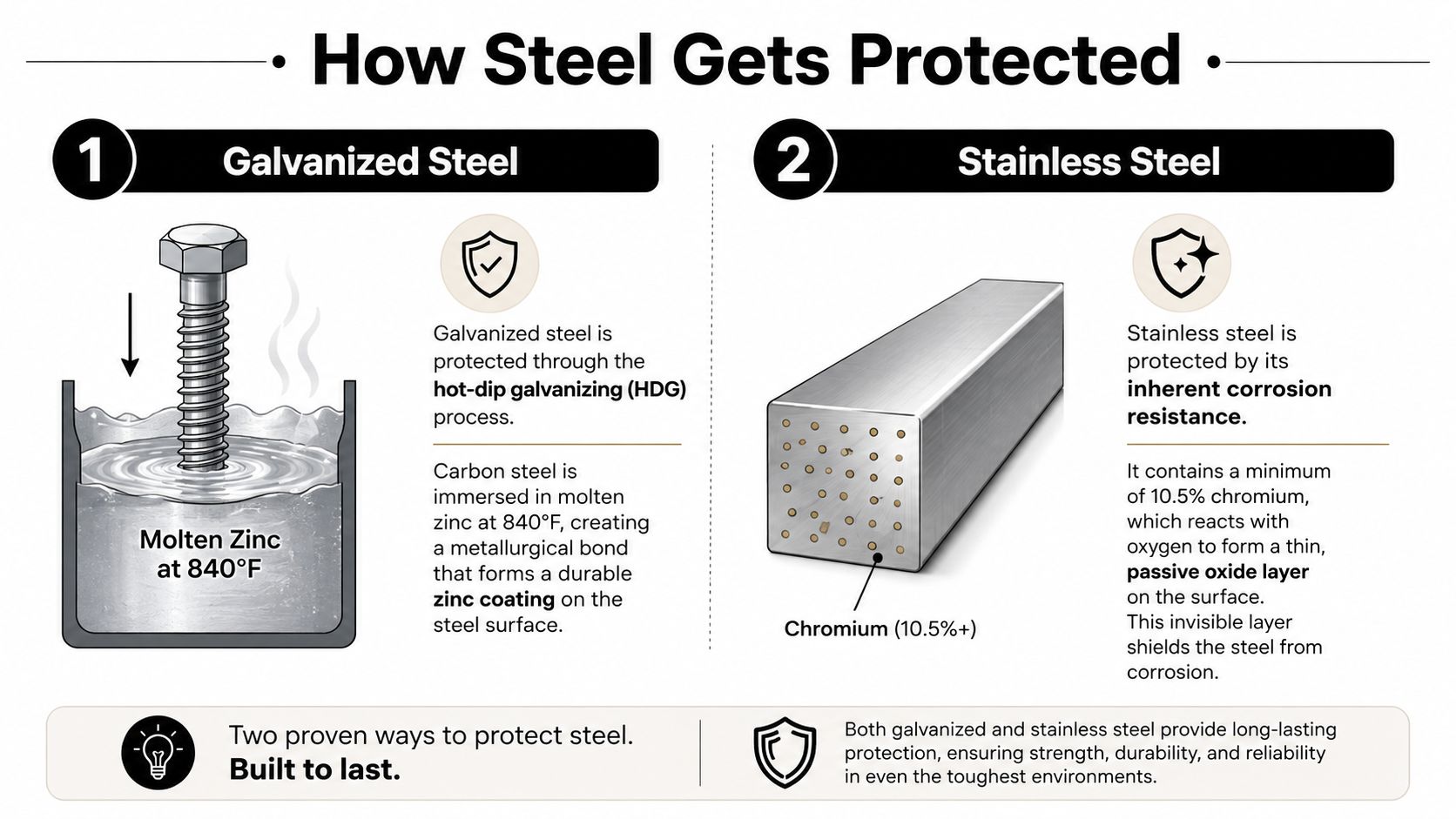
Hot-dip galvanizing, commonly abbreviated HDG, immerses carbon steel in molten zinc at roughly 840°F. The process creates a zinc coating over the steel surface. That coating forms a physical barrier between the carbon steel and the surrounding moisture and oxygen.
Zinc also acts as a sacrificial anode. If a small area is scratched, nearby zinc can corrode before the exposed carbon steel does. This protection isn't unlimited. Abrasion, repeated wetting, chemical attack, and atmospheric exposure consume the zinc over time.
Electro-galvanizing applies zinc through an electrical process rather than by immersing the part in a molten zinc bath. The resulting coating is generally thinner than an HDG coating, so the two products shouldn't be treated as interchangeable for demanding outdoor work. A screw labelled “zinc plated” may not provide the same field protection as a properly specified hot-dip galvanized fastener.
Stainless steel protects itself through chromium
Stainless steel contains iron combined with a minimum of 10.5% chromium. Chromium reacts with oxygen to form a thin passive oxide layer. If the surface is lightly damaged, that layer can reform in the presence of oxygen. The fastener doesn't depend on a separate zinc film for its basic corrosion resistance.
Grade selection still matters. 304 stainless, commonly described as an 18/8 chromium-nickel alloy, handles many general outdoor applications. 316 stainless adds molybdenum, which improves resistance to chloride attack. That makes 316 the more appropriate choice where salt air, de-icing salts, or marine exposure create a persistent chloride risk.
A passive layer isn't a licence to ignore installation. Dirt, trapped moisture, iron contamination from carbon-steel tools, and tight crevices can still produce staining or localized corrosion. Stainless fasteners also need careful handling because damaged threads and poor installation can compromise the connection even when the alloy is appropriate.
The manufacturing difference explains the practical trade-off. Galvanized steel can be economical because the base steel does most of the structural work and zinc supplies surface protection. Stainless steel costs more because corrosion resistance is part of the metal's composition, not a replaceable outer layer.
Galvanized vs Stainless Steel Head to Head
The strongest material on paper isn't automatically the best fastener for an outdoor connection. Galvanized fasteners can offer high raw strength for their size, while austenitic stainless fasteners may have lower strength in some comparable products. Corrosion changes that comparison over time. A fastener that retains its section and threads in a wet, salty environment can outperform a stronger fastener whose coating has been consumed.
| Criteria | Hot-Dip Galvanized | 304 Stainless | 316 Stainless |
|---|---|---|---|
| Corrosion resistance | Good in mild to moderate exposure, but finite because zinc is consumed | Good general resistance, with greater sensitivity to chlorides | Strong chloride resistance for coastal and marine conditions |
| Strength | Often high raw tensile and shear strength, depending on product grade | Austenitic stainless can have lower raw strength than some galvanized products | Comparable stainless limitations, with strong corrosion performance |
| Cost | Usually the lower upfront-cost option | Higher upfront cost | Usually the highest cost of the three |
| Inland climate | Practical for many exterior connections when properly specified | Useful where appearance and corrosion margin matter | Often more protection than a mild inland project requires |
| Coastal climate | Requires careful exposure and coating assessment | Can stain or pit in salt air | Preferred for aggressive salt-air and chloride exposure |
| Treated lumber compatibility | Must meet the treatment manufacturer and code requirements | Often selected where galvanized coating may be attacked | Strong choice for severe exposure, subject to project specification |
| Maintenance risk | Inspect for coating loss, rust, and damaged areas | Inspect for staining, pitting, and crevice corrosion | Inspect connections even though corrosion risk is lower |
| Lifecycle decision | Lower initial cost, possible future replacement | Higher initial cost, longer corrosion margin | Highest initial cost, often justified where failure is costly |
California exposure data show why location matters. A Southern California Rapid Transit District report recorded zinc-coated steel corrosion at 0.000034 inch per year after 64 months in Los Angeles, while stating that stainless steels shouldn't be prone to significant corrosion in the tested context (Southern California corrosion report). The same report estimated zinc-coated steel corrosion in polluted conditions between 0.000011 and 0.000048 inch per year.
The American Galvanizers Association lists Los Angeles zinc loss at 1.09 μm per year after one year of exposure, while its California comparisons identify zinc corrosion commonly around 1.09 to 1.6 μm per year in Los Angeles and 1.15 to 1.26 μm per year in marine-exposed California cities (AGA atmospheric corrosion data). The same data list unalloyed steel loss at about 21.4 μm per year in Los Angeles, illustrating how galvanizing can sharply reduce corrosion relative to bare steel without making the zinc layer permanent.
For fence layouts, material choice also depends on the specification. A practical galvanized fence buying advice guide can help homeowners compare coating and hardware options before they order. For stainless product selection, review the stainless steel fasteners range and match the grade to the exposure rather than choosing only by appearance.
Hidden Failure Modes That Catch Builders Off Guard
The common comparison stops at “galvanized is cheaper, stainless resists rust.” That misses the failures that cause the most trouble. A fastener can corrode because it's touching the wrong metal, sitting in chemically aggressive wood, or trapping chloride-laden moisture in a small crevice.
Galvanic corrosion starts at the connection
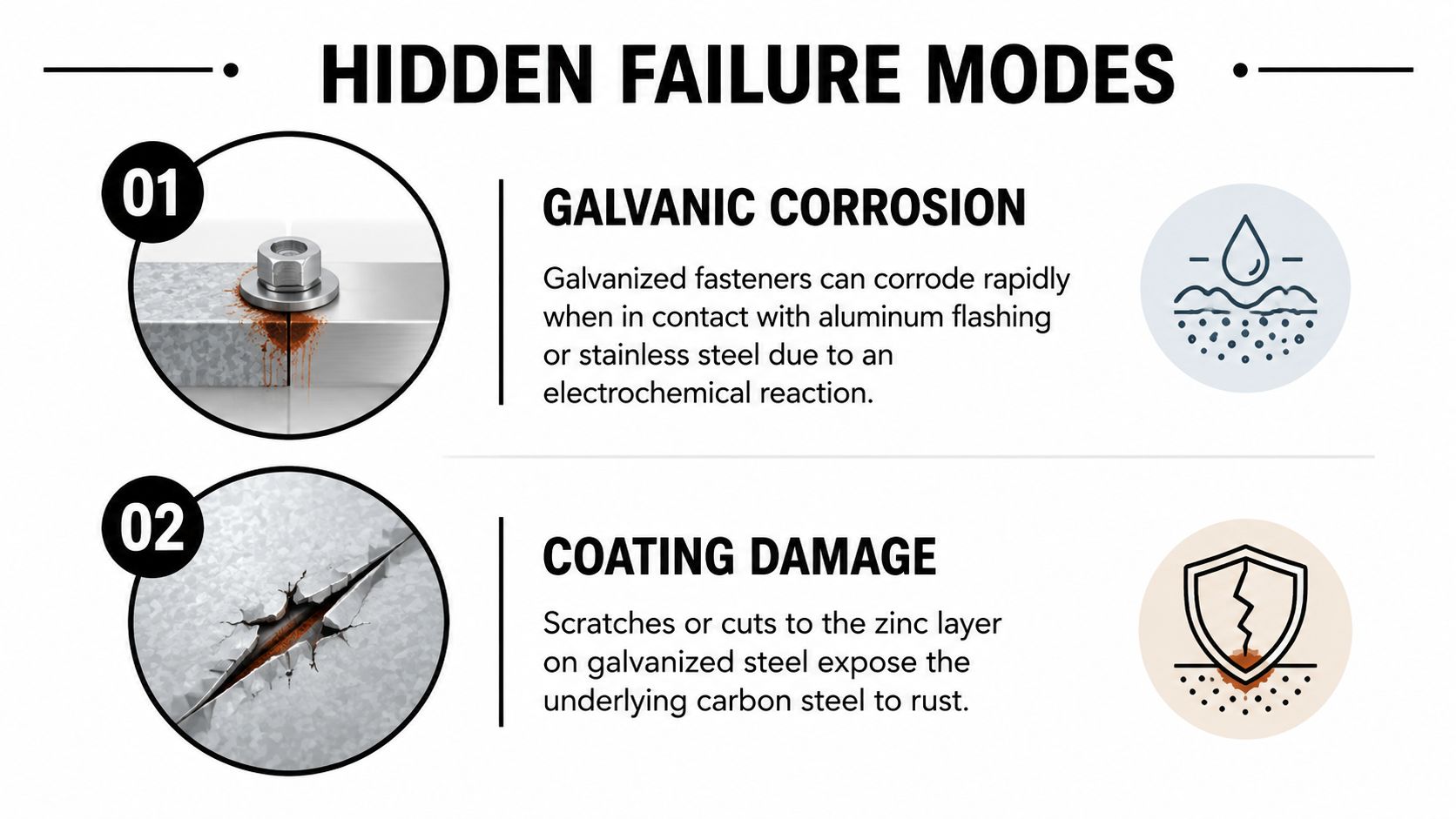
Galvanic corrosion occurs when dissimilar metals contact one another in the presence of an electrolyte, usually water carrying dissolved salts. A galvanized screw touching stainless hardware, aluminium flashing, or another conductive metal can cause the zinc to corrode faster than it would alone.
The risk rises when a small zinc-coated fastener contacts a larger dissimilar-metal surface. The zinc becomes the sacrificial part of the assembly, and the connection may develop white corrosion products, dark staining, or red rust after the zinc has been consumed. A deck frame with mixed brackets, washers, screws, and flashing needs a compatibility plan, not a collection of whatever hardware happens to be in the truck.
Treated wood can attack zinc
Pressure-treated lumber may contain preservatives such as ACQ, CA-C, or MCQ. In wet conditions, those chemicals can be aggressive toward unsuitable zinc coatings. The problem is easy to miss because the fastener is buried inside the board, where inspection is difficult.
Coastal construction guidance notes that G-90 galvanized connectors may corrode at roughly 0.1 to 0.3 mm per year in coastal environments, while Caltrans identifies galvanized coating loss in as little as 15 years for some corrosive applications (California coastal construction guidance). Those figures don't describe every product or every site, but they show why a generic “weather-resistant” label isn't enough.
Stainless steel has its own weak points
Stainless steel isn't rust-proof. 304 stainless can develop tea staining or chloride pitting near saltwater, particularly where salt deposits and moisture remain trapped. Crevice corrosion often appears beneath washers, inside tight laps, or at the underside of a bracket where air circulation is poor.
316 stainless offers a stronger defence against chloride attack because of its molybdenum content, but it still needs sound detailing. Drain trapped water, avoid contamination from carbon-steel grinding dust, and keep the connection accessible for inspection.
California code also sets specific galvanized fastener requirements. Fasteners over 3/8 inch, or 9.5 mm, must meet or be equivalent to ASTM A153 Class C, while smaller fasteners can qualify through ASTM A153 Class D, ASTM A641 Class 3, or specified corrosion testing with no more than 5% red rust after the required exposure period (California Building Code galvanized fastener provisions). Always confirm the governing local specification instead of assuming a product description satisfies it.
Which Material Fits Your Project Type
Choose the fastener by exposure, treated-wood chemistry, structural demand, inspection access, and expected service life. A galvanized fence staple may perform well inland yet corrode early on a damp coastal site or behind a privacy-fence board.
| Project Type | Recommended Material | Key Considerations |
|---|---|---|
| Inland residential deck | Hot-dip galvanized or approved stainless | Match the treated lumber chemistry, connector specification, and budget |
| Inland deck with difficult future access | Stainless, often 304 | Higher initial cost can reduce concern about hidden coating loss |
| Coastal deck or fence | 316 stainless for critical connections | Salt air and chloride exposure make zinc consumption and pitting major concerns |
| Agricultural chain-link fence | Hot-dip galvanized | Practical where exposure is moderate and parts are inspectable |
| High-humidity privacy fence | Stainless for critical hardware, or carefully specified HDG | Trapped moisture and treated wood can shorten zinc coating life |
| Commercial or multi-family exterior work | Project-specified galvanized or stainless, often stainless at critical connections | Inspection, liability, warranties, and replacement access affect the decision |
| Mixed-metal assembly | One compatible system, with isolation where needed | Avoid direct contact between dissimilar metals |
Decks need a connection-by-connection decision
For an inland residential deck with standard pressure-treated framing, properly specified hot-dip galvanized fasteners suit many applications. Confirm compatibility with the lumber treatment and connector system before installation. Electro-galvanized trim screws and unverified “outdoor” screws do not replace a specified structural fastener.
Choose stainless when a connection will be buried, difficult to inspect, repeatedly wetted, or costly to dismantle. Use 316 when chloride exposure is part of the site conditions. A premium appearance alone does not justify the grade.
A deck near the coast may need stainless at the ledger, rim, guard, and other connections where replacement would require dismantling finished work. An inland deck with accessible hardware can often use hot-dip galvanized components, provided the coating and connector approvals match the design.
Fences expose different weaknesses
Galvanized hardware cloth, post brackets, and chain-link fittings remain practical for many agricultural installations because the components are accessible and exposure may be moderate. High-humidity privacy fences create a different risk. Water collects behind boards, brackets stay against treated posts, and limited airflow slows drying. Those conditions can attack zinc coatings and accelerate reactions between treated wood and incompatible hardware.
Commercial and multi-family exterior work calls for a documented specification rather than a casual substitution. The project may require a particular coating, alloy, test standard, or inspection record. California's 2025 code update adds Section 2203A for structural stainless steel and directs the design, manufacture, and erection of austenitic and duplex stainless steel to AISC 370 (California structural stainless steel provision).
A hybrid system can control material cost without placing vulnerable connections at risk. Use stainless for coastal fasteners, hard-to-replace brackets, and exposed structural connections. Use properly specified galvanized hardware for accessible, non-structural elements where the exposure and governing code permit it. Isolate dissimilar metals, and confirm that the project specification allows the combination.
Buying Checklist and Installation Best Practices
A box label does not establish whether a fastener belongs in the connection. Before purchasing, verify the coating or alloy, structural role, lumber treatment, connector requirements, and the documentation required by the project.
Buying guidance for the yard
- Verify the finish: For galvanized structural fasteners, look for documentation confirming the required hot-dip galvanizing standard, such as ASTM A153 where applicable. For stainless components, confirm the grade and product standard instead of judging by a bright surface.
- Check the marking: Grade or manufacturer markings can support identification, but a magnet test is only a rough screen. Some stainless grades respond weakly to magnets, and the test cannot reliably separate 304 from 316.
- Match the thread: Deck screws, lag screws, machine screws, carriage bolts, and structural screws serve different purposes. Select the thread geometry and length for the material thickness and connection design.
- Separate the hardware: Keep stainless parts away from bins contaminated with carbon-steel filings. Store galvanized boxes off damp ground so moisture does not begin attacking the coating before installation.
The right protective coatings and hardware options can help with maintenance and repairs, but a coating cannot correct an incompatible fastener or hide an unsuitable specification. If a supplier cannot provide the grade, coating, or compliance document for a critical connection, select a product with traceable specifications.
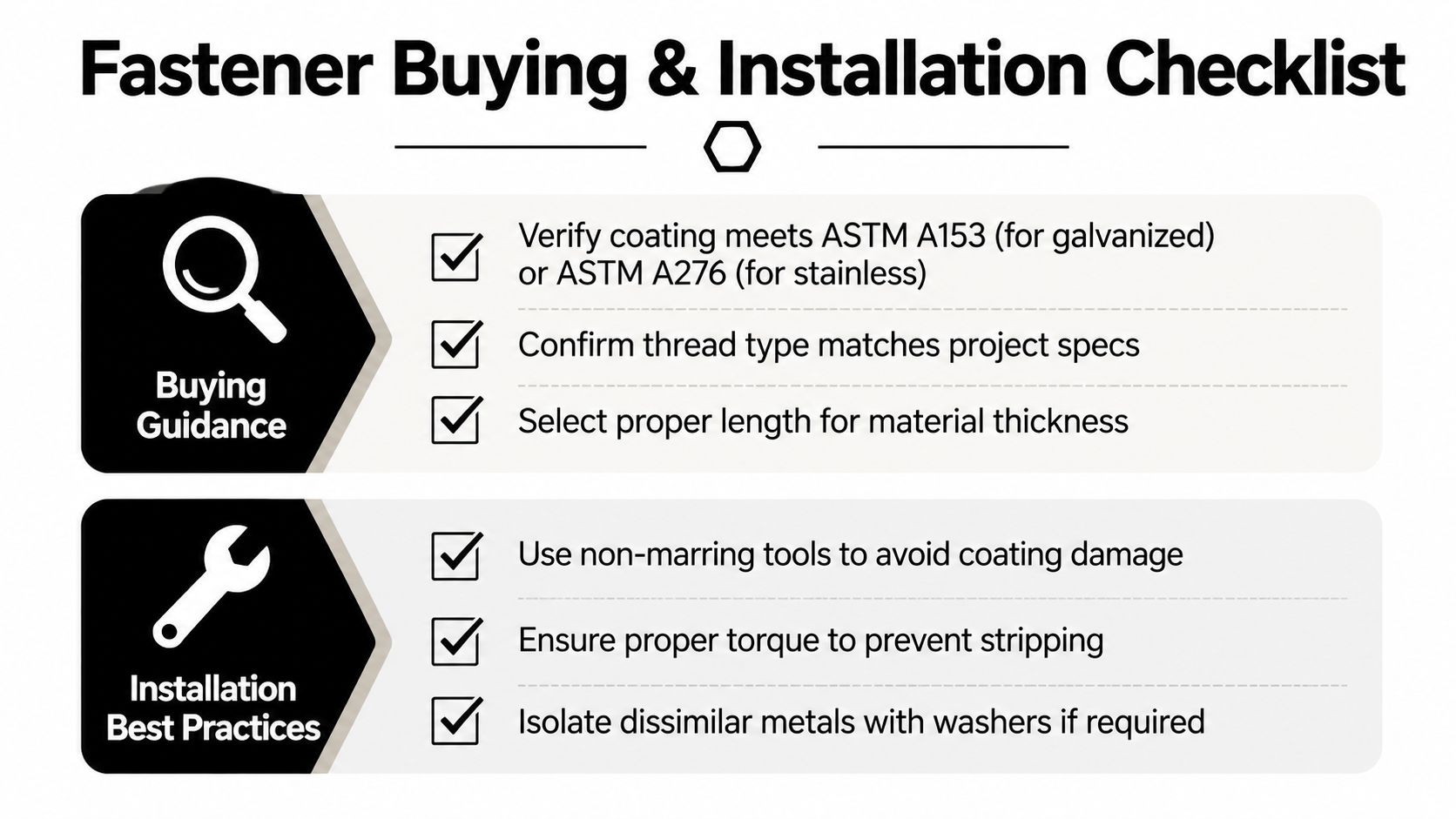
Installation practices that prevent damage
Stainless steel threads can gall when pressure and friction build during driving. Use compatible lubrication where the manufacturer permits it, keep the driver aligned, and stop if the fastener begins to bind. Pre-drill dense timber, and control driving speed rather than forcing the screw into the wood.
Galvanized screws require careful driving too. Over-driving can break the coating around the head and leave a moisture pocket in the timber. Use matching galvanized washers and brackets. If dissimilar metals must meet, install suitable nylon washers or an approved membrane to separate them.
Keep this checklist on the jobsite:
- Confirm the specification: Check the plan, connector instructions, lumber treatment, and local code.
- Inspect the finish: Reject damaged coatings, mixed boxes, bent threads, and unclear labels.
- Use the correct bit: A worn driver damages heads and encourages over-driving.
- Pre-drill where needed: Dense wood and stainless fasteners benefit from a controlled pilot hole.
- Protect the connection: Match metals or install an approved isolation layer.
- Inspect before closing the work: Examine every critical connection while it remains accessible.
Common Misconceptions and Frequently Asked Questions
“All stainless steel is rust-proof.” No. 304 stainless can stain or pit in coastal salt air, especially where moisture and chloride deposits remain trapped. 316 is the more dependable choice for severe chloride exposure, but detailing and cleaning still matter.
“Galvanized fasteners are always fine for pressure-treated wood.” That assumption can fail. ACQ, CA-C, and MCQ-treated lumber may attack zinc coatings in wet conditions, so the fastener must be approved for the specific treatment and application.
“Mixing galvanized and stainless hardware is harmless.” It isn't. Direct contact in a wet connection can accelerate galvanic corrosion and consume zinc faster. Use compatible components or isolate the metals.
Can galvanized screws be used with cedar? They can be suitable for some applications, but cedar's extractives and moisture can stain surrounding material and affect corrosion. Check the fastener manufacturer's recommendation, and select stainless where appearance, humidity, or long service life makes staining and corrosion unacceptable.
Is hot-dip galvanizing better than electro-galvanizing outdoors? HDG generally provides a more substantial zinc protection system than electro-galvanizing. For exposed structural or outdoor work, verify the actual standard and coating rather than accepting “zinc” as a complete description.
Do building codes mandate stainless steel everywhere? No. Code requirements depend on the connection, exposure, material, and governing specification. California, for example, defines galvanized fastener classes and corrosion-test pathways, while its 2025 update includes explicit structural stainless provisions. Canadian and Ontario specifications can also make galvanized steel the default for exterior fencing and define coating thresholds such as G90, Z275, or AZM150 (Ontario exterior fencing and sheet-steel specifications).
Surface rust may be cosmetic, but pitting, reduced threads, snapped heads, and loose connections signal a structural concern. A cheap “weather-resistant” screw may fail because its coating, alloy, or treatment compatibility never matched the job. When exposure or lumber chemistry is uncertain, 316 stainless is often the safer upgrade because the cost of replacing a hidden connection and returning to the site can exceed the initial material difference.
XTREME EDEALS INC. offers galvanized and stainless deck and fencing hardware, including fasteners, post caps, brackets, hinges, and related accessories for DIY and professional projects. Visit XTREME EDEALS INC. to compare compatible hardware options before you place the order, and match the material to your climate, treated lumber, and connection requirements.