
Your double gate closes, but it doesn't stay put. One leaf drifts, the latch lands crooked, and the whole setup sags just enough that you start fighting it every time you come or go, especially after a rough winter. That's usually the moment a cane bolt for gate hardware makes sense, because the problem is not the latch itself, it's the fact that one leaf needs to be held rigid so the other leaf can do its job.
What a Cane Bolt Does for Your Double Gate
A cane bolt, also called a drop rod, is the piece that keeps one leaf of a double gate anchored so the other leaf can swing and lock correctly. Manufacturer terminology even describes it as a “typical catching component of a double gate”, which is a good way to think about it, it catches and holds the inactive leaf instead of trying to fasten the two leaves together hardware terminology reference. In real installations, that means the rod drops into a hole or receiver, and the gate leaf stops moving sideways.
A homeowner usually notices the need after repeated frustration. The latch seems fine, but the gate leaf shifts in wind, settles on soft ground, or rubs because the inactive side is floating when it should be fixed. A cane bolt solves that by transferring lateral load through the rod and into the ground socket, not into the latch screws, which is why it belongs on many residential driveway gates, farm-style entries, and wide yard openings hardware terminology reference.
Why the simple design still works
The design has stayed almost unchanged for decades because it's purely mechanical. No power. No wiring. No complexity to fail in the rain or cold. That's why installers still use it alongside newer gate locks instead of treating it like old-fashioned hardware that got replaced.
Practical rule: if one leaf of a double gate needs to stay fixed while the other leaf latches to it, a cane bolt is often the right stabiliser.
The key is understanding what it does and what it doesn't do. It doesn't create high security on its own. It doesn't correct a badly sagged gate. It gives the active leaf something solid to close against, and that's often the missing piece on Canadian gate systems where wide openings are common.
Choosing the Right Material and Size for Your Gate
Material choice matters more in Canada than a lot of generic guides admit. A 304 or 316 stainless steel cane bolt is the right direction when moisture, coastal exposure, or de-icing residue are part of the picture, because stainless is built for better corrosion resistance than coated carbon steel cane bolt materials and finishes. Zinc-plated steel is the economy option, while black powder-coated steel sits in the middle, but coating integrity has to stay intact or rust starts where the finish is scratched during installation.
Size is the other half of the decision. Standard catalog options include 12-inch, 18-inch, 24-inch, 33-inch, and 48-inch lengths, with bolt diameters ranging from 1/2 inch to 1 inch depending on duty level McMaster cane bolt catalog. For wood gates in the Canadian market, an 18 in cane bolt with a 1/2 in bolt head and 4 mounting holes is a common specification, while heavier versions may step up to longer rods and thicker sections 18 inch wood gate cane bolt listing. The bigger rod resists bending better when the gate settles over time.
Matching hardware to the gate, not the catalog
If the inactive leaf is light and the opening is small, a basic drop-rod design is usually enough. If the gate is heavier, taller, or tends to move with wind, larger-section rods are the safer choice because the rod has to hold alignment, not just fill a hole. That's where the 0.60 in diameter steel options and longer lengths become relevant for tougher installations cane bolt materials and finishes.
| Material | Common Sizes | Best For | Climate Considerations |
|---|---|---|---|
| Stainless steel | 12 in to 48 in, with 304 or 316 components | Moist or coastal installs, long service life | Better resistance to rust where wet weather and salt exposure matter |
| Zinc-plated steel | 12 in, 18 in, 24 in styles | Budget-conscious repairs | Lower corrosion resistance, better for sheltered or drier sites |
| Black powder-coated steel | 24 in, 33 in, and longer heavy-duty styles | General residential and heavier gates | Depends on coating integrity, scratches can lead to corrosion |
Practical rule: match the rod diameter and length to gate weight and expected settlement, then aim for at least 2 inches of engagement into the receiver so the rod carries load instead of the fasteners 18 inch wood gate cane bolt listing.
Padlockable or retained-up versions make sense when you want the inactive leaf held out of the way, or when the gate needs an added locking function. Basic drop rods are simpler and cheaper, but extra locking hardware adds corrosion points and more parts to align, so don't buy features you won't use.
When a Cane Bolt Is the Wrong Solution
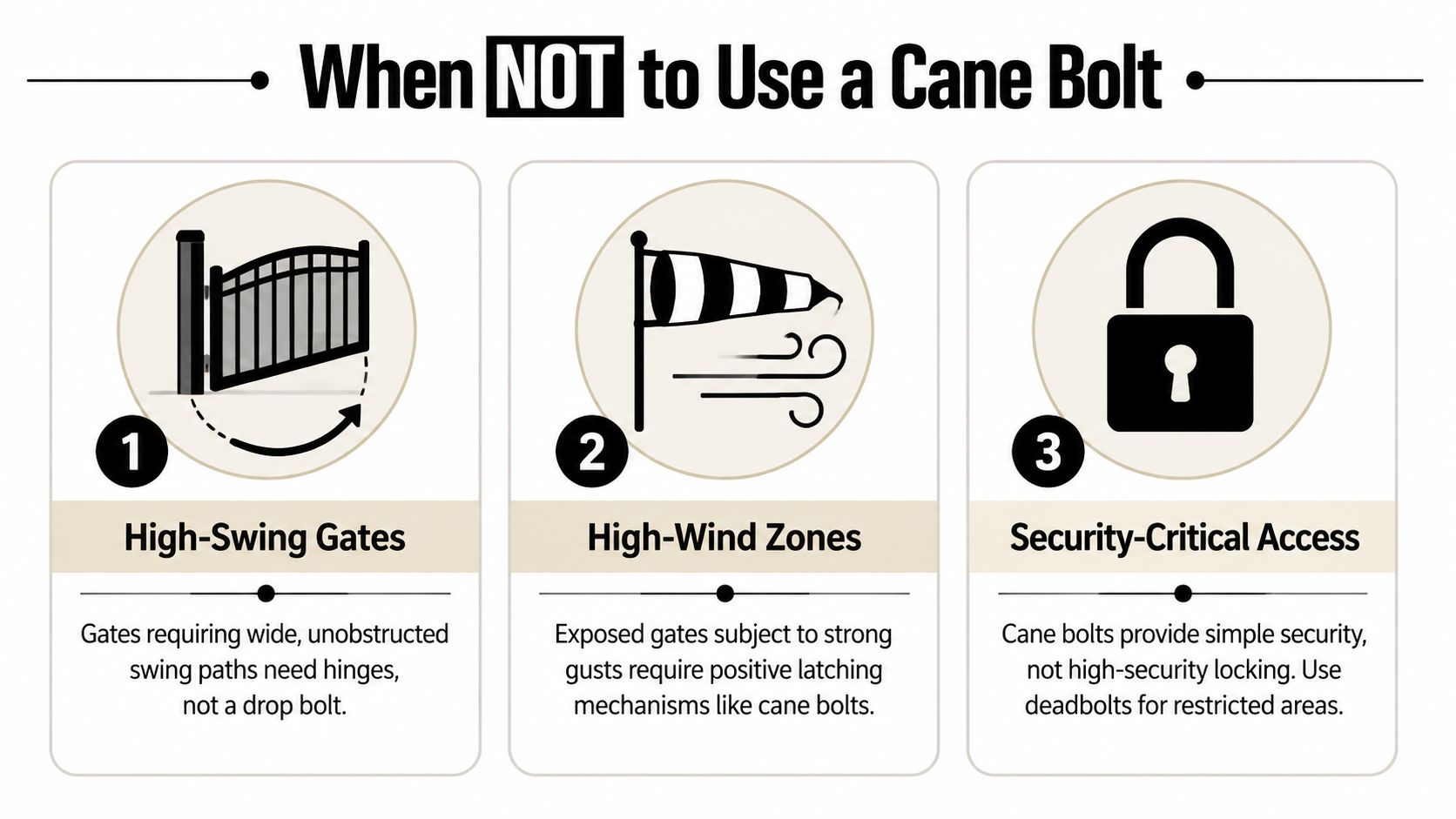
A cane bolt is a stabiliser, not a cure-all. If the gate needs high security, a basic drop rod rarely does enough on its own, because it holds one leaf down but does not turn the system into a secure barrier. If the problem is extreme wind resistance or a wide commercial opening that racks under load, a heavier latch system, a gate stop, or a more substantial locking setup may be the better fit.
The same point applies to frequent vehicle access in Canadian weather. Manual drop rods work when the gate opens only now and then, but they become a burden fast when someone has to walk out, pull a rod, swing both leaves, and reset everything several times a day. In winter, that routine gets worse when snow, ice, and frost heave shift the ground receiver or throw the leaves out of line.
The right question is whether the gate needs one
A cane bolt works best when one leaf just needs to stay fixed while the other leaf closes against it. It is not the answer for every double gate, especially where wind loads, abuse, or security expectations are high. For a broader latch comparison, the slide bolt latch guide helps show how different hardware handles restraint, because the decision often comes down to how much holding force the gate needs.
Before buying, check three points.
- Gate width and movement: wider gates flex more, and flex makes simple drop rods less forgiving.
- Wind exposure: open lots, exposed yards, and coastal properties need hardware that stays aligned under repeated gusts.
- Usage frequency: if people or vehicles need the gate open often, a manual rod can become more nuisance than solution.
A cane bolt can stabilise a double gate, but it will not automatically solve racking, forced entry, or poor hinge alignment.
If the gate already has sag or the opening is under constant stress, start with the structure, then choose hardware. The right fix matches the gate's load and the site conditions, especially where freeze-thaw movement can shift a surface-mounted receiver enough to cause winter misalignment.
Step-by-Step Installation Process
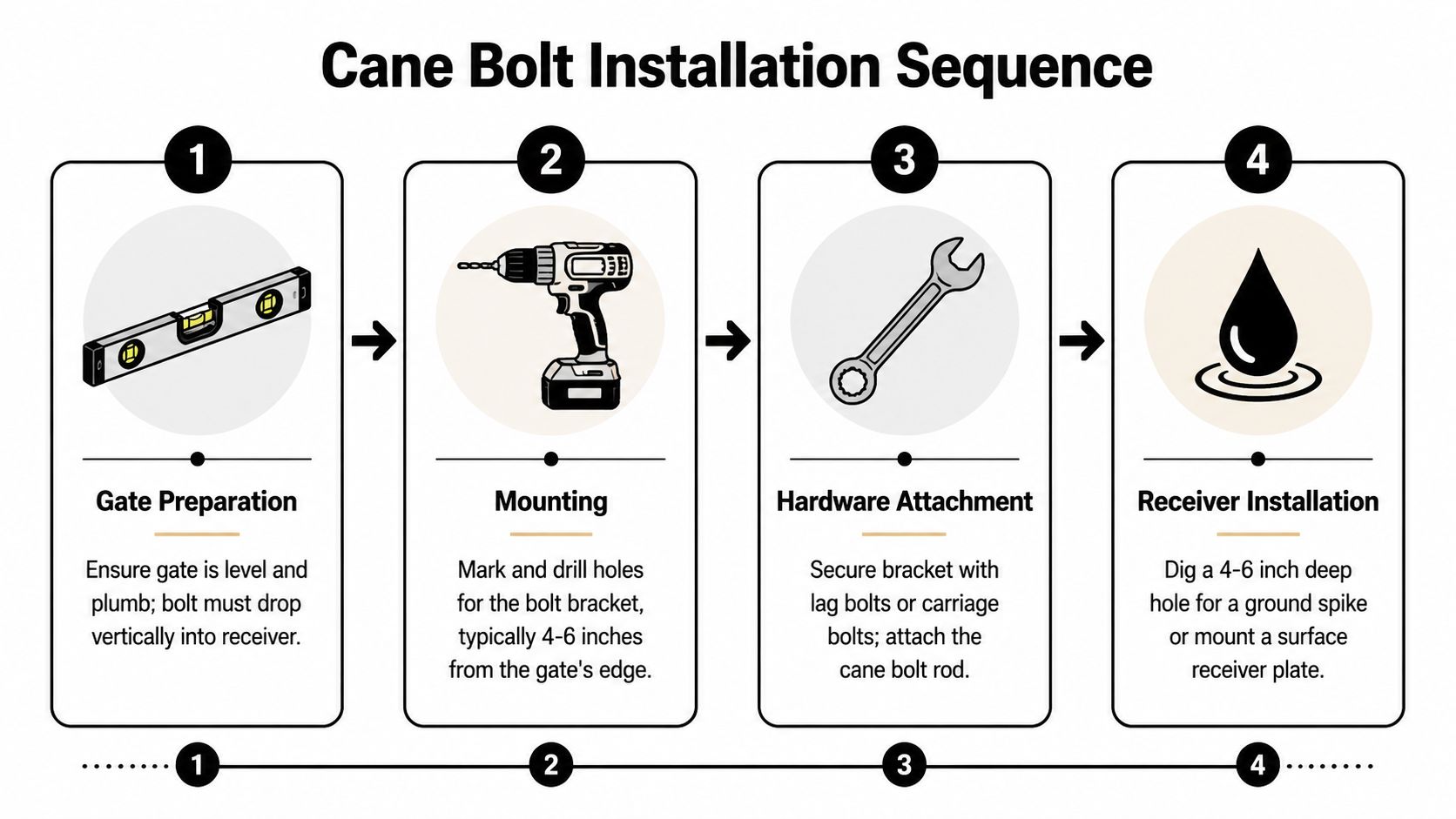
A cane bolt only works cleanly if the gate is already sitting right. Start with the leaf closed, level, and hanging plumb. The rod has to drop vertically without rubbing, so if the gate sags or the frame twists under hand pressure, correct that first. In a Canadian winter, a small alignment problem in fall can turn into a receiver that refuses to line up once the posts move through freeze-thaw.
Mount the bolt bracket to the gate frame with the included screws and the standard 4-hole pattern. On many gates, the body sits a few inches in from the edge so the rod can fall beside the post or into the ground socket without scraping the frame, but the final position still has to match the gate, the post, and the receiver location. The basic installation guidance shows the same principle, the hardware has to follow the gate's actual movement, not just the drawing.
Set the engagement depth before you drill the receiver
Aim for about 2 to 3 inches of rod engagement in the socket for steady retention. That depth gives the bolt enough bite to resist bounce and minor movement. If the rod only enters the receiver a little, it may look installed, but it will not hold well when moisture, soil shift, or daily use start working on the gate.
Set the ground receiver or hole directly under the rod's path. If the opening is offset, the rod binds and the gate never drops cleanly. Drill pilot holes where needed, keep the bracket square, and stay clear of the concrete edge, because fasteners too close to a corner can cause breakage or spalling much sooner than homeowners expect. For concrete anchors, use the right fastener for the slab, and review a practical guide to wedge anchors in concrete before you commit to the hole locations.
The sequence stays simple on site.
- Check alignment. Make sure the inactive leaf closes where it should.
- Mark the bracket. Confirm the rod will fall straight down.
- Drill pilot holes. This improves screw bite and reduces splitting or breakout.
- Install the receiver. Set the socket or hole where the rod naturally lands, not where you want it to land.
Field note: if the bolt binds on the first test, do not force it. Move the receiver instead. Forcing the rod usually hides a larger alignment problem, and that problem shows up again once the weather changes.
For a visual walkthrough, the installation sequence infographic is below, and the embedded video can help when you are comparing rod position with post clearance.
Mounting Surface Options for Canadian Freeze-Thaw Climates
The mounting surface is where a lot of cane bolt problems start, especially in Canada. Soil-set receivers are easiest to install, but they're also the most vulnerable to heaving and seasonal movement when the ground freezes and thaws. That kind of shift doesn't always break the hardware, it just knocks the receiver out of alignment enough that the rod stops dropping cleanly.
Concrete-set receivers are more stable, but they still depend on good placement and enough depth to stay put. If the concrete cracks or the receiver is set too shallow, winter movement can still create trouble. Surface-mounted receivers sit on a slab or timber and give you the most flexibility for later adjustment, which is why they deserve more attention than most how-to content gives them.
Soil, concrete, or surface mount
The best choice depends on how your site behaves through winter. If your gate area is sheltered and the soil stays relatively stable, a ground-set receiver may be acceptable. If your property sees repeated freeze-thaw cycles, slab movement, or small alignment changes every spring, a surface-mounted receiver often makes more sense because it can be adjusted rather than buried and forgotten.
For concrete anchoring, the fastener choice matters too, and the hardware should be matched to the substrate. A practical guide to fastening into concrete is the wedge anchors in concrete reference, which is useful when you're deciding how much permanence you want from the mounting point.
Use this rough comparison when you're choosing:
- Ground spike receiver: simplest install, but most prone to frost heave and misalignment.
- Concrete-embedded receiver: more permanent, better initial stability, but harder to change later.
- Surface-mounted receiver: more parts to install, but easier to adjust when the gate shifts.
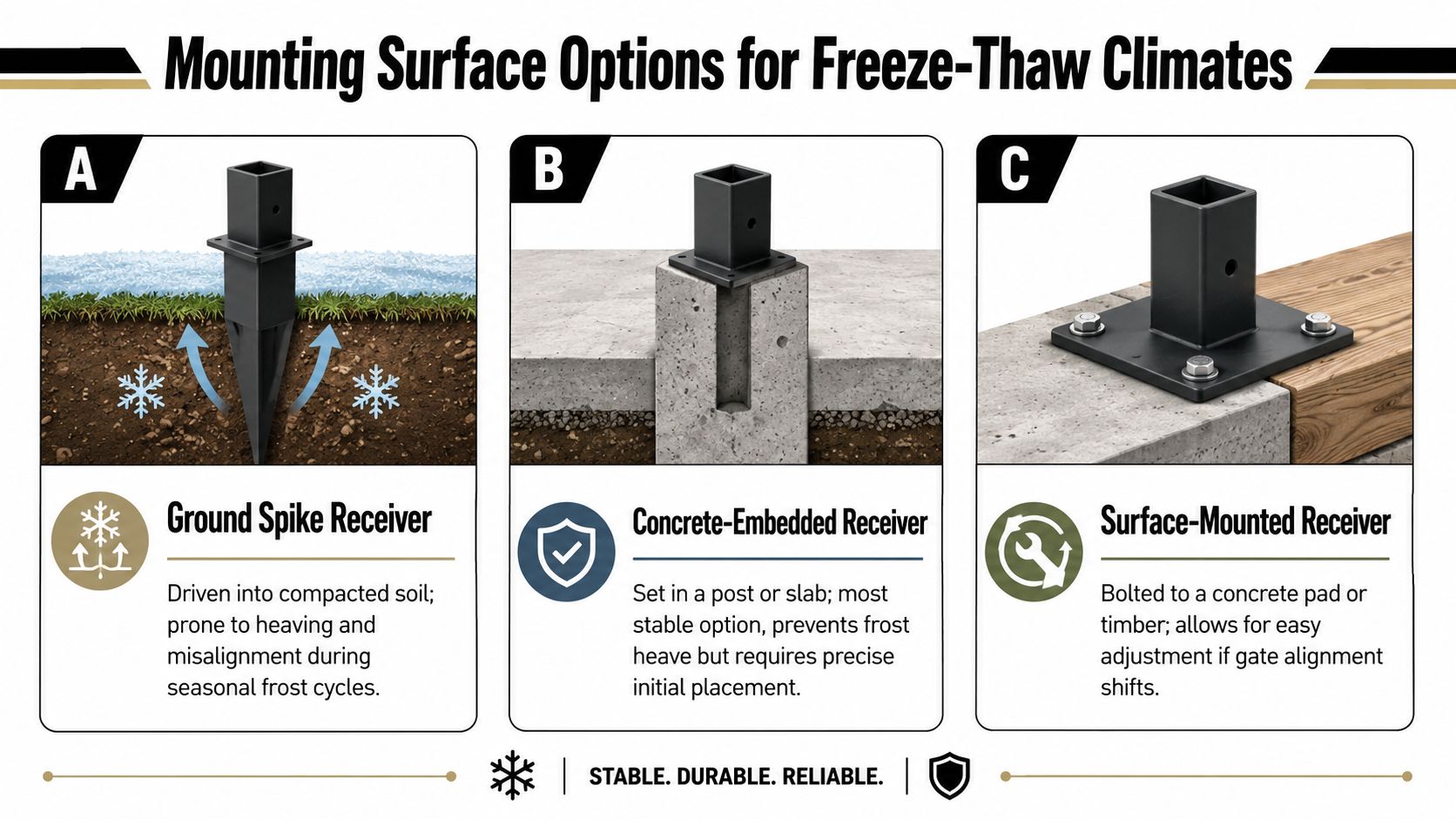
In freeze-prone regions, the main goal is to avoid a receiver that drifts out of line over winter. If you know your soil moves every spring, build for adjustment, not just initial installation.
Buying Guide for DIYers and Professional Contractors
For a DIY homeowner, the safest buy is usually the simplest one that still fits the gate properly. That means checking the rod length, bolt diameter, included fasteners, and finish before anything else. If the gate is exposed to damp weather, stainless steel is worth the upgrade. If the gate is sheltered and the budget is tight, zinc-plated or powder-coated steel can still be serviceable.
Professional contractors should think in terms of repeatability. A product with clear dimensions, included mounting hardware, and consistent finish saves time on site and reduces return trips. Multi-packs make sense when you're stocking for several gates, while single units are fine for one-off repairs or a homeowner replacing a worn rod. XTREME EDEALS INC. carries fence and gate hardware through its fence and gate hardware selection, and that's the kind of catalogue that helps when you need a straightforward match for an existing gate.
What to check before you buy
- Included hardware: screws, bolts, and receiver parts should be listed clearly.
- Exact dimensions: don't guess at rod length or diameter.
- Finish type: stainless, zinc-plated, or powder-coated should be obvious in the listing.
- Use case: double gate, single leaf hold-open, or lockable setup.
For contractors who want a broader hardware reference while planning a gate package, the deck framing hardware guide is a useful reminder that fastening details matter just as much as the visible hardware. The same thinking applies here, choose the rod, receiver, and fasteners as one system.
If you're buying for a weather-exposed Canadian property, don't chase the cheapest line item. Spend for the finish and size that match the load, then keep the hardware simple enough to maintain.
Maintenance and Troubleshooting Common Problems
Most cane bolt issues show up as binding, not failure. If the rod starts catching, the first thing to check is the gate itself. A sagging hinge, a shifted post, or a leaf that no longer sits square will make a perfectly good cane bolt seem defective. The hardware can only drop cleanly when the gate stays aligned.
Corrosion is the next common problem, especially on coated steel models. If the finish is scratched during installation, moisture gets to the base metal and rust starts there first. Stainless models avoid that maintenance headache better than coated carbon steel, but even stainless still benefits from an occasional rinse and inspection after messy weather.
What to check after winter
Seasonal movement is the big Canadian issue. After thaw, test whether the rod still drops 2 to 3 inches into the receiver and whether the gate still sits level when closed installation guidance. If the fit changed, the problem may be ground movement rather than the bolt itself, and you may need to adjust the receiver or correct the hinge side.
A quick maintenance routine helps:
- Lubricate moving parts: keep the rod sliding freely.
- Inspect coating damage: touch up scratches before rust spreads.
- Check depth engagement: make sure the rod still seats fully.
- Watch for repeated binding: that usually points to sag, not the rod.
If the rod bends or the gate keeps pulling it out of alignment, the hardware is probably undersized for the load. If the gate is otherwise solid but the receiver has moved, repair the mounting point instead of replacing the whole bolt. That distinction saves money and keeps you from swapping parts when the core issue is movement in the structure.
If the rod works in summer but not after thaw, look at the ground and hinges before you blame the bolt.
For a property that sees constant movement or rough use, upgrading to a heavier-duty rod is the cleanest fix. For everything else, seasonal checks and a little lubrication keep a cane bolt working for years.
XTREME EDEALS INC. carries practical fence and gate hardware that fits real repair work, not just showroom installs, so it's a useful place to compare cane bolts, fasteners, and matching accessories in one order. If you're sorting out a stubborn double gate or planning a new install in Canadian weather, visit XTREME EDEALS INC. and choose the hardware that matches your gate, your climate, and the way the gate gets used.