
The usual advice is to choose the head shape first, then buy an exterior version if the project sits outdoors. That's backwards. Treated-lumber compatibility and connection loads should pick the screw; the round head determines its visible profile and bearing surface. A tidy dome won't rescue a coating that reacts with the timber or a screw that lacks the required structural capacity.
If you're searching for wood screws round head, start with the connection, not the photograph on the box. A fence bracket, kitchen fitting and deck ledger can all involve wood, but they don't call for interchangeable fasteners.
Round Head Wood Screw Sizes at a Glance
Gauge identifies a diameter category, not a load rating. Use it to narrow the options, then check the screw's approved application, effective thread engagement and fit with the hardware. Coating and connection requirements come before head style.
Round head wood screw gauges, diameters and typical lengths
| Gauge | Nominal diameter | Common lengths | Typical use |
|---|---|---|---|
| #6 | 0.138 in (3.5 mm) | 1-1/4 to 2 in | Trim, cabinet hardware and light brackets |
| #8 | 0.164 in (4.2 mm) | 1-1/2 to 3 in | Fence rails and general exterior carpentry |
| #10 | 0.190 in (4.8 mm) | 2 to 3-1/2 in | Deck boards, framing and heavy brackets with application approval |
| #12 | 0.216 in (5.5 mm) | 2-1/2 to 4 in | Heavier connections where the code or evaluation allows |
Treat these lengths as common shopping categories, not a fastening schedule. Compare the screw's labelled diameter with the bracket hole size. It should pass through without forcing or enlarging the hole, while the head or an approved washer bears properly around it. A larger gauge can leave too little wood beside the fastener.
Count the length inside the receiving member
Consider a 2×6 deck board measuring 1-1/2 inches thick fastened to a joist with a 2-1/2-inch screw. Subtracting the board thickness leaves only 1 inch extending into the joist, before accounting for the screw point or a gap between the members.
That may be too short if the approved connection requires more effective thread engagement. The acceptable length depends on the deck system, screw design and installation schedule, so this example is not a universal rule.
Measure the useful engagement: The screw length buried in the top board does not provide withdrawal resistance in the joist beneath it.
Measure a round-head screw from the underside of its head to its tip. Include the bracket or washer thickness when calculating how much reaches the framing, and check that the tip will not emerge through the far side. Then confirm the connection's load requirements and the coating's compatibility with the lumber before choosing a finish or drive. Record the required gauge and length first, so a suitable-looking head does not distract from an unsuitable shank.
Head Shapes and Drives That Change the Job
A round head wood screw has a domed, rounded top that sits proud of the surface, a broad bearing face for washers and brackets, and a shank that threads into wood without a nut.
That exposed dome is useful when you want a deliberate hardware finish. It's less useful where clothing, furniture or a sliding component could catch on it.
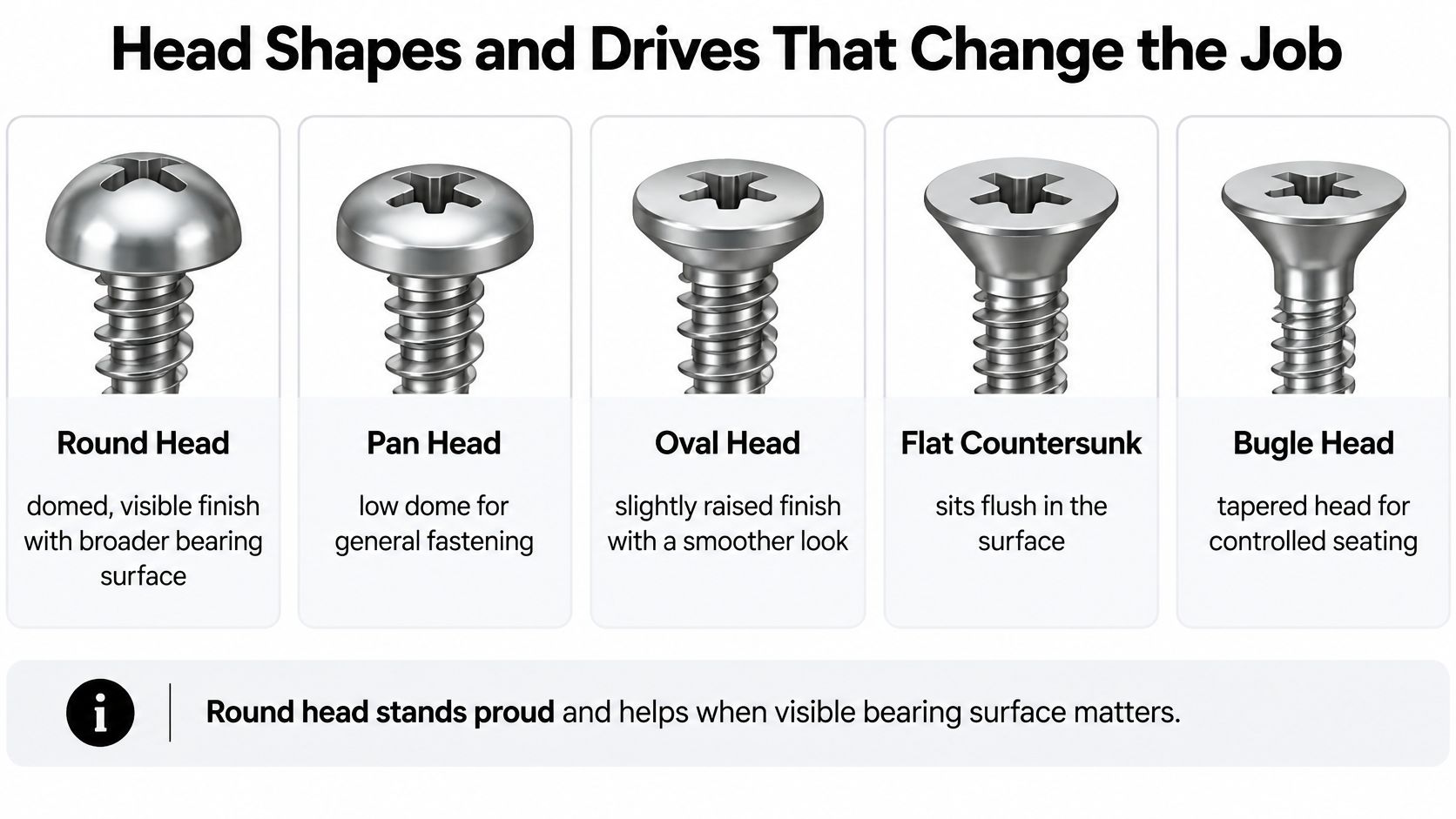
Match the underside to the surface
| Head shape | How it seats | Best reason to choose it |
|---|---|---|
| Round | Flat bearing face beneath a prominent dome | Visible washers, suitable brackets and decorative hardware |
| Pan | Flat underside with a lower rounded profile | Metal-to-wood fittings where projection matters |
| Oval | Countersunk underside with a slightly raised top | Decorative trim and matching countersunk hardware |
| Flat countersunk | Conical underside seated in a matching recess | A level finished surface |
| Bugle | Curved, tapered underside | Controlled seating in compatible board applications |
A round head can bear across a washer rather than wedge into it like a countersunk head. That doesn't mean it fits every bracket: some fittings have formed countersinks and require the matching head geometry.
For a fence bracket designed for flat-bearing hardware, a round head and compatible washer can make sense. For a trim board that needs filling and painting, a flush countersunk head is usually the better starting point.
Choose the drive separately
- Phillips: Widely available, but the bit can climb out under high torque. Keep the bit aligned and replace it when its edges wear.
- Square or Robertson: Provides positive engagement and suits controlled driving, including awkward cabinet positions.
- Torx: Offers strong torque transfer with little tendency to cam out when the bit fits correctly.
Torx is a sensible power-driver choice, but no recess compensates for an undersized pilot hole. An impact driver can break a screw before the operator realises how much resistance the timber is creating.
For heavier hardware, compare hex-head wood screws and their applications rather than assuming a round head is the only exposed option. Head shape doesn't establish code compliance; the approved material, dimensions, coating and application do.
Choose round when visible bearing area matters. Choose a flush head when the finished surface must remain level.
Coatings That Survive Treated Lumber
Copper-bearing preservatives can accelerate corrosion of ordinary steel when treated wood becomes damp. BC Housing's guide to safe, durable decks and balconies identifies G-60/G-90 electroplated galvanized steel and aluminum as insufficient for treated-wood contact, while identifying hot-dip galvanized G-185 as acceptable.
This is why colour isn't a corrosion specification. A bright silver screw, a dull grey screw and a brown-coated screw may have very different permitted uses.
Coating options matched to exposure and treated wood
| Coating or material | Typical exposure | Treated-wood contact | What to check |
|---|---|---|---|
| Electroplated zinc (G-60 or G-90) | Dry interior | Not suitable | Thin coating, avoid for decks and fences |
| Hot-dip galvanized (G-185) | Exterior | Acceptable | Confirm the coating class on the product sheet |
| Stainless steel (304 or 316) | Exterior and coastal | Suitable when compatible with the treatment and hardware | Choose 316 where salt exposure is heavy |
| Polymer or ceramic coating | Exterior | Only if evaluated for treated wood | Require an evaluation document |
| Bare steel | Dry interior | Not suitable | Rusts quickly outdoors |
The stainless grades in the table are selection starting points, not blanket approvals for every assembly. For salt-heavy sites, I'd start with marine-suitable stainless hardware and confirm the complete connection specification, including washers and brackets.
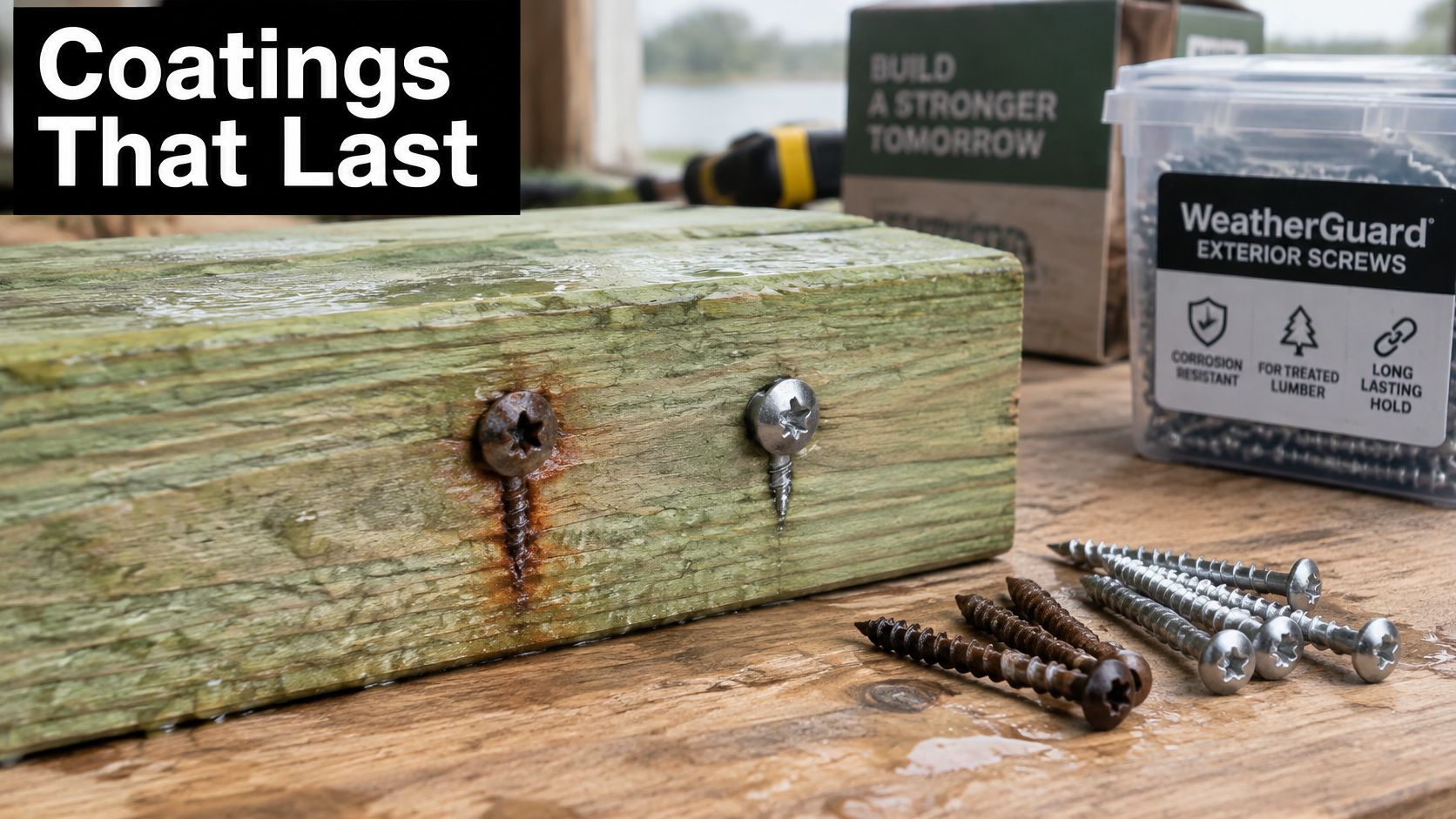
Read the permitted use, not the finish name
A coating can look substantial without having approval for the intended timber treatment. A Canadian Construction Materials Centre evaluation of surface-coated structural screws explicitly excludes preservative-treated wood for the products it evaluates, illustrating why structural branding alone isn't enough.
Corrosion can remove metal at the shank, beneath the head or around the bearing face. You may still see an intact dome while the concealed connection has lost useful section or clamping force.
Practical rule: Read the coating class and treatment compatibility on the product sheet. Don't approve a screw because the box says galvanized.
The trade-off between price and exposure is easier to assess with a galvanized-versus-stainless-steel comparison. Avoid mixing materials casually, particularly where moisture collects around brackets.
For a project that also includes exterior boards, TimberLodge365's guide to cedar cladding provides useful context for planning the timber finish alongside the hardware. Cedar cladding and pressure-treated framing shouldn't automatically receive the same fastening specification.
For exterior treated lumber, start with documented hot-dip galvanized or stainless fasteners, then confirm the exact product against the preservative, exposure and applicable evaluation. A generic finish description isn't enough.
Where Round Head Screws Fall Short on Structural Work
A tight-feeling screw does not prove a connection can carry its required load. Driving resistance reflects installation friction; structural capacity depends on the specified fastener and the way the connection transfers load.
Check the connection requirements before considering head shape:
- Nail substitutions need an approved basis. The Carleton Place Part 9 deck guideline requires substitute screws to be at least as long and large in diameter as the specified nail. In the relevant substitution context, it gives quantity adjustments of double for 9.5 mm (3/8-inch) fasteners and triple for 7.9 mm (5/16-inch) fasteners.
- Decking schedules belong to the evaluated system. A CCMC deck-plank evaluation specifies corrosion-resistant or stainless fasteners, at least two at every supporting joist, and a minimum length of 64 mm, about 2.52 inches.
- Withdrawal failure can be brittle. A Journal of Structural Engineering study relevant to Canadian timber designST.1943-541X.0003261) describes screw withdrawal failure as low-ductility and brittle.
Those substitution quantities do not make an unsuitable connection acceptable. Extra holes can create spacing problems, and matching a nail's dimensions does not give a general-purpose wood screw a published structural capacity.
Identify the load path before choosing hardware
Withdrawal resistance depends on thread engagement, wood density, moisture and installation geometry. For lateral lag-screw connections, the applicable design standard sets the minimum thread penetration into the receiving member. Follow that requirement alongside the full connection design.
Keep ordinary round-head screws out of structural connections unless an approved design specifically permits them:
- Ledgers: Use the specified lag, bolt or evaluated structural-screw arrangement.
- Guard posts: Follow a connection detail that addresses restraint.
- Joist hangers: Use only the connector manufacturer's permitted nails or screws.
- Other life-safety connections: Use the specified lag bolts, through-bolts or approved engineered alternative.
BC Housing's lag-bolt and through-bolt recommendations for critical deck connections do not establish a universal joist-hanger detail. For that distinction, see why ordinary deck screws don't belong in joist hangers.
Coating compatibility with treated lumber and load rules determine the screw; head shape affects appearance and bearing area. For a load-bearing connection, follow its code-compliant detail and product evaluation. A round head is a finish choice, not proof of structural suitability.
Driving, Fixing and Troubleshooting Round Head Screws
Prepare the hole before reaching for more driver torque. For conventional wood screws, careful drilling helps the head clamp the pieces together without splitting the receiving member.
The Canadian Wood Council guidance reproduced in the CBSA fastener reference covers 6-, 8-, 10- and 12-gauge screws complying with ASME B18.6.1, treats larger screws under lag-screw design requirements, and recommends pre-drilling screw connections. It describes the threaded portion as approximately two-thirds of overall length and requires a lead hole at least as long as the threaded shank where relative density is at least 0.5.
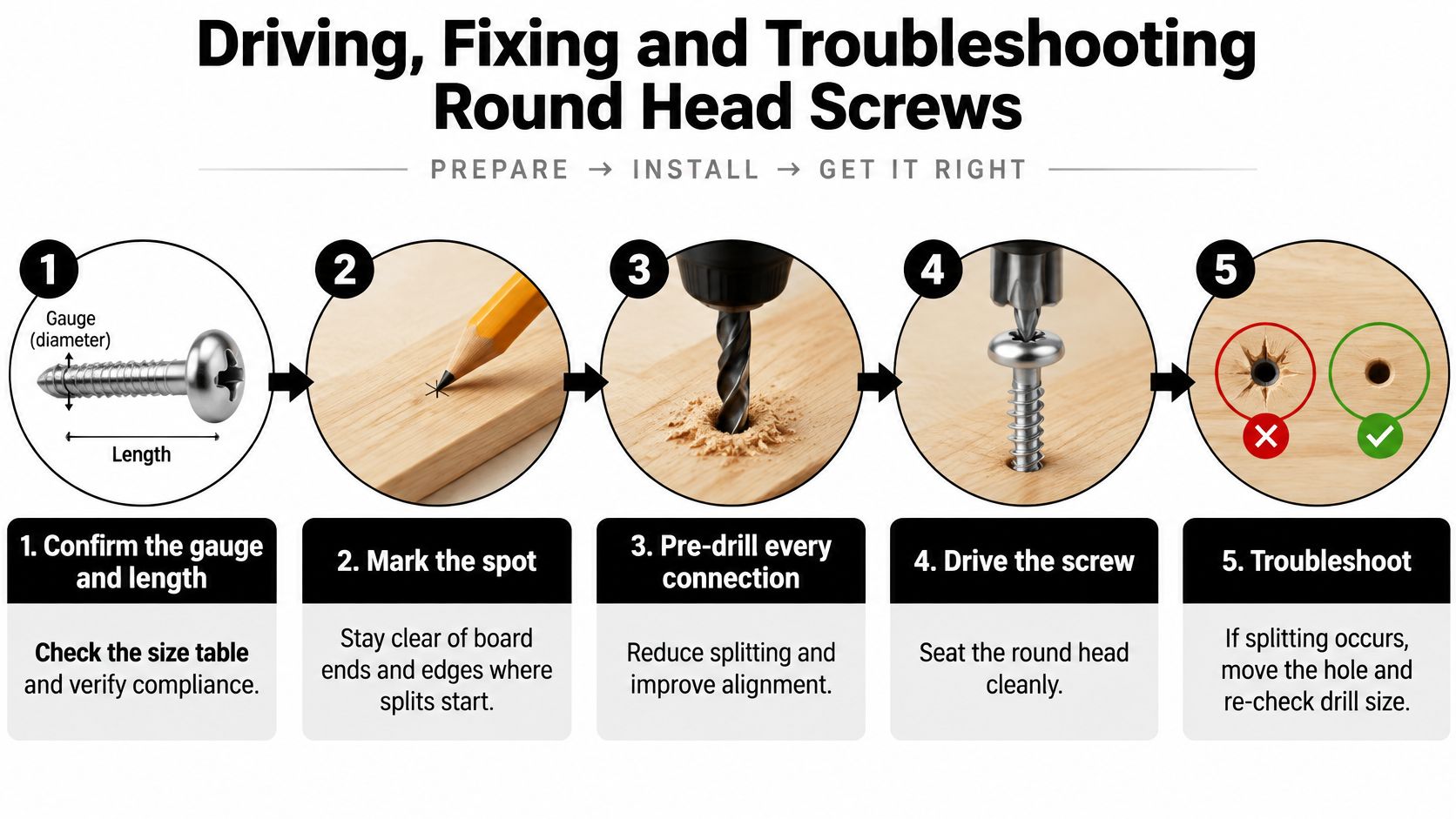
Set up the joint before driving
Confirm gauge, length and approval. Check the actual screw against the connection specification. Don't substitute a lookalike from an unlabelled container.
Mark clear of ends and edges. Use an awl to locate the centre and clamp the pieces in position. If the required edge distance won't fit, change the connection rather than forcing the screw into the remaining sliver of timber.
Drill the lead hole. Match the bit to the screw manufacturer's pilot-hole recommendation and the wood species. Mark the required depth on the bit with tape, measuring the screw's actual threaded length from its tip.
Clear the upper board where the joint requires clamping. A clearance hole lets the screw draw the upper piece against the receiving member. Threads biting both pieces can leave a gap locked between them.
Prepare the correct seat. A round head normally needs a flat bearing surface, not a conical countersink. Counterbore only where the detail allows a recessed head without excessively weakening the board.
Drive slowly and stop firmly. Start with a low clutch setting and keep the bit square to the recess. Stop when the bearing face seats; don't bury the dome in softwood.
Fit washers where specified. A compatible washer can distribute load beneath suitable brackets or thin metal. Don't add one where the connector's approved detail requires direct head contact.
A good installation has a level, firmly seated bearing face, no visible edge split and no gap between the clamped pieces. The top of a round head remains domed; it shouldn't be flattened or driven flush.
Diagnose the cause before replacing the screw
Symptoms, causes and fixes for round head wood screws
| Symptom | Likely cause | Fix |
|---|---|---|
| Board splits near the end | Missing lead hole or insufficient edge distance | Pre-drill the threaded length and relocate inward; replace a split structural member |
| Head cams out or strips the recess | Worn bit, wrong size or poor alignment | Fit a fresh matching bit; change to a compatible square- or Torx-drive screw if appropriate |
| Head snaps off | Excessive resistance in dense wood | Extract the broken fastener, drill correctly and install a new screw |
| Hole strips and the screw spins | Oversized pilot or overdriving | For non-structural work, repair and redrill or select an appropriate larger or longer screw |
| Rust streaks on treated wood | Incompatible corrosion protection | Replace with compatible stainless or specified hot-dip galvanized screws; inspect concealed damage |
| Head sinks below the surface | Overdriving in softwood | Use a depth stop and assess whether the damaged bearing area needs repair |
Bit changes and clutch adjustments can be minutes-level fixes. Split structural timber, extensive corrosion and failed load-bearing connections need inspection and potentially a rebuild, not another screw beside the damage.
For decorative interior fittings, establish alignment and head appearance before final tightening. The White Kitchen Company's guide to finishing touches for bespoke wood kitchens is useful when matching visible hardware to a kitchen's overall character.
Never repair a structural hole with filler and assume its capacity has returned. Likewise, exterior and rust-resistant labels don't establish treated-wood suitability without the supporting product documentation.
Confirm the Screw Before You Buy
Buy from a written connection list rather than choosing a box by its front label. Separate decorative attachments, board fastening and structural connections so that the hardware for one doesn't get used casually for another.
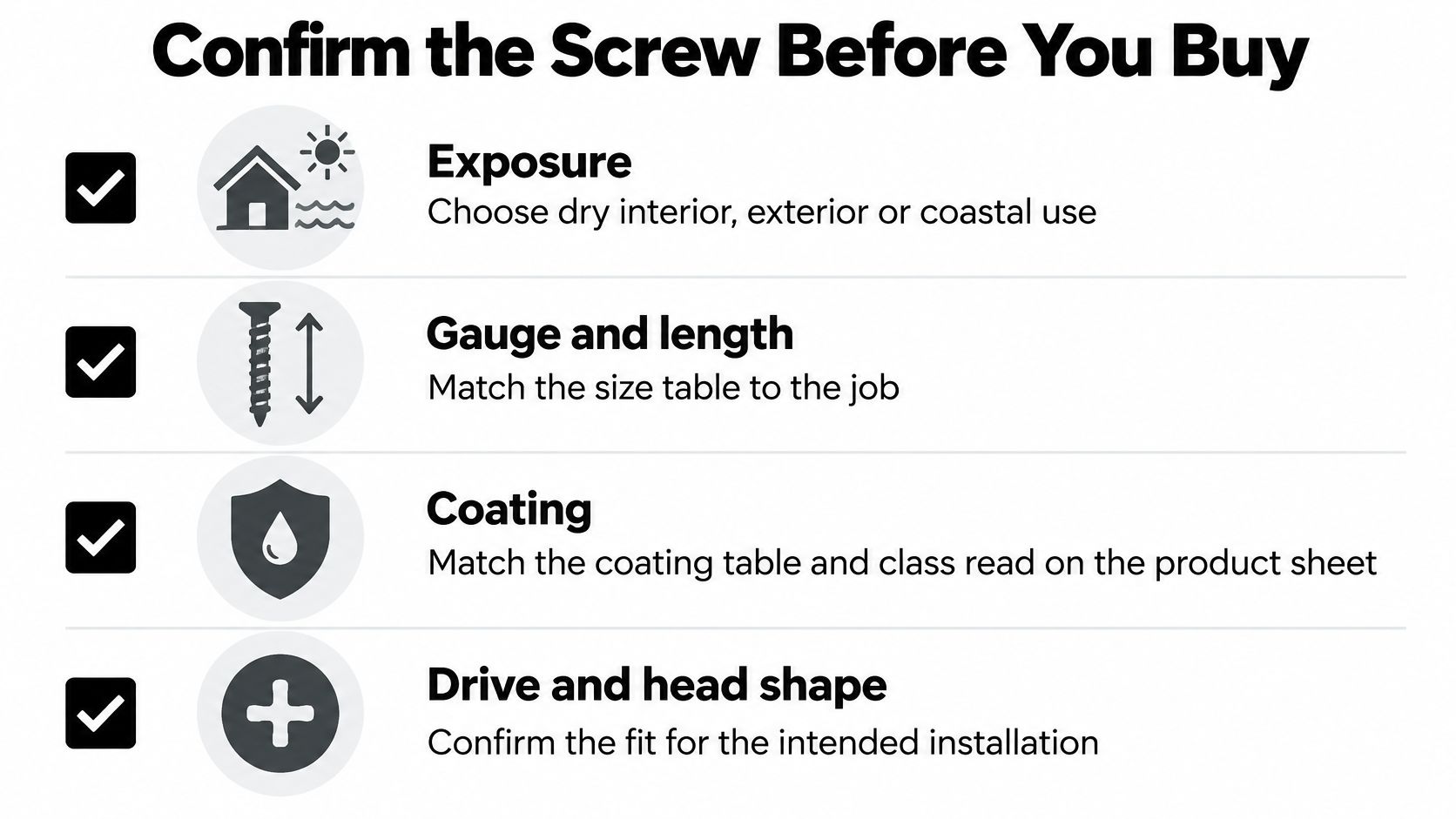
Make the purchasing decision in this order
- Exposure: Record whether each connection is dry interior, exterior or coastal. Note treated timber and locations that trap moisture.
- Gauge and length: Include the thickness of boards, brackets and washers, plus the required engagement in the receiving member.
- Coating: Read the documented coating class and permitted timber treatments. Keep an evaluation document where the application relies on one.
- Head and drive: Check the bracket seat, desired finished appearance and the bits you'll need.
- Load: Identify connections requiring a prescribed fastening schedule, connector-specific screws or an engineered detail.
Don't buy a round head just because the search term matches your project. A countersunk board screw or an approved hex-head structural fastener may be the correct purchase.
Match the product to the connection
Our 1/2″ x 8″ Lag Bolt Screws have hex heads, are hot-dip galvanized, meet ASTM A307, and come in 10-piece boxes. They're a product to assess when a connection detail calls for lag screws, not a universal replacement for round-head screws; confirm the listed specifications, coating class and suitability for that exact detail before ordering.
Our #10 x 3″ Deck Screws have a bugle head, square drive and brown ruspert finish, and cost $125.99 for a 2,000-piece box. They aren't round-head screws. Buy them only where the job calls for that seating profile, and verify treatment compatibility rather than inferring it from the brown coating.
Order the fastener the connection requires, even when that means leaving the round-head category.
Count the required fasteners from the approved installation schedule, then choose a box size suited to the work. Keep different fastener types in labelled containers, particularly when several crews or helpers share the project.
Save the product sheet, coating information and installation instructions with your project record. That gives you a reliable specification for later repairs instead of leaving the next person to identify a weathered screw by eye.
XTREME EDEALS INC. offers deck screws, lag bolts, washers and deck and fencing hardware for planned builds and repairs. Visit XTREME EDEALS INC. with your connection list, compare the listed specifications, and order the head style, coating and box size your project needs.