
Buying the highest-rated hinge you can find isn't a reliable way to stop a gate sagging. A wide leaf can overload its attachments, twist a post or expose a weak footing even when the hinge's advertised weight rating looks generous. Adjustability is useful for alignment, not a substitute for structural capacity.
If you're searching for “gate hinges heavy duty adjustable”, start with the complete assembly: gate, hinges, fasteners, post and foundation. Then check the opening's safety requirements and exposure conditions. That approach separates hardware that merely fits from hardware you can maintain safely.
Heavy Duty Adjustable Gate Hinge Types Compared
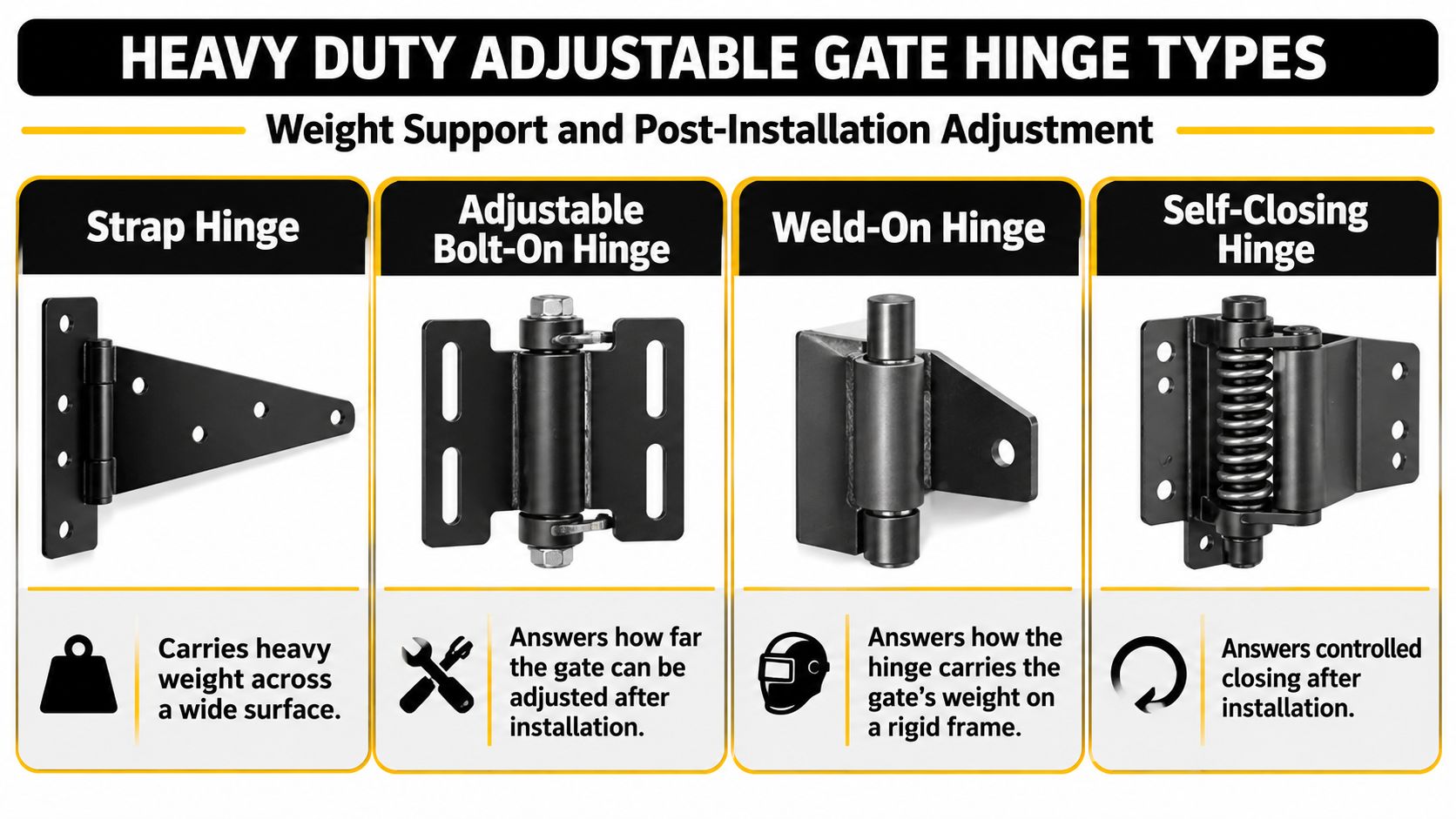
Heavy duty adjustable gate hinge types at a glance
| Hinge type | How it carries load | Adjustment | Best setting |
|---|---|---|---|
| Strap hinge | Long bolted strap spreads load across the gate face | Limited, set by bolt position | Timber and light steel gates |
| Heavy-duty butt hinge | Pin and leaf; weight rides on the pin | Low unless paired with an adjusting nut | Steel fence and yard gates |
| Self-closing hinge | Spring or cam return closes the gate after opening | Tension adjustment on many models | Pedestrian and pool gates |
| Adjustable pivot hinge | Threaded or eccentric adjustment in vertical and lateral axes | High, with lock nuts or set screws | Driveway and large gates that settle |
These categories describe different functions, so they can overlap. A pivot hinge might bolt onto a post or weld onto a reinforced bracket; a self-closing hinge might also offer lateral alignment. Mounting method, load support and adjustment are separate specifications.
The visual comparison highlights the mounting arrangements you'll commonly encounter.
Which type belongs on your shortlist
Strap hinges suit timber gates because the long leaf lets you attach hardware across a substantial rail rather than concentrate every fixing near the edge. Position matters: a long strap screwed into thin cladding won't make that cladding structural. Light steel gates also need suitable reinforcement behind the fixing points.
Heavy-duty butt hinges suit steel fence and yard gates with sound mounting faces. Their compact shape is useful where a strap would interfere with infill. Weld-on versions offer a permanent attachment, but correcting a misplaced weld is considerably harder than repositioning a bolt-on bracket.
Self-closing hinges belong on pedestrian and pool-gate shortlists. Check whether the mechanism controls closing speed or only provides return force. Increasing spring tension to overcome binding is the wrong fix, because it can leave a gate difficult to open and harsh when it closes.
Adjustable pivot hinges are the practical starting point for large driveway gates where future realignment is likely. Look for accessible adjusters, a positive locking method and enough usable travel after installation, rather than consuming the entire range during initial fitting.
Match the hinge to the gate construction
Before settling on a hinge, decide what the gate frame and adjoining fence will be. Equity Building Materials, Inc.’s fencing options for Central Valley homeowners can help compare privacy and ranch-rail settings before you specify the moving leaf.
A solid privacy gate and an open rail gate present different loading conditions. Shortlist by construction and use, then verify weight, width, attachments and exposure rather than treating the hinge style as a capacity guarantee.
Load Ratings and Hinge Count by Gate Width
For Canadian chain-link and similar swing-gate applications, the Canadian General Standards Board specification requires three hinges per section for gates 3 m (10 ft) or wider, with adequate hinge strength and sufficient bearing surface for clamping or bolting. That's a useful purchasing threshold within its scope, not a universal rule for every gate construction.
An advertised weight rating may describe a static test or a complete hinge set. Actual service also involves opening cycles, wind on the infill and force from the unsupported latch end. Don't assume a rating covers those conditions unless the technical sheet says so.
Hinge count and verification by gate type
| Gate width or setting | Hinges per section | What to verify |
|---|---|---|
| Under the Canadian specification's width trigger, single leaf | Two as an initial screening arrangement | Each hinge's rating covers the full leaf weight with margin; confirm the manufacturer's arrangement |
| At or above the Canadian specification's width trigger | Three | Canadian specification sets three hinges per section |
| Engineered commercial gate, Ontario | Set by engineer | Lateral and vertical design loads apply to the gate system, not one hinge |
| Fire-access gate with required clear opening | Set by manufacturer and engineer | Width alone does not set count; check manual operation and clearance |
Work from the complete leaf
Use the finished weight, including infill, latch, decorative inserts and attached operating hardware. Obtain it from the fabricator, calculate it from documented component weights or weigh the safely supported assembly.
Then follow this screening method:
- Establish the service load. Account for exposure and operating frequency using the manufacturer's selection guidance or an engineer's design, not an invented percentage.
- Divide by the proposed hinge count. This gives an initial average vertical share, not the final load on every hinge.
- Check the complete attachment. Review barrel dimensions, plate thickness, bolt size, edge distances and post reinforcement.
- Confirm the approved arrangement. Obtain the required hinge spacing and any gate-width limitation.
The average share doesn't capture unequal load distribution or the forces that resist the gate's tendency to rotate downward. A supplementary hinge can distribute support and reduce sag, but only when the frame is stiff enough and the pivots share an axis. A misaligned extra hinge can cause binding instead.
Rating check: Never multiply a per-pair rating by the number of individual hinges.
Read the assumptions beneath the rating
Look for wording such as per hinge, per pair or per gate set. Also check whether the test assumes a rigid steel post, a particular bracket or a maximum leaf width.
For engineered Ontario commercial work, the designer sets the arrangement. For fire-access gates, the approved gate design and manufacturer's instructions must also preserve the required opening and manual operation. Neither application can be signed off by dividing weight alone.
Materials and Finishes That Survive Outdoor Exposure
Gate hinge materials and finishes by exposure
| Material or finish | Corrosion behaviour | Strength and loading | Best setting |
|---|---|---|---|
| Hot-dip galvanized steel | Zinc protects steel; cut edges and threads need attention after modification | High-capacity designs suit heavy leaves | Most outdoor steel gates |
| Galvanized malleable iron | Galvanized finish needed outdoors | Suitable designs resist bending under repeated cycles | Commercial and engineered installations |
| Powder-coated steel | Coating protects until chipped; repair chips promptly | Set by the steel base and hinge design | Decorative gates in mild climates |
Hot-dip galvanizing provides sacrificial zinc protection, but drilling, cutting and damaged threads can compromise the protective system. Inspect modified areas and use a compatible repair treatment rather than painting over active corrosion.
Powder coating gives a clean decorative finish, but the hinge still needs protection where tools, washers and moving components damage it. Don't confuse an attractive black finish with a documented corrosion specification.
Match the assembly to its environment
For salt-air coastal properties, 316 stainless steel is generally preferable to 304 stainless steel where chloride exposure is a concern. Stainless isn't maintenance-free, and grade alone doesn't establish load capacity. A documented galvanized system can also be appropriate when damaged areas remain accessible for inspection and repair.
In dry inland locations, galvanized steel with an accessible, manufacturer-approved lubrication point is practical. In high-irrigation yards, inspect for repeated wetting and chemical residue around brackets and post bases. Redirecting a sprinkler can be more useful than repeatedly replacing stained hardware.
The Metrolinx fencing and gates specification calls for galvanized malleable-iron hinges, resistance to twisting under gate action and arrangements preventing a closed gate from being lifted off its hinges. Those are useful performance questions even where that commercial specification doesn't govern the project.
Fasteners and preparation matter
Specify compatible hot-dip galvanized or stainless bolts as appropriate to the assembly. Check washers, adjustment screws, anchors and backing plates too; a corrosion-resistant hinge body won't protect an unsuitable fixing.
For nearby painted timber affected by damp growth, mould preparation advice from Alex Trend Painters explains why preparation must precede repainting. Treat the moisture problem separately from hinge lubrication and metal coating repairs.
When planning a metal gate for outdoor use, leave physical access to every adjuster and service point. A beautifully finished bracket is a poor choice if you can't reach its locking nut once the fence is complete.
Adjustment Mechanisms and What They Can Fix
A dragging gate doesn't automatically need vertical adjustment. First identify whether the leaf has dropped, the frame has racked, the post has leaned or the hinge bearing has worn. Adjusting the wrong component can make the closed position look right while creating a bind during opening.
Use a spirit level, straightedge, tape measure and temporary support under the leaf. Support the gate before releasing any load-bearing adjuster, and isolate an automatic operator according to its instructions.
Diagnose the symptom before turning a nut
| Symptom | Adjustment to investigate | What to check first |
|---|---|---|
| Latch end sits low | Vertical threaded pin or approved shim arrangement | Frame squareness and bearing wear |
| Gate rubs a post or adjacent surface | Lateral eccentric bushing or slotted plate | Clearance through the full swing |
| Latch bolt misses the keeper | Combined height and lateral alignment | Whether the gate or latch moved |
| Gap widens toward the top | Differential hinge positioning | Post plumb and gate-frame distortion |
A vertical adjuster raises or lowers its support point. It doesn't necessarily remove a diagonal sag caused by a distorted frame. Lateral adjustment moves the leaf toward or away from the post, while coordinated hinge adjustment can change how the latch edge meets the keeper.
Latch-line adjustment is an alignment outcome, not necessarily a separate mechanism. Don't relocate the keeper immediately if the original gaps show that the whole gate has shifted.
Adjust, lock and test
Close the supported gate and measure the gaps at the top and bottom. Photograph the starting position and mark the adjuster so you can track movement.
- Change one axis at a time. Make small movements and watch the effect at both the hinge and latch ends.
- Secure the adjustment. Tighten jam nuts, set screws or locking pins using the manufacturer's procedure.
- Recheck engagement. The latch should enter its keeper without lifting, pulling or slamming the leaf.
- Cycle the gate ten times. As a practical commissioning check, watch the whole swing for rubbing, shifting gaps and adjuster movement.
A loose threaded component can creep during repeated operation. Confirm whether adjustment is permitted under load or intended only for final positioning with the gate supported.
A hinge should hold its setting. Repeatedly winding it farther out isn't a maintenance plan.
Adjustment won't repair a weak or leaning post, a moving footing, an unbalanced assembly or bushings worn beyond service limits. If the setting changes again, diagnose the structure and wear before using up the remaining adjustment travel.
When Hinge Choice Becomes a Code Issue in California
A heavy duty label doesn't establish compliance. The hinge must work within the gate's complete safety system, including retention, opening clearance, emergency access and any powered operator.
California's 2025 building standards took effect January 1, 2026, according to the California Building Standards Commission. The applicable requirements still depend on the gate's location, use and local jurisdiction.
Gate settings and the hinge requirements they trigger
| Gate setting | Requirement | Hinge implication |
|---|---|---|
| Pool gate, California, within the cited facility regulations | Swings away from the pool, self-closes and self-latches, with the latch no more than 6 in from the top, under the Department of Social Services regulations | Return action and latch alignment must remain reliable after adjustment |
| Fire-apparatus access gate, California, under the cited regional standard | 20 ft minimum unobstructed width, 13 ft 6 in minimum clear height, permit and applicable UL 325 and ASTM F2200 compliance, under the regional fire-access standard | Hinges must not bind; one person must be able to operate the gate manually |
| Regulated security or automated gate, California | ASTM F900 or ASTM F1184; balanced; no more than 45 degrees of fall if detached; positive stops on sliding gates, under Assembly Bill 2149 | Secure attachment and failure retention are essential; motorized systems also require compliant operators |
| Vehicular gate or gate over 48 in wide or 84 in high, San Mateo | The city's 2025 ordinance requires ASTM F1184 compliance and professional inspection at least every five years | Hinge specification must match the certified gate system |
| Gate in an electrical enclosure, California | At least 2 ft 6 in wide and 6 ft 6 in high, readily operable, with metal gates grounded or bonded, under Title 8, Section 2812.1 | Maintain clearance without sag; grounding is a separate electrical obligation |
| Engineered commercial fence, Ontario | Lateral 2.2 kN/m and vertical 1.5 kN/m design loads, engineer-certified | Request evidence for shear, pull-out, torsion and adjustment-lock retention |
The Ontario line loads apply to the gate system and foundations, not automatically to an individual hinge. Likewise, the California pool and fire-access rows have specific regulatory scopes; don't apply a facility rule or regional standard indiscriminately to every residential gate.
Different uses demand different checks
A pedestrian gate needs manageable operation and dependable latching. A driveway gate adds vehicle clearance and, where automated, operator compatibility and entrapment protection. A pool barrier needs its return and self-latching functions verified after every adjustment.
A regulated commercial gate also needs a plan for supporting-hardware failure. Anti-lift geometry isn't automatically an anti-drop system, and a stronger pin doesn't prove that the assembly will remain retained after detachment.
Before buying, obtain:
- The applicable code citation, including local amendments and inspection obligations.
- The gate manufacturer's installation instructions, including approved hinges and attachments.
- The operating-system requirements, where automation or emergency access applies.
Pull the actual local ordinance before specifying a San Mateo installation. Don't treat a general statewide summary as the final authority for pool barriers, egress routes or automated vehicular gates.
Installing, Inspecting and Replacing Hinges Safely
Keep the leaf supported throughout installation and replacement. Use rated lifting equipment or stable blocking suited to the gate, and keep people outside its possible fall and swing paths.
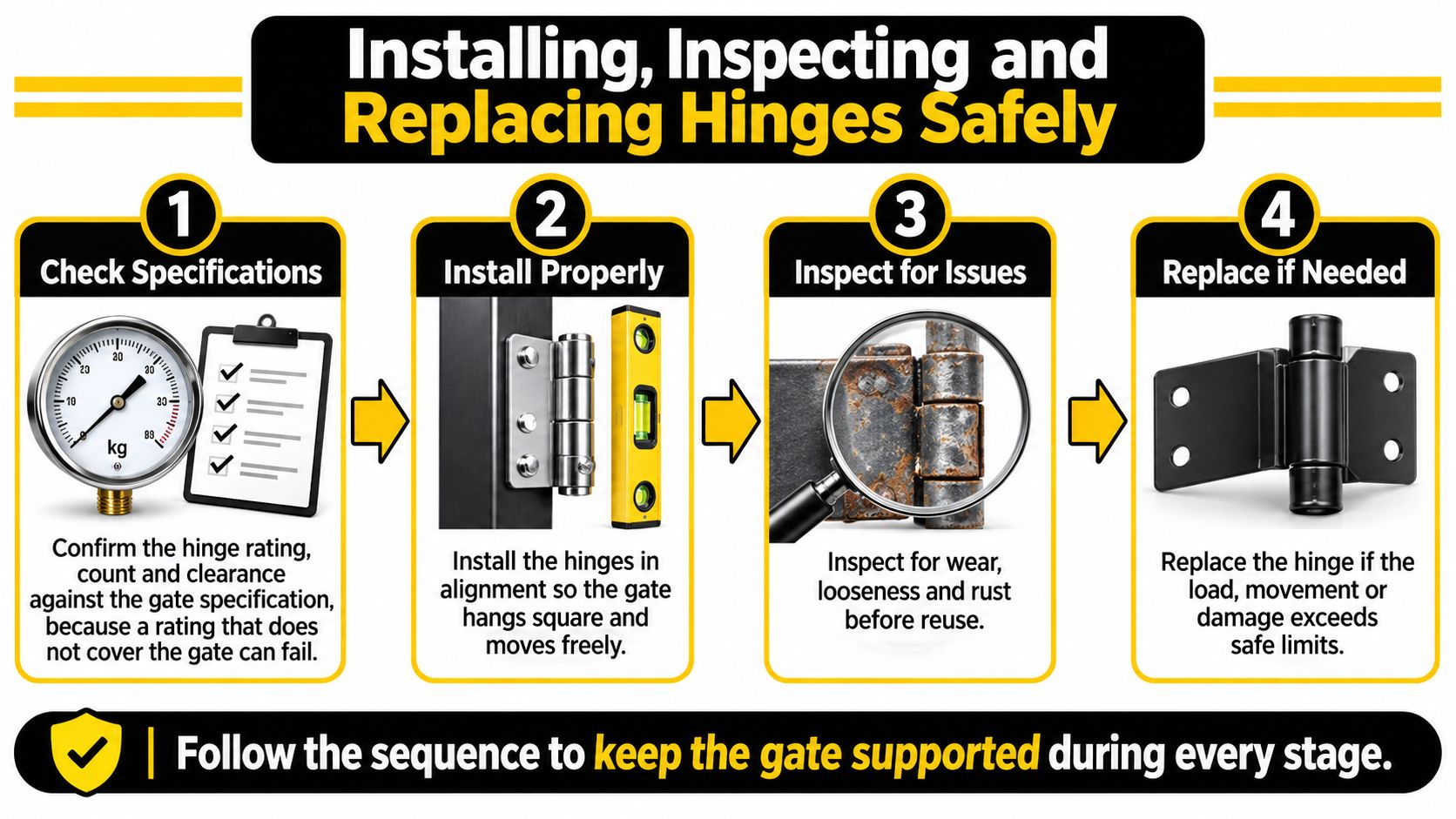
This process graphic summarises the safety sequence.
Install without forcing alignment
- Confirm rating, count and clearance. Hardware that fits the holes can still be unsuitable for the finished leaf.
- Check the post and footing. Use a level and inspect for movement, cracking and deteriorated mounting surfaces before attaching the gate.
- Locate the upper hinge. Establish the intended pivot axis while the leaf remains independently supported.
- Align the remaining hinges. Use a straightedge or alignment jig so the pivots don't fight each other.
- Torque and lock the hardware. Follow the specified fastener procedure and secure every adjuster before removing support.
- Test operation. Check balance, full swing, latch engagement and any self-closing function.
- Record the installation. Keep the hinge specification, settings, photographs and maintenance instructions.
The gate hinge installation guide provides additional planning context. For spring-loaded hardware, follow the hinge maker's tensioning sequence rather than improvising with an exposed spring.
Use the video as a visual supplement, not as a replacement for the instructions supplied with your particular hinge.
Set an inspection routine
As a practical owner-maintenance schedule, look monthly for drift, rubbing and changed gaps. Check after seasonal temperature swings, and carry out an annual torque and alignment inspection using the manufacturer's procedure. Arrange professional inspections wherever the applicable ordinance requires them.
California's current Title 24 code includes dedicated exterior wildfire-exposure provisions. That doesn't establish a universal hinge-cleaning interval, but exposed hardware still deserves attention after a fire event: remove ash and debris safely because grit and retained moisture can affect pins and threads.
Take the gate out of service for:
- Pitting or flaking at a load-bearing pin.
- Damaged threads that prevent secure locking.
- Drift beyond adjustment travel or unexplained recurring movement.
- Cracked welds or post movement affecting support.
Secure the opening, correct the underlying fault and recheck the complete assembly against its rating before reuse.
Choose Your Hinges and Confirm the Specs Before You Order
Order from a written specification, not a product photograph. A hinge can have the right colour and mounting shape yet lack the capacity, travel or return action your gate needs.
Complete the purchase check
- Record gate weight and width. Include the finished infill and hardware, then confirm the hinge count for the applicable gate specification.
- Choose the functional type. Match timber straps, steel-gate pivots or self-closing hardware to the actual use.
- Specify exposure protection. Consider salt air, irrigation, inland dust and access for cleaning.
- Verify adjustment details. Obtain usable travel, locking method and whether adjustment requires independent gate support.
- Identify the code category. Resolve local requirements before choosing hardware for a regulated opening.
- Obtain rating evidence. Check the test arrangement, approved fasteners, post assumptions and width limitations.
Keep those details with the order. If a listing doesn't publish a load rating or adjustment range, don't infer one from the words heavy duty.
Match the listed hardware to the job
Our T-Hinges 8 inch, product code DHH8, come as a 2 pack, are powder coated black and include screws, priced at $17.99 CAD. Treat them as candidates for light gate sections only after confirming the rating against the complete leaf weight. Their listed specifications don't establish an adjustment range, so confirm adjustment capability before ordering rather than assuming the strap can correct future sag.
Our Heavy Duty Gate Latch with Cable and Ring, product code DHHDGL, is powder coated black, includes screws and costs $19.39 CAD. It's a latch, not a hinge: choose it for compatible engagement and operation, then pair it with hinges whose suitability has been established independently.
The gate hardware kit guide can help organise the supporting hardware you need. Included screws are convenient, but their presence doesn't establish suitability for every timber species, reinforcement arrangement or mounting surface.
Before checkout: Confirm the hinge rating against your own leaf weight, width and post. Missing specifications are a reason to pause, not a reason to assume.
A complete order should leave you with a supported gate, accessible adjustment and a latch that engages without forcing the leaf. Confirm those requirements before adding anything to the cart.
XTREME EDEALS INC. offers gate hardware, contractor-grade fasteners and deck and fencing accessories for assembling and maintaining your project. Visit XTREME EDEALS INC. to compare the listed hardware, and match each component to your gate's confirmed load, mounting and adjustment requirements before ordering.