
Stop sorting screws by the word printed largest on the box. That's the most popular advice in the aisle, deck screws for boards and construction screws for framing, and it's how good lumber ends up held by the wrong metal. I've watched boards lift because a screw lost section in treated wood, and I've seen framing pulled apart because someone trusted a tough looking screw that had no business in that connection. In the deck screws vs construction screws decision, the label is the weakest evidence you have. The connection, the exposure, and the maker's published approval decide it.
Why the Screw Label Misleads Buyers
The shortcut sounds tidy. Deck screws go on top where you walk, construction screws go underneath where the load sits, and you're done. Don't buy that way. Deck screw and construction screw are marketing families, not code classes, and neither term tells you enough about load, coating, or treated wood compatibility.
Canadian guidance makes the point plainly. In exterior deck work, the decisive question isn't the label, it's whether the fastener is code compliant for the load and exposure, and the Canadian Part 9 deck guideline on screw substitution states that screws substituted for nails must demonstrate equivalent structural capacity and be at least the same length and diameter as the specified nail. The same guideline prohibits generic non structural construction screws except where specifically permitted. Read that twice before your next purchase. A construction screw without that proof isn't a framing fastener just because the carton says construction.
Ask Three Questions Instead
A deck screw is appropriate for face fastening boards only when the maker specifies that use. A construction screw isn't automatically right for joists, ledgers, guards, or hangers, even if it's thicker, longer, or harder to snap by hand. Strength you can't document doesn't help you with an inspector, and it doesn't help you when the connection starts moving.
Use this order every time:
- What's the connection: Is it a board to a joist, a joist to a beam, a ledger to a house, or metal hardware to wood?
- What will it live in: Is the lumber pressure treated, repeatedly wet, near a pool, or exposed to salt air?
- What's published: Does the maker list that exact use, with diameter, length, spacing, and corrosion rating to match?
If you can't answer all three from the package or product page, don't put the screw in the cart. That's not caution for its own sake. It's how you avoid paying twice, once for screws and once to tear out the boards hiding them.
Buyer's rule: Treat the label as a starting shelf, never as approval. Approval lives in the stated use, the coating, and the load data.
How Design Coatings and Threads Differ
Look at a screw in parts, because each part answers a different question. The head tells you about finish and bearing. The thread tells you how it bites and drives. The metal and coating tell you whether it'll survive the lumber and the weather. Shoppers blur those together and assume an aggressive thread proves durability. It doesn't.
Heads and Threads You Can See
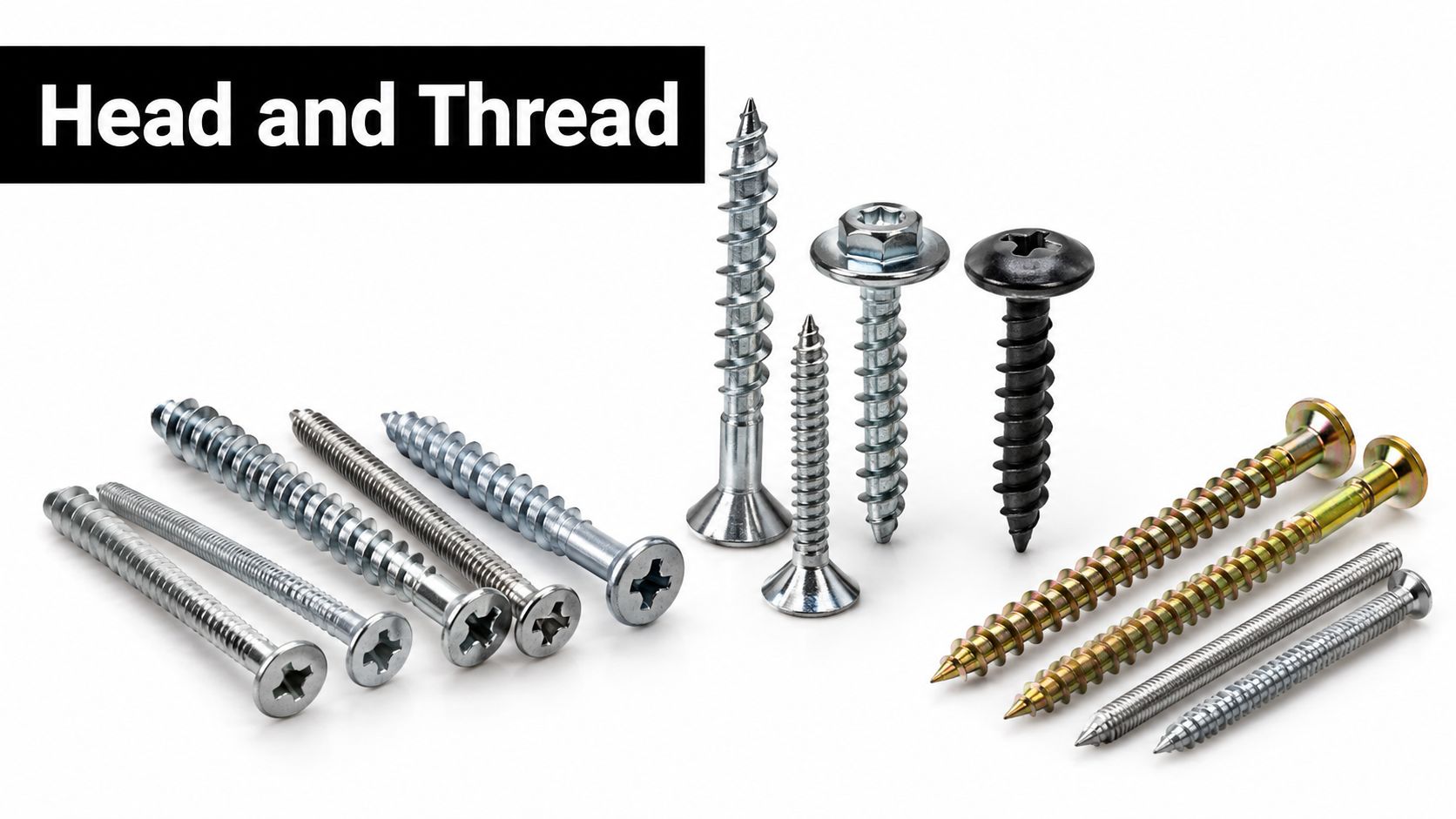
Deck screws commonly use flat, bugle, or trim heads that pull flush or nearly flush into a board. You want that on a walking surface, where a proud head catches feet, snow shovels, and chair legs. Framing oriented screws more often use larger bugle, washer, or hex style heads that spread bearing over a wider area and take higher driving torque. That doesn't make a washer head structural by itself. It just changes how the head sits and clamps.
Threads work the same way. Coarse threads bite well in softwood and treated spruce or pine, which is why you see them on most decking screws. Finer or specialty thread forms, partial threads, and self drilling points show up where the maker is solving a specific driving or clamping problem. A sharp point that starts fast in a deck board tells you nothing about shear capacity in a ledger. Don't let a clever tip do the work of a load table.
Metals and Coatings You Must Verify
Decks often fail at the fasteners. California guidance for preservative treated wood lists hot dipped zinc coated galvanized steel, stainless steel, silicon bronze, or copper as acceptable fastener materials, as set out in San Diego County guidance on treated wood fasteners. Notice what's missing. Plain interior steel, thin electro galvanizing, and vague painted finishes aren't on that list.
Treat exterior, deck, and pressure treated approved as three separate claims. A screw can be sold for outdoor trim and still be wrong in copper treated lumber. A lightly coated interior construction screw can match a deck screw in diameter and length and still corrode, stain the board, and loosen once it stays wet. If the box won't name the coating system or the treated wood approval, assume it doesn't have the rating you need. Colour is not a coating standard, and a green or brown finish is not proof.
Comparing Corrosion and Holding Power
Holding power gets talked about as if it were one number. It isn't. Withdrawal resistance, shear capacity, head pull through, and corrosion loss over time are different failure modes, and a screw that's fine on day one can lose the argument in year five because its shank got thinner. That's why documented corrosion resistance belongs in any honest deck screws vs construction screws comparison, right beside the connection type.
What to Verify Before Treating the Screws as Interchangeable
| Check | Deck-board fastening | Framing or structural connection |
|---|---|---|
| Primary job | Hold boards down to joists with a flush finish | Carry a defined load between framing members or hardware |
| Proof to demand | Maker states decking use and treated wood compatibility | Published structural evaluation, load data, and installation schedule |
| Corrosion evidence | Named coating or stainless composition suited to exposure | Same, plus compatibility with connectors and washers |
| Head priority | Sits flush, doesn't split board ends | Bears correctly for the connector or member, per instructions |
| Substitution rule | Don't swap in an interior screw of the same size | Don't swap at all without matching diameter, length, and approval |
The corrosion thresholds in current code language show how specific this gets. For fasteners 3/8 inch in diameter or smaller, acceptable demonstrations include ASTM A153 Class D, ASTM A641 Class 3, or testing showing no more than 5 percent red rust after 1,000 hours of ASTM B117 exposure, while diameters over 3/8 inch must meet or equal ASTM A153 Class C, under the cited screw, bolt, and nail corrosion provisions. Those figures describe corrosion resistance only. They don't give you a withdrawal value, and they don't approve a ledger connection.
An unsupported weatherproof claim is not a coating standard. If there's no named standard, coating, or metal, there's nothing to verify.
Read that distinction into every product claim. A purpose rated deck screw and a basic construction screw can look nearly identical in a bin, same drive, similar thread, similar colour, and still be worlds apart outdoors because one has documented resistance and the other has a slogan. When you're weighing coating against solid stainless for a wet or coastal build, our guide to galvanized versus stainless steel choices lays out where each option earns its cost.
For holding power, be blunt with yourself. If the maker publishes no load data for the connection you're building, you don't have a structural screw, whatever the carton calls it. Use face fastening screws where the load is shared across many fasteners in boards. Reserve structurally evaluated screws, specified nails, lags, or bolts for connections where one failure changes the shape of the deck.
Matching Screws to Deck and Framing Jobs
Walk a deck from the top down and the fastener changes at every layer. That's the practical picture most comparison charts flatten. The screw that earns its place in a cedar board has no automatic claim on a rim joist, a guard post, or a joist hanger two feet below it.
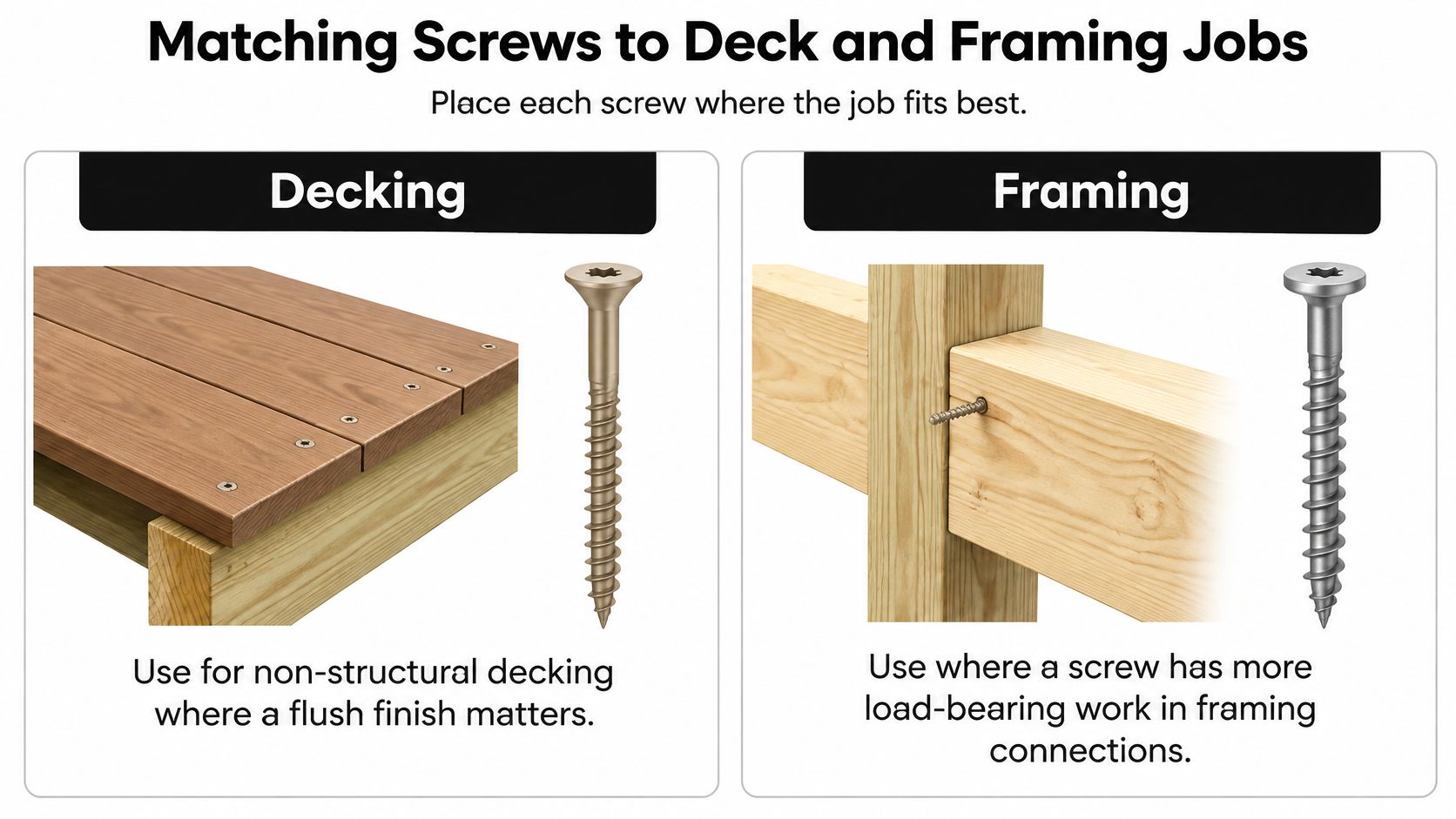
Start with the walking surface. California deck guidance commonly permits either two 16d galvanized nails or two #8 screws for attaching each decking board to a joist, and a separate municipal handout specifies at least two 8d threaded nails or two #8 wood screws at every supporting member, as summarised in Auburn, California's deck handout. Two fasteners per board per joist is your working baseline for face fastened decking. It keeps boards from cupping and rocking, and it's squarely non structural work, which is exactly where a corrosion rated deck screw belongs.
Framing and Connector Hardware Are Different Jobs
Move to the frame and the rules harden. Use a construction screw in framing only where it carries a structural evaluation for that connection, installed at the diameter, length, and spacing the evaluation requires. Move again to engineered hardware, joist hangers, post bases, hold downs, and the screw choice stops being yours. The connector maker specifies the fastener, and substituting a longer deck screw because it was already in your pouch is how hangers lose capacity. If you're hanging joists, check the fastener schedule alongside our notes on joist hangers and their screws before you drive anything.
The house connection sits in its own category. A deck attached to an exterior wall must be positively anchored to the primary structure, that attachment cannot be made with toenails or nails subject to withdrawal, and hold down tension devices are required in at least two locations within 24 inches of each end of the deck, per San Bruno's 2025 residential deck requirements. No general purpose screw satisfies that by being long. For wider planning on exposure, drainage, and detailing that keeps connections dry, these storm-resilient deck construction tips are worth reading before you finalise the frame design.
So place each screw properly. Deck screw in the board, yes. Evaluated structural screw in framing where it's listed, yes. Specified connector screw or nail in hardware, always. Anything else is improvisation.
Fastener Rules for Treated Wood Outdoors
Treated lumber and climate can overturn a choice that looked right indoors at the store. Most Canadian decks are built with copper based preservative treated wood, and copper is hard on ordinary steel. Add freeze and thaw cycles, snow sitting on boards, and shaded joists that stay damp until June, and a marginal coating runs out of luck quickly.
Check the Package in This Order
The Canadian Wood Council states that screws used with copper based preservative treated wood should be hot dip galvanized to ASTM A153 or use a high quality polymer coating when approved by the manufacturer and preservative supplier, and that stainless steel is recommended for maximum service life, high preservative retention, or severe salt spray exposure, in the Canadian Wood Council guidance on fasteners for treated wood. Follow that hierarchy and you'll rarely go wrong.
- Confirm treated wood approval: Look for explicit compatibility with the preservative in your lumber, not a generic exterior claim.
- Match the exposure: Inland and reasonably dry, a properly hot dip galvanized or approved polymer coated screw can serve well. Persistently wet, poolside, or salt exposed, move to stainless steel.
- Check the connector metal too: Screws, hangers, washers, and post bases need compatible protection, or the weakest piece corrodes first.
- Confirm size and count: Canadian exterior decking evaluations commonly require at least two fasteners per support and fasteners approximately 64 mm long, with corrosion resistant coating or stainless steel.
That second step produces a result shoppers don't expect. A well coated construction screw with genuine treated wood approval can outlast a poorly protected product sold as a deck screw on an inland build. The label loses again. What wins is the documented coating doing its job in that lumber, at that site.
Connectors deserve the same scrutiny. One Ontario municipal guideline specifies Z550 or G185 galvanized protection for connectors contacting treated wood, equivalent to a minimum coating mass of about 550 g/m², in the Canadian deck guideline material cited earlier. If your hanger carries that level of protection and your screw is a bargain interior fastener, you've built the failure point yourself. Ordinary interior screws in treated, wet lumber lose section, stain the wood around the head, and loosen as the hole and shank degrade together. Spend on the metal first. It's the cheapest part of the deck to get right and the most expensive to replace.
Choosing Deck Hardware at Xtreme eDeals
Once you've sorted connections, shopping gets simple, because your cart organises itself. You're no longer comparing two piles of screws. You're filling four lists, decking fasteners, evaluated framing fasteners, bolted connections, and connector hardware with its specified fasteners.
The screenshot below shows the kind of product listing to read closely, where size, finish, and intended use should be stated before price enters the discussion.

XTREME EDEALS INC. is an online retailer of deck and fencing accessories, fasteners, and home improvement hardware, with CAD pricing and offices in Ontario and New York. Map your lists onto that catalogue directly. Corrosion rated deck screws cover board fastening and exterior trim. Carriage bolts, lag bolts, washers, and wedge or sleeve anchors cover connections your plan or hardware instructions call out as bolted, including 1/2 inch minimum ledger lag screws or bolts referenced in Berkeley guidance in the California deck material cited earlier. Joist hangers and post base brackets belong in the cart only with the fasteners those connectors require, never with a handful of leftover deck screws.
You'll see recognisable outdoor hardware lines such as Decorex Hardware, in a field where Nuvo Iron is the familiar competing name shoppers cross check. Compare them on stated finish, sizing, and compatibility for your posts and rails, not on a claim that one brand is universally stronger. That claim doesn't survive contact with a real parts list anyway.
Watch the short video below before ordering, then pause on any connection in your plan you can't yet name a specified fastener for.
Multi packs make sense for decking screws on larger decks, where board fastening consumes fasteners by the hundreds. Keep the finishing hardware, post caps, balusters, hinges, and gate inserts, in a separate mental column. They're legitimate project supplies, and you'll want them, but they don't substitute for structural screws, bolts, or connector fasteners. Sort by connection first, finish second, and the deck screws vs construction screws question mostly answers itself.
What to Buy Before You Start Building
Write your buying list in connection order, not in the order you happen to walk the aisles. That single habit prevents most fastener mistakes I see, because it forces every screw to justify the job it's hired for.
A Four Step Buying Sequence
First, list every connection in the build. Deck boards, fascia and trim, joists and beams, the ledger or house anchor, guard posts, stair stringers, and every joist hanger and post base. If a connection isn't on paper, it'll get whatever screw is open on the day, and that's the failure pattern to break.
Second, match length and diameter to the specified nail, the connector schedule, or the structural screw's published installation table. Don't upsize by guesswork. A longer screw in a hanger hole can split the joist or miss the intended bearing, and a thicker screw without approval is still unapproved. For board work, confirm embedment as well, our guide to how deep deck screws should go covers the practical checks before you set your driver clutch.
Third, match metal and coating to the lumber and the site. Treated wood approval for anything touching treated stock, hot dip galvanized or approved polymer coatings inland, stainless steel where moisture is persistent or salt is in the air, and compatible metals across screws, washers, and connectors. Mixing dissimilar metals to save a few dollars on washers is false economy on a twenty year structure. While budgeting, it's worth understanding the factors that affect deck installation prices so fastener quality doesn't become the line item you trim to afford a wider board.
Fourth, refuse the wrong screw outright. No structural evaluation, no life safety connection, whatever the label says. No treated wood rating, no contact with treated lumber. No named coating, no outdoor use. Then place the order in that same order, decking screws separated from bolts, anchors, and structural hardware, confirming coating and intended use on each product page before multi packs go in the cart. You'll spend a little longer shopping and a lot less time explaining a loose guard or a stained, lifting board later.
Sort your next deck order by connection, corrosion rated deck screws for the boards, specified bolts and evaluated structural hardware for the frame, and connector fasteners matched to your hangers and post bases, then confirm treated wood approval on every listing. You'll find those fastener and hardware categories, in CAD pricing with multi pack options for larger builds, at XTREME EDEALS INC.. Bring your connection list, check each product page against it, and build with screws you can defend to an inspector and to yourself in ten years.