
You're halfway through a fence project on a Saturday morning when the first warning appears: a brown rust streak running beneath a freshly installed picket. The screws came from a familiar hardware aisle, but they're interior-grade zinc, and the coating is already failing outdoors. Replacing them now is irritating. Replacing them after the boards, rails, and gates are finished is expensive.
That's the problem with many home improvement essentials lists. They focus on visible materials, paint colours, and convenient tool kits while ignoring the small connectors that keep a deck or fence standing. A wrong joist hanger, undersized lag bolt, incompatible coating, or poorly selected bracket can corrode, shear, or pull out under load. The lumber may still look sound while the connection around it weakens.
California's repair market shows why these details matter. A California remodeling report estimates that about 9% of the state's 8.3 million single-family, condominium, and mobile homes are remodelled each year, creating an annual market of about $20 billion. It also places the average completed remodelling project at $29,500 and the median at $18,400, so hardware purchases can support everything from a small fence repair to a major outdoor renovation. California construction and remodelling information puts those projects in the context of the state's broader housing economy.
The practical lesson is straightforward. Buy the part that carries the load, resists the weather, and satisfies the applicable code before paying for decorative upgrades. This guide breaks down the home improvement essentials that contractors use for decks and fences, including structural connectors, fasteners, layout tools, safety equipment, weatherproofing, project quantities, and maintenance.
Why the Right Hardware Determines Project Success
The failure usually starts at the connection
A homeowner can choose straight cedar, pressure-treated posts, and carefully spaced pickets, then undermine the entire fence with the wrong screws. Interior zinc-plated fasteners may look clean in the package, but outdoor moisture and treated lumber create a much harsher environment. Rust streaks are an early visual warning. The more serious risk is loss of section, reduced holding power, and a connection that no longer behaves as intended.
Deck failures often begin in less visible places. A ledger board may be attached with nails where mechanical fasteners are required. A joist hanger may be installed with short trim nails instead of the manufacturer-specified connector nails. A post base may support vertical weight but offer inadequate resistance to uplift or lateral movement. Each shortcut leaves the surrounding wood doing work the hardware was supposed to perform.
Practical rule: If a connector carries load, touches treated lumber, or sits where water can collect, choose it by specification rather than appearance.
The cost problem grows because structural hardware is difficult to replace after finishing work is complete. A contractor may need to remove decking, disturb flashing, loosen rails, or dismantle a gate to reach one failed connection. A cheap fastener can therefore create labour, material, and scheduling costs far beyond its original price.
What belongs in a contractor-grade kit
A dependable outdoor build needs more than boards and a drill. The working list includes:
- Structural connectors: Post bases, joist hangers, beam seats, hold-downs, angle brackets, and approved ledger hardware.
- Fasteners: Structural screws, lag bolts, through-bolts, washers, connector nails, decking screws, and masonry anchors.
- Layout equipment: A reliable level, chalk line, tape measure, square, string line, and marking pencil.
- Tools and safety gear: A drill and driver, impact-rated bits, saws, gloves, eye protection, hearing protection, dust control, and stable access equipment.
- Weatherproofing materials: Ledger flashing, joist tape, compatible sealant, washers, corrosion-resistant coatings, and drainage details.
A professional mindset differs from a big-box checklist. A premium screw won't correct a crooked layout, and a perfectly positioned joist can still fail if the hanger nails are wrong. The finished structure depends on the complete system.
Core Categories of Home Improvement Essentials
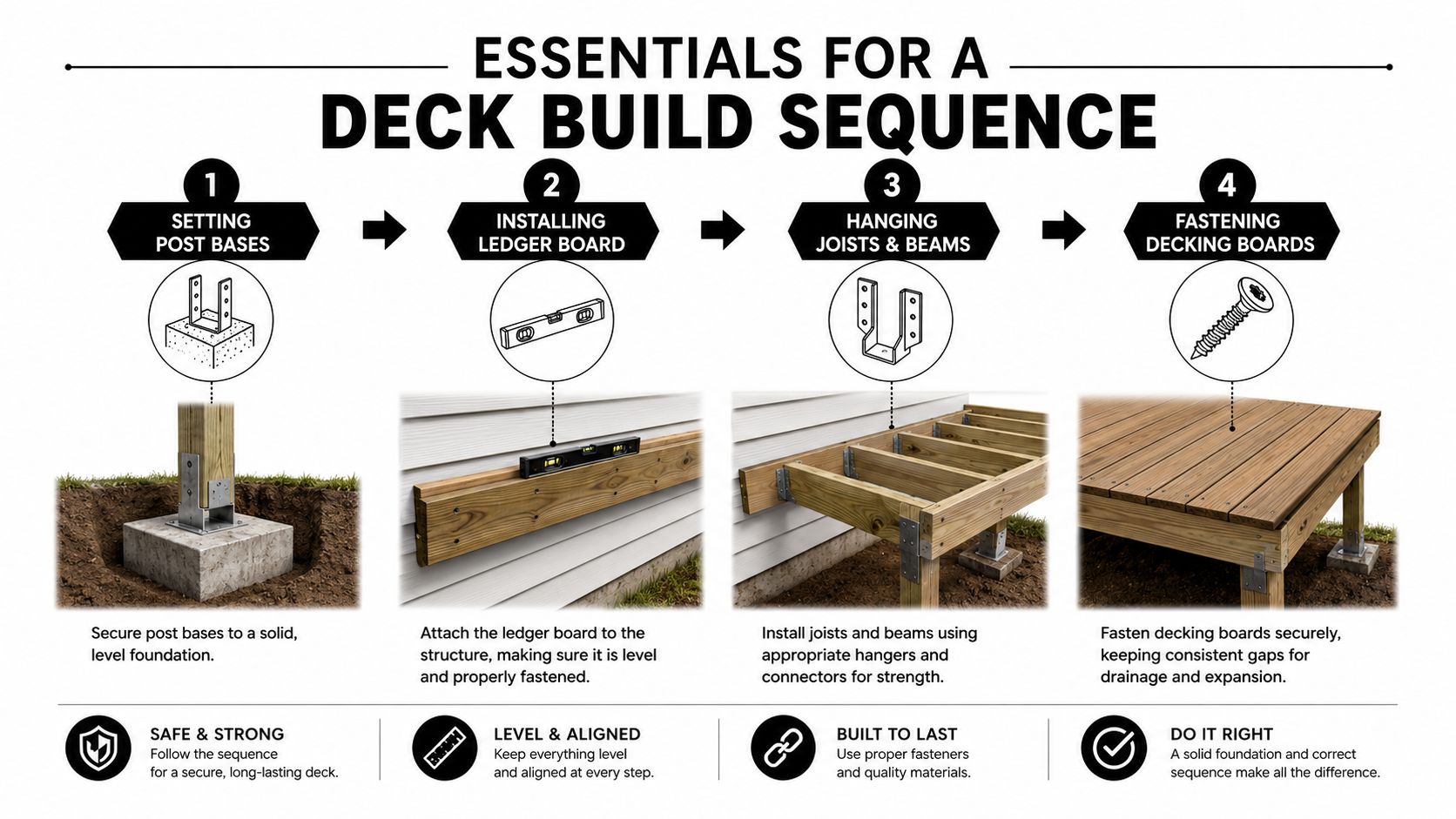
A deck build is easiest to understand in the order the work happens. Start at the ground, establish a stable load path, connect the framing, then protect and finish the walking surface.
Set the posts and bases first
Post bases separate wood from wet concrete or masonry and help control movement at the connection. Choose a base rated for the intended post size and for the uplift and lateral forces the structure must resist. Concrete anchors, washers, and the correct installation method matter just as much as the visible bracket.
The base doesn't replace sound footing work. It only transfers forces when the supporting concrete, post, and anchor assembly are properly sized and installed.
Install the ledger with approved hardware
A ledger connection deserves special attention because it ties the deck to the building. Use the fastener type, spacing, washers, flashing, and edge distances required by the applicable design and local authority. Ontario deck guidance, for example, specifies 1/2-inch lag screws or through-bolts, with a minimum 4-inch embedment into the rim joist and a staggered W-pattern layout. It also illustrates how spacing tightens as joist span increases, from about 30 inches on-centre for a 6-foot span to about 10 to 11 inches on-centre for a 16-foot span. The municipal deck code guide demonstrates the underlying principle: greater load demand requires denser, properly installed connections.
The IRC's Section R507 is a useful reference point for deck minimums, but local amendments and California requirements still control the project. California's 2025 California Building Standards Code was published on July 1, 2025 and became effective January 1, 2026, so current guidance should align with the updated Title 24 rules rather than an old code summary. California Building Standards Code information is a sensible starting point before purchasing materials.
Hang joists and beams
Joist hangers, beam connectors, hurricane ties, and hold-downs keep framing members seated and resist movement. Buy the connector for the actual lumber dimensions, then use the exact nail or screw schedule listed by its manufacturer. A structural screw is not automatically an acceptable substitute for a connector nail.
Fasten the decking
Deck screws must suit the decking material and exposure. Composite boards may require a hidden fastener system, while wood decking typically needs exterior-rated screws with a head and thread pattern suited to the board. Drive consistently and avoid over-sinking, which can create water-holding pockets.
Measure, protect, and work safely
A level, square, chalk line, and tape measure prevent cumulative errors. Safety glasses, gloves, hearing protection, and stable platforms reduce the chance that a routine cut or fastening task becomes an injury. For broader project planning, home improvement guidance by Four Seasons can provide useful context around related exterior work.
The sequence is summarised below.
A short visual demonstration can help homeowners understand how the components meet before they begin.
Choosing Fasteners and Hardware That Last
Fastener selection comes down to three questions: what material is the fastener made from, what coating or corrosion resistance does it provide, and is the connection approved for the intended load? Price matters, but only after those questions are answered.
Zinc-plated hardware is generally an interior choice or a limited-exposure option. Hot-dip galvanised hardware provides a thicker protective coating and is commonly preferred for outdoor framing. Stainless steel offers stronger corrosion resistance, with 304 suitable for many exterior settings and 316 better suited to salt air, poolside exposure, and other high-chloride conditions.
For ledger anchoring in Ontario, guidance specifies galvanised fasteners coated to ASTM A153/A153M. Canadian deck-fastener guidance recommends 316 stainless steel in salt-air, poolside, or high-corrosion environments, while 410 stainless with epoxy is less suitable for those exposures. The Ottawa ledger-board advisory explains why material grade is a structural decision. Chloride exposure accelerates corrosion, so a more suitable grade reduces the chance that the connection loses reliability over time.
Match the connection to the job
Structural screws work well where the approved product is rated for the connection and the installer can achieve the specified embedment. Through-bolts provide a strong mechanical connection for demanding joints when the assembly allows access to both sides. Lag screws can be appropriate for ledger or heavy timber connections when the diameter, embedment, washer, spacing, and substrate meet the applicable requirements.
Nails still have an important place. Joist hangers and other connectors often depend on a specified nail count and diameter, not any fastener that fits the hole. Read the connector label and installation guide before substituting screws.
Treated lumber creates another trap. Copper-based preservatives can attack ordinary galvanised coatings, so use hardware with the required corrosion resistance, such as a suitable heavier galvanised coating or stainless steel. A fastener that looks acceptable on installation day may be the wrong choice for the chemical environment inside the wood.
| Fastener Type | Material / Coating | Corrosion Resistance | Best Application | Relative Cost |
|---|---|---|---|---|
| Structural screw | Exterior-rated coated steel or stainless steel | Depends on listed coating and environment | Framing connections approved for the screw | Moderate |
| Lag screw | Hot-dip galvanised or stainless steel | Strong when grade matches exposure | Ledger and heavy timber connections | Moderate to high |
| Through-bolt | Galvanised or stainless steel with washer and nut | Strong mechanical resistance when protected | High-demand accessible connections | High |
| Connector nail | Galvanised or stainless steel | Must match connector and exposure | Joist hangers and approved framing connectors | Low to moderate |
| Decking screw | Exterior-rated coated steel or stainless steel | Selected for wood or composite decking | Surface or hidden decking systems | Moderate |
Buy products with a clear evaluation or approval path when the connection is structural. ICC-ES evaluation reports can help confirm whether a proprietary screw or connector is approved for a particular application. For projects involving electronic access hardware, information about the smart lock installation process is a useful example of why the installation method and surrounding substrate matter as much as the product itself.
You can also review construction fasteners and fittings when comparing deck screws, lag bolts, washers, nails, and anchors for different connections. XTREME EDEALS INC. offers these categories alongside deck and fencing accessories, so the purchase can be organised around the actual assembly rather than a collection of unrelated items.
Project Checklists for Decks and Fences
Quantities should follow the drawing, span, load, connector schedule, and material manufacturer's instructions. A generic shopping list can help you remember categories, but it can't replace the framing plan.
Ground-up deck checklist
Begin with the ledger and support structure. Count the ledger fasteners from the approved layout, then add the joist hangers, beam connectors, post bases, hold-downs, anchors, washers, and flashing. In Ontario residential deck guidance, ledger anchoring uses 1/2-inch lag screws or through-bolts, a minimum 4-inch embedment, and a staggered W-pattern. The same guide shows that fastener spacing depends on joist span, so don't copy a spacing pattern from a smaller deck onto a longer one.
A useful purchase worksheet includes:
- Ledger connection: Approved lag screws, structural screws, or through-bolts, plus washers and flashing.
- Framing connections: One correctly sized joist hanger for each supported joist end, with the specified connector nails or approved screws.
- Posts and beams: Post bases, beam seats, uplift hardware, lateral connectors, and concrete anchors rated for the assembly.
- Decking: Exterior deck screws or a hidden fastening system approved for the selected composite or wood boards.
- Weatherproofing: Joist tape, ledger flashing, compatible sealant, and end-grain protection where appropriate.
- Tools and safety: Driver bits, drill bits, levels, squares, eye protection, gloves, hearing protection, and stable access equipment.
The commonly cited decking estimate of 350 screws per 100 square feet is only a planning example, not a substitute for the board manufacturer's spacing requirements. Board width, joist spacing, perimeter details, angled cuts, and hidden clips can all change the final count.
Fence checklist
A fence needs posts, rails, pickets or panels, brackets, gate hardware, and concrete or masonry accessories suited to the site. A longer run may require more line posts, while a gate concentrates movement at its hinges, latch, and adjacent posts. Don't count only the visible pickets. Include tension bands where chain-link components are used, rail brackets for framed sections, washers, gate stops, and corrosion-resistant exterior screws.
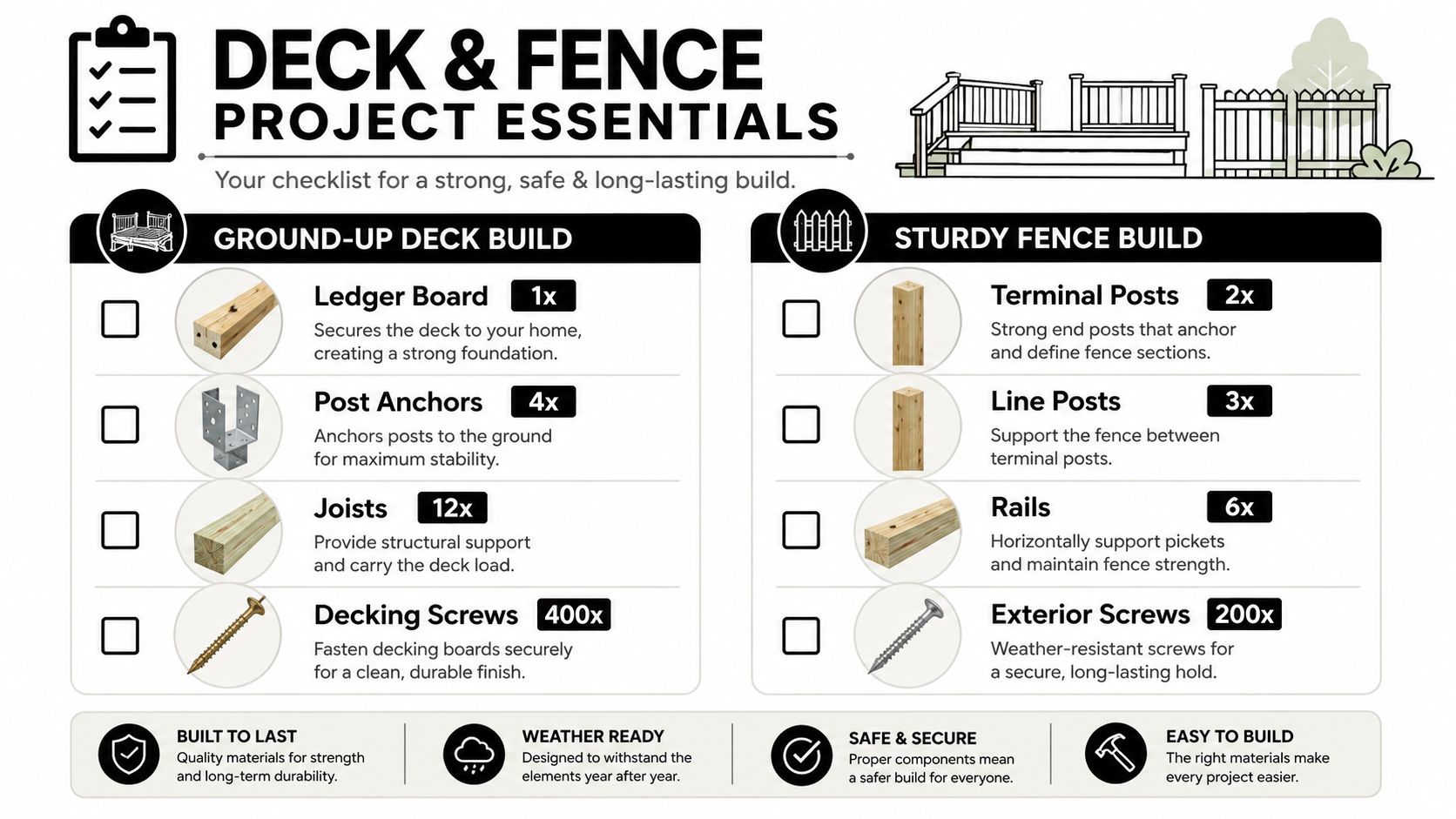
For a planning worksheet, the supplied construction visual uses one ledger board, four post anchors, twelve joists, and 400 decking screws for its ground-up deck example. Its sturdy fence example lists two terminal posts, three line posts, six rails, and 200 exterior screws. Treat these as the visual's project examples, not universal quantities. A landscape fence calculator can help organise post spacing and material estimates before you place an order.
Do not forget: Joist tape, ledger flashing, concrete anchors, washers, gate hardware, spare driver bits, and compatible sealant are easy to omit and difficult to improvise halfway through the build.
Plan a modest overage for cuts, damaged pieces, dropped fasteners, and consistent coating batches. The exact allowance depends on the project and supplier packaging, but running short on a structural fastener is a poor reason to substitute a different grade. For deck and fence categories, fence-building supplies can help keep posts, brackets, screws, caps, and gate components together in the purchasing process.
Prioritizing Durability Over Aesthetics
A decorative post cap is visible from the street. A failed post base is not, at least until the fence leans or the gate drags. Exterior projects should therefore spend first on the parts that carry load, stop water, and prevent corrosion.
Regional exposure changes the decision. Ontario guidance treats galvanised fasteners to ASTM A153/A153M as a technical requirement for ledger anchoring, while Canadian guidance points to 316 stainless steel for salt air, poolside locations, and other high-corrosion environments. Inland sites may be able to use suitable hot-dip galvanised hardware, but coastal or chloride-heavy conditions demand more careful material selection.
California's market also rewards disciplined prioritisation. In the first quarter of 2026, California represented 8.0% of all U.S. remodelling spending, equal to $22.2 billion, and led the states in market share, according to reported California remodelling market data. The state's home improvement stores industry is estimated at $28.3 billion in 2026 by IBISWorld's California home improvement stores profile. Those figures describe a large market, but they don't make wasteful replacement work any less painful for an individual homeowner.
Use the decision rule that contractors use
If a part bears load or touches moisture, buy the appropriate rated product first. If it only changes appearance, it can wait.
| Category | Priority Level | Budget Allocation | Examples |
|---|---|---|---|
| Structural hardware | Highest | Fund before finishes | Joist hangers, post bases, hold-downs, ledger fasteners |
| Weatherproofing | High | Fund with framing | Flashing, joist tape, sealants, drainage details |
| Exterior fasteners | High | Match exposure | Hot-dip galvanised, ASTM A153/A153M, 304 or 316 stainless |
| Safety equipment | Highest | Never defer | Eye protection, gloves, hearing protection, stable access |
| Decorative hardware | Later | Purchase after protection | Post caps, finials, ornamental brackets |
| Surface finishes | Later | Schedule after structure | Premium stain, paint, trim details |
Inflation and regional pricing make generic renovation advice less useful. Statistics Canada's Residential Renovation Price Index shows renovation prices continued rising through 2025 and 2026, while regional costs vary. For example, Halifax renovation costs increased 3.2% from the fourth quarter of 2024 to the fourth quarter of 2025, and all tracked CMAs recorded increases, as reported in the Residential Renovation Price Index release. That environment favours repairs that protect existing framing rather than cosmetic work that leaves moisture paths unresolved.
Maintenance Routines That Extend Hardware Life
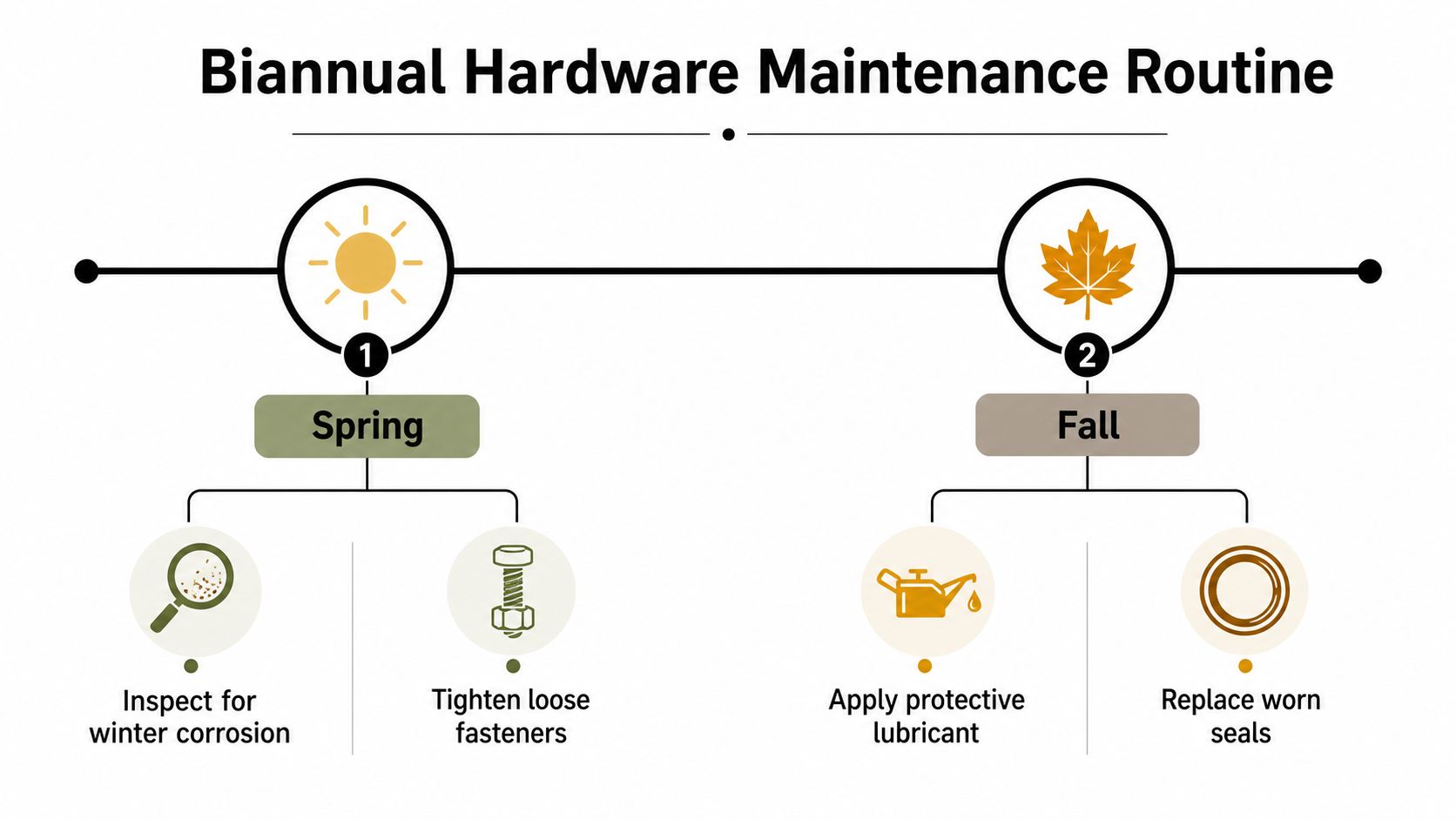
Outdoor hardware needs inspection because corrosion and movement often start where you can't see them from the yard. A simple seasonal routine catches loose connections, rust staining, trapped moisture, and wood deterioration before a small repair becomes a framing replacement.
Spring inspection
After winter, walk the deck and fence slowly. Look for loose fasteners, rust streaks, cracked wood around connectors, movement at post bases, and areas where water has collected. On a deck, check ledger attachment, joist hanger nails, post base corrosion, and whether hidden fasteners still engage the boards properly.
On a fence, push each post gently, inspect rail brackets, and open the gate repeatedly to reveal hinge wear or sag. A gate that drags is often signalling movement at the posts or a worn hinge connection.
Fall preparation
Before wet or freezing weather arrives, tighten accessible fasteners, clear debris from drainage paths, renew compatible sealant, and inspect protective coatings. Use a wire brush for light surface rust, then apply a suitable touch-up coating where a galvanised finish has been damaged. A torque wrench can help check lag screw tension where the connection specification provides a torque requirement, but don't tighten blindly and crush the wood.
Replace hardware when you find:
- Severe corrosion: Any fastener with more than 25% surface corrosion should be treated as a replacement candidate under the stated maintenance threshold.
- Damaged connectors: Joist hangers with missing or bent nails, visible rust-through, or deformation need corrective work.
- Failed bases: A post base showing rust-through is no longer providing dependable protection.
- Movement or distortion: Bent brackets, pulled screws, elongated holes, and visibly deformed hardware require investigation rather than cosmetic touch-up.
A seasonal check can be brief, but it must be deliberate. For coatings and compatible protective products, exterior protective coatings provide another purchasing category to consider alongside replacement fasteners.
Budgeting and Prioritization for DIYers and Pros
A sensible budget follows the load path. Buy the components that keep the structure standing, then the materials that keep water away, then the parts that make the finished project look polished.
Tier 1 covers essentials: joist hangers, post bases, hold-downs, ledger fasteners, approved structural screws or bolts, connector nails, and corrosion-resistant hardware. These items must suit the application and applicable code. They're not a decorative upgrade, and deferring them changes the safety of the build.
Tier 2 covers weatherproofing: ledger flashing, joist tape, sealants, drainage details, and compatible coatings. These materials may not carry the deck directly, but they protect the wood and connections from the moisture that accelerates decay and corrosion.
Tier 3 covers appearance: decorative post caps, finials, ornamental brackets, premium stain, and nonessential trim. Install them when the structural and weatherproofing work is complete.
| Priority Tier | Category | Deck Budget % | Fence Budget % | Can Defer? |
|---|---|---|---|---|
| Tier 1 | Structural hardware and fasteners | Highest share | Highest share | No |
| Tier 2 | Weatherproofing and corrosion protection | Next priority | Next priority | Only briefly |
| Tier 3 | Safety equipment and installation tools | Required before work | Required before work | No, if needed for safe work |
| Tier 4 | Decorative and finish materials | Remaining budget | Remaining budget | Yes |
The table intentionally uses priority levels rather than invented project percentages. A 12-by-16 deck and a 100-foot fence can have very different footing layouts, spans, elevations, materials, gates, and code requirements. Price the actual drawing and connection schedule instead of forcing either project into a made-up percentage split.
California's permit rules also belong in the budget. A deck is permit-exempt only when it is 200 square feet or less, no more than 30 inches above grade at any point, not attached to a dwelling or townhouse, and does not serve a required exit door. If any one condition fails, a permit is required, according to California deck permit guidance. Permit review, engineering, inspections, and code-required changes should be considered before material orders.
Buy compatible hardware in a planned batch, avoid substituting cheaper fasteners mid-build, and schedule purchases around your supplier's availability. Saving on a decorative finish is manageable. Saving on a ledger connector or post base can leave you paying twice for the same project.
XTREME EDEALS INC. offers deck and fence hardware such as construction screws, lag bolts, anchors, joist hangers, post base brackets, post caps, hinges, and related accessories in project-friendly pack sizes. Visit XTREME EDEALS INC. to compare the structural and finishing essentials for your next deck or fence before you start building.