

You're standing in the backyard in early spring, boots sinking into a soft patch of thaw, looking at a fence that's leaning worse than it was in October. That's the moment most Canadians realise fence decisions here aren't just about looks, they're about frost, salt, wildlife, bylaws, and whether the whole thing will still stand after one hard winter.
Fencing in Canada is a different job from fencing in milder places. The materials have to handle freeze-thaw movement, fasteners have to resist corrosion, and the design has to survive provincial and municipal rules that vary from one city to the next. If you want a fence that lasts, you need to think like a contractor, not like a catalog shopper.
Why Fencing in Canada Is Its Own Decision
A Canadian fence job usually starts with the same scene, a homeowner staring at a warped line of boards in March and deciding whether to patch it or replace it before the ground hardens again. That's not a cosmetic choice. In this country, a fence is fighting frost heave, wet snow, salt spray, wind, and local rules that can stop a project before the first post hole is dug.
Historical context matters too, because fencing in Canada has never been just one thing. The country's fencing roots go back to 1816, when Maitre Girard opened the first fencing school in Montréal, and the sport later formalised with the first Canadian Championships in 1902. The Canadian Fencing Federation says the national body now includes 10 provincial fencing associations representing 80 local clubs from coast to coast, which is a good reminder that fencing here has always evolved through structure and adaptation, not guesswork. You can read that history in the federation's own account of the sport's development in Canada, including the 1895 growth of organised clubs in Toronto Canadian fencing history.
The practical reality for homeowners
For a backyard fence, the big questions are simpler. Will the posts move when the ground thaws. Will the fasteners rust where snow piles against them. Will the design comply with the local by-law before you've even finished staining it. If you skip those questions, you usually pay twice, once for the fence and once to fix the mistake.
Practical rule: In Canada, a fence that looks fine in July can fail by April if the posts, hardware, and footing weren't chosen for local conditions.
This guide sticks to the stuff that changes the outcome, materials, climate match, permits, cost, installation, maintenance, and the final buying checklist. That's the order that matters on a real job site, and it's the order that keeps you from buying the wrong thing for your yard.
Common Fence Types and Materials in Canadian Yards
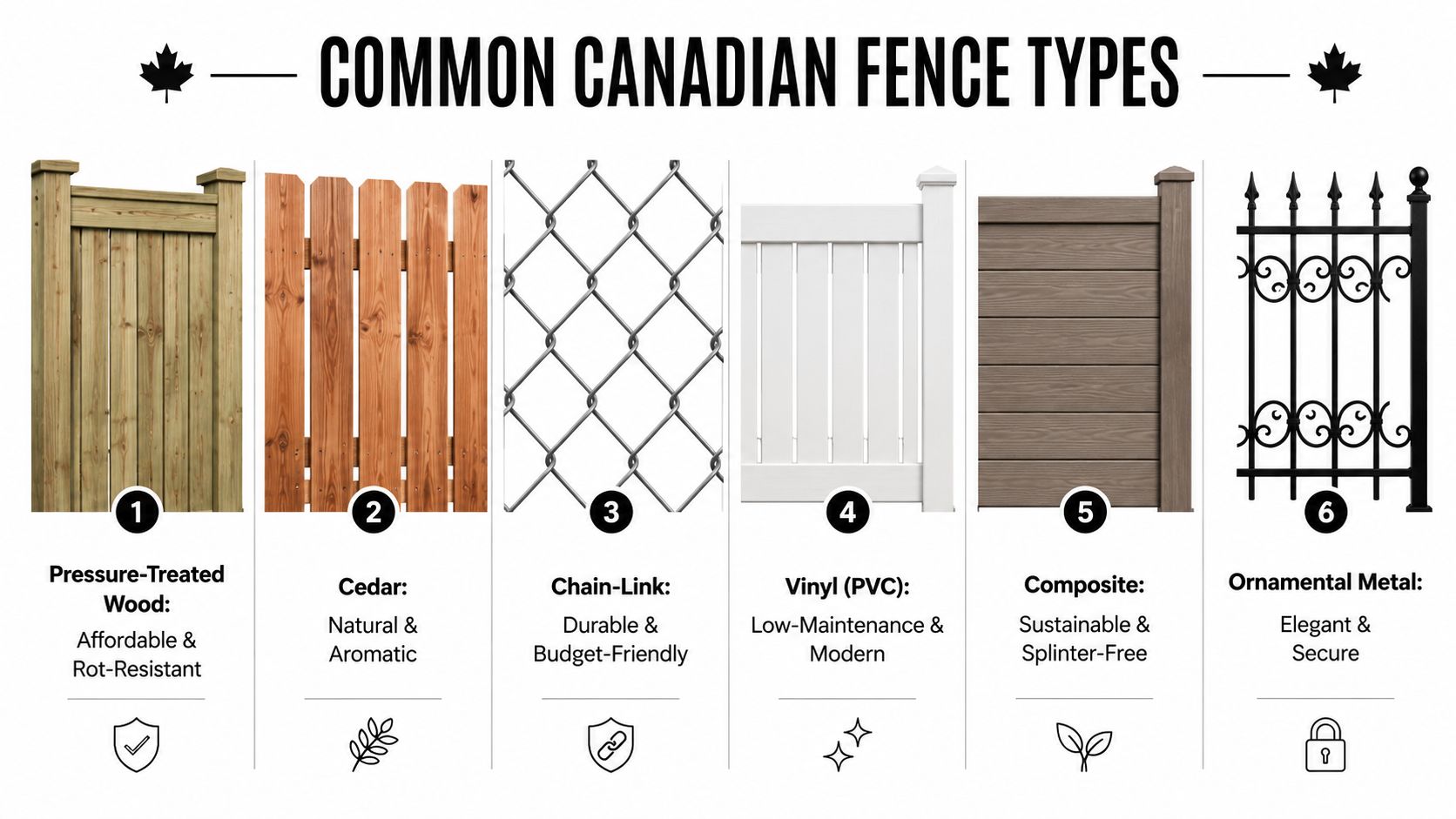
The six fence types most Canadian homeowners end up weighing are pressure-treated wood, cedar, chain-link, vinyl, composite, and ornamental metal. Each one solves a different problem, and each one fails in its own predictable way. The mistake I see over and over is people choosing the look first, then acting surprised when the material doesn't match the site.
Wood, cedar, and the real maintenance bill
Pressure-treated wood is the default suburban choice because it's familiar, affordable in feel, and easy to repair board by board. It works well for privacy and noise control, but standard residential wood is the first to complain when it gets repeated snow splash, melting pile runoff, and salty slush near driveways. Cedar looks better, smells better, and usually ages better than bargain wood, but it still needs consistent sealing or staining if you want it to stay upright and decent-looking.
Wood is fine if you accept maintenance. It's a bad choice if you want to install it once and forget it.
Chain-link, vinyl, composite, and ornamental metal
Chain-link is still the honest answer for many rural, utility, and side-yard jobs. It's durable, low-fuss, and makes sense where you care more about function than privacy. Public works specs in Canada commonly call for chain-link fabric built to CAN/CGSB 138.1 with 50 mm diamond mesh, 9-gauge galvanized wire, and galvanized steel framework to CAN/CGSB 138.2. Alberta transportation specs further require 60.3 mm O.D. line posts with 3.91 mm wall thickness, 88.9 mm O.D. terminal posts with 5.49 mm wall thickness, and a minimum zinc coating of 610 g/m² government specification reference. That's not overkill, that's what corrosion resistance and stiffness look like when a fence has to survive Canadian service conditions.
Vinyl (PVC) is popular because it looks clean and doesn't need painting, but thin profiles can turn brittle in extreme cold. Composite is the quieter premium option, especially where you want a more finished look and less splintering than wood. Ornamental metal fits pools, frontage, and higher-end properties because it looks sharp and resists casual abuse, though it's not the right answer when privacy is the main goal.
If you want design inspiration before choosing a style, this gallery is useful, but don't let aesthetics override the job conditions fence style ideas and photos.
Matching Your Fence to the Canadian Climate
Start with the climate, not the catalog. In coastal British Columbia, moisture is the enemy, so pick materials, fasteners, and coatings that tolerate long wet periods and repeated dampness without softening, staining, or corroding. In the Prairies, the problem is brutal cold and dry air, so the fence has to stay rigid and resist movement when temperatures swing hard.
Choose the hardware for the region
Ontario and Québec create a different headache, because freeze-thaw movement and road salt punish anything near driveways, walkways, and laneways. That's where fastener choice matters more than most homeowners realise. Galvanised hardware is the baseline, but salt exposure pushes you toward better corrosion resistance, tighter maintenance intervals, and more careful detailing around the base of posts and gate hardware.
Atlantic Canada adds wind and moisture to the mix. A fence that's too light will rattle, rack, or lean, especially where panels catch wind. In those settings, I'd rather see fewer decorative flourishes and stronger post work than a pretty but flimsy build.
Build below frost and stop pretending concrete fixes everything
Concrete footings need to go below frost depth. If they don't, the ground will move the post for you, and usually at the worst possible angle. That's why post size, footing depth, and drainage matter as a system, not as separate line items.
If the post base sits in wet soil and the hardware isn't built for corrosion, the fence is already losing.
For most homeowners, the right conversation with a supplier is simple. Ask what coating the fasteners have, what the post material is, and whether the system is intended for salt, wet freeze-thaw, or dry cold. Don't buy the same hardware for a lakefront yard, a suburban driveway, and a prairie acreage. Those are three different jobs.
Permits, Property Lines, and Provincial Rules
Fence fights usually start with people assuming the line is obvious. It isn't. Before you dig, confirm whether you're building a line fence, which sits on or near the boundary, or an on-property fence that sits fully inside your lot. In Ontario, the Line Fences Act gives property owners the right to build and maintain line fences, but it does not require them to build fences to mark their boundaries. It also excludes land owned by the federal government and First Nations reserves, and neighbour disputes can go through municipal Fence-Viewers Ontario line fences law.
City rules can be stricter than people expect
Toronto keeps it blunt. The city's fence by-law allows 1.2 metres for single residential properties and 1.8 metres for multiple-residential and non-residential properties. Pool enclosures have to fully surround the pool area, and pool gates must be self-closing, self-latching, supported on substantial hinges, and kept locked except when the pool is in use Toronto fence by-law.
Montreal is just as specific in a different way. It requires a permit in several named situations, including properties in the Mount Royal Historic District, brick or stone fences when the main building is setback from neighbouring buildings, and fences or hedges at certain regulated sites such as sports centres, playgrounds, gas stations, and childcare centres. It also requires fences, hedges, and masonry walls to sit at least 1 metre from the sidewalk or street edge, and it prohibits electrified or barbed-wire fencing, along with most iron-wire fencing other than chain-link in residential zones Montreal fence rules.
Do the survey first, not after the complaint
A clean survey is cheap compared with moving a finished fence. If you're near a boundary, near a pool, or near a heritage area, check the city rules before you order materials. If you're watching the market and want a useful local context for buyer expectations in one part of Montréal, Westmount market trends by Alp Perez is a practical read because boundary treatments and curb appeal often show up in how properties are presented and compared.
For a quick reference on height rules, this guide is worth keeping handy fence height requirements.
Costs and Lifespan Across Canada
Fence pricing in Canada varies wildly because the cost isn't just the boards or panels, it's the digging, concrete, hardware, gates, old-fence removal, and whether the site is level or awkward. Cheap quotes usually leave something out. If a quote looks suspiciously low, assume the contractor skipped proper post work, lightweight hardware, or cleanup.
| Material | Installed Cost Range | Typical Lifespan | Maintenance Level |
|---|---|---|---|
| Pressure-treated wood | Budget to mid-range | Moderate | Higher |
| Cedar | Mid-range | Moderate | Higher |
| Chain-link | Lower to mid-range | Long | Low |
| Vinyl (PVC) | Mid-range to higher | Long | Low |
| Composite | Higher | Long | Low to moderate |
| Ornamental metal | Higher | Long | Low |
Where the money actually goes
Most of the labour is in the boring parts, setting posts straight, making sure the line is true, pouring concrete properly, and hanging gates so they don't sag. Hardware is not an afterthought. If the brackets, screws, bolts, and anchors are weak, the fence will telegraph that weakness fast, especially at corners and gate openings.
For a basic suburban privacy fence, the cost gap usually comes down to whether you want lower upfront spend or lower maintenance later. Wood is easier to start with, but it asks for more care. Vinyl, composite, and metal ask for more money upfront, then generally make the back end easier to live with.
Don't confuse cheap with economical
A rural perimeter run changes the arithmetic. You might save money by choosing chain-link or a simpler wood system, but only if the posts, gates, and line layout are honest for the terrain. The cheapest material can turn into the most expensive fence when it needs constant repair.
Installation From Layout to Final Fastener
The first job is always layout. Verify the line, call utility locates, mark the run, and decide where the gate needs to live instead of putting it where it's convenient for the truck load. If the layout is sloppy, every later step gets harder and uglier.
Set the structure before you think about finish
Posts go in first, and they need to sit in concrete below frost depth. Rails come next, then panels or boards, then the gate. If the posts aren't dead straight and consistent, the fence will look amateur even if the surface material is expensive.
The RCMP's security guidance shows why structure matters even on simple chain-link runs. It sets technical selection ranges that materially change intrusion resistance, including mesh size from 2 3/8 inches down to 3/8 inch, wire gauge from 14 AWG down to 6 AWG excluding coating, and post sizing of 73 mm O.D. line posts and 114 mm O.D. strain posts for high-security applications RCMP security fencing guidance. Thicker wire and tighter mesh don't just sound stronger, they make cutting, climbing, and prying harder.
A fence fails at the weakest connection, not at the prettiest panel.
Hardware is where good fences become finished fences
Accessories earn their keep. Post caps in pyramid, ball, or decorative styles protect the top of the post and clean up the look. Joist hangers and post base brackets help with structural joins where the design calls for them. Gate hinges, self-closing hardware, deck screws, carriage bolts, lag bolts, and wedge or sleeve anchors need to match the load, not the package label.
If you're building near slopes, retaining features, or grade changes, the planning has to be tighter. Retaining wall help from Lawn & Leaf is useful context because fence lines and grade transitions often belong in the same conversation, not separate ones.
For a practical walkthrough of the post-setting stage, keep this installation reference nearby how to install a fence post.
Year-Round Maintenance in a Canadian Climate
Spring is inspection season, and it starts the moment the frost comes out. Walk the line and look for heaved posts, loosened brackets, popped fasteners, and gate bottoms that started dragging over winter. If a post has shifted, fix it early. Waiting until summer usually means the problem has spread into the adjoining panels.
Keep the routine simple
Summer is for cleaning and finish care. Wash off dirt, pollen, and road grime, then decide whether the wood needs stain or seal work before the next wet season. If you've got vinyl, this is the time to inspect for cracks, UV wear, or warped sections. If you've got chain-link, check tension and make sure the bottom hasn't started lifting where the ground settled.
Autumn is the prep month. Tighten hardware, check gate latches, and clear anything that will trap snow against the fence line. I'd rather see a homeowner spend an hour in October than three weekends in April.
Know what needs a contractor
Winter damage is usually obvious if you look for it. Snow press can bow panels, gates can freeze out of square, and damp wood can swell where it meets the ground. Small fixes, like tightening a latch or replacing a loose screw, are straightforward. Structural movement, repeated leaning, or rusted bases near post lines usually means the repair is bigger than a quick DIY patch.
Fix the small stuff before the fence teaches the wind how weak it is.
Wildlife, Security, and the Buying Checklist
Wildlife changes the fence conversation fast, especially outside dense urban lots. Alberta Conservation recommends wildlife-friendly modifications such as smooth wire, high-visibility markers, lowering top wires to 42 inches or less, and adding wildlife openings or passes. That's the part most homeowner fence guides skip, even though fence design can affect deer, small mammals, and birds in very direct ways. The broader problem is that fence interactions with wildlife are still under-studied, and many fence lines are mapped or understood only in limited ways wildlife and fence interactions overview.
Security is not the same as privacy
For security-minded properties, the RCMP says the fence should be based on a Threat and Risk Assessment, with a minimum recommended height of 2.4 metres and high-security installations considering 3.6 metres or more RCMP perimeter fence guidance. That's the honest answer for any owner who thinks a standard residential fence automatically equals security. It doesn't. Security comes from height, strength, visibility, and how the fence works with the rest of the site.
For a useful comparison in another property-security context, cameras for Australian builders is a good reminder that perimeter protection usually works better as a system than as one isolated product.
The buying checklist I'd use on my own job
- Match the climate first: Wet coast, salt-prone city, prairie cold, or windy Atlantic site each call for a different material and hardware choice.
- Confirm the legal line: Survey or verify the boundary before you order anything.
- Check the by-law: Height, pool enclosure rules, heritage zones, and setback rules can change the whole plan.
- Choose hardware for the exposure: Galvanised is the baseline, better corrosion resistance matters near salt and standing moisture.
- Buy for the specific purpose: Privacy, containment, pool safety, wildlife management, or security each need a different specification.
- Think in total cost: Include posts, concrete, gates, fasteners, disposal, and maintenance, not just boards or panels.
XTREME EDEALS INC. carries fencing and deck hardware, including post caps, hinges, brackets, bolts, anchors, and chain-link accessories, so it fits naturally into a Canadian fence build when you need the finishing parts that hold the job together. If you're ready to price out a smarter build, visit XTREME EDEALS INC. and compare the hardware against your fence plan before you buy.