
You finish the fence, hang the gate, check the swing, and then get stuck on the last piece of hardware. That's common. The latch looks small compared with the posts, rails, hinges, and panels, but it's the part you touch every single day.
A poor latch choice shows up fast. The gate rattles in the wind. It doesn't line up after a wet season. It looks wrong on a nice cedar gate. Or it doesn't give the level of security the opening needs. On a decorative garden gate, that's annoying. On a pool gate or side-yard access point, it can become a real safety problem.
The practical way to choose among the many types of gate latches is to start with the gate itself. Material matters. A light vinyl gate behaves differently from a framed steel gate. Purpose matters too. A privacy gate, a pool gate, and an ornamental entry gate shouldn't all get the same hardware. Environment matters as well. Rain, salt, heat, ground movement, and tight clearance all change what works over time.
Why Your Gate Latch Matters More Than You Think
It's common to decide on the latch last. That makes sense until the gate starts getting used.
A latch controls three things at once. It controls how the gate closes, how secure it feels, and how the finished gate looks from the street. If any one of those is off, the whole project feels unfinished. I've seen beautiful wood gates dressed up with hardware that belonged on a temporary utility opening, and I've seen heavy metal gates fitted with decorative hardware that never had the mechanical strength for daily use.
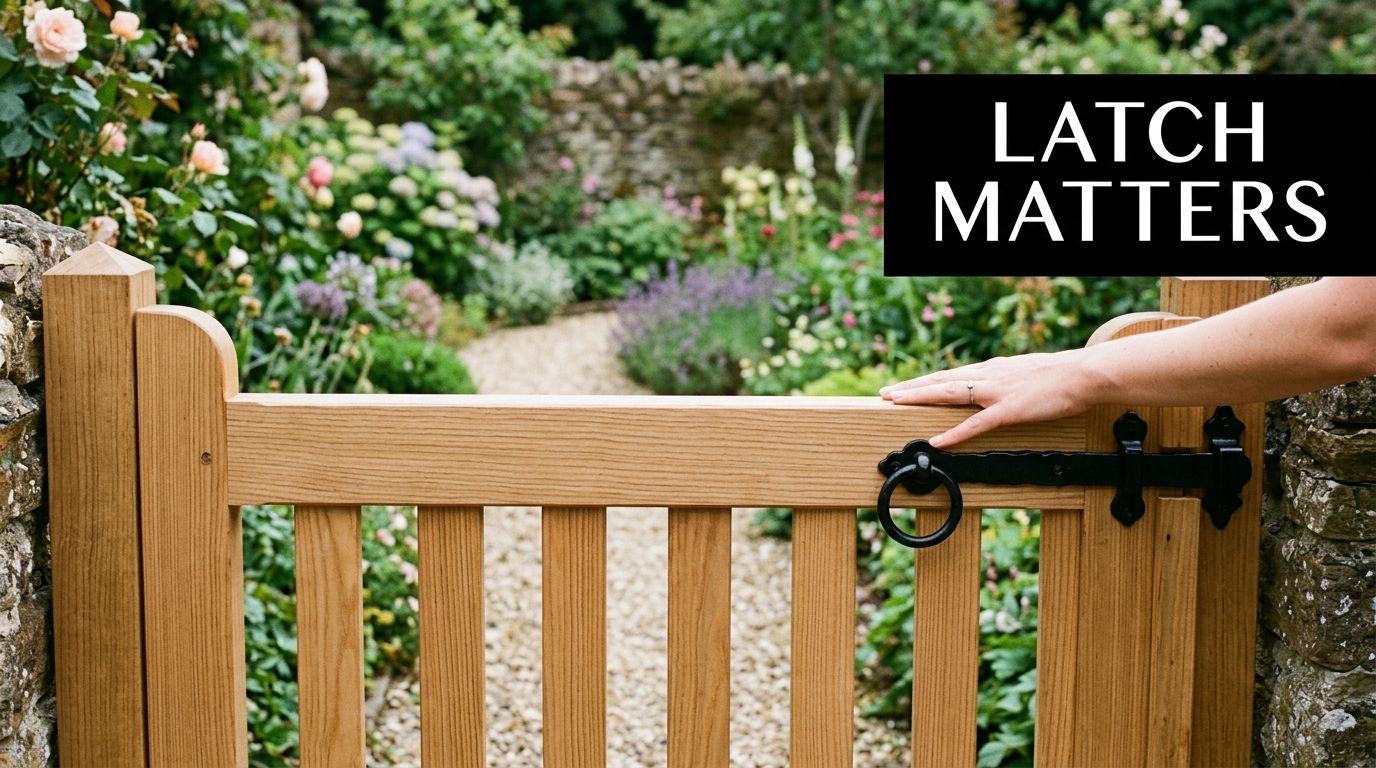
The latch changes the way the gate lives
A cedar garden gate may feel right with a ring or thumb style that matches the boards and trim. A vinyl side gate usually benefits from hardware that's easy to align and won't put unnecessary strain on a lighter frame. A steel or aluminum security gate often needs a firmer closing action and lock compatibility from day one.
That's also why the latch should be considered alongside the rest of the gate design. If you're comparing styles of custom security gates, pay attention to how the locking point, frame weight, and access pattern affect the hardware choice, not just the gate appearance.
Practical rule: Choose the latch for the gate's daily job, not for the five seconds it takes to click it shut in the showroom.
Small hardware, constant use
A gate can have perfect posts and strong hinges, but the latch still decides whether the opening feels smooth or frustrating. If the latch needs too much force, users yank the gate. If it's too loose, they slam it. If it's awkward to reach, they leave it unlatched.
That's why a latch isn't an accessory. It's the part that turns a gate into a working entrance.
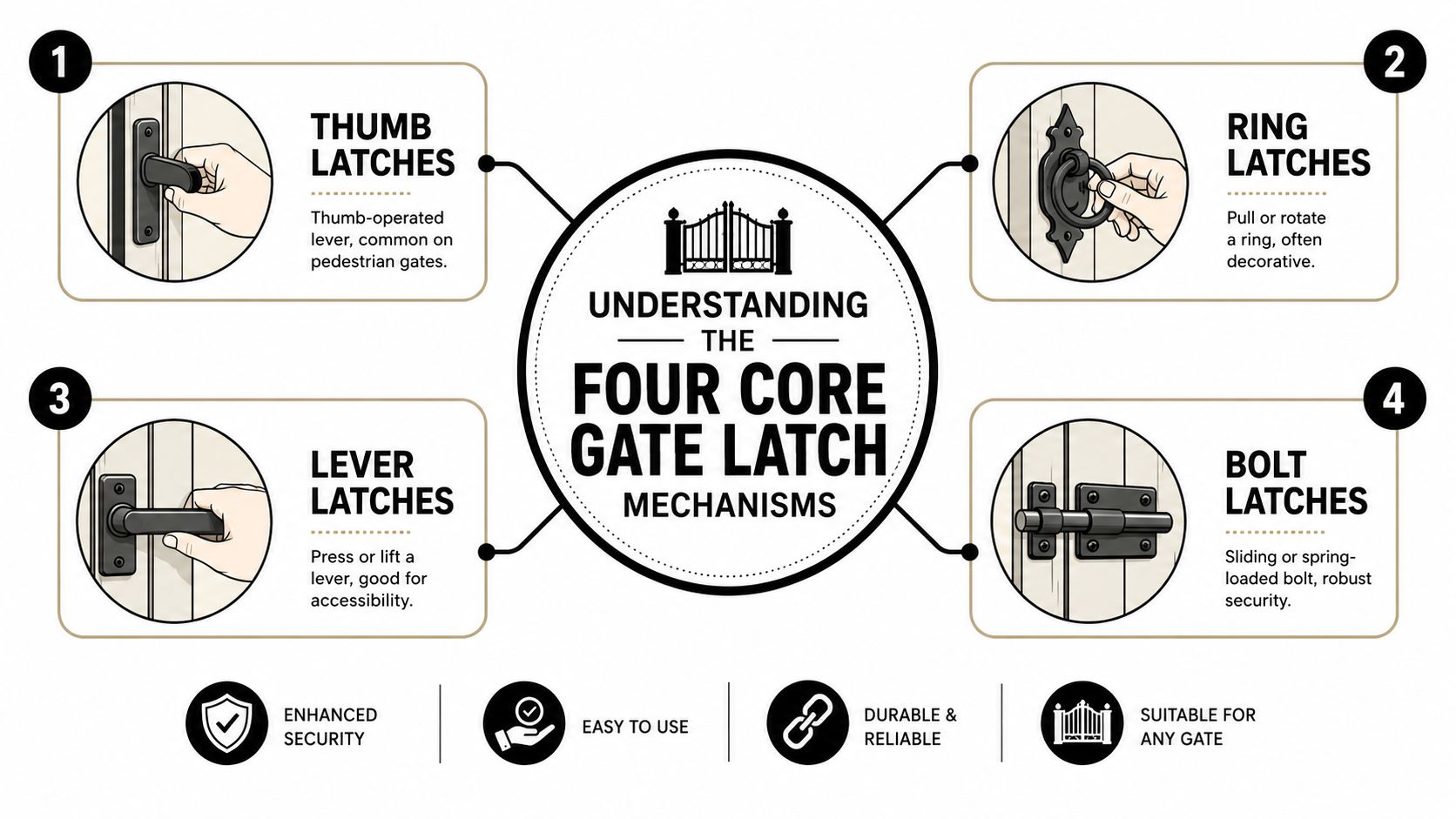
Understanding the Four Core Gate Latch Mechanisms
Before looking at individual products, it helps to sort the main types of gate latches by mechanism. Gate latches are technically categorized into four primary types: thumb, ring, lever, and bolt latches, with thumb latches using a downward press to lift a latch arm, lever latches using a handle-driven system, bolt latches sliding a heavy-duty bolt into a catch, and ring latches operating through a rotational turn. These are commonly made from galvanized steel, stainless steel, or cast iron for outdoor corrosion resistance, as outlined in this guide for fencing professionals.
Thumb latches and ring latches
These two are close cousins. Both are common on pedestrian gates, especially where appearance matters.
A thumb latch uses a press action on one side of the gate. That motion lifts the latch bar on the other side. It's straightforward, traditional, and well suited to wood gates where surface-mounted hardware looks intentional.
A ring latch works in a similar way, but the user rotates or pulls a ring to lift the bar. Ring latches often suit period-style gates, cottage designs, and decorative timber work because the visible hardware becomes part of the design.
Lever latches and bolt latches
These move into more functional territory.
A lever latch gives the user more mechanical advantage. That matters on heavier gates or gates used often. If a gate has more mass, more resistance from weather seals, or a need for lockability, a lever mechanism usually makes life easier.
A bolt latch is the plainest mechanism, but often the toughest. The bolt slides directly into a keeper or catch. For utility gates, service yards, and places where you want a firm hold without decorative intent, bolt systems are hard to beat.
The mechanism tells you more than the product name ever will. Once you know how the latch works, you can predict where it will struggle.
Why this framework helps
If you only shop by appearance, many latches look interchangeable. They aren't. A decorative ring latch can be perfect on a lightweight cedar garden gate and completely wrong on a tall metal privacy gate. A heavy-duty bolt can secure a service gate well and still feel awkward on a front walkway gate where guests expect simple one-handed use.
This is the shortcut. First identify the mechanism family. Then decide which version fits your gate's weight, swing, and purpose.
Exploring 9 Common Types of Gate Latches
Most homeowners don't need every latch on the market. They need the right one for the gate in front of them. These nine are the styles that come up most often in real projects, from simple garden gates to security-focused entries.
A quick hardware browse helps put names to the styles you'll see in the field.
Gravity latches
Gravity latches close automatically when the gate swings shut. For backyard and garden gates, that convenience is hard to ignore.
They work well when you want easy daily access and a latch that doesn't require deliberate locking every time. The downside is that they aren't the right answer when security is the top concern. If the gate shifts out of alignment, some gravity designs also become fussy.
Thumb latches and Suffolk latches
Suffolk gate latches, frequently found on traditional wood gates, are typically made from wrought iron or cast iron, use a thumb lever to lift a latch bar on the opposite side, have been in consistent use since the 18th century, and remain 30% of the market for ornamental wooden gates in CA rural areas, according to this overview of gate latch types.
A Suffolk latch suits a board-and-batten gate, cottage garden entrance, or any opening where rustic hardware belongs visually. It's less at home on a clean-lined metal frame or a gate where a modern keyed lock is expected.
Ring latches
Ring latches are one of the more elegant types of gate latches for decorative timber gates. They're often chosen because they work from either side and look finished instead of purely functional.
The trade-off is straightforward. They're usually better for access and appearance than for serious security. If the gate protects tools, equipment, or a side passage to the rear of the property, a ring latch often needs backup from another locking method.
Slide bolts
A slide bolt is simple, direct, and useful. It's one of the first things many contractors reach for on shed doors, service gates, and fixed leaf sections of double gates.
Its strength is mechanical clarity. You can see when it's engaged. Its weakness is convenience. On pedestrian gates that need frequent use from both sides, slide bolts can feel clumsy unless they're paired with other hardware.
Spring latches
Spring latches are a practical middle ground for gates that need positive catch action. They can be a good fit on side-yard gates, metal pedestrian gates, and openings where self-latching behaviour is useful.
For readers looking at a ready-made example, the spring loaded gate latch with cable and ring shows the kind of setup that combines a positive spring action with easier operation from the opposite side. That style can solve access issues where a basic latch would be awkward.
Here's a quick visual walkthrough of common gate latch styles and how they're used in practice.
Magnetic latches
Magnetic latches are often chosen where reliable self-latching matters more than old-world appearance. They're common on safety-focused gates because they don't rely on the same simple drop action as a gravity latch.
They do need proper alignment. If the gate sags or the post shifts, even a good magnetic unit won't perform as intended. On a well-built gate, though, they offer a clean and purposeful solution.
Deadbolts
Deadbolts belong on gates where controlled access matters. They're useful on framed wood or metal gates with enough structure to support precise alignment and lock operation.
They aren't usually the first choice for light garden gates. They ask more from the gate build and from the installer. But when privacy and security are central, they're worth considering.
Chain latches and hasps
These are utility choices. They're common on temporary closures, farm-style gates, sheds, and service areas.
They work, but they rarely feel refined. A hasp and padlock can secure a gate effectively, yet it also broadcasts that the hardware was chosen mainly for function. That's fine on a maintenance yard and far less appealing on a front or side gate at a residence.
Electronic latches
Electronic latches suit gates tied into keypad, remote, or managed entry systems. They're useful when convenience and controlled access outweigh simplicity.
Their limitations are practical. They need proper planning, compatible hardware, and a gate structure that stays aligned. On the right project they make sense. On a simple walk gate to a backyard, they're often more system than the opening really needs.
How to Match a Latch to Your Gate and Needs
The right latch starts with a blunt question. What is this gate supposed to do every day? A decorative gate, a privacy gate, and a secure side access gate may share the same fence line, but they shouldn't share the same hardware logic.
Start with gate material
Wood is forgiving visually, but it moves. Boards swell, frames dry out, and seasonal changes can alter alignment. That's why wood gates often do well with thumb, ring, gravity, or other surface-mounted hardware that tolerates a bit of movement.
Vinyl is different. It's lighter, cleaner looking, and often better suited to hardware that doesn't overburden the frame. Metal gates can handle firmer hardware, but they also demand better fit. If the frame is heavy, the latch should feel like it belongs there.
A useful companion read is this guide on choosing the right fence and gate hardware, especially if you're selecting hinges, posts, and latch hardware together rather than as separate purchases.
Match the latch to the security level
As of 2024, swing gate latches represent over 45% of all gate latch installations in North America, and 68% of homeowners choose decorative swing latches for aesthetic enhancement alongside security, according to this 2024 gate latch market overview. That tells you something practical. The market continues to favor hardware that balances ease of use with appearance.
If your gate's main role is decorative or low-risk access, a ring, thumb, or gravity style is usually enough. For a side yard, privacy gate, or anything protecting stored items, step up to a latch that accepts a lock or gives a firmer engagement. For high-security use, look at lever-based or lock-integrated options mounted to a gate frame that's stiff enough to support them.
Choose the level of latch that matches the consequence of the gate being opened by the wrong person.
Think about swing, clearance, and traffic
Gate swing changes everything. An inward-swinging gate may accept one style of latch easily while an outward-swinging gate may need a different catch arrangement. Double gates bring another layer because one leaf often needs a drop bolt or secondary fastener while the active leaf carries the main latch.
High foot traffic also changes the answer. If people use the gate constantly, awkward hardware becomes a nuisance fast. In those cases, ease of operation deserves more weight than appearance alone.
Gate Latch Suitability Guide
| Gate Material | Best for Low Security/Decorative | Best for Medium Security/Privacy | Best for High Security |
|---|---|---|---|
| Wood | Ring latch, Suffolk latch, thumb latch | Gravity latch, spring latch, lockable thumb or lever style | Deadbolt or heavy lockable lever on a rigid frame |
| Vinyl | Simple gravity or compact latch with clean fit | Spring latch or magnetic latch with careful alignment | Lockable latch only if the gate frame is reinforced |
| Metal | Decorative ring on ornamental gates | Lever latch, spring latch, slide bolt for selected applications | Heavy-duty lever, deadbolt, electronic latch |
Getting Gate Latch Installation and Sizing Right
Most latch problems aren't product failures. They're installation problems. The latch is mounted to a gate that twists, the gap is inconsistent, or the keeper is installed to match today's alignment with no allowance for movement.
Measure the gate as it hangs
Never measure latch position with the gate supported artificially or before the hinges are fully loaded. Let the gate hang on its own weight first. Then measure the gap from gate to post at the exact height where the latch will mount.
Check the top, middle, and bottom. If those numbers don't agree, the latch location becomes more important because some styles tolerate movement better than others.
Plan for movement, not just perfect alignment
A latch that works only when everything is perfectly square won't stay trouble-free for long. Soil settles. Posts shift a little. Wood dries and swells. Gates sag if the frame or hinges are marginal.
Specialised hardware proves its worth. 62% of urban CA homeowners in dense areas such as San Francisco and Los Angeles report struggling with standard lever or ring latches because of gate sag or limited clearance, while only 12% of online resources recommend angle-specific alternatives, according to this discussion of angle-mounted latch options. In tight spaces, angle-mounted, slam, horseback, or inclined latches can make more sense than forcing a standard latch into a bad geometry.
If the gate opening is tight, don't fight the layout. Change the latch style before you start slotting holes and shimming hardware.
Common installation mistakes
- Mounting too close to the edge: Thin material around fasteners can split on wood gates or flex on vinyl gates.
- Ignoring latch reach: A gate may close, but the latch tongue or bar may not engage sufficiently to stay secure.
- Using decorative hardware on a heavy gate: Good-looking hardware still needs enough mechanical strength for the leaf weight.
- Forgetting user access: A latch that works from one side only can become frustrating on a frequently used path.
For a broader look at how security-focused installers approach gate placement and operation in real settings, ABCO Security Services Australia offers a helpful reference point on gate installation considerations beyond the latch alone.
Pool Gate Latches and Security Code Compliance
Pool gates are a separate category. Convenience comes second. Safety and code compliance come first.
In California, pool gate latches must be installed at 60 inches (5 feet) for enclosure gates and 54 inches (4.5 feet) for house doors, and both self-closing and self-latching mechanisms are required under Health and Safety Code sections HSC 115923 and HSC 115922, as detailed in this California pool gate latch requirements guide. One of the most common mistakes is mixing up those two height rules.
What that means on a real gate
A pool gate shouldn't rely on someone remembering to close it. The hinges and latch need to work together so the gate returns to the closed position and latches on its own. The release point also has to be placed where young children can't easily reach it.
That's why magnetic and purpose-built self-latching systems are so often specified for pool areas. A standard decorative latch may look fine, but if it doesn't satisfy the self-closing and self-latching requirement, it's the wrong hardware.
A practical reference for matching those two parts is this page on self-closing and self-latching gate hardware. It's also worth treating the pool gate as part of a wider safety plan. For homeowners reviewing perimeter protection more broadly, this complete guide to property security adds useful context around how gates fit into residential security habits.
On a pool gate, “good enough” hardware isn't good enough. If the gate doesn't close and latch by itself, fix that before anything else.
Maintaining Your Latch and Finding Quality Hardware
A latch lasts longer when the gate itself stays healthy. If the hinges loosen, the frame twists, or the post starts to move, even solid hardware begins to feel unreliable.
Keep the hardware working
Check fasteners regularly, especially on wood gates that expand and contract through the seasons. Clean dirt and debris from the catch area so the latch can seat fully. If the finish starts to wear, deal with it early before corrosion gets into moving parts.
Lubrication helps, but don't treat lubricant as a cure for a misaligned gate. If the latch suddenly feels rough or inconsistent, inspect the gate swing and latch contact point before reaching for a spray can.
Buy hardware that fits the job
The best buying decision is usually the simplest one. Match the hardware material, mechanism, and size to the gate you have. Decorative cast pieces belong on decorative gates. Heavier privacy and security gates need sturdier latch bodies and stronger keepers. Pool gates need code-appropriate self-latching systems.
If you're sourcing hardware for a fence, deck, or gate project in one order, XTREME EDEALS INC. carries gate hardware along with post caps, hinges, brackets, fasteners, and related accessories, which is useful when you want compatible parts from one catalogue instead of piecing the job together from multiple suppliers.
If you're comparing types of gate latches for a new build or an upgrade, XTREME EDEALS INC. is a practical place to browse gate hardware, post caps, hinges, fasteners, and outdoor project accessories in one shop. It's built for DIY homeowners and contractors who want straightforward product selection for fencing and deck work.