
You're usually looking at hinges when something has already gone wrong. The gate drags on the paving. It won't latch unless you lift it. The gap at the top looks fine, but the bottom corner has started chewing into the post or scraping the ground. Frequently, the wood is blamed initially. In practice, the hinge choice and hinge layout are usually where the job succeeds or fails.
That's why smart buyers don't start with style. They start with load, the turning forces, and how the gate will move through the seasons. A wooden gate is a lever hanging off a post. If the hinge is too short, too light, badly placed, or made from the wrong material, the gate will tell you fast.
Why Your Gate Hinges Matter More Than You Think
A wooden gate can look solid on day one and still be heading for failure. I've seen plenty of gates built from good cedar, hung on a straight post, then ruined by hardware that was chosen for looks instead of support. The usual pattern is predictable. The gate starts with a slight drop, the latch gets fiddly, and then every opening and closing cycle makes the problem worse.
The hinge carries more than the gate's weight. It also deals with the twisting forces. The wider the gate, the harder the pull on the fixing points. That's why gate hinges for wooden gates aren't just accessories. They're the main structural connection between the moving gate and the fixed post.
The real problem is usually sag
Most hinge problems don't announce themselves with a dramatic break. They show up as slow misalignment. A gate that used to swing cleanly now catches. A self-closing setup stops closing properly. Screws loosen because the load isn't being spread well across the stile.
Practical rule: If a wooden gate is sagging, scraping, or pulling away from the post, the first place to look is the hinge length, hinge capacity, and hinge placement.
There's also a cost problem people miss. When hinges are undersized or poorly matched, you don't just replace hardware. You often end up re-drilling timber, shimming a post, patching split wood, or remaking the gate because the original fixing points are blown out.
Good hinges protect the whole gate
A well-chosen hinge does three jobs at once:
- Supports the load: It carries the gate without overstressing the screws or bolts.
- Controls movement: It keeps the gate aligned through repeated opening and closing.
- Extends service life: It reduces wear on the frame, latch, and post.
If you get those three right from the start, the gate stays square longer, the latch stays reliable, and the whole entrance feels better built.
A Visual Guide to Gate Hinge Types
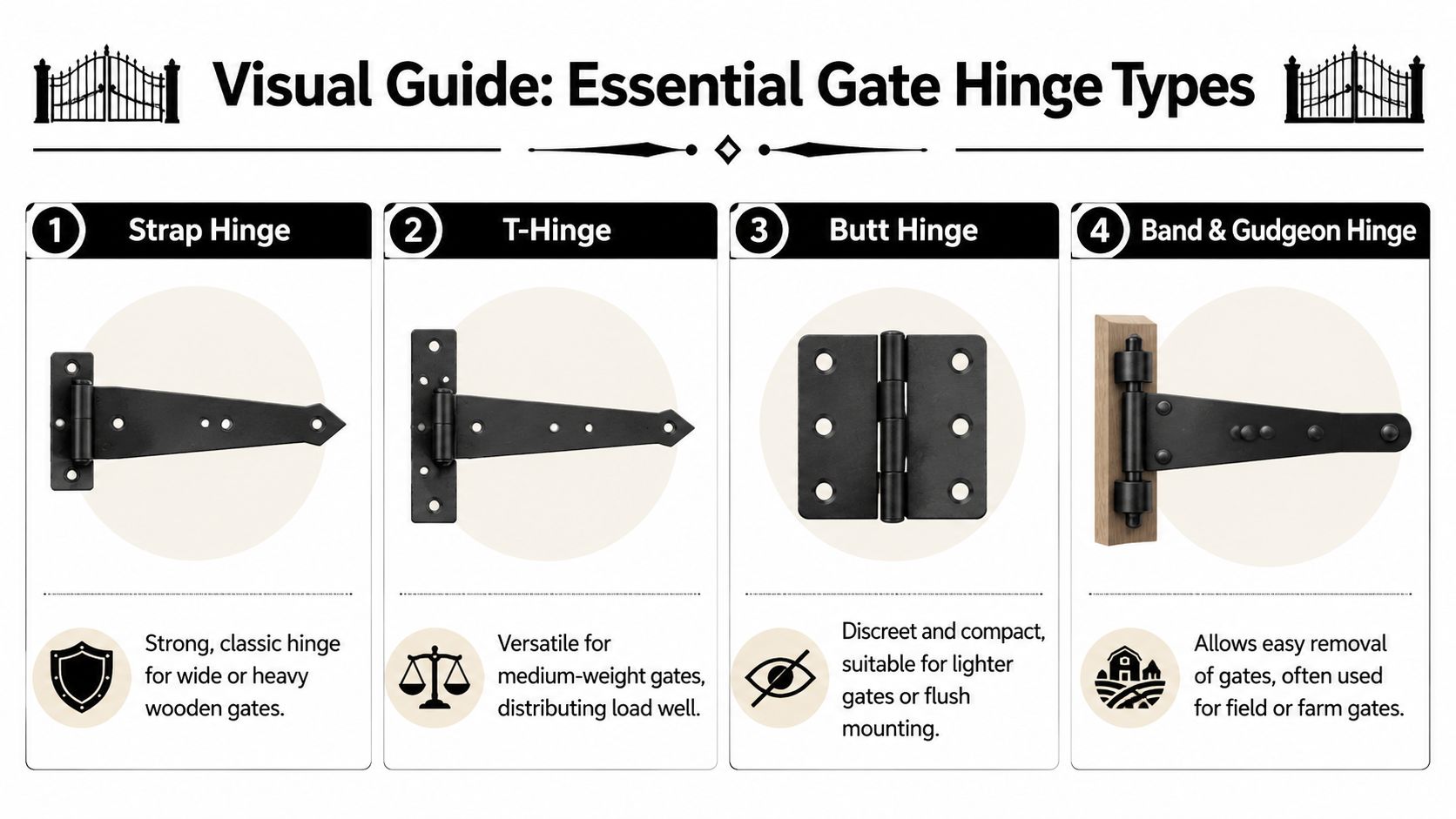
When customers compare gate hinges for wooden gates, they often mix up hinge style with hinge suitability. The shape matters, but the bigger question is what that shape does with the load. Some hinges spread force along the face of the gate. Others stay compact and discreet but suit lighter work.
Strap hinges
Strap hinges are the workhorses for timber gates. The long arm runs across the face of the gate and spreads load over a wider section of wood. That's why they're a strong choice for wider or heavier gates prone to significant stresses.
They also suit traditional garden and side-yard gates because the hinge itself becomes part of the look. If you're hanging a framed ledged gate or a boarded gate with visible ironmongery, strap hinges are often the practical and visual match.
T-hinges
A T-hinge combines a strap-style arm with a shorter fixing leaf. It gives better load distribution than a small butt hinge, but it stays more compact than a full strap hinge. That makes it useful for medium-weight timber gates where you want support without a long decorative arm stretching across the face.
T-hinges are common on pedestrian garden gates, tool enclosure gates, and smaller access gates. They're often the middle ground option when a butt hinge feels too light and a long strap hinge feels oversized.
Butt hinges
Butt hinges are neat and compact. They're familiar because they resemble door hinges, with two rectangular leaves around a central pin. On wooden gates, they're usually better reserved for lighter gates or flush mounting situations where appearance matters and the gate isn't asking too much from the hardware.
The mistake is using butt hinges on a heavy outdoor gate because they look tidy. Outdoors, timber movement, latch pressure, and repeated use can expose the limits of a hinge that doesn't spread load well across the stile.
A compact hinge can still be the wrong hinge. The cleaner look doesn't help if the bottom corner starts dropping after a season.
Band and gudgeon hinges
Band and gudgeon hinges use a long band on the gate and a pin fixed into the post. They're practical when you want a gate that can be lifted off easily for maintenance or seasonal access. Farm gates and field gates often use this setup, but it also has a place on some larger timber gates where easy removal is useful.
The main advantage is serviceability. If a gate needs to come off for repair, staining, or post work, that's much easier with this arrangement than with many fixed screw-on hinges.
Adjustable options
Adjustable hinges aren't a separate visual category in the same way, but they're worth treating as their own buying decision. If you expect seasonal movement, fine tuning matters. Many buyers looking through self-closing and specialty gate hinge options should also think about whether adjustability matters more than appearance.
In real jobs, that trade-off comes up all the time. A plain adjustable hinge often outperforms a prettier fixed hinge once the gate settles and the wood starts moving.
Choosing the Right Hinge Material and Finish
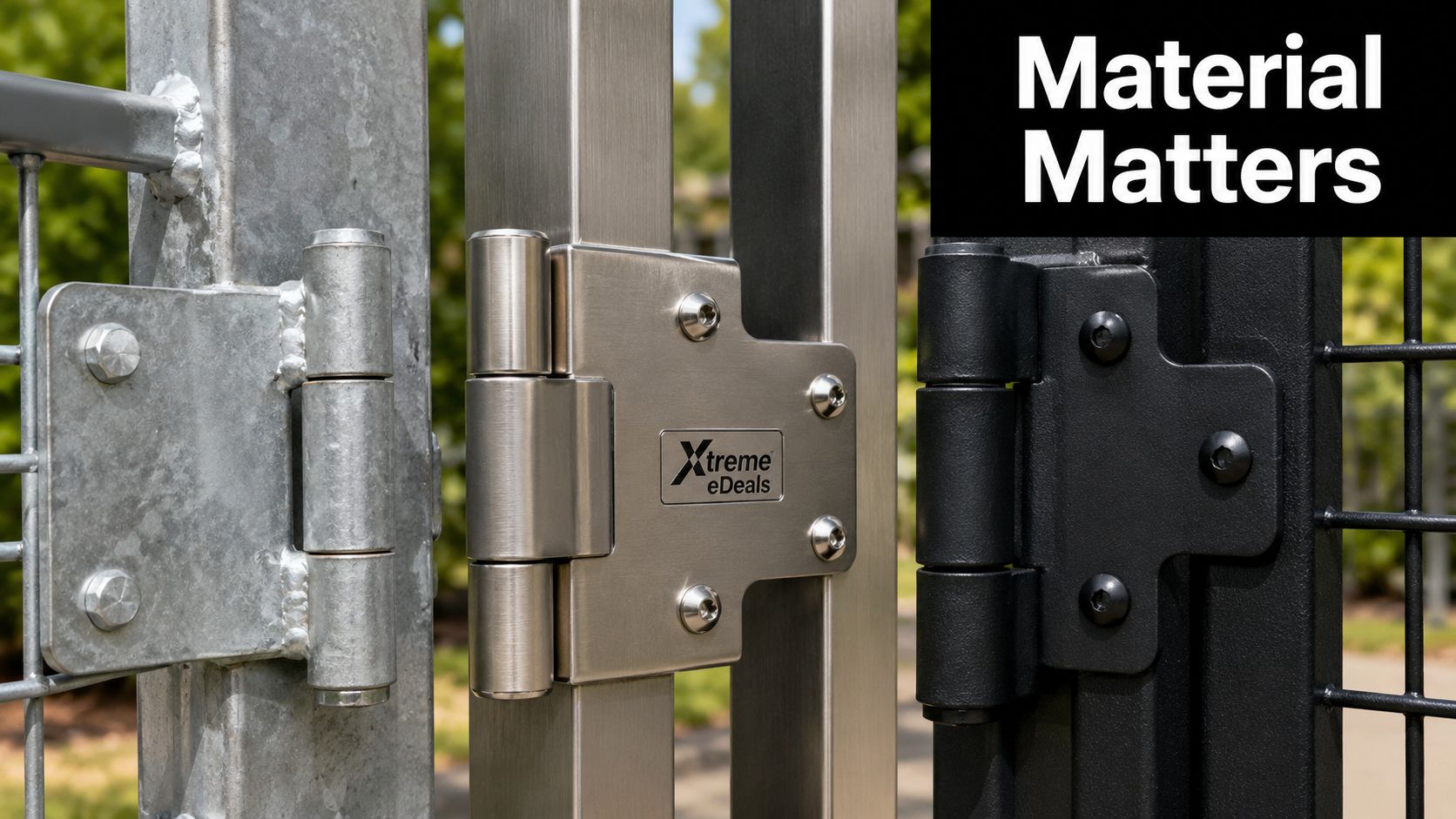
A strong hinge shape won't save you if the metal itself is wrong for the environment. Outdoors, finish failure becomes hardware failure. Rust stains the timber, pins seize, adjustment points bind, and thin leaves start deforming under load. That's why material choice isn't the last detail. It's part of the structural decision.
What holds up outdoors
For heavy-duty applications, stainless steel or powder-coated galvanized steel with a minimum thickness of 3mm is the safer specification because thinner material often fails. The same guidance notes that hinges with a central eye design and 180° adjustability can reduce gate sag by 35-50% compared with non-adjustable strap hinges, which matters for gates weighing between 65-110 lbs (supporting guidance).
If you're choosing between a bargain hinge and one with thicker steel, better coating, and a proper pin design, the better-built hinge usually costs less in the long run because it protects the gate frame and post as well as itself.
Match the finish to the site
Different sites punish hardware in different ways:
- Coastal or damp areas: Salt and moisture attack exposed steel fast. Stainless is often the safer call.
- Freeze-thaw climates: Repeated moisture cycling works on coatings and fasteners, especially where water sits around screw heads.
- Hot inland exposure: Expansion, drying, and repeated movement can loosen poor-quality fixings and highlight weak hinge knuckles.
A powder-coated galvanized hinge can be a very good choice when the coating is well applied and the base material is substantial. Stainless steel earns its place when corrosion resistance matters more than matching a black decorative finish.
Don't buy finish alone
A black hinge may look “heavy-duty” and still be thin, flexible, or poorly protected at the pin. I always tell buyers to look at three things before colour:
- Base metal
- Thickness
- Pin and eye design
If those are weak, the finish is mostly cosmetic.
Better metal solves problems that touch-up paint never will.
How to Select the Correct Hinge Size and Load Capacity
If there's one place people go wrong, it's here. They pick a hinge that looks about right. Gates don't work on “about right”. They work on support, effective mechanics, and margin.
The foundational rule for wooden gate sizing is straightforward. The hinge length should be approximately one-third of the gate's width to maintain structural integrity and help prevent sag. A standard example is a 1600mm-wide gate, where the calculation gives 533mm, rounded up to 600mm for safety margin. That 33.3% ratio is tied to load distribution, and using a smaller hinge than that threshold increases pressure on the connection points by over 50%. The same verified guidance notes that 2 out of 3 gate failures are caused by undersized hinges.
Start with width, then confirm weight
Width creates turning force. Weight creates load. You need to respect both.
A second key rule is capacity. For wooden and composite gates, the hinge must match the gate's weight capacity, and a hinge that can't support the gate's specific weight will cause sagging, loosening, and scraping (hinge capacity guidance from the referenced video).
For most residential wooden gates, exactly two hinges are standard. If the gate is taller than 1.8 meters or exceeds 150 lbs, capacity needs closer attention so the combined support of both hinges matches the gate weight. Verified guidance also states that for gates over 200 lbs, standard strap hinges show a 90% incidence of failure, pushing you toward heavy-duty, weld-on, or pintle designs rated up to 440 lbs.
A quick selection chart
| Gate Width | Gate Weight | Minimum Hinge Length | Required Hinge Type |
|---|---|---|---|
| Narrow pedestrian gate | Light | Approx. one-third of gate width | Butt hinge or T-hinge if load is modest |
| Standard garden gate | Moderate | Approx. one-third of gate width | T-hinge or strap hinge |
| Wide wooden gate | Heavy | Approx. one-third of gate width, rounded up for safety | Heavy-duty strap hinge |
| Very heavy or oversized gate | Very heavy | Proportionally longer heavy-duty hinge | Pintle, weld-on, or other heavy-duty hinge system |
The table stays qualitative where your actual gate dimensions and timber species will decide the final hardware. The rule doesn't change. Short hinges on wide gates are asking a small fixing area to resist a large twisting force.
When adjustable hinges earn their keep
Adjustable hardware becomes valuable when the post settles, the timber moves, or the site has wind exposure. If you're comparing options, adjustable gate hinges are worth looking at for gates that need alignment control over time, not just support on installation day.
Another verified benchmark matters for tall gates. For wooden gates exceeding 2100mm in height, a third hinge is structurally mandatory to spread shear load and reduce sag. That same guidance says the combined load capacity of the hinges should total at least 1.5 times the gate's total weight to account for dynamic wind forces, and for a 900mm-wide gate, the minimum hinge length should be 450mm.
When a gate fails, the hardware usually wasn't “a bit small”. It was mechanically mismatched to the job.
Our Recommended Hinges for DIYers and Pros
Buying hardware is easier when you stop thinking in categories and start thinking in use cases. A side-yard cedar gate, a taller privacy gate, and a heavy driveway leaf shouldn't all get the same answer. The right hinge is the one that fits the gate's size, weight, and maintenance reality.
Best fit for a typical DIY garden gate
For a straightforward pedestrian gate in cedar or pressure-treated lumber, a Decorex Hardware T-hinge is usually the sensible starting point. It gives more support than a compact butt hinge and doesn't feel oversized on a modest gate. It's a practical choice when the gate is used daily but isn't exceptionally wide or heavy.
This is the kind of hinge I'd point a DIY homeowner toward when they want a clean install without getting into specialty hardware. It's forgiving, familiar, and easier to align than some heavier systems.
Better choice for a wider timber gate
A Decorex Hardware strap hinge makes more sense when the gate gets wider and the hinge needs to spread the load across more of the frame. That long arm matters. It reduces strain at the fixing points and gives the stile more support against twist.
Aesthetics and mechanics often line up well. Strap hinges look right on many timber gates because they also happen to do the right mechanical job.
What pros usually choose for difficult sites
Contractors and experienced installers usually move toward heavy-duty adjustable or pintle-style hardware when the gate is tall, heavy, exposed to wind, or expected to stay precise at the latch line. Those jobs punish light hardware fast.
A few practical buying rules help sort the options:
- For light gates: T-hinges are often enough if the gate is narrow and well built.
- For medium timber gates: Strap hinges usually offer the best balance of support and simplicity.
- For gates that may move seasonally: Adjustable hinges give you a way to correct alignment without rebuilding the install.
- For oversized or high-stress gates: Heavy-duty systems beat decorative hardware every time.
Nuvo Iron has strong name recognition, but hardware selection still comes down to fit for the job, not logo or packaging. On demanding timber gates, durable construction and proper sizing matter more than trend-driven styling.
A Simple Guide to Hinge Installation and Mounting
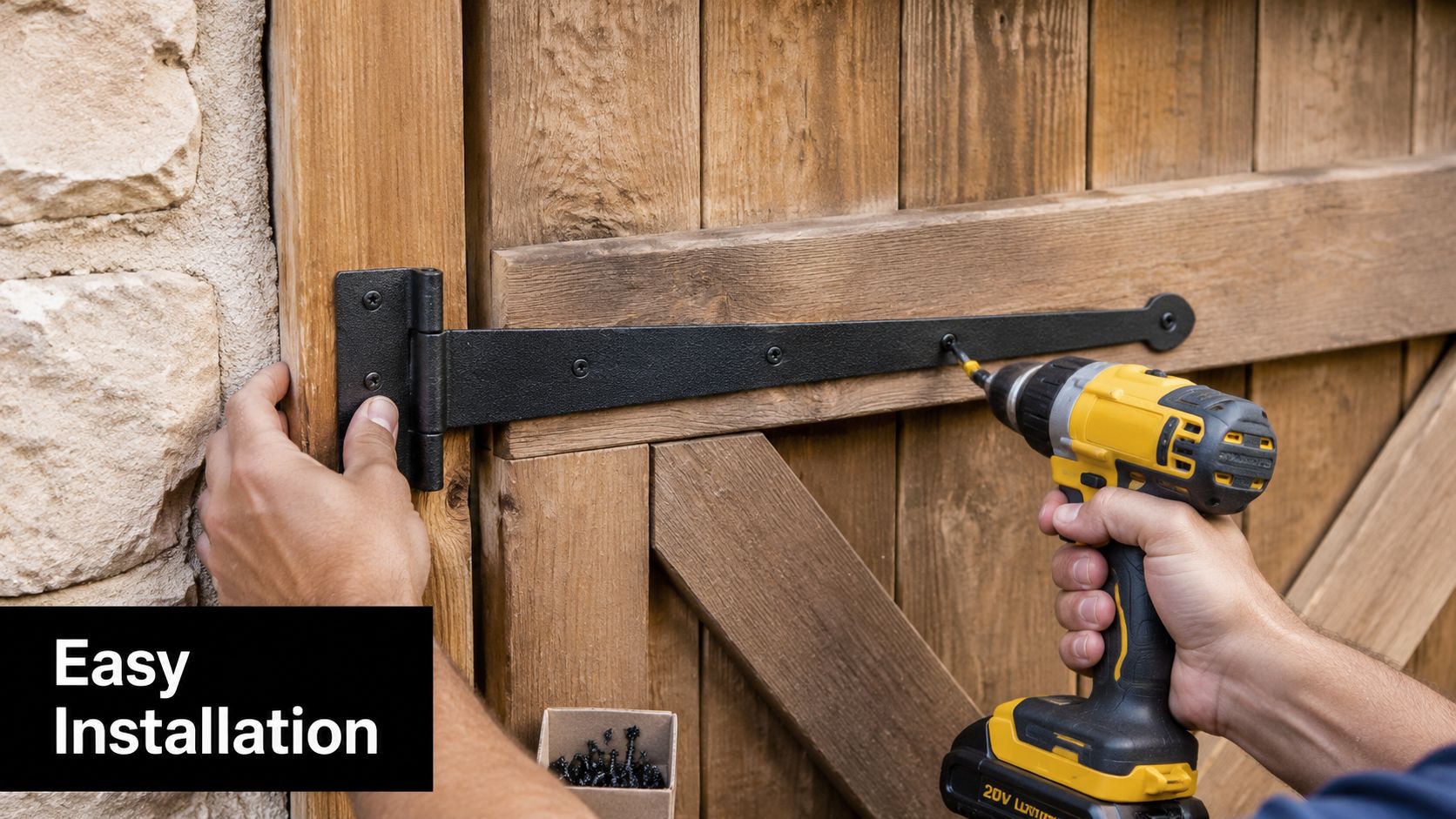
Good hardware can still perform badly if it's mounted poorly. Installation is where a lot of otherwise decent gate hinges for wooden gates lose their advantage. The basic goal is simple. Keep the gate square, distribute the load into sound timber, and give yourself enough adjustment to fine-tune the swing.
Face-mount or edge-mount
Face-mounting is common with strap and T-hinges. The hinge sits on the face of the gate, which spreads force over a bigger area and makes it a natural fit for many timber designs.
Edge-mounting suits certain compact or concealed setups, but it demands more from the timber and the fixing accuracy. If the gate is anything more than light-duty, face-mounted hardware often gives better forgiveness and better support.
Placement matters as much as hinge choice
For most residential wooden gates, install exactly two hinges. For taller or heavier gates, a third hinge is necessary, and the first hinge must be installed 15–20 cm from the top edge of the gate to distribute load pressure effectively, according to Nuvo Iron's gate hinge placement guidance.
That top hinge is doing serious work. If it sits too low, the gate puts more strain on it and starts dropping sooner. The lower hinge stabilises the swing, but the upper hinge usually tells you whether the gate will stay aligned.
Installation habits that prevent callbacks
A clean install usually comes down to a handful of habits:
- Support the gate during fitting: Use blocks or wedges so the hinges aren't carrying the full load during fastening.
- Pre-drill properly: Pilot holes reduce splitting and help screws track straight.
- Check the reveal before final tightening: Don't assume the gap will stay even once the hardware is snugged up.
- Tighten in stages: Bring fasteners up evenly instead of locking one side hard before checking alignment.
If you want a contractor-minded reference on fence building standards and repair judgement, Northpoint Construction fence expertise is a useful supplementary read because it reflects the kind of practical field thinking that prevents small errors from turning into rebuilds.
A visual walk-through helps if you're mid-project and want to sanity-check your mounting approach.
For product-specific fitting notes and mounting variations, a focused guide on gate hinge installation can help you compare what changes between standard, adjustable, and self-closing setups.
Maintaining and Troubleshooting Your Gate Hinges
A good hinge doesn't need constant attention, but it does need occasional inspection. Most gate problems are easier to correct when they're small. If you wait until the gate is scraping hard or the latch no longer lines up, you're often fixing wood movement and hardware strain at the same time.
What to check once a year
A simple maintenance pass goes a long way:
- Look for loose fasteners: Tighten anything that's backing out before the holes wear oversized.
- Clean the hinge body and pin area: Dirt and surface corrosion hold moisture and accelerate wear.
- Lubricate moving parts if the hinge design allows it: That helps with squeaks and reduces binding.
- Inspect the gate gap: If the reveal is changing, catch it early before the latch side starts dragging.
Common problems and the usual fix
If the gate has minor sag, adjustable hinges often let you bring it back into line without rebuilding the whole setup. If the hinge is fixed and the screws are loose, remove the load, correct the alignment, and refasten into solid material.
If the gate binds in one season and loosens in another, timber movement is usually part of the story. That's common on exterior joinery. The same kind of seasonal planning matters on other outbuildings too. If you're comparing closure systems for storage structures, this guide to overhead doors for sheds is useful because it shows how outdoor openings need hardware that tolerates repeated movement and weather.
Small hinge corrections are maintenance. Repeatedly ignoring them is how people end up rebuilding gates that were otherwise worth saving.
A hinge should let the gate swing freely, latch cleanly, and stay where you expect it. When it stops doing those three things, don't just force the gate harder. Find the source of the load problem.
If you're ready to choose hardware that matches your gate, XTREME EDEALS INC. carries gate hinges, adjustable options, fasteners, and fence hardware for both DIY builds and professional installs. It's a practical place to compare Decorex Hardware products, match hinge style to gate size, and get the right supporting hardware in one order.