
A lot of fences are still structurally sound long after they stop looking interesting. The posts are firm, the rails are straight, and the boards still do their job. But the overall look feels flat, especially when the garden has been updated, the patio has been redone, or the gate sits right in view from the street.
That's where fence decorative inserts make sense. They let you change the look of an existing fence without committing to a full tear-out. In practice, they can soften a blank privacy wall, add airflow to a gate, or give a standard panel a more finished architectural look.
Transform Your Fence from Bland to Beautiful
A common scenario goes like this. The homeowner has a plain wood privacy fence that works perfectly well, but every time they look out from the deck, it feels like the weakest visual element in the yard. Replacing the whole fence would be expensive and unnecessary, yet leaving it alone means living with a backdrop that never quite matches the rest of the space.
Fence decorative inserts solve that problem in a targeted way. Instead of rebuilding everything, you cut in a feature where it will have the most impact. That might be a centred gate insert, a repeated pattern across a privacy wall, or a top section that breaks up a heavy run of boards.
Fences have long served screening, decorative framing, and utilitarian exclusion, and in design-sensitive areas they're often judged by whether they fit local character in mass, scale, materials, and colour, according to historic district fence guidance. That's useful advice even outside a formal historic district because it points to the same question clients should ask on any project. Does this insert look like it belongs on the fence, or does it look like an afterthought?
Where inserts make the biggest difference
- On gates: A gate is the easiest place to add detail because it already acts as a focal point.
- In long privacy runs: One or two inserts can break up a big uninterrupted wall of boards.
- Near patios or seating areas: A decorative opening can add lightness without fully giving up privacy.
- At the top of a fence line: This works when the fence feels visually heavy and needs a lighter finish.
Practical rule: The best insert projects look intentional from a distance and well-fitted up close.
Used properly, inserts are a design upgrade, not just a hardware add-on. They work best when the pattern, finish, and scale match the fence they're going into.
Understanding Fence Decorative Inserts
Fence decorative inserts are pre-made decorative panels or framed accent pieces that fit into a cut-out section of a fence, gate, or privacy wall. They're not a full fencing system on their own. They're an upgrade component that changes the look and, in some cases, the feel of an existing assembly.

Most homeowners first notice them in three forms. Some replace a sizeable section inside a fence panel. Others act as smaller “window” inserts in gates. A third group works as decorative toppers that sit near the upper portion of the fence and change the silhouette.
What they do well
They're useful when you want one of these outcomes:
- More character: A patterned metal insert can make a plain panel feel custom-built.
- A visual break: Inserts reduce the look of a long, solid barrier.
- Selective visibility: Some designs open a sightline without turning the fence into an open picket style.
- Mixed-material styling: They help combine wood, vinyl, composite, and metal in a controlled way.
The broader market context also helps explain why these products keep showing up in residential projects. The U.S. residential fencing market is valued at over $6 billion, and modern decorative inserts grew out of 19th-century ornamental ironwork into today's lower-maintenance vinyl and composite styles, as noted in this history of fence construction and materials.
What they are not
They're not a shortcut around poor fence structure. If the posts are loose, the rails are twisted, or the gate sags, the insert won't fix that. In fact, adding an insert to a weak panel often makes the problem more obvious.
A decorative insert should go into a fence that's worth keeping. If the frame is failing, repair the fence first and decorate second.
They're also not all interchangeable. Some are designed around wood board thickness, some suit composite better, and some need a more rigid frame to avoid movement over time. That fit question matters just as much as style.
Comparing Materials and Popular Insert Types
Material choice decides whether an insert still looks sharp a few seasons from now or starts becoming a maintenance problem. In my experience, buyers often focus on pattern first and material second. It should be the other way around, especially in climates with salt air, strong sun, regular irrigation overspray, or freeze-thaw movement.
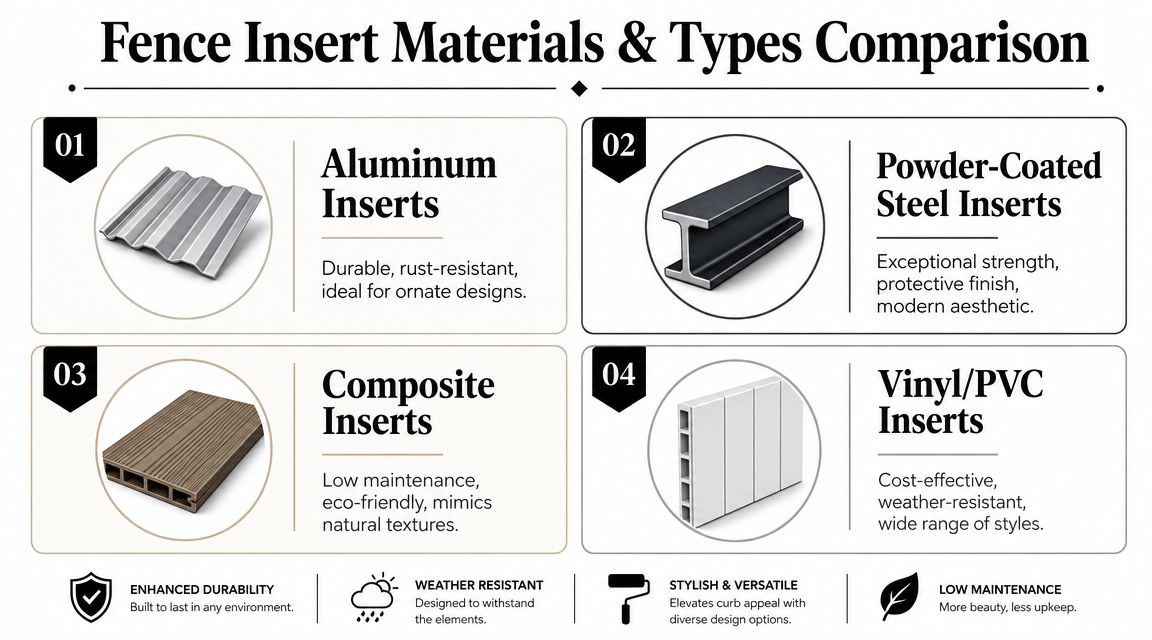
How the main materials differ
For coastal and high-humidity sites, corrosion resistance is a key driver. Aluminum is naturally corrosion-resistant, while steel needs a UV-stable powder coat over a zinc-primer system to help prevent rust, especially at cut edges, according to this ornamental fence material reference.
That leads to a straightforward set of trade-offs.
| Fence Insert Material Comparison | |||
|---|---|---|---|
| Material | Pros | Cons | Best For |
| Aluminum | Light, corrosion-resistant, easier to handle, good for ornate patterns | Can feel lighter-duty if the design is too thin | Coastal settings, humid climates, decorative accents |
| Powder-coated steel | Strong, rigid, dent-resistant, crisp modern look | Heavier, coating quality matters a lot, exposed cut edges need attention | Gates, high-wear areas, projects needing stiffness |
| Composite | Low maintenance, blends well with composite fencing, softer visual feel | Less sharp detail than metal, style range can be narrower | Modern privacy fences, low-upkeep yards |
| Vinyl/PVC | Clean finish, weather-resistant, easy-care, often budget-friendly | Can look less substantial on premium builds, style depends on product line | Simple upgrades, matching vinyl fence systems |
Popular insert types by use
Not every insert serves the same purpose. These are the categories I see most often:
- Full panel inserts: Best when the fence needs a noticeable feature wall effect.
- Gate inserts: Great for entry points, side gates, and pet-view openings.
- Topper inserts: Useful when the fence line feels too blocky and needs relief near the top.
- Small window-style inserts: A good choice when you want detail without giving up much screening.
If you're working on a gate or entry feature, it also helps to compare insert styling with complete rod iron gate options so the fence and gate don't end up looking like two separate projects.
What works and what doesn't
What works is matching the insert material to the exposure. Aluminum usually makes more sense near the coast. Properly finished steel works well where stiffness matters and the coating system is solid. Composite and vinyl fit buyers who want a softer look and lower upkeep.
What doesn't work is choosing purely by photo. A thin decorative pattern can look great online and still be the wrong choice if the gate gets slammed daily or the fence sits in constant overspray from sprinklers.
How to Choose the Right Decorative Inserts
Buying the right insert starts with one question. Are you trying to improve the fence's style, its feel, or both? The answer changes everything. A modern geometric panel in a charcoal finish suits a very different property than a leaf motif in a warm-toned cedar fence.

Start with the house, not the insert
A good insert should echo something that already exists on the property. Look at window trim, railings, siding lines, hardscape shapes, and garden style.
- Modern homes: Geometric cut-outs, simple rectangles, black or dark bronze finishes.
- Traditional homes: Scrollwork, softer curves, symmetrical layouts.
- Rustic or natural settings: Tree, leaf, or branch-inspired patterns, especially with stained wood fencing.
- Contemporary mixed-material yards: Clean metal accents paired with composite or horizontal boards.
If your fence is wood, species and durability still matter. Before adding an insert to a new or refreshed wood section, this guide on choosing wood for outdoor projects is a useful reference for matching the wood itself to exterior conditions.
Check the material details buyers often miss
Products that look similar begin to separate.
Look at:
- Base material: Aluminum, steel, vinyl, or composite.
- Finish quality: Powder coating, primer system, and whether field cuts can be sealed.
- Frame style: Some inserts need more support than others.
- Compatibility: Board thickness and fence construction affect fit.
- Pattern density: Dense designs offer more screening. Open patterns offer more visibility and light.
XTREME EDEALS INC. carries decorative gate and fence insert options along with related hardware, including products associated with brands such as Decorex Hardware and Nuvo Iron, which makes it practical to compare styles and accessory needs in one place at Xtreme eDeals.
The smartest buyers compare pattern, material, finish, and fastening method together. A nice design alone doesn't tell you how the insert will age.
Match the insert to your tolerance for upkeep
Some clients don't mind occasional touch-up work. Others want to install once and forget about it. Be honest about that before ordering. If low maintenance is the priority, choose a material and finish that fit your climate and won't keep asking for attention later.
Navigating Sizing Compatibility and Local Codes
The sizing side is where many insert projects go wrong. The product may be fine, but the opening is cut too large, the frame isn't square, or the installer assumes every fence board is uniform when it isn't. Accurate measuring matters more here than it does on many other fence accessories because the insert becomes a visible centrepiece.
Measure the opening the right way
Take the time to measure the actual install location, not a nominal panel size from memory.
Use this sequence:
- Check for plumb and level. An out-of-square gate frame changes your usable opening.
- Measure width in more than one place. Top, middle, and bottom can differ.
- Measure height on both sides. Older gates and fence sections can sag slightly.
- Confirm board and frame thickness. Insert systems often depend on sandwiching or fastening through specific material depths.
- Allow for the mounting method. Some products need a reveal or trim ring area around the cut-out.
Compatibility questions to ask before cutting
Different inserts suit different fence builds. A framed wood gate can usually take an insert more easily than a thin, flexible panel. Vinyl and composite can also behave differently when cut, especially if the panel relies on internal webs or channels.
Ask these practical questions first:
- Is the fence structural enough to stay rigid after removing material?
- Will the insert sit in boards only, or in a framed section?
- Does the gate already rack or sag?
- Will the pattern reduce privacy more than you want?
If you're unsure whether a decorative opening changes the strength of the section, reinforce the frame before installation instead of after the cut.
Don't skip code and approval checks
In fire-prone areas, local rules may require exterior materials to resist ignition, and that often makes non-combustible metal inserts such as aluminum or steel the safer route. Local authorities may also review fence height or material changes when an insert is added, as outlined in this design review and specification reference for exterior materials.
Municipal rules and HOA guidelines vary a lot. Height limits, corner-lot visibility, front-yard setbacks, and shared-boundary fence rules can all affect what you're allowed to do. For readers comparing approval processes in different jurisdictions, this overview of projects without council approval in SA is a helpful example of why checking local authority requirements early saves trouble later.
For a practical starting point on dimensional planning, review fence height requirements before finalising the layout. It won't replace your local code check, but it will help frame the right questions.
A General Guide to Installing Your Inserts
Most fence decorative inserts are within reach for a careful DIYer, but the project rewards patience. The hard part usually isn't the fastening. It's laying out the opening cleanly and keeping everything square so the insert looks built-in rather than patched in.
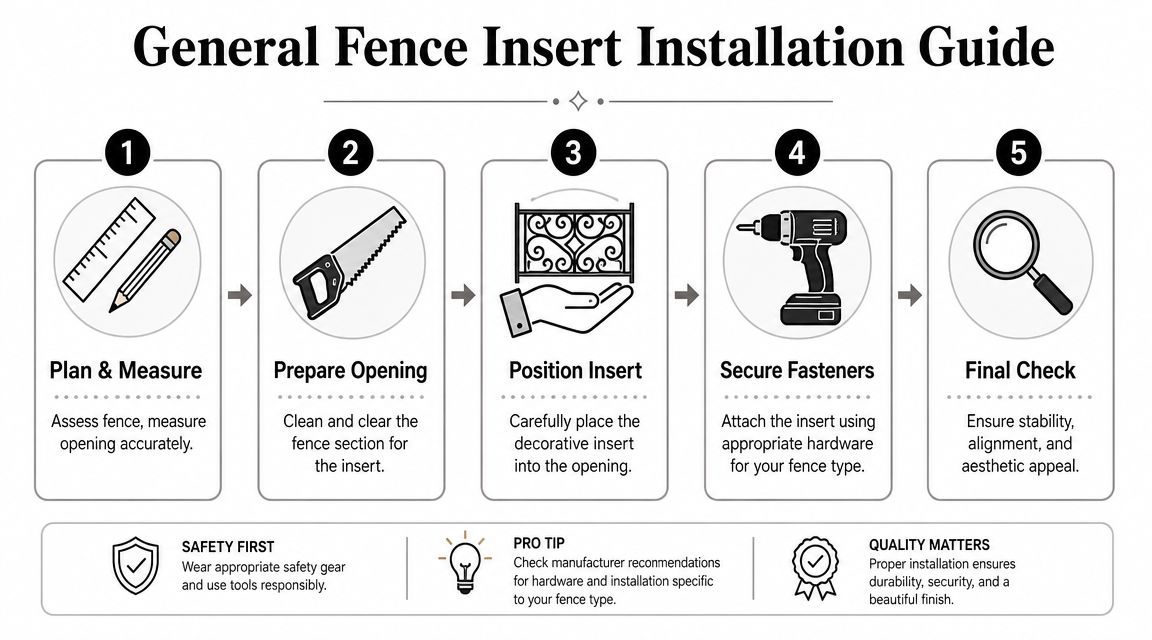
Typical installation flow
A general install looks like this:
Lay out the position
Mark the centreline, top and bottom limits, and side clearances. Step back and check the placement visually before cutting.Prepare the work area
Remove nearby obstructions, support the gate if needed, and protect the finish around the cut area.Cut the opening
Drill starter holes where needed and cut carefully with the right saw for the fence material. Clean the edges before test fitting.Dry fit the insert
Don't rush to fasteners yet. Make sure the insert sits evenly and that the surrounding material isn't under stress.Fasten and re-check
Use corrosion-resistant hardware appropriate to the fence material and exposure. Tighten evenly so the insert sits flush without distortion.
Tools and hardware that matter
The exact list depends on the product, but these are common:
- Measuring and marking tools: Tape measure, square, pencil, masking tape
- Cutting tools: Jigsaw or other suitable saw for the fence material
- Safety gear: Eye protection and hearing protection
- Fasteners: Stainless steel or coated screws where corrosion is a concern
- Support items: Clamps, blocks, and touch-up materials for cut edges where required
If you want to see a related process before taking on your own project, this article on installing Sunbelly privacy screens is useful because it shows the same importance of careful layout, support, and clean finishing on exterior screen installations.
The biggest install mistake
Most bad results come from one issue. The opening gets cut before the installer confirms the insert's exact fit and fastening method.
For product-specific help, a Nuvo Iron gate insert video guide can be a practical reference before you start.
Cut once the insert has been physically checked against the fence section. Packaging dimensions and actual install dimensions aren't always the same thing in practice.
Styling and Maintaining Your New Fence Inserts
The insert only looks custom if it still looks intentional after weather, dust, pollen, and regular use. That's why maintenance and styling belong together. The right pattern can enhance a fence immediately, but the wrong material or neglected finish will age faster than the surrounding structure.
Maintenance that actually helps
A common homeowner concern is whether an insert will hold up against sun, salt air, and temperature swings. The long-term result is tied directly to material choice and coating quality, as noted in this discussion of climate-related insert performance.
For day-to-day care, keep it simple:
- Metal inserts: Wash off dirt, pollen, and irrigation residue. Inspect any drilled or cut areas for coating damage.
- Vinyl and composite inserts: Clean with a mild exterior-safe cleaner and a soft cloth or brush.
- Wood-surround installations: Watch the wood around the insert just as closely as the insert itself. Swelling, cracking, or failed finish at the cut-out can spoil the whole look.
Styling choices that age well
Some insert styles have a long shelf life because they tie into the architecture rather than a passing trend.
Good pairings include:
- Geometric patterns with horizontal fences: Crisp, modern, and easy to repeat.
- Nature motifs in garden zones: Better in backyards than formal front boundaries in most cases.
- Simple rectangular gate inserts: Often the safest choice when you want a cleaner upgrade without making the fence too busy.
- Repeated small inserts instead of one oversized feature: Useful when the fence line is long and the design needs rhythm.
One practical styling rule helps nearly every project. Repeat the insert finish somewhere else on the property. That might be a gate latch, light fixture, railing, planter edging, or house hardware. The insert then feels connected instead of random.
A decorative insert should look like part of the property's language, not a separate accent pasted onto the fence.
Frequently Asked Questions
| FAQ on Fence Decorative Inserts | |
|---|---|
| Question | Answer |
| Can I add an insert to an old fence? | Yes, if the fence is still structurally sound. Check posts, rails, sagging, and rot before cutting into anything. |
| Will inserts reduce privacy? | Some will. Dense patterns preserve more screening, while open designs create visibility and airflow. |
| Are metal inserts always better? | Not always. Metal is often the stronger choice for durability, but the right answer depends on climate, look, and how much upkeep you want. |
| Can I install one in a gate? | Yes. Gates are one of the most common places for inserts, but the frame needs to stay rigid after the opening is cut. |
| Do I need a permit? | Sometimes. Height, materials, visibility, HOA rules, and fire-zone requirements can all affect approval. |
| What's the safest choice for harsh exposure? | In demanding conditions, focus on proper material selection, quality coatings, and correct fastening rather than pattern alone. |
| Can decorative inserts work with wood, vinyl, and composite fences? | Yes, but compatibility depends on panel construction, thickness, and how the insert mounts. Always confirm the fit before cutting. |
If you're planning a fence upgrade and need inserts, post caps, fasteners, hinges, or related hardware, XTREME EDEALS INC. is one practical place to compare compatible products and project accessories before you start cutting into the fence.