
You've found the right fence opening, picked a clean modern finish, and maybe even added an aluminum gate kit to your cart. Then a neighbour, inspector, or building department asks a question you didn't plan for: How tall is it, where is it located, what material is it, and will it be automated?
That's where many straightforward weekend projects become expensive revisions. A gate can look excellent and still fail because its height triggers planning review, its swing lacks clearance, its hardware is vulnerable to coastal exposure, or its location falls within a fire-hardening zone. The frame is only one part of the decision. Posts, hinges, latches, fasteners, permits, setbacks, and local rules all determine whether the finished gate works properly and passes inspection.
Planning Your Aluminum Gate Project
A Friday measurement can become a failed inspection by Monday. A front-yard gate may exceed a local height threshold, a driveway opening may violate a setback, or a wood-look infill may be unsuitable near a wildfire-exposed home. The expensive mistake is ordering the kit before checking the property's constraints.
Begin with the gate's location rather than the catalogue photo. Mark the property line, identify whether the opening is in a front yard, side yard, driveway, or pedestrian route, and measure its distance from the home or another occupied structure. Local rules may govern the gate, posts, swing, operator, and surrounding fence. Cupertino, for example, applies setback requirements to certain gates near front and street-side property lines. Confirm the applicable setback with the city's planning department before fixing the layout.
Questions to answer before ordering
Contact the local building or planning department and ask:
- Height: Does the proposed gate height require planning approval or a building permit?
- Placement: Do front-yard, street-side, visibility, or setback rules apply?
- Automation: Does a powered operator need a separate electrical permit?
- Fire exposure: Is the property subject to local wildfire-hardening or defensible-space requirements?
- Access: Does the gate serve a public, commercial, pool, or accessible route?
- Property control: Are there easements, shared driveways, or homeowners' association restrictions?
Oakland shows why a “DIY-friendly” label does not settle the permit question. The city requires planning approval for front-yard gates taller than 3.5 feet, building permits for gates over 7 feet, and a separate electrical permit for powered operators, as outlined in its gate permit guidance. Los Angeles County also requires a building permit for fences or similar structures over 6 feet, while front-yard height and setback rules may still trigger planning review.
Practical rule: Do not buy the frame, operator, or infill until you know which local threshold your project crosses.
California's adopted 2026 Zone 0 package gives aluminum a compliance role near occupied structures. It treats aluminum as noncombustible under ASTM E136 and identifies it as a compliant material for fence and gate sections attached to, or within 5 feet of, an occupied structure. The package was adopted on August 19, 2026, but still requires final administrative review before full statewide effect. Confirm the current status with the relevant authority using the California wildfire-hardening guidance.
Aluminum therefore supports some fire-hardening designs, but it does not automatically satisfy every California requirement. Verify the material, construction, location, and approval path before ordering, especially when the gate is the fence section closest to the home.
Comparing Aluminum to Wood and Steel
Aluminum earns its place in gate projects through a combination of low weight, corrosion resistance, and fire-zone suitability. Wood can offer warmth and privacy, but it needs protection from moisture, insects, and movement. Steel provides strength and a substantial feel, yet ferrous components can develop visible rust when coatings fail or marine air reaches exposed surfaces. Vinyl avoids rust, but it can look less architectural and may not provide the rigidity or hardware support some driveway applications need.
Coastal California makes the distinction obvious. Aluminum forms a protective oxide layer rather than the red rust associated with steel, and coastal gate guidance for Southern California homes recommends fresh-water rinsing to reduce salt buildup on the finish. That advantage doesn't make the entire assembly maintenance-free. Hinges, fasteners, latches, and dissimilar-metal connections still need careful selection.
Wildfire exposure changes the comparison again. California's adopted Zone 0 material package explicitly includes aluminum among compliant noncombustible materials for qualifying fence and gate sections near occupied structures, alongside steel, wrought iron, chain link, masonry, concrete, and stone. Wood and many plastic-based products require a different compliance assessment in those locations.
Gate Material Comparison Matrix
| Material | Corrosion Resistance | Fire Compliance | Maintenance Level |
|---|---|---|---|
| Aluminum | Strong resistance to red rust, but mixed-metal connections still need attention | Explicitly included as a compliant noncombustible example in California's adopted Zone 0 package for qualifying locations | Low, with washing and hardware checks |
| Wood | Can absorb moisture, rot, split, or attract insects without suitable protection | Must be assessed against the applicable local fire requirements | High, with ongoing sealing and repairs |
| Steel | Strong when protected, but exposed ferrous areas can rust, especially near salt air | Noncombustible, subject to the applicable construction rules | Moderate, with coating and rust control |
| Vinyl | Doesn't rust, but heat and impact can affect appearance and rigidity | Requires project-specific fire assessment | Low to moderate |
| Wrought iron | Durable but vulnerable to rust at damaged or unprotected surfaces | Listed among compliant noncombustible examples in the California package | Moderate |
The trade-off is structural feel. A steel gate can tolerate abuse and may suit a heavy commercial opening, while aluminum keeps hinge posts and operators under less load. A wood gate can be repaired with ordinary carpentry tools, but its movement can make latch alignment a recurring task. Vinyl may be easy to wash, yet it isn't always the right choice for a narrow, rigid, custom-looking entry.
For design inspiration outside California, Ottawa aluminum gate options show how aluminum can be paired with different fence styles and infills. For component planning, review metal gate outdoor hardware alongside the frame specification rather than treating accessories as an afterthought.
Sizing Rules and Clearance Requirements
A weekend gate project can fail inspection before the panel is ever hung. The usual causes are an opening measured only between posts, a swing path that crosses a walkway, or a local rule triggered by the gate's size or automation. Measure the opening at several points, check whether the posts are parallel, and record the finished grade and slope before choosing a single or double configuration.
California labor rules set a baseline for enclosed areas. A fenced or walled enclosure must have a gate or door at least 2 feet 6 inches wide and 6 feet 6 inches high, and it must be readily operable, according to the California gate requirements. These dimensions do not select the kit for you, but they show why a decorative opening still has to work as an access point. Fire-zone material rules and local permit thresholds can impose separate requirements, so confirm them before ordering components.
Measure the opening, then measure the movement
Use a tape measure, level, plumb line, and straightedge. Record:
- Width at the top, centre, and bottom: A tapered opening may require post correction before you order the gate.
- Height from the finished grade: Include paving, soil, gravel, or a planned future surface.
- Post condition: Rot, movement, or undersized posts make an otherwise accurate measurement unreliable.
- Swing arc: Check walls, parked vehicles, steps, landscaping, walkways, and neighbouring property.
- Slope: A gate swinging downhill may drag even when its frame is level.
Leave the hinge and latch clearances specified by the manufacturer. A nominal opening is not automatically the clear opening. Confirm whether the kit dimension describes the frame, the distance between posts, or the usable passage after hardware is installed. If the opening is close to a standard size, allow room for adjustment instead of forcing the panel into a tight gap.
Pedestrian access needs separate review. California accessibility rules for public and commercial pedestrian gates on an accessible route require a 32-inch clear opening with the gate open 90 degrees, plus manoeuvring clearance and hardware that can be operated without tight grasping, pinching, or twisting. Use the applicable California Building Code and ADA provisions for that requirement. An aluminum double-gate product example may help with layout ideas, but a sales page should not replace the governing accessibility standard. A residential side gate may fall outside those rules, while a public or commercial project may not.
Automation changes the measurement
California's draft regulated-gate rules cover automatic vehicular gates, manual vehicular gates, and gates wider than 48 inches or higher than 84 inches. They also address ASTM F900 and F1184 compliance, positive stops, covered rolling wheels, and limiting a detached gate's fall to 45 degrees from vertical, according to this Southern California gate-code guide.
Treat those points as a design checkpoint, then confirm the current local requirements with the authority having jurisdiction. Automation adds operator loads and safety hardware. The hinge post must remain stable, the travel path must be controlled, and the frame must accept mounting forces without twisting.
Step-by-Step Installation Overview
A good aluminum gate kit installation starts with the posts. If the posts move, every later adjustment becomes temporary. Prepare the opening, verify the finished grade, and set the structural supports before you worry about decorative caps or final latch tuning.
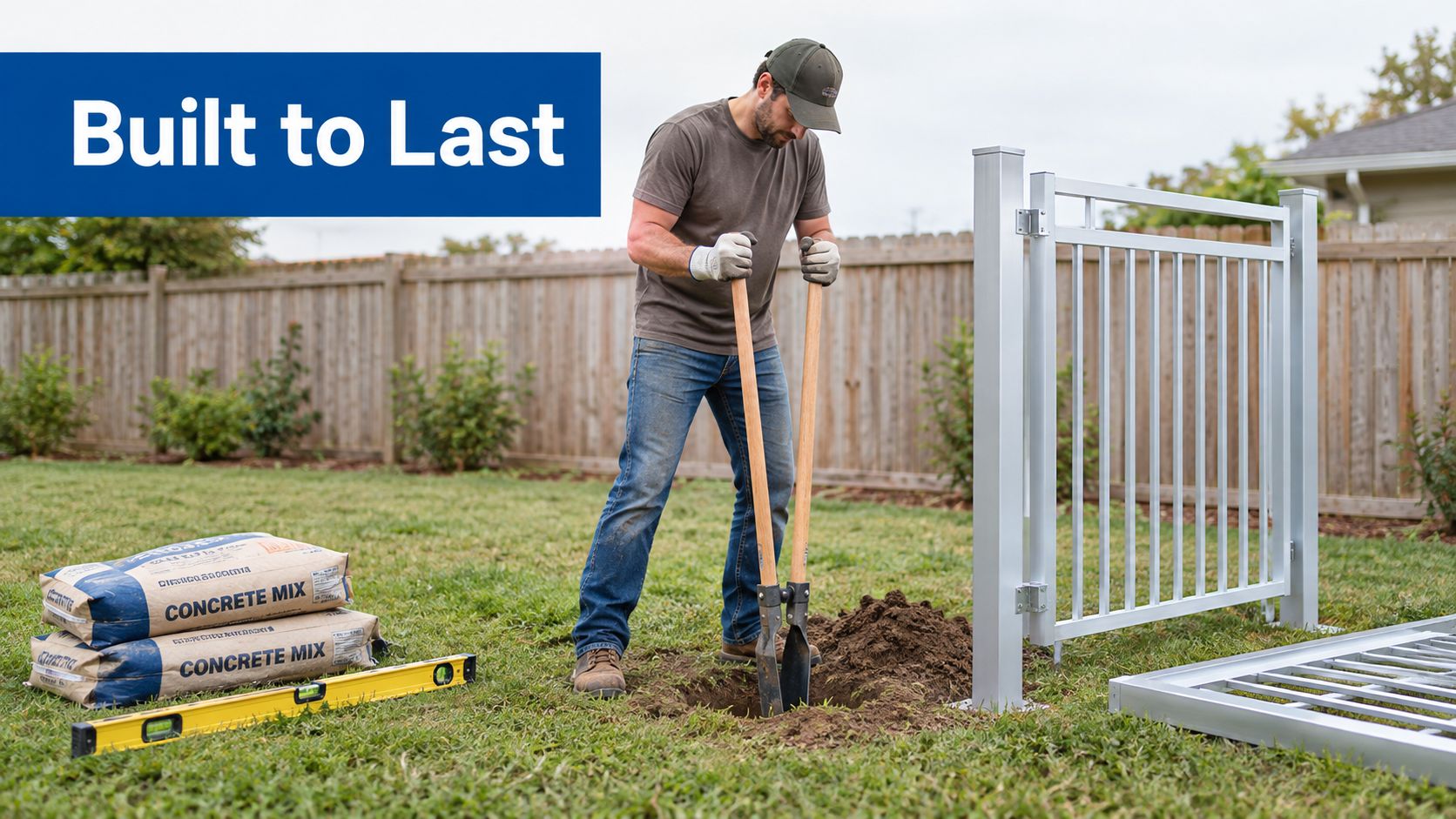
Set the foundation before hanging the frame
Confirm the layout: Recheck the swing direction, post locations, property clearance, and finished ground level. A string line and long level help expose a post that looks straight from one angle but leans across the opening.
Prepare the post holes: Dig to the depth and diameter required by the kit and local conditions. Remove loose soil, keep the holes clear of standing water, and plan for drainage where the ground holds moisture.
Set and brace the posts: Place the hinge post first, then the latch post. Brace both posts so they remain plumb and aligned while the concrete sets. The hinge post carries repeated movement and, with automation, additional operating force, so it deserves particular attention.
Pour and consolidate the concrete: Fill around the post without leaving voids. Work the concrete into the hole, check plumb on two faces, and brace again before the mix stiffens. Follow the concrete product's curing guidance before loading the posts.
Build or inspect the frame: Lay out the gate on a protected surface. Check that corners are square, fasteners are compatible with aluminum, and the hinge and latch locations match the post arrangement.
Install the hinges: Mount the hinges without forcing the frame into alignment. Use adjustment features to establish a consistent gap, then tighten the fasteners gradually so you don't pull the frame out of square.
For a gate adjacent to a pool, an existing damaged enclosure may need more than a replacement panel. A specialist such as Pool & Landscaping of Vistancia LLC for pool fence repair in Peoria can help identify whether the posts, latch, and surrounding barrier also need attention.
Tune the latch after the frame is stable
Hang the gate with temporary support if the panel is heavy or the opening is wide. Check that it swings without dragging, then install the latch so it catches without lifting, slamming, or forcing the panel sideways. A drop rod or stop may be necessary for a double gate, while an automated assembly needs positive travel limits and a controlled closing path.
Use gate brackets and kit hardware that matches the frame profile and load. Don't substitute random screws because the head fits the hole. Fasteners that are too short can strip out, while incompatible metals can accelerate corrosion at the connection.
The following video demonstrates the type of gate installation sequence worth reviewing before you start:
Finish by checking the gate from both sides. The panel should remain plumb through its travel, the latch should engage consistently, and the posts should show no movement when the gate is opened and closed.
Hardware Selection and Coastal Maintenance
Aluminum's resistance to red rust doesn't protect a gate from poor hardware choices. Standard steel screws can stain the frame and create trouble where dissimilar metals meet, particularly in salt-laden air. The main frame may remain sound while a hinge pin, latch spring, washer, or fastener becomes the weak point.
Use stainless or appropriately coated hardware specified for exterior exposure. Separate incompatible metals where the design allows, use suitable washers, and avoid trapping salty moisture around connections. A coating on the frame helps, but it isn't a licence to mix whatever fasteners happen to be in the toolbox.
What deserves regular attention
A coastal maintenance routine is simple, but it has to happen:
- Rinse the frame: Fresh water removes salt deposits before they build up on the finish and joints.
- Inspect connections: Look for staining, white residue, loose screws, damaged coating, and movement around hinges.
- Lubricate moving parts: Use a lubricant appropriate for the hinge and latch manufacturer's materials.
- Check the latch: Confirm that it closes without force and that the strike hasn't shifted.
- Review automation: Inspect arms, brackets, stops, and wiring protection rather than focusing only on the motor.
Aluminum forms a protective oxide layer, so it doesn't develop the red rust associated with steel. Still, California coastal guidance recommends fresh-water rinsing near the ocean because salt buildup can affect the finish, and dissimilar-metal connections can stain or corrode even when the principal gate material performs well. That distinction matters. Aluminum is low maintenance, not zero maintenance.
Coastal reality: The frame may outlast the hardware if you ignore the fasteners and hinge interfaces.
If you're adding remote access or cellular control, a GSM gate opener is one type of automation component to evaluate alongside the gate's weight, swing, power supply, and local permit requirements. Automation also adds electrical and safety considerations, so the operator should be selected after the frame, posts, stops, and travel path are understood.
For exposed joints, review stainless steel fasteners by grade, size, head style, and compatibility with the gate system. A fastener that resists the climate but doesn't suit the frame thickness is still the wrong fastener.
Sourcing Quality Components from Xtreme eDeals
A gate kit rarely arrives as a complete answer to every finishing and mounting question. The frame needs compatible hinges, a latch, stops, post caps, fasteners, and sometimes decorative details that protect open post ends from water. Buying those pieces as a coordinated set makes it easier to confirm sizes before installation.
XTREME EDEALS INC. supplies deck and fencing accessories, fasteners, and home-improvement hardware through its online catalogue. Its range includes pyramid, ball, and decorative post caps, finials, balusters, gate inserts, hinges, joist hangers, post base brackets, deck screws, carriage and lag bolts, nails, washers, and wedge and sleeve anchors. Product listings include brands such as Decorex Hardware, with CAD pricing and direct online purchasing.
Match each accessory to the load
A post cap is mostly a finishing and weather-management component, while a hinge carries repeated movement. Don't evaluate them by appearance alone. A decorative finial may suit the fence style, but the hinge and latch must match the gate mass, opening direction, post material, and exposure.
For a practical order review, separate the components into three groups:
- Structural hardware: hinges, brackets, anchors, bolts, and post connections.
- Operating hardware: latches, catches, drop rods, stops, and operator mounts.
- Finishing hardware: post caps, finials, inserts, and matching decorative pieces.
This classification helps prevent a common error, ordering a visually compatible latch that doesn't provide the security or alignment the opening needs. It also exposes missing items before concrete is mixed.
Check whether the selected hardware is intended for aluminum, steel, wood, composite, or a mixed-post assembly. Some products can serve several post materials, but the mounting method and fastener choice still matter. For example, a latch designed for a broad range of residential and prefabricated gate posts may require different screws or backing arrangements depending on the actual post.
Keep a small compatibility record with the kit model, post dimensions, hinge type, latch side, fastener material, and any operator bracket requirements. That record is useful when a replacement part is needed later, and it helps contractors keep the same specification across a fence line.
Final Pre-Purchase Verification Checklist
Before checkout, treat the aluminum gate kit as a small construction project, not just a boxed accessory. A correctly sized panel will not solve an incorrect setback, undersized post, missing permit, or hinge system exposed to salt air. Complete these checks while changes are still inexpensive.
Legal and site checks
- Confirm the jurisdiction: Ask the local planning and building departments which rules apply to the property.
- Verify height thresholds: Confirm with your local authority which heights trigger planning approval, a building permit, or a separate electrical permit for powered operators. Review the Oakland gate permit guidance before relying on a generic kit description. Los Angeles County may apply different requirements to structures over 6 feet.
- Review setbacks: Confirm front-yard, street-side, visibility, and easement restrictions. Local placement rules can affect where the posts and gate may be installed.
- Assess fire exposure: If the gate attaches to, or sits within 5 feet of, an occupied structure in a California fire-hardening context, verify whether adopted noncombustible material rules apply and whether the package has completed the required administrative review.
- Plan automation separately: Confirm electrical permitting, safety controls, operator compatibility, and post capacity before ordering powered hardware.
Physical and hardware checks
- Measure the opening repeatedly: Record width at several points, height from finished grade, post spacing, slope, and the full swing path.
- Confirm clear access: For a public or commercial accessible route, verify the required 32-inch clear opening with the gate open 90 degrees, along with manoeuvring clearance and operable hardware.
- Check regulated-gate conditions: If the gate is vehicular, automatic, wider than 48 inches, or higher than 84 inches, review the applicable California requirements. Check for stops, covered rolling wheels where relevant, and fall-control provisions.
- Specify compatible hardware: Select hinges, latches, brackets, washers, and fasteners for the frame and climate. Coastal exposure demands more than a corrosion-resistant gate skin.
- Confirm the foundation plan: Have the hinge post, latch post, braces, concrete, tools, and curing plan ready before delivery.
- Keep the documentation: Save the kit instructions, hardware list, finish information, permit records, and maintenance notes.
If any answer remains uncertain, pause the order and request written guidance from the local authority or a qualified installer. Confirming the rules now costs less than rebuilding a gate that cannot open, fails clearance requirements, or uses unsuitable material in a fire-sensitive location.
XTREME EDEALS INC. offers gate brackets, hinges, fasteners, post caps, finials, and other fence and deck hardware for completing an aluminum gate project. Visit XTREME EDEALS INC. to review compatible components before ordering.