
A gate that won't stay shut is rarely a big problem at first. It rattles in the wind, swings open when someone forgets to catch it, or leaves a shed door sitting just slightly ajar after a long day on site. Then the timber starts wearing unevenly, the latch side sags, and what should have been a quick hardware fix turns into a repair job.
That's why the slide bolt latch still earns space on so many gates, shed doors, side entries, and utility openings. It's simple, visible, easy to understand, and when you match the latch size, material, and fasteners properly, it keeps working through weather, daily use, and seasonal movement. A lot of failures people blame on the latch are really failures in selection or installation.
Why a Simple Slide Bolt Latch Is Your Best Friend
A specific annoyance often prompts the search for a slide bolt latch. A side gate won't stay closed. A shed door lifts just enough to miss the strike. A garden enclosure needs a basic latch that anyone in the house can use without fiddling with keys every time.
That's where this hardware earns its keep. A slide bolt latch does one job clearly. It gives the door or gate a physical stop point, and it does it with very few moving parts. On timber gates, that matters. On utility doors, it matters even more because dust, paint build-up, and slight frame movement can make more complicated hardware a nuisance.
The demand for dependable hardware isn't slowing down either. The global market for slide bolt locks reached USD 2.65 billion in 2024, with residential installations growing 3.8% annually since 2019, according to slide bolt lock market data. That tracks with what contractors and homeowners see every season. More people are upgrading fences, side yards, sheds, and deck access points rather than leaving them with temporary hardware.
Where it solves real problems
A slide bolt latch is often the fix when you need:
- A quick close point that doesn't rely on a spring mechanism
- A visual lock position so you can tell at a glance whether the gate is secured
- A simple secondary latch for sheds, storage doors, and utility enclosures
- A practical pairing with broader security planning, especially if you're already reviewing an essential guide to property security for cameras, access points, and perimeter weak spots
A good latch doesn't need to be complicated. It needs to line up cleanly, resist weather, and suit the weight and movement of the gate it's mounted on.
Why people keep coming back to it
A slide bolt latch is forgiving in the right way. It can work on new builds, retrofit jobs, painted timber, powder-coated steel frames, and gates that have a bit of seasonal movement. That's why it remains a staple at fencing and deck supply counters. It isn't flashy, but it solves a real problem fast.
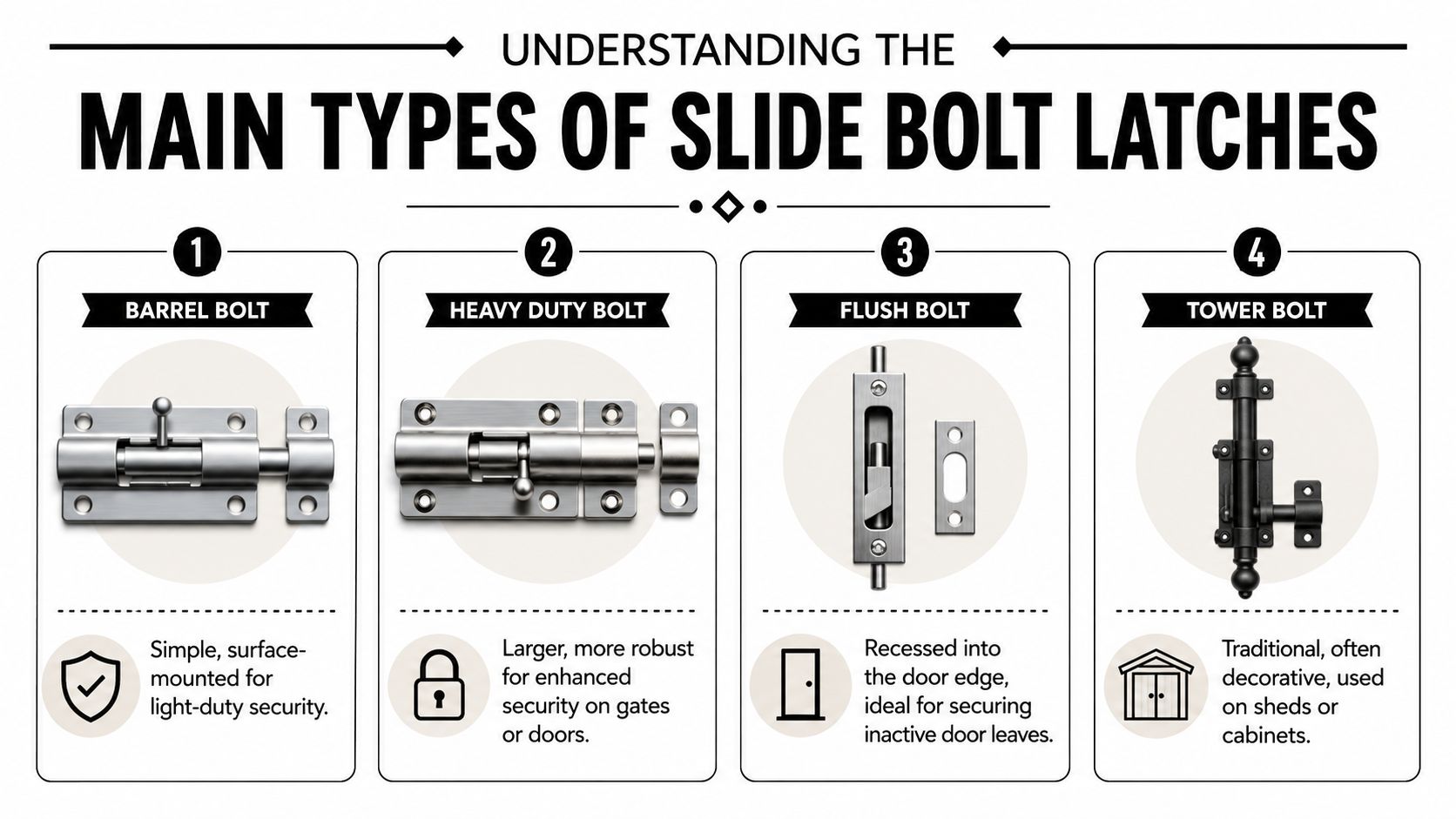
Understanding the Main Types of Slide Bolt Latches
Not every slide bolt latch works the same way in the field. Some are ideal for a light side gate. Others belong on large timber or steel gates where a light barrel bolt would twist, bind, or wear out early.
Barrel bolts
The barrel bolt is the familiar all-rounder. It mounts on the face of the gate or door, and the bolt slides horizontally into a keeper. For sheds, light garden gates, cabinet-style utility doors, and simple privacy screens, it's usually the first style people consider.
Think of it as the practical everyday option. It's easy to fit, easy to see, and easy to replace. If the gate is light and the alignment is decent, a barrel bolt does the job well.
What doesn't work is using a light barrel bolt on a gate that moves heavily or takes wind load every day. That's where people get into trouble. The latch isn't necessarily defective. It's just undersized for the application.
Flush bolts
A flush bolt sits recessed into the edge of a door rather than surface-mounted on the face. You see these more often on double doors where one leaf stays fixed until needed.
They're cleaner visually, but they ask more from the installer. You need to cut the recess accurately, keep the hardware square, and make sure the bolt enters the floor or frame receiver without drag. For decorative timber doors, flush bolts can look excellent. For many outdoor gates, they're more effort than is generally necessary.
Surface bolts
A surface bolt gives you straightforward installation with broad compatibility. It mounts to the face of the gate or door much like a barrel bolt, but the form can be flatter or more architectural depending on the product.
This style suits:
- Flat gate faces where you don't want to mortise hardware
- Retrofit jobs where speed matters
- Shed and utility doors where appearance still matters, but easy servicing matters more
- Mixed-material installs such as timber gates meeting steel posts
If you're sorting through options by use case rather than by product photo, a practical reference is this guide to different gate latch types.
Heavy-duty and cane bolt styles
When the gate gets larger, heavier, or more security-sensitive, move up. In such cases, heavy-duty slide bolt latches and cane-bolt-style hardware make sense.
A commercial-style example is the Chicago Slide Bolt Latch Lock (C-A-2), which has a 3/8-inch rod diameter and a 4 1/4-inch length, noted in the Chicago latch product specification. That kind of hardware is built for heavier gates and more demanding service.
Practical rule: If the gate has enough mass to rack the frame slightly when it closes, skip the light decorative latch and move straight to a heavier body and rod.
Tower bolts
Tower bolts are the older, narrower style many people recognise from sheds, cupboards, and traditional utility doors. They can look right on rustic buildings or heritage-style projects.
Their limitation is application. They're better for lighter-duty holding and simple closure than for larger perimeter gates that need stronger engagement and better resistance to repeated stress.
Choosing the Right Material and Finish
Most slide bolt latch problems outdoors start with the wrong material, not the wrong idea. A latch that works well inside a shed may rust, seize, stain surrounding timber, or lose its finish quickly on an exposed side gate.
What the material changes in real use
Material affects four things immediately. Corrosion resistance, rigidity, finish life, and how much maintenance the latch will need once it's installed.
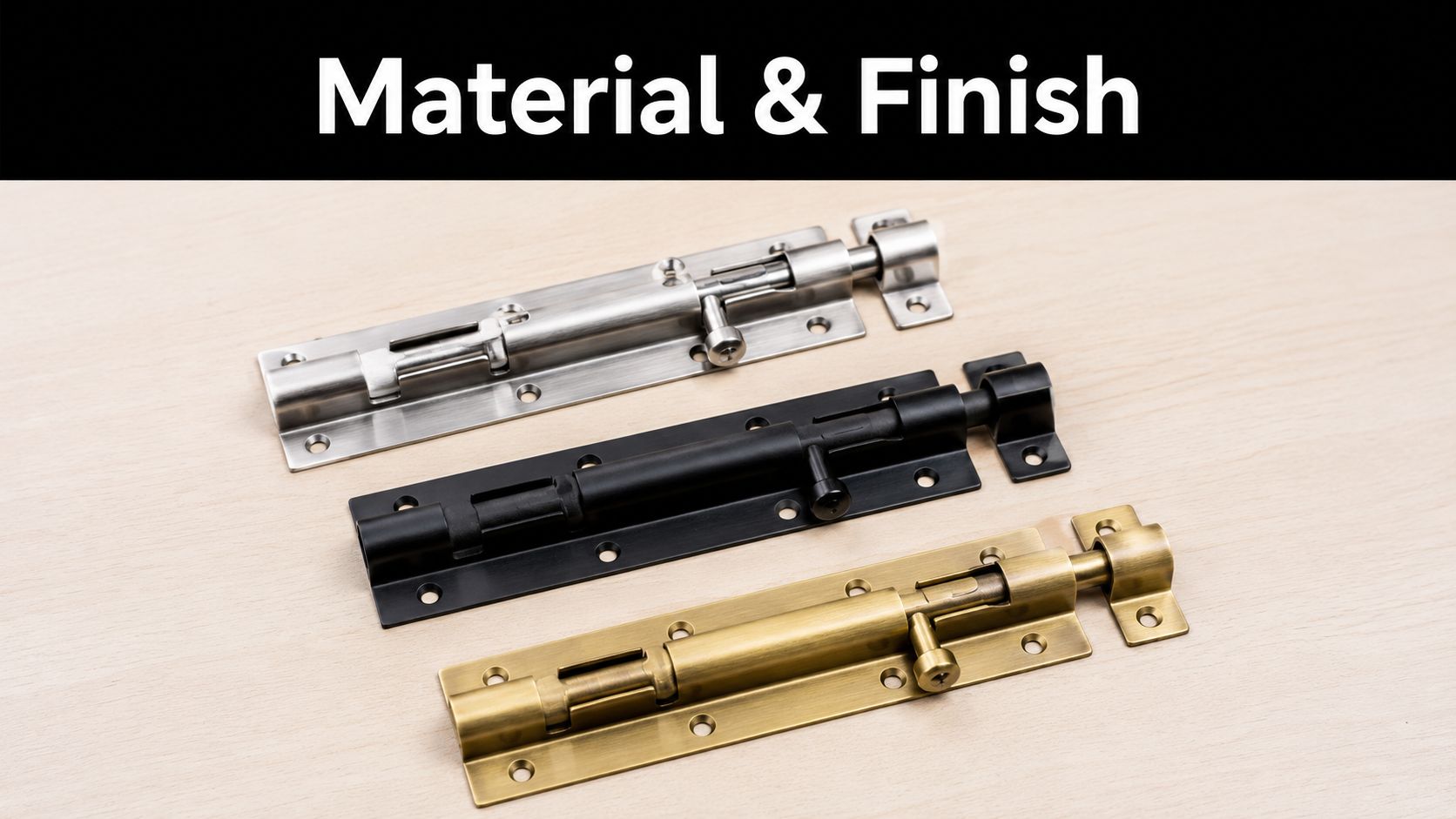
A zinc-plated latch can be perfectly reasonable on a sheltered gate or painted shed door. Brass-finished hardware can suit decorative use where appearance matters and the environment is less aggressive. Stainless is usually the better call where rain, irrigation, and salt exposure are part of normal life.
Decorex Hardware products are a useful reference point here because they show what a properly finished hardware line looks like in practical outdoor categories. The same applies when you compare them against lower-cost options that look similar on a product page but don't hold up the same way once they're exposed.
For broader matching of latches, hinges, bolts, and mounting accessories, it helps to review a complete range of fence and gate hardware options.
Slide Bolt Latch Material Comparison
| Material | Corrosion Resistance | Strength | Cost | Best For |
|---|---|---|---|---|
| Stainless steel | High | High | Higher | Coastal areas, exposed gates, long-term outdoor use |
| Zinc-plated steel | Moderate | High | Moderate | General residential gates and sheds |
| Brass or brass-finished steel | Moderate | Moderate | Moderate | Decorative doors, sheltered applications |
| Aluminium | Good | Lower than heavy steel options | Moderate | Light-duty gates, low-weight installations |
Trade-offs that matter
Here's the short version from the trade counter:
- Stainless steel handles exposure well and stays serviceable longer in wet or coastal conditions.
- Zinc-plated steel offers solid value for many residential jobs, but it's not what I'd choose for constant weather and salt.
- Brass finishes can look right on feature doors, but they're usually selected for appearance first.
- Aluminium has its place, though I don't recommend it where the latch also needs to absorb repeated gate impact.
Buy for the site, not the shelf photo. A latch under a deep porch roof and a latch on a wind-driven side gate are not the same purchase.
Finish and fastener pairing
The latch body and the screws should make sense together. If you mount a corrosion-resistant latch with low-grade fasteners, the screws often become the first failure point. You'll see streaking, loosening, and rust transfer before the latch body itself gives up.
That's why the material, size, and fastener choice belong in the same decision. Treat them separately and the whole install ages poorly.
Sizing Your Latch for a Perfect Fit
Good sizing removes half the frustration before installation begins. Too many people buy by photo, then realise the bolt throw is too short, the plate is too small for the rail, or the keeper lands awkwardly on the post edge.
Start with the three measurements that matter
For most gate and shed applications, check these before you buy:
The width of the gate stile or mounting rail
You need enough flat surface for the latch body to sit properly without overhanging an edge.The width of the post or frame member receiving the keeper
A keeper that lands too close to the corner of the post is harder to fasten securely and more likely to split timber if the pilot holes are poor.The gap between the gate and the post
This is the one people miss. A latch can look right in the packet and still fail if the bolt doesn't travel cleanly into the keeper across the actual field gap.
Use standard dimensions as a reality check
A lot of standard slide bolt latches have plate dimensions of about 2.72 inches wide and 1.81 inches high, with a bolt length of 3-1/8 inches, according to this slide bolt lock dimensions reference. That size range is one reason these latches work across common gate frames and posts from 2×2 to 6×6.
That doesn't mean every standard latch fits every standard gate. It means you're starting from a common hardware footprint. You still have to confirm where the bolt projects and whether the keeper can sit squarely on the post or frame.
A quick fitting method that works
When checking fit, I tell people to hold the latch body where they want it and ask three plain questions:
- Can the body mount fully flat?
- Will the bolt enter the keeper without rubbing?
- Is there enough room for your hand to operate it comfortably?
If any of those answers is no, the latch is wrong for that spot even if the package says it suits gates.
A latch that just barely fits on the rail usually becomes the latch that loosens first.
Common sizing mistakes
The most common errors are easy to avoid:
- Buying too small for a wide timber gate so the latch looks undersized and works loose
- Ignoring bolt travel and focusing only on overall body size
- Mounting too close to an edge where screws have poor bite
- Forgetting gate sag allowance on older timber gates that move seasonally
For 6×6 posts, don't assume bigger timber makes layout easier. It often creates more room to make a bad placement decision. Keep the keeper in solid material, not hanging near a corner or decorative chamfer.
A Step-by-Step Installation Guide
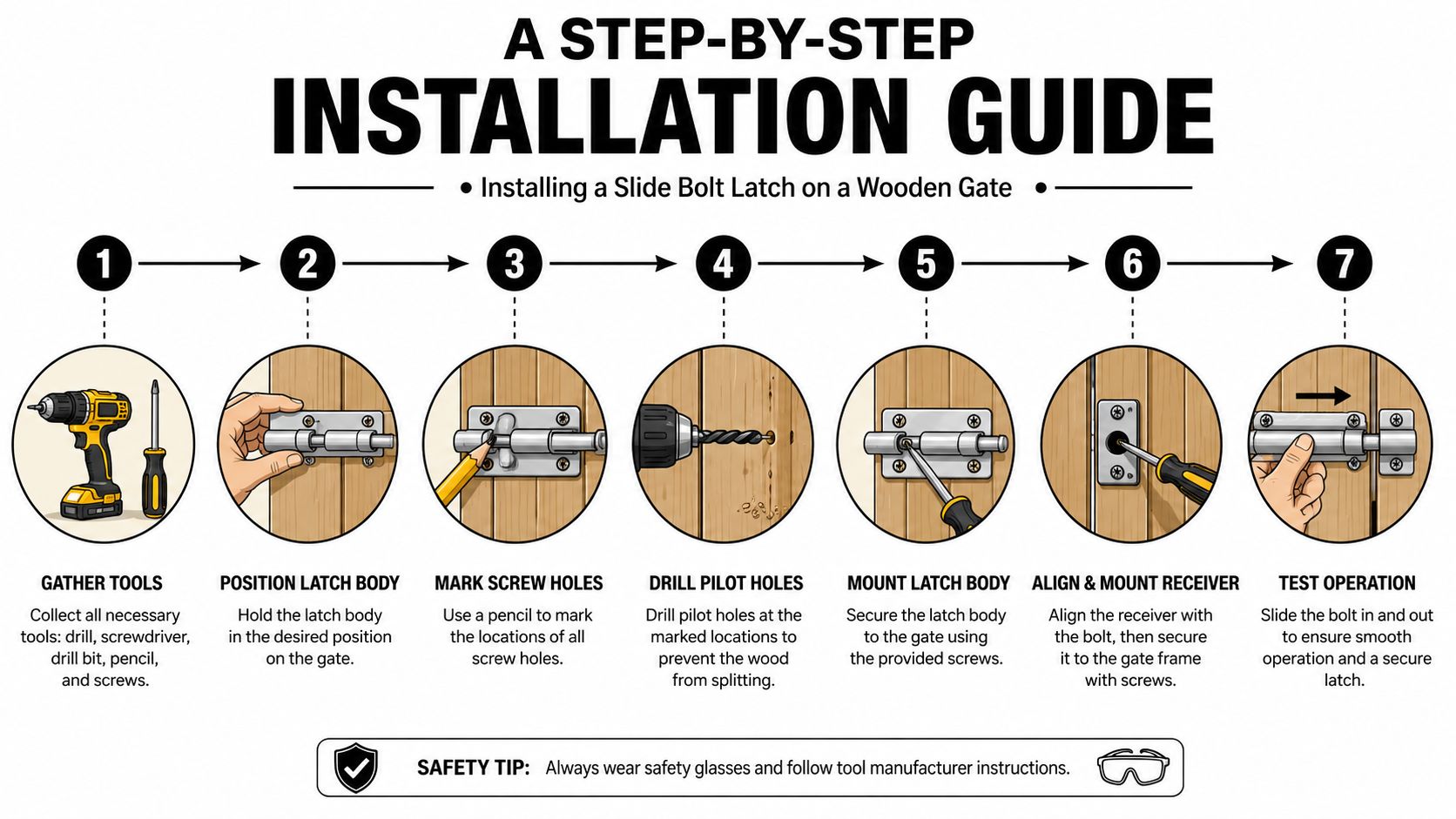
A slide bolt latch installs easily when the layout is right. Most bad installs come from rushing the marking stage, drilling without checking final alignment, or forcing the keeper to suit a gate that's already out of line.
Gather the right tools first
For a standard timber gate install, have these on hand:
- Latch kit and keeper
- Drill and driver bits
- 5/32-inch and 1/4-inch drill bits where required by the latch specification
- Tape measure
- Set square or speed square
- Pencil or marking knife
- Driver or screwdriver
- Suitable exterior screws or supplied fasteners
Some installation guides for automated or technical sliding bolt systems also call for measuring with a set square ruler, drilling pilot holes with a 5/132-inch or 1/4-inch drill bit, and testing actuator setups with ±12 VDC, as outlined in the California code page that discusses egress rules and related installation context. For a standard manual gate latch, the key takeaway is simpler. Accurate measurement and correct pilot drilling matter.
Mark the latch body before touching the drill
Close the gate fully. Hold the latch body against the gate where it will be comfortable to operate and where the bolt can travel straight into the post-side keeper.
Use a square to keep the body level. Mark the screw holes only after you've slid the bolt back and forth a few times in position. If the latch body is even slightly skewed, the keeper alignment gets harder later.
Drill pilot holes properly
This step decides whether the install stays tight. Don't drive exterior screws into dry timber without pilots and expect a clean result.
For technical-grade latch hardware such as the 5000-122/12SP, the installation protocol specifies a 5/32-inch drill bit for the plate and 1/4-inch, or 7/32-inch for lag bolts, for the keeper, according to the installation instructions for that slide bolt latch model. Follow the actual hardware spec you have in hand, but the principle is universal. Correct pilot size keeps the screws centred and reduces stress on the latch during use.
A frequent weak point is mounting on heavier posts. A common but critical installation error involves incorrect drilling on 6×6 posts; only 12% of California DIY guides specify torque-specific depths for 5/32” bits, a factor contributing to 34% higher failure rates at post mounting points, as noted in this post mount failure analysis reference.
On 6×6 timber, don't over-drill and don't bury screws blindly. You want clean bite, straight entry, and enough edge distance to preserve the post face.
Mount the latch body and then the keeper
Fasten the latch body first. Snug the screws evenly so the body stays flat to the timber. Don't overtighten and distort thinner plates.
Then extend the bolt and position the keeper to meet it exactly. This is the moment where patience pays off. If you mount the keeper by eye and hope the bolt will find it, the latch will scrape and wear every time it's used.
For comparison shopping, a product such as the self-locking gate latch range shows how different latch styles solve alignment differently, but a standard slide bolt still depends on precise receiver placement. XTREME EDEALS INC. also carries products such as the Nuvo Iron Slide Bolt Latch Black SBL for gate and shed door applications.
Here's a video reference if you want to see the install sequence in action:
Test under real movement
Don't stop after one smooth slide with the gate held perfectly still. Open and close the gate several times. Push it gently upward and downward at the latch side. Check how the bolt enters when the gate settles under its own weight.
If the latch binds only when the gate hangs naturally, the layout was close but not correct. Fix it now. A latch that needs force on day one usually becomes the latch that tears out screws later.
Security Maintenance and Troubleshooting
A slide bolt latch doesn't ask for much maintenance, but neglect shows up quickly outdoors. Stiff operation, rust marks, loose screws, and keeper misalignment all start small. Leave them alone and the latch becomes unreliable right when you need it.
Keep the mechanism moving cleanly
Start with the basics. Check screw tightness, remove packed dirt or paint overspray, and keep the bolt path clear. If the latch feels gritty, clean it before adding lubricant. Lubricating over dirt turns debris into grinding paste.
For most outdoor latches, a light, suitable lubricant on the moving bolt is enough. You don't need to soak the hardware. You need smooth travel and a clean engagement point.
Use security upgrades that make sense
A slide bolt latch is a physical hold point first. If the model includes padlock provision, using it adds a practical second step for sheds, side gates, and service access points. That matters more on low-visibility parts of the property.
Local compliance matters too, especially in California. There's a significant knowledge gap regarding California's positive latching requirements for certain doors, with 78% of fence contractors reporting confusion over whether standard slide bolts meet compliance on perimeter gates, according to this California civil code reference. In plain terms, don't assume a standard slide bolt is automatically appropriate for every door or gate condition just because it mounts easily.
If you manage multi-unit or commercial property, this broader guide on commercial door maintenance best practices is useful for setting up regular inspection habits that catch hardware issues before they become access or liability problems.
Most latch “failures” are maintenance failures. Loose fasteners, swelling timber, and ignored misalignment do the damage long before the metal gives up.
Troubleshooting common problems
Here's what usually works in the field:
Bolt won't enter the keeper cleanly
Recheck keeper position with the gate resting naturally. Don't force the bolt to compensate for sag.Latch feels stiff
Clean the slide path, inspect for bent parts, and confirm the screws aren't overtightened enough to distort the body.Rust appears around screws first
Replace poor fasteners with exterior-rated ones that match the latch environment more closely.Gate rattles even when latched
The bolt may be too short for the movement in that opening, or the keeper may be too loose for the amount of play in the gate.
What doesn't work
What doesn't work is treating a slide bolt latch like a cure for a badly built gate. If the frame is twisted, the hinges are undersized, or the post is moving, the latch can only do so much. Hardware should finish a sound installation, not compensate for a weak one.
Your Ultimate Slide Bolt Latch Buying Checklist
Buying the right slide bolt latch gets easier when you stop shopping by appearance alone. The right choice usually comes from five decisions. Where it's going, what it's mounted to, how exposed it is, how much abuse it will take, and whether you need a simple closure or a more security-focused setup.
Check the application first
A shed door, a side gate, and a large driveway gate don't need the same hardware. Match the latch body and bolt style to the weight and movement of the opening.
Use this quick checklist when you're comparing products:
Application
Light shed and garden doors can use standard barrel or surface bolts. Larger timber gates usually need a heavier body and stronger fasteners.Environment
Exposed rain, irrigation, and coastal air push you toward more corrosion-resistant materials and better-matched screws.Mounting surface
Check whether you're fixing into a narrow rail, broad stile, steel frame, or a full 6×6 post. Hardware that fits the product page dimensions may still mount poorly on the actual gate.Security level
Basic privacy closure is different from restricting access to equipment, service yards, or side entries.Finish and appearance
Decorative projects often need hardware that matches hinges, post caps, and surrounding metalwork rather than looking like an afterthought.
Compare product quality, not just shape
Two latches can look almost identical online and perform very differently outside. Better hardware usually shows up in cleaner machining, stronger plating, a more solid bolt, and better mounting alignment.
Trusted brands such as Decorex Hardware are worth considering when long-term finish and fit matter, especially on visible gates and deck-adjacent projects. If you're assembling a full order of outdoor hardware in one place, XTREME EDEALS INC. carries a curated selection of hardware that includes slide bolt latches and related gate components, along with Decorex Hardware product lines for fencing and deck work.
The final buying filter
Before you add any latch to cart, ask this:
- Will it fit the gate and post properly?
- Is the material right for the weather?
- Are the fasteners suitable for the substrate?
- Will the bolt engagement be enough for how the gate moves?
- Does the style suit the level of use?
If you can answer those confidently, you're buying properly rather than guessing.
If you're comparing slide bolt latch options for a gate, shed, or deck access point, XTREME EDEALS INC. is a practical place to start. The catalogue covers fencing and deck hardware, fasteners, post components, and gate accessories in one shop, which makes it easier to match the latch, screws, hinges, and finishing hardware to the same project instead of piecing the order together from multiple suppliers.