
You're probably at the point where the deck frame is sorted, the surface boards are chosen, and now the railing suddenly feels more complicated than it should. That's where it becomes clear balusters aren't just trim pieces. They affect safety, inspection, upkeep, and the finished look of the whole deck.
I've seen good deck projects get slowed down because the owner picked a baluster style first and checked spacing later. I've also seen the opposite problem. People build only for code, then end up with a railing that looks bulky, dated, or out of place with the house. The right approach is to make both decisions together.
For most homeowners and contractors, deck railing balusters come down to four things. They need to keep people safe, satisfy local code, hold up in the climate you live in, and suit the architecture instead of fighting it. If you get those four right, the rest gets much easier.
More Than Just Spindles: The Role of Deck Balusters
A common renovation story goes like this. The old deck is still structurally serviceable, but the railing looks tired, the spacing feels wrong, and the whole perimeter makes the deck look older than the house. Replacing the balusters seems like a small upgrade until you start comparing profiles, materials, and code requirements. Then it becomes clear they do much more than fill empty space.
Balusters shape how open or enclosed a deck feels. Thin metal lines can make a smaller backyard feel less boxed in. Wider wood members can suit a traditional porch, but they also create a heavier visual rhythm. On raised decks, that difference is obvious from both the yard and the house.
The idea itself is old. The history of the balustrade traces the term to 17th-century Italy, where “balaustra” referred to a form resembling a blossoming pomegranate flower, while the earliest examples appear in sculptural murals from the 13th to 7th centuries BC. Modern deck railings are much less ornamental than those earlier influences, but the basic point remains the same. A railing has to protect people and contribute to the design.
If you've ever wondered whether “baluster” and “spindle” are the same thing in deck work, this quick explanation of baluster vs. spindle clears up the language homeowners and contractors often use interchangeably.
Good railing work disappears in the best way. It feels safe, looks right, and never makes the deck seem overbuilt or unfinished.
That's why it helps to treat balusters as part safety device, part design decision, and part long-term maintenance choice.
The Anatomy of a Safe and Stylish Deck Railing
A railing works like a team. The posts and rails do the heavy structural work. The balusters fill the open field between them so nobody slips through.
That distinction matters because people often expect balusters to do jobs they weren't meant to do. Balusters serve as the primary infill elements that fill the space between rails and posts, with their main architectural purpose being safety prevention against dangerous falls rather than load-bearing support, as outlined by Deck Expressions. If the railing feels loose, the problem is usually in the posts, rails, or hardware, not the balusters themselves.
What each part does
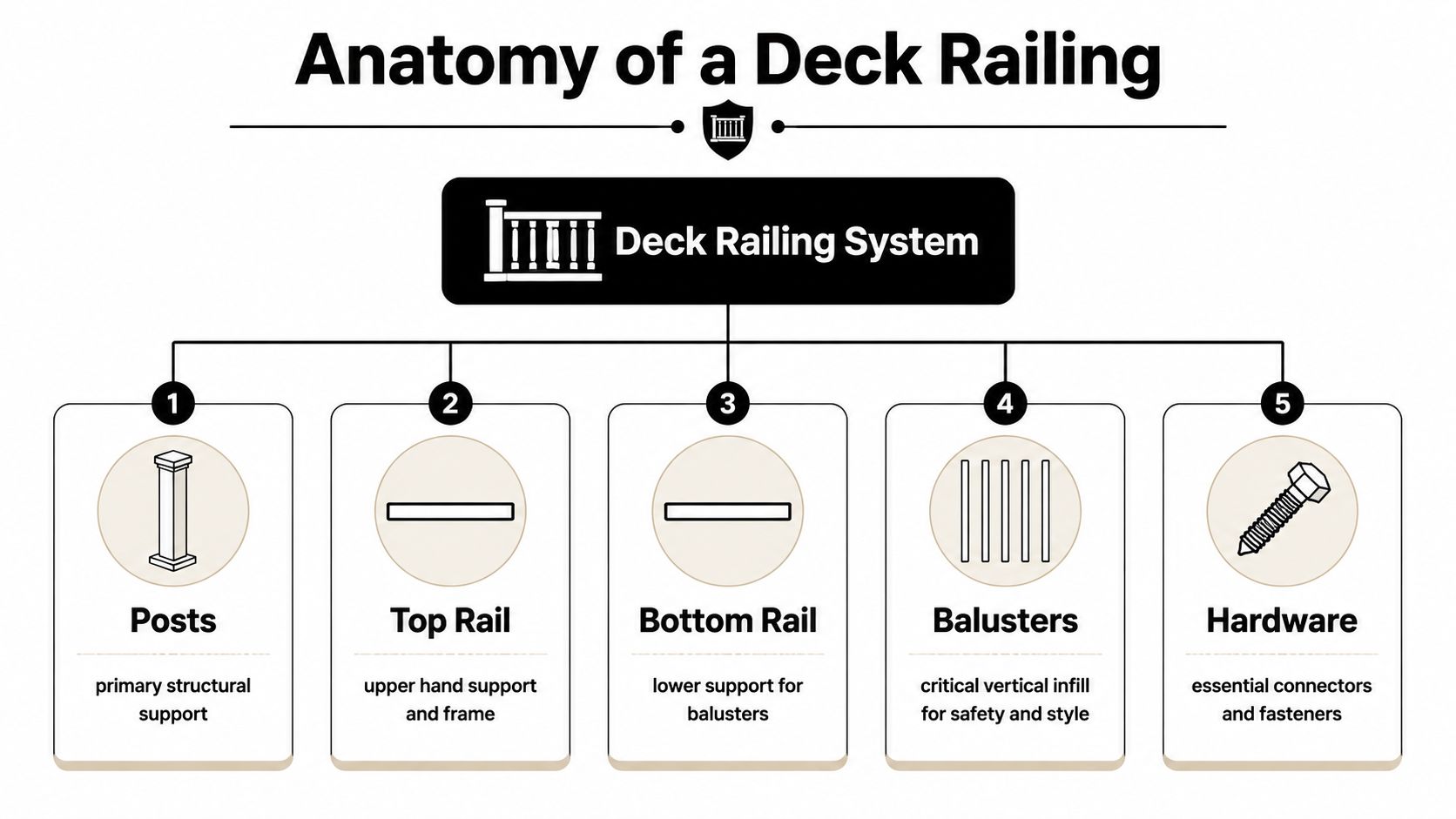
Think of the system in five parts:
- Posts hold the railing in place and transfer force into the deck structure.
- Top rail gives the assembly its upper line and usually acts as the hand-contact surface.
- Bottom rail creates the lower frame and sets the mounting line for the balusters.
- Balusters block openings and define the style.
- Hardware ties everything together. Weak connectors ruin otherwise decent materials.
If one part is undersized or poorly installed, the whole railing suffers. That's why a nice-looking baluster won't rescue a weak post connection.
Terms people mix up
Homeowners often use several words for the same area of the railing. Here's the practical distinction:
- Balusters are the vertical infill pieces on deck railings.
- Spindles is a term many people use interchangeably, especially in older carpentry language.
- Pickets usually describe fence infill more than deck railings, though the term still gets used casually.
- Posts are the larger vertical supports anchored to the deck framing.
- Rails are the horizontal members that frame the balusters.
Practical rule: When ordering parts, use the manufacturer's terminology, not the jobsite nickname. That avoids mismatched connectors and wrong-length pieces.
Why the assembly matters visually
A deck railing isn't read one part at a time. People see the full pattern. Slim balusters with bulky posts create one look. Chunkier square balusters with broad rails create another. Before choosing any profile, stand back and think about the whole elevation of the deck, not just the individual piece in your hand.
Keeping Your Deck Safe and Legal
Most railing mistakes aren't style mistakes. They're measurement mistakes. A deck can look perfectly finished and still fail inspection if the openings are wrong or the railing height misses local requirements.
This is the part that deserves slow, careful planning. If you're in Canada, check your local and provincial requirements before you order materials. If you're working from U.S. examples online, don't assume every detail transfers directly to your municipality.
The spacing rule that drives everything
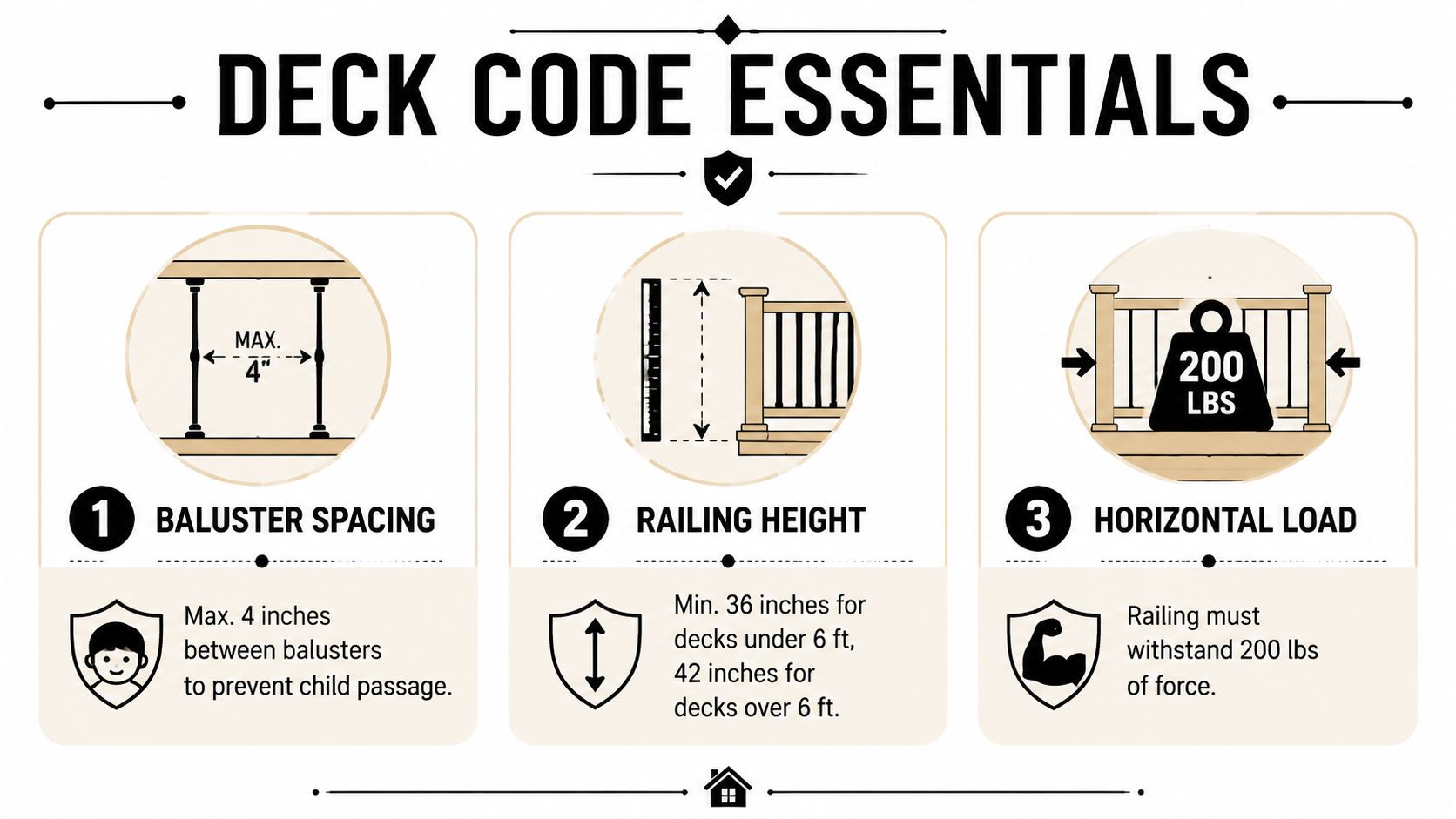
The single measurement that shapes most baluster layouts is the 4-inch sphere rule. Xtreme eDeals' deck guidance notes that deck railing balusters must be spaced so a 4-inch sphere can't pass through any gap, and that this applies across the whole railing assembly, not just between adjacent balusters. For standard 3/4-inch round balusters, that works out to about 7.375 inches on centre to maintain a 3.5-inch clear gap.
That last part matters. Installers sometimes measure from centre to centre on one run, then forget to check the gap at the post or under the bottom rail. Inspectors won't overlook that.
Height changes the parts list
Most residential code discussions around deck guards end up at one of two numbers: 36 inches or 42 inches. Your local authority decides what applies, and that height affects more than the top rail line. It changes baluster length, rail placement, connector selection, and sometimes the stiffness of the full assembly.
If you're sorting through regional differences, this summary of deck railing height code is a useful starting point before you finalise your drawings or cut list.
A practical way to avoid rework is to confirm these items before ordering:
- Deck height above grade determines whether a guard is required and what height may apply.
- Inside-face rail dimensions affect the actual baluster length you need.
- Opening checks at every point matter, including beside posts and below the bottom rail.
- Stair sections often need separate review instead of copying the flat-deck layout.
Don't lay out a full railing run by “what looks even” until you've worked backwards from the maximum allowable opening.
For builders who want another contractor-focused perspective on deck planning and compliance details, the Templeton Built Adelaide deck guide is a worthwhile reference. It's useful for seeing how experienced deck builders frame design decisions around real installation conditions, not just catalogue photos.
Here's a walk-through that helps visualise spacing and assembly details before you build:
What usually goes wrong
The failures I see most often are simple:
- Uneven layout at the ends because the installer divided the field without accounting for posts.
- Wrong baluster length because rail thickness was ignored.
- Bottom-gap violations when the deck surface isn't perfectly level.
- Mixed hardware systems that don't hold the balusters cleanly or consistently.
None of those are hard to prevent. They just require planning before the first hole is drilled.
Choosing the Right Baluster Material for Your Deck
Material choice decides how your railing will age, how much attention it will need, and whether the upfront savings still look sensible a few seasons from now. In making these choices, homeowners often get pulled toward whatever matches the deck boards, even when another material would make more sense for the climate and maintenance routine.
In Canadian conditions, especially in coastal or damp regions, the question isn't only what looks good on day one. It's what still looks good after wet seasons, temperature swings, and normal wear.
Wood balusters
Wood still suits a lot of projects. On older homes, cottages, and decks where you want the railing to feel built-in rather than added on, wood has a warmth metal can't fully copy. It's easy to cut, easy to customise, and straightforward for carpenters who are already building the full railing from lumber.
The trade-off is maintenance. Wood needs regular attention if you want it to stay straight, clean-looking, and protected. In humid or coastal conditions, that maintenance cycle can become the deciding factor. As noted earlier in the article's source material, wood balusters required 3x more treatments compared to metal balusters during extreme humidity events, which changes the long-term ownership picture for many homeowners in damp regions.
Wood also shows installation errors more visibly over time. Slightly inconsistent spacing, end grain exposure, and uneven finish absorption tend to become more noticeable after weathering.
Metal balusters
Metal is the practical choice on many modern deck projects because it gives you a slimmer sightline and a lower-maintenance finish. Aluminum and steel profiles can suit contemporary homes, transitional designs, and even traditional decks when paired with the right rails and post details.
This is also where specific product selection matters. Decorex Hardware metal balusters, including hollow styles in satin black, are a common option for railing systems where installers want a clean vertical look and the ability to cut to custom height. For homeowners comparing supply options, XTREME EDEALS INC. carries deck balusters for handrails along with connectors, fasteners, post caps, and related hardware, which can simplify sourcing when you're ordering multiple railing components at once.
Metal works well when you want the railing to frame the deck, not dominate it.
The main caution with metal is compatibility. Use the right connectors, the right finish for the setting, and a rail system that was designed around that baluster style. Mixing parts from unrelated systems can create fit problems fast.
Composite and glass
Composite balusters appeal to homeowners who want a coordinated manufactured look, especially on decks built with composite boards and matching trim systems. They reduce some of the finishing work associated with wood, though the visual effect can be heavier depending on profile and colour.
Glass belongs in a different category because it changes the entire feel of the railing. It's less about rhythm and more about openness. It's a good fit when the view is the selling feature, but it demands a cleaner installation and more frequent visible upkeep because dirt and fingerprints don't hide.
For another climate-specific angle on low-maintenance railing choices, especially polymer-based systems, FenceScape's insights on PVC deck railing for Ottawa are useful to review alongside wood and metal options.
Deck Baluster Material Comparison
| Material | Average Cost | Durability & Maintenance | Best For |
|---|---|---|---|
| Wood | Varies by species and finish | Traditional look, but needs sealing, staining, or repainting over time | Classic homes, custom carpentry, painted rail systems |
| Metal | Varies by profile, finish, and connector type | Low-maintenance, durable, good in damp conditions when properly finished | Modern decks, long-term practicality, slimmer sightlines |
| Composite | Varies by brand and system | Lower upkeep than wood, coordinated manufactured appearance | Composite deck systems, uniform design language |
| Glass | Typically higher than basic infill options | Clean look, but visible upkeep is ongoing | View-focused decks, contemporary homes |
What works in practice
If the homeowner enjoys seasonal maintenance and wants a fully wood-built deck, wood can still be the right call. If they want the railing to stay crisp with less upkeep, metal usually wins. Composite sits in the middle for buyers who prefer system-based products. Glass suits a specific visual goal, but not every budget or privacy need.
The mistake is choosing by showroom appearance alone. Material should match the climate, the house, and the amount of maintenance the owner will do.
Matching Balusters to Your Home's Aesthetic
Once the material is settled, style gets much easier. The wrong profile can make a well-built deck feel disconnected from the house. The right one makes the railing look like it was always meant to be there.
Profiles that suit modern homes
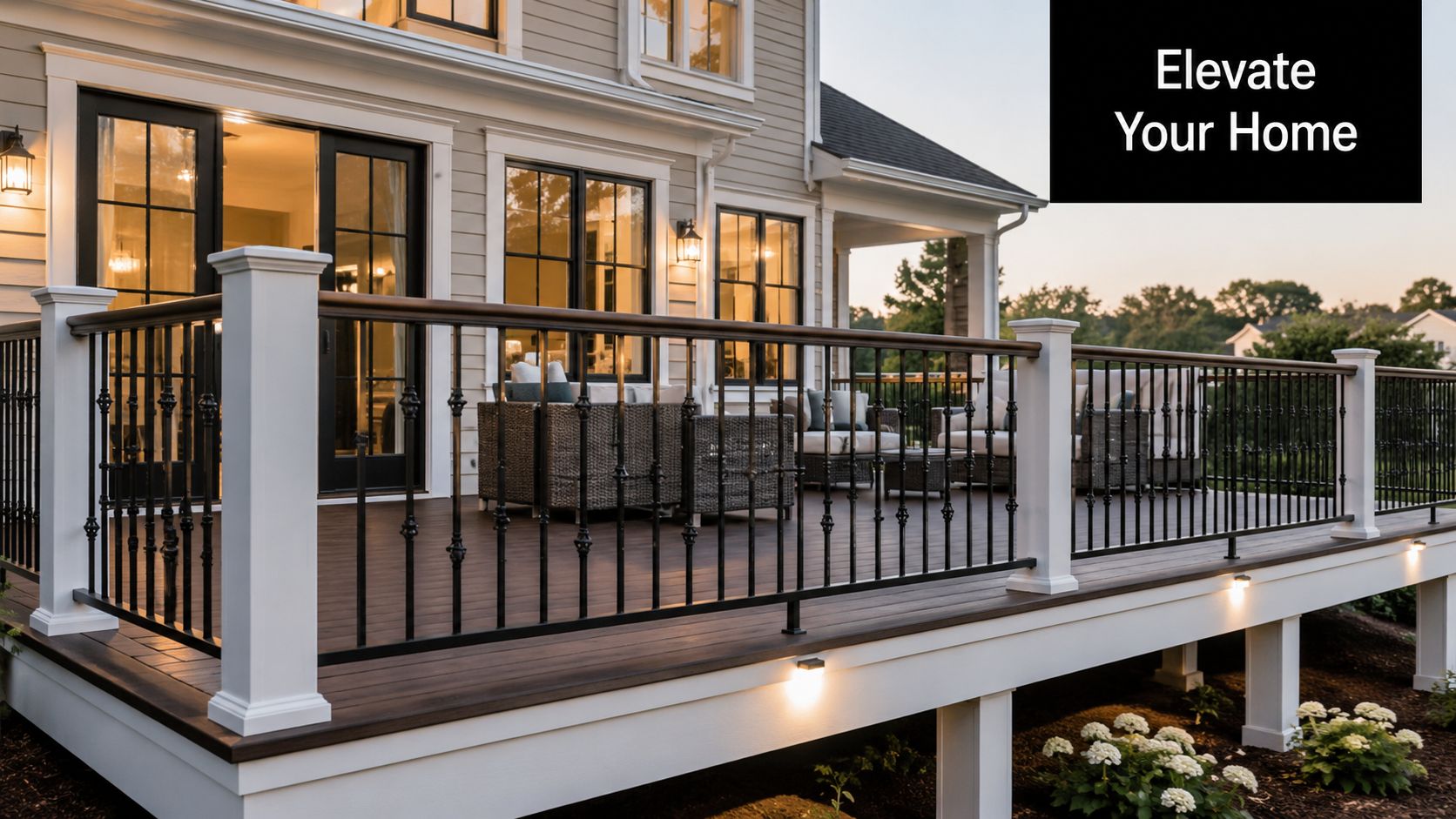
Modern and contemporary homes usually benefit from restraint. Simple square balusters, slim round metal, or clean face-mount styles keep the view more open and avoid unnecessary visual noise. Black finishes often work well because they read as a shadow line rather than a decorative statement.
If the home has large windows, minimal trim, or strong horizontal architecture, ornate basket or twist details can feel out of place. Cleaner shapes usually sit better with that envelope.
Styles that work on traditional homes
Traditional houses can carry more detail. Square wood balusters, slightly heavier proportions, or decorative metal profiles can suit colonials, farmhouses, and older suburban homes where the trim package already has more character.
A few style pairings generally work well:
- Simple square balusters fit craftsman, farmhouse, and many transitional homes.
- Twisted metal balusters can add detail without making the railing look overworked.
- Basket styles are better reserved for homes with more classic or formal detailing.
- Straight satin black metal suits renovations where the goal is to lighten the look of an older deck.
Product style matters more than catalogue names
Homeowners often get distracted by decorative names instead of stepping back to look at the house. A baluster doesn't need an elaborate profile to look expensive. It needs the right scale and rhythm for the façade behind it.
I generally tell clients to look at three things together: the window trim, the deck size, and the viewing distance from the yard. Decorative balusters can look appealing up close in a product photo but read as clutter from twenty feet away. On the other hand, a plain square profile on a formal home can look underdressed.
If the house already carries the design weight, keep the railing quiet. If the exterior is plain, the railing can do a little more visual work.
An Overview of Baluster Installation and Maintenance
Installation gets easier when the railing system is planned as a complete assembly instead of a pile of parts. The biggest errors usually happen before the first baluster goes in. Wrong lengths, uneven layout, and incompatible connectors all start at the measuring stage.
The key dimension isn't just the advertised railing height. Cheap Stair Parts explains that most building codes use 36 inches or 42 inches for railing height, so the actual baluster length has to be calculated from the thickness and configuration of the top and bottom rails. That's why a baluster that sounds right on paper can still end up short or too long in the field.
Common installation approaches
Some systems use pre-drilled rails, which speed up layout and keep spacing consistent. Others use surface-mount connectors, which are common with metal balusters and can make replacement easier later. Custom wood railings often rely on field layout, which gives flexibility but leaves more room for error.
Before cutting or fastening anything, work through:
- Rail position first so the inside opening is fixed.
- Baluster count second based on the allowable gap.
- Connector compatibility third because hardware dimensions affect fit.
- Final dry-fit check last before permanent fastening.
If you're planning a layout yourself, this guide to spacing deck balusters helps with the practical side of turning code requirements into an even field pattern.
Maintenance follows the material
Wood asks for the most owner involvement. Expect cleaning, inspection, and refinishing as part of normal deck care. If water sits on the rail system or finish maintenance gets postponed, the balusters usually show it early.
Metal is simpler. Most of the job is inspection and routine cleaning. Check the finish, look for coating damage, and make sure connectors stay tight. Composite typically sits between those two in maintenance demand, while glass needs regular cleaning if appearance matters.
What saves trouble later
A few habits pay off over the life of the railing:
- Seal cut ends where required so exposed material isn't left vulnerable.
- Keep spare connectors from the original system if the product line changes later.
- Inspect the full assembly seasonally, especially after freeze-thaw cycles or heavy moisture.
- Fix movement early because a slight wobble rarely stays slight.
The smoother installations are the ones where the owner chooses a system they're willing to maintain, not one they hope they'll maintain.
Your Final Baluster Buying Checklist
By the time you're ready to order, the goal isn't finding the fanciest baluster. It's choosing one that fits the deck, satisfies code, and won't become a maintenance regret.
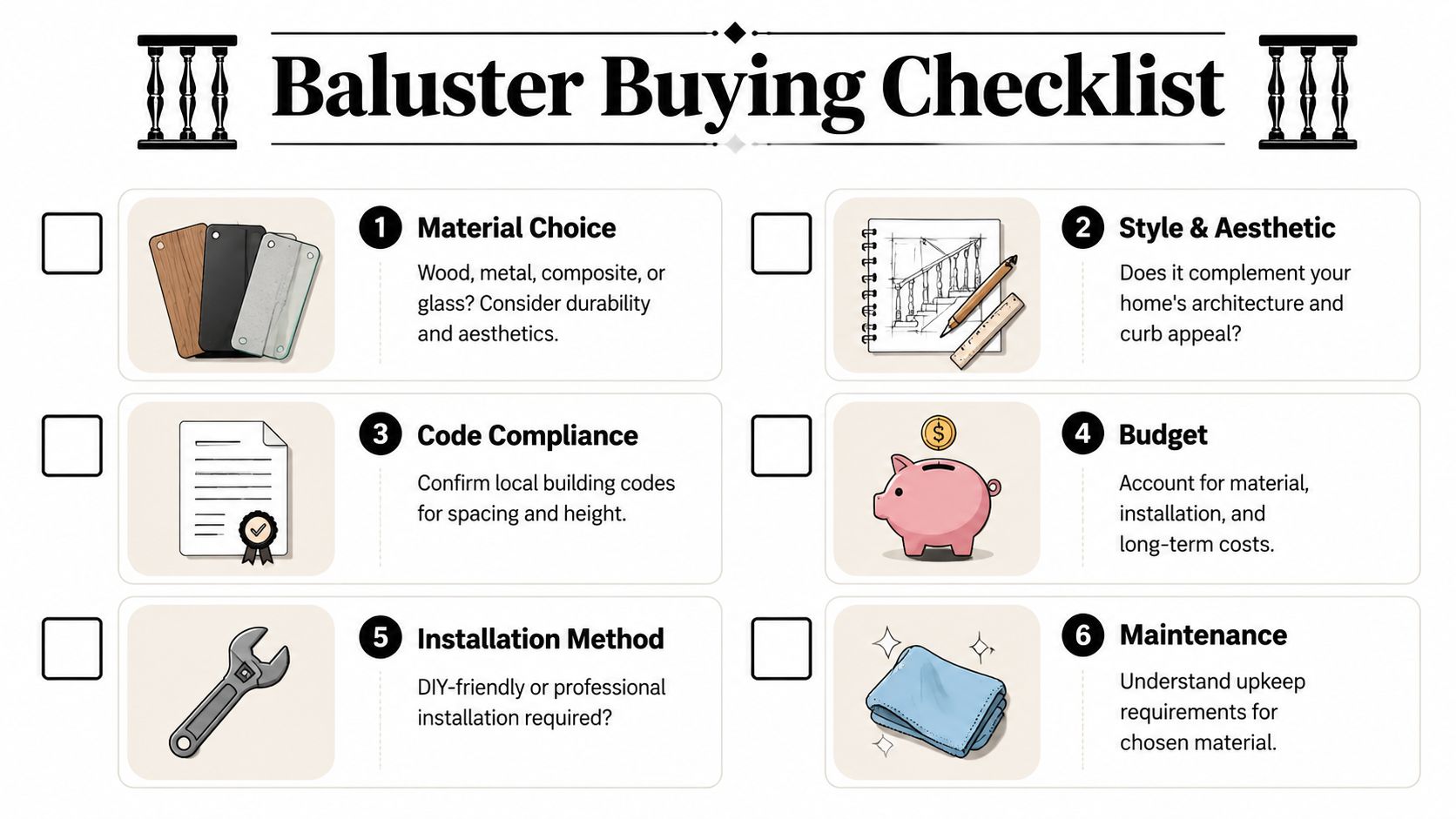
A solid buying check usually comes down to these six checks:
- Confirm your code requirements. Verify local height and opening rules before choosing a profile.
- Measure the actual rail opening. Don't order balusters based on nominal railing height alone.
- Choose material by climate and upkeep. Wood, metal, composite, and glass all ask different things from the owner.
- Match the style to the house. The railing should support the architecture, not compete with it.
- Check the installation method. Some systems are DIY-friendly. Others are much cleaner when handled by an experienced installer.
- Buy all related parts together. Balusters, connectors, fasteners, and post details should work as one system.
The expensive mistakes usually come from skipping one of those checks, not from choosing the “wrong” decorative pattern.
If you want the simplest rule to remember, it's this: buy for fit, compliance, and maintenance reality first. Buy for appearance second. The best-looking railing is the one that still looks right after it's been through real weather and real use.
If you're comparing deck railing balusters, connectors, post caps, and matching hardware for one project, XTREME EDEALS INC. is one place to review Decorex Hardware options alongside the related fastening and finishing parts that usually have to be sourced at the same time.