
You're probably looking at a deck frame, a porch repair, or a fence line and thinking about the visible parts first. The post spacing, the rail style, the cap that finishes the top cleanly. That's normal. It's common to picture the finished project before thinking about the hardware buried inside it.
The trouble starts when a connector gets treated like trim. A clean-looking joint can still be a weak joint. If a post shifts, twists, lifts, or kicks sideways under load, the prettiest build on the property won't matter much. The hardware is what decides whether the structure stays aligned and supported when weather, movement, and daily use start working on it.
The Unsung Heroes of Your Outdoor Project
A lot of outdoor builds begin the same way. Someone wants a deck for summer meals, or a fence that finally looks straight and finished instead of patched together over time. They choose the boards carefully, spend time on stain colours, and compare post caps and rail options because those are the parts everyone sees first.
Then they get to the connection points and grab whatever bracket looks close enough.
That's where projects go sideways. A post to post connector isn't just a piece of metal that fills a gap between wood members. It's part of the structure's skeleton. It helps keep posts where they belong, keeps load moving through the frame properly, and gives the assembly a mechanical attachment instead of relying on friction, toenails, or hope.
In real builds, the connector choice changes how the whole job goes. A fence corner that racks in the wind, a pergola post that develops a wobble, or a deck support that never feels fully solid often traces back to the connection, not the lumber. The wood may be fine. The joint isn't doing its job.
Practical rule: If the joint affects stability, don't shop it like a finishing accessory. Shop it like a structural component.
For deck framing and post support details, it helps to review solid guidance before buying hardware. The deck support resources from Xtreme eDeals are useful for seeing how brackets, post bases, and related fittings fit into the bigger assembly.
Good connectors don't make a bad layout good. But the right ones keep a good layout from failing at its most vulnerable points. That's why experienced builders pay attention to them early, not after the posts are already cut and standing.
Structural Support Versus Decorative Accent
The biggest mistake I see is simple. People use the word connector for two completely different products.
One product helps carry load and resist movement. The other helps finish the look or protect the post surface. Both have value. They are not interchangeable.
Know which job the hardware is doing
Consider the analogy of a hard hat versus a baseball cap. Both go on your head. Only one is meant for impact protection.
The same logic applies to post hardware. Some caps and brackets are made for moisture management, appearance, or surface protection. Others are made to support beams, lock members together, and transfer load. Industry guidance notes that many people searching for post connectors are trying to solve a structural problem, not buy a decorative cap, and that caps or bases used for protection are often confused with hardware that supports and transfers load in deck or fence assemblies, as explained in this guide to post bases and caps.
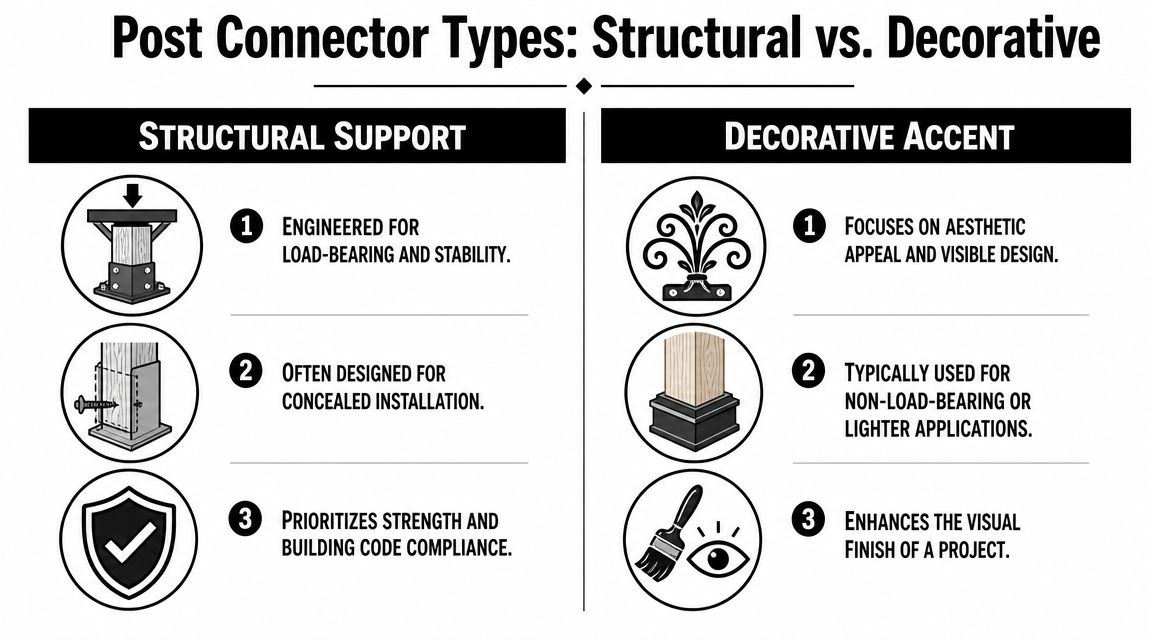
If you're buying for a fence gate post, deck support, pergola corner, or any post that takes real force, start by asking one question. Does this connector transfer load, or does it just cover and protect the wood?
Signs you need structural hardware
Use structural hardware when the connection does any of the following:
- Carries weight: If a beam, cross-member, or upper post section bears on the connector, it needs rated structural hardware.
- Resists side movement: Wind, gate swing, vibration, and normal use all push laterally on posts.
- Prevents uplift or separation: Outdoor structures don't only load downward. Parts can pull apart too.
- Affects alignment over time: If movement at the joint would create sag, lean, or rack, you need more than a decorative fitting.
By contrast, decorative parts usually do a different job:
- Cover end grain
- Improve appearance
- Reduce direct weather exposure
- Finish the top or edge of a post
Those are useful jobs. They just aren't structural jobs.
What to buy for each use
For trim and finish, post caps and ornamental accessories make sense. For actual connections, look at purpose-built brackets and straps. If you're comparing options for wood fence posts and similar assemblies, the post and fence bracket collection is the category to look at, not decorative cap pages.
A connector can look heavy and still be non-structural. Gauge, shape, and finish don't tell the whole story. The product's intended use does.
That distinction saves money too. You don't want to overspend on structural steel where a finish cap will do. But you also don't want to install a nice-looking cap where the frame needs a real mechanical connection.
A Guide to Connector Types and Materials
Once you separate structural hardware from decorative hardware, the shopping gets easier. You're no longer asking, “What looks right on this post?” You're asking, “What kind of joint am I building?”
That leads you to connector type first, then material second.
Common connector types in real projects
A few styles show up again and again because they solve the most common problems cleanly.
Post bases anchor a wood post to concrete or another foundation surface. They help with alignment and create separation from standing moisture. On decks, pergolas, and porch repairs, this is often the first connector that matters.
Post caps can mean two different things, which is where confusion starts. Some are decorative caps for the top of a post. Others are structural caps that sit at the top of a post and accept a beam or crossing member. The structural version belongs in load-bearing assemblies. The decorative version belongs in finish work.
T-straps and tie plates work where two members meet and need reinforcement across the joint. They're common on gates, fence bracing, and site-built framing details.
L-straps and angle brackets help at corners or where a member needs help resisting twist or kick-out. These are handy on fences, arbour details, and light framing connections that still need a positive mechanical tie.
Adjustable brackets give you a little room when the field conditions aren't perfect. They can be helpful on retrofit work where existing posts are slightly out or where the framing dimensions don't match a fixed connector exactly.
Material matters more outdoors
Outdoor hardware lives a hard life. Water, pressure-treated lumber, seasonal movement, and fastener reaction all work against it. Connector material and finish should match the environment, not just the colour scheme.
Here's a practical comparison.
| Material | Corrosion Resistance | Best For | Consideration |
|---|---|---|---|
| Hot-dip galvanized steel | Good for many exterior applications | General deck and fence framing | Must be matched with compatible fasteners and treated-lumber conditions |
| Stainless steel | High | Wet, harsh, or corrosive environments | Higher material cost |
| Powder-coated aluminium | Good surface protection and clean finish | Decorative and light-duty exterior applications, visible hardware | Confirm whether the specific product is structural or decorative before using it in load-bearing work |
Matching the connector to the build
For a basic fence repair, a galvanized angle or strap often makes sense because it's tough, practical, and easy to fasten. For a visible pergola detail, powder-coated pieces can give a cleaner finished look. Decorex Hardware products are commonly chosen for that reason, especially where a black powder-coated finish needs to stay consistent across brackets, caps, and trim details.
For hidden structural points, appearance matters less than fit, fastener pattern, and intended load path. That's where many builders move back toward more conventional structural brackets and plates.
What works and what doesn't
Some combinations hold up well in the field:
- Galvanized steel with exterior-rated structural fasteners: A dependable pairing for many deck and fence assemblies.
- Stainless steel in demanding exposure: Useful where corrosion is a bigger concern than budget.
- Powder-coated visible hardware on architectural features: Good where the bracket is part of the finished design.
What usually causes trouble is mixing categories:
- Decorative cap used as a beam support
- Thin ornamental bracket used where the joint carries force
- Wrong fasteners in a good connector
- Uncoated or lightly coated hardware in wet exterior service
Buy the connector for the job the joint is doing, then buy the finish for the look you want. In that order.
That approach avoids one of the most common DIY problems. The build looks solid on day one, then starts showing movement because the hardware was selected by style instead of function.
Choosing the Right Size and Strength for Your Project
Most connector mistakes happen before the first screw goes in. The buyer picks the wrong size, assumes a post is a true dimension when it isn't, or chooses a bracket that fits physically but doesn't suit the forces on the joint.
A connector that almost fits is no bargain. It wastes time, chews up lumber, and usually leaves you trying to shim or force a connection that should have been straightforward.
Measure the post you actually have
Start with the post size in your hands, not the name on the shelf tag. In wood framing, nominal sizes and actual sizes are not the same thing. That's why a connector listed for a 4×4 post is typically meant for the actual dressed dimension of that post, not a literal four-inch square member.
Measure with a tape or calipers across the face in both directions. Don't assume old posts are consistent. On retrofit work, swelling, shrinkage, wear, and previous planing can all change the fit.
Look closely at these details before ordering:
- Actual outside measurement: Take it from the installed or purchased post, not from memory.
- Post type: Wood, metal, and wrapped posts all need different hardware approaches.
- True-size versus nominal-size products: Some accessories are made for actual dimensions, including true 6×6 options.
- Connection orientation: Top-of-post, side-mount, corner, or base-mount all change the bracket you need.
Strength is not just about downward weight
A lot of DIY builders think only in terms of what sits on top of the joint. Real outdoor structures load in more than one direction.
In regions with seismic or high-wind activity, structural connectors should be chosen so the post-to-post load path resists gravity and lateral overturning forces without brittle failure. Guidance on connector engineering also stresses using connectors with published uplift, shear, and moment capacities and checking compatibility with the wood species and fastener schedule, because the connection can become the weak link even when the post itself looks oversized, as outlined in these product engineering notes on structural connectors.
That matters for ordinary projects too. A gate slams. A deck sways slightly under use. A pergola catches wind. Loads aren't always gentle and vertical.
A practical selection checklist
When I'm choosing a post to post connector, I narrow it down with a short checklist.
Define the joint clearly
Is the connector joining post to beam, post to post vertically, post to a side member, or post to concrete? Don't search broadly if the joint is specific.Decide whether the connector is visible
If it will show, finish matters. If it's buried inside the framing, capacity and fit matter more.Account for exposure
Wet yards, coastal conditions, and pressure-treated lumber all push you toward better corrosion resistance and compatible fasteners.Check the fastener pattern before you buy
A good bracket with an awkward or excessive fastener schedule can be a poor fit for your tool access and layout.Avoid “close enough” sizing
Sloppy fit creates movement. Forced fit creates split wood and bad alignment.
For anyone sourcing multiple sizes and styles in one order, XTREME EDEALS INC. carries deck and fence hardware including brackets, caps, and accessories for common post sizes, including options suited to true 6×6 posts, which is helpful when a project mixes nominal framing stock with exact-dimension finish components.
Treated lumber changes the conversation
Pressure-treated wood is hard on hardware. If the connector coating and the fasteners aren't suitable for that environment, the joint may age poorly even if the initial install feels tight.
If the lumber is treated and the project is outdoors, assume compatibility matters until the product specs say otherwise.
That one habit prevents a lot of callbacks and rebuilds. The connector isn't a separate decision from the fasteners or the wood. Those three pieces work as a system.
Installation and Fastening Essentials
A well-chosen connector can still fail in practice if it's installed with the wrong hardware or rushed into place on a crooked assembly. Good installation is less about tricks and more about discipline.
Get the post plumb. Get the joint seated fully. Use the fasteners the connector was designed around.
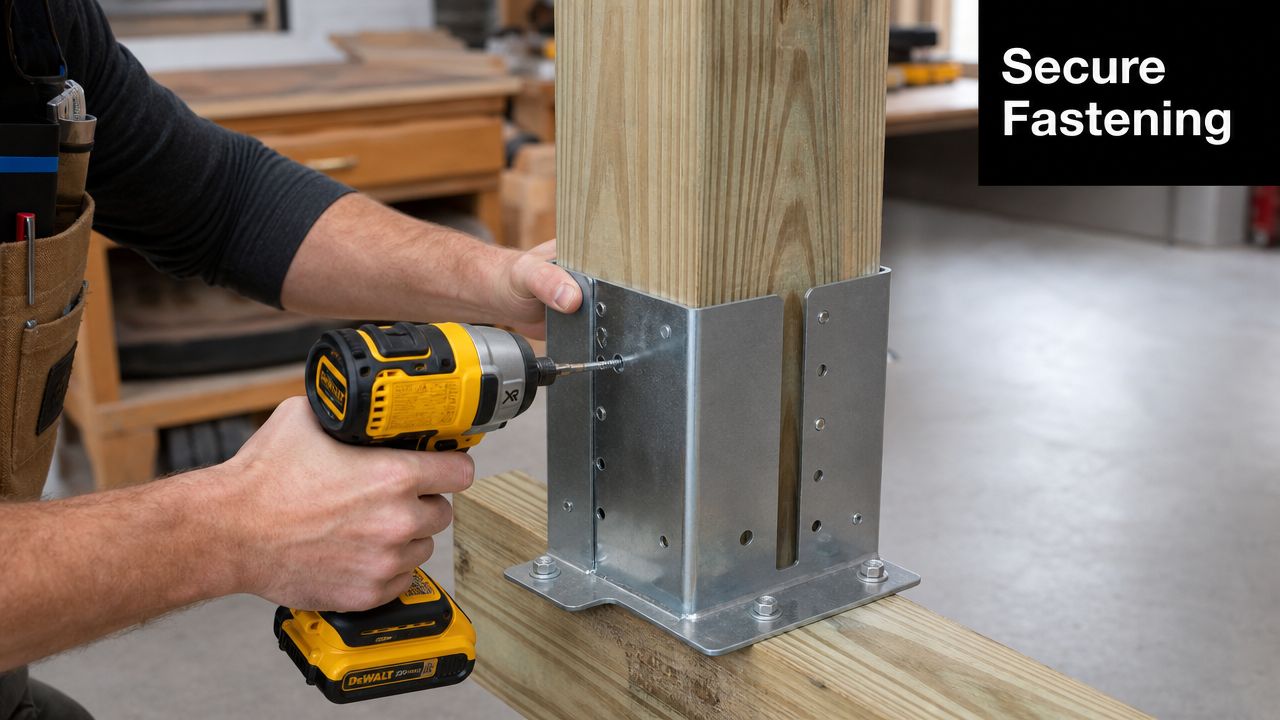
Fasteners are part of the connector
Many DIY builds lose strength when someone buys a structural bracket, then installs it with leftover deck screws. That's not a small substitution. It changes the joint.
Use fasteners that match the connector's intended application and hole pattern. Structural screws, lag screws, carriage bolts, washers, anchors, and approved nails all have their place. Standard deck screws are great for decking. They are not the universal answer for structural connections.
A practical rule set looks like this:
- Structural screws: Good when you want strong holding power with easier installation than through-bolting.
- Lag bolts or lag screws: Useful for heavy wood-to-wood connections where substantial clamping force matters.
- Carriage bolts with washers and nuts: Strong choice for through-connections where both sides of the assembly are accessible.
- Anchors for concrete: Necessary when the connector depends on a secure base attachment.
If you're gathering hardware for one project in one place, the fasteners and fittings category is where to match brackets with bolts, washers, anchors, and structural fastening hardware instead of piecing it together blindly.
Fit and prep make the fasteners work better
Don't drive hardware into a joint that isn't seated properly. If the post is out of plumb or the connector is racked when you start, the fasteners lock that error in place.
Check these basics first:
- Plumb the post: Use a level on adjacent faces.
- Seat the connector fully: Gaps reduce bearing and can distort the bracket.
- Pre-drill where needed: Especially near edges or in dense material.
- Keep hole alignment clean: Misaligned bolts chew up holes and reduce the quality of the connection.
A little setup time saves a lot of frustration. It also gives you a cleaner-looking finished job because the hardware sits where it should.
Common mistakes that weaken the joint
I'd put these near the top of the list for avoidable errors.
- Over-tightening bolts: This can crush fibres, deform hardware, or make later adjustment difficult.
- Mixing random fasteners: If the connector calls for a certain type or size, substitute carefully, not casually.
- Skipping washers where they're needed: Washers help distribute load and protect the wood surface.
- Leaving fastener holes empty: On many structural connectors, the full pattern matters.
The video below gives a useful visual reference for fastening technique and hardware handling.
A connector is only as strong as its installation. Good steel installed badly is still a bad connection.
When the joint matters, slow down enough to treat the hardware as part of the engineering, not the last step before cleanup.
Understanding Building Codes and Safety
A lot of people hear “code” and think paperwork, inspections, and hassle. On site, code is much simpler than that. It's a set of minimum rules meant to keep structures standing and people safe.
That matters a lot with post connections because joints are where force changes direction. Loads travel down, sideways, and sometimes upward. If the connection at a post can't handle those forces, the whole structure is relying on its weakest point.
Why connectors matter more in demanding conditions
California is a good example of how serious this gets. There, post-to-post connector practice is shaped less by one product standard and more by a prescriptive structural code framework for wood construction and seismic safety. State building provisions aligned with the 2018 International Codes in the 2019 code cycle, and connection detailing for decks, porches, and exterior framing is evaluated through that code structure, with emphasis on positive mechanical attachment and preventing lateral displacement, as discussed in this overview of California post and beam connection code context.
You don't have to build in California for that lesson to matter. The principle applies anywhere. If wind, shifting soil, repeated use, or impact can move the structure, the connector has to keep the load path intact.
Code is practical, not theoretical
The phrase load path sounds technical, but the idea is simple. Every part of the structure needs a continuous route to transfer force safely. If one connection is weak, force stops travelling where it should and starts tearing at that weak point instead.
That's also why local rules matter for fences as well as decks. Height, exposure, and layout often affect what's required. If you're planning a boundary project and want a plain-language reference on local fence restrictions, this guide to maximum fence height UK rules is a useful starting point before you finalise posts and hardware.
The safest habit is to ask your local building department or inspector what they expect for your specific project. Ask whether the connector is considered structural, whether the fastening schedule matters, and whether the post size and lumber type affect approval. Those are better questions than asking whether a bracket “looks strong enough”.
A good connector choice protects the build, the budget, and the people using the structure. That's the primary point of code. It turns guesswork into a minimum standard you can trust.
If you're sorting out brackets, post caps, bolts, anchors, or other deck and fence hardware, XTREME EDEALS INC. is a practical place to compare compatible parts and finish a hardware list before you start cutting.