
You're probably looking at a set of steps that no longer feels safe, no longer matches the house, or looks tired. Maybe the old wood rail moves when you grab it. Maybe painted steel has started to show rust at the joints. Maybe you're building new stairs and don't want to buy parts twice because something doesn't fit on install day.
That's where a complete aluminum staircase railing system makes sense. It solves more than the appearance problem. It deals with weather, code, hardware compatibility, stair angle, and finish durability all at once. If you choose the system properly at the start, installation gets cleaner, inspection gets easier, and the finished railing looks intentional instead of pieced together.
Why Choose an Aluminum Staircase Railing
Wood and plain steel still show up on stair projects, but both come with predictable headaches. Wood can twist, crack, absorb moisture, and demand regular repainting or staining. Plain steel feels solid, but outdoors it can become a maintenance project fast, especially where rain, snow, and salty air keep attacking exposed metal.
Aluminum avoids most of that. In Canadian coastal and prairie climates, industry guidance states that aluminum railings “will not rust nor corrode”, and that a powder-coated finish can support “decades of high performance railing” in wet or snow-prone conditions, as noted by Kane Innovations on aluminum railings. That matters just as much on staircases as it does on decks because stair rails are high-touch safety components. If the finish fails or fasteners loosen around corrosion, the problem is no longer cosmetic.
What aluminum does well
An aluminum staircase railing works because it balances several things at once:
- Low maintenance: You're not signing up for seasonal scraping, patching, and repainting.
- Weather resistance: Moisture, freeze-thaw cycles, and general exterior exposure are easier on powder-coated aluminum than on many traditional materials.
- Light weight: It's easier to carry, align, and install than heavier metal systems.
- Clean finish options: Aluminum suits both simple picket layouts and more modern stair designs.
Practical rule: If the railing is outside and you want less upkeep over the life of the stairs, aluminum usually beats wood and plain steel on day-to-day ownership.
Where it fits best
This material isn't only for one style of property. It works on front entry steps, side yard stairs, deck access stairs, split-level interior transitions, rental properties, and commercial entries. The reason is simple. You can get a neat, durable assembly without custom fabrication for every opening.
That said, aluminum isn't magic. A weak post layout, poor anchoring, or mismatched components can still create a bad railing. Most failures I see don't happen because aluminum was the wrong material. They happen because someone bought loose parts from three different sources and tried to make them work together on site.
That's why the smarter purchase is usually a system, not just a rail and a bag of screws.
Anatomy of a Modern Railing System
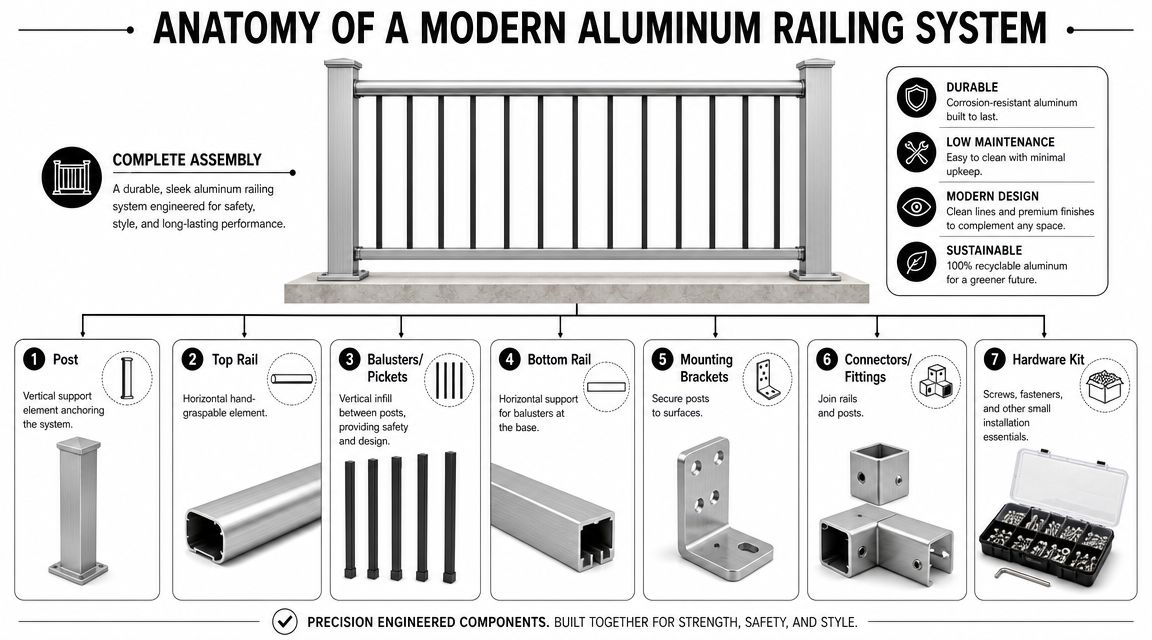
A railing looks simple once it's installed. In reality, it's a group of parts that have to work together under load, along a stair angle, and under code scrutiny. Treat it like a system and the project goes more smoothly. Treat it like a pile of decorative parts and you'll fight fitment at every stage.
The broader market supports that system-first approach. The global aluminum railing market is projected at USD 1,053.8 million in 2026, rising to USD 1,287.3 million by 2033, with North America representing 28.5% of the market in 2026, according to Coherent Market Insights on the aluminum railing market. That scale reflects how standardised, code-driven railing systems have become.
The core parts
Think of the railing in layers.
- Posts carry the load into the stair framing or landing surface. If the posts are weak or poorly anchored, nothing above them matters.
- Top rail gives the assembly its visual line and often contributes stiffness.
- Handrail is the part people grip. On some systems it's integrated. On others it's separate.
- Balusters or pickets fill the opening and provide fall protection.
- Bottom rail helps locate and secure the infill.
- Brackets, connectors, and fasteners do the hidden work. These parts determine whether the system stays aligned on a sloped run.
Why matching components matters
A stair run is less forgiving than a flat deck section. Angles, post transitions, and landing connections all have to line up. If one manufacturer's rail profile doesn't match another manufacturer's bracket geometry, the install starts to look improvised very quickly.
That's where curated product lines help. For example, Decorex Hardware components such as balusters, post brackets, post caps, and related fastening hardware give buyers concrete options when they want a coordinated finish across stairs, decks, and adjacent exterior details. Retailers such as XTREME EDEALS INC. carry those kinds of railing-related parts in one place, which is useful when you're trying to keep spacing, finish, and attachment details consistent across the whole job.
A professional-looking staircase railing rarely comes from “close enough” parts. It comes from posts, rails, brackets, and hardware that were meant to work together.
Parts people forget to order
The visible railing is only part of the purchase. Jobs get delayed when buyers forget:
| Component | Why it matters |
|---|---|
| Stair-specific brackets | Flat-rail brackets often won't work cleanly on stair pitch |
| Correct post bases | Surface condition and framing below affect stability |
| Transition fittings | Landings and corners need planned connections |
| Anchors and structural fasteners | Decorative screws are not structural hardware |
| Post caps and trim | These finish the job and hide small layout imperfections |
A clean install starts with a complete parts list. That's true whether you're ordering a boxed kit or building a custom configuration from standard system components.
Exploring Styles and Protective Finishes
It's common to start with colour and style, then think about performance later. On staircase projects, that order should be reversed. Choose the finish based on exposure first, then choose the look that suits the house.
Common style directions
Vertical picket systems are still the most practical option for many homes. They suit traditional, transitional, and straightforward modern exteriors. They're also easy to read visually on stairs, which matters when safety is part of the design.
Glass infill systems work well where you want open views and a lighter visual barrier. They can look sharp on raised decks and feature stairs, but they usually demand more cleaning and more exact installation.
Cable systems keep sightlines open and fit contemporary architecture. They can be a good design choice, but stair applications need careful planning so the whole assembly still feels solid and compliant.
For many first-time buyers, aluminum picket systems remain the easiest place to start. They're easier to maintain, easier to source, and more forgiving during installation than some premium infill options. If you're comparing adjacent deck and stair materials, browsing aluminum deck materials and components can help you keep the style consistent across the whole exterior.
Powder coating versus anodized finishes
The finish matters as much as the base metal because it affects colour, durability, and how the railing ages in your environment.
Aluminum Finish Comparison: Powder Coat vs. Anodized
| Feature | Powder Coating | Anodizing |
|---|---|---|
| Appearance | Wide colour selection, from classic black to custom architectural tones | Metallic look with a more industrial finish |
| Surface feel | Smooth, even coated surface | Harder metallic surface appearance |
| Outdoor use | Common choice for residential and commercial rail systems | Useful where a metallic finish is preferred |
| Touch-up considerations | Colour matching matters if damage occurs | Less about paint matching, more about finish consistency |
| Design flexibility | Better for matching trim, doors, posts, and exterior accents | Better when you want the metal look itself |
What works in tougher environments
For coastal exposure, finish quality and fastener choice deserve extra attention. The practical question isn't just whether aluminum resists corrosion. It's whether the full assembly, including brackets and screws, suits marine air and regular moisture. If you're interested in how protective coatings perform in harsh water-adjacent conditions, this ultimate guide for protecting boat hulls offers useful context on why surface protection matters so much on aluminum used around wet environments.
A few finish rules hold up well in practice:
- Choose dark powder coat carefully: Black looks sharp, but scratches and salt residue can show if the site is exposed.
- Match the finish to the property style: Matte black suits modern homes. Bronze and textured finishes often fit traditional facades better.
- Don't ignore the hardware finish: A good rail with poor fastener selection is still a poor system.
If you want the shortest path to a good-looking result, pick one finish family and keep it consistent from posts to brackets to accessories.
Code Compliance and Measurement Essentials
This is the part homeowners most often underestimate. A staircase railing isn't approved because it looks sturdy. It has to meet code in how it's shaped, mounted, and sized.
In California, the CBC requires handrails on stair flights with 4 or more risers, and the rail system has to provide a continuous, graspable surface with geometry and connections that reduce fall risk, as outlined in this CBC-aligned handrail specification reference. The same logic applies anywhere else. Inspectors care about safety function first, appearance second.

What to confirm before you buy
Don't order a system until you know which parts of the stair need a handrail, which need a guard, and whether your local permit office treats the project as a repair or a new installation.
Check these points first:
- Riser count: Once the stair flight reaches the code trigger, a handrail isn't optional.
- Railing height: Residential and commercial applications often differ. Some manufacturers commonly standardise around 36 inches for residential and 42 inches for commercial, which is useful for planning, but local enforcement still decides what passes on your project.
- Graspability: A broad decorative top rail doesn't automatically qualify as a proper handrail.
- Continuity: Interruptions at posts and awkward terminations can fail inspection.
- Openings and spacing: Infill layout has to protect users, especially on family homes and raised exterior stairs.
For a broader refresher on why local rules matter on real jobs, this overview of crucial construction safety standards is a useful companion read.
A practical measuring sequence
Measure the stair before you compare product pages.
- Count the risers so you know whether handrail rules are triggered.
- Measure the total stair run from top landing to bottom.
- Confirm the stair angle because not all brackets handle the same slope equally well.
- Measure each landing area where posts will mount or transition.
- Locate framing or solid backing before choosing anchors and post bases.
If you need a quick reference for common dimensional expectations, this guide to deck railing height code is useful for comparing the general height conversation around guards and rails.
Don't measure only the visible opening. Measure where each post will actually fasten. A beautiful layout on paper can fail once it meets real stair framing.
What usually causes inspection trouble
Most failed installs come from a short list of mistakes:
- Wrong post placement at the top or bottom transition
- Non-graspable top rail used where a handrail is required
- Improvised site cuts that weaken connection points
- Mismatched brackets on sloped sections
- Missing documentation for the system and hardware
A code-compliant kit or coordinated system removes a lot of that risk before the first hole is drilled.
Selecting the Right Aluminum Railing System
Buying a railing gets easier once you stop shopping by appearance alone. The right question is not “Which rail looks good online?” It's “Which system fits my stair geometry, code requirements, finish needs, and budget with the fewest unknowns?”
Kits versus loose components
A complete kit makes sense when your stair layout is straightforward and the manufacturer offers a stair package built for your dimensions. This route saves time and reduces the chance of forgetting a critical bracket or connector.
Buying individual components makes more sense when the project includes unusual landings, transitions, or mixed runs where one standard kit won't cover everything cleanly. It also helps if you want to coordinate balusters, post caps, and trim details more precisely.
The trade-off is simple:
| Option | Better for | Watch out for |
|---|---|---|
| Complete system kit | Standard stair runs, first-time buyers, quicker installs | Limited flexibility if the staircase is unusual |
| Build-from-components system | Custom layouts, remodels, detailed design control | Easy to miss parts or create compatibility issues |
Budgeting without surprises
Cost shifts quickly depending on whether you install it yourself or hire a contractor. Verified pricing guidance places professionally installed aluminum railings at $150-$300 per linear foot, while DIY kits can reduce that to $75-$150 per foot. That makes your labour plan just as important as your material choice.
The railing itself isn't the only budget line. Include:
- Anchors and structural fasteners
- Stair-specific brackets
- Touch-up materials if supplied by the manufacturer
- Tools you may need to buy or replace
- Freight or shipping on long rail sections
If you want to sketch the full project cost before ordering, a tool such as Exayard construction estimating software can help organise labour, hardware, and material line items in one place.
A buying checklist that actually helps
Use this filter when comparing systems:
- Is it sold as a true stair system? Flat deck rail parts adapted to stairs often create avoidable problems.
- Are the connection details clear? If the listing doesn't show brackets, post options, and compatible hardware, expect guesswork.
- Can you source replacement parts later? This matters if one post cap or bracket gets damaged.
- Does the finish match your environment? Coastal and exposed conditions deserve closer attention.
- Will the system look complete when finished? Trim rings, caps, and matching hardware matter more than buyers think.
Buy the railing the same way you'd buy a door system. Slab, frame, hinges, and hardware need to belong together or the install becomes a workaround.
A good aluminum staircase railing purchase feels boring in the best way. All the pieces show up. The brackets fit. The post sizes make sense. The result looks planned because it was.
Installation DIY or Hire a Professional
A lot of homeowners can install aluminum railing successfully. A lot of homeowners also underestimate how precise a stair install needs to be. Both things are true.

Why DIY is realistic for many projects
Aluminum helps the DIY route because it's easier to handle than steel. Manufacturer guidance notes that its lightweight nature makes positioning and installation simpler, and that standardised post lengths and hardware for common stair angles can help with proper angled connections and load transfer, as shown by Peak's aluminum railing system information.
That doesn't mean every project is beginner-friendly. It means the material itself isn't fighting you.
A DIY install usually makes sense when:
- The stair is straight: Fewer transitions mean fewer opportunities for error.
- The mounting surfaces are sound: Rotten wood, cracked concrete, or weak framing change the whole job.
- You own the right tools: A quality drill, level, layout tools, proper bits, and saw setup matter.
- You can follow layout carefully: Stair work punishes rushed measuring.
If you want a practical overview of the process before deciding, this guide on railing stairs installation is a useful starting point.
When hiring a professional is the better call
The pro route makes more sense when the stairs are exposed, raised, irregular, or tied to an inspection schedule. Remodels also get tricky because older framing rarely lines up with modern system assumptions.
Watch this kind of install comparison before deciding how much complexity you want to manage yourself:
A contractor earns their fee on stairs by getting the details right:
- Post placement that aligns with framing and final sightlines
- Bracket selection that suits the stair pitch
- Clean cuts and terminations instead of field improvisation
- Code-focused installation rather than purely cosmetic assembly
The honest trade-off
DIY usually saves money. Professional installation usually saves time, reduces rework, and lowers the risk of inspection trouble.
A simple way to decide is to ask three questions:
- Can I measure and lay out accurately on an angled run?
- Do I know how the posts will anchor into the actual structure below?
- Will I be comfortable fixing mistakes if the first fit isn't right?
If any of those answers is no, bringing in a pro is often the cheaper decision in the long run.
Long-Term Care and Final Considerations
One reason aluminum staircase railing keeps gaining ground is that ownership is simple. Once it's installed correctly, maintenance is mostly about keeping the finish clean and making sure the hardware stays tight.

A maintenance routine that works
You don't need a complicated care plan.
- Wash with mild soap and water: This removes dirt, salt film, and general buildup before it sits on the finish.
- Inspect fasteners periodically: Posts, brackets, and rail connections should stay snug.
- Clear debris at post bases: Wet leaves and packed dirt shouldn't stay trapped around connection points.
- Avoid abrasive cleaners: Rough pads and harsh chemicals can dull or damage the finish.
- Deal with damage early: Scratches, dents, and loose trim should be handled before they spread into a bigger repair.
What ages well and what doesn't
Aluminum systems tend to age well when the original install was done properly. That means solid post anchoring, compatible hardware, and a finish suited to the environment. The railing that still looks good years later is usually the one that wasn't forced into place during day one.
The opposite is also true. Cheap anchors, weak framing, random replacement screws, and neglected coastal buildup can make even a good-looking railing feel loose and tired before it should.
The longest-lasting railing is not the one with the fanciest profile. It's the one installed square, anchored properly, and cleaned once in a while.
Final buying perspective
If this is your first railing project, keep the decision grounded in function:
- Start with safety and code
- Buy a complete system where possible
- Choose the finish for the environment
- Be realistic about your installation skill
- Don't cheap out on hidden hardware
That approach usually produces the best result. Not just visually, but in how the railing feels every time someone grabs it going up or down the stairs.
If you're ready to compare components, stair balusters, post caps, brackets, and fastening hardware for your project, XTREME EDEALS INC. offers a practical starting point for assembling a coordinated railing-related package with products such as Decorex Hardware.