
A lot of people start shopping for gate hardware only after the gate has already started dragging. It rubs the walkway, the latch stops lining up, and every opening feels heavier than the last. At that point, many homeowners assume the wood moved, the post shifted, or the gate was built wrong.
Sometimes that's true. More often, the hinge choice was wrong from the start.
A gate is a moving load sitting outdoors through rain, frost, heat, and repeated slamming. The hinge has to carry weight, resist twist, survive weather, and keep the gate aligned. If you get that decision right up front, the gate works smoothly for years. If you get it wrong, you spend your time shimming, tightening, lubricating, and eventually replacing hardware that was never suited to the job.
Why Your Gate Hinges Are Non-Negotiable
The hinge is the part that takes the punishment every time the gate opens. Latches get attention because you touch them, but hinges carry the load and control the swing. When a gate sags or starts scraping, the hinge setup is usually where the problem starts showing itself.
That matters because modern gate hardware isn't some minor accessory. The history of hinges shows early hinge forms date to around 1600 B.C., and the U.S. door-hinges market reached $1.8 billion in 2024, growing at 5% annually. That tells you two things. First, hinges are a mature, highly engineered category. Second, the right fence door hinge is a structural choice, not a finishing touch.
A typical failure pattern looks like this:
- The gate drops at the latch side because the hinge doesn't match the gate's width or weight.
- Fasteners loosen because the hinge leaf is too small to spread the load.
- Rust starts early because the finish suits indoor use better than exposed weather.
- The gate binds because the hinge type doesn't match how the gate moves or how the post was built.
Practical rule: If a gate feels heavy on day one, the hinge arrangement is already telling you something.
For contractors, bad hardware leads to callbacks. For homeowners, it leads to weekend repairs that keep coming back. That's why solid planning matters as much as the installation itself. If you run a fencing business, even your service reputation depends on details like this, which is why broader resources on effective fence company marketing often matter after the workmanship is already in the field.
If you're comparing hardware options, start with a proper gate-hardware category rather than generic door parts. A focused selection of fence and gate hardware makes it easier to match hinge style, finish, and mounting method to the gate you're building.
Decoding Hinge Types for Your Fence Gate
Different hinges solve different problems. The mistake I see most often is choosing by appearance first and function second. That works on lightweight decorative panels. It doesn't work on a real gate that opens every day.
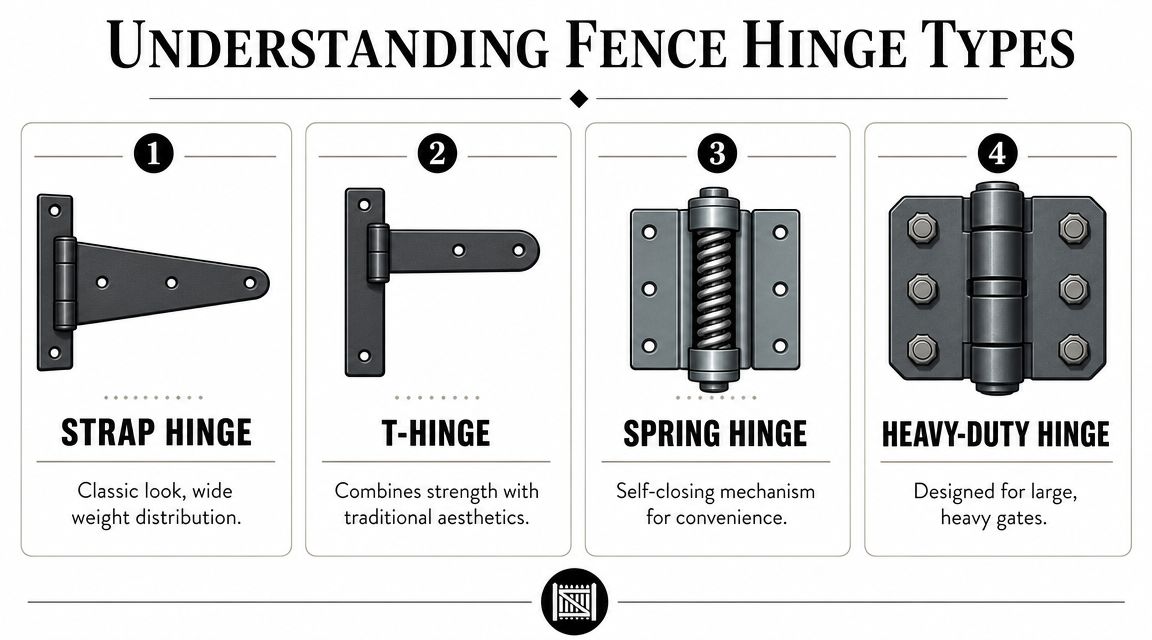
Strap hinges
A strap hinge acts like a long lever attached to the gate face. Because the leaf runs farther across the gate, it spreads load better than a compact hinge. That makes it a sensible choice for wider wood gates where you want support without hiding the hardware.
Strap hinges also suit rustic and traditional designs. The downside is that they're visible, and on a clean modern gate they can look too busy.
T-hinges
A T-hinge gives you some of the load-spreading benefit of a strap hinge but in a shorter format. It's common on timber garden gates and side-yard gates where the gate isn't oversized and the owner wants a classic look.
For decorative wood work, products like Decorex Hardware T-Hinges fit that traditional style well. They're not the hinge I'd reach for on a large privacy gate with a lot of wind exposure, but for smaller wood applications they can be a tidy solution.
Butt hinges
Butt hinges are compact and familiar because they look like door hinges. On gates, though, that familiarity causes mistakes. A butt hinge can work on lighter gates and some metal assemblies, but the hardware must be rated for gate duty, not just door duty.
If you use a basic interior-style butt hinge outdoors on a substantial gate, you usually get sag, wear, or fastener movement.
Pivot and weld-on hinges
Pivot and weld-on styles belong in heavier service. Metal gates, framed gates, and installations that need a cleaner swing often benefit from these options. Weld-on hinges remove some of the weakness that comes from screws working loose over time, but they need proper fabrication and alignment.
This is also where hinge thickness starts to matter. According to heavy-duty steel gate hinge guidance, leaf thickness commonly ranges from 1/4 in. to 3 in., and a thicker leaf improves resistance to bending from wind load and gate slam. That's not a cosmetic upgrade. It changes how the hinge handles real-world abuse.
Spring hinges and adjustable hinges
Spring hinges are for self-closing action. They're useful on pool-style access points and gates that people often forget to shut. The trade-off is that they add tension to the system, so poor alignment shows up faster.
Adjustable hinges are valuable when the post, frame, or gate may need fine-tuning after installation. For builds where alignment needs to stay serviceable, adjustable gate hinges are worth considering.
Fence Hinge Comparison
| Hinge Type | Ideal for Gate Material | Typical Load Capacity | Best For |
|---|---|---|---|
| Strap hinge | Wood | Varies by build and hardware size | Wide wooden gates, traditional appearance |
| T-hinge | Wood | Varies by build and hardware size | Smaller garden or side gates |
| Butt hinge | Metal or lighter framed gates | Varies by gate-rated model | Compact appearance, cleaner reveal |
| Pivot hinge | Wood or metal | Varies by assembly | Controlled swing, heavier custom gates |
| Weld-on hinge | Metal | Varies by fabrication and hinge size | Heavy steel gates, high-use installs |
| Spring hinge | Wood, vinyl, metal | Varies by model | Self-closing gates |
Choose the hinge by how the gate carries weight, not by what looks familiar on a door.
Choosing Materials and Finishes for Longevity
Hinge type gets most of the attention. Material usually decides how long the hardware lasts.
A gate can be perfectly aligned and still fail early if the hinge material can't handle moisture, salt, or constant temperature swings. Outdoor hardware lives in a rough environment. Water sits in seams. Dirt holds moisture. Wind shakes joints. Sun breaks down cheap coatings. The hinge has to survive all of that while moving cleanly.
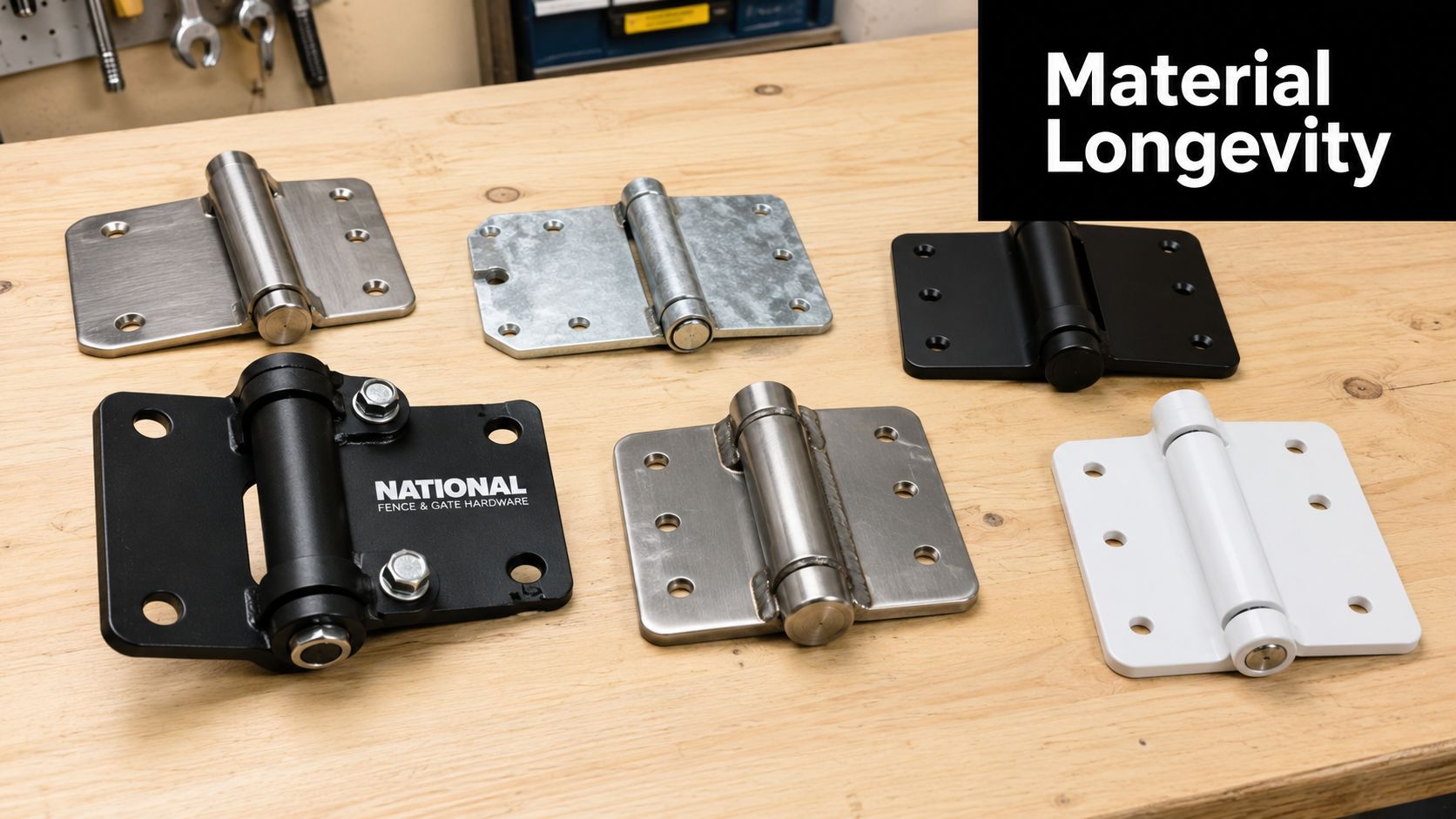
Stainless steel
If corrosion is the main concern, stainless steel is usually the safer call. That's one reason it holds such a large share of hinge material demand. As noted in this hinge material overview, stainless steel accounts for about 40% to 47% of global hinge-material share.
That doesn't mean every gate needs stainless. It does mean corrosion resistance is valuable enough that buyers and specifiers keep choosing it for exposed hardware.
Use stainless when:
- You're near salt air and rust starts quickly on standard finishes.
- The gate sees regular moisture from irrigation, snow, or poor drainage.
- You want lower maintenance and fewer finish touch-ups over time.
Galvanized steel
Galvanized hinges make sense when you need durability at a more practical cost. The zinc coating protects the base steel and gives you a solid middle ground for many residential gates. For inland installations, galvanized hardware is often a sensible balance between price and service life.
The weak point is damage to the coating. If the hinge gets gouged, ground, or heavily abraded, the exposed steel becomes the spot to watch.
Powder-coated finishes
Powder-coated hardware works well when appearance matters and the coating quality is good. A proper powder-coated finish can hold up well against weather and UV better than ordinary painted hardware. It also gives you a cleaner, more finished look on visible gates.
Still, coating isn't magic. If the base material is light-duty, the finish won't save a poor hinge from deformation or loose mounting.
What I'd match to the environment
Use the site conditions to make the call:
- Coastal or high-corrosion areas: Stainless steel is the safer starting point.
- General residential use: Galvanized or powder-coated steel often works well if the hardware is properly sized.
- High-use commercial or shared access gates: Favour strong materials and heavier leaves over decorative finishes.
A practical example is the Decorex Hardware range sold by XTREME EDEALS INC., which includes galvanized and powder-coated hardware options for fence and gate projects. That's useful when you want to compare finish and format without dropping into generic indoor hardware.
Sizing Hinges by Gate Weight and Dimensions
A gate doesn't just hang. It pulls.
The wider the gate, the more strain it creates against the hinge side. That's why a gate that isn't especially tall can still sag badly if it's wide, built from heavy boards, or faced with dense trim. The top hinge takes a lot of stress because the latch side is trying to pull downward and outward at the same time.
Weight first, width second
The best starting point is simple. Choose hinges by gate weight and width. That's the core rule behind gate hardware selection. It's also why door hinges and gate hinges aren't interchangeable.
According to gate hinge selection guidance, interior doors typically weigh 50 to 100 pounds, while gates can weigh 200 pounds or more. The same guidance notes that most gates need two hinges, with a third often needed for taller or heavier gates. For chain-link gates taller than 8 feet, three hinges per leaf are recommended.
What that means on a real project
If you're hanging a narrow pedestrian gate, two properly sized hinges may be enough. Once the gate gets taller, wider, heavier, or more exposed to wind, the load stops being forgiving.
Use this logic:
- Look at the gate frame first. A flimsy frame will move even with good hinges.
- Assess the gate's width. Greater width quickly amplifies the force.
- Count cladding weight. Vertical boards, privacy panels, and decorative overlays all add load.
- Consider wind exposure. A solid privacy gate catches more force than an open picket gate.
- Add the third hinge early if the gate is pushing the limits. It's cheaper than a callback.
A third hinge doesn't make a badly built gate good, but it can reduce stress concentration and help a properly built heavy gate stay aligned.
Match the hinge body to the gate
For certain chain-link and tubular gate setups, fit matters as much as rating. The hinge body needs to match the gate upright diameter. The guidance linked above notes common sizes like 1-5/8 in. O.D. and 2 in. O.D. with collar repositioning depending on the setup.
That detail matters because a sloppy fit creates movement before the gate even starts to age. On wood gates, the equivalent mistake is using short screws into weak stock or mounting too close to an edge where the wood can split.
A sizing mistake that keeps repeating
People often buy hinges that look strong in the hand but don't have enough leaf size, enough thickness, or the right mounting layout for the gate. The result is usually the same. The latch side drops, people start lifting the gate by hand to close it, and the fasteners work loose from that repeated strain.
Your Step-by-Step Hinge Installation Checklist
Good hinges still fail when they're installed badly. Most installation problems come from misalignment, poor fastener choice, or rushing the layout. A clean installation keeps the hinge working the way it was designed to work.
Before you fasten anything
Start with the gate and post in their final positions. If the post moves later, the hinge won't save you. If the gate frame is twisted, fix that before you touch hardware.
Use a level, tape, clamps, pencil, drill, pilot bits, and the right screws or bolts for the post and gate material. Don't substitute random fasteners from a leftover bin if the coating or length isn't appropriate for exterior use.
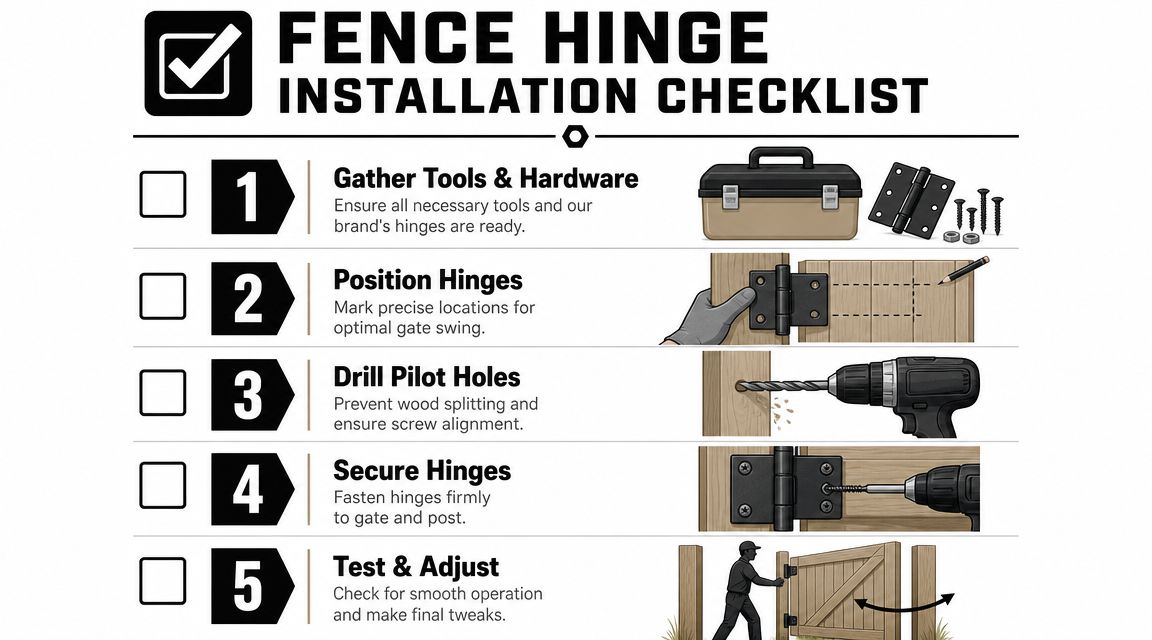
The working checklist
Dry-fit the gate in the opening
Set the bottom clearance and side gaps before marking hinge positions. If the reveal is uneven now, it'll only get worse after fastening.Mark hinge locations with the gate supported
Don't guess by eye while someone holds the gate. Use blocks or shims so the gate sits exactly where it should live when finished.Pre-drill pilot holes in wood
Pilot holes reduce splitting and help keep screws from wandering. That matters most near board edges and on hardwoods.Fasten the hinge to the gate first when practical
This gives you a stable reference while you align to the post. On some metal systems, the sequence changes, but the principle is the same. Control alignment before final tightening.Check swing and latch alignment before fully loading the hardware
Open and close the gate several times. Watch for binding, rising, or dropping as it swings.
Fastener choices matter
The hinge is only as good as what holds it.
- Wood-to-wood mounting: Use exterior-rated screws or through-bolts when the gate is heavy.
- Metal gates: Match the mounting method to the hinge design, including bolt-on or weld-on formats.
- Soft or weathered timber posts: Through-bolting often outperforms relying on screws alone.
If you're fitting a gate that needs automatic closure, choosing a purpose-built self-closing gate hinge is easier than trying to force closing action from hardware that wasn't designed for it.
Where installers get into trouble
A few mistakes keep repeating:
- Mounting too close to the edge: This invites splitting or pull-out.
- Ignoring hinge spacing: Hinges set too close together don't control the gate well.
- Overtightening on soft wood: This crushes fibres and can reduce holding power.
- Skipping test swings: Misalignment shows up immediately if you cycle the gate before calling it done.
If the gate has to be lifted to latch right after installation, stop and correct it. Time won't improve that condition.
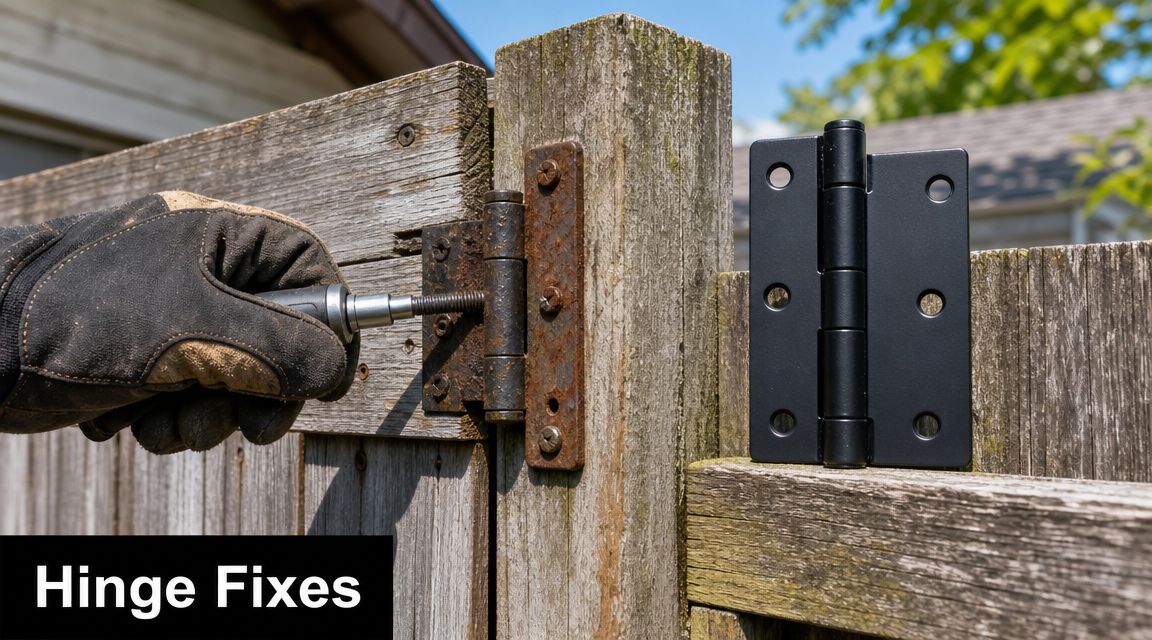
How to Fix Common Fence Hinge Problems
Most hinge problems are repairable if you catch them early. The key is figuring out whether the issue is wear, corrosion, movement in the post, or a bad original hardware choice.
Sagging gate
A sagging gate usually points to undersized hinges, poor spacing, loose fasteners, or frame movement. Start by checking whether the post is still plumb. If it is, inspect the top hinge area first because that's where strain usually shows up earliest.
Try this in order:
- Tighten or replace fasteners if the holes aren't wallowed out.
- Shift to through-bolts on heavier wood gates where screws keep loosening.
- Add a third hinge if the gate is tall or pushing the limit of a two-hinge setup.
- Replace with a more suitable hinge style if the current one is light-duty.
Squeaking or binding
Noise isn't always serious, but binding is. Clean dirt and oxidation from the hinge knuckle or pivot area, then use an appropriate lubricant. If the gate still binds, look at alignment rather than adding more grease.
Binding often means the gate has dropped, the post moved, or the hinge leaves were mounted out of line.
Rust and premature failure
In exposed locations, maintenance guidance often flags rust and early failure as the main problems. The better fix is choosing the right material from the start, especially in salty or wet conditions. The maintenance guidance for heavy-duty gate hinges recommends prevention through hinge materials such as stainless steel or durable powder-coated finishes designed for weather exposure.
Here's a practical video walkthrough that helps with diagnosis and replacement steps:
Loose hinges on wood posts
When screws keep backing out, don't just drive in bigger random screws and hope for the best. Check whether the wood is split, softened, or crushed around the mounting points. If it is, move to sound material, reinforce the area, or rebuild that section properly.
Hardware can't compensate forever for a weak post or a deteriorated gate stile.
Routine inspection helps. Look at hinge screws or bolts, the top hinge area, visible rust, and whether the latch side has started dropping. Small corrections are easy. Neglected movement usually turns into replacement work.
Expert Answers to Your Hinge Questions
Can I paint my gate hinges instead of buying a finished hinge
You can, but it's usually a compromise. Paint chips faster on moving hardware than on fixed surfaces. If the gate is exposed, a purpose-finished hinge is the more durable choice.
What's the real difference between a door hinge and a gate hinge
Gate hinges are built for higher loads, outdoor exposure, and repeated movement under weather. A standard door hinge may look similar, but that doesn't mean it belongs on a fence gate.
Should I mix hinge types on one gate
Usually no. Mixing hinge types can create uneven movement, odd load sharing, and installation headaches. Use one system designed to work together unless a specific engineered setup calls for something different.
Are self-closing hinges enough for every gate
No. They work well when the gate size, weight, and alignment suit the hinge. If the gate is too heavy or poorly balanced, the closing action won't solve the root problem.
When should I replace instead of repair
Replace when the hinge is rusted through, bent, badly worn at the pivot, or the wrong type for the gate. Repair makes sense when the hardware is still suitable and the issue is limited to alignment or fastening.
If you're replacing worn fence door hinges or planning a new gate build, XTREME EDEALS INC. carries gate and fence hardware, post accessories, and related installation components that can help you match hinge style, finish, and mounting method to the job instead of forcing a generic solution.