
You're probably looking at a fence, deck, or gate line that feels finished in daylight and disappears at night. That's where solar powered post lights earn their keep. They're one of the few outdoor upgrades that can change how a space looks and how it functions, without turning into a wiring project, a trenching job, or a callback for an electrician.
For most DIYers, the main challenge isn't whether solar works. It's choosing a light that properly fits the post, survives the weather, and still looks right after a few seasons. Brightness matters, but fit, housing material, battery quality, and post compatibility matter more. A cheap cap that wobbles on a nominal 4×4 or traps water inside the housing stops being a bargain very quickly.
An Introduction to Solar Post Lighting
A good post light does two jobs at once. It gives you usable evening light around stairs, railings, gates, and fence lines, and it makes the whole build look intentional after sunset. On a deck, that means a perimeter that doesn't vanish at dusk. On a fence, it means cleaner sightlines and a safer path to the side yard, gate, or bin area.
Solar powered post lights make sense because they package the working parts into one self-contained fixture. You mount the cap, let it charge, and the unit handles the rest. That's a very different job from hardwired lighting, where every good result depends on planning cable runs, power source location, weatherproof connections, and future access.
According to PacLights' overview of outdoor solar pole lighting, solar post lights are composite systems typically consisting of four specific components: a solar panel to harvest energy, rechargeable batteries to store it for nighttime use, LED bulbs for illumination, and a control unit that automatically manages energy flow based on ambient light levels. That's the simplest way to understand them. They're small off-grid systems sitting on top of your post.
Why they work so well on decks and fences
The appeal is practical.
- No trenching: You don't have to cut into finished landscaping or pull cable under a deck.
- Cleaner retrofit: They're ideal when the deck or fence is already built.
- Low-risk DIY: If you can measure a post accurately and drive screws straight, you can usually install them.
- Visible upgrade: Even modest lighting changes the feel of the whole perimeter.
Practical rule: Buy the post first, measure the actual top size second, and only then choose the cap.
What they're best at
Solar post caps are strongest as accent and perimeter lighting. They define edges, mark transitions, and create a steady visual rhythm down a fence or railing line. They're not always the right answer for every security application or every heavily shaded location. That's where many buyers go wrong. They expect one small cap light to behave like a floodlight.
Used for the right job, though, they're one of the easiest ways to make a new build look complete.
Decoding the Specs Lumens Batteries and Materials
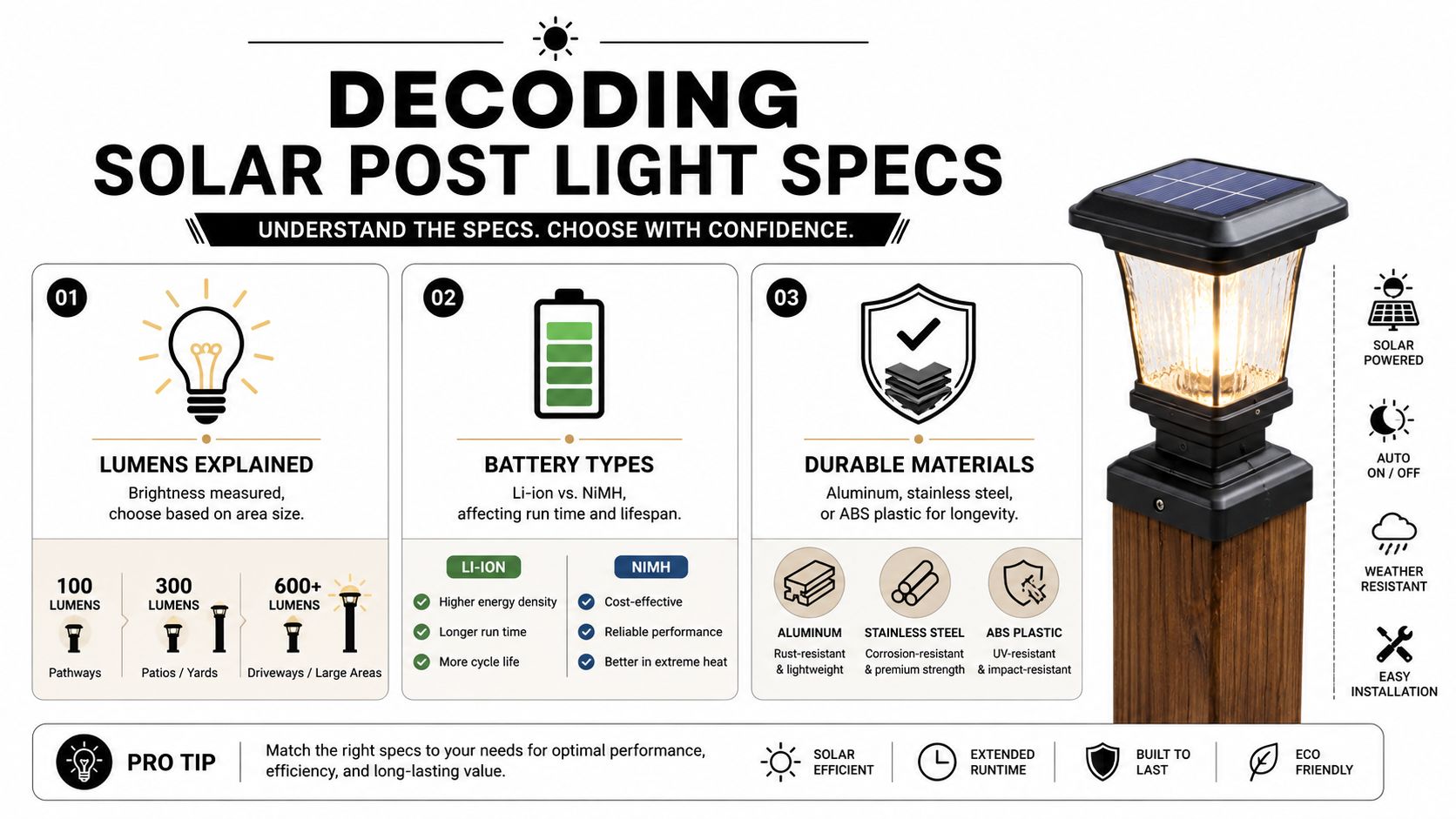
When selecting solar lights, style often takes precedence over brightness. In practice, material quality and battery type usually have a bigger effect on long-term value than the product photo.
Lumens are only part of the story
For a fence or deck cap, the question isn't “What's the brightest unit?” It's “What job is this light doing?” A low, warm glow can look excellent on a decorative fence line. A gate post near steps or a dark walkway usually needs a more purposeful output and better lens design.
At the infrastructure end of the market, Inlux Solar's guide to commercial solar pole lights notes that commercial-grade solar pole lights typically require 3,000 to 8,000 lumens per pole when installed at heights of 6m to 8m, and that high-quality systems can have a projected lifespan of 10 to 15 years, with LiFePO₄ batteries lasting 5 to 8 years. That isn't a buying spec for a deck cap, but it is a useful reminder that brightness requirements rise sharply with mounting height and task. A small decorative cap and a true area light are not the same product class.
If you're browsing solar post cap options, think in layers. Perimeter ambience, stair visibility, and entry emphasis can each call for a different fixture style.
Battery chemistry changes the ownership experience
The battery decides whether a light feels reliable or annoying. Better battery systems typically hold charge more predictably, recover more consistently after cloudy days, and age more gracefully. That matters more in real life than a product title claiming “ultra bright”.
A few practical buying notes:
- LiFePO₄ batteries: Common in higher-grade solar systems. They're associated with longer service life in the commercial guidance cited above.
- Replaceable batteries: Worth favouring when available. Disposable fixtures are rarely good value.
- Battery access: If the battery compartment is awkward or poorly sealed, maintenance becomes a chore.
Material quality is where cheap lights get exposed
This is the part buyers tend to overlook until winter, rain, and summer sun do the review for them. A solid powder-coated aluminium housing generally holds up better than thin plastic shells that fade, crack, or warp. Stainless accents can look good, but the overall build still depends on gasket quality, lens fit, screw quality, and how the cap sheds water.
For outdoor hardware, these are the details that separate a decent fixture from one that starts rattling or yellowing too soon:
| Feature | Better choice | Why it matters |
|---|---|---|
| Housing | Powder-coated aluminium | Better rigidity and weather resistance |
| Lens | Thick, well-seated plastic or glass-like lens | Reduces clouding and movement |
| Fasteners | Corrosion-resistant screws | Less staining and easier servicing |
| Fit | Snug cap-to-post contact | Better appearance and fewer moisture issues |
A post cap that fits badly won't look premium, no matter how nice the finish is.
For a capable DIYer, the shortlist should start with post size, exposure to weather, and material quality. Brightness comes after that.
The Perfect Fit A Guide to Post Cap Sizing
The most common mistake with solar post lights is simple. People buy by the nominal post name on the shelf, not by the actual measured size of the installed post. If the cap is too loose, it looks sloppy and may shift. If it's too tight, it can crack during installation or never seat properly.
Nominal size versus actual size
Dimensional lumber names don't match finished measurements. That catches people every day with 4×4 and 6×6 posts.
| Nominal Size | Actual Size (inches) | Actual Size (mm) |
|---|---|---|
| 2×2 | 1.5 x 1.5 | 38.1 x 38.1 |
| 4×4 | 3.5 x 3.5 | 88.9 x 88.9 |
| 6×6 | 5.5 x 5.5 | 139.7 x 139.7 |
Before ordering, measure the top of the installed post in both directions with a tape measure. Don't assume all posts on your project match. Pressure-treated wood can vary slightly. Wrapped posts, older posts, and painted posts can vary even more.
For a deeper fit guide, these post cap buying tips are worth reviewing before you order.
Wood, vinyl, and metal don't behave the same way
A wood post gives you the most straightforward installation. If the cap is sized correctly, it should seat evenly and fasten securely. The main issue is swelling, shrinkage, or rough saw edges on the top face.
Vinyl and composite sleeves need more care. What matters is the outside dimension of the sleeve, not the inner support. You also want to avoid overtightening screws and distorting the material.
Metal posts are their own category. Some take adapter-style caps well. Others need low-profile decorative solutions rather than a classic wood-post cap. Square metal railing posts can look excellent with sleek solar caps, but only when the fit is exact and the finish matches the surrounding hardware.
A simple measuring method that prevents returns
Use this process every time:
- Measure the top, not the side: Posts can be planed, wrapped, or slightly out of square.
- Check both directions: A post that reads square by eye may not be square by tape.
- Note the material: Wood, vinyl, aluminium, and steel all affect fit and fastening.
- Check the cap base dimensions: The visible top style can hide a smaller or larger internal opening.
If the product description only lists “fits 4×4” and doesn't clarify actual fit, pause before buying.
Sizing is boring right up until the shipment arrives. Then it's the whole job.
Featured Solar Post Lights for Your Project
Some projects need a classic cap that looks right on pressure-treated fence posts. Others need a lower-profile light for a modern railing or a cleaner line along a deck perimeter. The best pick is the one that matches the post material, top dimension, and the visual style of the build.
Good matches for common builds
Classic wood fence look
A pyramid-style solar cap suits standard wood fence posts well because the shape sheds water and looks natural on traditional builds. For this application, powder-coated metal housings or better-grade composite housings tend to give a cleaner long-term result than very light plastic.
Modern deck railing
Square, low-profile caps work better on contemporary decks, especially when you've used black hardware, dark balusters, or metal accents. Bulky lantern-style caps can feel oversized on minimalist railings.
Larger feature posts
On entry posts, gate pillars, and wider 6×6 deck corners, a small cap can look undersized. In such instances, proportion matters more than brightness. A properly scaled cap anchors the line visually and finishes the post instead of looking perched on top of it.
What to look for in retailer listings
When I evaluate solar post light listings, I'm checking four things first:
- Actual compatibility: The listing should clearly match the post size and material.
- Housing material: Aluminium and heavier-duty construction are usually better bets for exposed locations.
- Finish quality: Matte black and similar finishes often pair well with modern deck and fence hardware.
- Replaceable parts: Battery access and serviceability matter if you want the fixture to earn its keep over time.
Retailers that carry deck and fence hardware alongside lighting usually do a better job with this category because they understand post sizes, rail systems, and material compatibility. That's where product lines from brands such as Decorex Hardware make sense in the same shopping flow as post caps, brackets, fasteners, and other finishing pieces.
Don't buy one style for every location by default
A full property doesn't need to be lit with one fixture type. A contractor-minded approach works better:
- Use clean decorative caps on the main railing line.
- Use more visible fixtures at stairs, gates, or transitions.
- Use larger caps only where the post scale justifies them.
That mix usually looks more deliberate than repeating the same cap everywhere.
DIY Installation in Under 15 Minutes
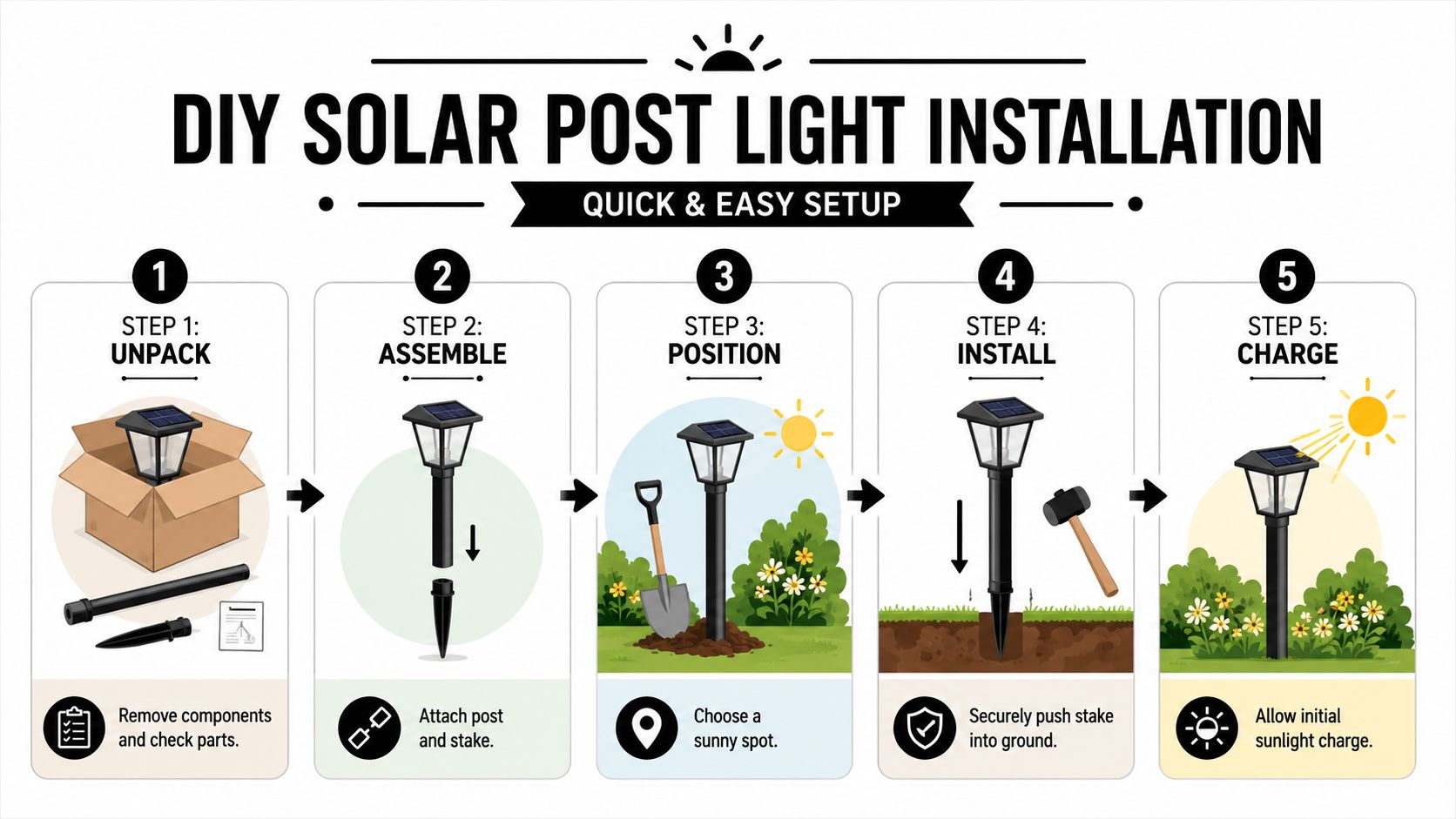
A solar post cap is one of the few outdoor lighting jobs that a careful DIYer can handle quickly without making the project look improvised. The key is doing the small details properly. Square fit, clean surface, and sun exposure matter more than speed.
What you need before you start
Most installations only require a short tool list:
- Tape measure: Confirm the actual post size one last time.
- Driver or screwdriver: For mounting screws if included.
- Level or square: Helpful on visible feature posts.
- Clean cloth: Wipe dust, pollen, or saw residue from the mounting surface.
If you want a broader overview of outdoor fixture prep and mounting habits, this guide to outdoor lighting installation is a useful reference.
Five steps that make the install go smoothly
Dry-fit the cap first
Set the fixture on the post before removing any tabs or fastening anything. It should sit flat and square.Clean the top surface
Dirt, splinters, and old finish buildup can stop a cap from seating properly. On wood, I'll often knock down rough fibres first.Activate the unit
Many solar lights have a switch or battery isolation tab. Miss this step and you'll think the unit is defective.
Before fastening, it helps to see the basic sequence in action:
Fasten lightly and evenly
Don't drive one screw fully home before the others. Bring them in gradually so the cap stays centred.Give it a full first charge
Let the fixture see good daylight before judging night performance. Fresh out of the box isn't the fairest test.
Placement matters more than most buyers expect
Even the best fixture underperforms in deep shade. Trees, privacy walls, roof overhangs, and adjacent structures all affect charging.
For larger off-grid outdoor lighting, California has already formalised acceptance under code. Beyond Solar's summary of California requirements notes that off-grid solar street light systems are accepted under Title 24 and exempt from outdoor power density limits while also meeting state renewable energy mandates. That's not a deck-cap installation guide, but it does reinforce how normal off-grid outdoor lighting has become when the design fits the application.
Set your best-looking cap in the shadiest corner of the yard, and it won't perform like the same cap in open sun.
Maintenance and Troubleshooting Guide
Solar post lights are low-maintenance, not no-maintenance. If you want them to keep performing, the panel surface needs to stay clean, the housing needs to stay sealed, and the battery needs to be treated as a service item rather than a permanent part.
One California supplier states that certain solar-powered post lights offer a 20-year design lifespan with low maintenance requirements for commercial and street lighting applications in the state, according to Solar Lighting International's California solar street light overview. For a homeowner, the useful takeaway isn't to expect every decorative cap to last that long. It's that solar lighting can be a long-service product when the build quality is solid and maintenance is basic but consistent.
Seasonal upkeep that actually matters
You don't need a long checklist. You do need a sensible one.
- Clean the panel lens: Dust, pollen, grime, and bird mess reduce charging.
- Inspect the housing seam: Look for cracks, shifted lenses, or loose screws.
- Check for shade creep: Trees grow, vines spread, and nearby planters can change light exposure.
- Open the battery compartment if serviceable: Look for corrosion or moisture intrusion.
For panel cleaning habits, Sparkle Tech's AZ solar panel care offers a practical maintenance checklist that applies well to small solar fixtures too. The scale is different, but the cleaning logic is the same.
Common problems and the usual fix
The light is dim
The panel is often dirty, shaded, or not getting enough direct daylight. Clean it first and reassess the location second.
The light doesn't stay on long enough
That usually points to weak charging conditions or an ageing battery. If the battery is replaceable, start there after confirming sunlight exposure.
The light stopped working after bad weather
Check for water entry, cracked lenses, and loose battery contacts. If moisture got into the electronics compartment, replacement is often more realistic than repair on lower-cost units.
The cap rocks on the post
That's a sizing issue or a warped mounting surface. Correct fit should come first. Don't rely on excessive sealant or overtightened screws to solve a bad match.
What works and what doesn't
What works is simple. Buy a serviceable fixture, keep the panel clean, and mount it where it can charge properly. What doesn't work is treating solar caps like sealed ornaments that can be ignored forever.
A solar light that's “failing” often just needs cleaning, better sun, or a fresh battery.
Styling Your Outdoor Space with Light
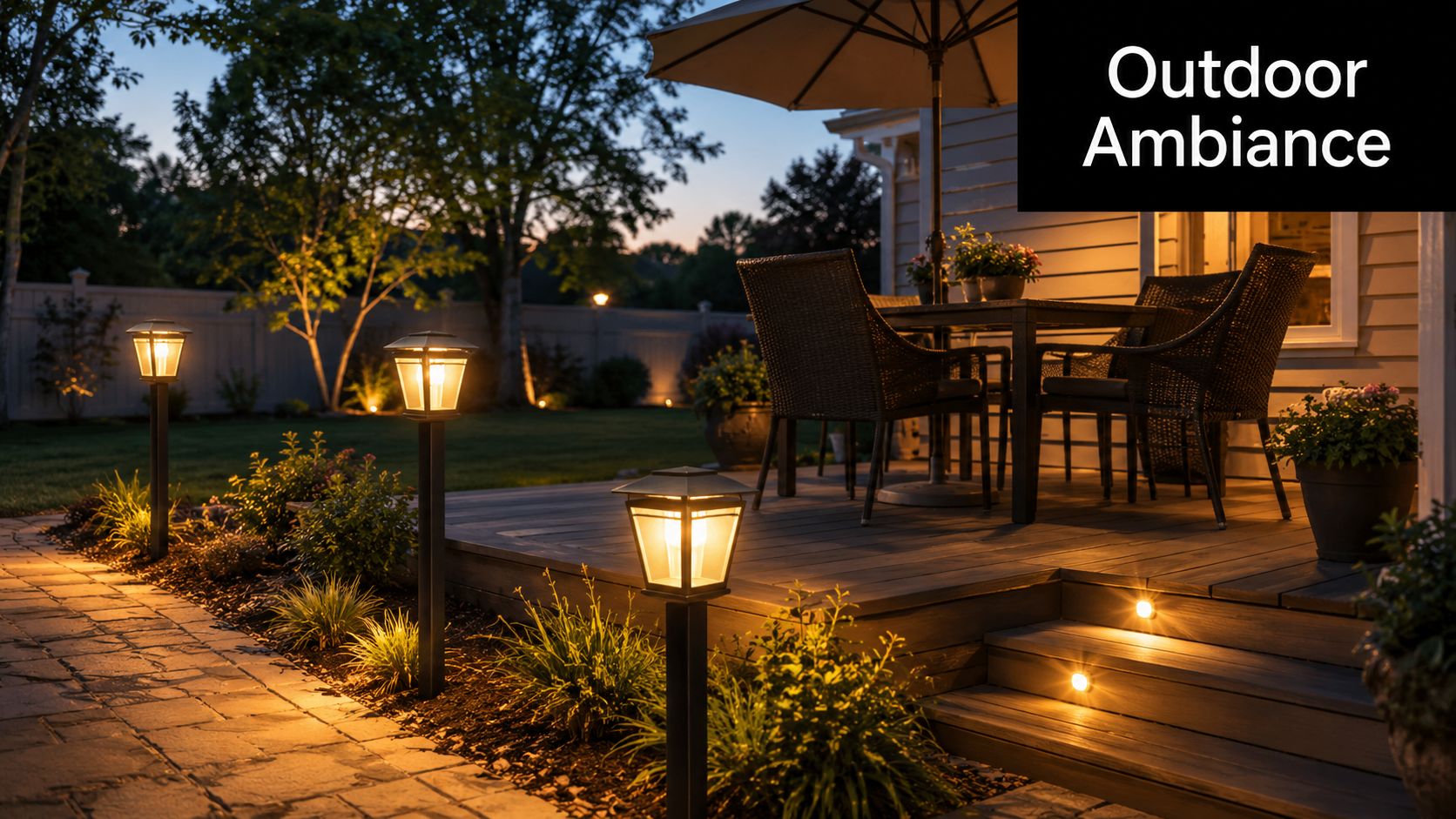
The best outdoor lighting doesn't draw attention to itself first. It makes the space feel complete. You notice the shape of the deck, the edge of the path, the gate opening, the seating area, and only then the fixtures themselves.
Three layouts that consistently look good
Fence rhythm
A repeating line of post caps down a fence creates structure without adding clutter. This works especially well when the fence is visible from a patio or kitchen window. The lights read as part of the architecture.
Entry emphasis
Putting stronger visual weight at gate posts, stair openings, or deck corners creates natural wayfinding. It also makes the build feel more deliberate because the eye lands on transitions.
Perimeter room effect
On a deck or stone patio, lit posts can outline the usable evening zone. The result feels less like scattered fixtures and more like an outdoor room with boundaries.
A good real-world lesson from public infrastructure
Large projects use solar lighting for practical reasons, not novelty. In Los Angeles, a city initiative covered in this report installed 91 new solar-powered street lights in Lincoln Heights and Cypress Park as part of a $500,000 refresh project. The work was designed to prevent copper wire theft and eliminate outages tied to stolen copper. The same report also notes that Los Angeles already has a street lighting system that is 98% LED, producing annual energy savings of 114 gigawatt-hours, and that the 91-light solar conversion was installed within a single month. For homeowners, the point isn't scale. It's that solar lighting can solve both appearance and reliability problems when wired infrastructure is vulnerable or impractical.
That same thinking applies at residential scale. A dark side gate, a detached fence line, or a deck perimeter with no easy wiring route is often a better candidate for solar than for retrofitted low-voltage cable.
Design before you buy
If you're trying to visualise spacing, style, and placement before ordering hardware, a tool like landscape ai design can help you test layout ideas. That's useful when you're deciding whether to light every post, only the corners, or a mix of corners and entry points.
The strongest-looking installs usually follow one rule. Use light to reinforce the structure that's already there. Posts define edges, corners, transitions, and sightlines. When the lighting follows that logic, the whole project looks more organised.
XTREME EDEALS INC. carries the kind of hardware that makes deck and fence projects go together properly, from solar post caps and decorative post tops to brackets, fasteners, anchors, and finishing details for wood and metal builds. If you want compatible sizes, recognizable brands like Decorex Hardware, CAD pricing, and one place to source both the lighting and the hardware around it, browse XTREME EDEALS INC..