
Most homeowners start in the same place. They step into the back garden, look at a patch of lawn, a tired slab, or an old deck with soft boards, and think, “This should be doing more.”
That instinct is common for a reason. An outdoor area isn’t just extra square footage. Done properly, it becomes a dining room in summer, a quiet morning coffee spot, a place to host family, and a buffer between the house and the rest of the world. It can also become a maintenance headache if the build is all style and no structure.
From Empty Yard to Outdoor Oasis
The strongest outdoor living space ideas start with a simple shift in mindset. Stop thinking of the garden as leftover space. Treat it like another room of the home, one that just happens to deal with sun, rain, movement in the soil, and heavier wear from weather.
Homeowners are clearly moving in that direction. 64% of California homeowners now aspire to multi-functional outdoor spaces with integrated features like seating and fire pits, up from 52% in 2020, according to the NAHB report. That matches what builders and tradespeople see on site. People don’t want a lonely table on a concrete pad anymore. They want zones, comfort, shade, privacy, and materials that won’t disappoint after two seasons.
A lot of online inspiration skips the hard part. You’ll see beautiful photos, but not much about footings, connectors, anchor choices, drainage, or how a privacy screen behaves in wind. That’s where many builds go wrong.
What lasts and what fails
The projects that age well usually share a few traits:
- The layout fits the property: A small urban lot needs tighter planning than a wide suburban back garden.
- The structure comes first: Deck framing, patio base preparation, and post anchoring decide how the space performs.
- The hardware matches the exposure: Coastal moisture, heat, and movement all punish cheap fasteners.
- The finish details are functional: Post caps, balusters, hinges, and brackets shouldn’t be afterthoughts.
Practical rule: If a feature adds weight, catches wind, or carries people, build it from the hardware outward, not from the furniture inward.
That’s the difference between a pretty weekend project and an outdoor room that still feels solid years later. Good design matters. So do comfort and style. But the small pieces, deck screws, joist hangers, post base brackets, anchors, caps, and gate hardware, usually decide whether the whole job feels professional or patched together.
Choosing Your Foundation Decks Patios and Pergolas
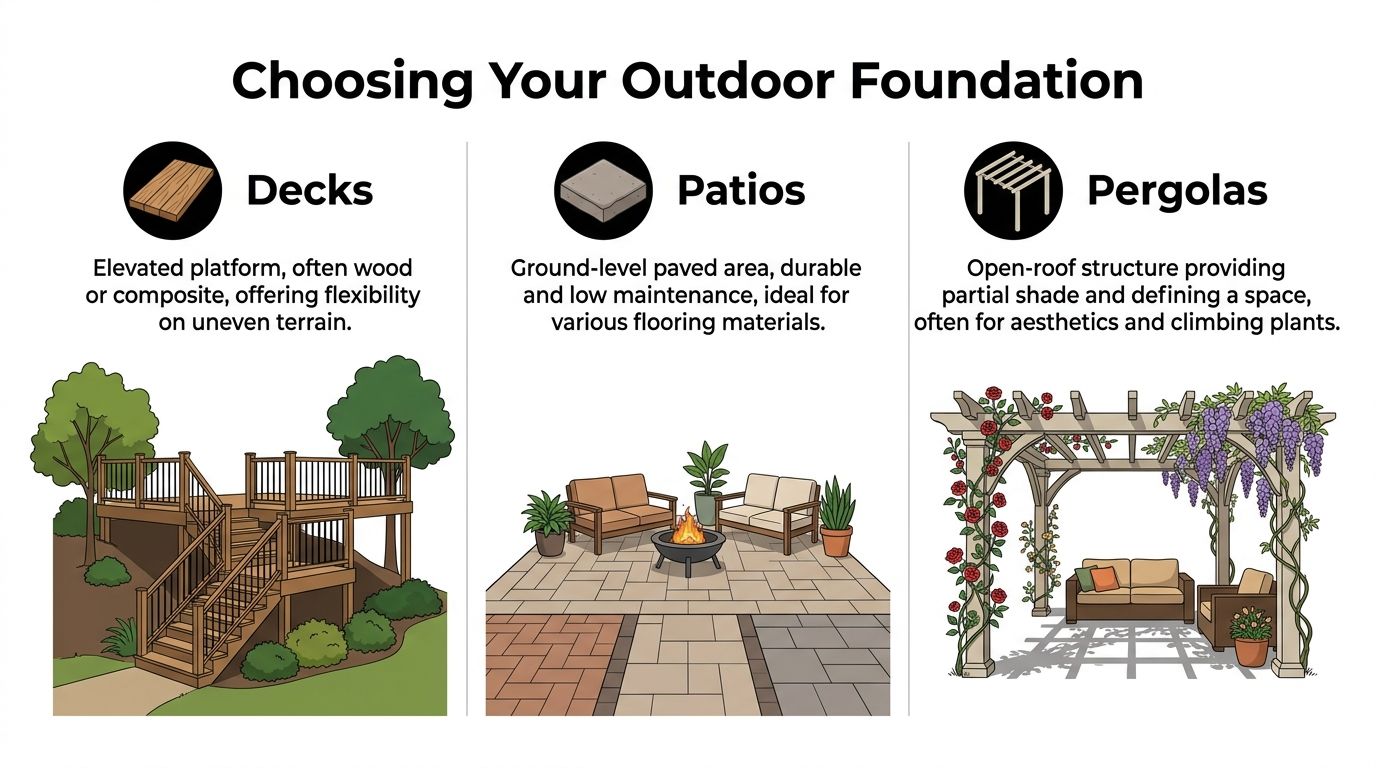
Before picking cushions, lighting, or a fire feature, choose the structure that makes sense for your site. Most outdoor living space ideas come back to three base forms: patios, decks, and pergolas. Each solves a different problem.
Patios for simple ground-level living
A patio is usually the cleanest option when the site is already fairly level. Pavers, stone, brick, and poured concrete all work, but they don’t behave the same way.
Pavers are forgiving. If one section settles, you can lift and reset. Concrete is more monolithic and often gives a cleaner modern look, but once it cracks or heaves, repair is less elegant. Natural stone has character, though installation needs care if you want a stable, even walking surface.
Patios work well for:
- Dining zones: Easy furniture placement and no bounce underfoot
- Outdoor kitchens: A solid base for heavier fixtures
- Low-maintenance layouts: Less structural framing than a raised deck
What doesn’t work is treating a patio base casually. If the sub-base is weak, the surface telegraphs every mistake. You’ll see movement at edges, uneven joints, and drainage problems.
Decks for elevation and flexibility
A deck makes more sense when the ground falls away from the house, when you need to clear obstacles, or when you want a stronger indoor-outdoor connection at door threshold height. Decks also let you create levels and transitions that a patio can’t easily match.
The beauty of a deck is flexibility. The risk is that people underestimate the engineering. A deck is a structure, not just a platform with boards on top. Posts, beams, joists, hangers, ledger connections, and fasteners all matter. If one part is underspecified, the entire surface can feel springy, shift over time, or fail inspection.
For support details, spacing, and framing basics, this deck support guide is a useful reference.
A deck should feel boring in the best possible way. No sway, no bounce, no mystery movement when several people step onto it.
Common deck mistakes include:
- Using the wrong screws: Interior screws snap or corrode outdoors
- Skipping proper joist connectors: Toenailing alone isn’t enough where hangers are required
- Ignoring post isolation from moisture: Wood in constant contact with wet concrete ages badly
- Building for looks first: Wide stairs, privacy walls, and pergolas all add loads that need support
Pergolas for shade and room definition
A pergola isn’t usually the foundation itself, but it changes how the space works. It creates a ceiling plane without fully enclosing the area. That can turn a plain deck or patio into a proper outdoor room.
Pergolas are useful when you want:
- Visual structure: They frame the sitting area and make furniture placement feel intentional
- Partial shade: Better comfort in strong sun
- Vertical interest: Vines, lighting, or drapery can soften the build
- Zoning: One part for dining, another for lounging
Pergolas don’t replace good siting. If they’re undersized, they look decorative but don’t help comfort much. If they’re oversized without enough post support, they become a structural liability.
Choosing by site conditions
A quick side-by-side view helps:
| Foundation type | Best use case | Main strength | Main caution |
|---|---|---|---|
| Patio | Level ground | Durable surface and straightforward use | Base prep and drainage must be right |
| Deck | Uneven ground or raised entry | Flexible layout and elevation changes | Structural hardware is non-negotiable |
| Pergola | Shade and spatial definition | Creates an outdoor room feel | Needs proper anchoring and post support |
A lot of successful builds combine all three. A raised deck off the house, a lower patio for dining, and a pergola over the lounge area can create natural zones without making the garden feel crowded. The trick is using each element for what it does best, rather than forcing one structure to do every job.
Applying Essential Outdoor Design Principles
A good outdoor space should feel easy to use. If people have to sidestep furniture, squeeze past the barbecue, or sit in the only shady corner next to a gate swing, the design isn’t working no matter how attractive it looks.
Zoning and flow
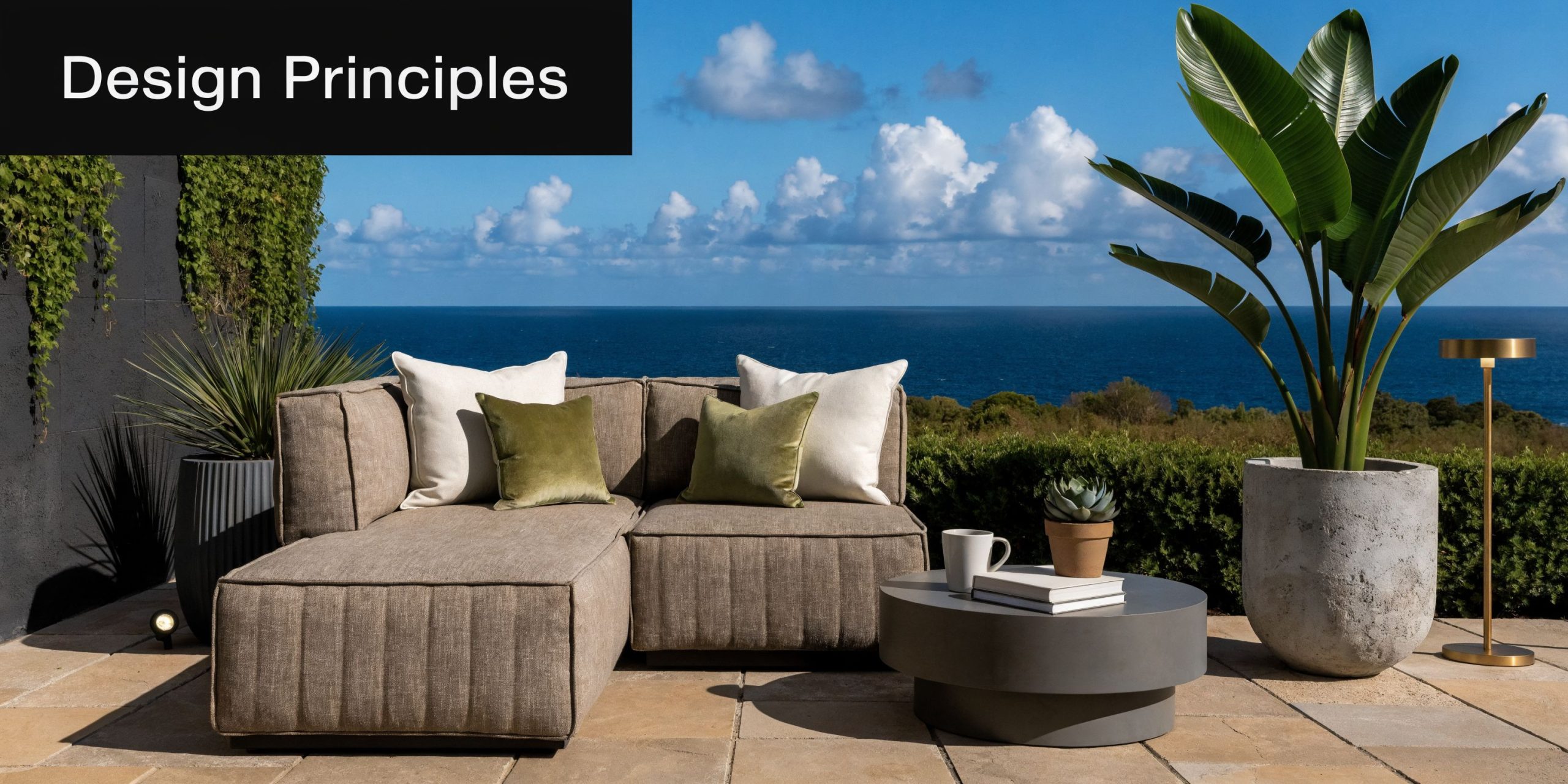
Think about the space the way you’d think about an open-plan interior. You still need separate functions, but they should connect naturally.
A practical layout often includes:
- A cooking edge: Keep the grill or prep area where smoke and foot traffic won’t interfere with seating
- A dining zone: Close enough to serving space that meals feel convenient
- A lounging area: Positioned for the best view, privacy, or shade
- A circulation route: A clear path from the house to the garden, gate, or steps
Many homeowners try to centre everything in one spot. That usually creates clutter. A better layout gives each activity a reason to sit where it does.
For more furniture-focused planning ideas, this practical guide to designing an outdoor living space is a helpful companion to the building side of the project.
Scale and proportion
Big furniture in a modest yard makes everything feel tighter. Tiny furniture on a broad deck leaves the space looking unfinished. The house matters too. A compact bungalow usually suits lower-profile railings, simpler lines, and restrained colour palettes. A larger home can handle more visual weight.
Use built-ins carefully. Bench seating can be brilliant where floor area is limited, but fixed seating also locks the layout in place. If the space needs flexibility for gatherings, loose furniture often wins.
If you have to ask whether a feature is too large, mark it on the ground first. Tape, stakes, and spray paint reveal bad proportions faster than a sketch.
Lighting and shade
Lighting should do at least three jobs. It should help people move safely, create mood, and highlight architectural features or planting. One harsh floodlight doesn’t do that.
A layered approach works better:
- Low path or step lighting: For safe movement
- Soft overhead or string lighting: For general ambience
- Accent lighting: For screens, posts, or planters
Shade deserves the same early attention. It shouldn’t be the thing you think about after the furniture arrives. A shade sail, umbrella, covered section, or pergola changes where people want to sit.
This walkthrough gives a useful visual sense of how layout, furniture, and shelter come together in a real setting:
The spaces that feel right
The most inviting outdoor living space ideas usually have restraint. They don’t try to force every feature into one footprint. They leave breathing room around furniture. They account for sun angles, gates, doors, and real human movement.
That’s why the best layouts often look simple. Simplicity on the finished surface usually comes from careful planning underneath it.
Selecting Materials and Hardware That Endure
Materials get the attention. Hardware decides whether the build survives. That’s the plain truth on decks, patios, pergolas, privacy screens, and gates.
Surface choices matter, of course. Timber has warmth. Composite is consistent. Pavers handle abuse well. But the frame, fixings, and connectors carry the load, resist the weather, and hold the details together when seasons change.
Surface materials and the trade-offs
Composite decking keeps gaining ground for a reason. Projections for 2025 show that 55% of new outdoor projects in regions like California will incorporate eco-friendly materials such as recycled composites, according to this outdoor living trends report. That doesn’t make it the automatic winner. It makes it one strong option.
Timber still appeals because it looks natural and can be easier to cut, shape, and repair. The downside is maintenance and weathering. Some boards age beautifully. Others cup, split, or go rough if the installation details are weak.
Pavers and tile belong in the same conversation because many homeowners compare a deck against a hardscape patio. If you’re weighing surface finish and style for a paved area, this guide on the best tile for outdoor patio is useful for understanding finish and application choices.
Decking Material Comparison
| Material | Upfront Cost | Annual Maintenance | Lifespan | Best Fastener Type |
|---|---|---|---|---|
| Pressure-treated wood | Lower | Higher, because it usually needs more regular care | Varies by exposure, build quality, and maintenance | Exterior-rated deck screws |
| Cedar or similar wood | Moderate | Moderate to higher | Varies by exposure and upkeep | Corrosion-resistant deck screws |
| Recycled composite | Higher | Lower | Generally long-lasting when installed correctly | Manufacturer-compatible composite screws or hidden fasteners |
| Pavers | Moderate to higher | Lower, but joints and settling may need attention | Long-lasting with proper base prep | Not applicable to surface, but edge restraints and anchors matter at transitions |
The unseen hardware that makes the build work
Most failures don’t start with the visible finish. They start where water sits, where movement wasn’t accounted for, or where someone used bargain fasteners in the wrong environment.
On deck projects, the critical items usually include:
- Deck screws: Use exterior-rated, corrosion-resistant screws sized for the board and framing application
- Joist hangers: These support consistent framing connections where joists meet beams or ledgers
- Lag bolts and carriage bolts: Useful where stronger mechanical fastening is required
- Post base brackets: They separate wood posts from standing moisture and create a more reliable connection to concrete
- Anchors: Wedge and sleeve anchors matter where posts, brackets, or structural accessories attach to masonry
A small accessory can solve a big long-term problem. Joist tape is one example. It helps protect the top of the framing from trapped moisture where deck boards sit above the joists. If you’re trying to lengthen the life of a wood-framed deck, deck joist tape is worth considering early, not after the boards are already down.
Cheap visible materials look expensive on day one. Cheap hidden hardware looks expensive on day seven hundred, when things start moving, staining, or failing.
Finishing details that are more than decoration
The accessories at the end of the project do more than tidy up the look. Good finishing parts protect exposed surfaces, improve safety, and make the build feel complete.
Consider where each detail earns its place:
- Post caps: Pyramid and ball styles protect post tops from water entry while sharpening the finished look
- Balusters: Metal balusters can visually lighten a railing compared with chunky timber infill
- Gate hinges and latches: These have to handle daily use, misalignment pressure, and outdoor exposure
- Decorative finials and inserts: These can add character, but only if the base structure is already sound
Brands such as Nuvo Iron and Decorex Hardware are often chosen because they bridge that gap between utility and finish. They don’t replace proper construction. They complete it.
A lasting outdoor build is rarely about one miracle material. It’s about sensible pairings. Good boards over protected framing. Stable pavers over a sound base. Strong brackets under upright posts. Exterior hardware wherever water and time are guaranteed to test the job.
Your Project Planning and Budgeting Checklist
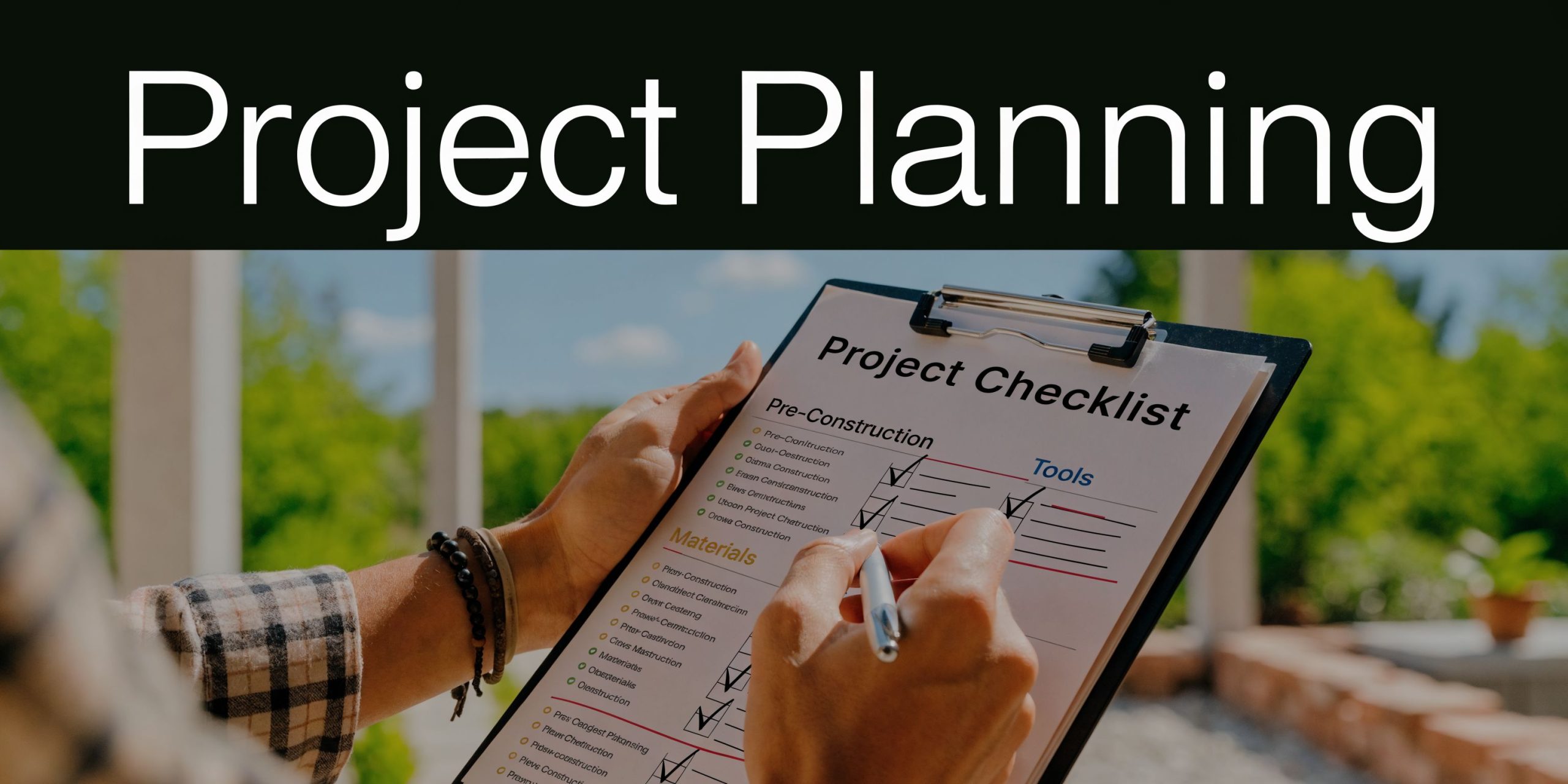
The easiest way to blow a budget is to start buying before the plan is settled. The easiest way to regret a layout is to build before the site is measured properly. Outdoor work rewards discipline.
Start with the site, not the wish list
Walk the space at different times of day. Note where the sun hits hardest, where water collects, and which views are worth framing or hiding. Watch how you already move through the garden.
Then sketch rough zones. You don’t need architectural drawings on day one. You do need basic dimensions, door swings, grade changes, and the location of services or obstacles.
A strong first pass answers practical questions:
- Where will people enter and exit?
- What needs shade most?
- Does the site slope enough to favour a deck over a patio?
- Will a privacy screen block a useful breeze or an important sightline?
Check permits and code early
This step saves headaches. Local requirements vary, and they can affect height, railing needs, post depth, setback rules, electrical work, privacy fence limits, and structural connector choices.
If your project includes a raised deck, stairs, a pergola tied into the deck frame, or a tall privacy wall, don’t assume a simple sketch and a shopping list will be enough. Check your municipality before material orders go in.
Build your budget in layers
The best budgets separate visible finishes from structural necessities. That keeps the nice-to-have items from eating the money needed for the parts that make the project safe.
A simple budgeting method looks like this:
Base construction
Include excavation, footings, framing, sub-base, and surface material.Structural hardware
Account for screws, hangers, anchors, post bases, bolts, washers, and connector plates.Finish hardware and accessories
Add balusters, post caps, hinges, gate hardware, trim, and lighting components.Comfort features
Furniture, shade, planters, storage, and fire features belong here.Contingency
Leave room for site surprises, especially on older properties.
Buy the structural hardware as if no one will ever compliment it. That’s often the smartest money in the whole job.
Consider phased construction
Not every outdoor space has to be built all at once. Phasing can be smart if cash flow is tight or if you want to live with the first stage before committing to the next.
A sensible sequence might be:
- Phase one: Foundation, deck or patio, steps, and railings
- Phase two: Pergola, privacy panels, and lighting
- Phase three: Built-in seating, planters, or an outdoor kitchen
That approach works only if the first phase is designed to accept the later additions. Leaving structural allowance for future posts, power, or screening is much easier than retrofitting after the fact.
Source with compatibility in mind
A project stalls when one bracket doesn’t match the post size, the balusters don’t suit the rail layout, or the anchor type isn’t right for the slab. Try to source with system compatibility in mind.
That means checking:
- Post dimensions: Nominal versus true size matters
- Fastener finish: Match exposure conditions
- Connector ratings: Use the right hanger or bracket for the application
- Accessory fit: Caps, finials, and inserts need the correct post profile
Organisation is half the battle. A clean material list, grouped by framing, decking, railing, fencing, and finishing hardware, prevents costly last-minute substitutions.
Advanced Solutions for Privacy and Durability
Most inspiration articles stop at mood boards. Real projects have to survive movement, weather, neighbours, and inspection. Two issues deserve more attention than they usually get: seismic resilience and privacy on tighter lots.
Build for movement, not just appearance
In California, structural detailing isn’t optional background work. Over 10,000 earthquakes occur annually in the state, and building codes require specific hardware, with seismic-rated post base brackets and appropriate anchors often necessary for deck permit approval, according to this outdoor planning article.
That matters because decorative additions often change the load path. A pergola on top of a deck, a privacy wall at one side, or a heavier railing system all affect how the structure behaves.
What helps on these builds:
- Seismic-rated post base brackets: Better connection at the post-to-concrete interface
- Appropriate anchors: Wedge or sleeve anchors need to match the substrate and load condition
- Proper joist connectors: Especially where lateral movement is a concern
- Tight, compatible fastener schedules: Mixed metals and random substitutions create problems
The mistake I see most often is treating decorative screening as separate from the structure. It isn’t. Once you bolt something tall to a deck, it becomes part of the engineering question.

Privacy without building a dark box
Privacy is one of the biggest drivers behind current outdoor living space ideas, especially on suburban and urban plots where houses sit close together. The answer isn’t always a tall hedge. Hedges take time, water, and steady maintenance. They can also eat up valuable floor area.
A more controlled approach is layered screening:
- Fence panels with visual rhythm: Solid enough to screen, open enough to avoid a heavy feel
- Baluster-style privacy sections: Cleaner lines than bulky timber lattice
- Decorative post caps and finials: These finish the top edge so the fence feels intentional, not improvised
- Gate hardware with real durability: Privacy fails fast if gates sag or twist
For design directions focused specifically on separation and screening, these ideas for privacy on a deck are worth reviewing.
Privacy should block sight lines, not airflow, light, and every bit of character in the garden.
Good privacy design also respects maintenance. Narrow side yards and tight rear boundaries are hard enough to clean and repair. Oversized planters, deep hedge beds, and awkward layered screens can turn a smart idea into a nuisance.
The better solution is usually a simpler one. Strong posts, well-anchored panels, durable hinges, and a finish that fits the house. It looks sharper, behaves better in weather, and gives the space a calmer feel.
Bringing Your Outdoor Vision to Life in 2026
The outdoor spaces that people keep using aren’t the ones with the most features. They’re the ones that feel comfortable, safe, and easy to live with.
That comes from balancing design with construction reality. Choose the right foundation. Keep the layout logical. Use materials that suit your climate and maintenance tolerance. Then spend real attention on the hardware, because that’s what carries the load and protects the investment.
Shade planning is a good example. Pergolas can reduce peak solar heat gain on a deck by 30 to 50%, lowering surface temperatures that can otherwise exceed 120°F (49°C) and extending usable hours and lifespan, according to Borst.com/articles/outdoor-living-space/). That’s not just a design flourish. It changes how the space works day to day.
If you’re planning a project for 2026, start with one measured sketch and one realistic materials list. Don’t chase every trend. Build the bones properly, choose details with purpose, and let the space earn its keep season after season.
Frequently Asked Questions
What’s the most common DIY mistake in outdoor living projects
Skipping structural planning. People often choose boards, pavers, and furniture before sorting out drainage, framing, connector types, and post anchoring. The finished look suffers when the base isn’t sound.
Is privacy really that important in smaller gardens
Yes. In dense suburban areas, privacy is a top concern for 68% of homeowners, according to Vera Iconica. That’s why screens, fences, and thoughtful layout matter so much on compact sites.
Can I mix hardware finishes
You can, but do it deliberately. Mixed finishes can look sharp when there’s a clear palette. Random mixing usually looks accidental. Keep structural hardware appropriate for exterior use and suitable for the environment.
Do pergolas replace umbrellas or covered roofs
Not always. Pergolas define space and improve comfort, but they don’t provide the same shelter as a solid roof. Choose based on how you’ll use the space and how much weather protection you need.
Should I build everything at once
Only if the plan and budget support it. Many homeowners get better results by completing the structural shell first, then adding screening, lighting, and decorative elements in phases.
If you're ready to turn your outdoor plans into a buildable project, XTREME EDEALS INC. is a practical place to source the hardware that often makes the difference between a short-lived job and a lasting one. Their range covers deck and fencing essentials such as post caps, joist hangers, post base brackets, deck screws, lag bolts, anchors, balusters, hinges, finials, and more, with options suited to both DIY jobs and trade work.