

A composite deck can look finished the day the boards go down and still fail early if the fastening system is wrong. That's the part many capable DIYers underestimate. They spend time comparing board colours, capstock finishes, and rail styles, then treat fasteners like a commodity.
They aren't.
Composite deck fasteners control how the boards sit, how they move in heat and cold, how clean the surface looks, and whether the deck stays quiet underfoot. They also affect inspection, warranty coverage, and long-term maintenance. A deck that creaks, crowns, mushrooms around screw heads, or develops uneven gaps usually tells you the same story. The installer chose a fastener that didn't match the board, the climate, or the framing.
Your Guide to a Lasting Composite Deck
Property owners often begin with the visible elements of the project. They want a deck that looks sharp, feels solid, and doesn't ask for constant upkeep. That's the main appeal of composite in the first place. You put the work in once, then you expect the result to hold.
That outcome depends heavily on the fastening system. The board is the finish material. The fastener is what keeps the finish material behaving properly over time. If the wrong screw or clip goes in, the deck may still look good for the first season, but movement, noise, edge swell, and loose boards show up later.
A good fastening plan answers four questions before installation starts:
- How does this board move? Composite doesn't behave like wood.
- How will it be attached? Hidden clip, face screw, or plug system.
- What environment is it facing? Inland heat, wet freeze-thaw, coastal exposure, or high humidity all matter.
- What does code or the manufacturer require? That includes corrosion resistance, structural performance, and profile compatibility.
Practical rule: Choose your composite deck fasteners at the same time you choose the deck boards, not after the framing is done.
That's how pros avoid the usual regrets. They don't ask, “What screw can I use?” They ask, “What fastening system was this board designed to work with, and what conditions will this deck live in?”
Why Standard Screws Fail on Composite Decks
A standard wood screw can hold a board down. That doesn't mean it's the right fastener.
Composite boards are denser, more temperature-sensitive, and less forgiving at the surface than pressure-treated lumber. Drive the wrong screw into them and you often get a raised ring around the head, a rough hole, or a head that sits proud. On a stained wood deck, that might be cosmetic. On a composite deck, it's a sign the fastener and material aren't working together.
Composite moves more than wood
This is the first thing to understand. Composite materials expand and contract at rates 2 to 3 times greater than pressure-treated wood, and some systems use a primary locking clip plus a secondary Control Expansion & Contraction clip to allow movement while keeping the board restrained, as described in NewTechWood's deck clip system.
That movement is why the old “just screw it down tighter” approach causes trouble. If the board can't move the way it needs to, stress builds. Then you start seeing peaking, warping, distorted gaps, or clips that fight the board instead of guiding it.
Think of it this way. Wood screws are built for a material that fibres around the threads and tolerates compression differently. Composite acts more like a manufactured product with a fixed shape and a changing length. Fasteners for composite have to manage both grip and movement.
What usually goes wrong in the field
The failures are familiar:
- Over-driven face screws crush the surface and create mushrooming around the head.
- Single-point restraint in the wrong location can force a board to move unevenly.
- Cheap clips may hold initially but lose control of board spacing as the deck cycles through seasons.
- Incompatible screws can leave a poor finish on capped boards.
A composite deck shouldn't be locked down like a pine fence board. It needs controlled restraint, not brute force.
That's why specialised composite deck fasteners exist. They aren't marketing fluff. They solve a real material problem. A proper system lets the board stay flat, maintain spacing, and move without tearing up the surface or transferring stress into the framing.
Exploring the Types of Composite Deck Fasteners
There isn't one “best” fastener for every composite deck. The right choice depends on the board profile, the finished look you want, and how much control you need over movement and installation speed.
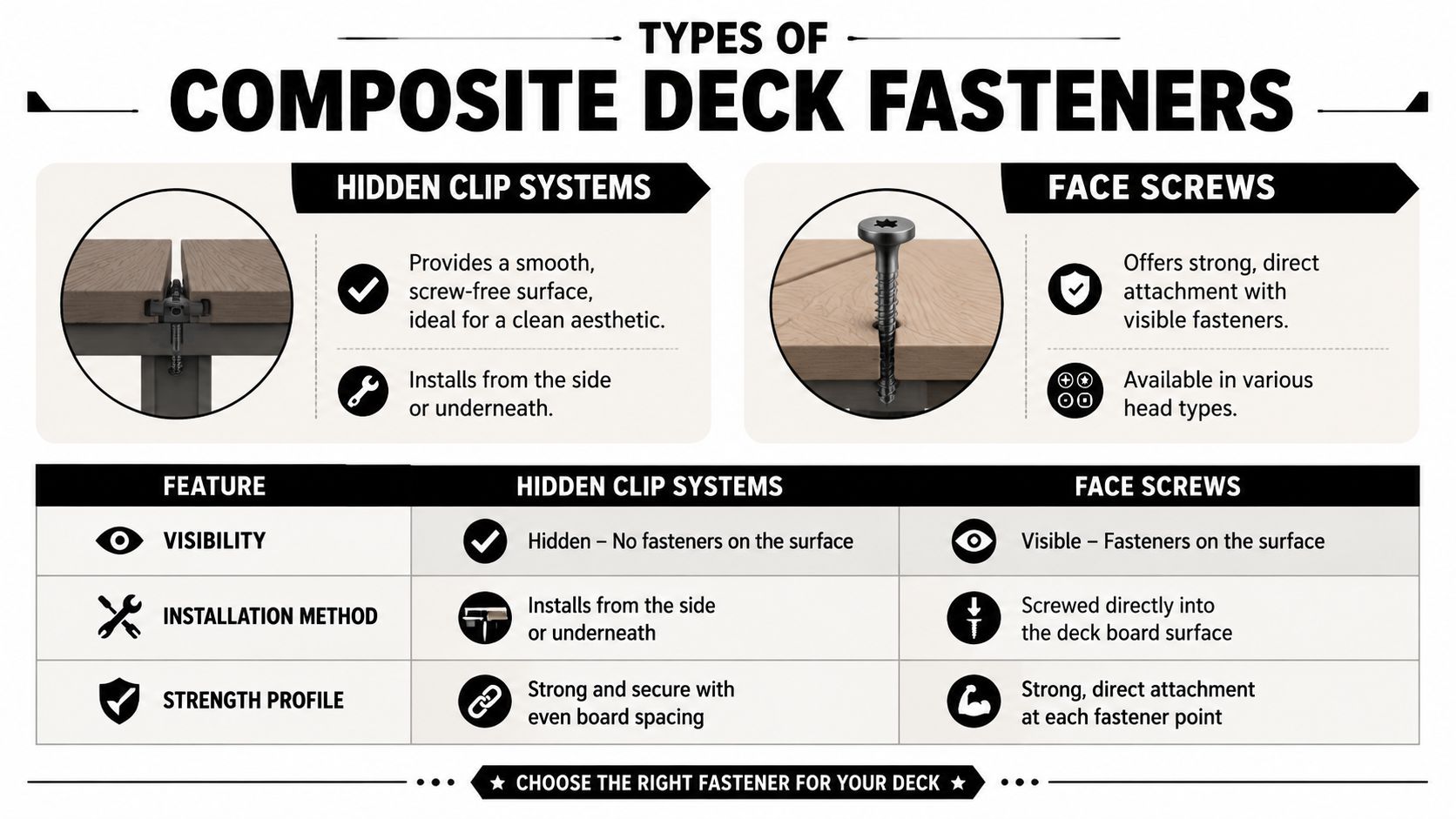
Hidden clip systems
Hidden clips are made for grooved-edge boards. They sit between boards and fasten into the joist, leaving the walking surface free of visible screws. This is the cleanest look and the one most homeowners picture when they think of a premium composite deck.
They also help with spacing consistency. A good hidden clip system gives each course a repeatable gap and reduces the chance of a deck looking hand-laid in the bad sense of the term. The trade-off is that clip systems demand better framing accuracy. If your joists wander, the board line will tell on you.
Some hidden systems are excellent. Some are flimsy. The difference usually shows up during installation. Strong clips engage the groove cleanly, hold alignment, and don't deform when the screw is set properly.
Face screws and colour-matched screws
Face screwing is still the right call in several places. You'll use it on square-edge boards, perimeter boards, stair treads, breaker boards, and often on picture-frame details. A good composite face screw cuts cleanly, seats flush, and doesn't leave a fuzzy crater.
If you're already comfortable with premium screw hardware in other carpentry work, it helps to compare what makes specialty deck screws different from more general Value Tools Co contractor-grade hardware. Decking fasteners have to do more at the surface and in weather than an interior wood screw ever will.
Plug systems and specialty clips
Plug systems use a face screw plus a matched plug made from the same decking material. Done well, they nearly disappear. They're a strong option where hidden clips won't work but a clean finish still matters.
Specialty clips come into play at starts, stops, stairs, breaker boards, and steel framing. These aren't accessories to improvise. They're usually the difference between a deck that looks planned and one that looks solved on site.
For browsing the wider category, a dedicated selection of deck fasteners and fittings helps when you're matching parts across a full project.
Composite deck fastener comparison
| Fastener Type | Best For | Finished Look | Installation Difficulty | Key Advantage |
|---|---|---|---|---|
| Hidden clip system | Grooved-edge field boards | Clean, screw-free surface | Moderate | Consistent spacing and premium appearance |
| Face screws | Square-edge boards, stairs, perimeter | Visible fastener heads | Moderate | Strong direct attachment |
| Plug system | Borders and visible areas needing a cleaner look | Nearly concealed | Higher | Hides face fastening while keeping holding power |
| Starter and finishing clips | First and last boards | Minimal visible hardware | Moderate | Clean edge treatment without awkward screw placement |
| Specialty framing clips | Unique layouts or steel framing | Depends on system | Higher | Solves manufacturer-specific installation needs |
Selecting the Right Fastener Material and Coating
Fastener type is only half the decision. The material matters just as much. A clip or screw can be perfectly designed and still fail early if the metal doesn't match the environment.
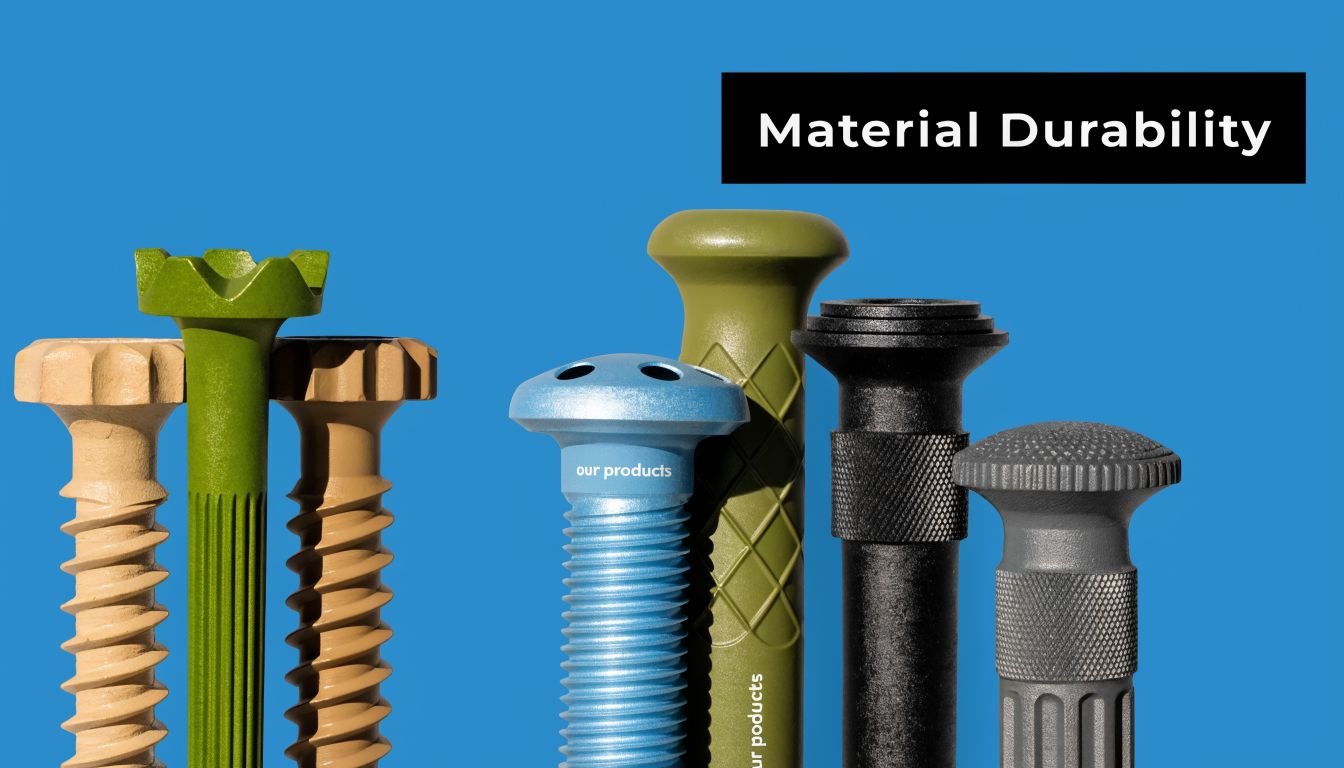
Stainless grades that actually matter
For composite decking, 305 or 316 stainless steel is the right starting point. Grade 316 provides 2 to 4 times superior salt-spray resistance compared to 304 grade per ASTM B117 testing, according to the TimberTech fastener guide PDF. That matters on coastal jobs, lakefront properties, and any build where salt exposure hangs around.
If you build inland in a normal residential setting, 305 stainless is often a solid choice for screws and clips designed for composite. If the deck is near salt air, persistent moisture, or corrosive exposure, I'd move straight to 316 and stop thinking about it.
You can browse purpose-built stainless steel deck screws for exterior projects when you need corrosion-resistant options rather than generic hardware.
Why coatings aren't just cosmetic
A coating can do two jobs. It can improve corrosion resistance, and it can help the screw head finish cleanly in capped composite. Some products, such as Cap-Tor XD screws, are engineered to create a flush finish without marring the surface, as noted in the same TimberTech guide.
That's useful because capped composite has a tougher outer shell than wood. A screw that works fine in framing lumber may tear, smear, or leave an ugly witness mark in a capped board. A purpose-designed deck screw usually has the thread pattern, head shape, and finish to avoid that.
Avoid mixed-metal mistakes
Galvanic corrosion is the quiet problem people don't see coming. If the fastener, clip, framing connector, and surrounding environment don't play well together, corrosion can start where metals meet. You may first notice staining, then surface degradation, then loss of holding power.
Use this checklist before buying:
- Match the environment: Inland jobs and marine-exposed jobs shouldn't use the same assumptions.
- Match the board surface: Capped composite often benefits from screws made specifically for capped boards.
- Match the rest of the hardware: Don't treat the deck screw as a standalone part.
- Match the manufacturer guidance: If a board maker calls for a specific material or system, follow it.
The cheapest screw in the aisle can become the most expensive part of the deck once corrosion shows up on finished boards.
Matching Fasteners to Major Composite Decking Brands
Brand compatibility is where many DIY builds get off track. A board may look interchangeable from one manufacturer to another, but the fastening details often are not.
The first split is simple. Grooved-edge boards are usually intended for hidden clips. Square-edge boards are usually intended for face screws or screw-and-plug systems. That sounds obvious, but people still try to force one method onto the wrong profile because they want a certain look or have leftover hardware from another project.
Board shape decides the fastening path
Grooved boards are machined to accept clip engagement along the edge. The clip thickness, groove shape, and seating depth all matter. If you use an off-brand clip that doesn't fit correctly, the board may sit high, bind during installation, or fail to hold spacing consistently.
Square-edge boards don't give you that side-entry option. They're meant for direct top fastening, especially at picture frames, stairs, and the outside border where clip geometry doesn't solve the layout cleanly.
A few practical examples help:
- Trex-style grooved field boards usually point you toward hidden clip systems, while square-edge boards at borders need face fastening or plugs.
- TimberTech collections often have fastener recommendations tied to the board profile and finish system.
- Other capped composite brands may permit several fastening methods, but only specific ones preserve the warranty.
Warranty language matters more than people think
Manufacturer instructions aren't there for decoration. If the brand says a certain board must use a specific clip, plug, or screw type, that's part of the system approval. Swapping in a random fastener because it “looks close enough” can create a problem later if movement, splitting, or surface damage appears.
One detail catches people out often. Trex documentation specifies that plug-based hidden fasteners can't be used with scalloped-bottom Enhance profiles, because board geometry affects compatibility. That's exactly the sort of fine print that separates a correct install from a warranty headache.
A quick way to check compatibility
Before you order fasteners, verify these points:
Board edge profile
Grooved and square-edge boards are not interchangeable from a fastening standpoint.Board construction
Solid, scalloped, and capped profiles may call for different hardware.Field boards versus trim boards
Many decks use clips in the main field and face fasteners at borders and stairs.Manufacturer approval
If the board maker names a clip or screw family, use it.
If the fastener description doesn't clearly name your board profile or approved use case, assume it's not the right one until proven otherwise.
Perfect Installation for Composite Deck Fasteners
A good fastening system still needs disciplined installation. Most call-backs happen because the installer rushed spacing, over-drove screws, or treated composite like standard decking.
Start with framing that gives the fasteners a chance
Hidden clips won't correct sloppy joists. If the frame crowns unevenly, twists, or wanders out of plane, the boards and clips will show every bit of it. Before the first board goes down, check joist alignment, flatten high spots, and confirm your layout lines.
Fastener quantity also matters more than people expect. For a 300 sq ft deck with 16-inch joist spacing, some codes specify at least 350 #10 x 2-3/4" composite screws per 100 sq ft, totalling 1,050 fasteners, according to deck fastener quantity guidance. That's one reason bulk planning matters. Running short halfway through a deck often leads people to substitute whatever they have on hand.
Install with controlled pressure, not speed
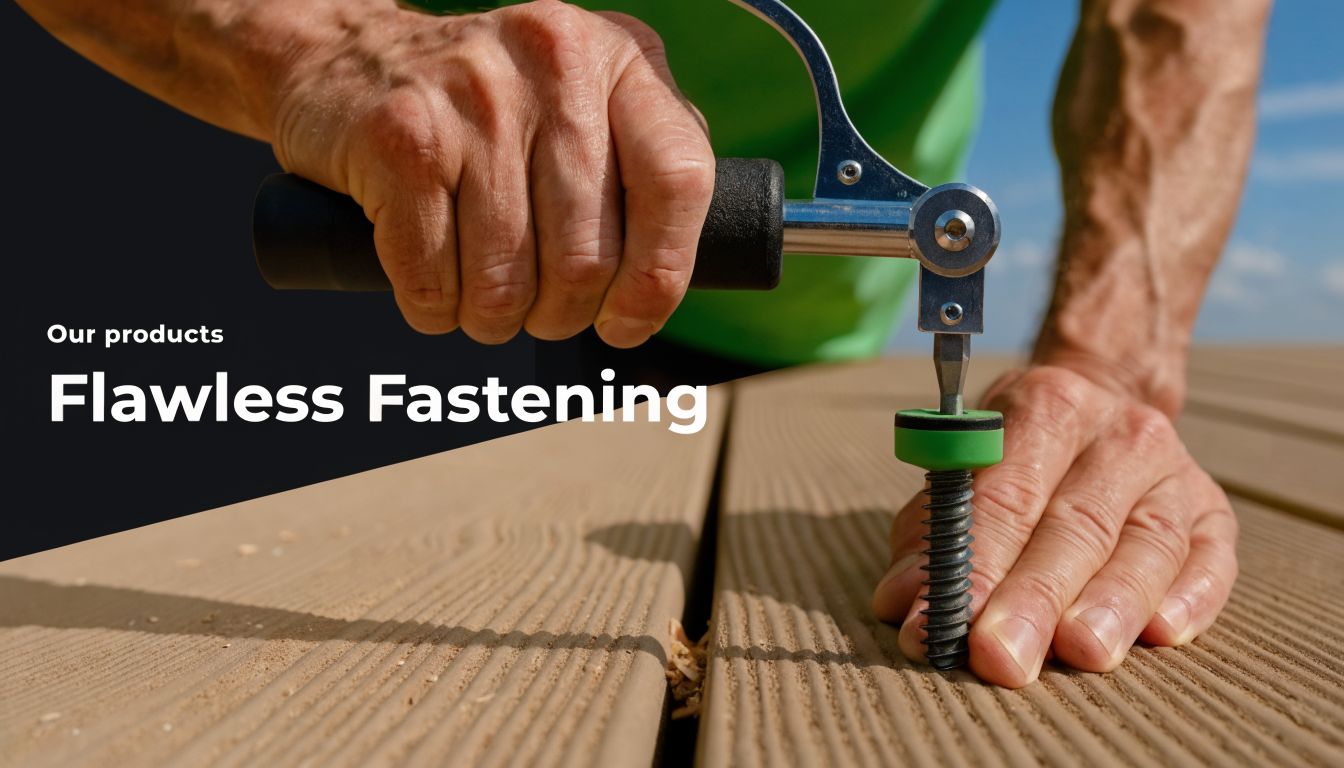
Composite punishes impatience. If you run an impact driver at full aggression and bury every head by feel, surface defects show up fast. Use the bit or setting recommended for the system. If you're face screwing, test on an offcut first and check whether the head sits flush without crushing the cap layer.
What I want to see on site is consistency:
- Steady screw depth: Flush means flush. Not sunk, not proud.
- Clean board support: Every fastener should pull against a fully supported board edge or face.
- Repeatable spacing: Let the clip system or layout method control the gap. Don't eyeball long runs.
- Correct screw count at each board location: Don't “save time” by skipping fastening points.
Field note: Most ugly composite installs weren't caused by bad boards. They were caused by installers forcing the boards to fit a poor frame or over-driving fasteners.
A quick visual walkthrough can help before you commit to a full run:
Give the boards room to move
Composite needs proper gapping at ends and sides based on the manufacturer's guidance and site conditions. Even the best clip system can't save a deck where boards were packed too tightly on a hot day or left with careless inconsistency across the field.
Installers often get tripped up by seasonal conditions. A board installed cool may grow when summer heat arrives. A board installed hot may shrink back when temperatures drop. That's why fastening systems built around movement control outperform improvisation.
A simple install sequence works well:
Sort and stage boards first
Check lengths, edge profiles, and visual consistency before fastening starts.Set the first course accurately
Every board after it depends on that line.Use the intended starter, field, and finish hardware
Don't substitute a face screw where a finishing clip belongs.Check every few rows
Confirm alignment, gap consistency, and board seating before the error compounds.Handle borders and stairs separately
These areas usually need different fasteners and more precision.
Common mistakes worth avoiding
| Mistake | What it causes | Better approach |
|---|---|---|
| Using wood screws on capped boards | Mushrooming and rough surface finish | Use composite-specific face screws |
| Mixing incompatible clips with the board profile | Loose fit or binding | Match clips to the manufacturer-approved profile |
| Driving too hard with an impact | Crushed cap layer or sunk heads | Test depth and use controlled torque |
| Ignoring frame alignment | Uneven gaps and stressed clips | Plane, shim, and straighten before decking |
| Treating borders like field boards | Awkward fastening and poor appearance | Use the proper face-fastening or plug method |
Meeting Building Codes for Deck Fasteners
Fastener choice isn't only about looks or convenience. It can be a code issue, especially where corrosion, wind, or seismic demand is higher than average.
Why inspectors care about small hardware
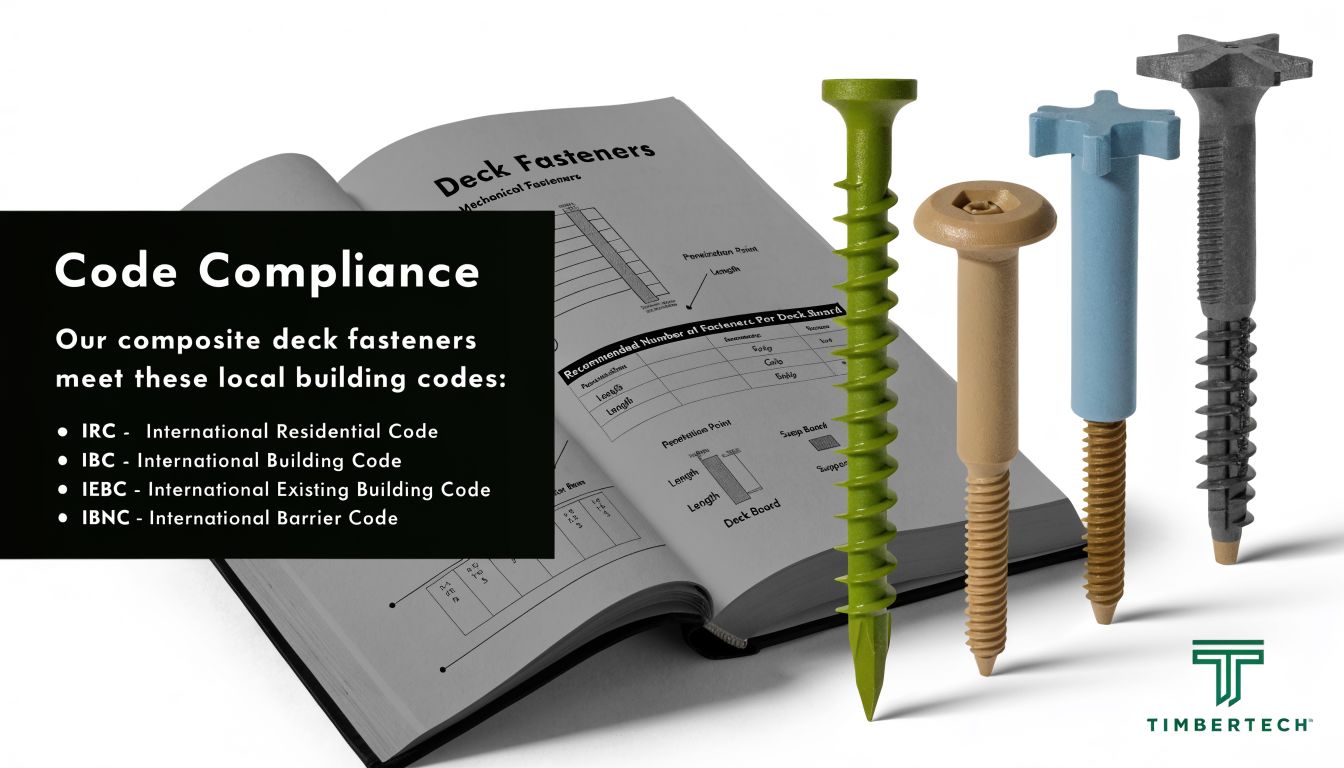
Inspectors know decks often fail at connections. That includes ledger attachment, hold-downs, post bases, and the fasteners that keep the walking surface and related components performing as designed. If the hardware doesn't meet the environment or load requirement, the problem may not show immediately, but the risk is still there.
California is a strong example because the code environment is demanding. In high seismic regions, the California Building Code requires fasteners that can withstand up to 1,500 lbs of shear force per fastener under specific seismic provisions, and decks using manufacturer-approved composite fasteners showed 40% less joist separation during simulated earthquakes compared with standard wood screws, according to TimberTech's composite fastener guidance.
That tells you something important. Fastener selection can affect deck behaviour under load in ways that aren't obvious during routine use.
Code compliance usually follows three checks
The practical side of compliance comes down to this:
Load performance
The fastener has to meet the structural demand of the application.Corrosion resistance
Coastal or wet environments may require stainless or approved corrosion-resistant hardware.System approval
The installed fastener needs to work with the board and framing system the way the manufacturer and code expect.
If you're building in a demanding jurisdiction, don't assume a product sold as a “deck screw” is enough. Read the manufacturer literature, your local code requirements, and any inspector notes before the decking stage starts.
Code officials don't care whether a fastener was convenient to buy. They care whether it's appropriate for the job and approved for the conditions.
Build Your Deck to Last
Good composite decks last because the installer makes the right decisions in the right order. Start with how the board behaves. Then match the fastener to the board profile, the finished look, the environment, and the code requirements. After that, installation discipline takes over.
That same mindset applies below the boards too. Protecting framing with deck joist tape for moisture defence helps the whole assembly last longer, not just the visible surface.
The best-looking deck on day one isn't always the best-built deck. The one that stays flat, quiet, secure, and clean years later usually has the better fastening system.
XTREME EDEALS INC. carries practical hardware for deck builders who want to get the details right the first time. If you're sourcing composite deck fasteners, stainless deck screws, clips, connectors, or other outdoor project hardware, explore XTREME EDEALS INC. for project-ready options that suit both DIY work and professional installs.