

You've got the slab poured, the post bases laid out, and the tape measure in your hand. The framing plan looks straightforward until you hit the one decision that can ultimately make or break the whole job. Which concrete anchor bolts belong here, and which ones will cause trouble later?
That question comes up on deck builds, fence repairs, pergolas, gate posts, and retrofit work all the time. The hardware may look simple on the shelf, but concrete anchoring is where small mistakes turn into loose posts, cracked slab edges, failed inspections, or callbacks you didn't price into the job.
The Foundation of a Secure Project
A common job starts like this. A homeowner wants a deck on an existing concrete pad, or a contractor is setting fence post brackets on a cured footing. The framing decisions feel familiar. The anchor decision doesn't. That's usually the moment people realise concrete anchor bolts are not just another fastener. They are the connection between everything you build above and the concrete that has to hold it.
If that connection is wrong, the rest of the project never really recovers. A deck may feel solid on day one and start moving after a season of use. A fence may stay plumb until wind starts working the brackets loose. A pergola can look finished and still have weak points hidden at the base.
Why anchors matter more than people think
Concrete anchoring has come a long way from improvised site methods. The J-bolt, introduced in the 1950s, became the standard for residential and commercial construction after replacing earlier methods like bent rebar that lacked uniformity and strength, according to the history of concrete anchor bolt development. That shift matters because it changed anchoring from a rough field fix into a predictable building component.
For today's projects, that predictability matters even more. North America remains the dominant market for concrete anchors, and the same source notes the market is projected to grow from USD 2.91 billion in 2026 to USD 3.94 billion by 2035, driven by construction demand in deck, fencing, and foundation work.
Practical rule: If the base connection is an afterthought, the whole build is weaker than it looks.
A lot of outdoor work also blends wood framing with concrete foundations. If you're planning larger timber structures, these open concept post and beam layouts are useful for seeing how structural loads move down into the supports. That's where anchor choice stops being a hardware question and becomes a structural one.
What a good anchor decision looks like
The right anchor choice comes down to a few jobsite realities:
- Base material: Cured slab, stem wall, footing, or new pour.
- Load direction: Pull-out, uplift, sideways force, or a mix.
- Environment: Dry interior, wet exterior, freeze-thaw exposure, or corrosive conditions.
- Placement limits: Near an edge, close to another anchor, or in open field concrete.
- Inspection risk: Some jurisdictions are simple. Others are not.
Good anchoring isn't complicated once you stop guessing. It's a matter of matching the anchor type, size, material, and installation method to the job that's in front of you.
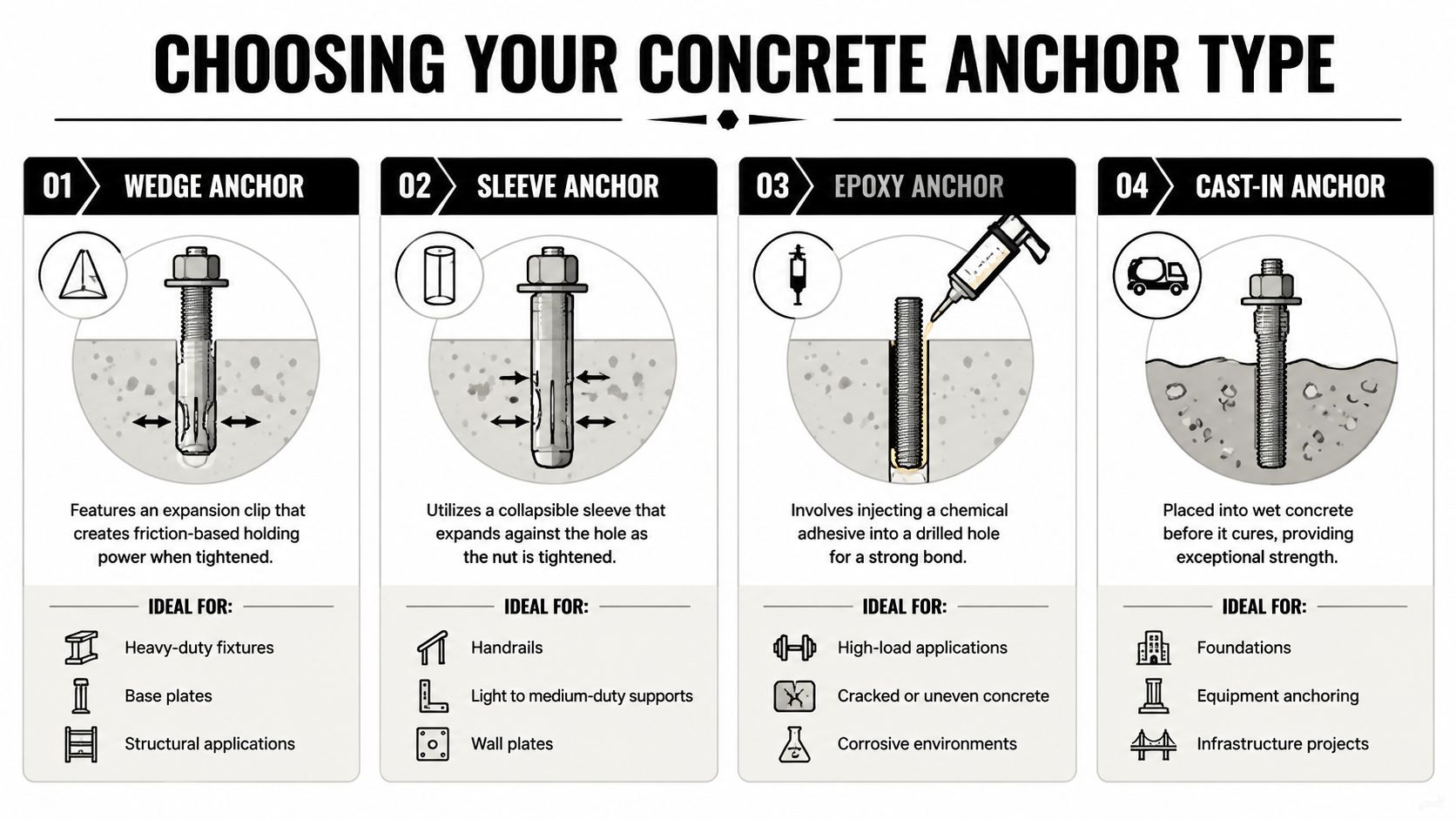
Choosing Your Anchor Type Wedge Sleeve Epoxy and Cast-In
Not all concrete anchor bolts work the same way. Some grip by expansion. Some bond into the hole. Some need to be placed before the concrete cures. If you treat them as interchangeable, you'll get mixed results at best.
Wedge anchors
A wedge anchor is a mechanical expansion anchor. You drill a hole the same diameter as the anchor, insert it through the fixture into the concrete, then tighten the nut. That tightening action pulls the clip into place and locks the anchor against the concrete wall.
For heavier outdoor hardware, wedge anchors are often the first choice because they give a strong mechanical hold in sound concrete. In 4000 psi concrete, a 1/2-inch wedge anchor at 2-1/4-inch embedment can achieve 2999 lbs tension pull-out strength and 5564 lbs shear strength, based on wedge anchor data and installation guidance.
What works:
- Ledger connections: Good where through-fastened hardware needs solid grip.
- Post base anchoring: Strong option when edge distance is adequate.
- Bracket and hanger mounting: Useful for steel connectors fixed to slab or foundation.
What doesn't:
- Very close edge placement.
- Oversized or dusty holes.
- Installers guessing torque instead of tightening properly.
A practical product reference for this category is wedge anchors for concrete applications, especially when you need common diameters for deck or fence work.
Sleeve anchors
Sleeve anchors are more forgiving in lighter-duty and medium-duty work. Instead of a wedge clip, they use an expanding sleeve around the anchor body. Tightening the nut expands that sleeve against the hole.
They're useful when you want one anchor style that can handle brackets, light framing attachments, and some outdoor fixtures without stepping up to heavier expansion hardware. They also tend to be easier for capable DIYers to install cleanly.
A sleeve anchor is often the workhorse choice for:
- Fence post brackets
- Light-to-medium base plates
- General-purpose attachments in sound concrete
The trade-off is simple. If the job gets more structural, more heavily loaded, or more sensitive to movement, sleeve anchors may not be the first option.
Epoxy anchors
Epoxy or adhesive anchors work differently. You drill the hole, clean it thoroughly, inject adhesive, and set threaded rod or rebar into the hole. The bond carries the load instead of expansion pressure.
That makes adhesive anchors useful in tricky placements, especially where expansion stress near an edge could damage the concrete. They can also be a strong choice for retrofit work or irregular site conditions where standard expansion anchors aren't ideal.
If the hole isn't cleaned properly, an adhesive anchor can look perfect and still be unreliable.
The downside is speed and discipline. Adhesive anchoring takes more care, more patience, and proper cure time. On fast-moving outdoor jobs, that can be a benefit or a headache depending on the crew.
Cast-in anchors
Cast-in anchors are installed before the concrete cures. This includes classic J-bolts and other embedded anchor systems. For new construction, they're often the cleanest and strongest answer because the anchor becomes part of the pour.
They're ideal for:
- New footings
- New slab work
- Planned post locations
- Sill plate and base connections laid out in advance
Their weakness is obvious. Once the pour sets, layout mistakes become expensive.
A practical way to choose
Use this quick filter on site:
- Need a strong post-installed mechanical hold in cured concrete? Start with wedge anchors.
- Need a versatile medium-duty option for brackets and general attachments? Sleeve anchors are often easier to work with.
- Need strength near edges or in retrofit work? Consider adhesive anchoring.
- Still at the forming stage? Cast-in anchors usually beat post-installed fixes.
Matching the Bolt to the Job
Selecting the anchor type places you in the correct category. The subsequent choice involves diameter, length, and material. Many installations fail at this stage. Contractors often purchase based on diameter alone while neglecting embedment depth, spacing requirements, edge distance, or the specific tension and shear forces on the connection.
Think in pull-out and sideways force
A deck ledger connection and a fence post base don't behave the same way. One sees significant outward pull and repeated loading. The other may deal more with sideways force and movement at the bracket.
That's the practical difference between tension and shear.
- Tension load: Force trying to pull the anchor straight out of the concrete.
- Shear load: Force pushing across the anchor sideways.
A railing people lean against creates a different demand than a post carrying vertical weight. That's why anchor selection should start with how the connection is loaded, not which box is closest.
Embedment is not optional
With drop-in anchors, embedment depth directly affects performance. In 3000 psi concrete, a 1/2-inch drop-in anchor requires 2-inch embedment to achieve a pull-out capacity of 3105 lbs, with a generally accepted 4:1 safety factor, according to drop-in anchor technical specifications.
That same guidance also matters for layout. Anchors should respect minimum spacing of 10 times the anchor diameter and minimum edge distance of 5 times the diameter to reduce the risk of concrete breakout.
On the slab, layout is part of strength. A correctly sized anchor placed too close to an edge is still a bad install.
Quick reference table
| Anchor Diameter | Minimum Embedment Depth | Typical Pull-Out Strength (lbs) |
|---|---|---|
| 1/4" | 1" | 939 |
| 3/8" | 1-9/16" | 1560 |
| 1/2" | 2" | 3105 |
| 5/8" | 2-1/2" | 3323 |
| 3/4" | 3-3/16" | 6678 |
These figures are for drop-in anchors in 3000 psi concrete from the same technical source linked above.
Length and coating choices
Length isn't just embedment. You also have to account for the thickness of the material being fastened, plus washers, nuts, or internal thread engagement depending on the anchor style.
For outdoor deck and fence work, material finish matters almost as much as strength. In practice:
- Zinc-plated anchors: Better suited to dry interior conditions.
- Galvanized anchors: A more sensible choice where moisture is routine.
- Stainless steel anchors: Worth considering when corrosion exposure is a real concern.
Ontario and New York jobs force this decision more than indoor work does. Wet seasons, freeze-thaw cycles, and de-icing exposure punish the wrong finish quickly. An anchor that's mechanically adequate but poorly matched to the environment can still become the weak link.
Anchor Selection for Common Outdoor Projects
General advice is fine until you've got a ledger board in one hand and a box of anchors in the other. For decks, fences, pergolas, and post bases, some choices are more dependable than others.
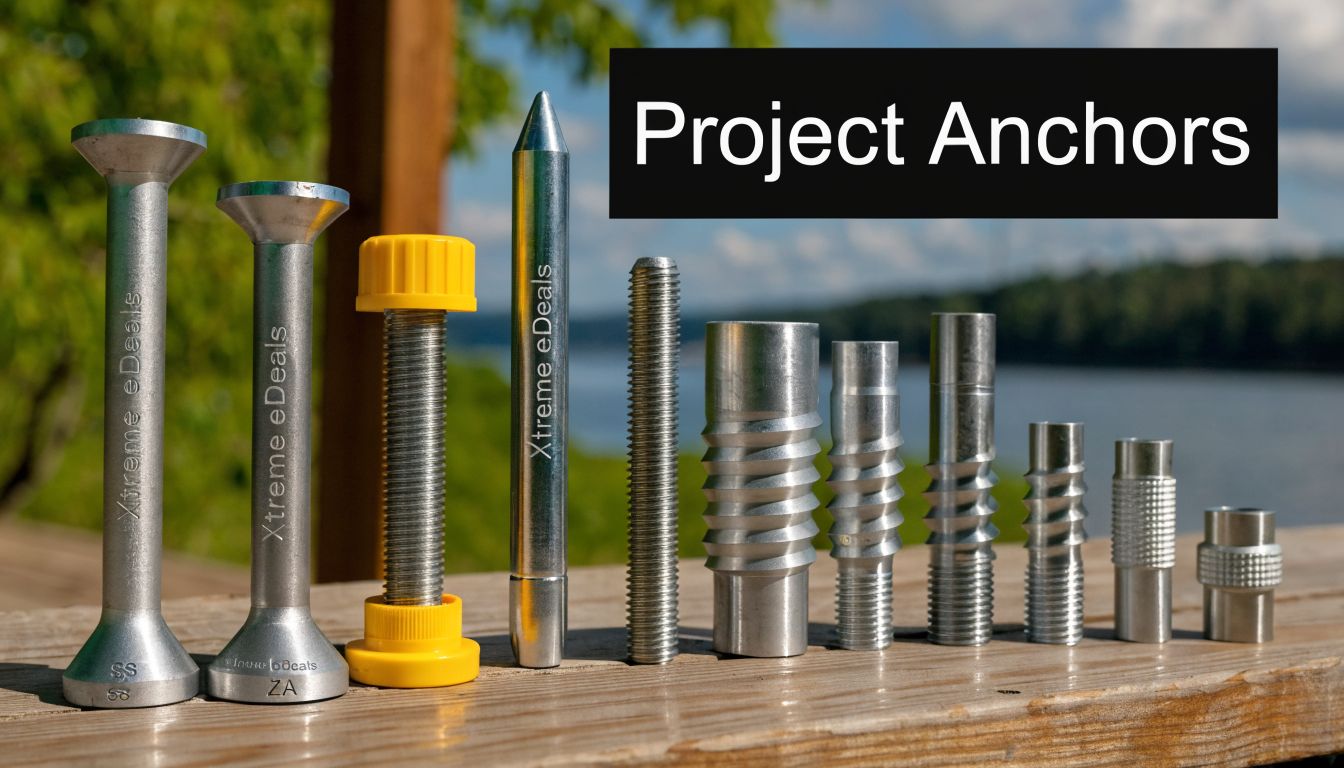
Deck ledger to concrete foundation
For a deck ledger attached to concrete, a wedge anchor is usually the professional starting point. It offers solid mechanical engagement, and the through-fastened setup suits ledger hardware well. If the foundation is sound and you've got enough edge distance, wedge anchors are hard to beat for this kind of work.
What usually fails here is not the anchor type. It's the install. Wrong hole size, poor cleaning, rushed torque, or bad spacing can turn a strong anchor into a weak connection.
If the project calls for alternative fastening in cured concrete, concrete screw anchors for deck and fence hardware are another practical category to consider, especially where removal or adjustment may matter.
Post bases on slabs and patios
For post base brackets on an existing patio or slab, the right answer depends on placement.
A sleeve anchor often makes sense when:
- The load is moderate
- The concrete is in decent shape
- The bracket isn't crowded near an edge
- You want a straightforward install
An epoxy anchor becomes more attractive when:
- The base is close to an edge
- You're retrofitting into older concrete
- Expansion pressure could create problems
- The connection matters more than speed
Fence brackets and gate posts
Fence hardware sees repeated movement. Wind, gate use, and seasonal shifting all work those connections over time. For that reason, light-duty shortcuts usually cost more later.
My bias on outdoor fence work is simple. Use anchors that match the bracket, the slab condition, and the exposure. Pair them with proper post bases, washers, and compatible hardware so the connection acts as a system, not a pile of parts.
A strong anchor under a flimsy bracket is still a weak base.
What I'd avoid
For common outdoor builds, I'd avoid three habits:
- Using indoor-finish hardware outside: Corrosion starts at the base, where inspection is hardest.
- Choosing by price alone: Cheap hardware doesn't stay cheap after a callback.
- Treating every bracket the same: A pergola post, fence post, and deck ledger don't ask the same thing from the concrete.
How to Install Concrete Anchors Correctly
Most anchor failures don't start with the steel. They start with the hole. Bad drilling, dust left in place, shallow embedment, and guessed torque ruin more installs than the anchor itself ever does.
Drill the right hole
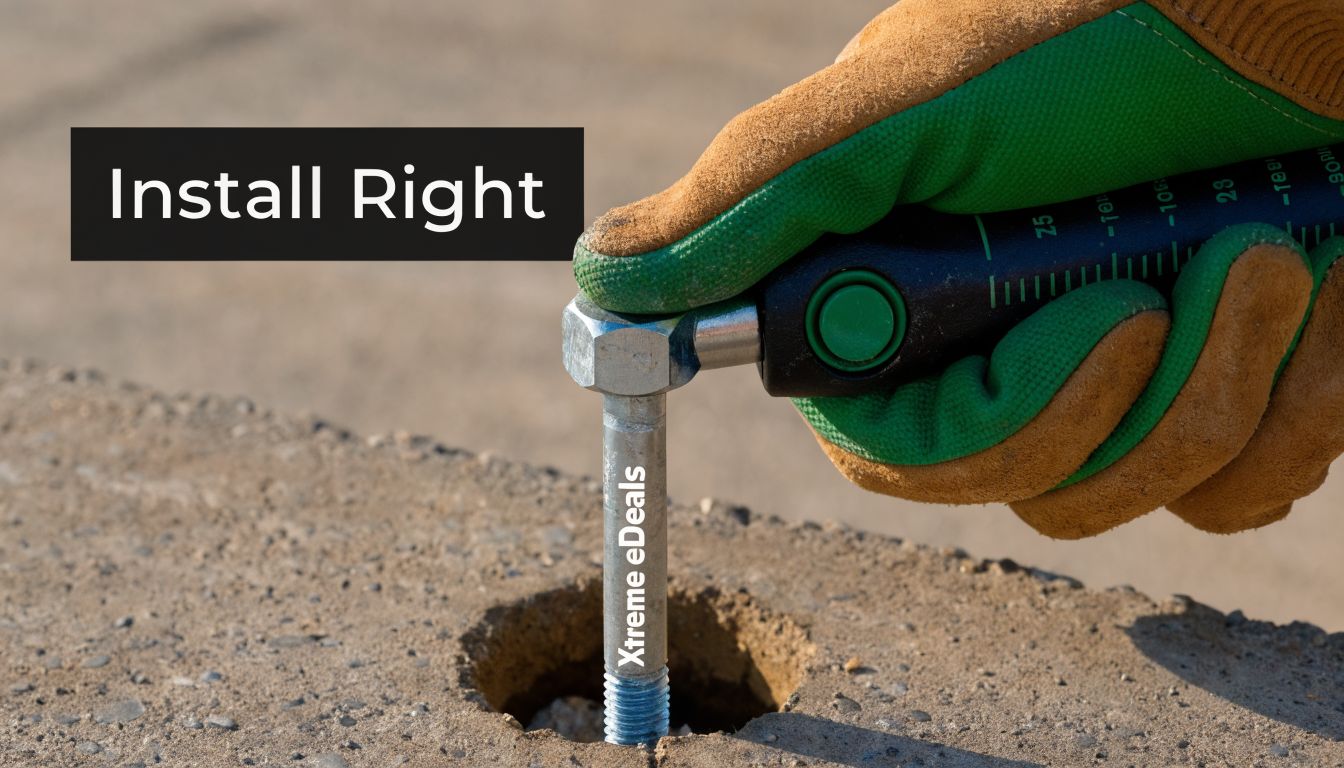
For expansion anchors, hole size has to match the anchor requirements. With wedge anchors, that usually means using a hammer drill and a carbide bit of the same diameter as the anchor. If the hole is oversized, the expansion mechanism can't do its job properly. If the hole is shallow, the anchor won't seat where it should.
Mark your depth before drilling. On repeated installs, that simple step keeps the crew consistent.
Clean the hole properly
This is the part people skip because it doesn't feel like work. It is.
The wedge anchor guidance cited earlier notes that thorough hole cleaning to remove dust can prevent up to 50% of installation failures. Dust interferes with expansion, seating, and bond. It also masks whether the hole is ready.
A clean sequence is better than a fast one:
- Drill to full depth.
- Clear dust and loose debris.
- Confirm the hole is usable before setting hardware.
- Only then insert the anchor.
For more field-specific guidance, this article on anchoring posts to concrete is a useful companion when you're working through post base installations.
Set and tighten with control
Seat the anchor fully. Make sure the fixture sits flat. Start tightening evenly so the anchor expands as intended rather than binding early.
For wedge anchors, torque matters because it activates the expansion clip. Too little and the anchor never fully engages. Too much and you risk damaging threads, overstressing the anchor, or creating problems in the surrounding concrete.
This walkthrough is worth watching before you start a batch of installs:
Respect spacing and edges
Anchors don't work in isolation. Concrete around the anchor has to stay intact for the anchor to carry load properly. That's why edge distance and spacing matter so much on post bases and narrow slab sections.
If you don't have room for the anchor type you planned, change the anchor strategy. Don't just move the hole slightly and hope the concrete forgives it.
Final check before you leave the job
Before calling the install done, verify:
- Anchor depth: The hardware is seated where it was designed to work.
- Bracket fit: No rocking, no gap, no twisted base plate.
- Torque: Tightened correctly, not guessed.
- Concrete condition: No visible spalling, breakout, or edge damage.
- Fastener match: Washer, nut, rod, and bracket all belong together.
That last five-minute check prevents a lot of expensive returns to site.
Avoiding Common Problems and Inspection Failures
Many people assume any anchor that feels tight is sufficient. That assumption causes failures, especially outdoors and in jurisdictions where inspectors review anchorage details.
The failures that show up most often
The usual trouble spots are not mysterious:
- Wrong finish for the environment: Zinc-plated hardware used in wet exterior conditions corrodes sooner than people expect.
- Anchors too close to edges: The bracket may fit, but the concrete doesn't have enough room to resist breakout.
- Mixed hardware without a plan: A strong anchor paired with the wrong washer, base, or bracket creates uneven load paths.
- No documentation for code review: Permit delays begin at this stage.
Outdoor deck and fence jobs especially punish lazy assumptions because the load is repeated, the weather is constant, and movement never fully stops.
Regional code issues are real
Code requirements are not uniform. Ontario and New York contractors already know that local expectations can differ from what a generic product listing suggests. California is an even stronger reminder of that point.
In stringent code regions like California, up to 68% of post-installed anchors can fail prequalification tests due to issues such as cyclic loading in seismic zones, based on the discussion of anchor qualification and seismic requirements. That same source notes that while standard anchors may be enough for low-load fences, decks and other critical structures may require specific ICC-ESR approvals and deeper embedment to avoid permit problems.
The anchor that works physically on site may still fail on paper if it doesn't meet local approval requirements.
What to inspect before an inspector does
For existing or newly installed anchors, check these points:
- Corrosion at the base: Look where water sits, not where the hardware still looks clean.
- Movement under load: If the bracket shifts, the problem may be anchor fit, not framing.
- Concrete cracking around the anchor: Hairline cracks near edges deserve attention.
- Product paperwork: If the project needs approval, verify the hardware is acceptable before installation, not after.
For contractors, this isn't paperwork for paperwork's sake. It's protection against tear-out, rework, and arguments on site.
Your Next Steps for a Rock-Solid Build
Good anchoring comes down to four decisions. Pick the right type, size it for the job, choose a finish that matches the environment, and install it as if the hardware rating only matters when the hole is correct. That's what separates a durable outdoor build from one that starts loosening before the rest of the materials have even aged.
The trade-offs are straightforward once you look at the actual connection. Wedge anchors suit many heavy deck and structural-style attachments in cured concrete. Sleeve anchors handle a lot of bracket and medium-duty work. Adhesive anchors help when edge conditions or retrofit challenges make expansion less appealing. Cast-in anchors remain the clean answer when the job is still at the pour stage.
There's also a clear shift toward cleaner installation methods. One emerging direction is low-dust fastening, including torque-controlled screw anchors, which can reduce respirable silica by 2 to 5 times compared with traditional drilling while also helping reduce pullout risk in cracked concrete, as noted in this overview of low-dust concrete fastening trends. For crews working in tighter regulatory environments, that's worth paying attention to.
Keep your final checklist simple:
- Application: deck ledger, post base, fence bracket, or retrofit
- Concrete condition: sound, aged, edge-limited, or new pour
- Load direction: tension, shear, or both
- Exposure: dry, wet, freeze-thaw, or corrosive
- Approval needs: local code, permit review, and listing requirements
If you're choosing concrete anchor bolts, post bases, deck fasteners, or related hardware for an outdoor build, browse the practical product range at XTREME EDEALS INC. and match the hardware to the job before you drill.